During our ride-along with Bosch, we came across some very unexpected friends

Photo credit: Chris Wellhausen
We were lucky enough to ride with the team from Bosch eBike Systems and take a break from the crowded booths and noise typically associated with CES. Our destination was Red Rock Canyon National Conservation Area, a 17-mi. scenic route full of beautiful red rocks … and, yes, donkeys.

Photo credit: Chris Wellhausen
Of course, the ride wasn’t all about the scenery. We had the chance to test ride seven different e-bikes that were powered by different Bosch motor systems. Our ride gave us a chance to discuss several key topics with Claudia Wasko (General Manager Bosch eBike Systems Americas VP), Kurt Hoy (Marketing & Media Relations), and Brian Cleavland (eBike Technical Product Specialist).
Bosch Smart System and eBike Flow App

Photo Credit: Bosch
Bosch continues their focus on updating their motors to their Smart System, which makes a lot of sense to me. Bosch motors have always been some of the best-performing e-bike motors, and adding the ability to receive regular software updates over-the-air is amazing. Similar to how people talk about how cool it is that Tesla can push out an update to your car, Bosch can do the same thing with their Smart System via the eBike Flow App. The practical value of this is that you won’t have to take the bike back to the dealer for every update, which saves you time and money (some dealers have a charge for updating your bike given the time it takes them to do it).
However, over-the-air updates are just one feature of what you can do with the eBike Flow app. With the app you can:
- Secure your bike with the eBike Lock (free feature)
- Further secure your bike with the eBike Alarm. This is free for first 12 months, then is included with in a paid subscription thereafter. Their subscription is called Flow+, and costs $3.99/month or $34.99 annually. In other words, it’s under $5/month so you’ll probably sign up and forget that you signed up for it. Fortunately, that’s also not a lot of money for peace of mind when you’re riding around the city on a $3K+ e-bike.
- Use your phone as the display to show you your speed, ride duration, distance traveled, current battery level (the reading is actually accurate, btw), and you can even connect to an Apple Watch and get heart rate data.
- Plan your route and get navigation guidance. If you have a unit with the Kiox 300 or 500 (their display units), you can do this from the display itself. If you don’t have a Kiox, then you can use your smartphone.
- Create custom riding modes. This isn’t something we normally do at Electric Bike Report, simply because we are riding too many bikes. However, for every bike I personally own, I always love the ability to create custom riding modes to match how I like to ride.
Then, one of my personal favorite features of the Flow app is that you can connect it with Strava and the app will AUTOMATICALLY start recording your ride, then push it to Strava once you’re finished. I don’t know about you, but I would say about a third of my rides I forget to start Strava and have to stop a mile into a ride when I remember that fact.

Photo credit: Chris Wellhausen
Note: we did have a few issues connecting to the eBike Flow app when we started. This is not generally a problem for the average rider—our issues were simply because so many other riders had already connected to each bike, and there were about 10 different bikes there that our phones kept trying to connect to (not a normal situation, obviously).
If you are having problems connecting to the Bosch Flow App, I’d recommend deleting and re-installing the app. That worked like a charm.
E-Bike Battery Safety
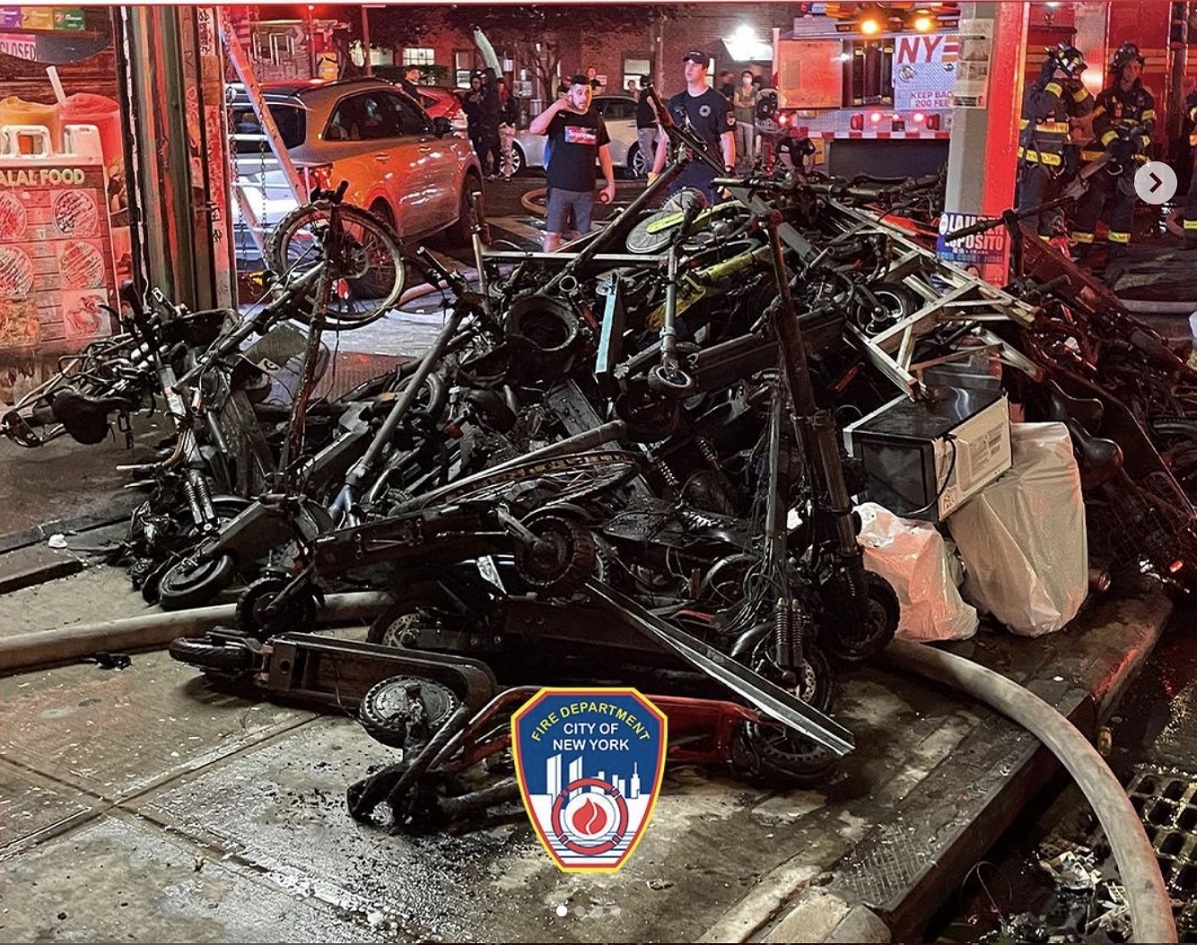
One theme that kept coming up on the ride (and something we have continually covered here at EBR), is the topic of e-bike battery safety. I am pretty sure every person who rides e-bikes and pays attention to e-bike news have seen the tragic stories from New York City on what are alleged to be e-bike fires. We did a fairly in-depth dive into what’s causing the e-bike fires in New York, so it was great to catch up with Bosch and get a few of their thoughts on the topic.
The main takeaway that we want our readers to know is that Bosch batteries are safe. As a German company, Bosch manufactures their products to both EU and USA safety standards, and we consider them a leader in e-bike safety, especially when it comes to battery and motor safety. Claudia Wasko sits on the steering committee for People for Bikes and is very active in helping promote not just electric bikes, but also safety throughout the United States.
Obviously, please make sure you are taking care of your battery and charging it properly. My conversation with Claudia gave me two additional takeaways I think are important to EBR readers:
- Of the fires caused by lithium-ion batteries in New York City, none of them have been caused by stock e-bike batteries. Most of them have been caused by other e-mobility devices (such as scooters), while a few have been caused by reconditioned batteries. A stock Bosch battery hasn’t been responsible for a single fire in New York City.
- Buying an e-bike from a brand that specs Bosch motors is a good bet, safety-wise. The brands spec’ing Bosch have made quality a priority (again, you need to take care of the battery).
Pretty Cool E-Bikes Featuring Bosch Motors
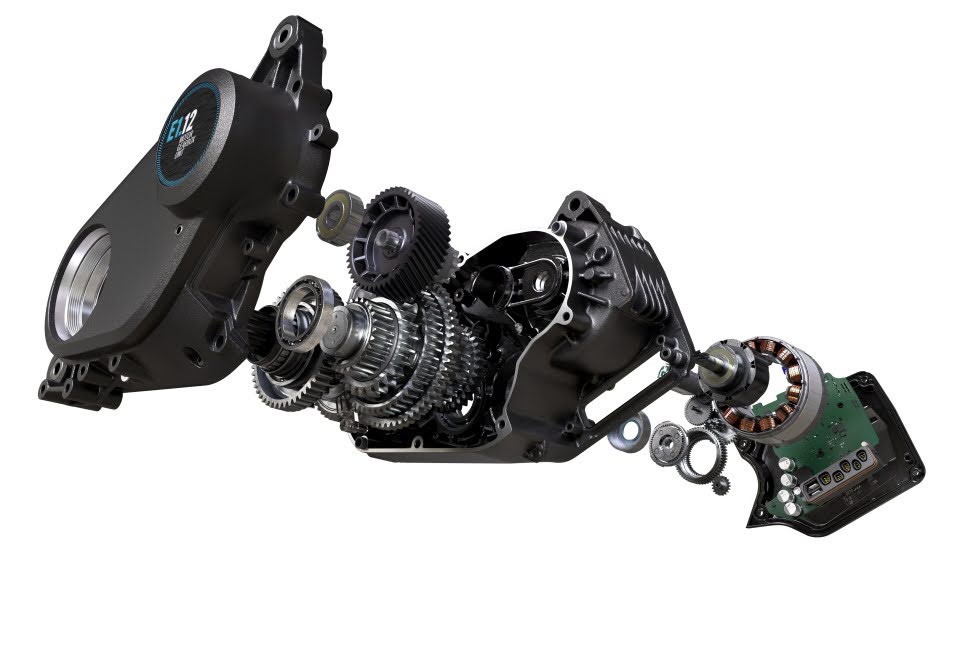
I always say that the heart of an e-bike is the motor. And we were able to ride some pretty cool bikes featuring Bosch’s latest motors, including their Performance Line Speed, Performance Line, and Active Line Plus systems.
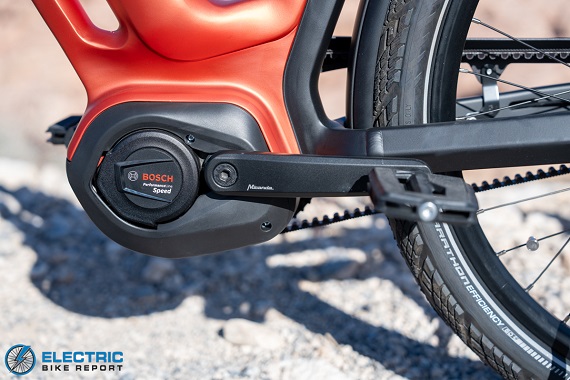
Gazelle Eclipse C380

Photo credit: Chris Wellhausen
While the Gazelle C380 they had on hand was a little small for me (as you can see in the photos), I was still very impressed by the bike. A few of the highlights for me were:
- Bosch Performance Line Speed motor. Putting one of Bosch’s most powerful motors on a city commuter is a solid choice. The bike had a ton of power to climb hills, and being able to pedal up to 28 mph makes the bike a great option for commuting.
- Overall comfort of the bike. Wide tires, a front suspension fork, and an Enviolo internally geared hub combined with a belt drive made for a very smooth ride.
- Beautiful color. I’m not sure if this was planned, but the bike looked simply stunning against the backdrop of the red rocks!

Custom Co-Motion E-Bike

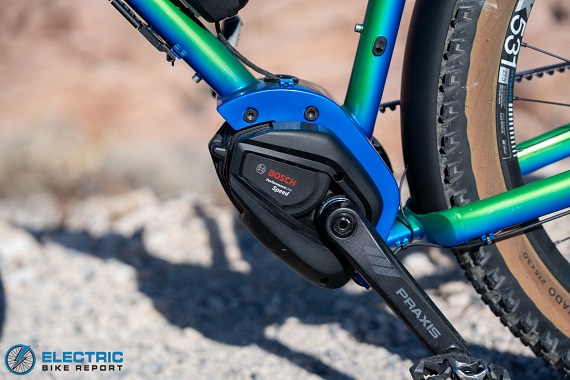
Probably the coolest bike I saw during CES was this custom built Co-Motion e-bike that’s based on an upcoming model geared toward bikepacking. Sadly, I didn’t get all the specs written down, but I can say this much: if you’re looking for a very unique touring e-bike to take you across the country, then go see what Co-Motion can do for you.
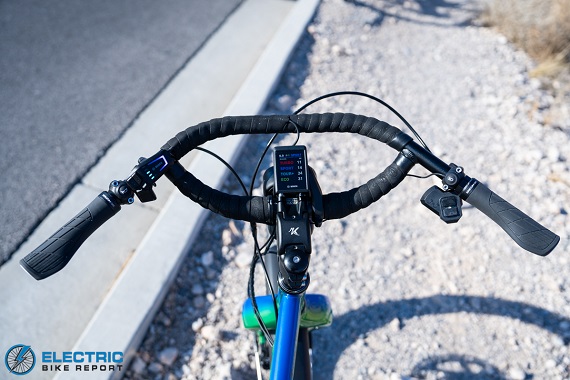
The production model will be an analog bike with 29″ wheels that can be run with a rigid carbon fiber fork or a 120mm-travel suspension fork. This custom electric version I tested, however, was super comfortable, with the unique alt bars that would really help on long tours being one of the standout features. Of course the paint job can’t be ignored, and neither could the choice of motor (Bosch Performance Line Speed).
Benno RemiDemi XL

Photo credit: Chris Wellhausen
I think I have told myself 10 times already that I’m going to buy a Benno RemiDemi. The only reason I haven’t is because I have an office full of 150 e-bikes and have to routinely switch out which bikes I have at my house for personal testing.
However, if I wasn’t lucky/fortunate enough to have access to so many bikes, and had to have only one bike in my garage for my whole family to ride, it might just be the RemiDemi XL. It’s a bike that does it all (minus the mountain biking, of course) and is a ton of fun to ride. With the long-tail version I can not only carry groceries, but also add my 6 year old, which slashes my need to drive everywhere.
The one thing I would change on the bike we rode at this event would be to go with the Bosch Performance Sport motor as it goes up to 28mph.
CES / Bosch Ride Wrap-Up

Photo credit: Chris Wellhausen
For us, this was a great way to end CES 2024. While we wish more e-bike companies attended CES to put their products in front of consumers, we were glad to see Bosch representing their e-bike systems at the show and supporting great manufacturers like Benno, Gazelle, Riese & Müller, Co-Motion, Trek, Cannondale, and more.
To learn more about Bosch’s e-bike systems, you can go to their website here: https://www.bosch-ebike.com/us/