

Florida’s 10 MPH E-Bike Law, Megamo’s Avinox E-Road & Gravel Bikes, PeopleForBikes City Rankings | TWR Ep 88
Jun 21, 2026
 1 Comments
 Share
Share
Plus, Pedego partners with Velosurance for e-bike insurance, we break down why you shouldn’t buy an e-bike from Amazon, Velotric’s Prime Day deals, and more!
Florida’s legislature has passed a bill that would set a 10 mph speed limit on e-bikes in certain situations. It still needs the Governor’s signature to become law, but if approved, it goes into effect July 1st. Is this reasonable pedestrian safety policy, or does the wording raise concerns?
Spanish brand Megamo has released e-road and e-gravel bikes powered by Avinox mid-drive motors, the same system making waves in the eMTB world. The Upon and Along both feature carbon frames, fully internal 600 Wh batteries, and specs ranging from Shimano 105 to SRAM Force XPLR AXS. How do they stack up?
PeopleForBikes ranked over 3,000 U.S. cities on bike-friendliness this year, and the results are pretty interesting. The top spot went to a city that doesn’t even allow e-bikes. St. George, Utah, our home base, crept up six points, though there’s still plenty of room to grow.
Pedego has teamed up with Velosurance to offer standalone insurance coverage for its customers. If you’ve ever wondered what it actually costs to insure an e-bike, we ran the numbers.
Read more below, or watch and listen above!
Sponsor
Sponsor
This Week’s E-Bike News Headlines
Florida Passes a Bill Setting a 10 MPH Limit on E-Bikes
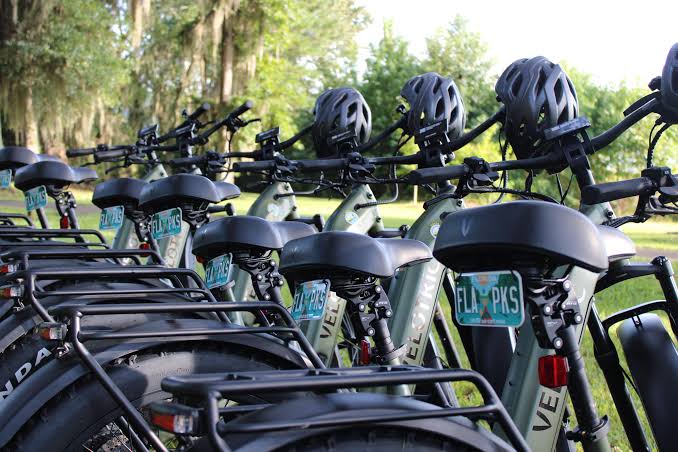
Credit: Florida State Parks Foundation
Florida’s SB 382 has cleared the state legislature and is now waiting on the Governor’s signature. We covered the bill back in February when it was still working its way through the process, so this is the next step.
The 10 mph limit is situational. It applies to e-bikes on sidewalks or in other areas shared with pedestrians, and only when a rider comes within 50 feet of a pedestrian. The bill also requires riders to yield to pedestrians and give an audible warning before passing on shared pathways. Violations are classified as noncriminal traffic infractions and carry a $30 fine.
Beyond the speed rules, the bill establishes a task force to study incidents involving e-bikes and other micromobility devices. Florida’s highway patrol, sheriff’s offices, and police departments would be required to log all such incidents, including the rider’s age, e-bike class, and whether the rider holds a driver’s license. The task force is required to meet at least once a month and submit a report with recommendations to the Governor by the end of October.
If signed, these rules take effect July 1st.
Our Take:
On its face, slowing down near pedestrians makes sense. Nobody is arguing that e-bikes should be flying past walkers at full speed in shared spaces. The situational nature of the 10 mph rule, applying only on sidewalks and pedestrian areas and only within 50 feet of another person, is a more measured approach than a blanket restriction would be.
The task force and incident-tracking requirements are also reasonable. Better data on where and how accidents are happening is something the industry should want.
That said, we’ll be watching how enforcement shakes out. A 50-foot trigger zone in real-world riding is not an easy thing to judge in the moment, and there’s always a risk that well-intentioned rules get applied unevenly. Florida is a high-volume e-bike state, so this will be worth tracking.
PeopleForBikes Releases 2026 City Ratings
PeopleForBikes has published its annual city ratings, ranking more than 3,000 cities across the US on how well their bike infrastructure connects residents to the places they need to go. Cities are scored on a 100-point scale across six categories: access to residential areas, core services like hospitals and grocery stores, retail, jobs and schools, recreational amenities, and transit hubs.
The top six cities all have populations below 2,500, with two sitting below 1,000 residents. The number one city is Mackinac Island, which, notably, doesn’t even allow e-bikes. Among larger cities, Brooklyn, Minneapolis, and Seattle performed well. For mid-size cities, the top three were Hoboken, NJ, Rochester Hills, MI, and Anchorage, AK.
St. George, UT, our home base, moved up from a 33 last year to a 39 this year. The national average across all cities was 36, so we’re just above the middle. PeopleForBikes considers a score of 50 to be the threshold where infrastructure makes biking genuinely easy and convenient for getting around. More than 550 cities cleared that benchmark this year.
Cities that have improved the most in recent years include Baltimore, MD, Tampa, FL, and Charlotte, NC.
PFB CEO Jenn Dice said communities of all sizes can make meaningful progress when they focus on connected networks, and that the results show biking is becoming a practical part of daily life in more places across the country.
Our Take:
It’s good to see this data getting published year over year, because progress tends to show up when you’re actually tracking it. Cities like Tampa and Charlotte turning up as big improvers is encouraging, especially given how car-centric both areas have historically been.
The Mackinac Island result is funny on the surface, but it makes sense when you think about the methodology. A small, dense, car-free island where everything is reachable by bike is going to score very well on connected infrastructure, regardless of which types of bikes are allowed. The categories reward connectivity, not e-bike access specifically.
For St. George, six points in one year is real progress. We’re still below the 50-point “easy and convenient” threshold, and that’s worth acknowledging. There’s more to do.
Megamo Launches E-Road and E-Gravel Bikes with Avinox Mid-Drives
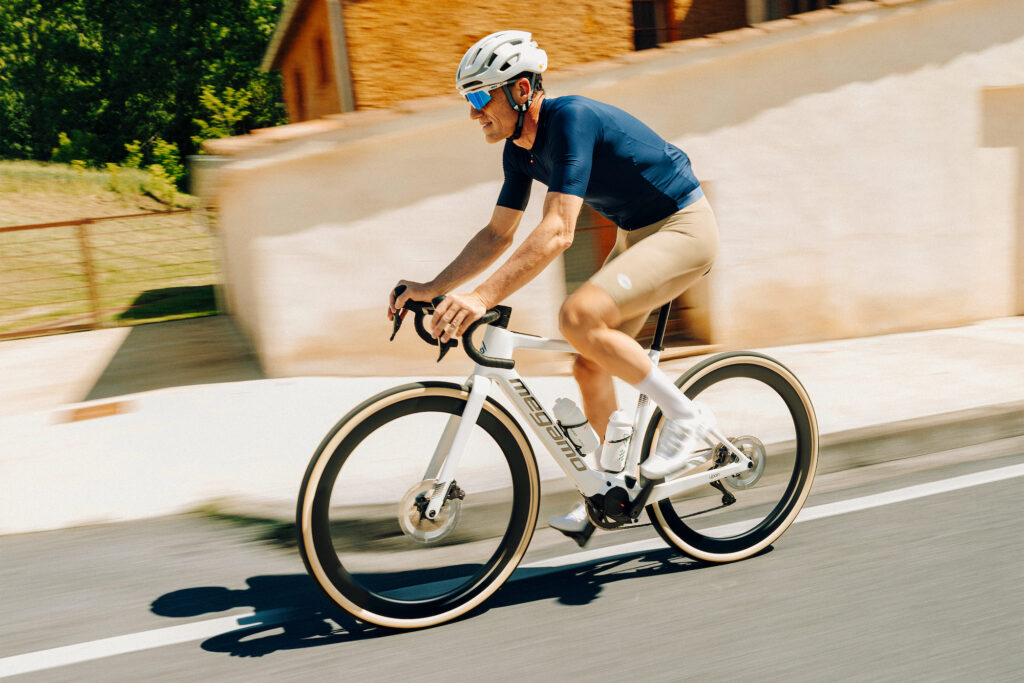
Credit: Megamo
Spanish bike brand Megamo has expanded its use of the Avinox mid-drive motor system beyond eMTBs, releasing two new drop-bar models: the Upon e-road bike and the Along e-gravel bike. Both share carbon frames, fully internal 600 Wh batteries, and a choice between the Avinox M2 or M2S motor depending on spec tier.
The Upon comes in three tiers priced from €3,999 to €6,499, all with a carbon stem and handlebars. The entry-level build includes the M2 motor (110 Nm torque, 1,100W peak), a Shimano 105 12-speed groupset, and aluminum wheels. The top spec steps up to the M2S motor (130 Nm, 1,300W peak, with a 150 Nm / 1,500W Boost mode), Shimano Ultegra Di2, and carbon wheels.
Megamo described the Upon as “a road bike that happens to have a motor,” developed with the same geometry, cockpit philosophy, and component approach as a high-performance conventional road bike, not as a crossover or compromise.
The Along e-gravel bike has five builds ranging from €3,999 to €7,999, all riding on 700x50c tires. The base build gets the M2 motor, Shimano Deore groupset, aluminum wheels, and an alloy seatpost with flat bars. The top build moves to the M2S motor, SRAM Force XPLR AXS 13-speed, carbon wheels, a carbon monocoque stem and handlebar with computer mount, and a carbon seatpost. Models with the M2S motor include a 12A fast charger; standard M2 models come with a 4A charger.
Our Take:
Avinox has earned attention on the trail. Seeing it applied to road and gravel geometry is a logical next step, and Megamo seems to be serious about treating these as proper road and gravel bikes rather than just motorized versions of something else.
The price range is steep, but that’s consistent with where high-spec e-road and e-gravel bikes tend to land. The spec differences between tiers are meaningful, particularly the motor upgrade from M2 to M2S and the inclusion of a fast charger on higher builds. Those aren’t trivial choices for riders who want to use these bikes for longer efforts.
We haven’t tested either model yet, but Avinox’s performance in eMTBs gives us a decent baseline for expectations. These will be worth watching when reviews start coming in.
Pedego Partners with Velosurance to Offer E-Bike Insurance
Pedego has selected Velosurance as its preferred insurance partner, giving Pedego customers a direct path to coverage for their bikes. Velosurance policies can include crashes, theft, and accidental damage, with additional options for liability, medical, and uninsured motorist coverage.
Plans cover the bike itself along with added accessories, including lights, racks, baskets, and mirrors, regardless of whether they were installed by the owner or added at a Pedego dealer. Velosurance also offers coverage for other types of electric and analog bikes and trikes, with separate options for racing bikes and international travelers.
One practical detail: a Velosurance policy is standalone, meaning claims won’t affect your other insurance rates. To get a real sense of what coverage costs, an actual quote using realistic options came out to around $24 per month or $316 per year.
Pedego CEO Larry Pizzi said the partnership gives customers a clear way to ride with confidence, noting that Pedego owners tend to treat their bikes as part of the family and want them protected accordingly.
Our Take:
E-bike insurance is one of those things that’s easy to skip until you wish you hadn’t. A $316 annual premium for a bike that might cost $3,000 or more is not an unreasonable ask, especially when theft coverage is included.
The standalone policy structure is a nice detail. Keeping your e-bike claim separate from your home or auto insurance means you’re not risking a rate increase on everything else for a bike-related incident.
Velosurance isn’t new to the space. It covers all kinds of bikes, not just Pedego’s lineup, so this partnership mostly makes it easier for Pedego customers to find their way to coverage. Whether you ride a Pedego or not, it’s worth knowing this option exists.
Gear Highlight – GoTrax F2 & E-Fold
No new accessory or gear item was highlighted in this episode. Two GoTrax bikes recently went live with full reviews on the site: the GoTrax F2 and the GoTrax E-Fold. If you’re shopping in the budget end of the market, both are worth a look.
Sponsor
You Asked, We Answered. Questions Covered In The Weekly Recharge
- Why should you avoid buying a cheap, high-claims e-bike from Amazon, and what red flags should you watch for?
- Is there a good e-bike available for riders on a tight budget, and where does the “sweet spot” price point land for most buyers?
- Between the Aventon Level 4 REC, Velotric Discover 3, and Euphree Stellar Falcon 2, which is the best fit for a 6’2″, ~300 lb rider commuting 10-12 miles with some hills?
- Can e-bike motors overheat, and what factors affect how quickly that happens?
E-Bike Deals Found This Week
- Velotric’s Prime Day Sale (ends June 28th)
- Discover 2 — $300 off (now $1,699)
- Nomad 2 — $200 off (now $1,799) + free Velotric Rear Rack Pannier Bag (worth $74.99)
- Nomad 2X — $200 off (now $2,299 Multi-Terrain Camo / $2,199 non-MTC) + free Velotric Rear Rack Pannier Bag (worth $74.99)
- Fold 1 Plus — $100 off (now $1,399) + free Velotric Rear Rack Pannier Bag (worth $74.99)
- 2026 New Lineup Special Accessory Bundles — GoMad, Discover M, Discover 3, Summit 2, and Tempo; some bikes include Gift Boxes with a reusable water bottle, Velotric cap, wool socks, a sticker pack, a ride log calendar, and a Velotric keychain
- Ride1Up’s Upgrade Your Summer Sale
- Portola (folding e-bike) — $100 off, down to $895
- Vorsa (SUV-style commuter) — $1,495 for the standard model, $1,395 for the Lite
- Revv1 HT (moped-style e-bike) — $1,695
Make sure to tune in to the full episode to see the e-bike trail system highlight and rider of the week! Want to be featured in future episodes? Comment on any YouTube video or page of the website, or send to [email protected].
Sponsor
*Please help support our efforts at Electric Bike Report. We work hard to provide the highest quality content, news, and reviews for our readers – and our sponsors make all of this possible. Please visit our sponsors from their ads on our website and let them know that you appreciate what they do for the e-bike industry and Electric Bike Report
Sponsors
Sponsor
Reader Interactions
Comments
Leave a Reply




Hey good people. Love your shows/website and emails etc.
I have a question. I would like to know in particular the geometry of the Discover 3. (does not appear on their website)
And how it compares to the Aventon Aventure, and the Aventon Level 3/4.
Feel free to include another Bike that should be included in this thread.
Once again, Love the shows, information and the culture. Great job!!!
Thanks, Lynn