Pedego Ridge Rider 2 Review | Versatility, Power, and Precision
Oct 30, 2026
 0 Comments
 Share
This SUV style eBike offers strong performance and useful features, as well as an impressive 5 year warranty.
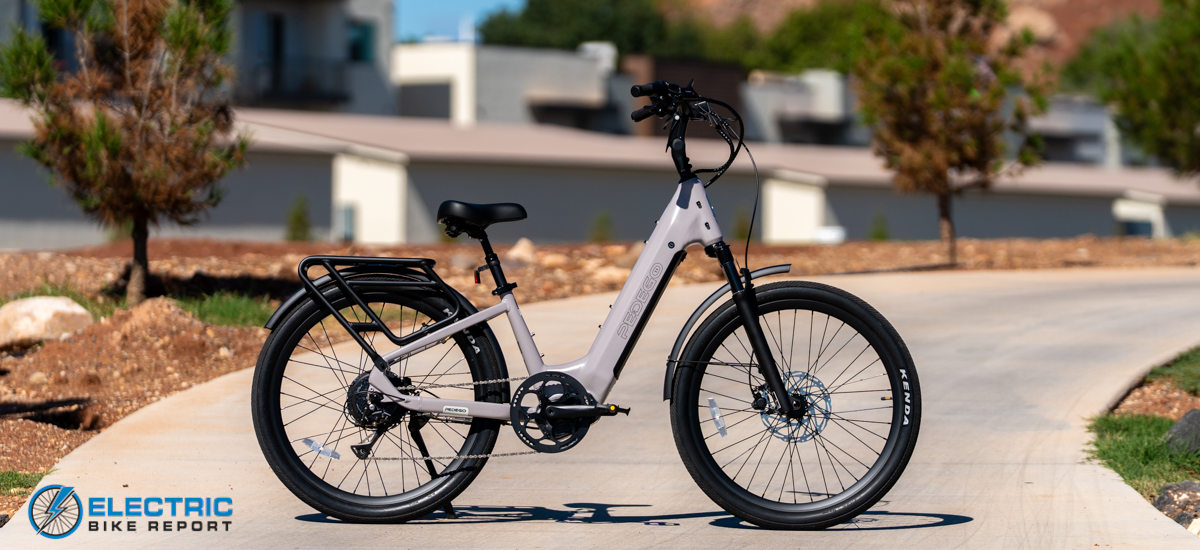
The SUV eBike category is a popular one, and it’s easy to see why. The namesake describes the multifaceted nature of these bikes; they’re worthy commuters, fun cruisers, capable grocery getters, and great campground crawlers. “Do-it-all” is an overused phrase, but it’s the most accurate way to describe the modern SUV eBike. However, there’s more going on in this category than just versatility.
I’ve noticed that many brands put forth their SUV offerings as flagship models; These bikes are typically powerful, well-equipped, and striking. If you want to understand a brand’s ethos, their SUV style eBike will usually exhibit the message.
The Ridge Rider 2 is Pedego’s recent take on the SUV category. At a glance, it’s obvious that this bike is eager to prove that it belongs with other heavy hitters. It has strong power, a solid tech experience, and lots of comfort – there’s also name brand parts to be found, and the bike is capable of class 1, 2, and 3 speeds.
However, it’s one thing to glance at the spec sheet and make assumptions about a bike (or a brand in the case of these flagship models). Doing this can give you the gist, but it’s hard to nail down a bike’s true pros and cons until you test it – luckily, that’s what we’re here for.
Read on to see the Ridge Rider 2’s results in our test process!

Sponsor
E-Bike Category:SUV
E-Bike Class:Class 1 (Pedal Assist to 20 mph)
Class 2 (Throttle to 20 mph)
Class 3 When Unlocked by Dealer (Pedal Assist to 28 mph)
Class 2 (Throttle to 20 mph)
Class 3 When Unlocked by Dealer (Pedal Assist to 28 mph)
Sponsor
Pedego Ridge Rider 2 Video Review
 Pros
- Powerful, quiet motor – the Ridge Rider 2’s powerplant is rated for 750W nominal, 1200W peak, as well as 90 Nm of torque.
- High level of comfort thanks to the suspension fork and seatpost.
- Strong, reliable stopping power – see brake test for details.
- Modern tech experience – there’s a choice of sensors, riding modes, OTA updates, and motor tuning.
- Commuter necessities like an MIK HD rack, turn signals, and integrated lighting are present.
- Pedego offers a 5 year warranty, as well as a nationwide network of dealers/stores to service your ride.
- The quick release adjustable stem/handlebar combo is convenient and well-done.
 Cons
- Limited leg extension for taller riders; We found the sizing to be better for riders on the shorter side of the 5’4″ – 6’1″ range. A longer seatpost would help solve the issue.
ELECTRICAL SPECS & FEATURES
- Battery: 48V, 17.4 Ah (835 Wh)
- Charger: 48 V 3.5 Ah Charger
- Display: 3.5 inch Color Display
- Motor: 48V, 750W, 90 Nm Torque
- Headlight: 100 Lux, Handlebar Mounted
- Taillights: Integrated with Brake Activation and Turn Signals
- Pedal Assist: 3 levels in Torque mode, 5 levels in Cadence Mode
- Claimed Range: 90 miles
- Throttle: Twist
- App: Pedego Ride App
- UL Certification: UL 2271, UL 2849
Weight & Dimensions
- Claimed weight: 71.1 lbs
- Tested Weight: 73.84 lbs
- Rider height range: 5’4″ – 6’1″
- Total payload capacity: 400 lbs
Components & Accessories
- Brakes: Tektro HD-E3520 Hydraulic Disc Brakes, 203 mm front rotor, 180 mm rear rotor
- Fenders: Front and Rear Alloy
- Fork: 80 mm Travel Suspension Fork
- Frame: Alloy
- Drivetrain: Shimano Acera 8 speed
- Grips: Lock-On Rubber
- Saddle: Comfort, Faux Leather, 30 mm Travel Suspension Seatpost
- Handlebar: Alloy, 680 mm
- Kickstand: Included
- Pedals: Platform
- Tires: Kenda K1052E with K Shield, 27.5 x 2.4 inch
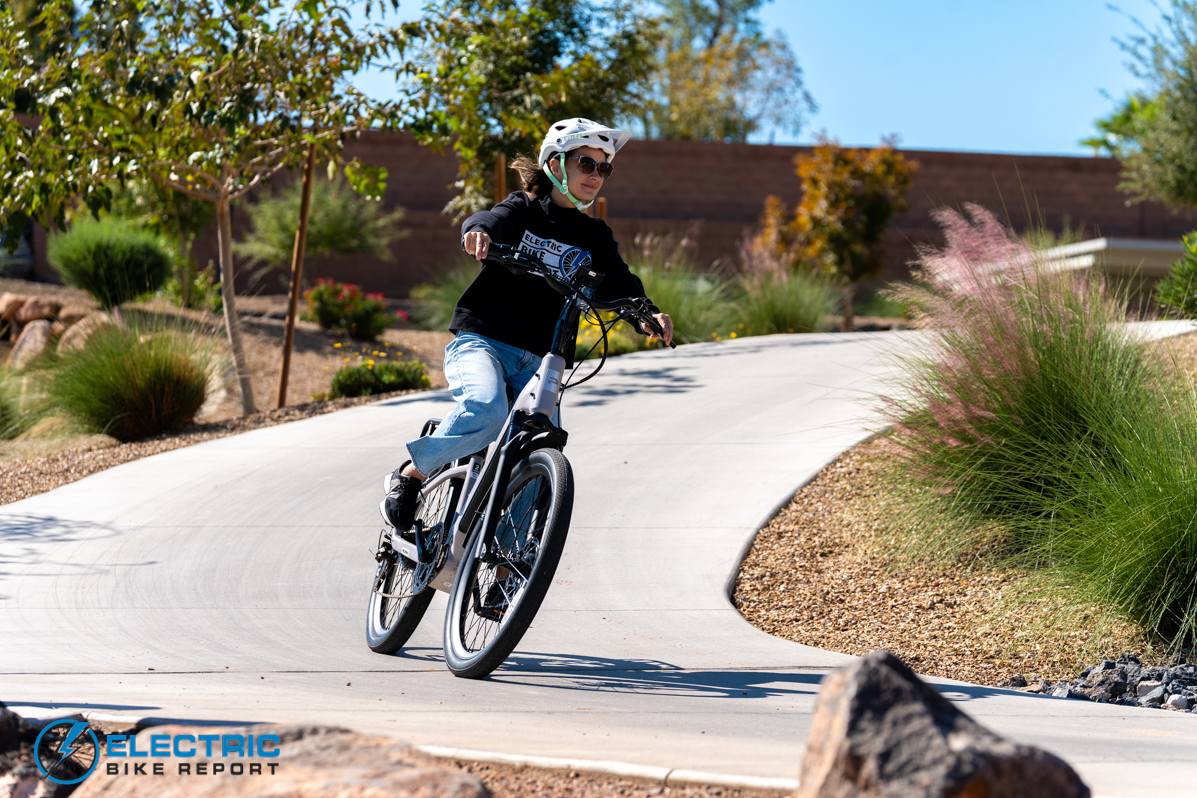
Commuting, fun rides, off-road adventures… The Ridge Rider 2 is game for all of it.
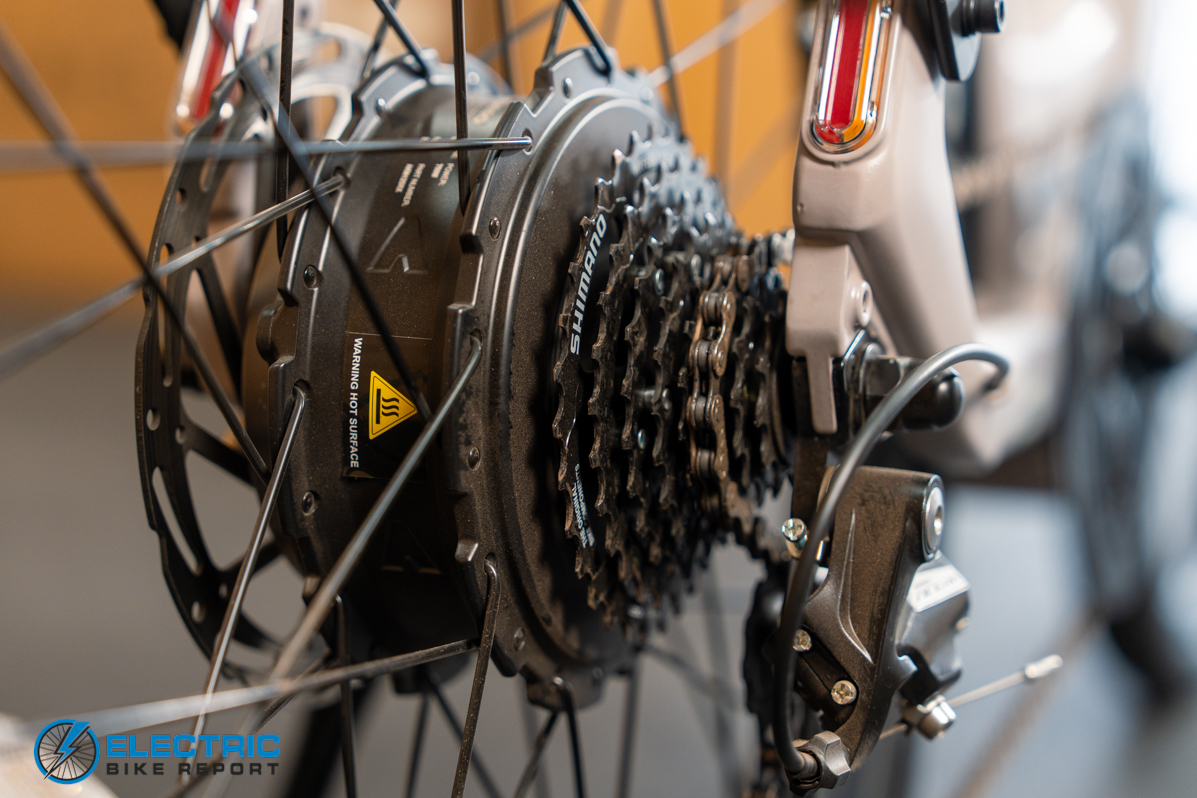
Shimano’s 8 speed Acera drivetrain is smooth and reliable.
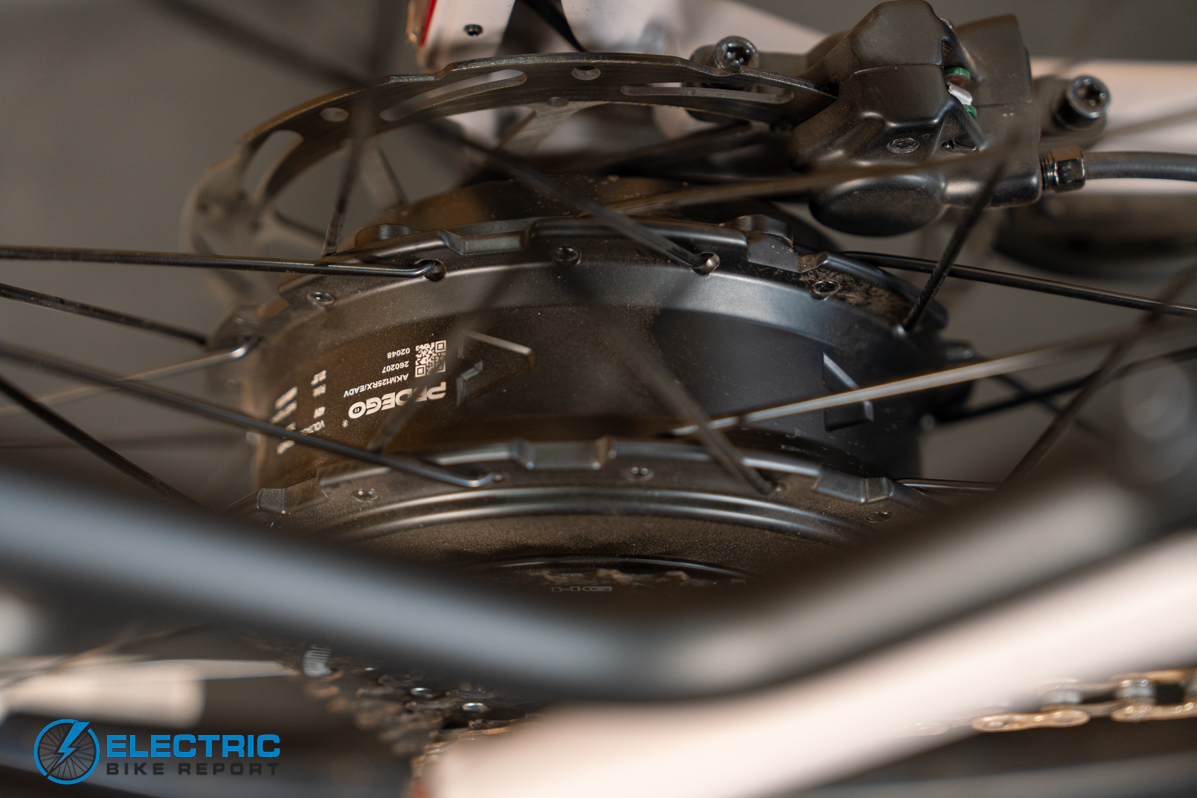
The 750W rear hub motor is smooth and powerful.
Pedego Ridge Rider 2 Review: Speed Test
We do the speed test for a few central reasons. First, it gives us an understanding of how a bike is programmed; generally, we’re looking for predictable, incremental increases in speed as you move through the assist levels. It also shows us if the bike reaches/adheres to its advertised speeds.
The Ridge Rider 2 is equipped with torque and cadence sensors, as well as class 2 and 3 speeds. We tested each combination of these to get a picture of Pedego’s programming approach – however, I do want to note that this bike has a choice of 3 riding modes (Mellow, Standard, and Pedego) as well as some PAS tuning options. These were left in their out-of-the-box presets.
I began the speed test by pedaling with no assist power. I averaged 7.0 mph here; the Ridge Rider 2 does ask for fairly strong pedaling without the motor, so I’d avoid running out of battery when possible.
At class 2 speeds while using the torque sensor, I averaged 11 mph in PAS 1, 16 mph in PAS 2, and then topped out at 20 mph in PAS 3.
In the class 3 torque test, PAS 1 saw 10 mph, PAS 2 saw 17 mph, and PAS 3 reached 28 mph with some extra pedal encouragement.
Cadence mode takes a slightly different approach. Instead of 3 PAS levels, there are 5, and each one comes with a preset speed limit.
At class 2 speeds, cadence mode yielded 7 mph in PAS 1, 11 mph in PAS 2, 14 mph in PAS 3, 17 mph in PAS 4, and 20 mph in PAS 5.
Class 3 mode saw the bike reach 12 mph in PAS 1, 16 mph in PAS 2, 20 mph in PAS 3, 24 mph in PAS 4, and 27 mph in PAS 5.
That’s a lot of data; so, let’s break this down into a few core themes.
First and foremost, this Ridge Rider 2 is approachable and well-programmed. There is little overlap between assist levels, and each step-up in power feels significant yet controllable. Torque mode features fewer assist levels, but riders can still modulate speed based on their pedal input. I found the sensor to be responsive, so despite the fact that we typically see more PAS levels, this method works well for the Ridge Rider 2.
Cadence mode is oriented around speed limits in each of its 5 PAS levels. It offers a very relaxed pedal experience – you can put very little effort in and receive a lot back from the motor, but you’ll typically cruise right up to the preordained speed cap. Because of this, most of your speed control is done by selecting an assist level – your pedal input has less to do with it.
We also tested the Ridge Rider 2’s twist throttle. It delivers easy power off the line, then smoothly ramps up. It’s decently peppy, but still very manageable. Out of the box, it’s programmed to require two twists to activate; this is a safety feature that can be turned off in settings. I like the safety first mentality, but prefer this to be disabled for easier traffic merging.
Overall, this bike posts a good showing in the speed test. It’s easy to access the power while still hitting the marks on safety and legality.
Sponsor
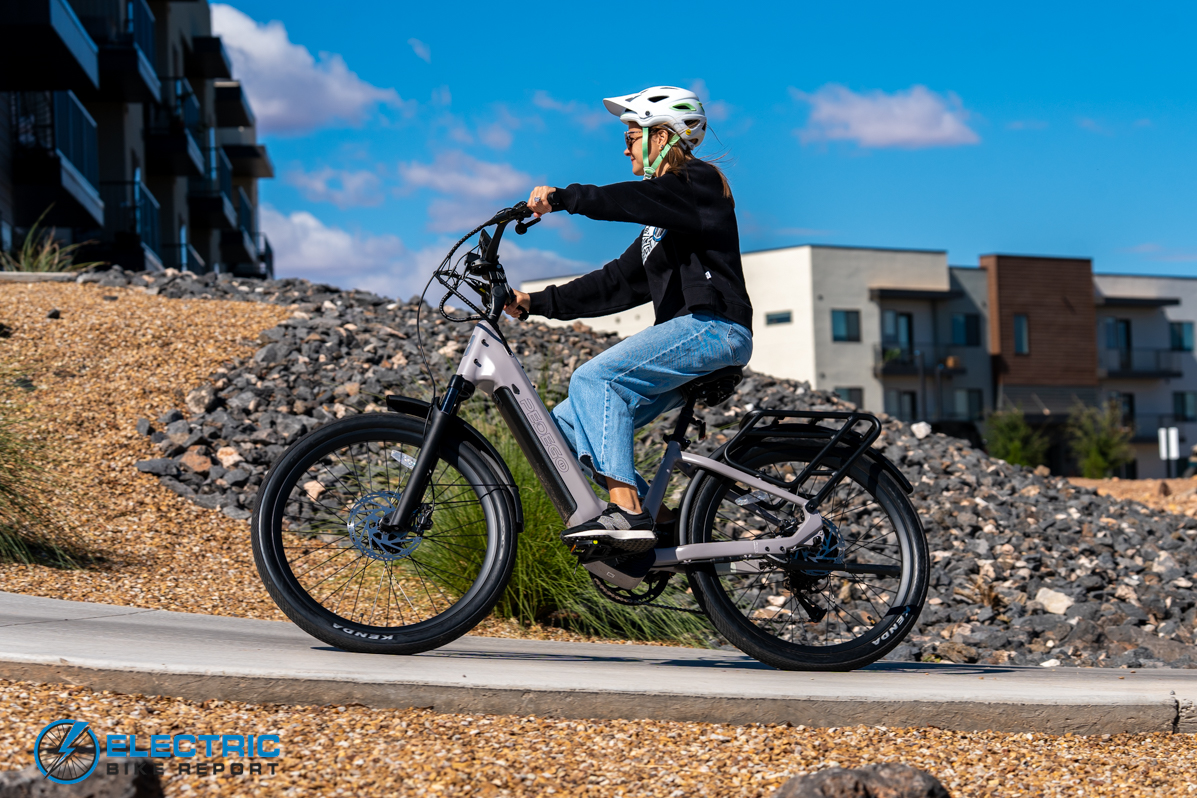
A true do-it-all machine.
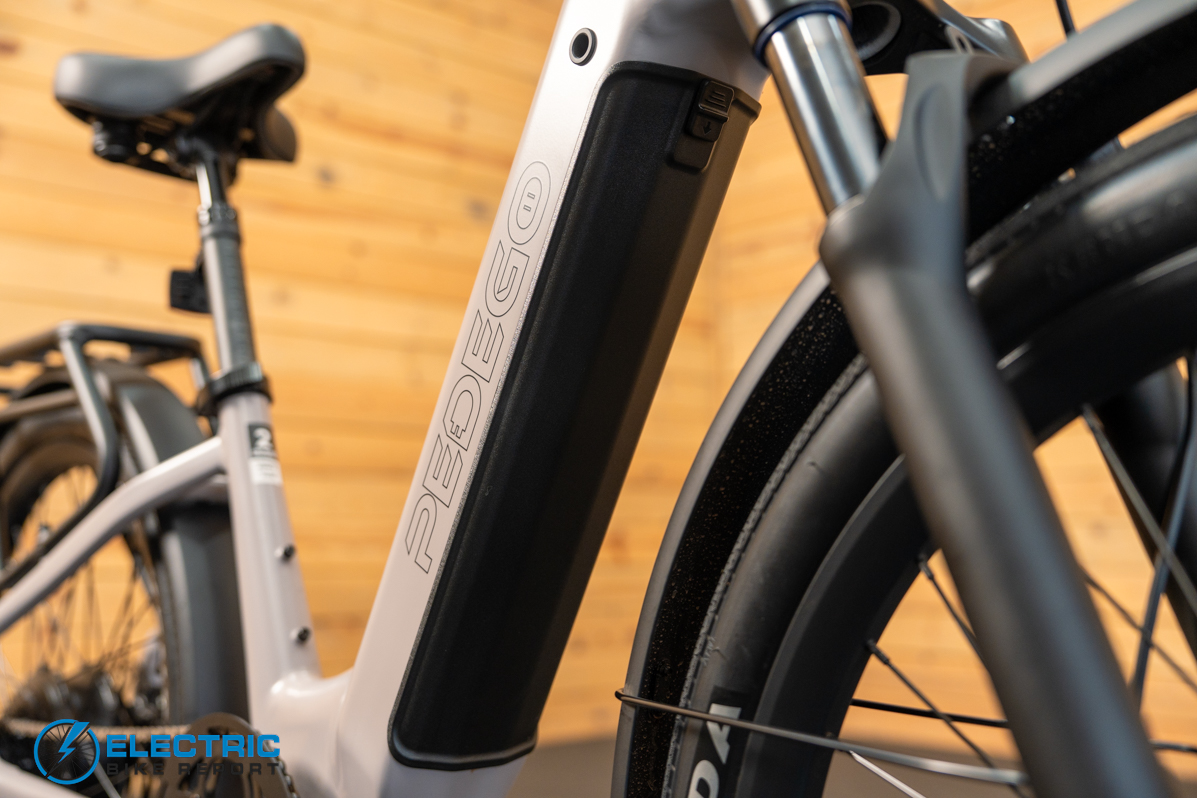
The powerpack is easily removable for charging or storage.
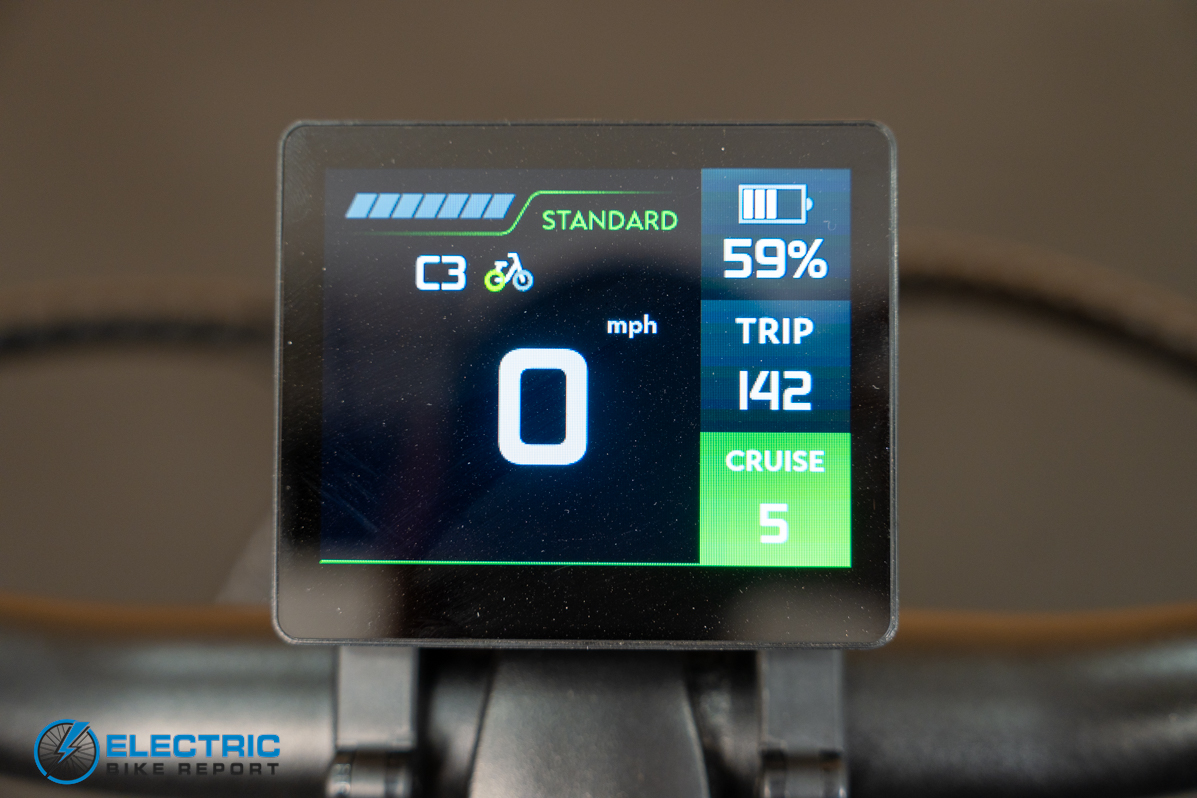
This display’s layout is simple, but easy on the eyes.
Pedego Ridge Rider 2 Review: Range Test
Our range test consists of two separate trials: One using the lowest PAS level, another using the highest. We do this to establish bookend distance numbers, so riders can get a feel for how long their rides will be in both modes.
The Ridge Rider 2 reached 55.34 miles in our low power test, while the category average of similar bikes was 75.83 miles, putting this bike behind the class average.
In the max power test, the Ridge Rider 2 was right on par with the comparison class; It logged 37.57 miles, while the average of similar bikes was 38.07 miles.
The Ridge Rider 2 is equipped with an 835 Wh battery – by the numbers alone, this is larger than most of the comparison group. This bike delivers a good performance on maximum power, but we expected slightly further distance in the low power test.
We dove deeper into the results, and found that the Ridge Rider 2 recorded higher speeds in our testing. For example, in the minimum power test, it recorded an average speed of 13.8 mph, while the comparison class came in at 11.8 mph. This is typically indicative of higher power output, and therefore more battery usage.
This is in line with what I felt in my own time with the bike – The torque sensor delivers a healthy surge of power, and I didn’t have to push hard to access the grunt. It’s rewarding, but the trade off here is that it can decrease range.
Additionally, I’d like to add some perspective. 55 miles is still a practical amount of range – you’re not limited to the local neighborhood with this bike. It still has enough battery for commuting, errands, and campground cruising. The most likely outcome of the shorter range results? You’ll probably need to charge slightly more often.
Moreover, we tested this bike’s range using its as-shipped “Standard” ride mode. “Mellow” would likely yield some extra mileage. Pedego’s claimed range was determined with a 165 lb rider on flat terrain – Our tester’s heavier weight, as well as the usage of the out-of-the-box settings, explain the gap between our results and their target distance.
With that said, the test results are solid. Riders don’t need to shy away from the higher assist levels due to range anxiety. Overall, the Ridge Rider 2 has enough juice to get you where you need to go.
Sponsor
Sponsor
Pedego Ridge Rider 2 Review: Hill Test
SUV style eBikes tend to be strong hill climbers. In fact, some of our top hill test performers belong in this class – the question is, can the Ridge Rider 2 keep up?
In a word: Yes. On throttle alone, this bike completed the Devil’s Backbone segment in 1:50 at 16.5 mph; essentially identical to the category average of 1:49 at 16.7 mph.
Using maximum PAS power, the Ridge Rider 2 came in at 1:40 at 18.1 mph; a few seconds faster than the average of 1:43 and 17.8 mph respectively.
Like I said, this is a competitive test group. The Ridge Rider 2 hangs in with the pack, which makes it a good hill climber – it’s similar to making an All-Star team. It’s on par with its peers, and as a group, they’re great performers in this test.
A glance at the spec sheet gives us some insight into why the bike did so well. The Ridge Rider 2 has a 750W hub motor that packs 90 Nm of torque, and peaks as high as 1200 W. These numbers, once again, put it exactly where it needs to be. It’s simple – this bike is powerful, and therefore climbs hills well.
In my own testing, I felt very confident tackling inclines. The Ridge Rider 2 doesn’t ask for much effort when handling hills; you have to push a little bit, but generally, it does most of the heavy lifting for you.
Sponsor
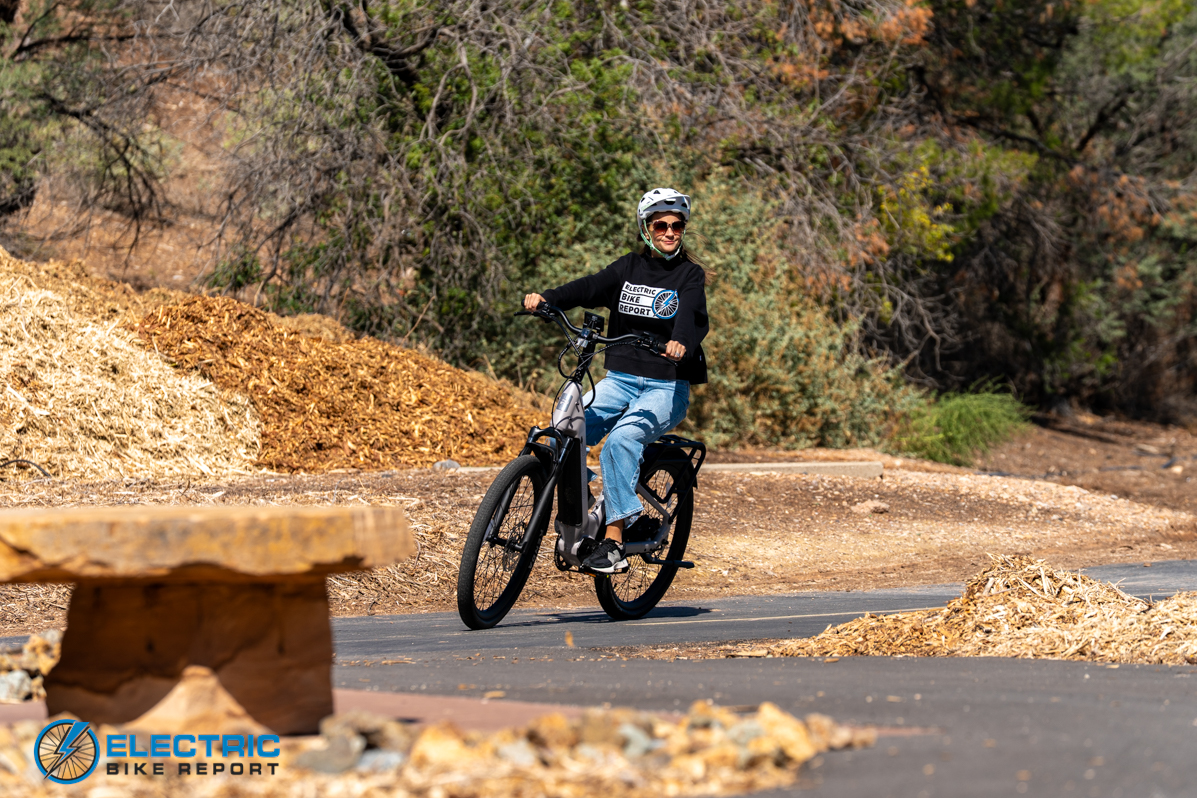
The Ridge Rider 2 is available in 3 colors: Cloud Cover (Grey), Veiled Vista (Green), and Quiet Violet.
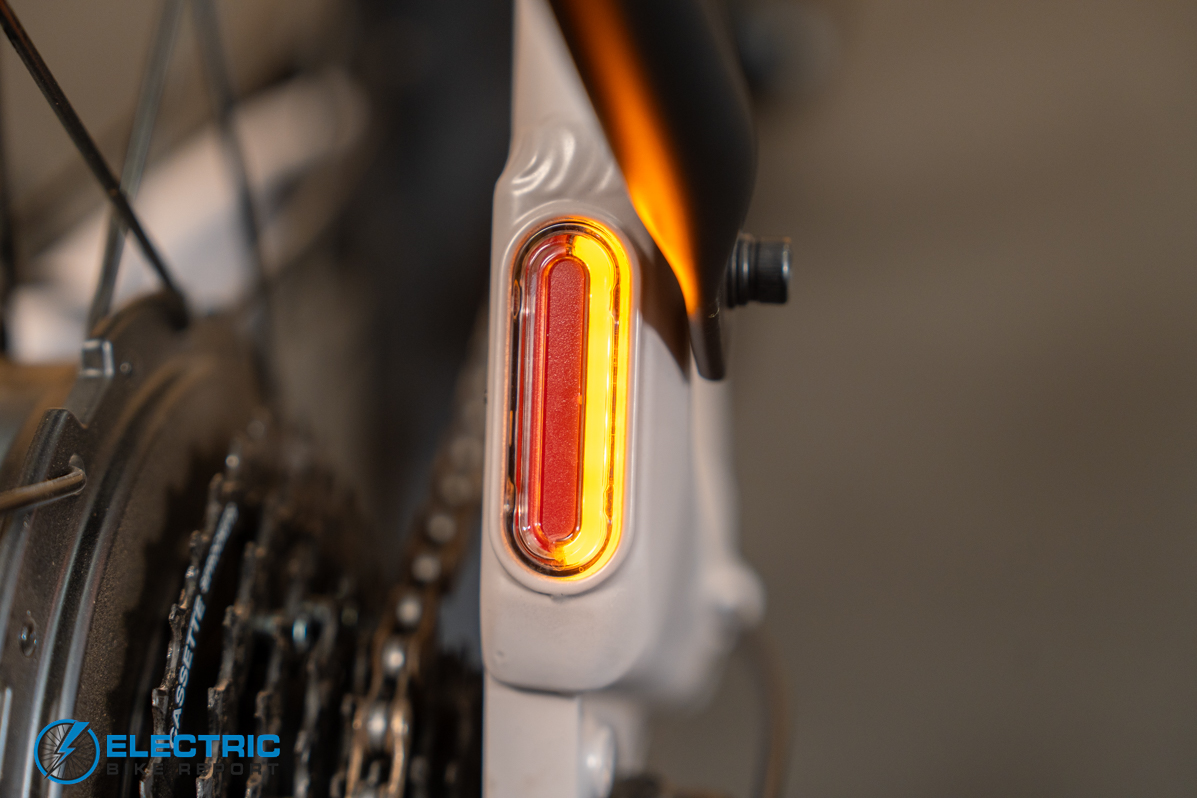
One of the frame integrated taillights – there’s a twin on the other seatstay.
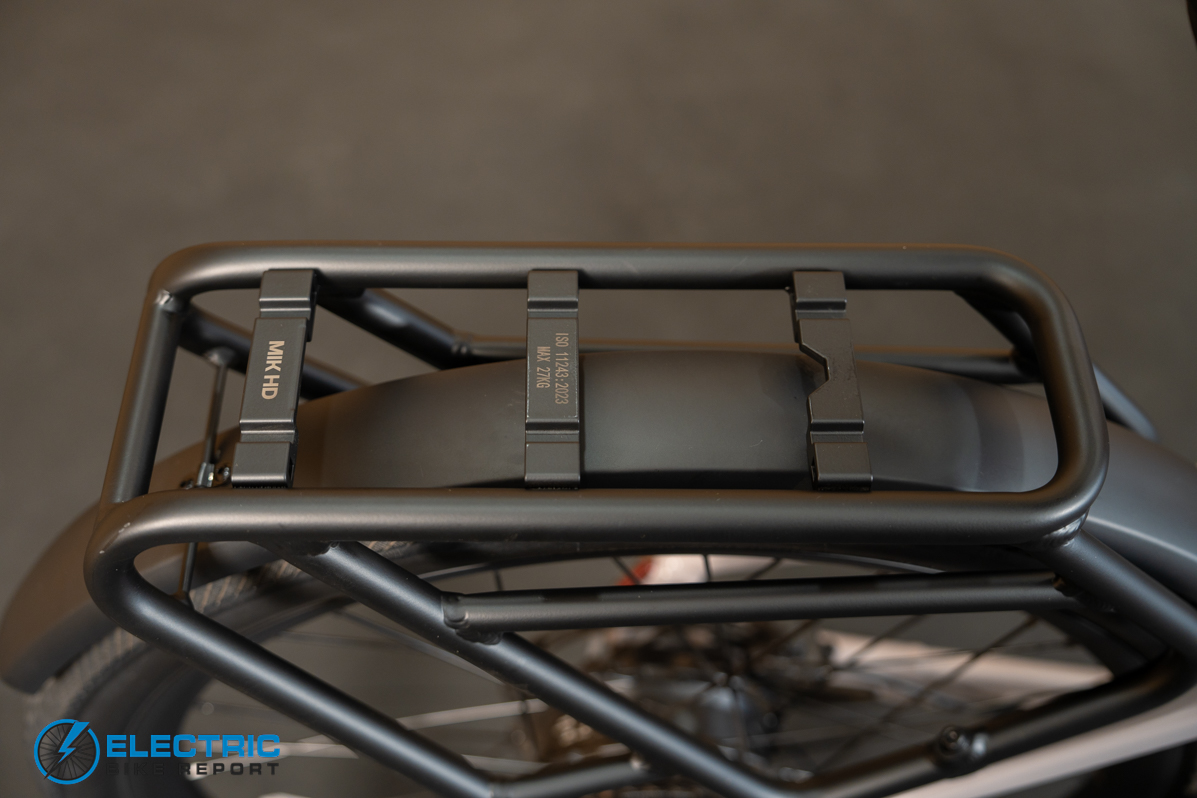
Not only is this rack good for basic hauling, but it’s also compatible with your favorite MIK accessories.
Pedego Ridge Rider 2 Review: Brake Test
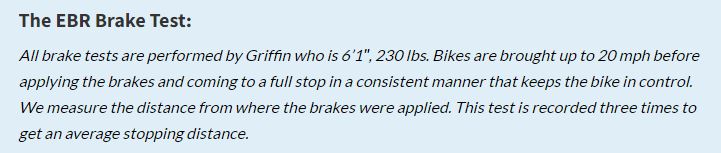
Something has to keep all that power in check; good brakes are equally as key as a solid motor and battery. The Ridge Rider 2 is a strong stopper: Over three runs, it recorded an average stopping distance of 18’0″, which is considerably shorter than the category’s posted mean of 20’4″.
This is an impressive showing, but it’s not surprising. The Ridge Rider 2 is equipped with Tektro HD E3520 Hydraulic Disc brakes, a 203 mm front rotor, and a 180 mm rear rotor. Put simply, this is a recipe for good braking performance.
The front wheel absorbs most of the force under braking, so the decision to fit a larger rotor up front is a good one. The 203 mm disc provides more leverage, as well as improved heat dissipation, which means more consistent performance. Additionally, the 180 mm rear rotor isn’t undersized – it still has enough size to manage braking force.
We’re familiar with Tektro brakes, as they’ve become a go-to option for many eBike makers. Performance is dependent on the model, but these are solid and reliable. We found the levers to feel strong and supportive, and their consistency over multiple hard stops was impressive. There’s little fading, and we were able to modulate with good accuracy.
This is a good braking system, both in terms of test performance and feel. I’d feel confident running this setup on my bike – It’s definitely one of the Ridge Rider 2’s strengths.
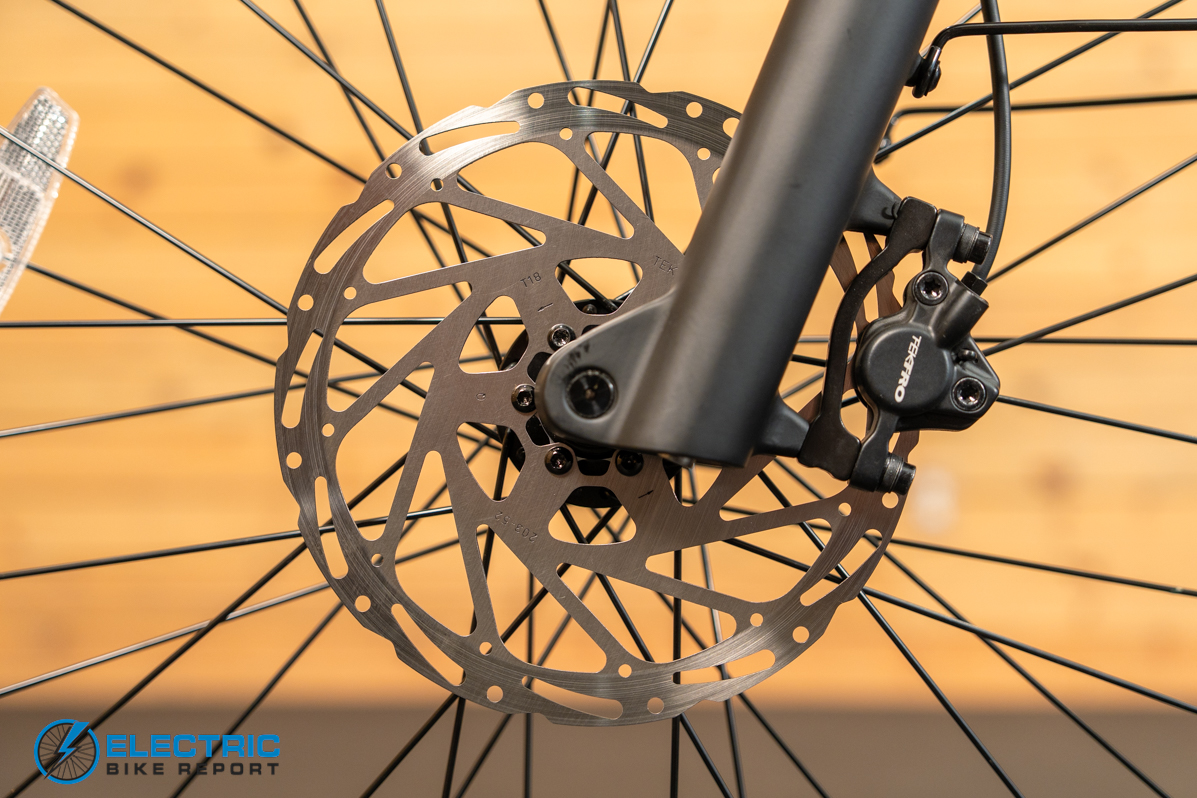
Pictured: the larger 203 mm rotor.
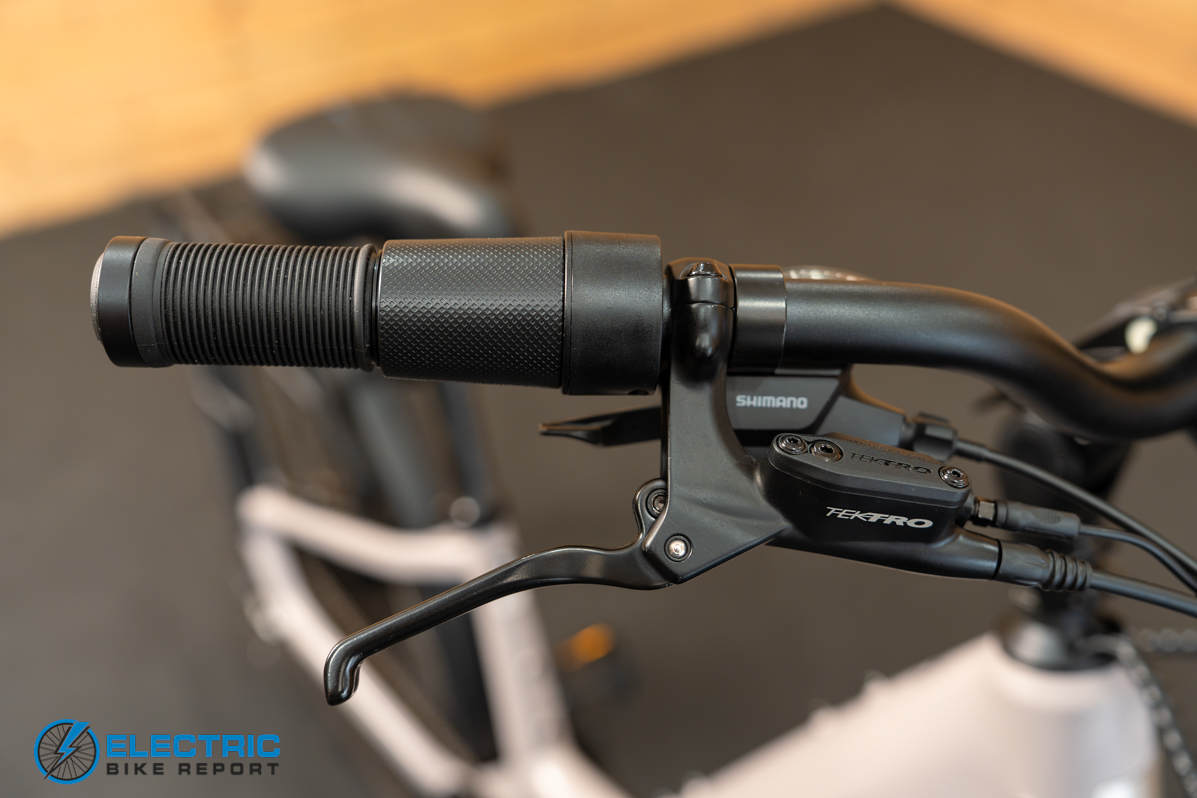
Tektro brakes are solid, familiar, and reliable.
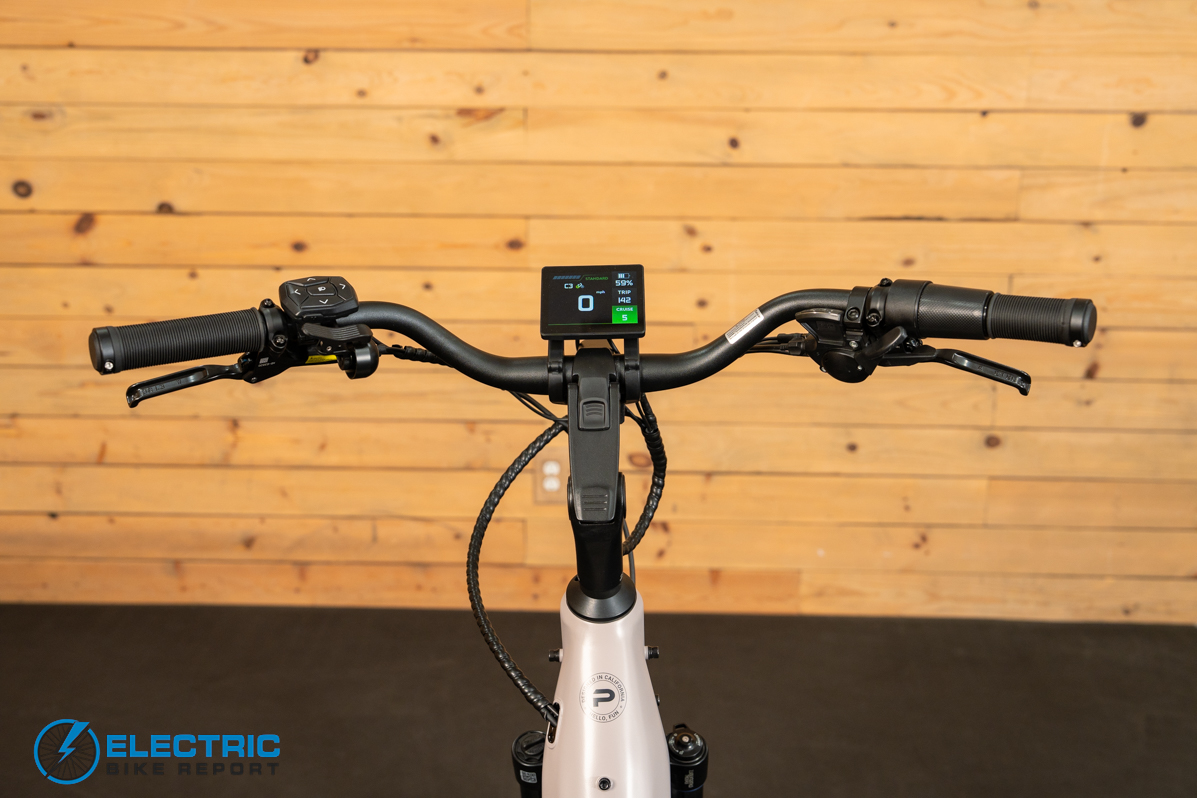
I liked how central the 3.5 in display is.
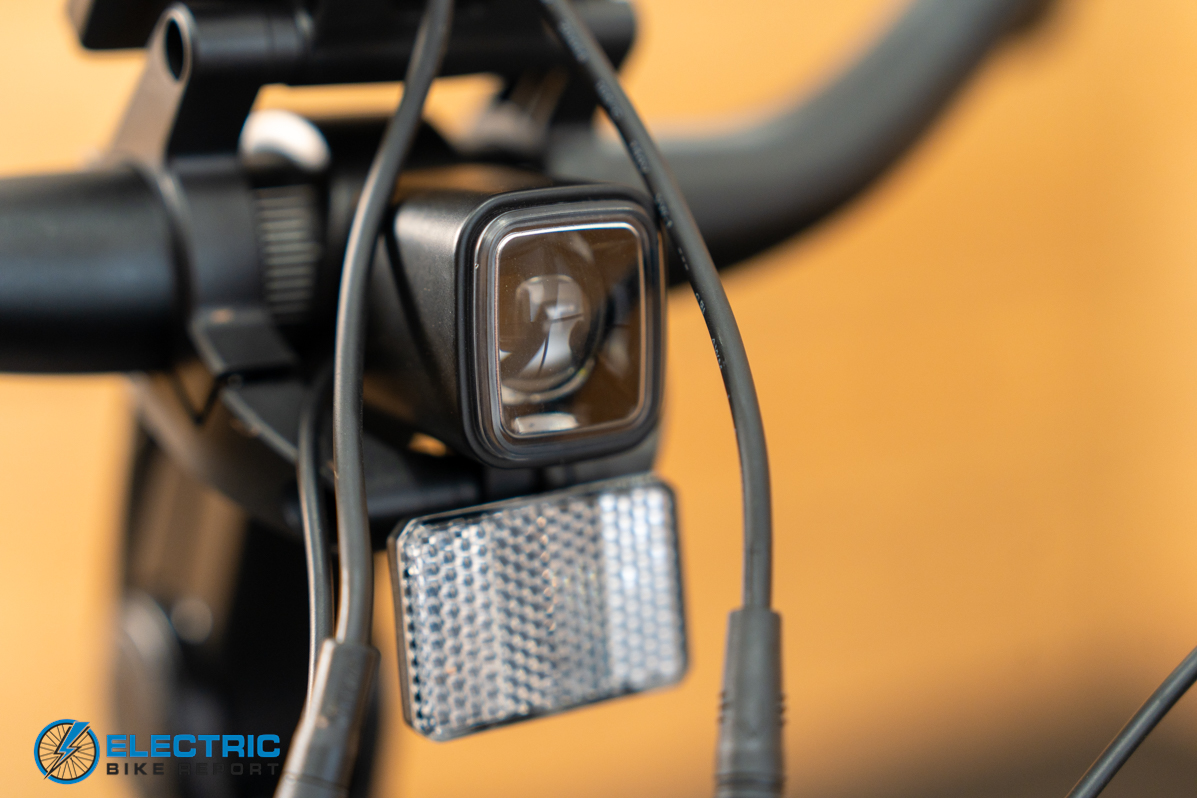
You’re covered when the sun goes down – No additional lights needed.
Pedego Ridge Rider 2 Review: Ride Quality
Ride quality is a mix of several different factors. Comfort, fit, adjustability, pedal experience, and other variables are part of the equation. Boiled down into a sentence: This section is about how a bike feels.
From a personal perspective, this is the make-or-break element for me. A bike can be a great performer, but if it doesn’t feel right, it’s difficult to actually want to spend time on it. Luckily, the Ridge Rider 2 has a lot going for it here.
At a basic level, this bike is comfortable. The suspension fork and seatpost work together to insulate riders from bumpy surfaces, as well as provide some off road optionality. While this approach works (very) well on rough pavement, I was slightly more cautious when venturing off-road.
The primary reason for this was the Kenda 27.5 x 2.4 tires. They have a smoother, street-oriented tread that is passable in off-road situations, but a knobbier tire would be ideal. You can absolutely ride this bike with its stock tires around the campground or on forest roads – but if you plan on doing that on a frequent basis, an upgrade might be worth it.
In terms of sizing, Pedego lists the appropriate range from 5’4″ – 6’1″. In terms of reach, I’d say this feels accurate. However, I did notice that leg extension feels slightly limited. I’m about 6’3″, and while I don’t get proper extension on most single-size bikes, I did feel that the Ridge Rider 2 was mildly more cramped than normal. With that in mind, I’d estimate that this tops out closer to 5’11”. If you’re at the top of the size range, that’s something to be aware of, but otherwise, the established range is accurate.
Pedego also deserves credit for the adjustability of the stem and handlebars. A quick release clamp allows for adjustable reach and handlebar roll – no tools required. This allows riders to dial in riding position with ease, even mid-ride.
Speaking of rider stance, the Ridge Rider 2 does lean more into the upright, comfort oriented side of things. It’s not a full cruiser, but generally feels relaxed. Comfort is a strength here – between the suspension and riding position, I felt like long miles on this bike wouldn’t be a chore.
Motor engagement and pedal experience are also high points on the Ridge Rider 2. The torque sensor is particularly responsive; it’s quick to engage, and very sensitive to pedal input. I noticed no overrun, either. There is a slight learning curve given how responsive the sensor is – If you ease off the pedals, it will ease off the power. If that’s not your jam, cadence mode offers steadier power.
Commuter essentials are also present on the Ridge Rider 2. The MIK HD rack is good for 100lbs of capacity, and the integrated taillight features brake activation and turn signals. Traits like these make this bike suitable for the weekend cruise and the office commute. It’s a true all-rounder like SUV eBikes should be.
The actual ride quality of the Ridge Rider 2 is very good – it’s smooth, comfortable, and confidence inspiring. However, there’s more to like here; Pedego offers a 5 year warranty for riders’ peace of mind. I dug into the warranty terms, and owners will need to meet some annual maintenance criteria, so make sure to stay on top of that to keep coverage.
Sponsor
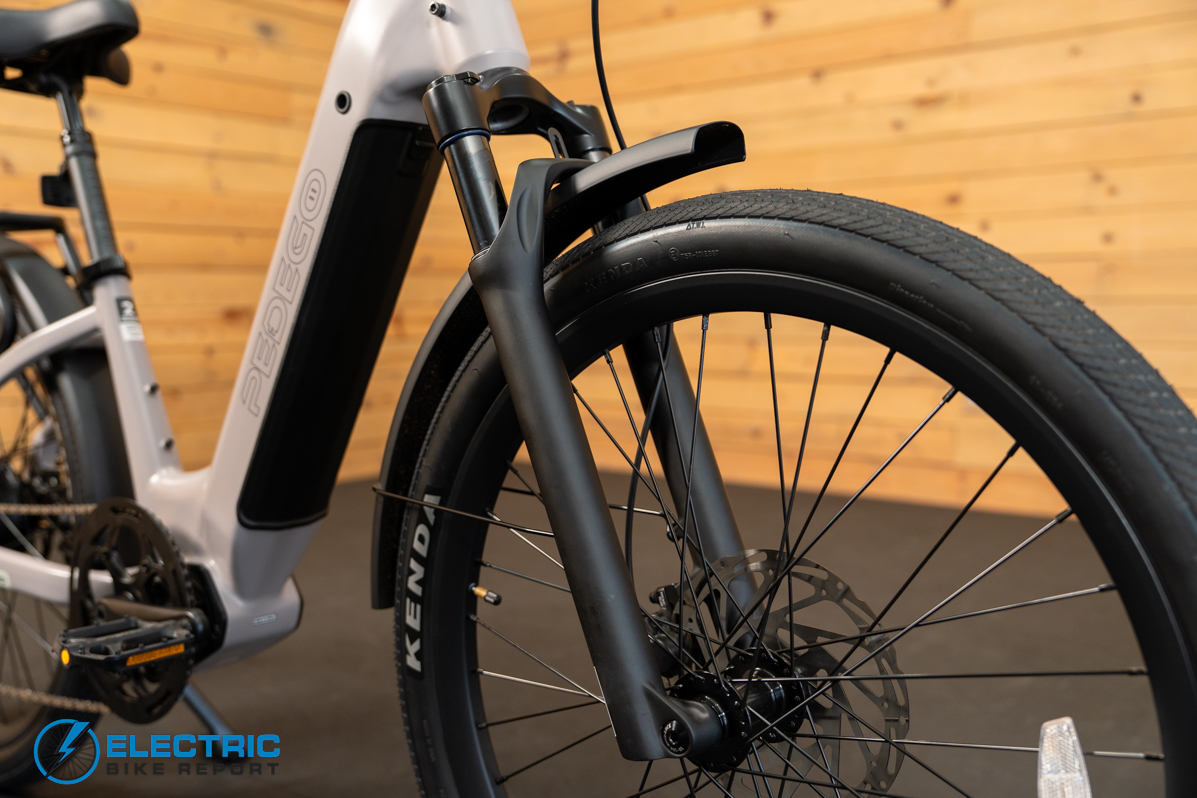
I found the fork to be smooth and plush.
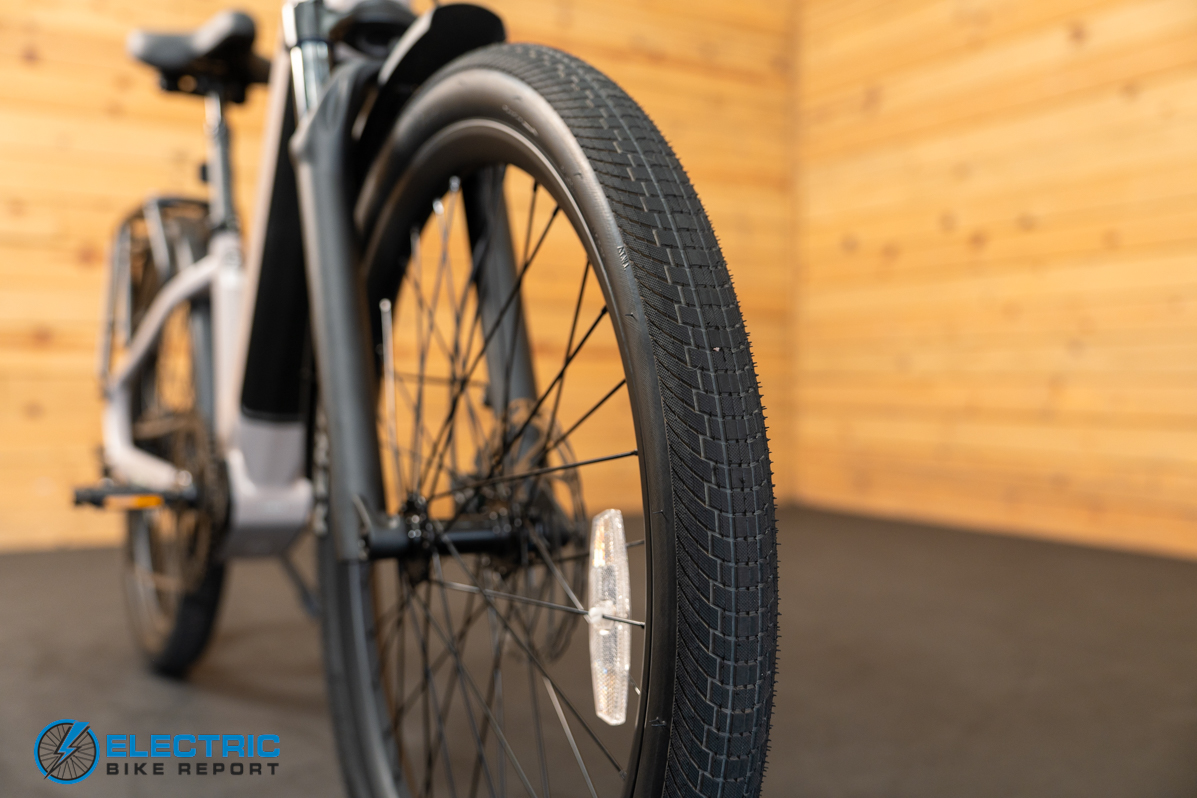
These street tread tires roll well, but also give good grip.
Pedego was recently acquired by Urtopia, and judging by this bike, they’ve done good things with the brand.
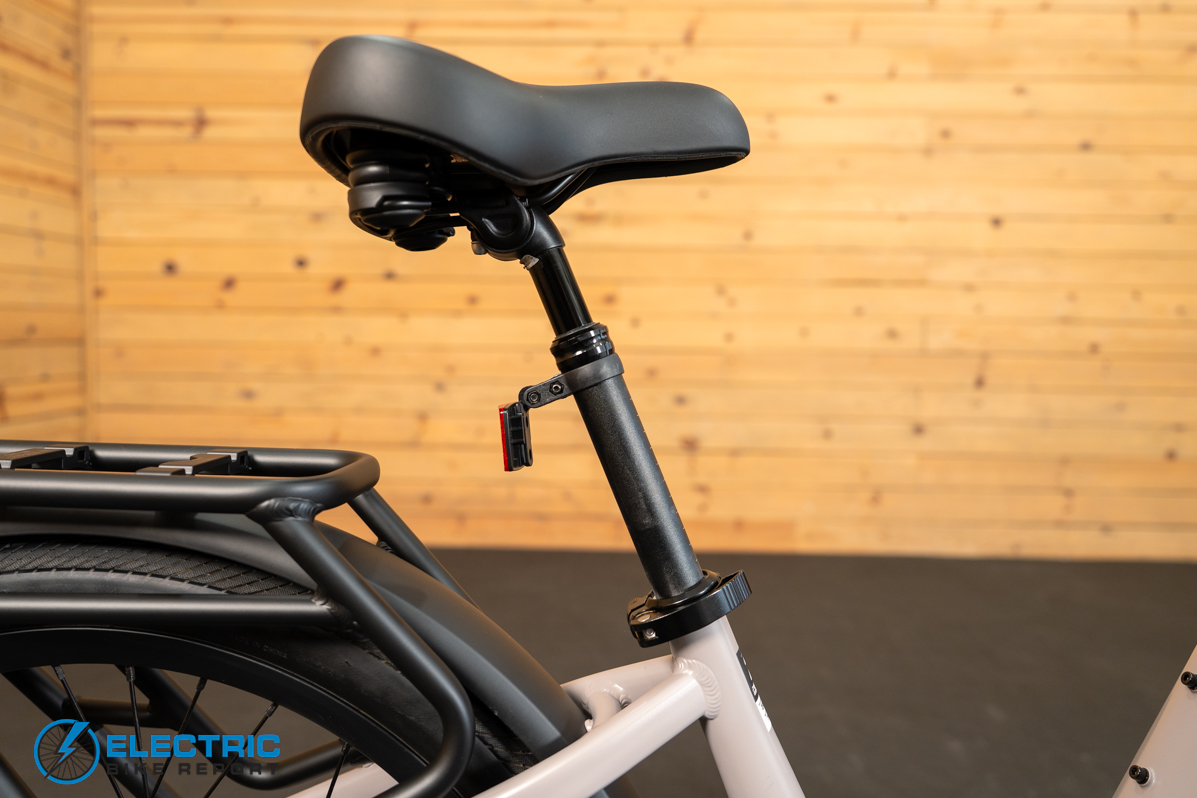
Another layer of comfort is added thanks to the suspension seatpost.
Pedego Ridge Rider 2 Review: Summary / Where to Buy
The fact is, eBikes have made leaps and bounds in terms of quality, features, and sophistication in the last few years. It’s hard to keep up; they’re getting better every day.
The Ridge Rider 2 is right where it needs to be – it hits the modern benchmarks. Between its powerful 750W motor, choice of sensors, and solid tech experience, this bike offers many of the features today’s riders are looking for.
It also checks the SUV eBike boxes. The Ridge Rider 2 is incredibly versatile, and is a great fit for those who want a bike that’s well equipped for the commute and the campground. The MIK rear rack, turn signals, and integrated lighting make it a strong daily driver, while the power and comfort make it fun for the weekends.
Across the board, it’s a solid tester. The programming is intuitive, it climbs hills well, stops with gusto, and has enough range to get where you need to go.
Pricing changes often, but this currently sits at $2,195. From my perspective, that’s a fair value – it’s slightly more expensive than other options, but the brick and mortar dealer network and 5 year warranty are unique benefits. They do result in a mild cost increase, but it’s not excessive, and many riders may value an in-person service experience.
The central critique is on sizing; Leg extension is slightly more limited than we’d like to see. In the short run, a longer seatpost would help solve the issue.
Beyond that, the Ridge Rider 2 is a strong entry into the SUV eBike world.
Happy Riding! Make sure to let us know if you have any questions or if you think we left anything out in this review of the Pedego Ridge Rider 2 down in our comments section.
Sponsor
Sponsor
Reader Interactions
Leave a Reply