Pedego Latch 2 Review: Full-Size Ride Quality in a Folding E-Bike
Oct 26, 2026
 0 Comments
 Share
This folder has all of the portability benefits, but punches above its weight in ride quality.
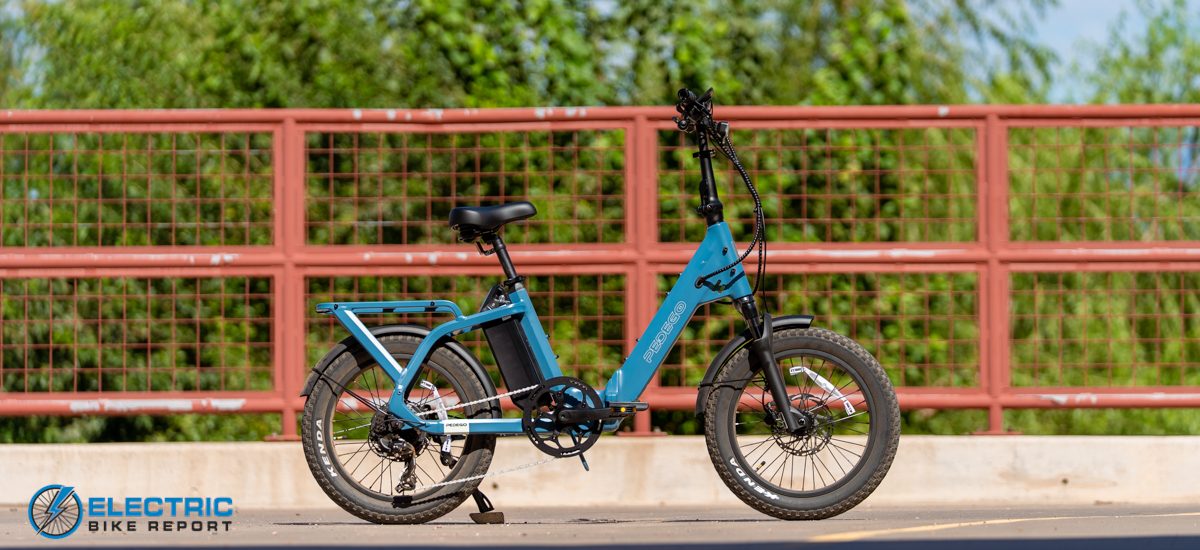
Folding ebikes are exceptional from a portability and practicality standpoint. Have a sedan, but want to bring your bike somewhere? Folder. No bike rack? Folder. Looking to save space in the garage? Folder!
You get the point. If saving space and staying mobile are priorities, it’s hard to go wrong with a folding eBike.
However, there’s a reality to this eBike genre that isn’t as easy to get excited about. While practical, folders can sometimes feel compromised and flexy. The small footprint tends to result in tradeoffs; sizing and frame stiffness are usually the first areas to suffer. You’ll save space, but many folding eBikes simply aren’t as nice to ride as their full-sized counterparts.
But, what if you want both? What if saving space AND ride quality are necessary?
Pedego thinks they have the answer; Currently at $1,695, Latch 2 has folding capability, a sturdy frame, accommodating geometry, and an assortment of useful features.
This bike is complete with a step through frame, 750W hub motor, and a suspension fork. Riders have options for both torque and cadence sensing modes, as well as class 1, 2, and 3 speeds.
There’s also ride modes, turn signals, and name brand parts to be seen across the build. In short, this isn’t a bare-bones product. It aims to solve the folding eBike problem and then some. It sounds great in theory, but how does it work in practice?
We took the Latch 2 through our series of speed, range, hill, brake, and ride quality tests to see if Pedego pulled it off.

Sponsor
E-Bike Category:Folding
E-Bike Class:Class 1 (Pedal Assist to 20 mph)
Class 2 (Pedal Assist and Throttle to 20 mph)
Class 3 (Pedal Assist to 28 mph)
Class 2 (Pedal Assist and Throttle to 20 mph)
Class 3 (Pedal Assist to 28 mph)
Sponsor
Pedego Latch 2 Video Review
 Pros
- The Latch 2 offers the benefits of a folder, but rides like a full sized eBike. The frame feels stiff and sturdy relative to other options in the class.
- The 750W hub motor is powerful; see the hill test section for details.
- All around, the specs are solid. Recognized names like Tektro and Shimano are present.
- This bike has a solid tech experience. There’s a choice of sensors, riding modes, and over the air updates.
- Pedego offers a 5 year warranty – see ride quality for details.
- Riders can easily switch between torque and cadence modes with a button – it’s nice to be able to do this without diving into the settings.
- Folds up with ease in a few simple steps.
 Cons
- We didn’t find the twist throttle to be particularly ergonomic; it works, but a thumb throttle would be preferred.
- The motor is powerful, but it’s louder than average.
ELECTRICAL SPECS & FEATURES
- Battery: 48 V 17.4 Ah (835 Wh)
- Charger: 48V 3.0A
- Display: 3.5 Inch Color Display
- Motor: 750W Hub Motor, 90 Nm Torque
- Headlight: 60 Lux, Integrated
- Taillights: Integrated, Brakelight and Turn Signals
- Pedal Assist: 3 in Torque mode, 5 in cadence mode
- Claimed Range: 84 miles
- Throttle: Twist Activated
- App: Pedego Ride
- UL Certification: UL 2271, UL 2849, UL 2580
Weight & Dimensions
- Claimed weight: 66 lbs
- Tested Weight: 74.18 lbs
- Rider height range: 5’4″ – 6’1″
- Total payload capacity: 400 lbs
Components & Accessories
- Brakes: Tektro HD E3520 Hydraulic Disc Brakes, 180mm rotor F/R
- Fenders: Front and Rear Alloy
- Fork: 80mm Suspension Fork w/ Preload Adjust
- Frame: 6061 Aluminium Alloy, Folding
- Drivetrain: Shimano Tourney 7 speed
- Grips: Rubber
- Saddle: Comfort, Faux Leather
- Handlebar: Flat Alloy, 660 mm
- Kickstand: Frame Mounted
- Pedals: Platform, Folding
- Tires: Kenda K905, 20″ x 3.0″, K-Shield
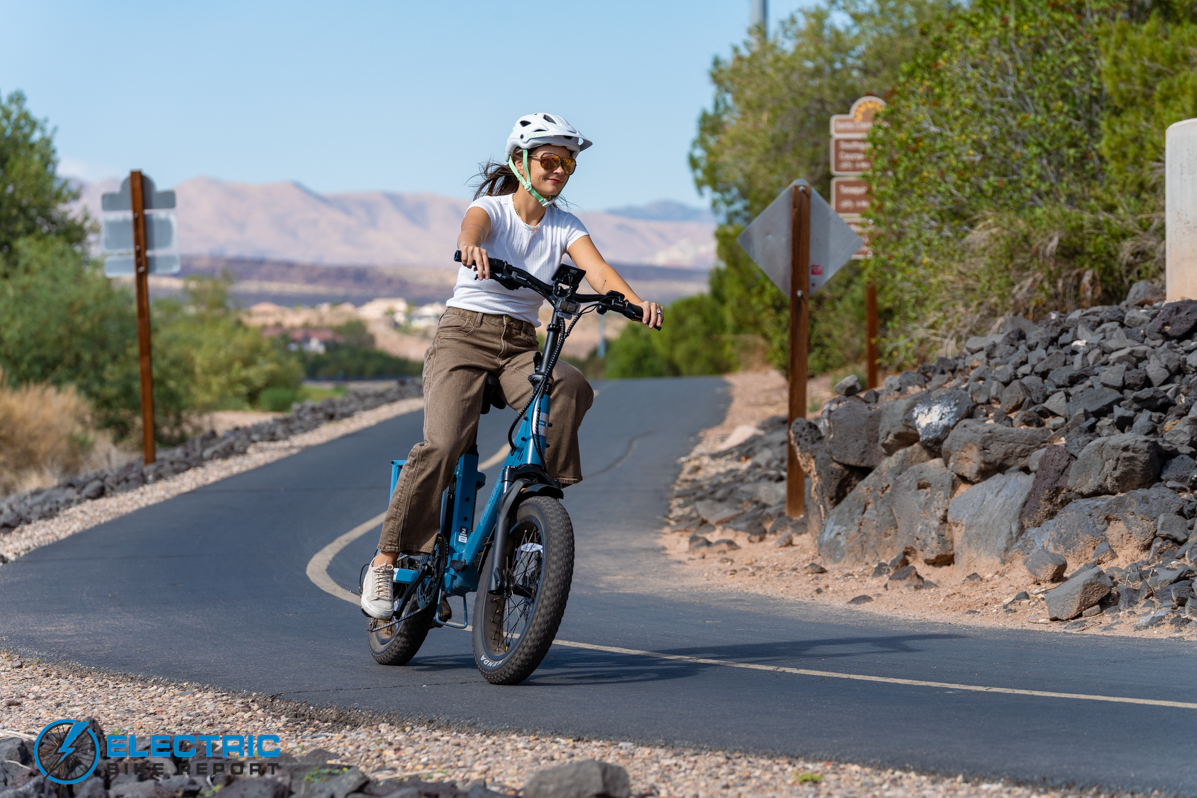
The Latch 2 was stiffer than we expected; it handles well.
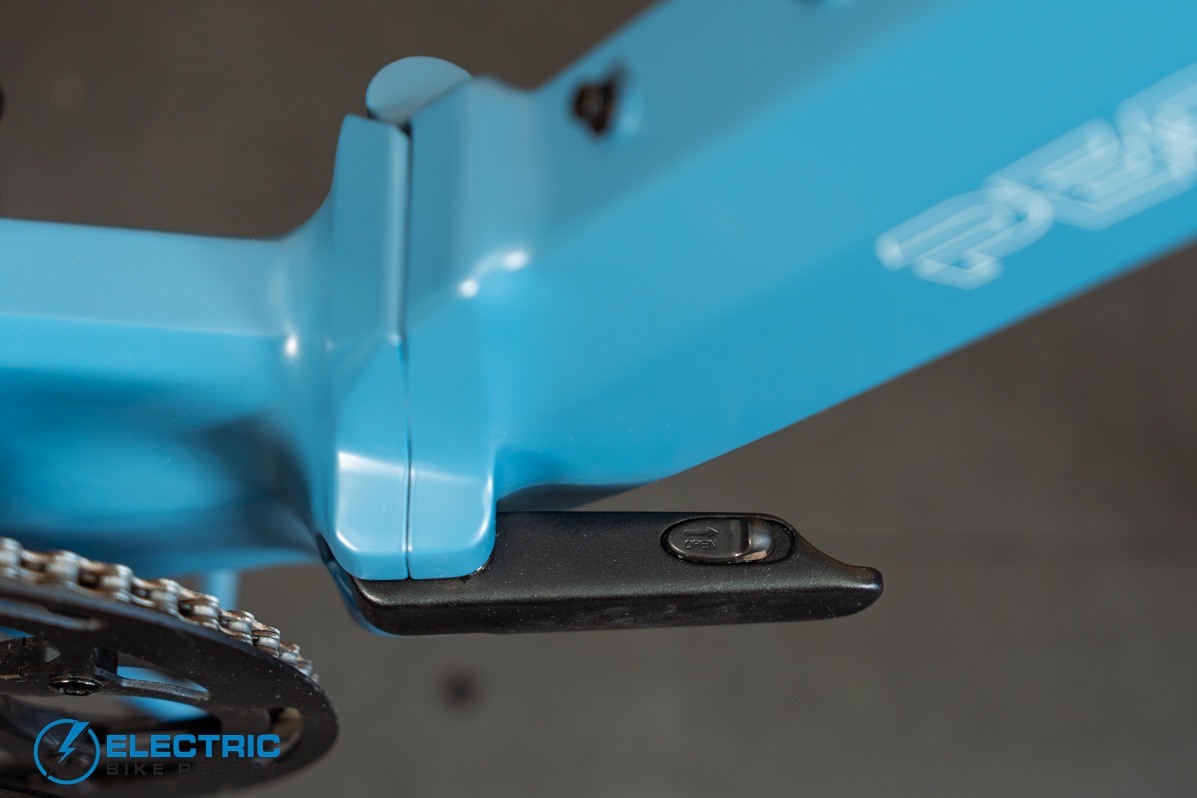
Pictured: The Latch (Pun intended).
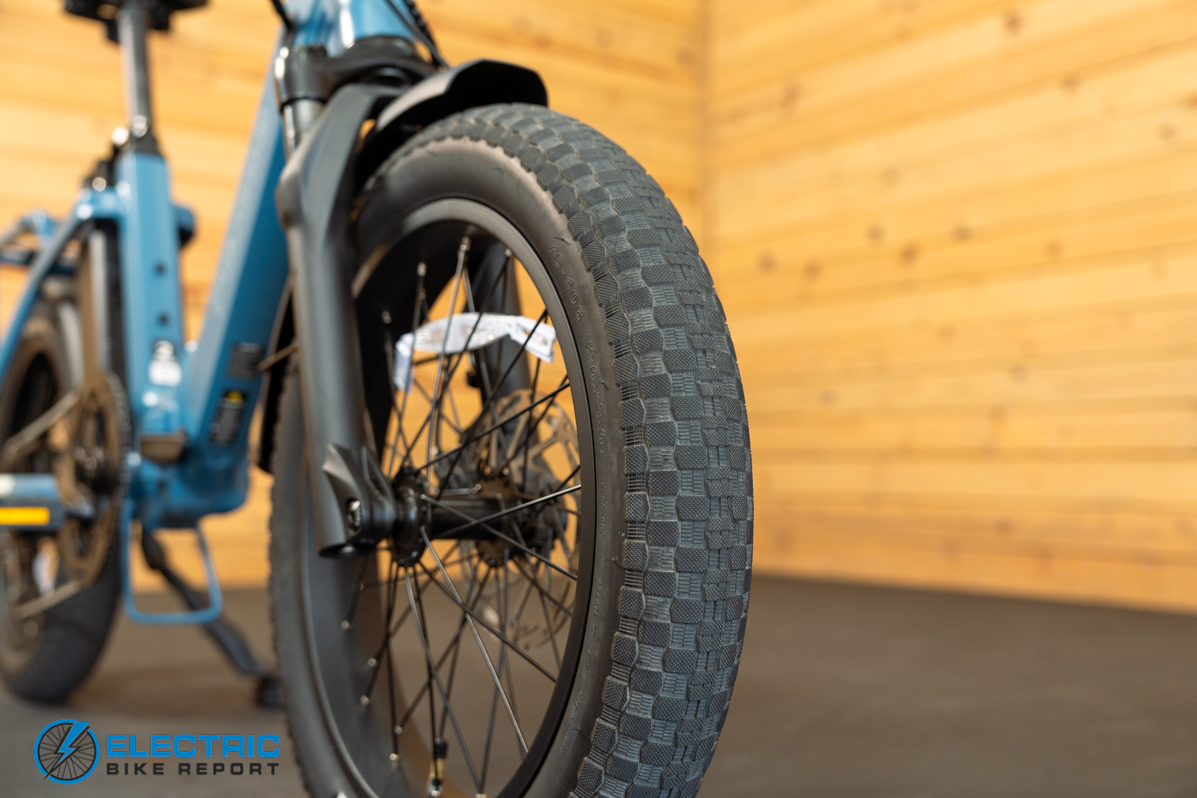
20 x 3.0 mid-fat tires – Personally, I prefer these to full sized 4.0 inch wide options.
Pedego Latch 2 Review: Speed Test
Our speed test is designed to get a feel for each eBike’s programming. We’re looking to see how each bike feels as you move through the assist levels, as well as see if it reaches its advertised speeds.
The Latch 2 has several modes and speed settings. We tested it using the torque and cadence sensors at class 2 and 3 speeds; this gives us a well rounded picture of the bike’s programming. Additionally, we tested the bike’s throttle.
As always, I began the speed test with no pedal assist. I averaged 7 mph here; as with most eBikes, pedaling without assist wouldn’t be my first choice, but the Latch 2 isn’t the worst bike to move without the PAS system.
A quick note – this bike’s speedometer only shows round numbers, so these following speeds are an approximation.
Regardless, at class 2 speeds while using the torque sensor, PAS 1 settled at 9 mph, PAS 2 at 15 mph, and PAS 3 maxed out at 20 mph.
The class 3 torque test saw PAS 1 average 8 mph, PAS 2 sat at 16 mph, and PAS 3 reached 28 mph.
I then switched to the cadence sensor. At class 2 speeds, PAS 1 settled at 7 mph, PAS 2 at 11 mph, PAS 3 at 14 mph, PAS 4 at 17 mph, and PAS 5 at 20 mph.
At class 3 speeds, PAS 1 averaged 12 mph, PAS 2 at 16 mph, PAS 3 at 20 mph, PAS 4 at 24 mph, and PAS 5 at 28 mph.
Let’s boil this down. There’s a few main takeaways of the Latch 2’s speed test results:
First, the blanket statement is that the programming is solid. The approaches to torque and cadence mode differ a little bit, but they’re both done well.
The torque sensing mode uses only 3 assist levels, which is fewer than many other options we see. However, this sensor feels responsive and intuitive, so while there are fewer assist levels, it’s easy to modulate your speed via pedal input. I also noticed that I didn’t have to put in much effort – the Latch 2 is generous in delivering its power.
Cadence mode, and also feels powerful, but any speed modulation is done using the assist levels. Contrary to torque mode, there are 5 levels here. Each one has a speed limit; you’ll cruise right up to the cap and hover at that speed until you increase the level. This is common on many cadence sensors – whether you like it or not is a matter of preference.
In either case, the increases in speed are linear and progressive.
We also tested the Latch 2’s throttle. It’s definitely peppy; the 750W motor has some muscle to it. The bike does require that you twist the throttle twice to engage it. This is a safety feature that can be altered in settings; personally, I’d have it turned off for easier traffic merging.
The only real point of critique (disclaimer: I’m nitpicking here) is that I didn’t find the twist throttle to be particularly ergonomic. A thumb lever would be my preference; but even as twist throttles go, this one felt slightly awkward.
Beyond that, the Latch 2 is an approachably programmed bike that posts good results in the speed test.
Sponsor
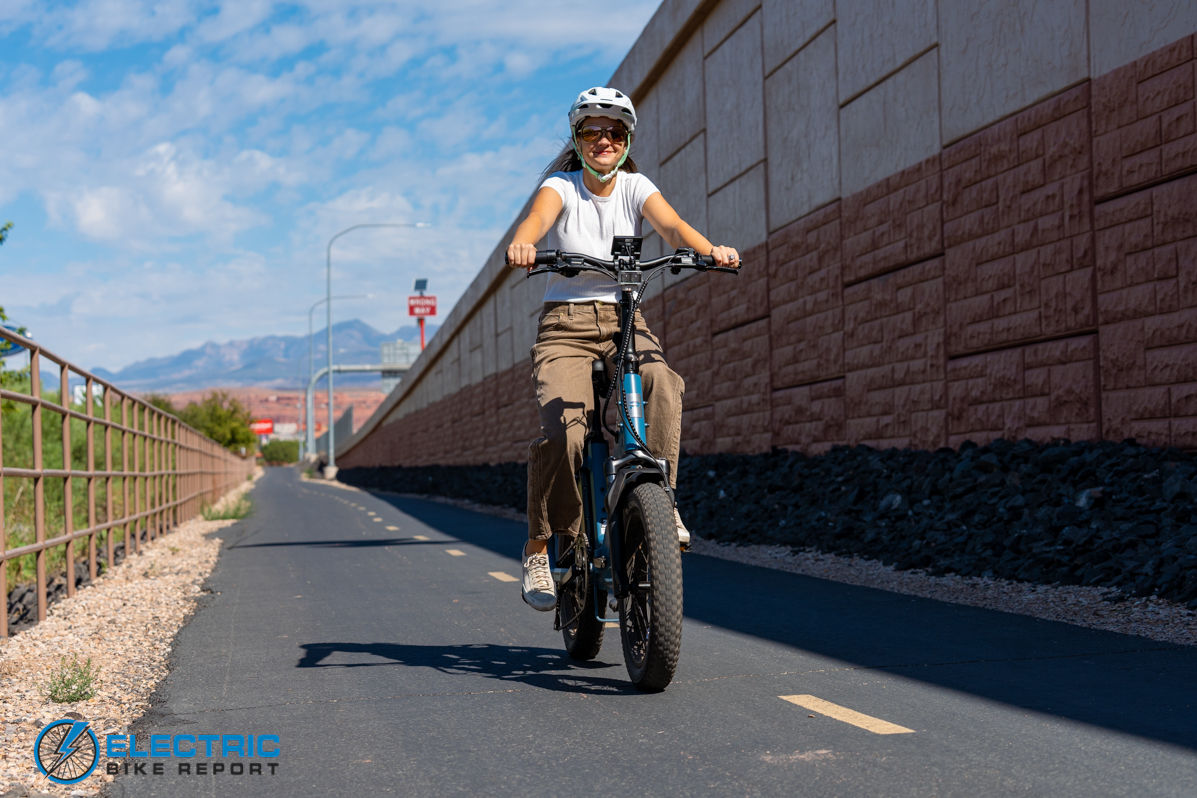
Notice the sizing. While it is a folding eBike, it rides like a full sized step-thru.
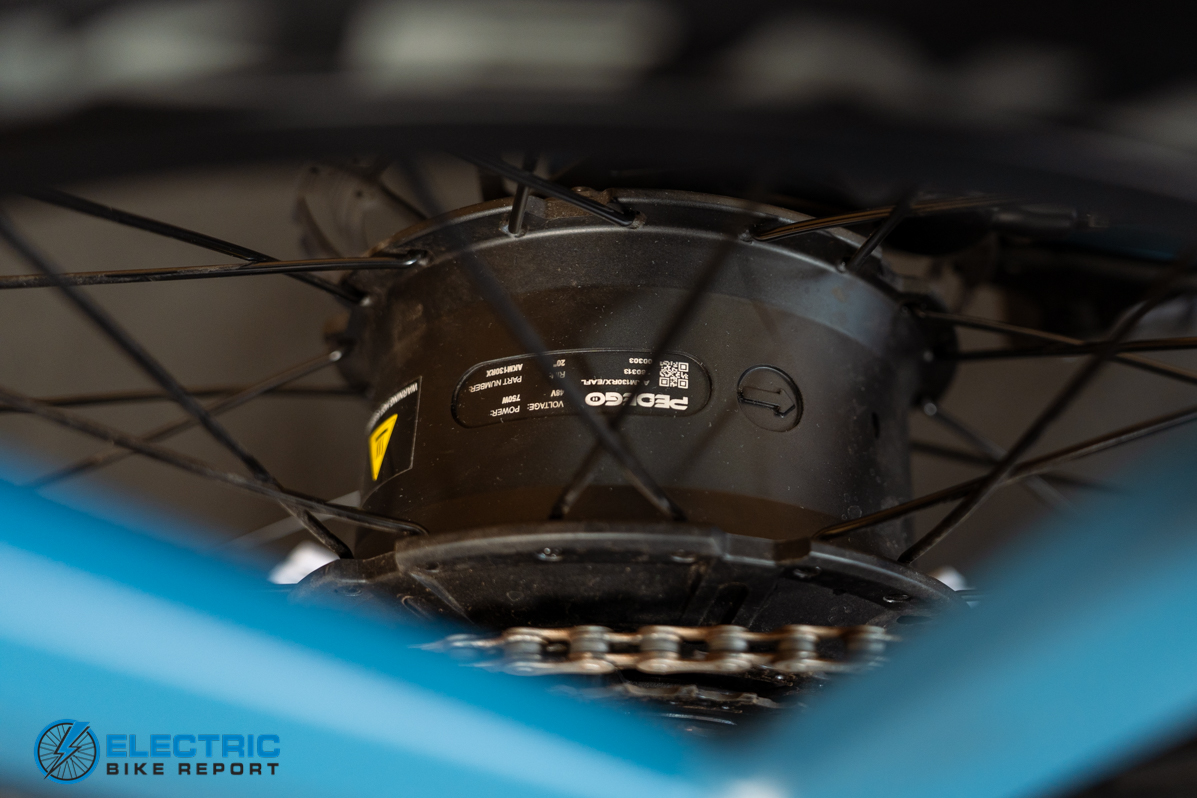
This 750W rear hub motor is no slouch.
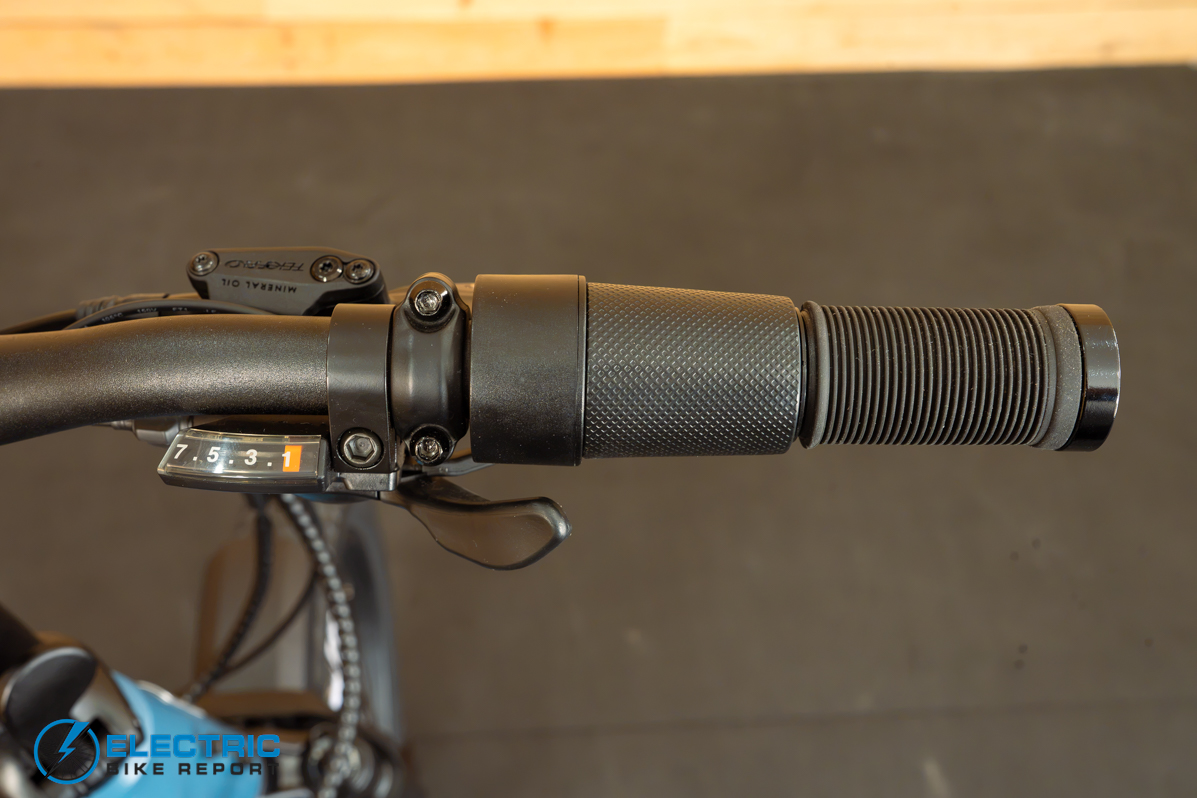
In the future, I’d love to see a thumb throttle, but that’s more of a personal preference.
Pedego Latch 2 Review: Range Test
When it comes to commuting and cruising, a central data point on eBikes is range capability. We tested the Latch 2’s ability to go the distance using both high and lower power assist levels.
When using low power settings, the Latch 2 reached 60.8 miles, while the class average of similar bikes we’ve tested came in at 63.14 miles – so, right in the neighborhood of the mean. On maximum power, the Latch 2 posted an impressive 39.5 miles, while the category came in at 30.33; almost 10 miles shorter.
This is a good showing, and it’s likely due to the large 835 Wh battery. That size is on par with the largest in this class, and the results show that it pays off. The high power test is particularly impressive. In fact, that’s at the top of the class.
Pedego clearly put some thought into the battery here. The cells are made by LG and are UL 2580 certified; in short, the powerpack is a quality product, and it performs like it. The bookends are roughly at 40-60 miles, which is plenty for the usual commute or leisure ride.
It’s worth noting that we tested the Latch 2 using its “standard” settings. There are options for both “Mellow” and “Pedego”, which are modes for less and more power respectively. Pedego claims an 84 mile range – I’d be willing to bet that “Mellow” mode is the way to go if you’re looking to stretch your range even further.
Sponsor
Sponsor
Pedego Latch 2 Review: Hill Test
Easier hill climbing is a central tenet of what I like to call “The eBike Promise”. A huge appeal of electrification is that it makes tackling hills much more manageable than on analog bikes.
Not only does the Latch 2 make steep ascents more accessible, it handles them with confidence and gusto. This bike logged a time of 1:51 at 16.4 mph on throttle, while the category average was 1:53 at 16.3 mph. Using maximum PAS power, the Latch 2 finished the climb in 1:45 at 17.3 mph. Once again, this was faster than its counterparts, which came in at 1:52 and 16.4 mph.
In a sentence: The Latch 2 is a good hill climber. These are above average results, relative to both other folding eBikes and the broader range of all eBikes we’ve tested.
This performance rests on the shoulders of the 750W motor. It’s good for 90 Nm of torque and can peak up to 1,200 watts; these are solid numbers, and they translate to a confident real-world hill climbing experience.
In my own testing, I found the Latch 2 to be very approachable. Yes, the power is there, but it doesn’t feel unwieldy or difficult. The grunt is delivered smoothly, and the sensor is very responsive. Additionally, like in the range test, we set the bike to “Standard” for our hill segment. If you’d like to climb hills even faster, “Pedego” mode is the way to go – however, the out-of-the-box settings offer plenty of pep.
Sponsor
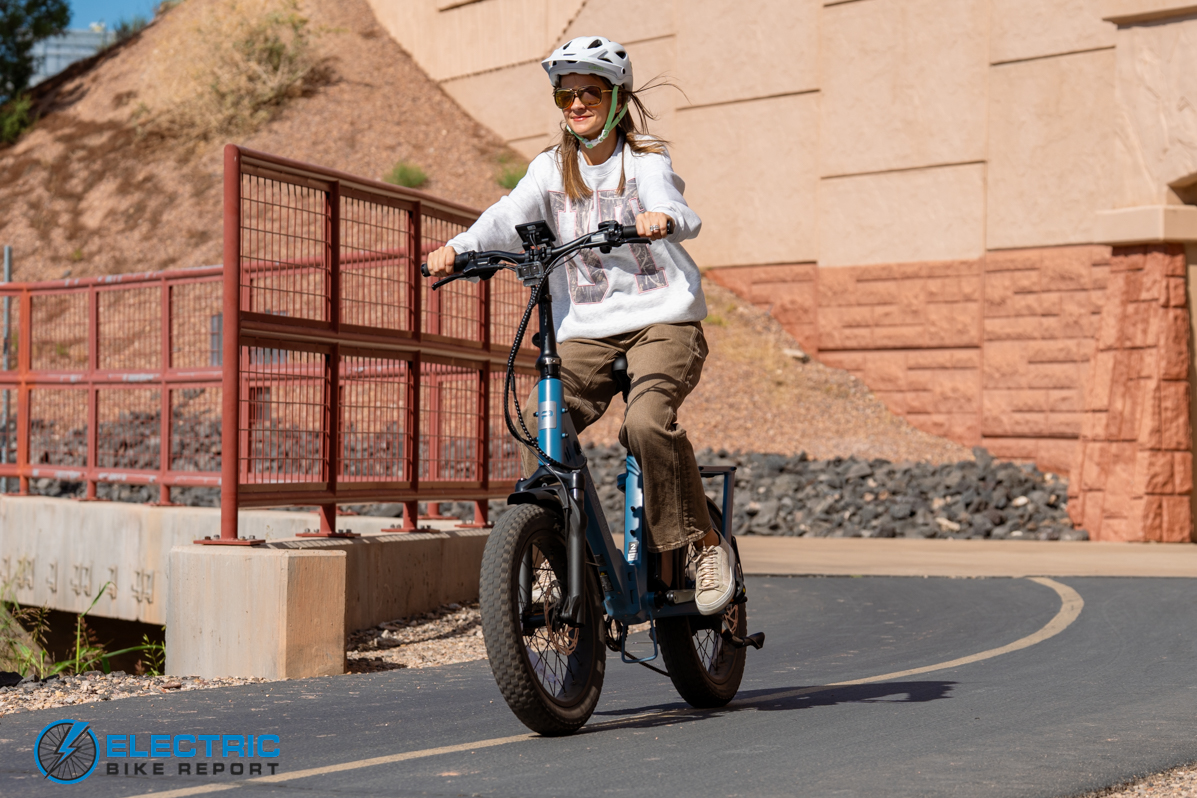
Three colors are available: Blue Fusion, Cloud Dancer (White), and Hematite (Gray).
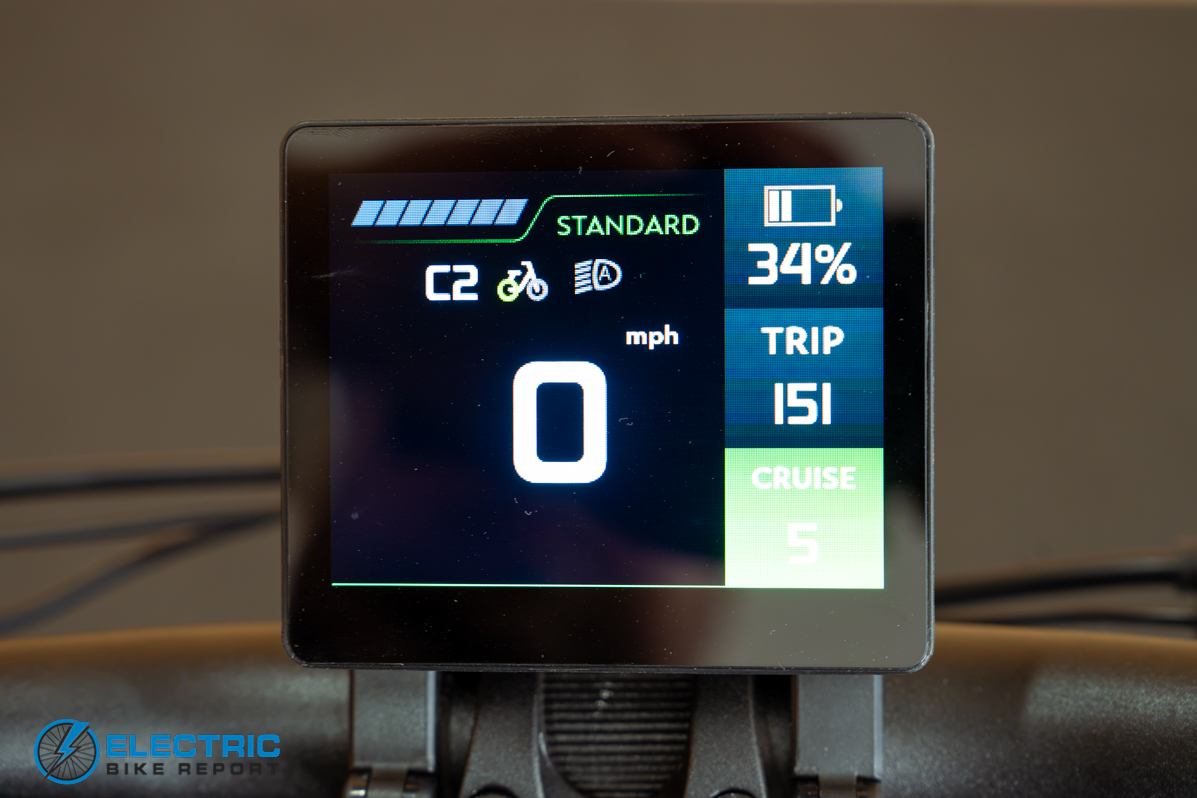
I liked this display – it’s straightforward, but gives you all of the need-to-know information.
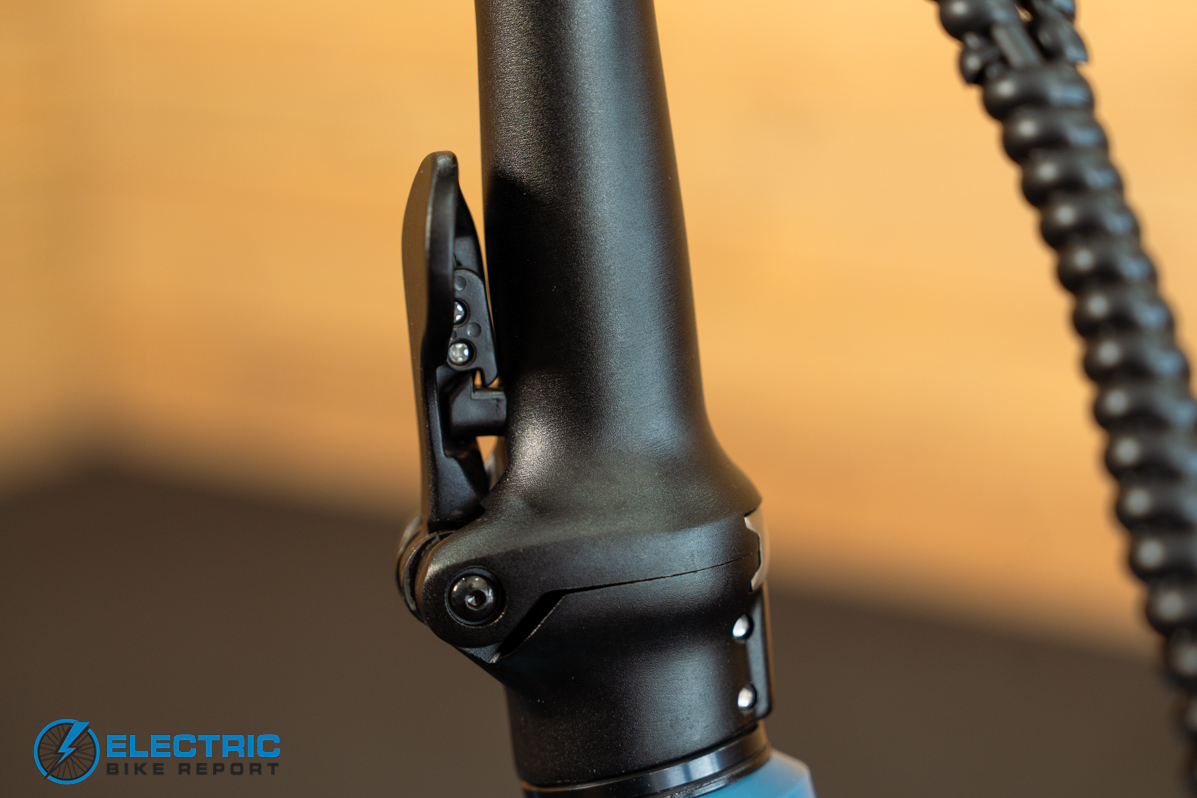
This stem hinge allows you to fold the handlebars out of the way.
Pedego Latch 2 Review: Brake Test
I mentioned that the Latch 2 has name brand parts across the board. That’s beneficial in several areas, including braking performance. Tektro’s HD-E3520 hydraulic disc brakes are paired with 180mm rotors front and rear to handle this bike’s stopping setup.
The Latch 2 did well; Over three runs, it averaged an 18’2″ stopping distance, while the class average was 18’10”.
Generally speaking, most of the bikes in this category stop well. The Latch 2, along with many of its peers, is a good performer in terms of stopping power. This bike’s braking setup is well within safe bounds.
However, numbers only tell part of the story. Feel is very important too; These brakes provide solid modulation and feedback. Generally speaking, I felt that I could feather the levers with accuracy.
Much of this performance comes down to the sizable rotors. At 180mm, these discs are large relative to the 20 inch wheels; they provide significant leverage, and therefore better braking performance. They’re also better at dissipating heat, which means more consistency. Additionally, the Latch 2’s tires fit into the “mid-fat” category. At 3.0 inches wide, they’re not excessively fat, but they do have a larger contact patch than many eBikes do, which also bodes well for stopping power.
The Latch 2 is a safe and strong stopper – I’d be confident with these brakes on my bike.
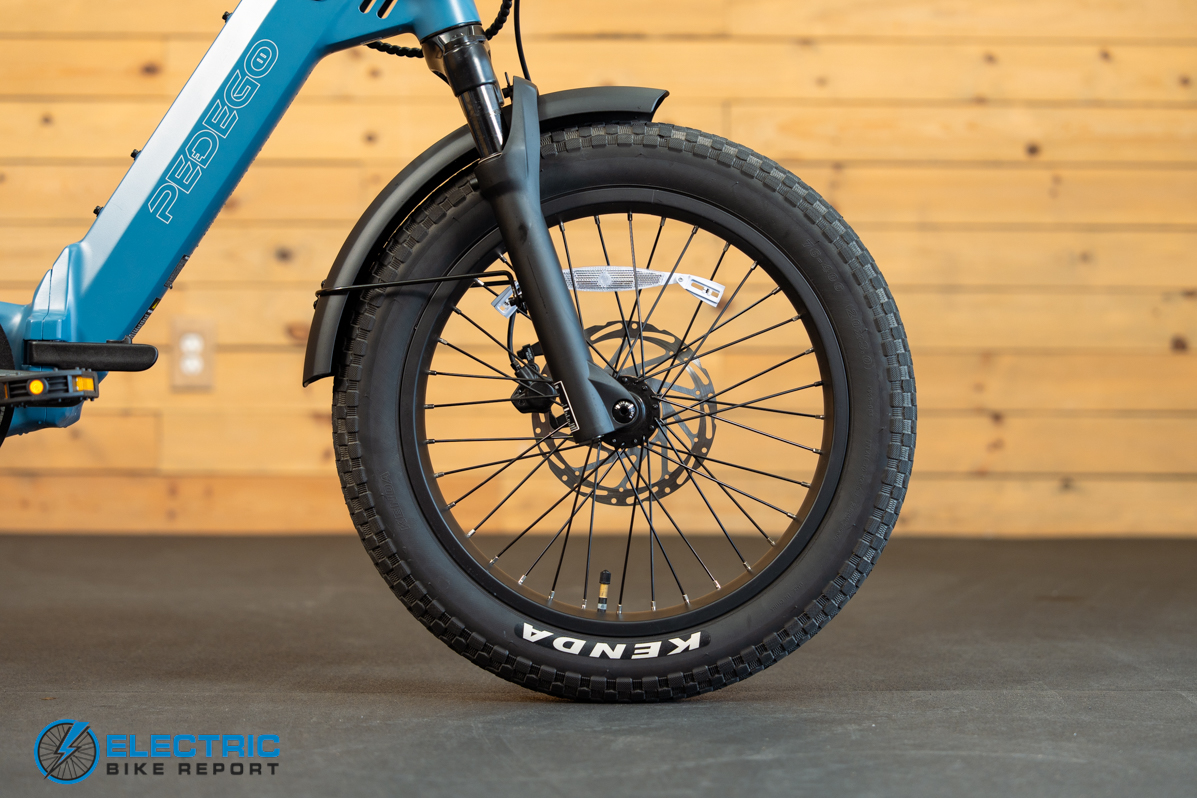
Relative to the 20″ wheels, these 180 mm discs are quite large.
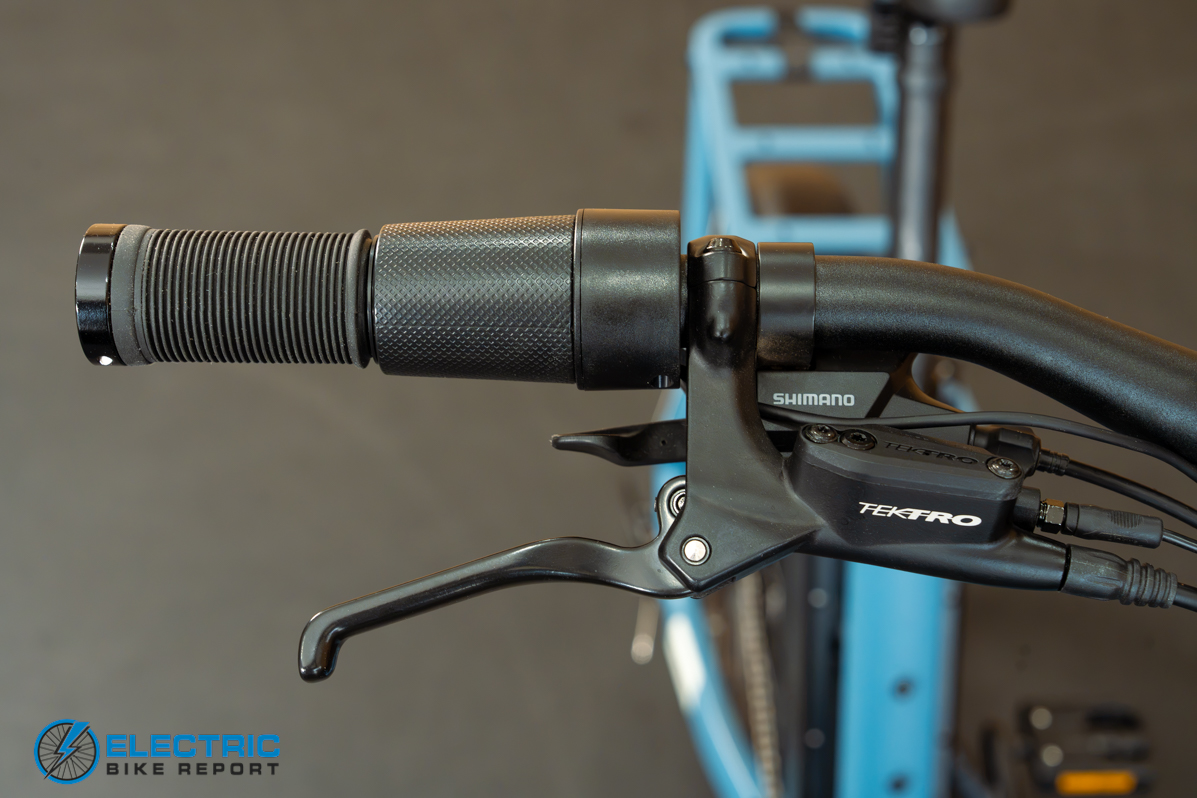
We’re familiar with Tektro brakes; they’re reliable and sound.
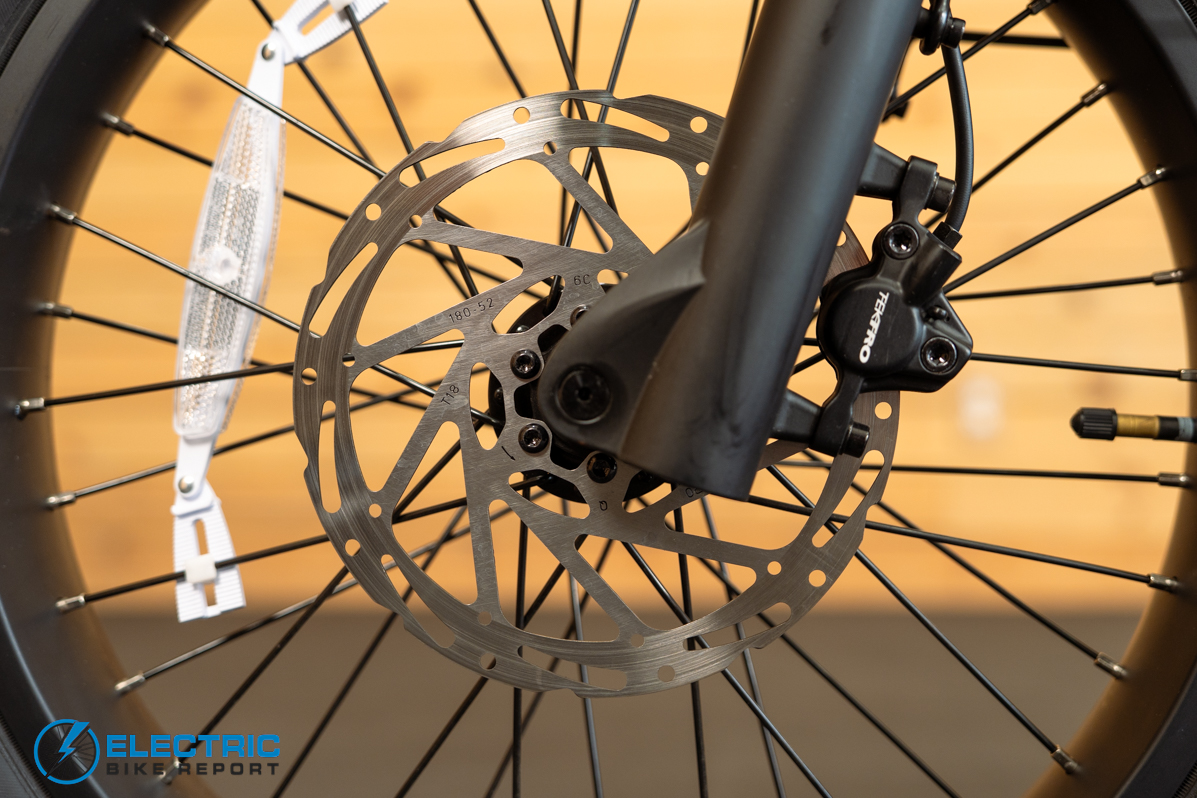
The front 180 mm rotor.
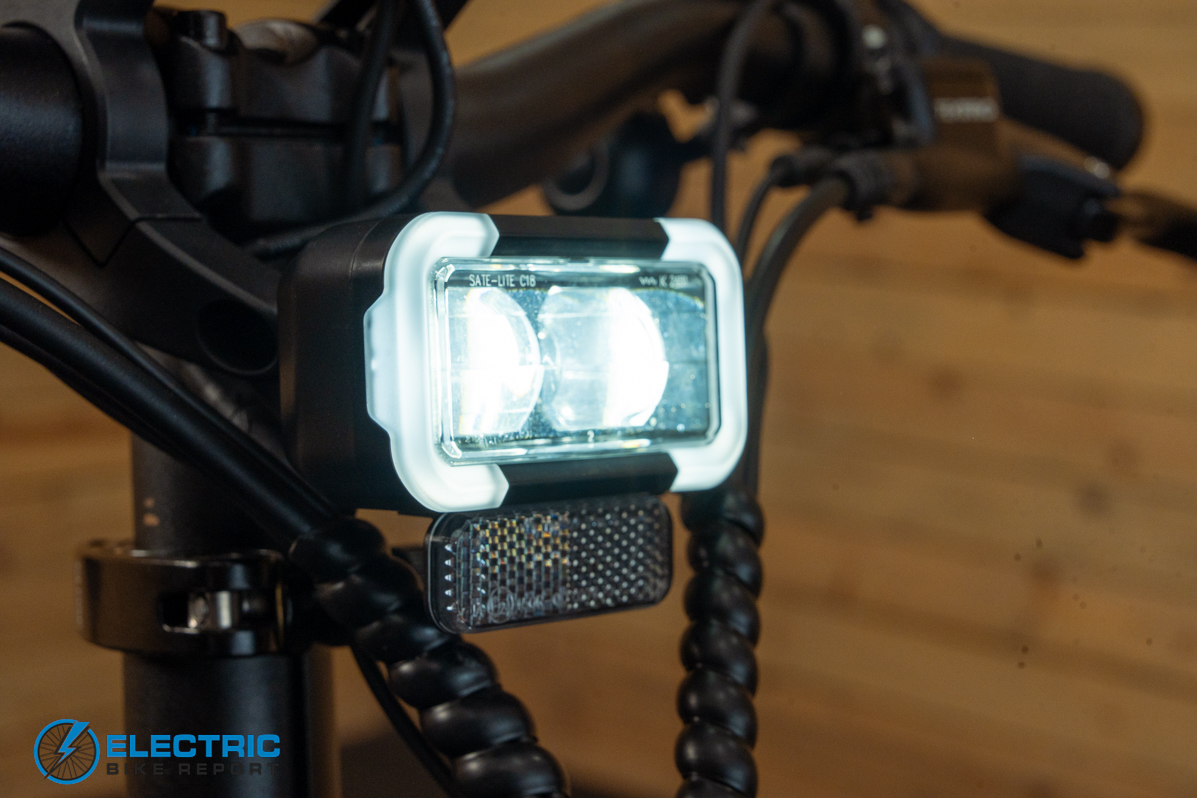
Keep the ride going after dark with the integrated headlight.
Pedego Latch 2 Review: Ride Quality
The Latch 2 has posted good results in our testing thus far, and I might argue that we haven’t even discussed some of its core strengths yet; those can be found in the bike’s ride quality.
Starting off with sizing, I was pleasantly surprised with the Latch 2’s ability to accommodate riders of different stature. Pedego says that the bike is suitable for riders from 5’4″ to 6’1″. I’m about 6’3″, and I was actually more comfortable than I expected. The stated size range feels accurate, and I might even add a few extra inches to it. Taller riders can make it work (albeit with slightly less ideal leg extension), and those on the shorter end will appreciate the adjustable stem and shorter-than-average reach.
Despite the portability, the Latch 2 doesn’t ride like a folding eBike. That’s not to say folders are bad; but they can often feel flexy when compared to other types of eBikes. This one feels sturdy and rigid – which pays dividends in terms of handling and responsiveness.
This sturdiness is also present in the folding latch and rear rack. There’s no play in the hinges when you’re riding, and the rear rack is welded to the frame, resulting in an impressive 100lbs of capacity.
There are several styles of folders on the market, but these mid-fat tire options often seek to add a layer of comfort and smoothness. Broadly speaking, the Latch 2 hits the mark here – the suspension fork and wider tires soak up rough pavement well. If you’re looking to insulate yourself even further from bumpy surfaces, a suspension seatpost could be a worthy upgrade, but not a necessary one.
The Latch 2’s pedal experience would be best described as rewarding and responsive. The torque sensor is the more sophisticated of the two, but both options feature significant power for your pedal. Cadence mode is slightly slower to engage, but still reactive. There’s no excessive delay or overrun from the powerplant. I do notice that the motor is slightly louder than the average – This doesn’t affect performance, but it’s something to be aware of.
One of the key benefits on the Latch 2 is Pedego’s 5 year warranty. The brand has a nationwide network of dealers and self-owned stores that will be familiar with the Latch 2 and other Pedego models. The warranty does require annual maintenance by either Pedego or an approved partner – so stay up to date on that to ensure coverage.
Lastly, on the value of the Latch 2: At $1,695, the bike does cost slightly more than some of the folders on the market. The extra cost does come with its benefits though. Pedego’s network of brick and mortar stores is great for those who value in-person assistance, but it’s likely a factor in the cost. Additionally, the Latch 2 is spec’d with name brand parts in several places, which also affects expense. Overall, the asking price feels fair.
Sponsor
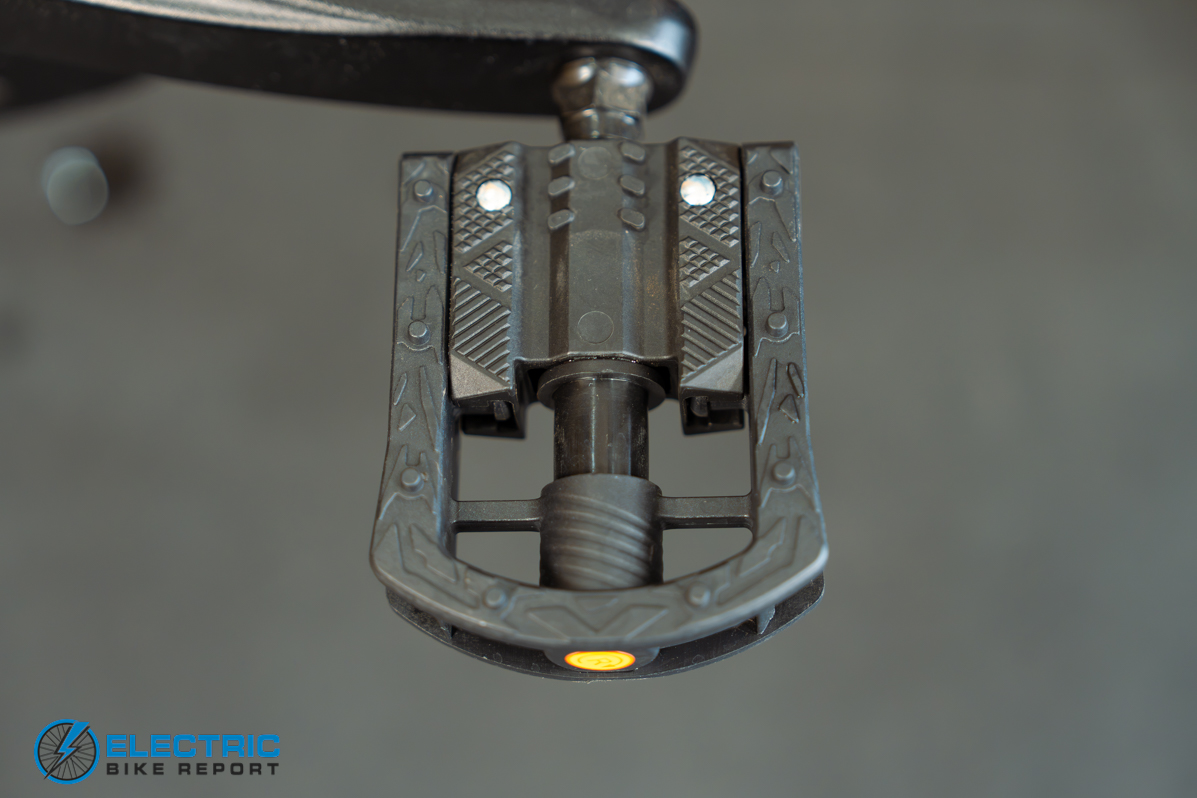
Even the pedals fold up!
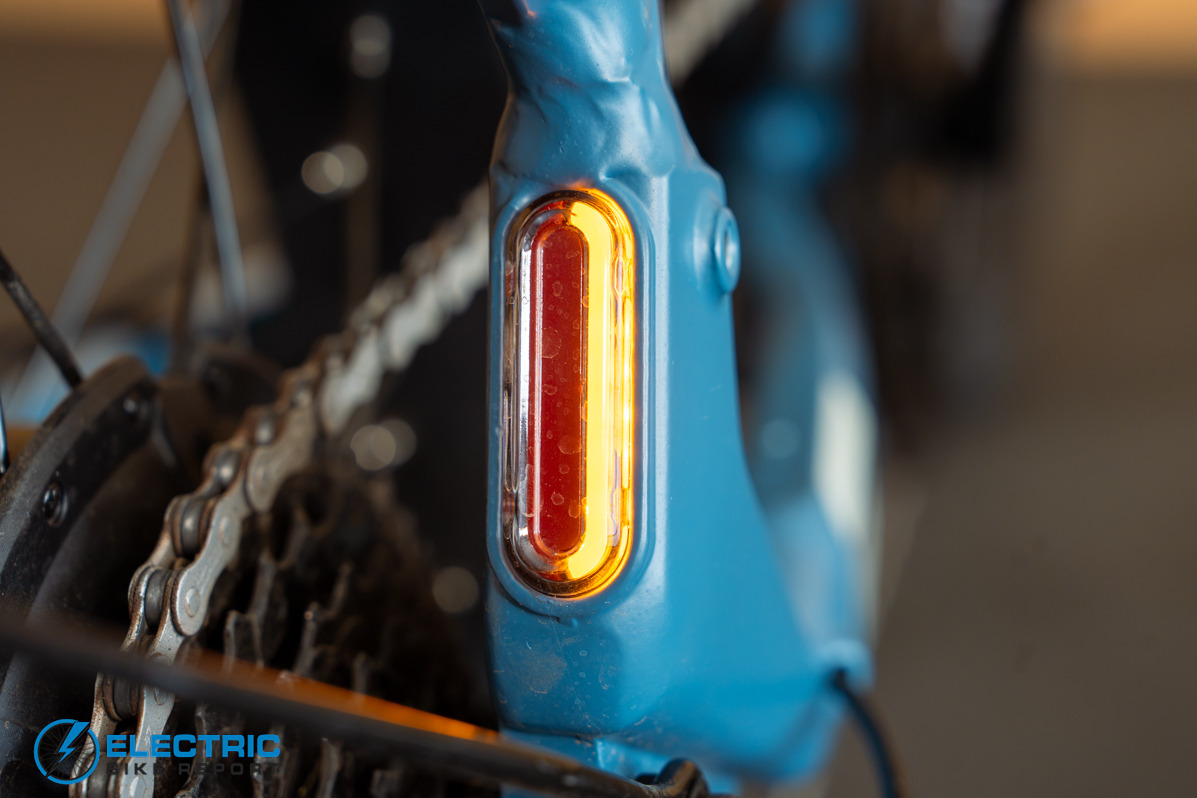
The taillights are nicely frame integrated – there’s one on both seatstays.
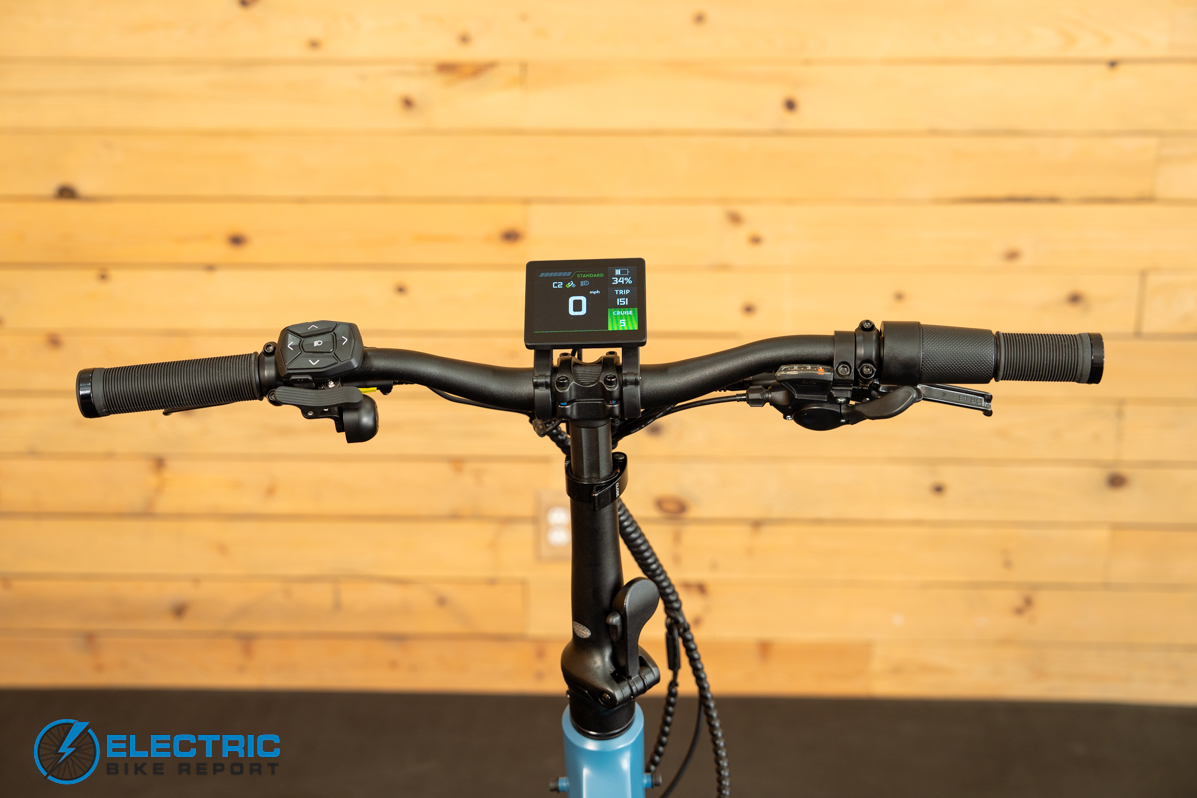
The 3.5 inch display is central and easy to see.
Pedego was recently acquired by Urtopia, and based on this review, they’re doing good things with the brand.
Pedego Latch 2 Review: Summary / Where to Buy
There’s an old Van Halen song called “Best of Both Worlds”, and while I doubt the band was writing about the Latch 2, it’s a perfect anthem for it. This bike does a lot well – It covers the folding eBike bases, but rides with the confidence and sturdiness of full sized options.
Even beyond the fact that it strikes an impressive balance, it’s a strong tester across the board. The Latch 2 has intuitive programming, solid range, great brakes, and rewarding power. In terms of performance, it’s exactly where it needs to be.
In addition to the raw numbers, it’s also well suited for lots of uses. Class 3 speeds, a rear rack, turn signals, and integrated lighting make this a worthy commuter. It’s also a great fit for the campground due to the 3.0 inch tires and suspension fork.
So yes, this is a genuinely good all-rounder. Better still, Pedego’s 5 year warranty is a nice plus, and the brand’s shop network makes service easy.
My complaints were mostly trivial. I’d like to see a more ergonomic throttle, as the current one can feel awkward. The motor can also run loud – this isn’t something that bothers me, but it’s louder than the librarian crowd might prefer.
Overall, this is a solid option for riders who don’t want to sacrifice performance for practicality. The Latch 2 is the best of both worlds.
Happy Riding! Make sure to let us know if you have any questions or if you think we left anything out in this review of the Pedego Latch 2 down in our comments section.
Sponsor
Sponsor
Reader Interactions
Leave a Reply