Pedal AWD S Review: Dual 1000W E-Moto Tested
Aug 25, 2026
 0 Comments
 Share
Share
Yes, really. This bike has tons of power, range, and style – with a big caveat.
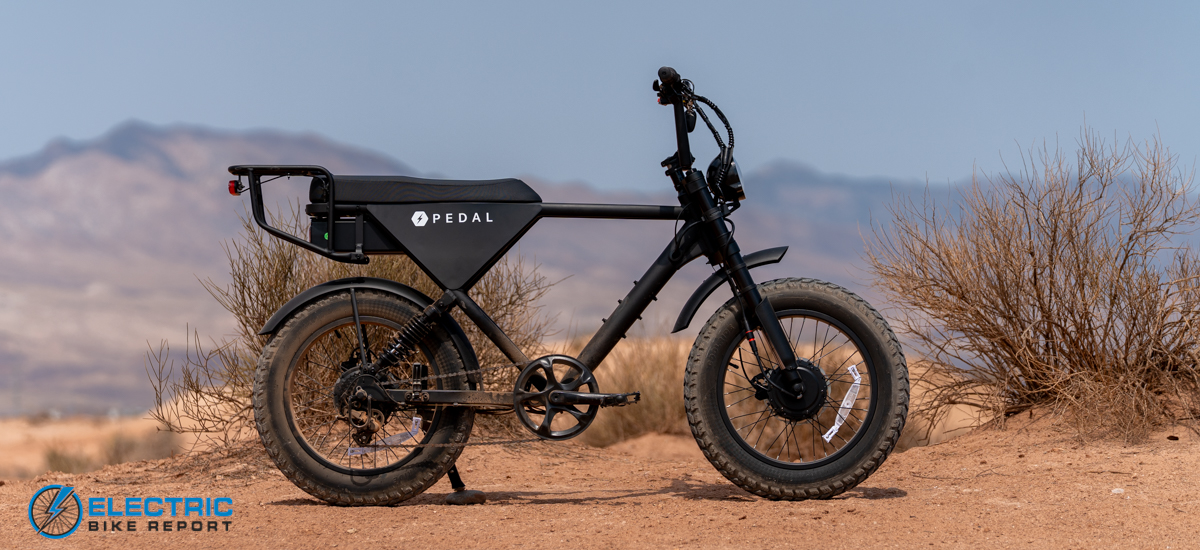
The Pedal AWD S is not a subtle bike. It has striking moto-inspired styling, dual 1000W motors, and one of the largest batteries we’ve seen. There’s no doubt, it’s an attention-getter.
Pedal actually made headlines when NBA star Luca Doncic purchased over 100 units from the brand – he then gifted them to Lakers players and staff. Apparently, the bikes were a hit.
So, if you’re an L.A. Laker, you already know what it’s like to ride this dual-motor powerhouse. Don’t worry – if you didn’t make the team, we have you covered.
This is an option that prioritizes power above all else. It has excellent range, good brakes, and an exuberant personality that’s sure to thrill. However, there are some caveats – read on to see how the bike performed in our comprehensive testing!

Sponsor
E-Bike Category:E-Moto
E-Bike Class:E-Moto
Sponsor
Pedal AWD S Video Review
 Pros
Pros- The bike does pack a serious punch – there’s a ton of power here!
- The plush suspension makes for a smooth, comfortable ride.
- Outstanding range from one of the largest batteries we’ve seen.
- Above-average results in our brake test.
- Can accommodate a passenger using the extended length seat.
- Well-equipped. The AWD S has turn signals, a rear rack, and an integrated headlight/taillight.
 Cons
Cons- In many places, the AWD S falls outside the legal definition of “EBike” – this is technically an E-moto.
- The throttle programming could use an update – see speed test for details.
- The front wheel has trouble keeping traction when the motor is engaged.
ELECTRICAL SPECS & FEATURES
- Battery: 48V 1200Wh
- Charger:
- Display: Digital
- Motor: 1000W Hub Motors front and rear
- Headlight: Included
- Taillights: Included with turn signals
- Pedal Assist: 5 levels
- Claimed Range: 45-80 miles
- Throttle: Twist
- App: None
- UL Certification: UL 2271, UL 2849
Weight & Dimensions
- Claimed weight: 85 lbs
- Tested Weight: 106.5 lbs
- Rider height range: 5’5″ – 6’4″
- Total payload capacity: 350 lbs
Components & Accessories
- Brakes: Tektro 2 piston Hydraulic
- Fenders: Front and rear alloy
- Fork: Adjustable Air Fork, 125 mm
- Frame: Moped-Style
- Drivetrain: Microshift Advent 9 speed
- Grips: Rubber
- Saddle: Moped style
- Handlebar: BMX style
- Kickstand: Yes
- Pedals: Platform
- Tires: 20 x 4.0 Knobby Tread
There’s no denying it: The AWD S definitely looks the part.
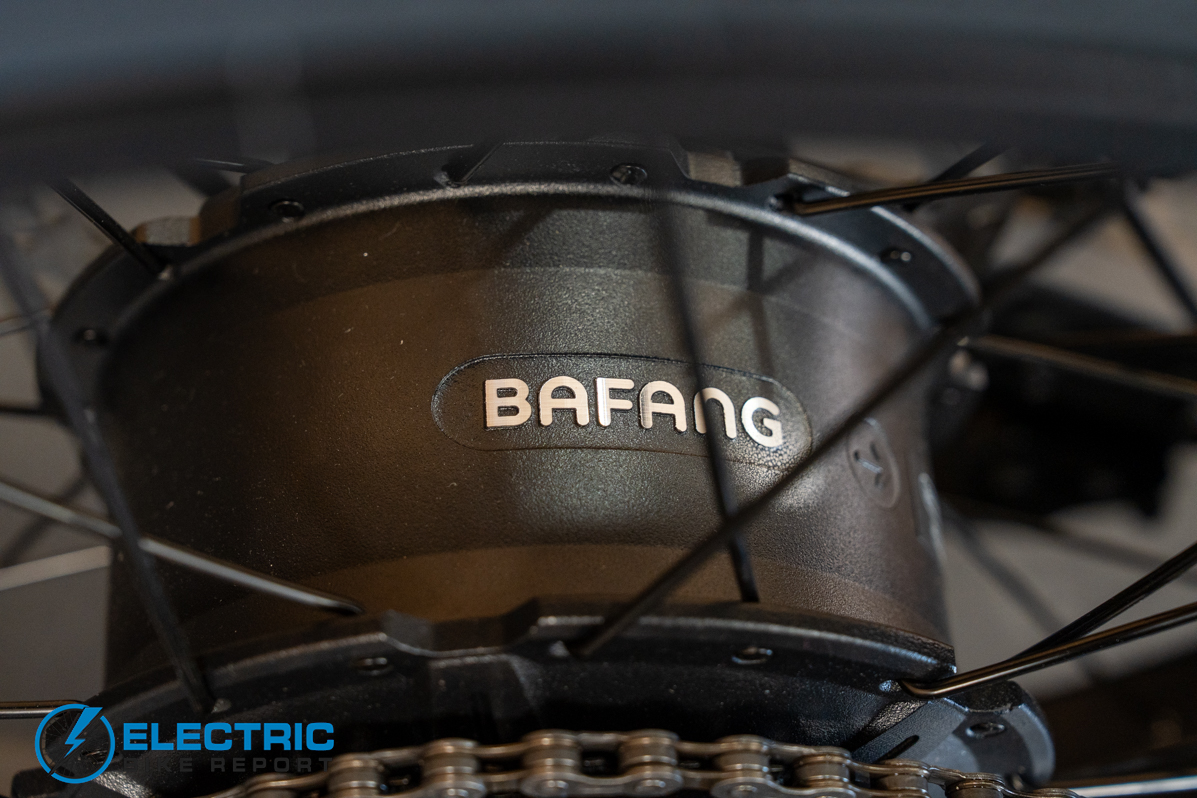
One of the two 1000W hub motors.
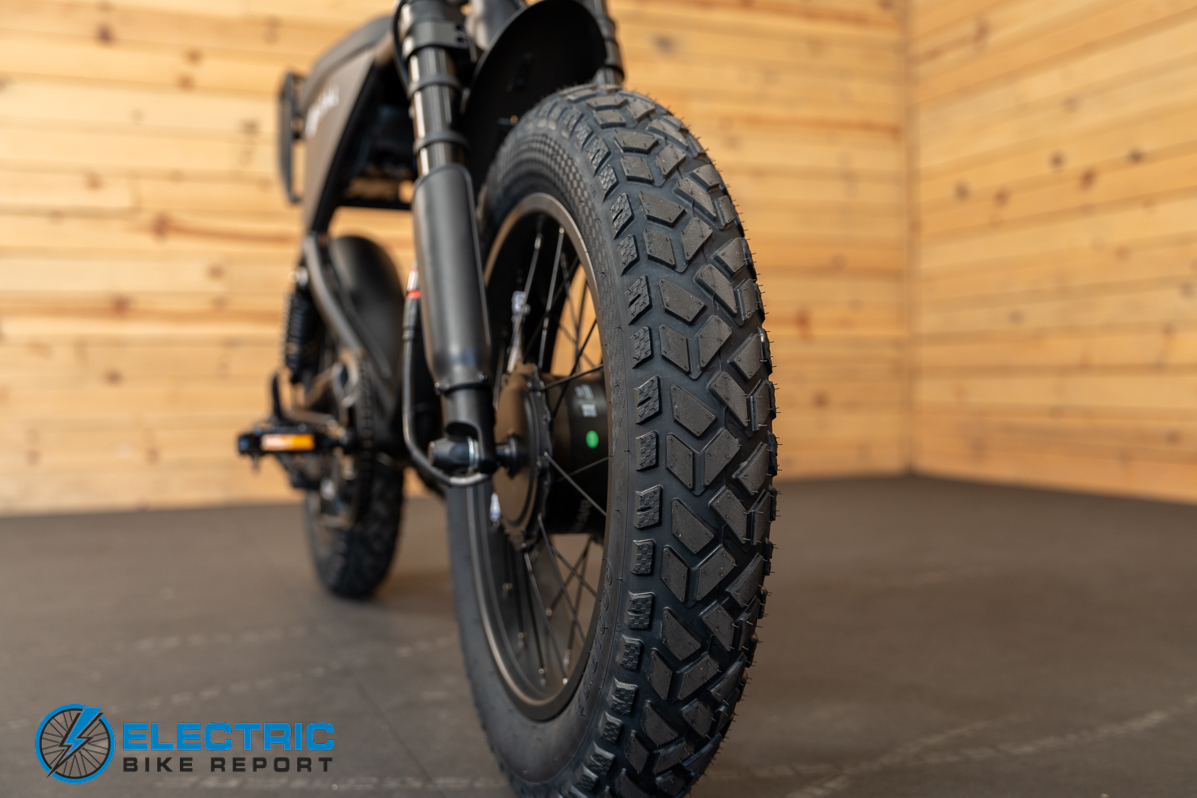
Aggressive, knobby tires.
Pedal AWD S Review: Speed Test
Before we get into the speed test, I want to touch on the legal implications of this bike’s speed and power. We’ll get into more details later, but this bike can be set to exceed the legal Ebike speeds as defined by People For Bike’s 3 class system. Additionally, the 1000W motor power also goes above the limit of 750W – in short, this is technically classified as an E-motorcycle in many places. So, if you choose to buy the AWD S, make sure you read up on your local laws and regs – they may require registration and a license plate to ride this on the road.
On moped style bikes, the throttle is typically the main tool that riders use. However, you can still pedal this bike – we tested both the PAS system and the throttle to get a feel for the bike’s programming. The AWD S has 5 assist levels and capability to reach class 2 and 3 speeds. Although it has two motors, we completed much of our testing using the rear hub motor only, including the speed test.
I started out pedaling under my own power, which is usually difficult on moped-style Ebikes; on this, it’s extra taxing. The bike weighs in at 106.5 lbs, which I could definitely feel when the motor(s) weren’t engaged. Regardless, I averaged 7.0 mph using just my legs.
From there, I activated the PAS system. For this first portion, I was set to class 2 speeds. In PAS 1, I averaged 10.2 mph. PAS 2 settled at 12.8 mph, PAS 3 at 15 mph, PAS 4 at 17.3 mph, and PAS 5 maxed out at 19.8 mph.
Then, I unlocked the bike’s class speed 3 capability. With the speed limit raised to 28 mph, PAS 1 averaged 14.2 mph, PAS 2 did 17.4 mph, PAS 3 did 20.8 mph, PAS 4 did 23.8 mph, and PAS 5 sat at 27.0 mph even.
These numbers illustrate a generally well-programmed bike. In both runs, the assist levels are spaced out evenly and show incremental increases in speed. I found each level-up to feel very predictable. This portion of the test shows good power management.
The throttle test left us with some different conclusions. This bike ships as a class 2 package, with capacity for class 3 and even further unlimited speeds. We tested the throttle at class 2 speeds; here, the bike is supposed to be limited to 20 mph.
We found that while using the throttle, the AWD S will initially accelerate past the 20 mph speed limit, usually to about 24 mph. If you continue to keep the power on, the bike will eventually settle down to about 20 mph. So, it does reach a cruising speed that fits class 2 standards, but exceeds the limit at first pull. We’d like to see some programming adjustments here – even outside of legality implications, the throttle should stop at the preset speed limit.
I’d also like to note that while you can raise the speed limit on the AWD S, it doesn’t have defined class modes. So, increasing the speed limit to 28 mph also affects the throttle. In this configuration, the bike is no longer adhering to the 3 class guidelines, and therefore is pushed into the E-motorcycle category.
Despite the quirks, the acceleration is punchy and responsive. This is a powerful bike.
I also tested the throttle with both motors engaged. In terms of speed programming, the bike behaved similarly here – it exceeds the 20 mph cap, then slowly backs down. However, the power delivery felt very different. The acceleration is even quicker, but with a caveat. The front wheel is overpowered by its corresponding motor, and the tire can’t actually grip the pavement – it spins and fights for traction until the bike gets up to speed. As you can imagine, it’s difficult to steer when your front wheel is mid-burnout. I’ll leave any conclusions on this piece up to you – but just remember to always ride safely and within legal limits.
Sponsor
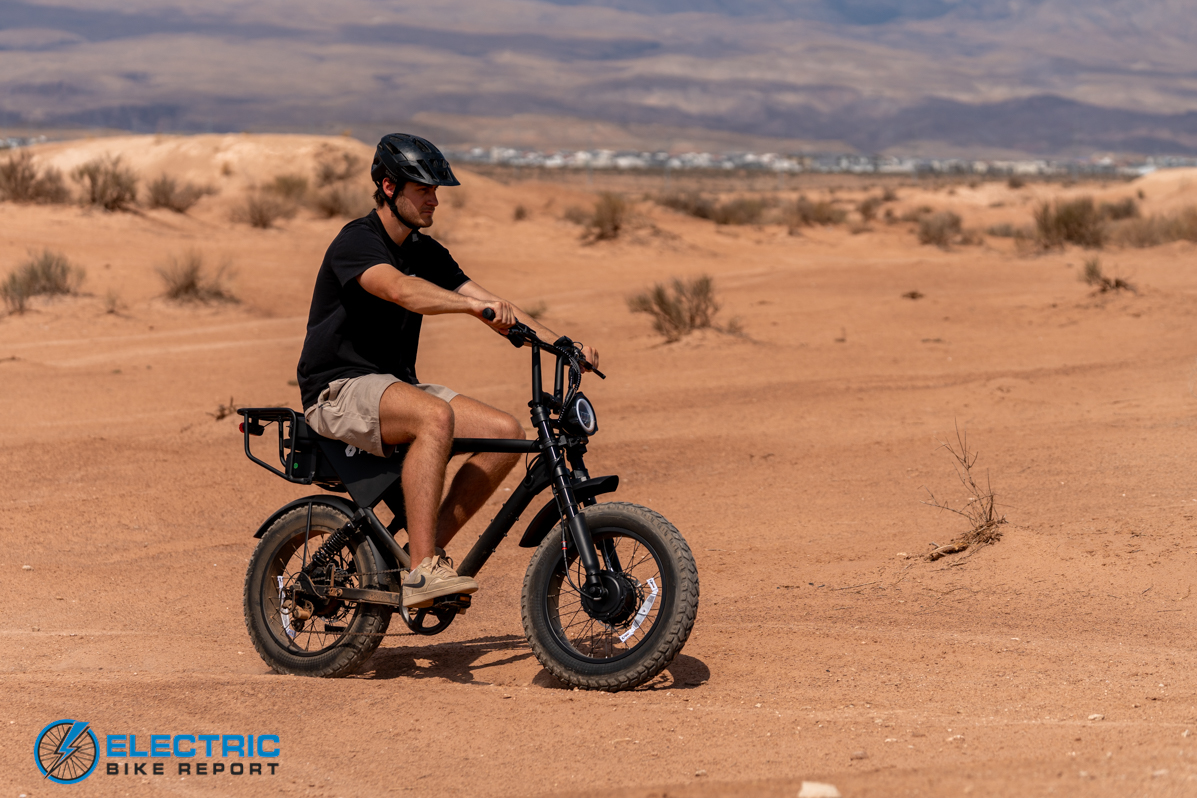
The AWD is best suited for places with no speed limit – like this.
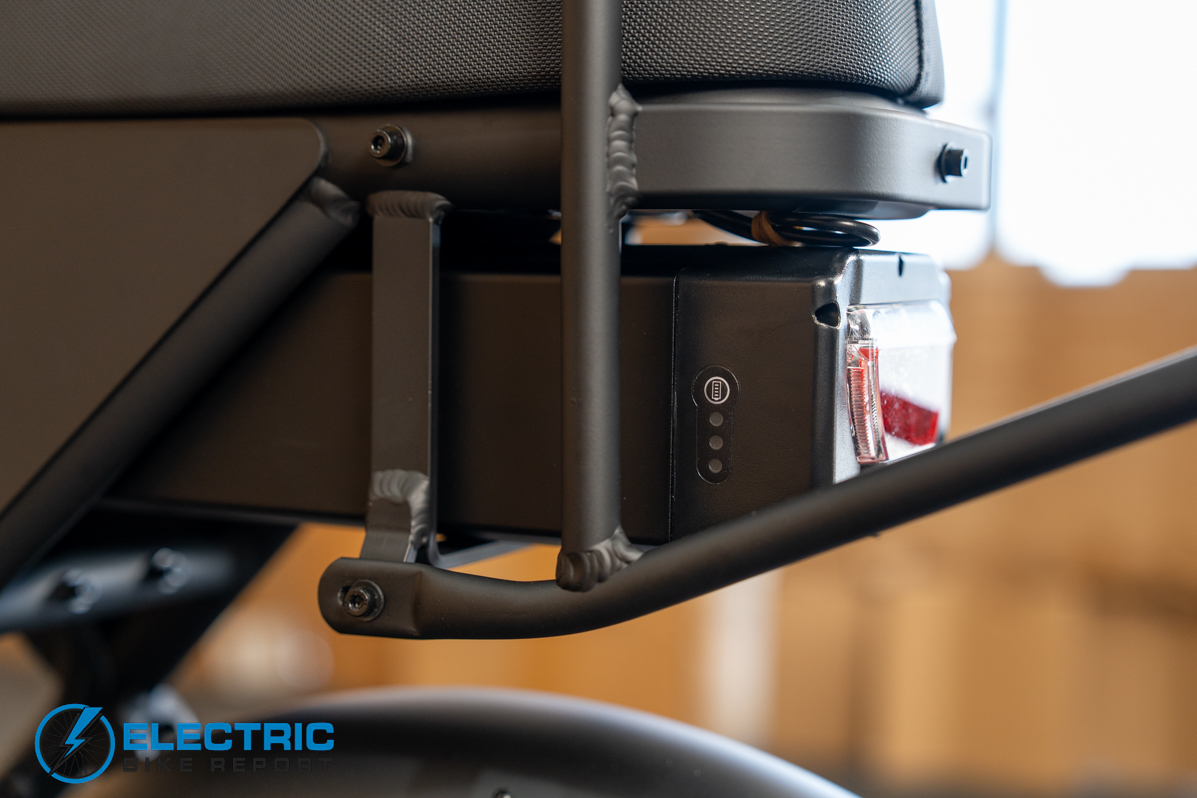
The battery is stored snugly under the saddle.
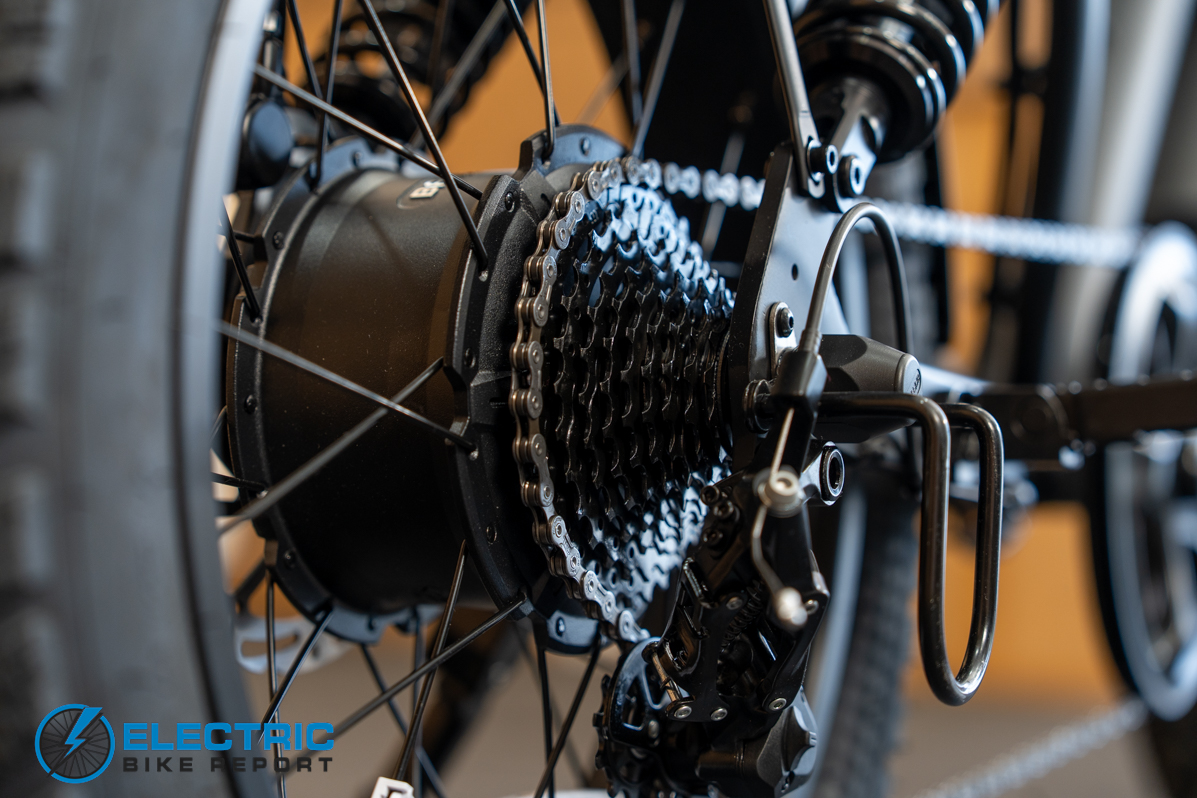
Microshift’s 9 speed drivetrain makes for snappy and responsive shifting.
Pedal AWD S Review: Range Test
On most bikes, we measure range using the pedal assist system. Moto-inspired options are more likely to be ridden using the throttle; Because of this, we did a single range test using the throttle only, as that fits the use case much more closely than a pedal test. I’d also like to note that we only had the rear motor engaged for this segment – just note that having both motors engaged would change these results dramatically.
The AWD S was a standout here. It reached 45.89 miles on throttle; considerably above the class average of 29.99 miles.
This performance is likely due to the high capacity power pack. At 1200 Wh, this is actually one of the largest batteries we’ve seen on a moped style E-bike, and the extra size pays off. This result really opens up the use case for this bike. At 45 miles, the AWD S is good for more than leisure rides and short laps around the neighborhood. Commuting is a reasonable expectation here, and riders can expect to charge less frequently than other moto-inspired options.
Sponsor
Sponsor
Pedal AWD S Review: Hill Test
There’s no denying that this bike is powerful – Both motors come in at 1000 watts. Based on the spec sheet alone, this bike should post a good time in our hill test.
We broke up our hill test into a few different segments. First, we tested both the PAS system and the throttle using only the rear hub motor. We then did an additional throttle run with both motors engaged.
We’ll start with the single motor results. Using the pedal assist, the AWD S completed the climb in 2:04 at 14.6 mph. This puts it noticeably behind the class average of 1:50 at 16.7 mph.
The throttle test saw the AWD S summit in 1:54 at 15.9 mph, while the category average was 1:50 at 16.7 mph along the way. The bike was a bit closer to the target here.
Despite the power numbers, this bike didn’t post dramatically fast times when using just one of the motors. One reason for this could be the weight; at 106.5 lbs, there’s a lot of mass to move. Another could be the more meager torque numbers, which are around 70 nm. Regardless, the results improved when we engaged the dual-motor system.
With the bike sending power to both wheels, the AWD S completed the climb in 1:34, averaging 19.3 mph along the way. This is much faster than the category average mentioned earlier – although, there are no other dual-motor options in the comparison.
The dual-motor numbers make sense; the power is doubled and the bike holds a high speed throughout the course of the ascent. The extra grunt also helps deal with the weight.
If the question is “Can the AWD S climb hills?”, the answer is yes. Even when using a single motor, it can make the ascent, just at a more gradual pace.
Sponsor
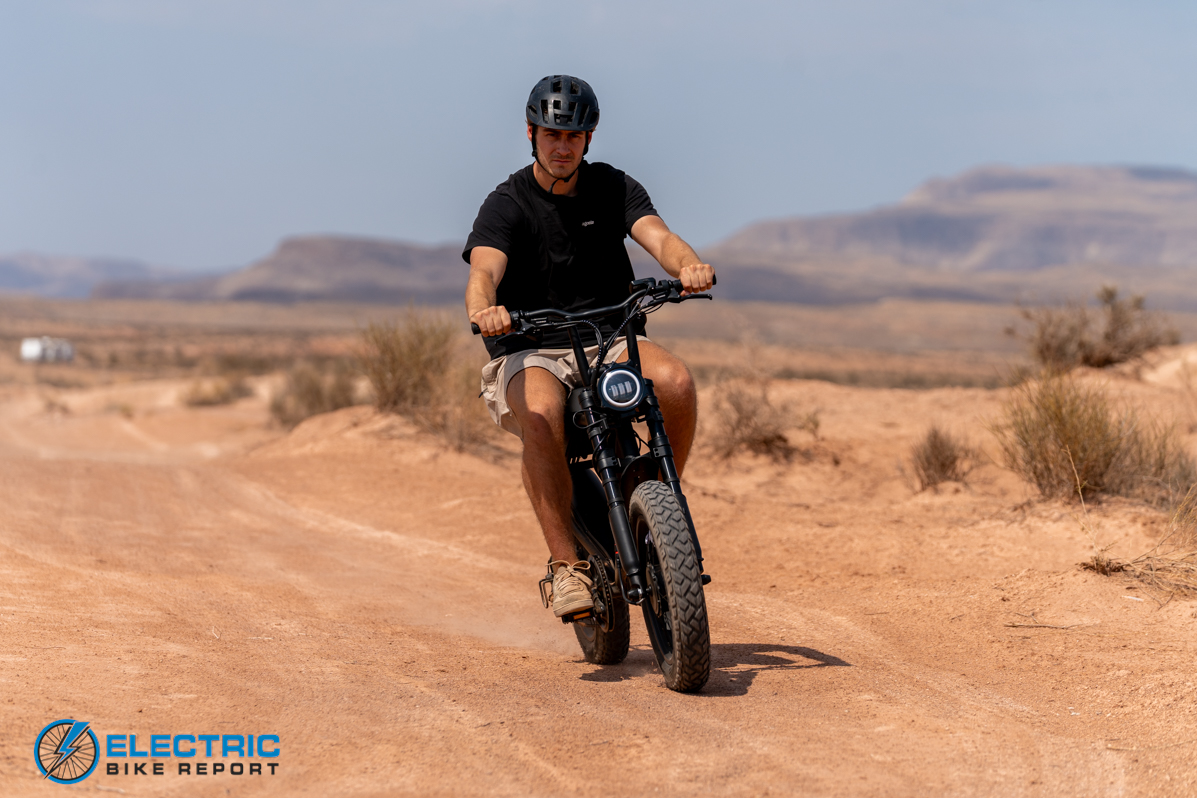
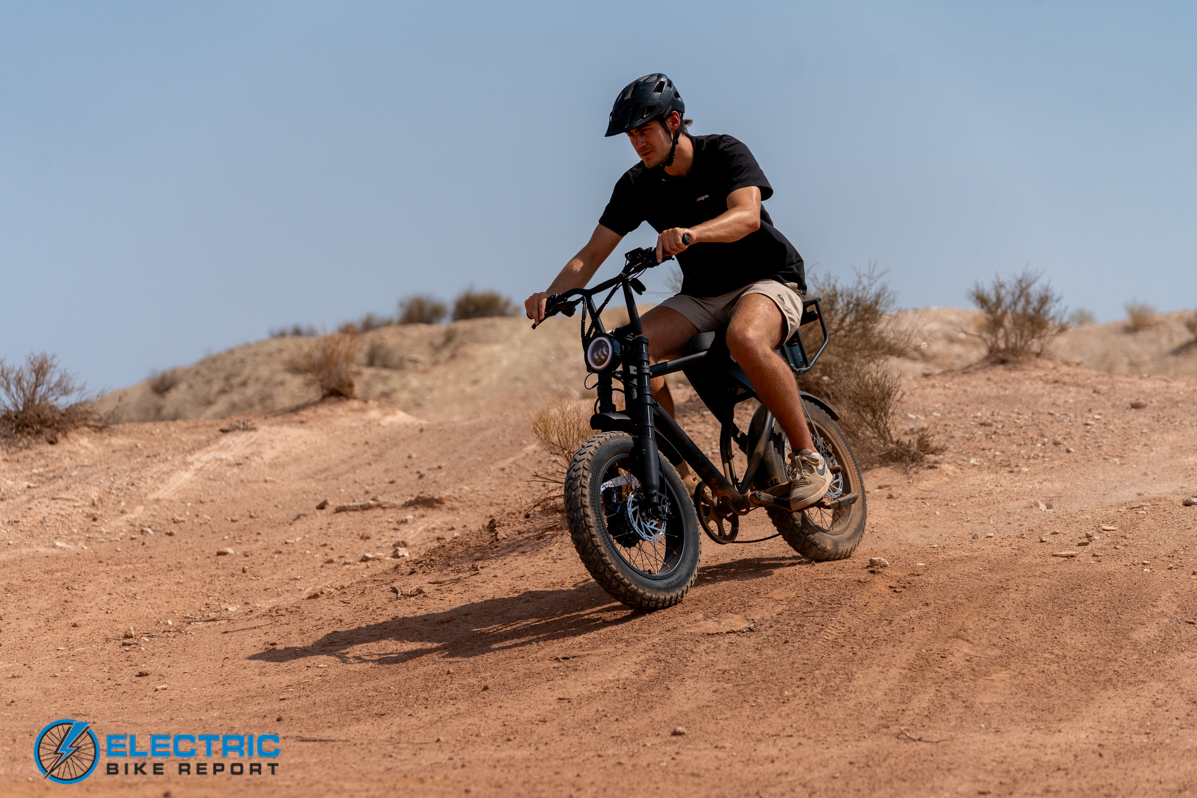
Dirt surfin’.
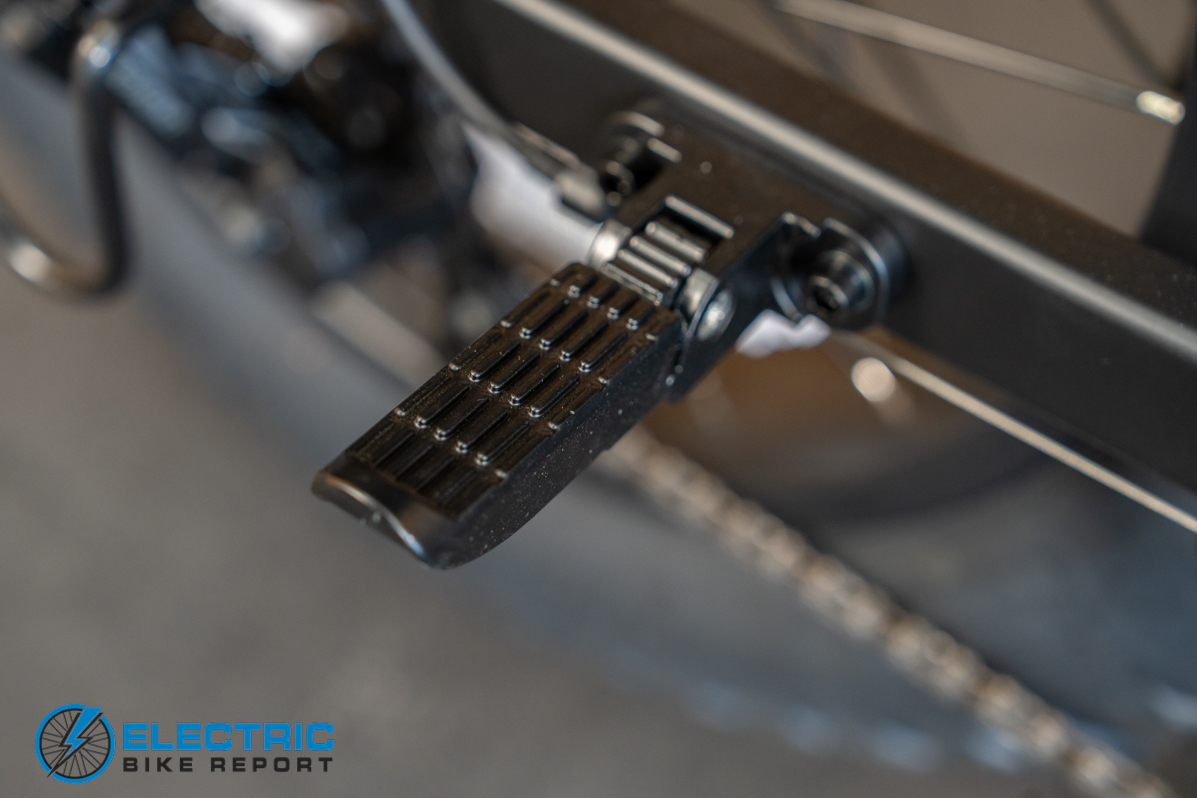
Footpegs for passenger comfort.
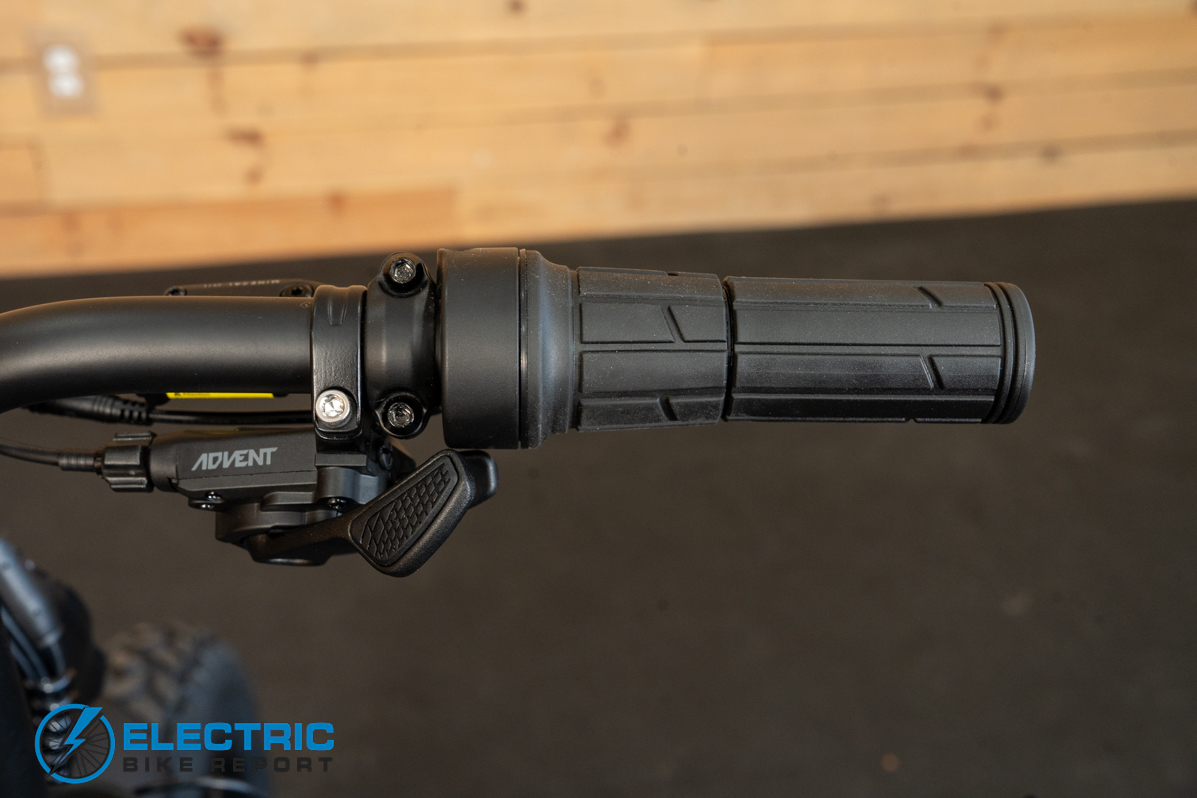
The twist throttle is simple and speedy.
Pedal AWD S Review: Brake Test
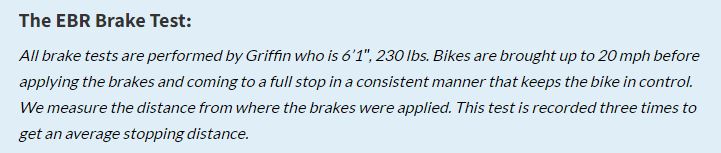
With a bike this powerful, good brakes need to be a priority. Thankfully, Pedal was on the ball here; the AWD S recorded an averaging stopping distance of 17 feet 6 inches, which is considerably better than the class mean of 19 feet 3 inches.
The bike is equipped with a pair of Tektro 2-piston hydraulic brakes. These, paired with the 180 mm rotors, make for a solid system. Tektro is known for reliable, trustworthy brakes at a reasonable price – these uphold the reputation. They have decent modulation and a healthy amount of bite. Fat tires also help with performance here; the larger contact patch makes for better grip on the braking surface.
When considering the weight and power of this bike, it’s pretty clear that the brakes need to be capable. Thankfully, they are – this system puts forward some impressive numbers, and feels trustworthy while doing it.
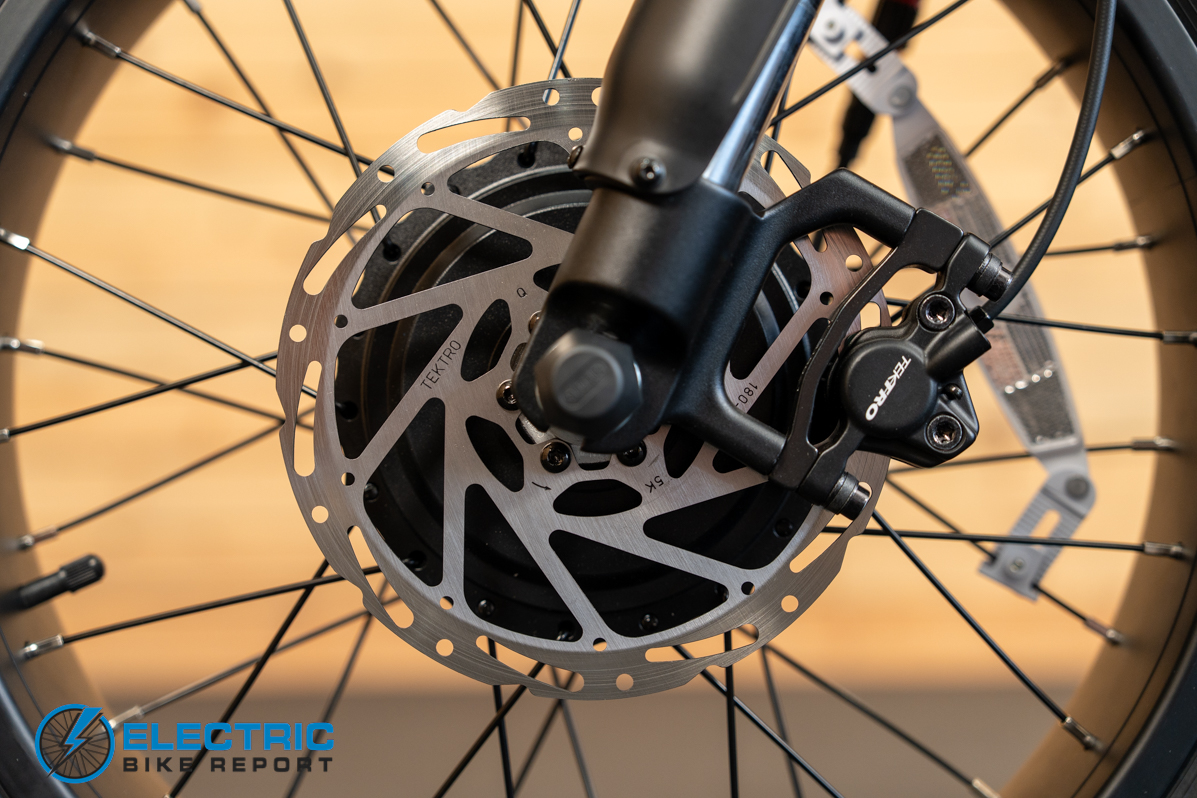
180 mm rotors front and rear.
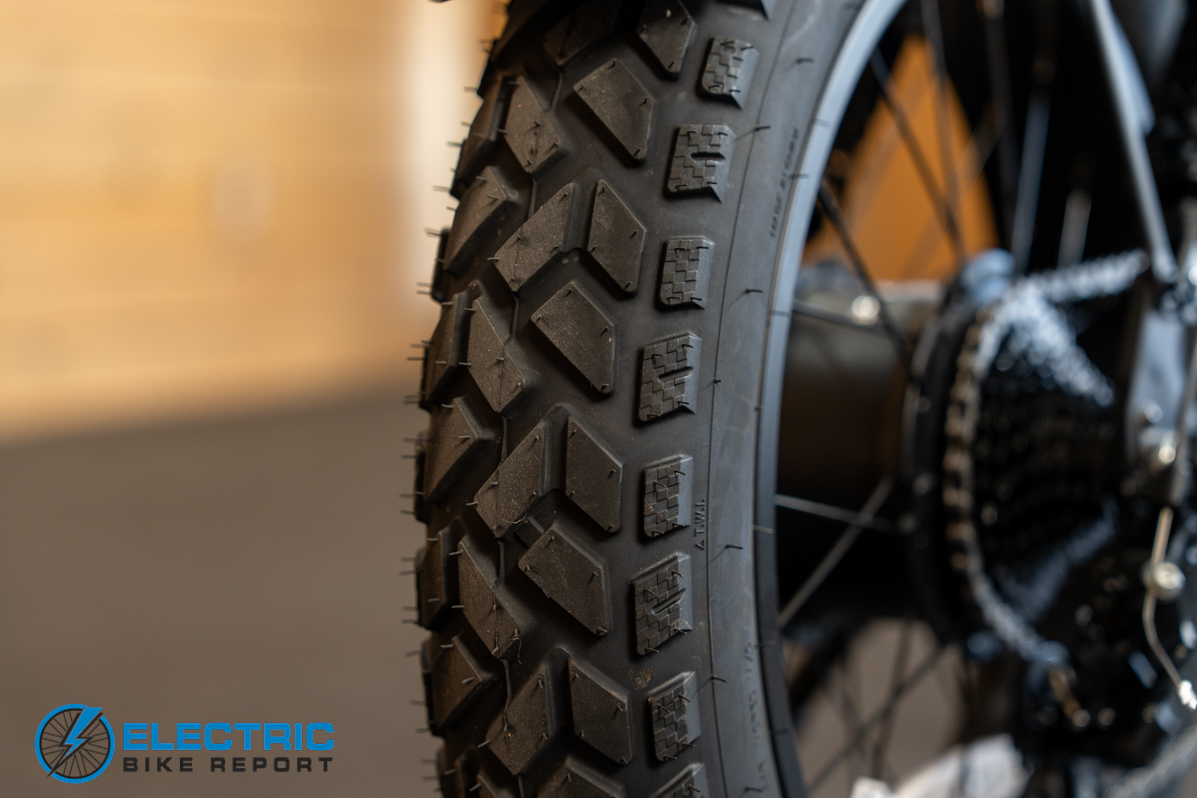
20 x 4.0 tires are part of the reason for the bike’s good braking.
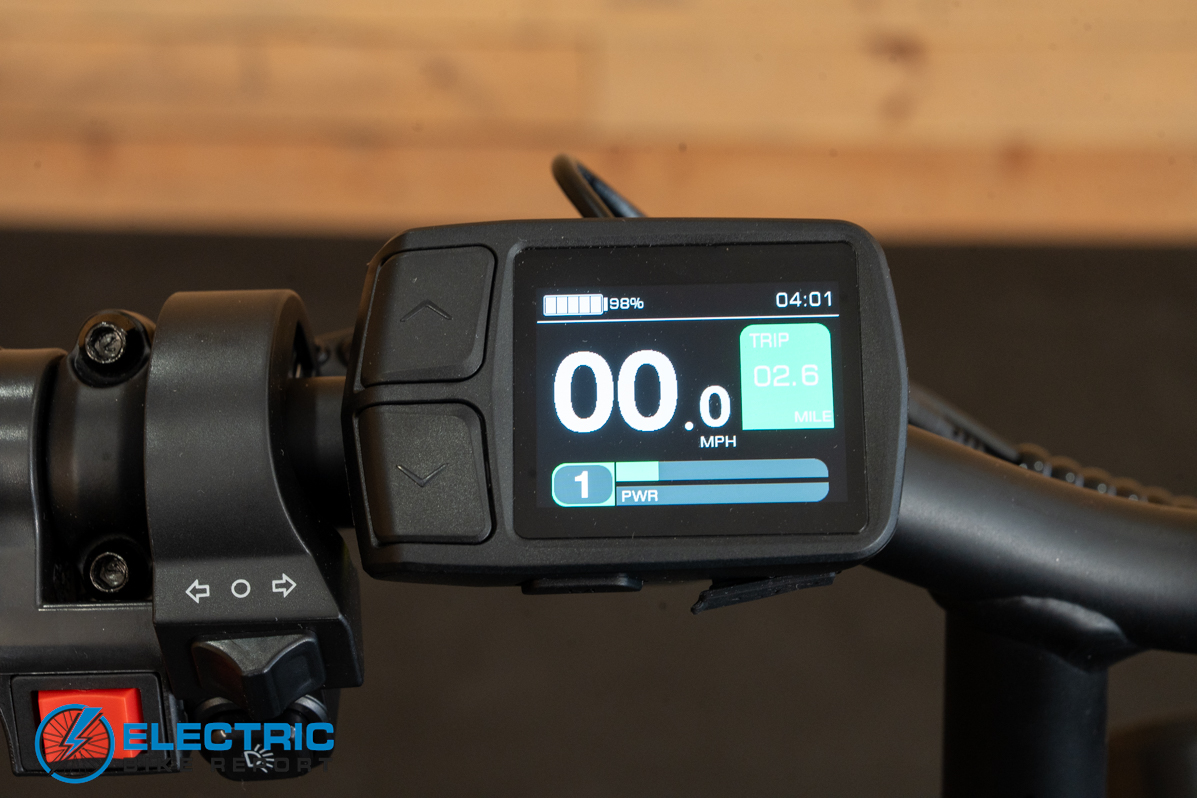
See that red switch? That’s for selecting between the front and rear (or both) motors.
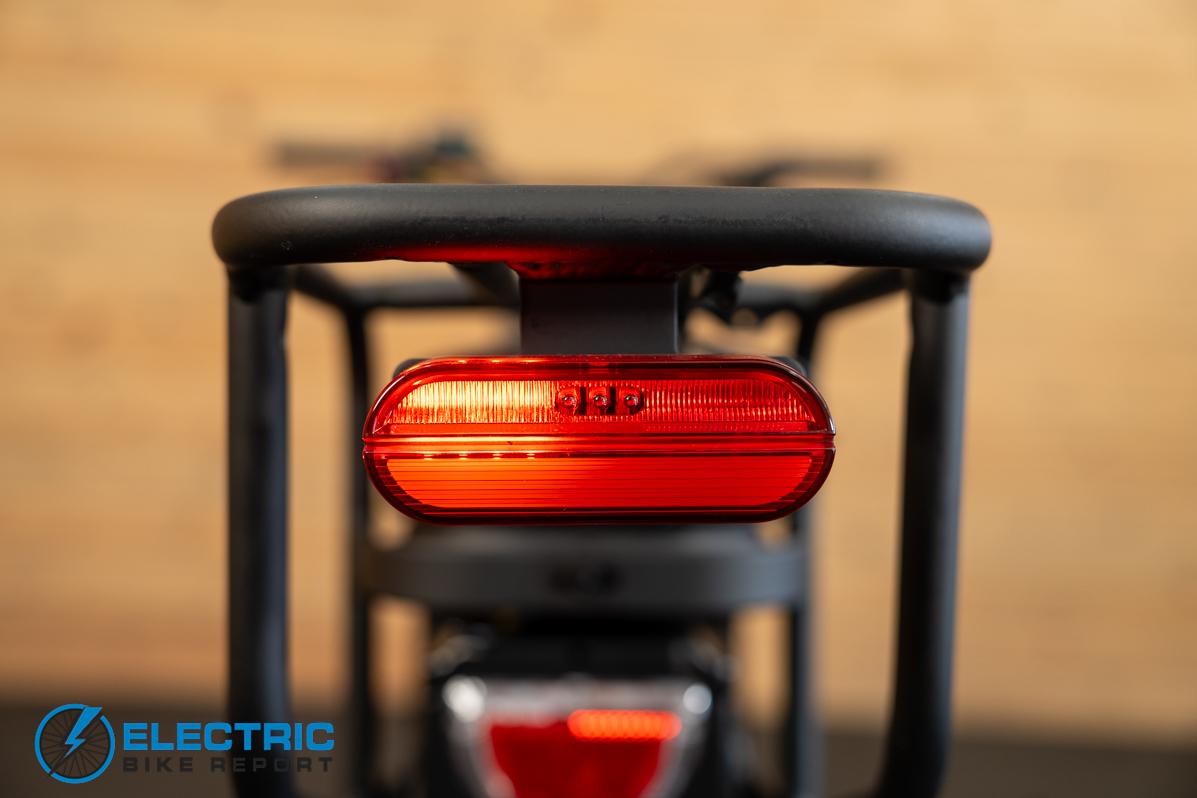
An integrated taillight for nighttime safety.
Pedal AWD S Review: Ride Quality
This bike has a moped style frame, and the riding position is in line with the moto-inspired genre. The leg extension is limited, but this isn’t a huge issue, as pedaling isn’t the main purpose of this bike anyway. I actually found this frame to be solidly accommodating – the seat is designed to fit two riders if need be, but it’s also great for taller riders to be able to scoot back and find a comfortable reach.
The AWD S has both front and rear suspension, which helps smooth out rough roads, as well as enables some off road ability. The tires play a role here too; they’re a knobby-style tread in a 20 x 4.0 size.
As for handling, this bike was more maneuverable than I expected. The heavy weight would suggest a sluggish and cumbersome bike, but it’s not necessarily the case here. At low speeds, I could feel the weight, but at a cruise, the bike feels relatively responsive.
Cornering proved to be interesting on this bike. When using a single motor, I felt very confident taking bends. The tires provide solid grip, and the AWD S is very stable. However, with both motors engaged, I didn’t have the same sense of certainty. With the front motor also running, I was struggling to trust the tire’s ability to hold a line – In the back of my mind, I was concerned the power would overwhelm the front wheel and cause me to lose grip.
I felt similarly when off roading. When using the rear hub only, the bike felt fine. When activating both motors, the front wheel struggles to keep traction, especially on loose gravel or dirt.
Here’s the thing; the AWD S is fun. It’s a rowdy, rambunctious bike that puts a smile on your face. However, the power and dual motor setup make it risky. I wouldn’t say that it’s explicitly dangerous, but it does demand more caution and experience than most E-Bikes do, especially with both powerplants on.
As you’ve probably gathered by now, this bike has a central theme – raw power. While the grunt this bike offers is great, it also ropes it into an increasingly hot debate about Ebike laws and regulations.
The AWD S blurs the lines between moto-inspired and full-on e-motorcycle. Laws and regulations change depending on location, but here’s what we can say with confidence: This bike doesn’t fully comply with the 3 class system as outlined by People For Bikes.
There are a few reasons for that; chiefly, in order to comply with the class definitions, motor power is capped at 750W continuous. The AWD S has dual 1000W motors. While having two motors isn’t technically specified as noncompliant, the power itself is outside of the legal limit.
Additionally, while the bike ships with Class 2 speeds, these can be removed via the settings. The AWD S can be set to throttle past 20 mph, and this fact also affects its legality. Pedal lists the top speed of this bike at 36 mph, which makes this, at least in legal terms, an e-motorcycle.
The debate on this is ongoing, and new laws are being introduced in many places. However, the bottom line is that this is technically classified as an e-moto, which requires a license plate and registration.
The legality conflicts present a significant dilemma. To solve the issue, we’d like to see Pedal lean into the E-moto category on the AWD S. Remove the pedals, add some pegs, and call this what it is.
Not only would this help clean up the gray area, but it would also enable Pedal to make the AWD S a more focused, capable vehicle. It’s already a very good product, but it sits in limbo; legally, it’s an E-moto, but there’s a lot of E-bike suggestion here. By choosing to fully jump out of the E-bike category, the speed and power capabilities aren’t bound by class regulations, and the AWD S could just be an off road or private property vehicle.
Sponsor
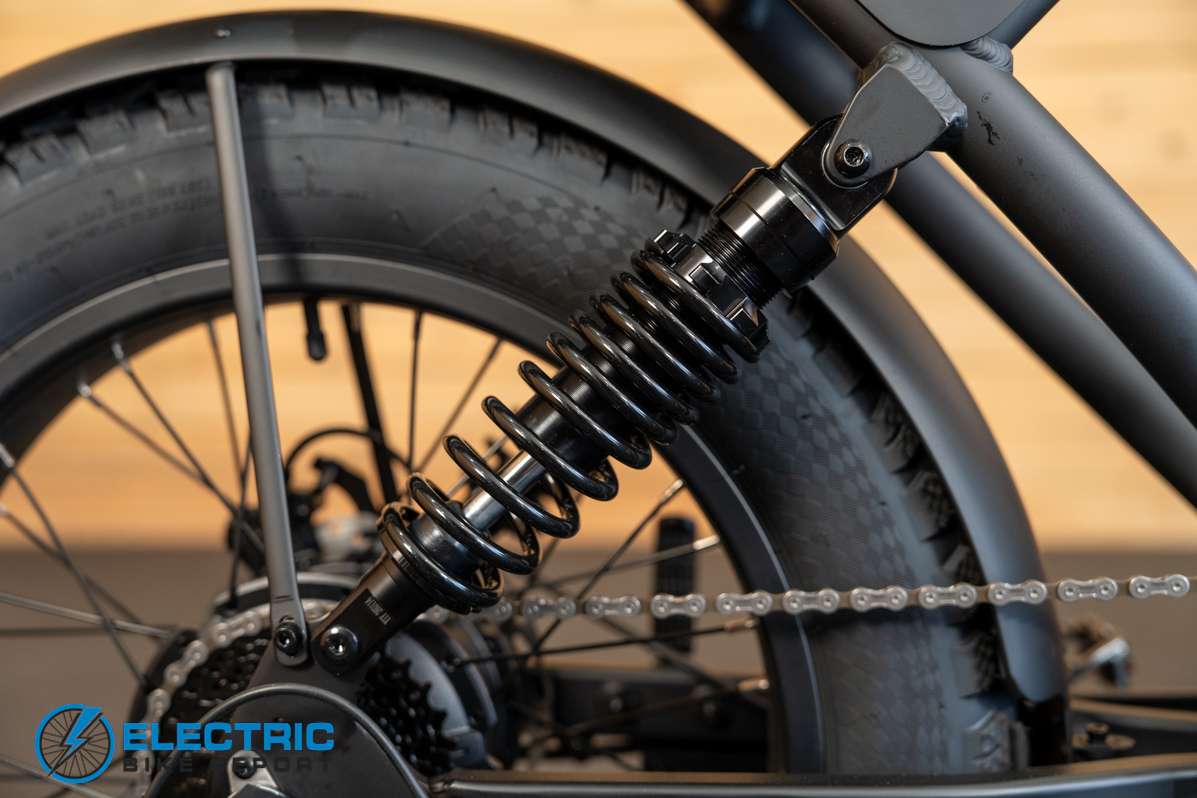
Rear suspension is a nice addition here; it helps smooth out the ride quite a bit.
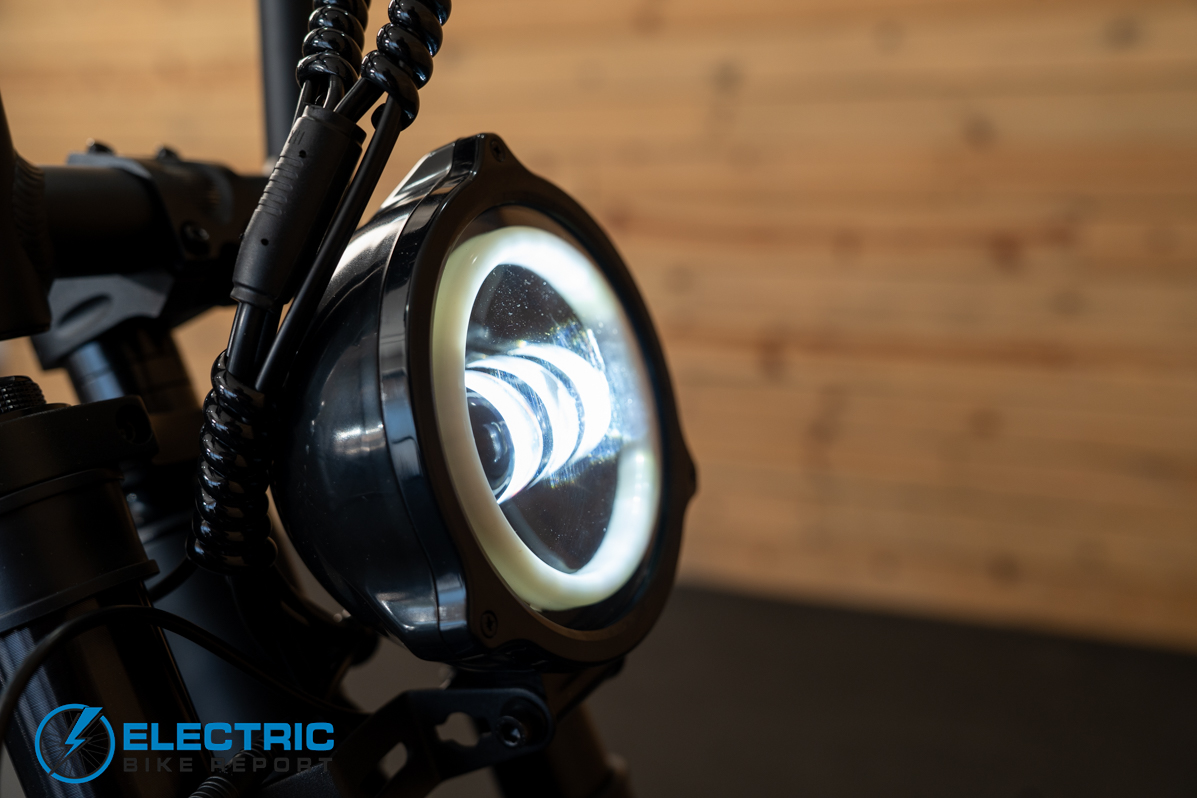
Check out the cool cafe-racer inspired headlight.
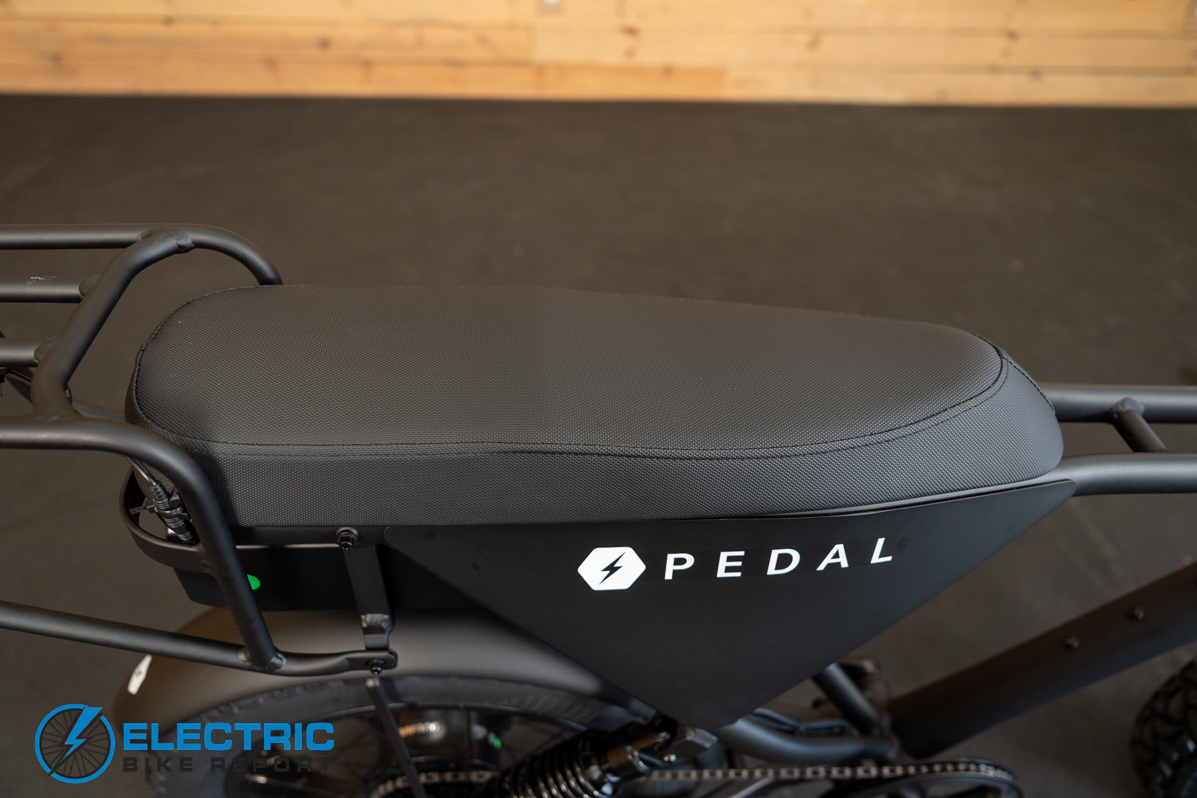
The elongated saddle is good for two riders.
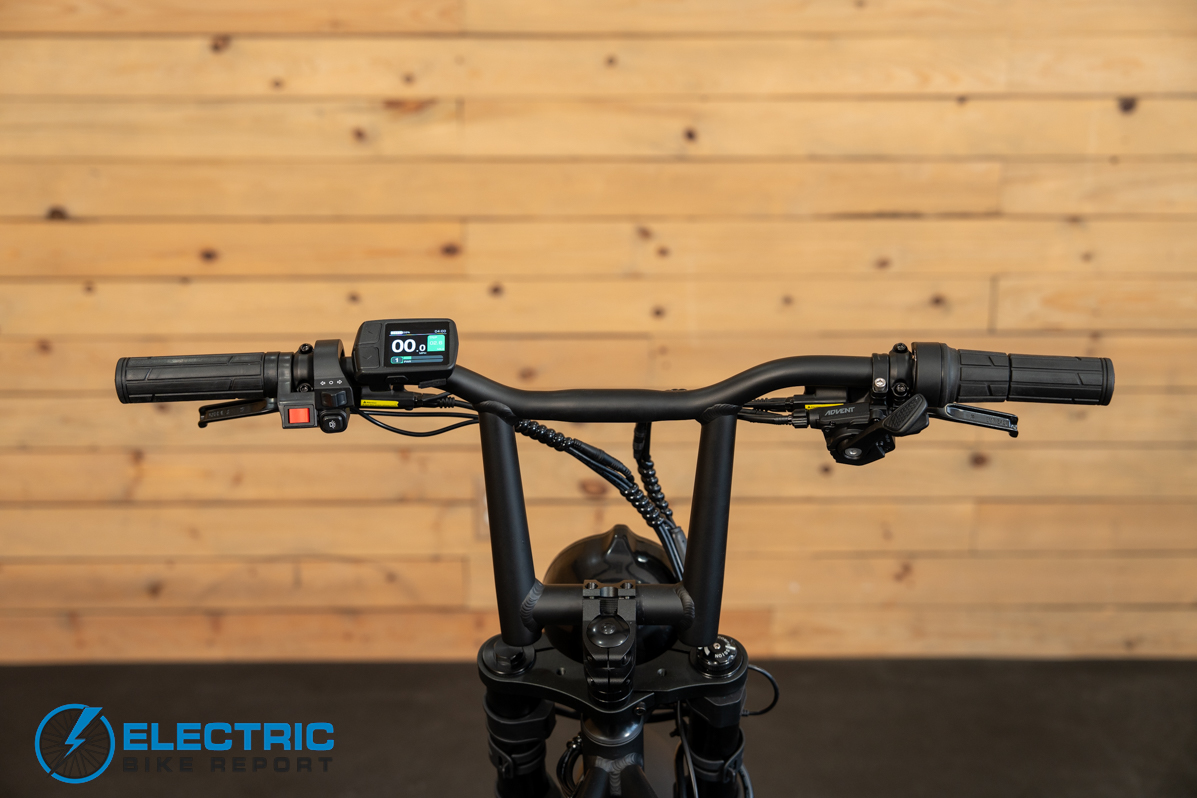
The bars are an interesting mix of moto-inspired and BMX style.
Pedal AWD S Review: Summary / Where to Buy
So, the AWD S is a bit complicated. With that in mind, I’d like to discuss who this bike is for, along with its use case.
Ebikes and E-motos are modes of transportation, not toys. This, with its gray areas and all, is no exception. That doesn’t mean that it’s bad or poorly made. In fact, the AWD S is quite the opposite. It performed well in our testing; the brakes are good, the range is great, and there’s heaps of power. By no means is this a bad product – it’s just technically not an Ebike.
It’s best suited for experienced riders who are familiar with a lot of power; even then, we recommended taking some time to learn the bike. Additionally, if you’re a rider who is more interested in off-roading or exploring unregulated areas (like private property or similar), this could be a fit. If road riding is your intention, remember that in many places this must be registered in order to be legal.
For the right person in the right situation, the AWD S is a blast. It’s a good performer across the board, and a quality product. With that said, the compliance deficits limit the bike’s use cases. Rather than rework the entire thing, we’d like to see Pedal embrace the E-moto label on this bike, and continue to make other models that follow the 3 class system.
Happy Riding! Make sure to let us know if you have any questions or if you think we left anything out in this review of the Pedal AWD S down in our comments section.
Sponsor
Sponsor
Reader Interactions
Leave a Reply