

N+ Ford Mustang eBike Review | Classic, Sporty, and Cool
Sep 21, 2026
 1 Comments
 Share
Share
Designed in collaboration with Ford, this auto-inspired e-bike looks and feels like the sports car it’s named after.
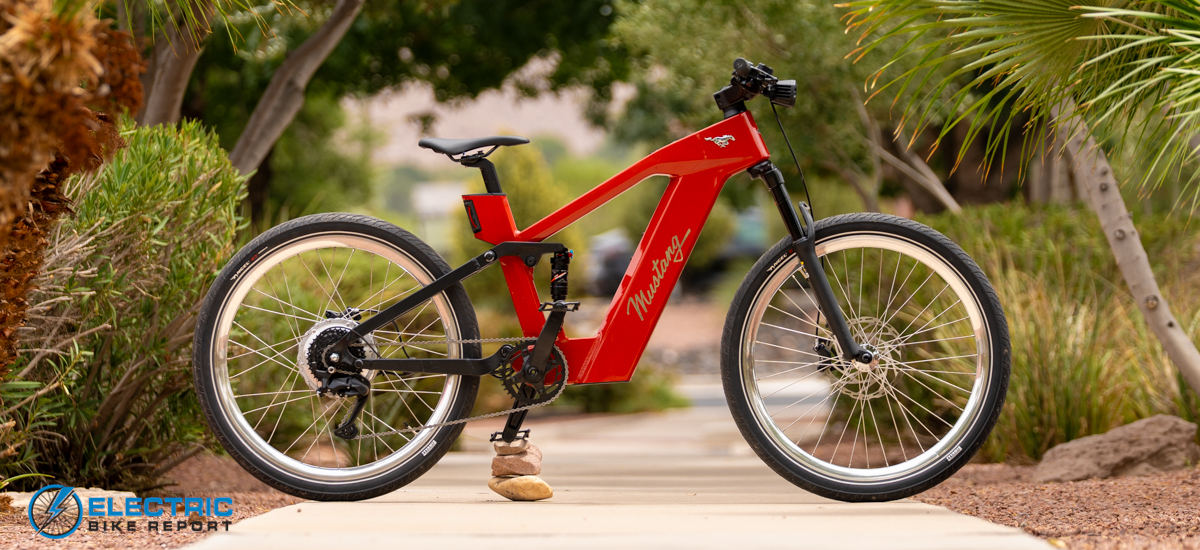
Half art piece and half head-turning commuter, the N+ Ford Mustang eBike is a unique, sporty-looking product inspired by the classic muscle car with the same name. Offered in both a limited red 60th Anniversary Heritage Edition and a more contemporary base model with over 10 color options, the bike is clearly aimed at collectors and Ford enthusiasts.
The Mustang automobile has proven its legacy and longevity through more than six decades and multiple generations, but does it also make a good e-bike? That’s the question we aim to answer in this review.
The bike’s manufacturer is a solid starting point. Like a handful of other auto companies before and since, including Mercedes-AMG and Volkswagen, Ford partnered with N+ to develop the Mustang (and its sibling model, the Bronco). We previously tested the high-end Rallye Edition Mercedes model and found it to be fun, cool-looking, and well put together.
N+ also equipped the Mustang with a great foundation: a torque-sensing 750W rear-hub motor and a 48V, 720 Wh battery. On paper, this power and battery capacity are well-matched to the bike’s size and style. Many more of the bike’s components also stood out, including its Tektro brakes, Shimano drivetrain, and Pirelli tires.
While I’ll save the details of our formal performance tests for the sections below, I can say that my first test ride was revealing. The Mustang’s athletic feel and adaptive pedal assist system seemed like an ideal pairing, and in general, the bike’s ride matched its looks. No e-bike is perfect, however, and I also noticed some areas with room for improvement.
To fully evaluate its performance and feel, we subjected the Mustang eBike to our standardized Speed, Brake, Range, and Hill Tests. Continue reading below to find out how it scored in comparison to similar commuter e-bikes we’ve reviewed—and to learn whether the Mustang is a great fit for your garage.

Sponsor
E-Bike Category:Commuter
E-Bike Class:Class 2 (throttle to 20 mph)
Class 3 (pedal assist to 28 mph)
Class 3 (pedal assist to 28 mph)
Sponsor
N+ Ford Mustang eBike Video Review
 Pros
Pros- The Mustang eBike’s sharp aesthetic matches the sports car, giving it huge appeal for Ford enthusiasts and collectors.
- Pedaling feels natural and responsive, similar to an analog bike, but faster and easier—thanks to the Mustang’s 750W motor.
- A full air suspension keeps riders well-cushioned and comfortable, softening bumps and ensuring the tires maintain traction.
- The ride is sporty and somewhat aggressive, with a forward-leaning posture and quick, precise steering.
- N+ offers the bike in three frame sizes for riders under 5’6″ to as tall as 6’3″. Each has an impressive 10+ inches of saddle adjustment.
- It’s outfitted with many high-quality components, including a Shimano CUES drivetrain, Tektro Auriga+ brakes, Pirelli Angel Urban GT tires, etc.
- The bike’s overall operation is simple and straightforward, with four assist levels and a throttle—no apps, complex settings menus, etc.
- The standard model has 13 color options to match your Mustang car, but there’s also a limited edition model for those who prefer a more retro-inspired look!
 Cons
Cons- The Mustang’s single-piece stem/handlebar and integrated display looks great, but it can’t be swapped out for handlebar height or reach adjustments.
- A removable battery would make the bike more portable and the charging process easier for those who prefer to charge indoors.
ELECTRICAL SPECS & FEATURES
- Battery: 48V, 15Ah | 720Wh
- Charger: 48V/3A
- Display: Full color stem-integrated display
- Motor: 750W, 900W peak, 85 Nm torque
- Headlight: Integrated LED, 2000 Lm Output, 180Lux
- Taillights: Integrated LED Sequential Taillights
- Pedal Assist: Four modes (Eco, Normal, Sport, and Track)
- Claimed Range: Up to 60 miles
- Throttle: Left thumb throttle
- App: None
- UL Certification: UL 2271 & UL 2849 Compliant
Weight & Dimensions
- Claimed weight: 68 lbs (Size Medium)
- Tested Weight: 71.1 lbs (Size Large)
- Rider height range: <5’6″ (Small), 5’7″ – 5’11” (Medium), 5’11” – 6’3″ (Large)
- Total payload capacity: 216 lbs (max system weight including bike, rider, and accessories is 287 lbs)
Components & Accessories
- Brakes: Tektro HD E-740 4-piston hydraulic caliper, 203mm front and rear rotors
- Fenders: Front fender optional
- Fork: High performance air-sprung front suspension fork with 120mm travel
- Shock: DNM, 200x53mm air-sprung rear shock
- Frame: Aluminium alloy 6061
- Drivetrain: Shimano Cues U4000, 9-speed, 40T chainring, 11-36T cassette
- Grips: Rubber
- Saddle: Performance-style sport saddle
- Handlebar: Aluminium alloy 6061 integrated handlebar and stem
- Kickstand: None
- Pedals: Wellgo alloy platform pedals
- Tires: 27.5″ 36H alloy E-MTB wheelset and 2.25″ Pirelli Angel Urban GT tires
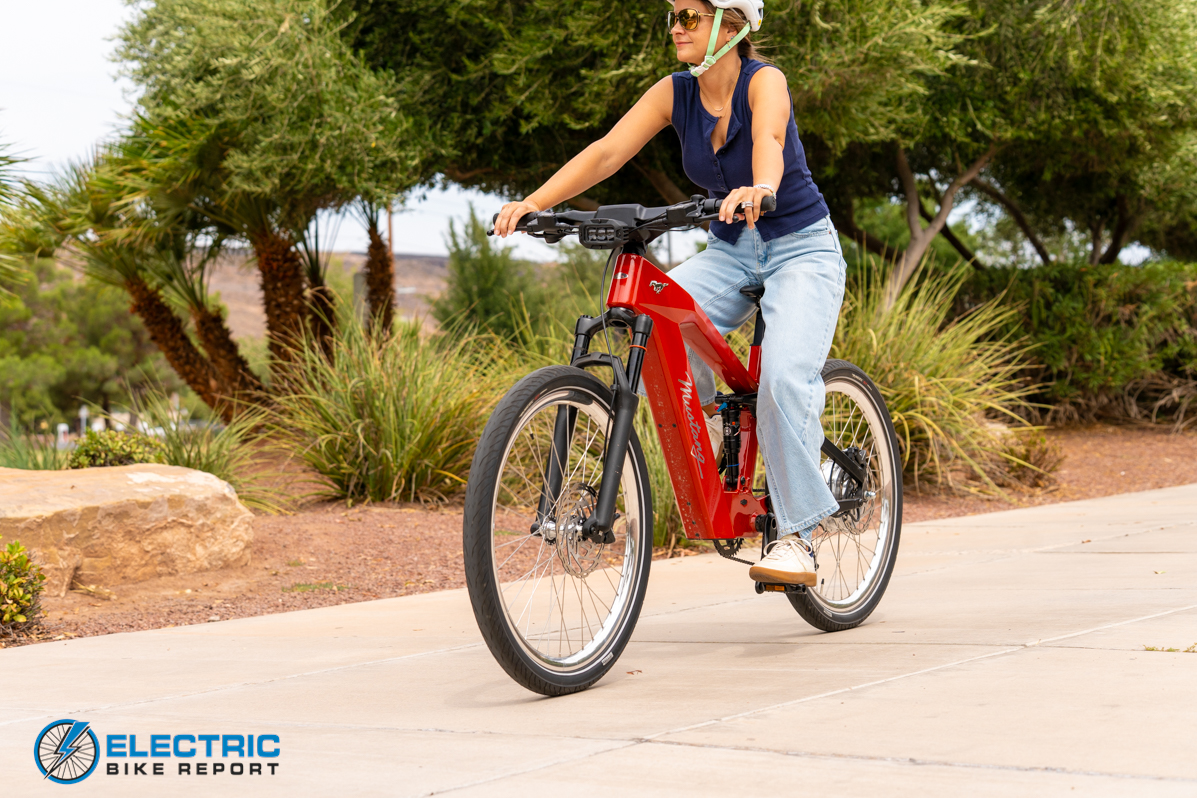
As a Class 2 and 3 e-bike, the Mustang offers pedal assist up to 28 mph and throttle to 20 mph.
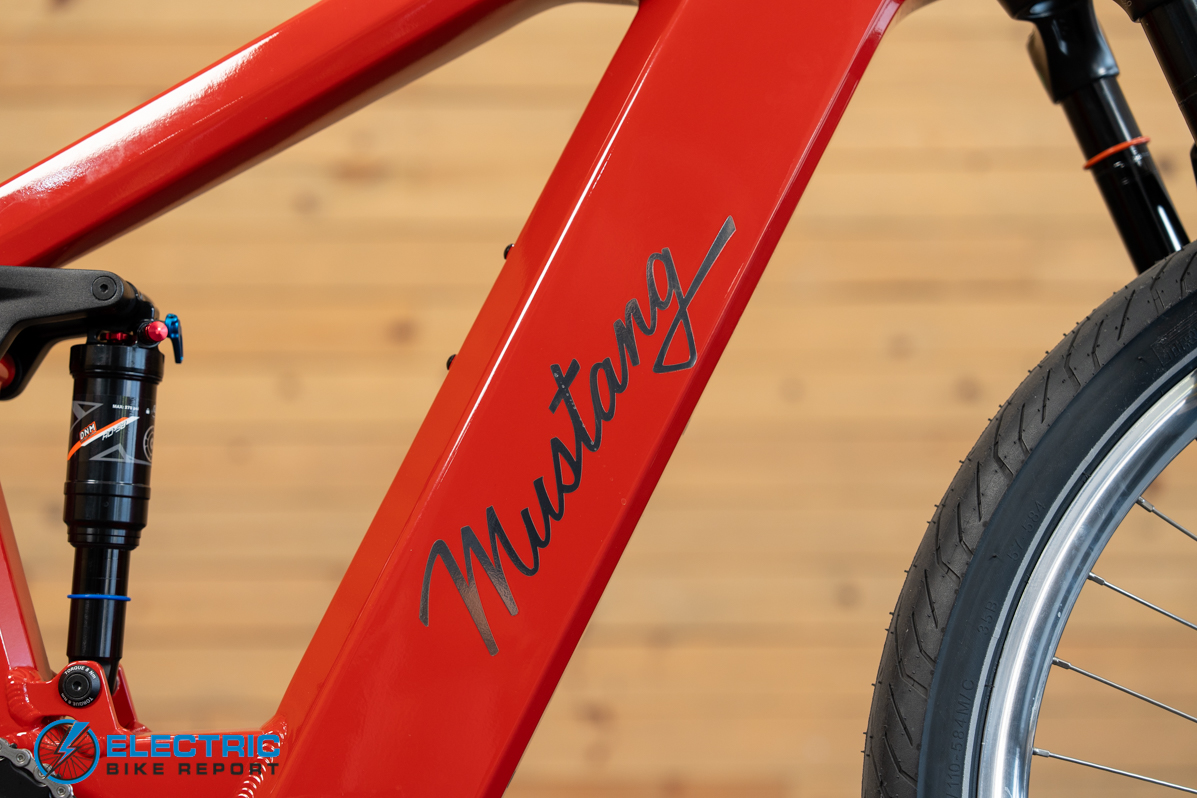
The Mustang’s name is emblazoned on its down tube, where the internal 720 Wh battery is housed.
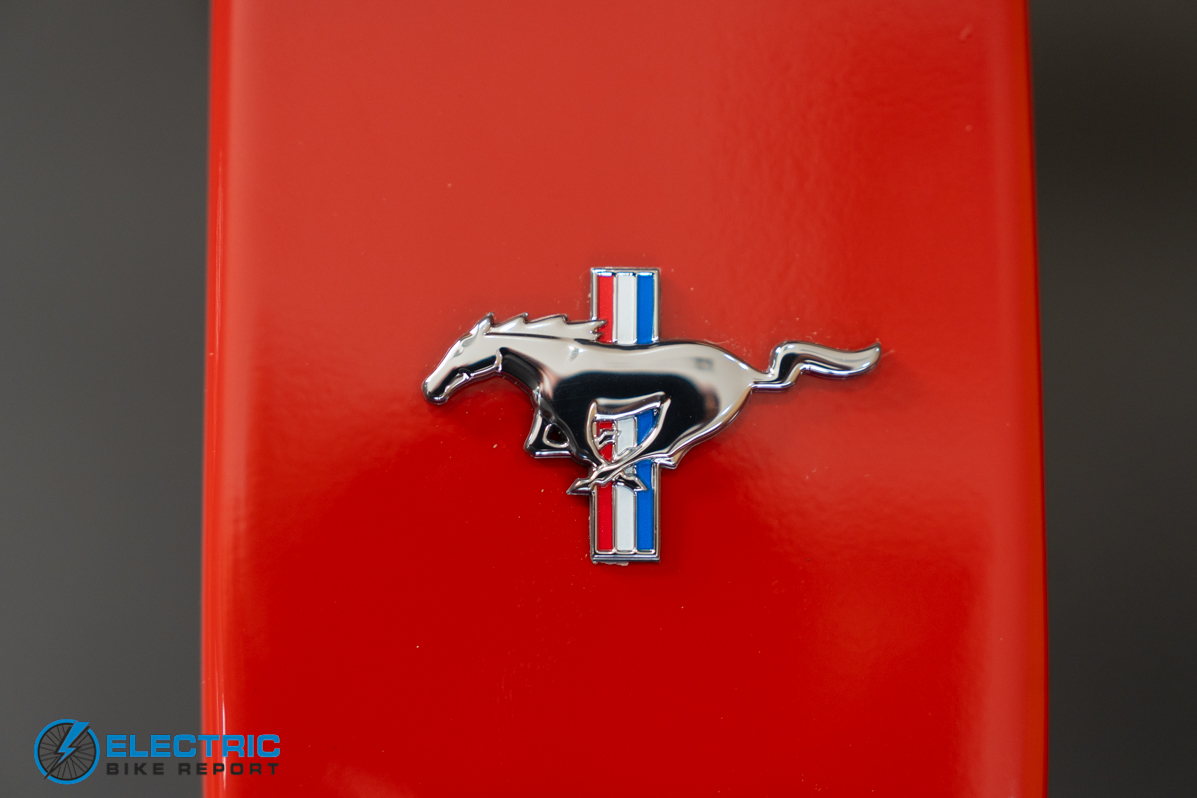
A retro badge and Rangoon Red paint job mark the 60th Anniversary Edition as a special, commemorative e-bike.
N+ Ford Mustang eBike Review: Speed Test
Mustang sports cars have a well-earned reputation for their muscle and speed, so we tested the N+ Mustang eBike to find out how well it lived up to this bar. I rode it on a network of flat, paved paths as I monitored my average speed, starting with no pedal assist and moving up through its four power levels (Eco, Normal, Sport, and Track).
As a Class 2 and 3 e-bike, the Mustang is rated to reach 20 mph via throttle and a maximum of 28 mph through pedal assist. In our testing, it matched both of these speed limits, though there is more nuance to how it got there.
Starting without pedal assist, I was pleased by how comfortably the Mustang pedaled. Weighing over 70 lbs, I could feel its weight when starting from a complete stop, but the bike’s wide gearing range and slick tires made it easy to move. Like most e-bikes, I wouldn’t necessarily want to pedal it for many miles without power, but it could be done.
When I engaged the motor, I felt an initial surge of power. While the lowest assist level felt relatively reserved and natural, it also delivered a helpful boost in speed and ease. In Normal, the power ramped up smoothly, making pedaling more rewarding. The two subsequent levels felt similar in power; I noticed small speed increases while maintaining roughly the same level of effort.
In Track, I was able to reach (and slightly exceed) the 28 mph maximum with a faster cadence and more pressure on the pedals. In short, I had to work a bit more for it, but the motor responded to my effort by rewarding me with higher speeds.
Ultimately, I found that changing between the bike’s lowest assist levels showed the most meaningful differences in speed and power, while the high levels had more overlap in feel. That said, I liked that I never lost touch with the fact that I was riding a bicycle instead of a motorcycle. The bike’s setup made it generally easy and intuitive to ride.
On throttle, the Mustang took off gradually from a stop, easing off the line before its acceleration ramped up. With more time, the bike steadily built speed up to the 20 mph limit, feeling capable but also approachable. I’ll admit that, given the bike’s appearance and branding, I expected more punch, but I appreciated that it was useful without being either scary or underpowered.
Sponsor
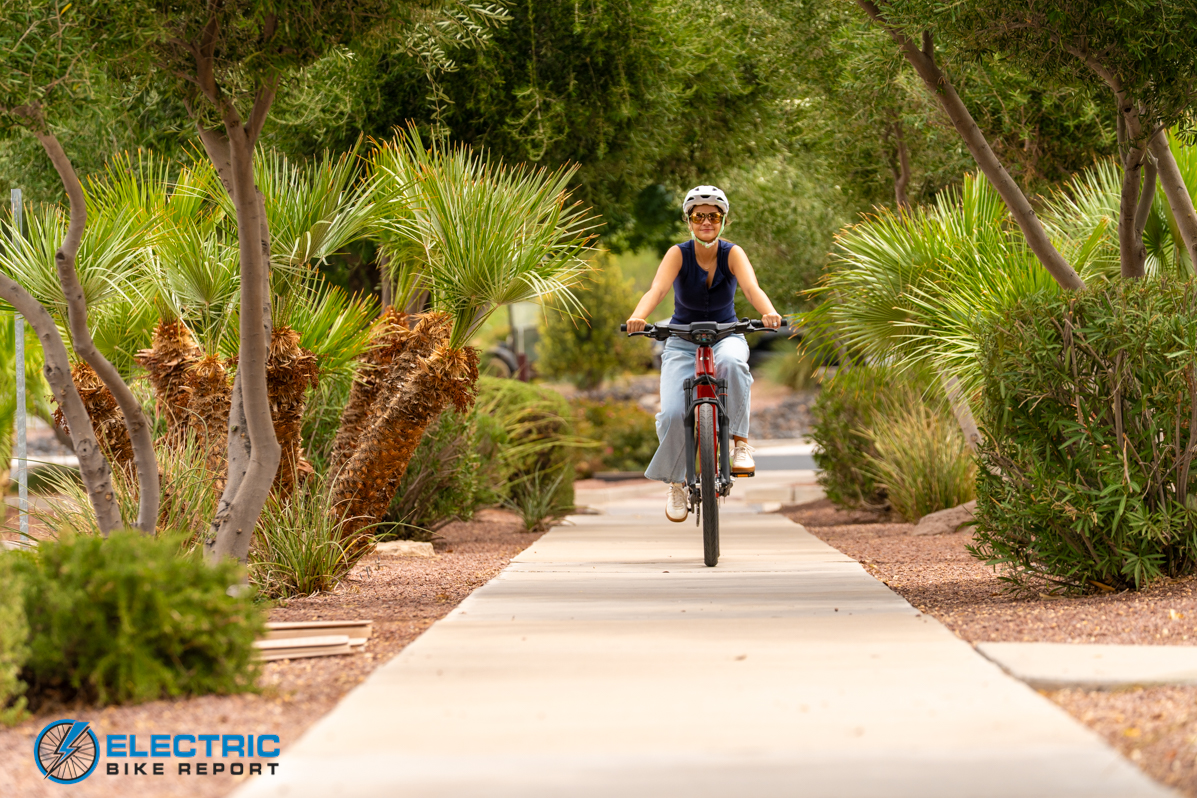
Whether you’re riding the limited edition red Mustang or the standard model in any of 13 color options, this bike is sure to turn heads.
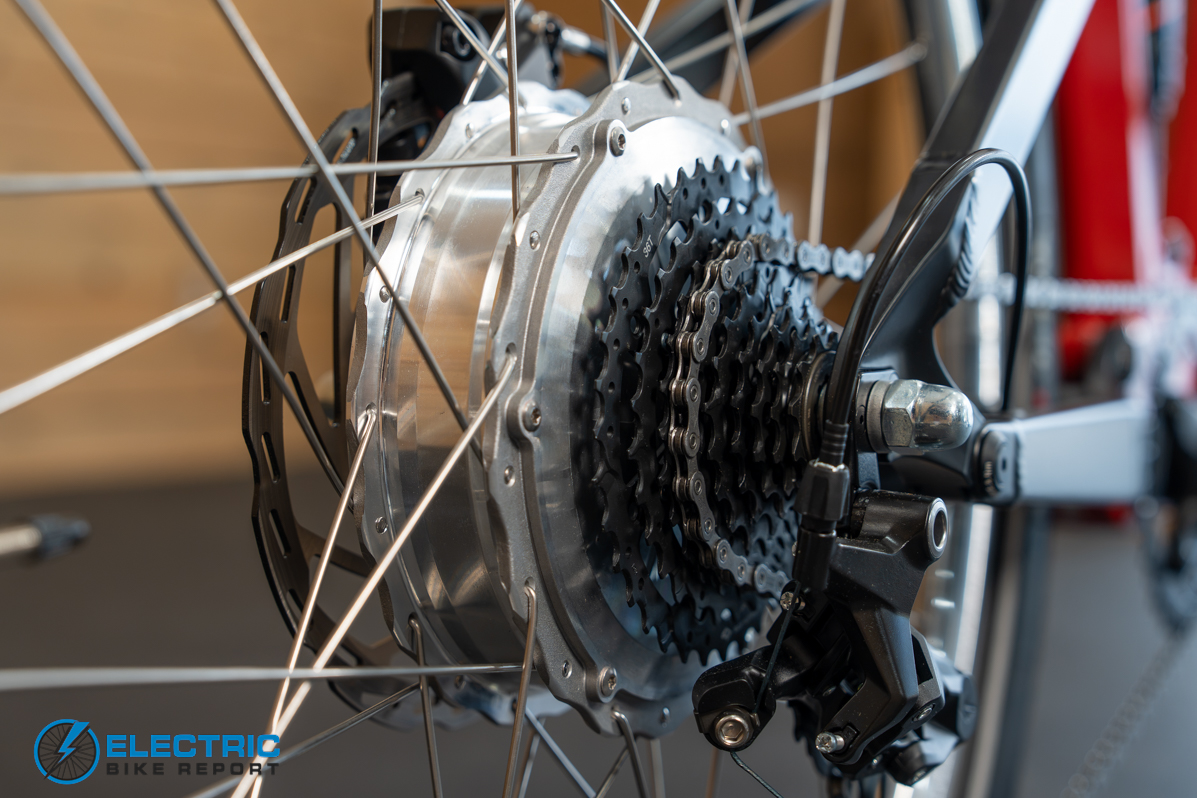
N+ equipped the Mustang eBike with a torque-sensing 750W rear-hub motor.
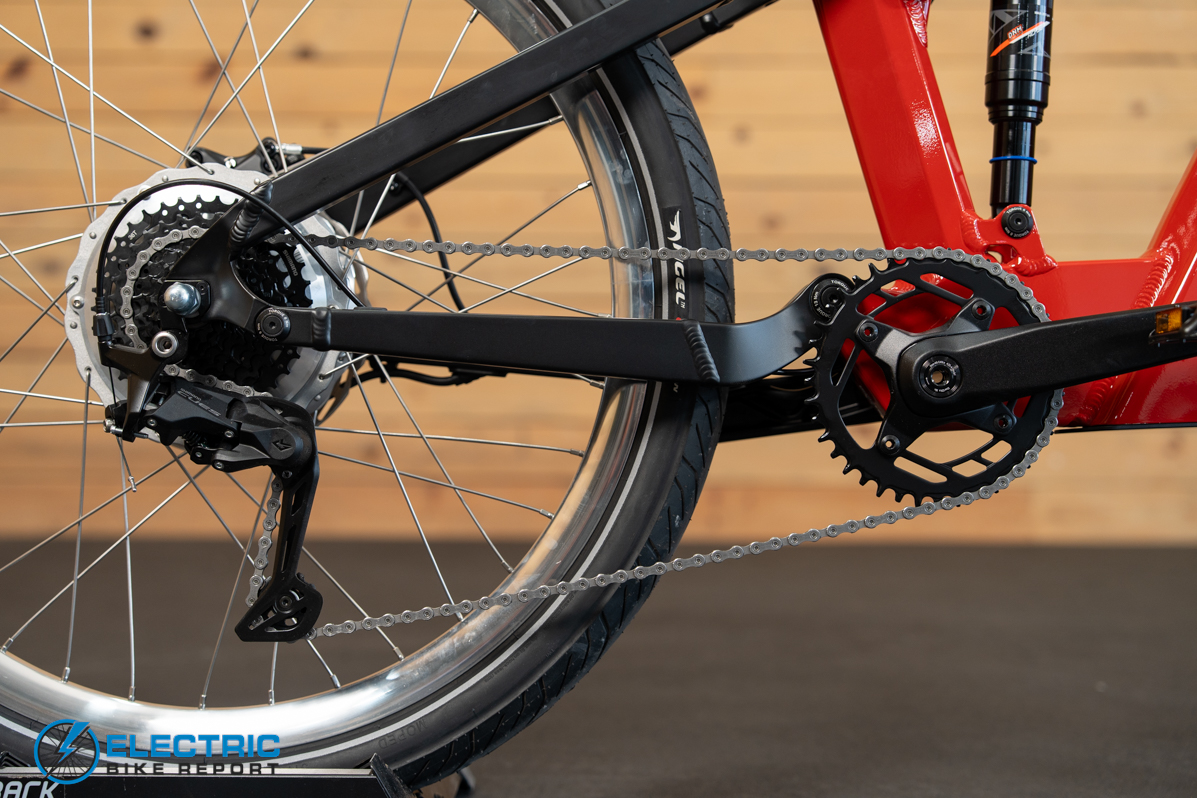
The bike has a reliable 9-speed Shimano CUES drivetrain with a wide gearing range.
N+ Ford Mustang eBike Review: Range Test
N+ advertises that the Mustang eBike has a maximum range of up to 60 miles. To evaluate this claim and compare it with other commuter-style e-bikes we’ve tested, we rode the Mustang in its highest and lowest pedal assist levels to find its minimum and maximum range. In each test, we started with a full charge and pedaled until the battery was depleted.
The results of our Range Test largely reinforced the findings of our Speed Test—namely, that the power output of the Mustang’s motor doesn’t differ wildly between its four assist levels. Case in point: while our test riders recorded 48.2 miles in Track, their Eco result of 55.2 miles differed by only 7 miles.
This is further reinforced when calculating the bike’s energy efficiency. We can divide its battery capacity in watt-hours (Wh) by its distance in miles (mi) to determine how much energy it used as it traveled: the Mustang used 13.0 Wh/mi in Eco and 14.9 Wh/mi in Track.
For comparison, similar commuter-style e-bikes we’ve tested straddled the Mustang’s results. They traveled 37.4 miles in their max-assist tests and 73.6 miles in their low-power tests. With batteries averaging 703 Wh, they used 10.1 to 19 Wh/mi, depending on the selected assist level.
First things first—while we fell a few miles short of the 60-mile maximum N+ advertises, we consider the brand’s ballpark figure to be accurate enough. After all, range can be affected by a broad spectrum of factors, including rider weight, speed, terrain, weather, and more.
Additionally, a range of roughly 48-55 miles makes the Mustang useful for many purposes, including exercise, leisure, commuting, touring, and beyond. A Ford enthusiast with a relatively average commute who chooses to leave their sports car at home, for example, should expect a few days of round-trip travel on a single charge.
Given the relatively small difference in energy consumption between Eco and Track, there seems to be little reason to use the Mustang’s low-power assist levels (unless doing so makes the difference between making it home with remaining charge or not).
In my personal testing, I spent the majority of my ride time using Track Mode, as it felt adaptive enough for riding conservatively or putting the proverbial pedal to the metal. In short—I recommend simply having fun and not stressing about range!
When the Mustang’s 720 Wh battery is depleted, users can employ the included 3A fast charger to power it up. Keep in mind that the battery is fully internal, meaning that it cannot be removed from the bike for storage or charging; we’d prefer a removable power pack to make this process easier.
A roughly five-hour charge time means commuters can plug in upon arriving home and unplug again before bed.
Sponsor
Sponsor
N+ Ford Mustang eBike Review: Hill Test
As with all e-bikes we review, we tested the Mustang eBike’s climbing prowess by running it up our half-mile test hill (see the graphic above) twice. In its throttle-only test, it completed the test in 2:04 at an average of 14.6 mph. When our test rider, Justin, used Track Mode to pedal to the top in a second test, his time and average speed were 2:23 at 12.7 mph.
Similar models we’ve tested averaged 1:54 on throttle and 1:56 when pedaling, so the Mustang’s results place somewhat below average, but its test scores make sense when considering its maximum motor output.
While similar models differed marginally in their torque (86 Nm, compared to the Mustang’s 85), on average, they weighed a few pounds less and their motors peaked significantly higher. Our comparison group averaged 1062W of peak motor power and a weight of 67.5 lbs, with the Mustang’s peak power reaching 900W and its weight being 71 lbs.
In short, with a less-powerful motor and a higher weight, the Mustang was slower than many of its peers when climbing—but it’s important to consider that it still completed both portions of the test successfully.
As I touched on previously, the Mustang is very much a bicycle, albeit one with a motor that can supplement the rider’s effort. Yes, it has a throttle, but it’s also intended to provide an active pedaling experience—and in my experience, it leans into that role while giving enough assistance that climbing hills becomes significantly lower-effort.
Like Justin, I tested the Mustang eBike’s throttle and pedal assist system in Track mode at our secondary test location, Pilot Hill. There, the throttle steadily but unhurriedly carried me to the top. Pedaling felt like a mild to moderate workout, but I was left with plenty of energy and oxygen when I reached the hill’s summit.
Overall, while our testing shows that the Mustang is built more for flats than hills, it’s still plenty effective at making the job of tackling them faster and easier—especially when compared to an analog bike! Based on its results, we’d recommend it for those who don’t mind putting in a moderate level of legwork when riding uphill or those who prefer a relaxed throttle-only cruise experience.
Sponsor
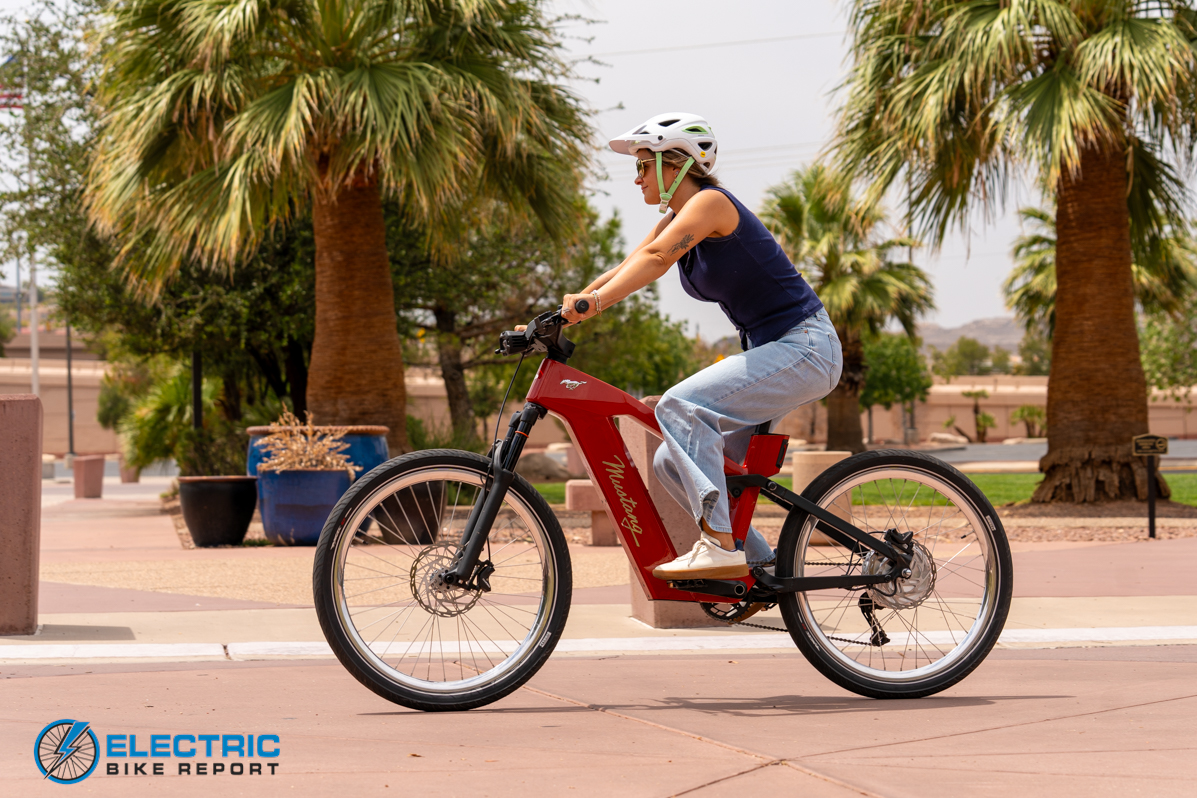
The Mustang rides a lot like a sports car, with a moderately aggressive forward-leaning posture.
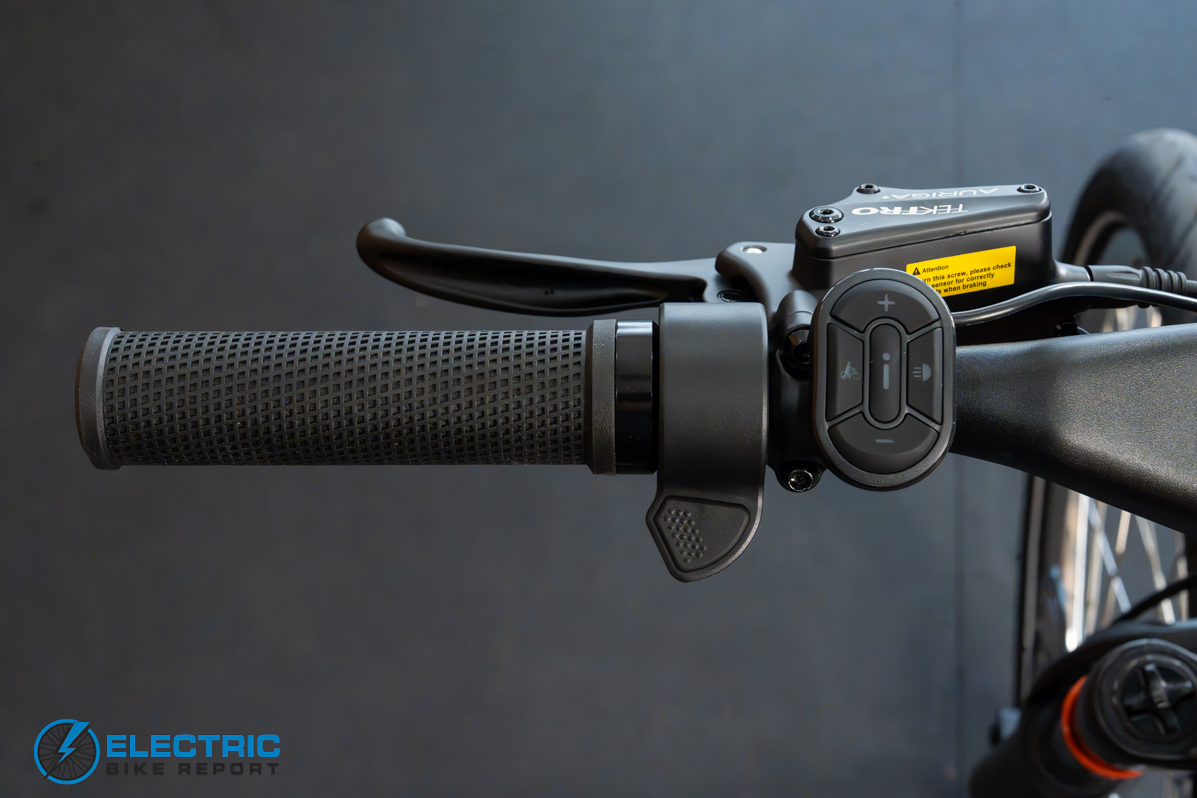
A thumb throttle sits on the left handlebar between the rubber grip and button pad.
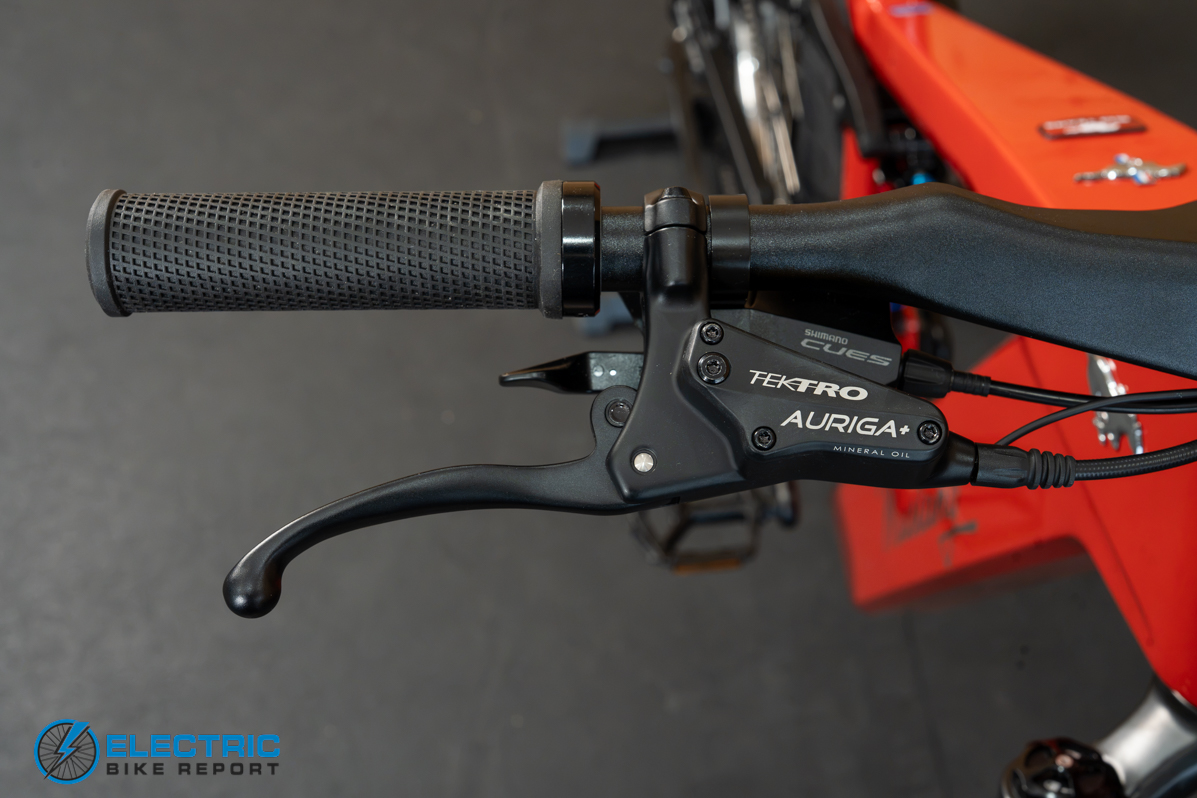
The bike comes with powerful 4-piston Tektro Auriga+ hydraulic disc brakes.
N+ Ford Mustang eBike Review: Brake Test
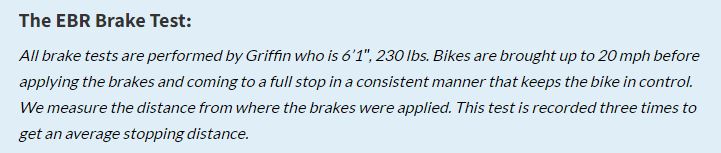
Our Brake Test was one of the Mustang eBike’s strongest test results. We tested the stopping power of its Tektro Auriga+ hydraulic disc brakes by pedaling up to 20 mph, applying the brakes at a predetermined point, then measuring how far it traveled before stopping. We repeat this process three times to smooth any inconsistencies.
After three tests, the Ford Mustang’s average stopping distance was 17’3″, exactly four feet shorter than the average among similar commuter-style e-bikes. This comparison group, which includes many of the best commuters we’ve tested, averaged 21’3″, proving the Mustang’s brake system to be both powerful and safe.
The bike’s brake system is, indeed, the biggest difference between it and other models we’ve reviewed. While many commuter e-bikes come equipped with two-piston hydraulic brakes and 180-mm rotors, the Mustang has more powerful four-piston calipers and larger 203mm rotors.
The difference in caliper spec and rotor size means that, in comparison to its peers, the Mustang’s brake system has more leverage and applies more even pressure to larger brake pads. This factor more than counteracts the fact that it is a few pounds heavier than its peers, and is a great match for the bike’s 28 mph maximum speed.
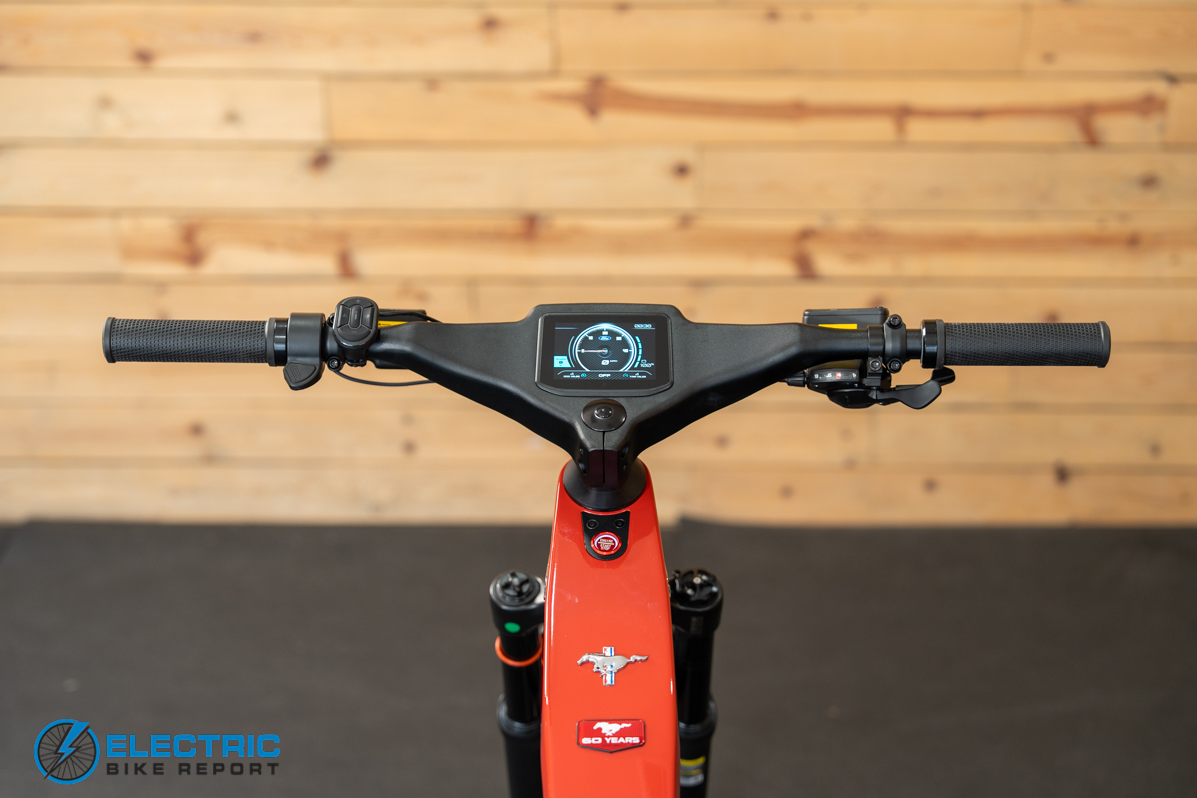
The beefy single-piece stem and handlebar unit looks great, but has some drawbacks.
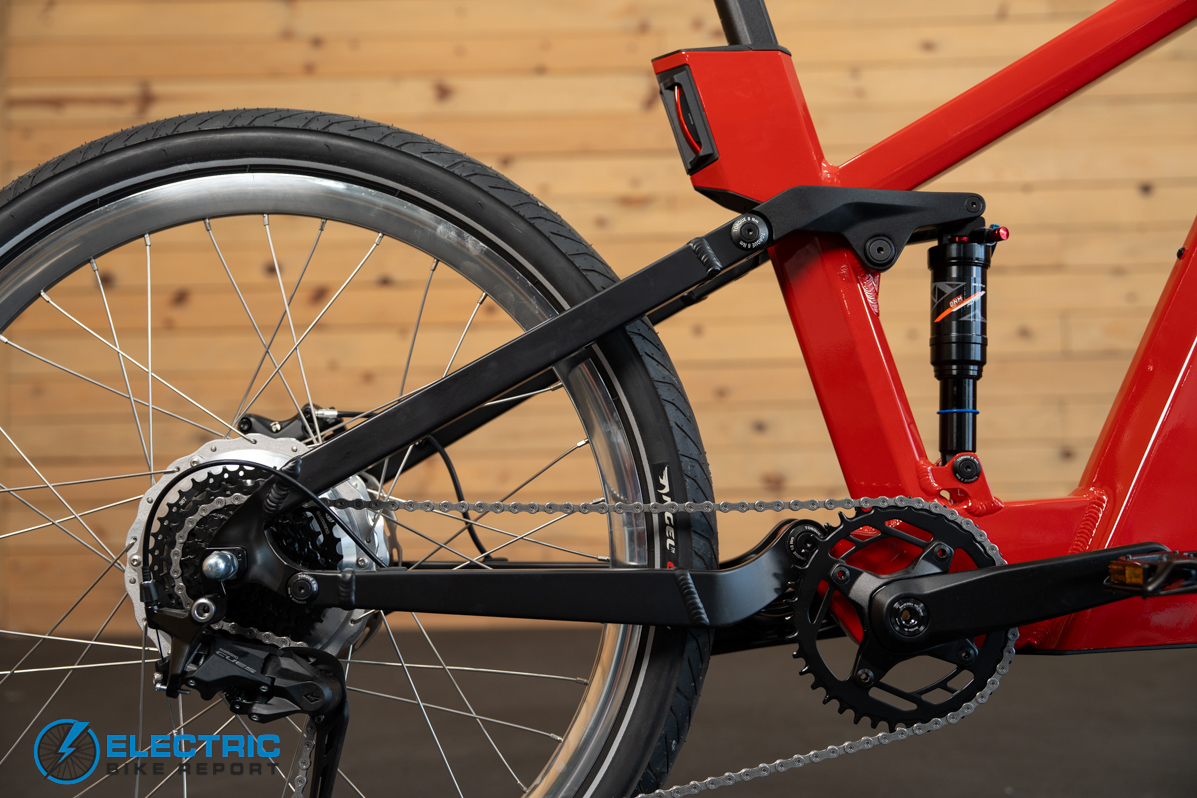
The rear shock helps to keep the ride soft and smooth at all times.
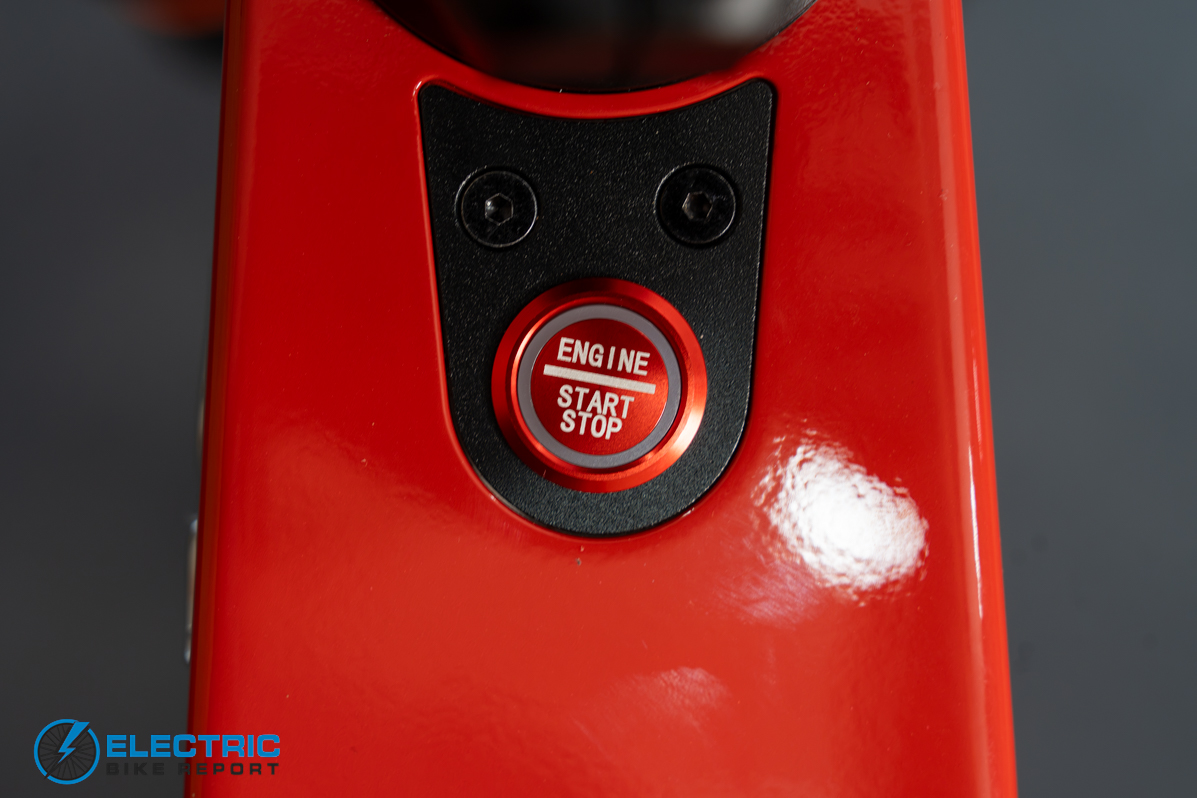
Riders turn the bike on and off via a red button on the down tube.
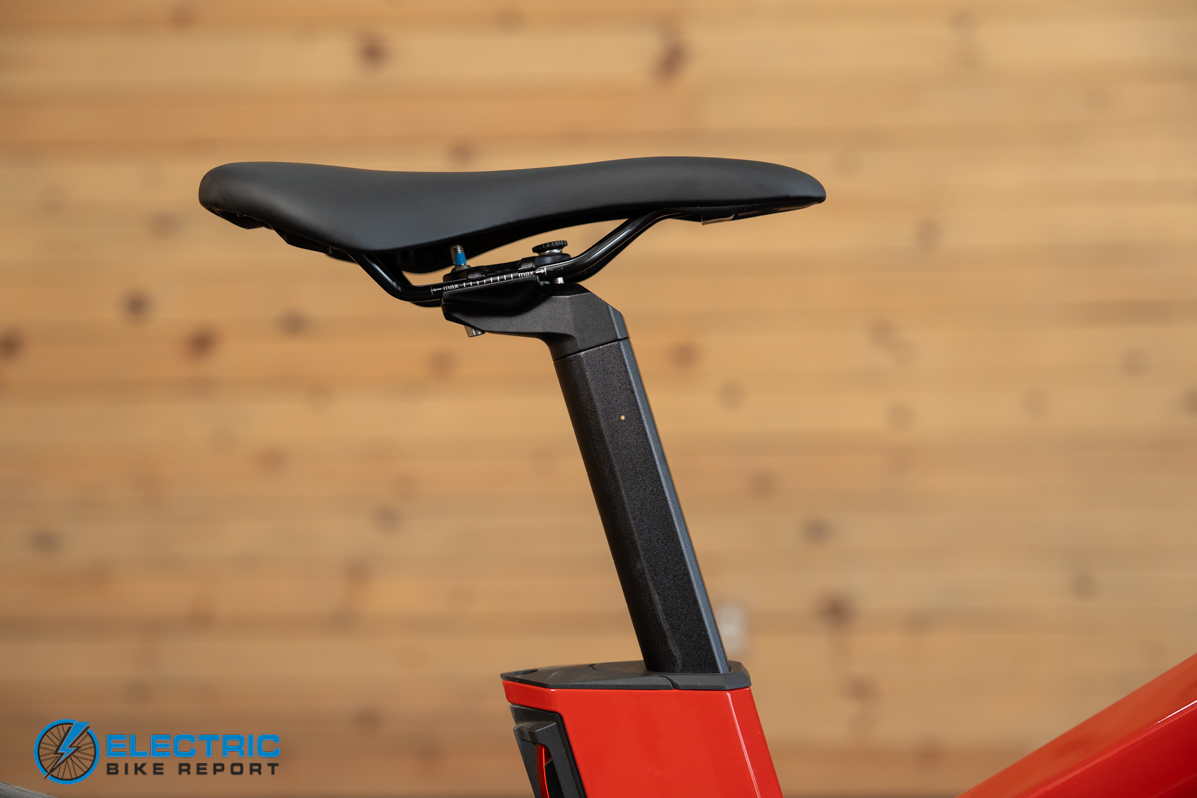
The Mustang’s saddle is slim and sporty, with a largely adjustable height.
N+ Ford Mustang eBike Review: Ride Quality
In my experience, the N+ Ford Mustang eBike approaches the subject of ride quality somewhat differently than many of its peers. While many commuters focus on maximizing comfort and utility, the Mustang prioritizes sportiness and style. As we’ll discuss, the bike is indeed comfortable to ride, but its cool factor undoubtedly takes center stage.
For real—this bike feels aggressive, fun to ride, and something that you want to pedal fast. If our bright Rangoon Red test bike is anything to go by, it will also get some attention from passersby; I noticed both pedestrians and drivers of cars giving the Mustang a double-take as I (or they) passed.
While not as severe as a road bike, its riding position is decidedly forward-leaning. I found its feel to be appropriately athletic and well-balanced by the smoothness of its full suspension. The 120mm Zoom air fork and DNM air shock offer adjustable comfort for softening bumps and rough or cracked pavement.
As for sizing, N+ offers three size options: a Small for those 5’6″ and under, a Medium for riders between 5’7″ and 5’11”, and a Large intended for those between 5’11” and 6’3″. I rode the Large frame, so I found myself on the low end of its recommended height range; I felt somewhat stretched out due to its size, but it generally fit well overall.
Contact points were somewhat on the firm side, though I make that statement through the lens of personal preference. Many riders may appreciate the default setup, though I’d likely prefer a slightly softer saddle and more supportive ergonomic rubber grips.
Adjustability is somewhat of a mixed bag on the Mustang. I appreciated that the bike’s saddle height could be set anywhere within a 10.5″ range of adjustment; this amount of flexibility is uncommon. Riders can also slide the saddle on its rails for small reach adjustments, though larger tailoring of the bike’s fit is limited.
As with other N+ models we’ve tested, the Mustang eBike features a 710mm single-piece stem/handlebar with an integrated color display. This setup looks clean, high-tech, and appealing, but by its nature, it doesn’t allow riders to swap the stem or handlebars to make large adjustments to handlebar height, width, or reach.
We encourage N+ to opt for a more adaptable system in the future—which might also provide more real estate on the handlebars for riders who want to add mounted accessories.
Otherwise, the cockpit setup is generally well laid-out, with the bike’s remote/control panel and a throttle lever on the left side and a trigger-style shifter on the right. I appreciated that the bike’s operation was relatively straightforward and easy to grasp. There are no apps to pair with, complex settings menus full of options, or an overload of buttons or modules.
As for handling, the bike felt planted but also well-balanced and nimble. The Mustang’s Pirelli Angel Urban GT tires are some of my personal favorites, as their minimal tread allows for fast acceleration, while their relatively gummy compound helps keep the bike stuck to the road.
Overall, the bike is well-outfitted. N+ equipped it with many name-brand components, which suggests solid long-term performance and serviceability. As for accessories, I liked that the large, bright headlight offered both high and low beams—the Mustang-inspired three-bar tail/brake light is cool, too.
A front fender can be added, and I’d love to see turn signals on the next iteration of the bike. N+ also offers a Unit 1 smart helmet that can pair with the bike, that includes integrated lights. Riders who choose to add this accessory can customize the light patterns using the Unit 1 app.
In summary, the Mustang’s overall ride quality largely matches its appearance and inspiration.
Sponsor
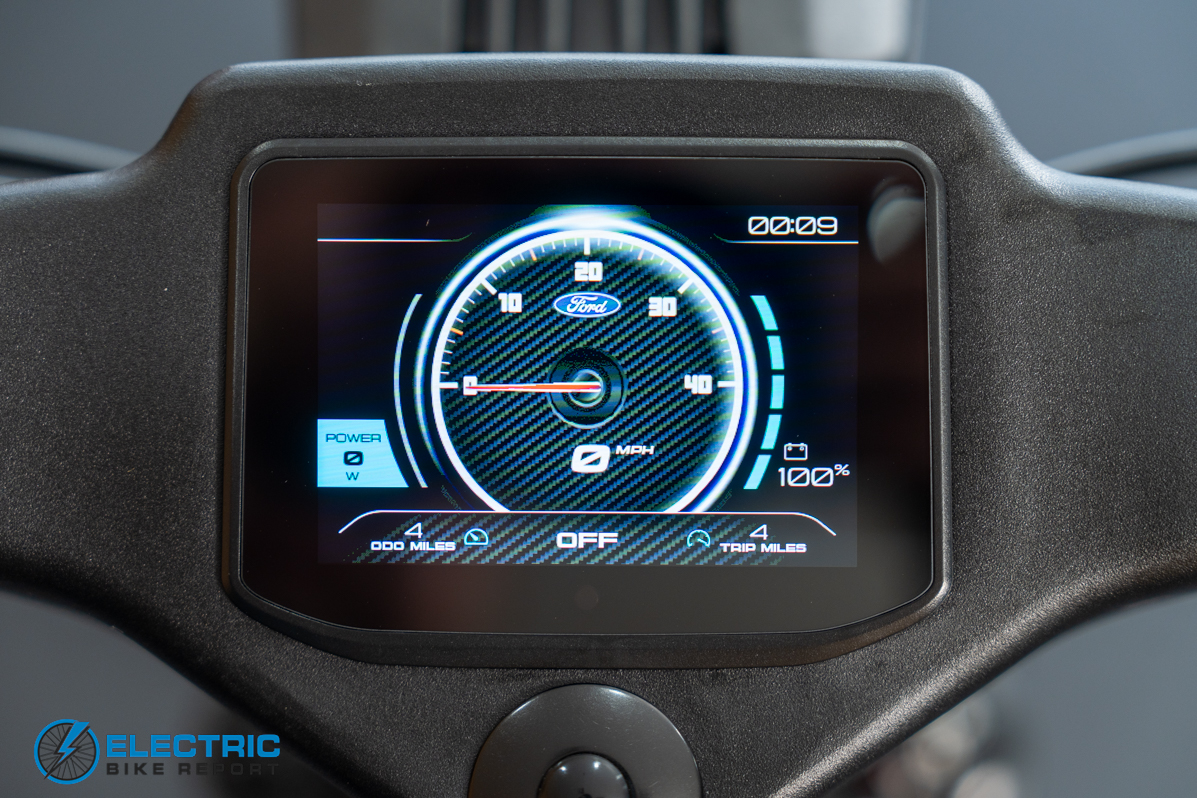
The large color display features Ford branding and a simulated speedometer gauge.
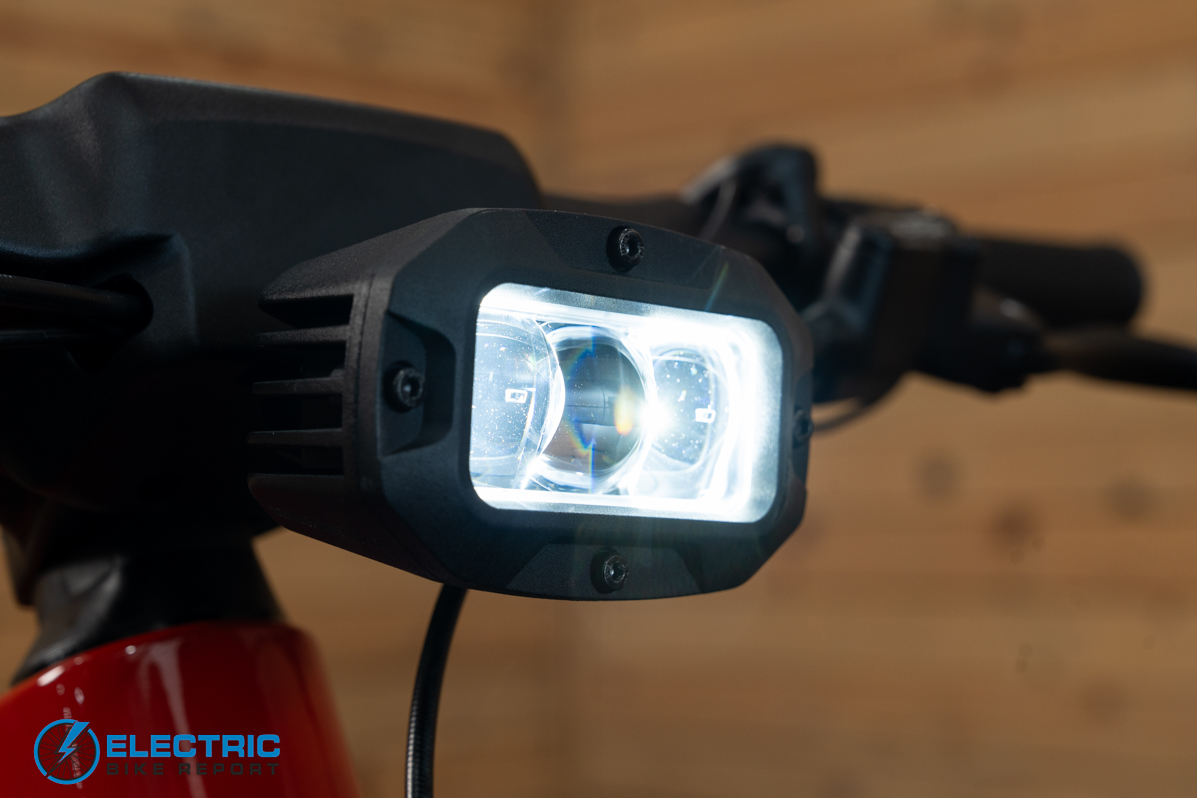
A bright and powerful triple-LED headlight with high and low beams illuminates the road ahead.
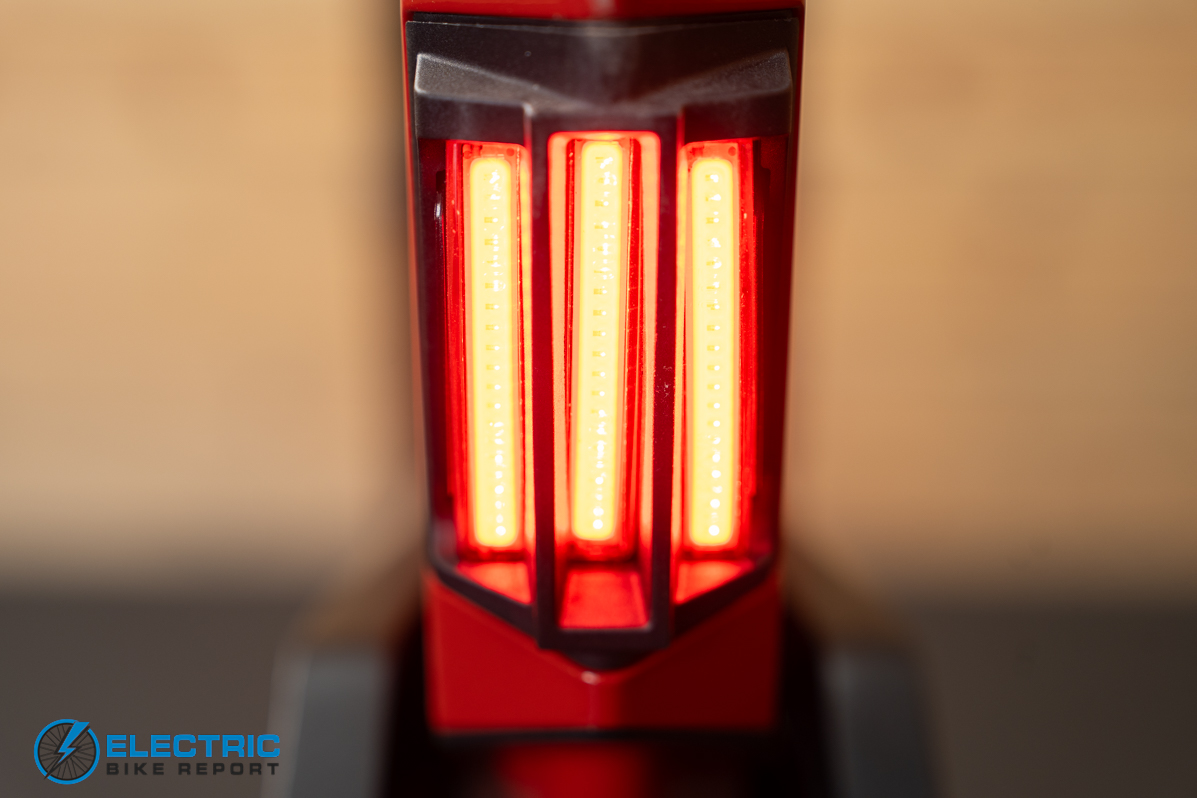
Even the bike’s tail/brake light is heavily inspired by the Ford sports car.
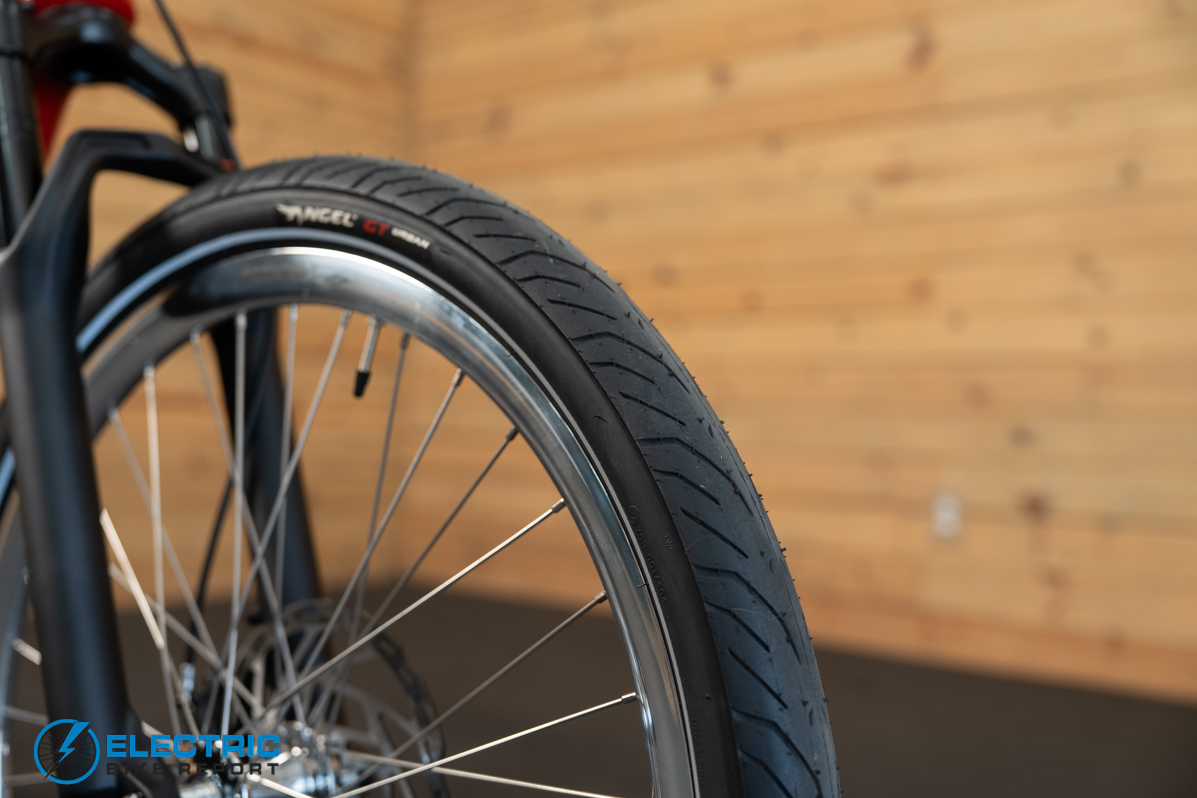
27.5 x 2.25″ Pirelli Angel Urban GT tires offer excellent traction and low rolling resistance.
N+ Ford Mustang eBike Review: Summary / Where to Buy
There’s something special and memorable about an e-bike that feels like a sports car, and while I enjoy the opportunity to test a variety of e-bike styles, I admit that I was particularly excited about this one. It’s not every day that I have the chance to ride a bike with such iconic heritage, and the fact our test bike was the red 60th Anniversary Edition was the icing on the cake.
As with other N+ Models we’ve tested, the Mustang is a unique, sharp-looking, and thoughtfully crafted e-bike with a solid component package. In terms of performance, the bike’s brake test score was a standout, with other areas measuring up well in comparison to its competitors.
Our testing showed that the bike’s range is useful for a variety of purposes, from daily commuting to exercise or leisure. Its climbing power should be sufficient for most riders, offering a relaxed pace to throttle users and an active feel for those who enjoy pedaling. Its pedal assist system delivers responsive, natural—and, most importantly, rewarding power.
Still, like all e-bikes, the Mustang has some room for improvement. We’d love to see a removable battery in the future to make charging, maintenance, and eventual replacement more user-friendly. Additionally, we encourage N+ to use a different stem and handlebar setup with parts that could be changed out to adjust the bike’s fit and feel.
One of the things I appreciated most about the Mustang, however, is that it didn’t go the route of feeling like a motorcycle; instead, it feels very aware of the fact that it is a bicycle. It offers the sporty look, handling, and feel of a Mustang, while still giving its rider a true cycling experience.
Overall, the Mustang eBike succeeds at what it set out to do; it offers a cool, highly aesthetic, sporty, and fun-to-ride e-bike to anyone who finds its automobile-inspired design appealing. We could see it parked in a garage next to a modern or classic Ford Mustang, used as a decorative visual statement, or ridden for the daily commute by Mustang enthusiasts.
Happy Riding! Make sure to let us know if you have any questions or if you think we left anything out in this review of the N+ Ford Mustang eBike down in our comments section.
Sponsor
Sponsor
Reader Interactions
Comments
Leave a Reply




No kickstand, I’ll pass.