Momentum Vida E+ EX Review | Living Life in the Fast Lane
Aug 17, 2026
 0 Comments
 Share
Share
A cruiser/commuter hybrid for those who appreciate comfort, smoothness, and speed.
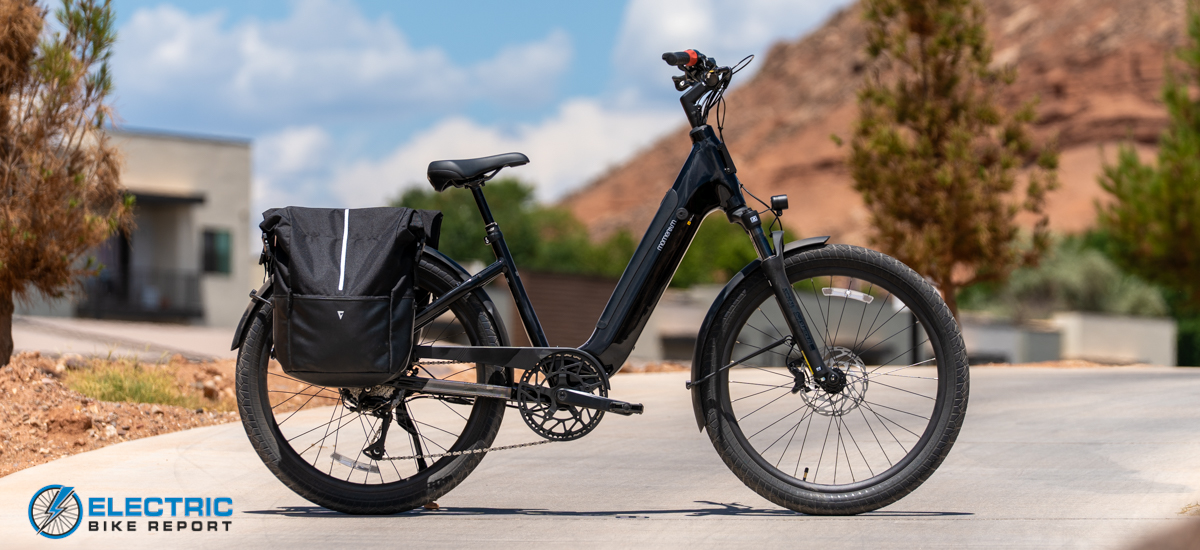
E-bikes are often complex and nuanced, so it can take some time to understand one’s personality and feel. Programming can change a bike’s behavior in subtle ways when switching between different modes. Some can even have unique characteristics that only become apparent after repeated testing. In short, what you see isn’t always what you get.
Other bikes, like the Momentum Vida E+ EX, show you who they are right away. From the moment I jumped on the saddle for a short ride across the parking lot, I could tell that the Vida prioritized three things:
First, a comfortable, cruiser-influenced riding experience. The bike’s swept-back handlebars, ergonomic rubber grips, sturdy suspension fork, wide tires, and supportive saddle combined to give it a cushy, relaxed, and enjoyable feel. I instantly felt right at home, like I wanted to head out for an hour-long adventure on the local bike paths.
Second, a responsive, helpful pedal assist system. The bike’s 500W motor is paired with three different sensors (torque, cadence, and speed) to deliver power in proportion to your effort. Even in its lowest assist level, the Vida E+ EX felt generous and rewarding, making pedaling both fun and easy.
Finally, a user-friendly design. The Vida pairs with Giant’s RideControl app to expand its functionality, but riders who don’t want to get too technical can enjoy a relatively simple control layout, an uncrowded cockpit, and three intuitive power levels.
Additionally, the bike’s step-thru frame makes it easy to get going, and the adjustable seatpost makes stops and starts feel controlled and balanced.
Clearly, the bike left a great first impression, but many questions still remained. Did the Vida E+ EX provide good value? Did its feel match its performance data? Would the highlights from this first test ride fade with more time in the saddle? Continue reading our full review below to find out!

Sponsor
E-Bike Category:Commuter / Cruiser
E-Bike Class:Class 3 (pedal assist to 28 mph)
Sponsor
Momentum Vida E+ EX Video Review
 Pros
Pros- Pedaling feels extremely smooth and responsive, and the 500W hub motor provides power that ranges from subtle and natural to ample yet controlled.
- The ride is also seriously comfortable, thanks to the combination of an 80mm suspension fork, ergonomic handlebars and grips, 2.4″-wide tires, and a supportive saddle.
- The included dropper seatpost allows riders to quickly adjust saddle height for efficient pedaling and the option to put your feet flat on the ground when stopped.
- The Vida E+ EX’s brake system is fantastic, giving it one of the shortest stopping distances we’ve recorded from similar e-bikes in our Brake Test.
- As a Class 3 e-bike, the Vida E+ EX offers pedal assist up to a speedy 28 mph right out of the box. Many similar models are limited to 20 mph by default.
- We found it intuitive and easy to use, with three assist levels, a basic but useful set of features, and a relatively simple user interface.
- Giant’s RideControl app offers easy speed adjustment and turn-by-turn navigation.
- Momentum’s dealer network is huge, offering nearby post-sale service and support to most customers.
 Cons
Cons- Considering the bike’s price point and marketing language (i.e. “throttle e-bike”), we’d like to see the currently optional throttle included where legal.
ELECTRICAL SPECS & FEATURES
- Battery: Energy 700 46.8Vdc 14.7Ah, 48V
- Charger: 48V 3A charger
- Display: RideControl Dash Core, high-angle visibility, full color LCD display
- Motor: SyncDrive Move S, 60Nm, 48V, 500W Rear Hub Motor
- Headlight: Integrated LED
- Taillights: Integrated LED w/brake signal
- Pedal Assist: 3 support levels
- Claimed Range: 40-55 miles (Pedal assist), 31-43 miles (throttle assist)
- Throttle: Optional Half-Twist
- App: Giant RideControl
- UL Certification: UL 2271 & UL 2849 Certified
Weight & Dimensions
- Claimed weight: 66 lbs
- Tested Weight: 67.8 lbs
- Rider height range: 5′ 1″ – 5’9″ (S), 5’8″-6’3″ (L)
- Total payload capacity: 300 lbs (includes bike, rider, cargo, and accessories)
Components & Accessories
- Brakes: 4-piston (F) 2-piston (R), hydraulic disc, 180mm [F&R]
- Fenders: Standard (MMT gear)
- Fork: SR Suntour XCM 34 Boost DS Coil 80mm travel 15×110 AH axle
- Frame: ALUXX aluminum, Low step thru, integrated lock mount
- Drivetrain: Shimano Acera, 8-speed, 52T chainring, 11-40T cassette
- Grips: Momentum comfort grip
- Saddle: Momentum saddle w/ Rear Handle
- Seatpost: Giant Contact Switch AT, 30.9mm travel-adjust dropper post
- Handlebar: Momentum aluminum, 20° Back Sweep, 50mm Rise, 31.8x720mm
- Kickstand: Direct mount kickstand
- Pedals: Friction Top platform type
- Tires: 26×2.4″
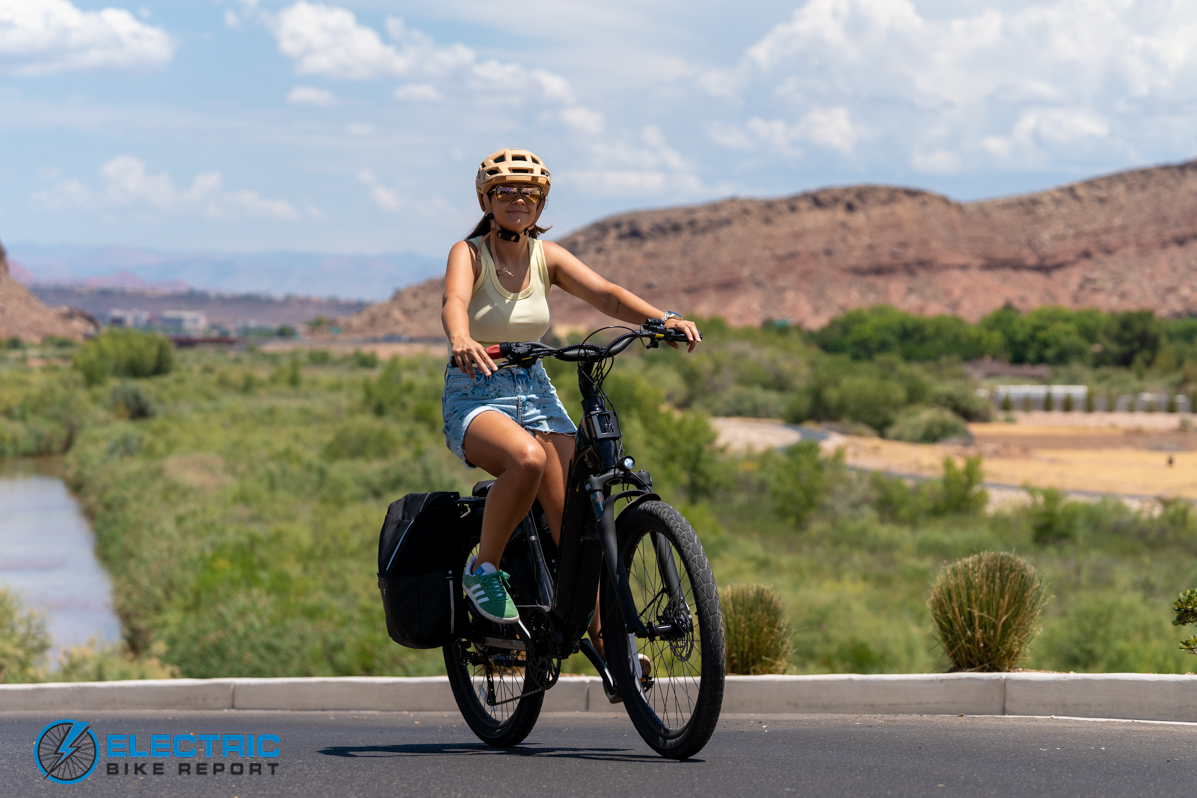
Comfort is one of the Vida E+ EX’s primary areas of focus: it feels cushy, smooth, and generally enjoyable to ride.
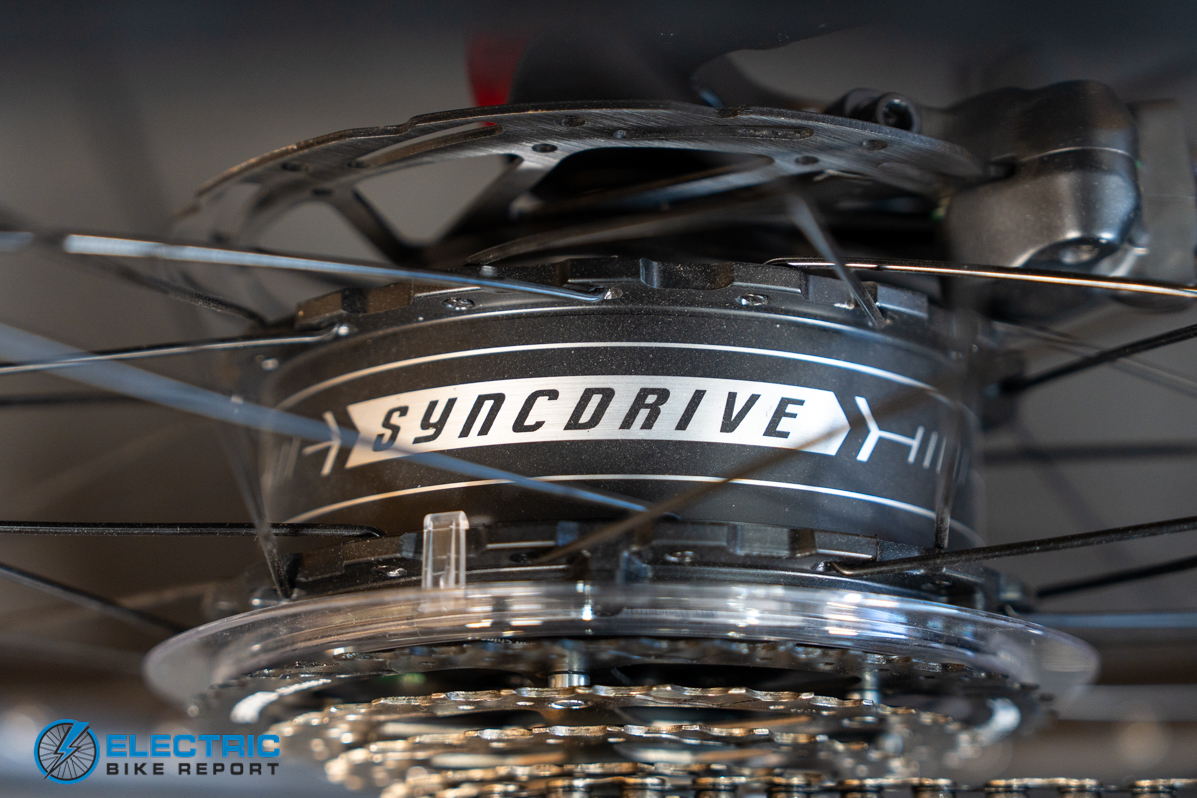
A 500W SyncDrive motor produces up to 750W of peak power and 60 Nm of torque.
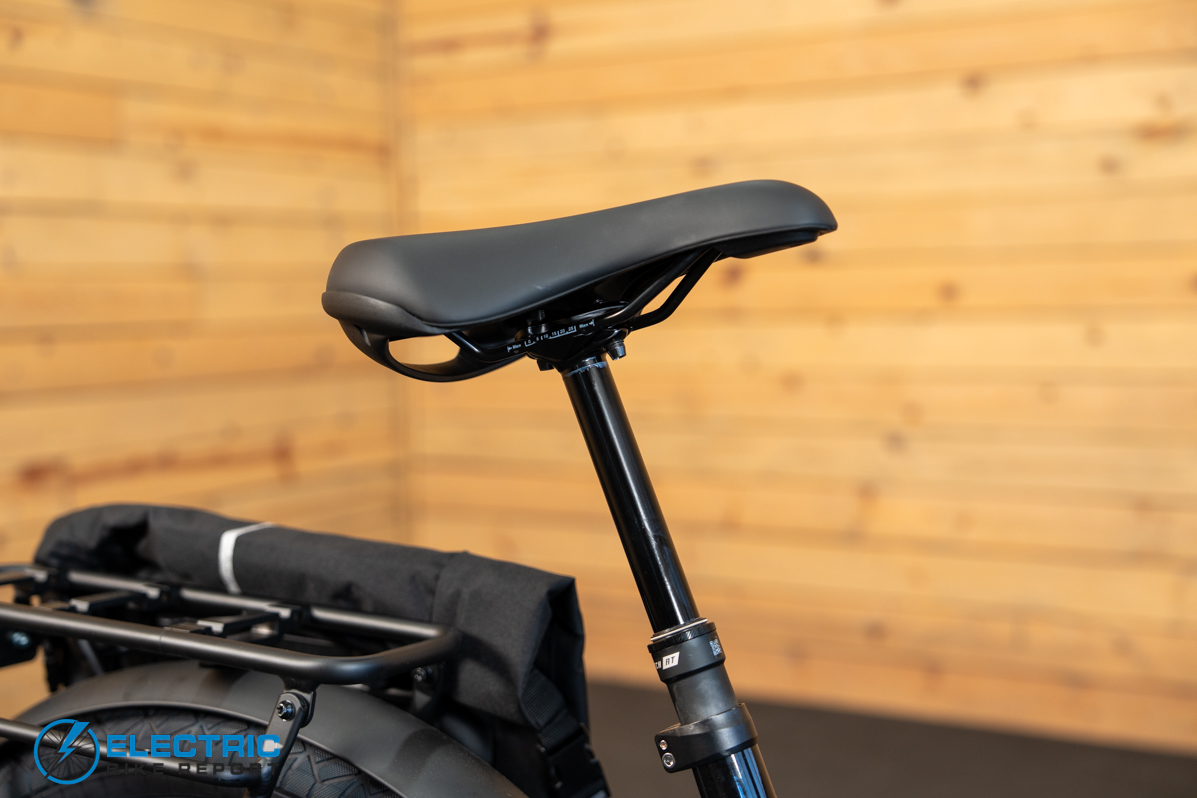
The bike’s saddle is mounted to a dropper seatpost with 140mm of travel.
Momentum Vida E+ EX Review: Speed Test
Our Speed Test measures how a bike performs across its full range of assist levels. It tells us a few things: how fast the bike can go, how much effort the motor asks from the rider in return, and how the bike’s power is distributed across each of its assist settings.
We tested the Vida E+ EX in both its default Class 3 configuration and at Class 2 speeds, pedaling a flat, paved trail with relatively consistent effort through all three assist levels in both settings. Momentum included the optional throttle on our test bike, so we also evaluated its acceleration and programming.
To start the test, I pedaled without the motor contributing to the bike’s movement. There, the bike felt lighter and easier to move than its actual weight would suggest. The bike’s gearing range made riding without power both possible and enjoyable.
When its pedal assist system is engaged, the Vida E+ uses a combination of sensors to deliver power smoothly and responsively. It reacts and responds to the amount of pressure on the pedals; riders pushing harder get more power and speed, while those using a casual level of effort get a slower and more relaxed experience.
In the default Class 3 mode, the jump from unassisted riding to Eco was the largest single movement: nearly 10 mph of additional speed with the same effort. This result shows that the motor delivers a generous amount of power even in its lowest setting; Eco felt the most like riding an analog bike, but it was also seriously rewarding.
The middle assist level, Active, felt proportional, with the motor and my legs sharing the load roughly equally. This setting made for a useful, comfortable cruising mode. Power mode required very little effort to move the bike, though it asked for a higher cadence and some added pedal pressure to reach 28 mph.
In Class 2, my Eco result was similar to that of my initial test. The 20 mph ceiling compressed the upper results; in Active and Power, there was a clear sense of the motor holding back more than it did in Class 3, though each assist level still delivered a noticeable jump in speed.
On the throttle, acceleration from a stop was gradual at first, then the motor engaged more fully after a few seconds and built speed in a controlled ramp. Riders who add the optional throttle should anticipate that short lag; it may feel somewhat delayed, but it still seemed usable and practical for starting up or getting off the line at an intersection.
Overall, the Vida E+ EX’s three-level Class 3 system is well-calibrated for a range of riding styles: Eco suits a casual pace or light workout, Active covers most commuting needs without much effort, and Power brings the Class 3 ceiling within reach for riders that crave higher speeds and who are willing to put in a little more leg work to get it.
Sponsor
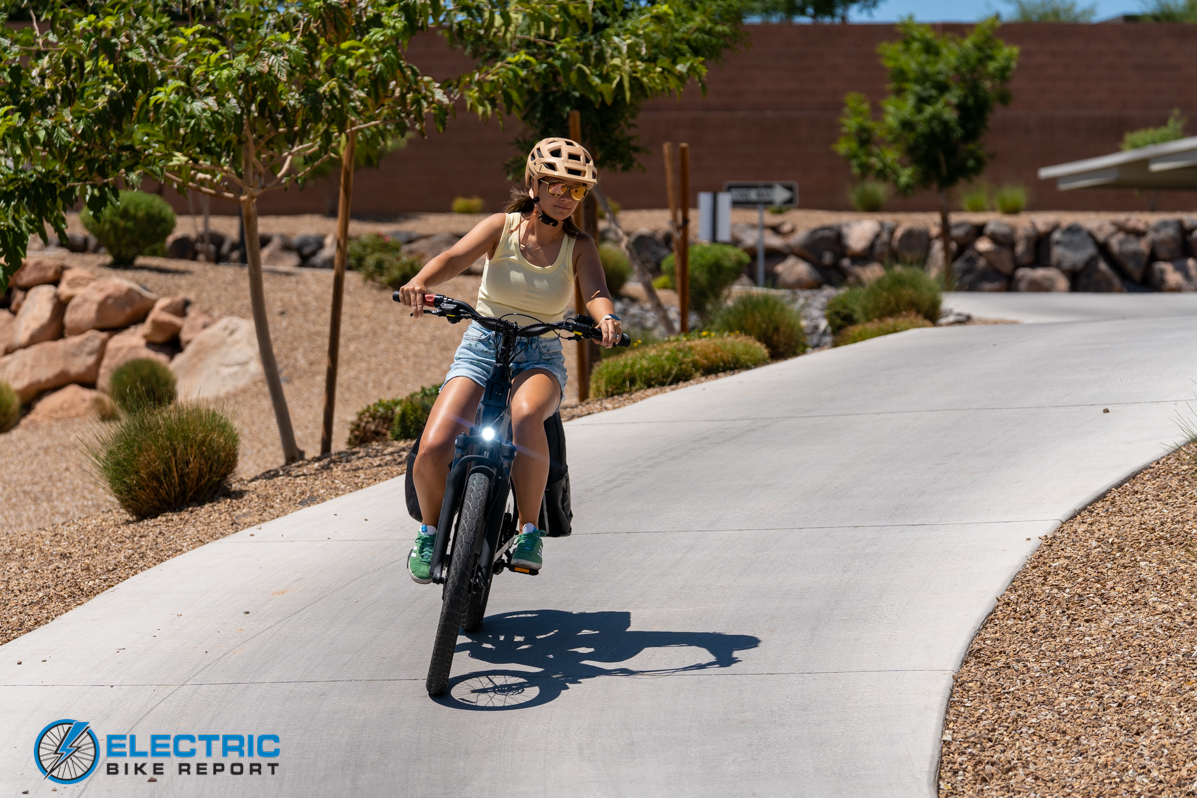
As a Class 3 e-bike, by default, the bike pedals up to 28 mph but does not come equipped with a throttle.
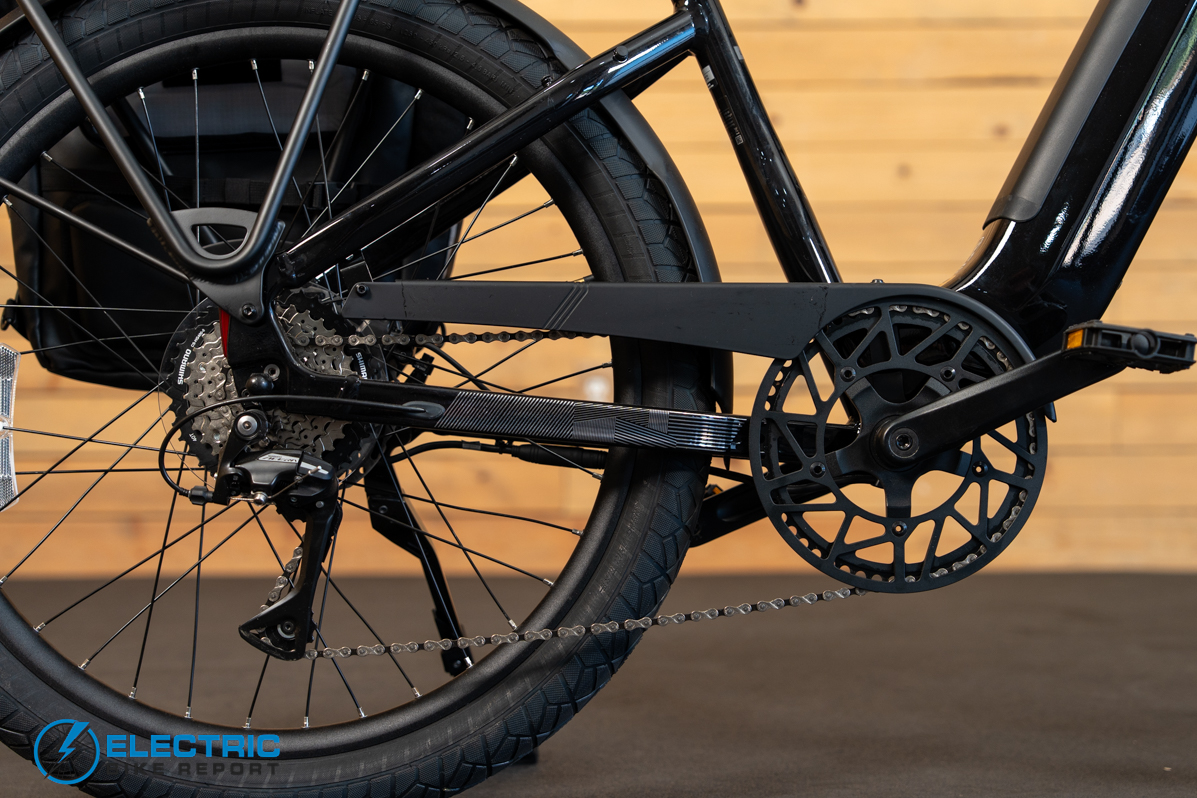
The chain for the 8-speed Shimano Acera drivetrain is covered by an included chain guard.
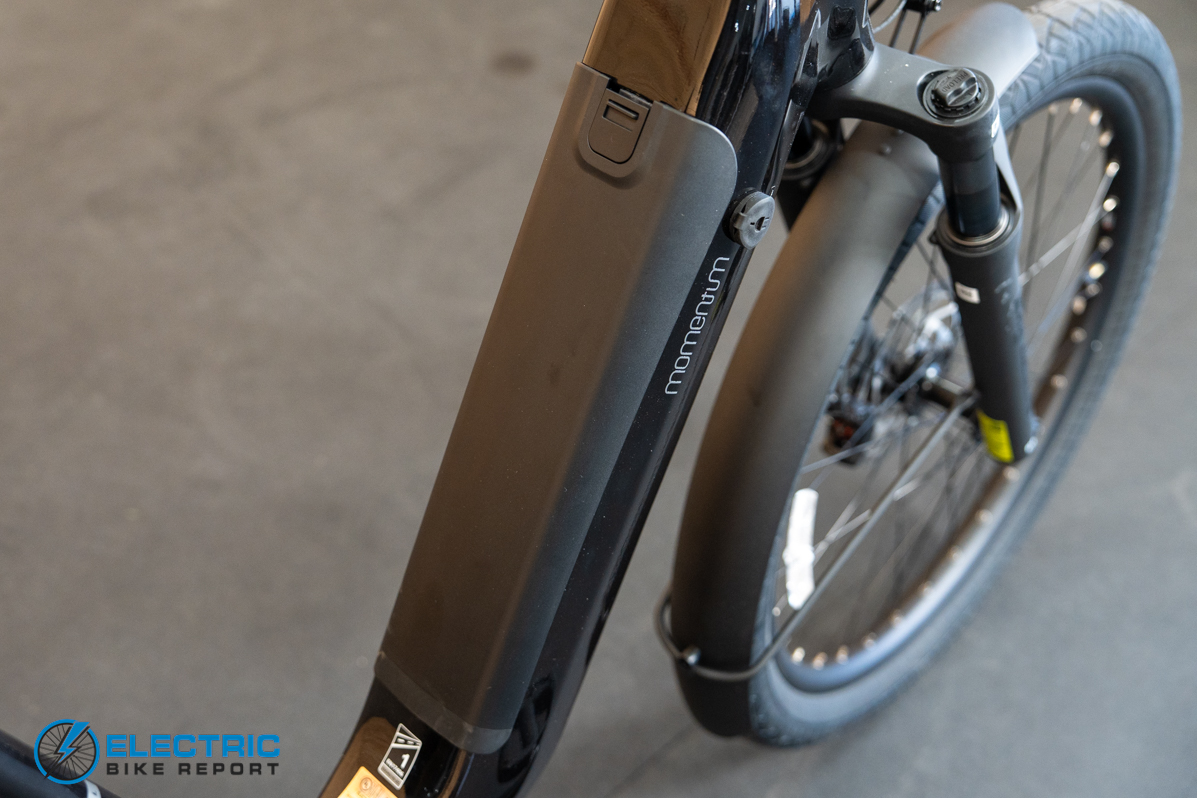
The 700 Wh battery nests completely into the Vida E+’s down tube, but it can be removed for charging.
Momentum Vida E+ EX Review: Range Test
Range is typically one of the first subjects buyers ask about, since it determines how many miles the bike can actually cover—and whether that distance includes all the places you need to be. In our test, we pedal on a paved shared-use path in both the highest and lowest practical assist levels until the bike’s fully-charged battery is depleted. This approach gives us consistent, comparable data across every model we test.
Our Power mode result came in at 33.7 miles. The Eco result of 58.5 miles comes from our earlier test of the previous Vida E+ model, which shared the same 500W motor, 700 Wh battery, and near-identical weight. Both versions’ Power results came within a mile of each other, which gave us confidence in carrying the Eco figure forward from our earlier test.
Both results fall below the category averages for similar commuter and cruiser-style e-bikes we’ve tested: 38.5 miles for the high-power test and 74.5 for the low-assist trial. The Vida E+ EX trailed those averages by 4.8 miles and 16 miles, respectively.
At 700 Wh (technically 688 Wh), the Vida’s battery capacity is nearly identical to the category average of 709 Wh, so battery size alone does not explain the difference.
In the area of energy consumption, however, there was a clear reason for the Vida’s lower results. Using the bike’s mileage and battery capacity, we calculated that it expended roughly 2 more watt-hours per mile than average in both tests: the Momentum used 12 Wh/mi in Eco against a category average of 10, and 20.8 Wh/mi in Power against 18.7.
This higher-than-average expenditure made some sense following the results of our Speed Test; its motor puts out an ample amount of power even in the lowest assist level, feeling lively and helpful in all modes.
For most commuters, a minimum range of 33.7 miles should cover even a lengthy round trip with room to spare; many riders should expect a couple of days of commuting before needing to recharge. Those using the bike for shorter leisure rides or errand running may see many trips before the battery charge drops to that point.
FYI: the included 3A charger refills a depleted battery in approximately 5 hours, so I’d recommend using a timer if charging overnight.
As a caveat, we conducted our test on paths with a 20 mph speed limit, so we never approached the Class 3 ceiling of 28 mph. Riders who regularly push to that speed should expect fewer miles per charge than our results reflect.
Overall, the Vida E+ EX’s range window of roughly 34–58 miles is practical for most everyday riders, covering a daily commute at higher power with more available as you dial the assist back.
Sponsor
Sponsor
Momentum Vida E+ EX Review: Hill Test
Much of the popularity of e-bikes comes down to their ability to make riding more enjoyable—and few things make as much of an impact on that as hills. The results of our Hill Test tell you what an e-bike’s motor can do in real-world conditions when the road gets steep and pedaling is more difficult.
Because this version of the Vida E+ EX shares its motor and battery with the previous Vida model, differing in tested weight by less than a pound, we carried forward the results from our earlier Devil’s Backbone test rather than performing a second climb.
When we tested the Vida E+ on throttle alone, our rider Justin finished in 2:17 at an average of 13.2 mph. Similar e-bikes we’ve tested averaged 2:00, so the Vida was 17 seconds behind. Using its highest level of pedal assist, the bike’s time was 2:19 at 13.0 mph, 25 seconds behind the category average of 1:54.
To be clear, the bike effectively made a difference when climbing, but there is no disputing that it was on the slower side. The reason it fell somewhat behind was clear: less motor power means slower climbing.
The Vida’s SyncDrive Move S is rated at 500W, peaks at 750W, and produces 60 Nm of torque. The averages among comparable bikes in our dataset, which are often equipped with 750W nominal motors, are 1,131W of peak power and 81 Nm of torque. In both cases, the Vida E+ had less force to apply, making it slower to reach the finish line.
In my personal testing, I took the bike to our secondary test location, Pilot Hill, to get a feel for its capabilities. On my first throttle attempt, which I performed on a 100-degree afternoon, the motor overheated before I reached the top, showing more sensitivity to heat than I expected.
On my second attempt, done in the morning before peak temperatures, the bike successfully reached the top, and felt steady and confident while doing so. This feeling continued in my pedal assist test, though the motor required a moderate level effort from my legs most of the way.
Elsewhere, I noticed that the bike climbs better when it has momentum to work with. On steeper sections where I wasn’t able to build up speed in advance, the motor lost power noticeably; it seemed to favor high speeds instead of low-end torque.
My takeaway from this test is that the Vida E+ EX is a capable bike for moderate, rolling terrain. Riders who deal with steep grades regularly should know that this motor will require some legwork—the bike is helpful but its experience is relatively active when riding uphill.
Sponsor
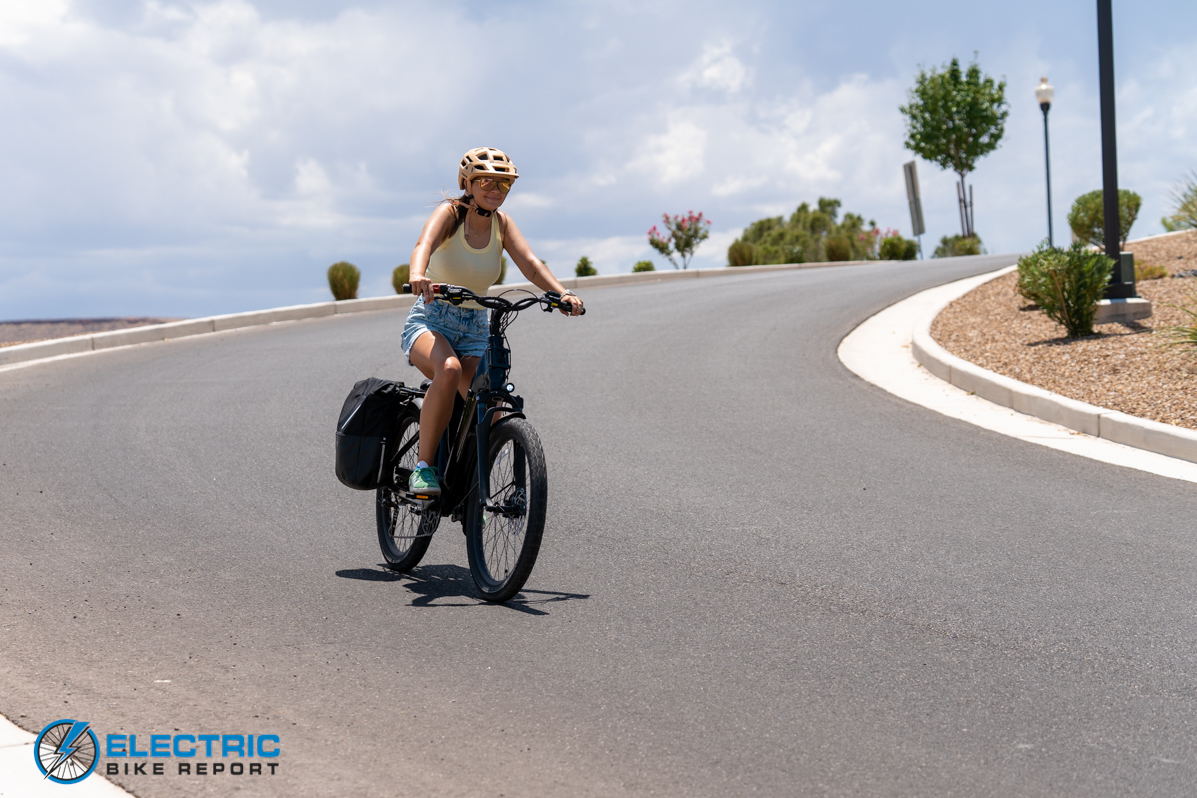
Pedaling feels smooth, natural, and relaxed, thanks to the 500W motor and combination of torque, speed, and cadence sensors.
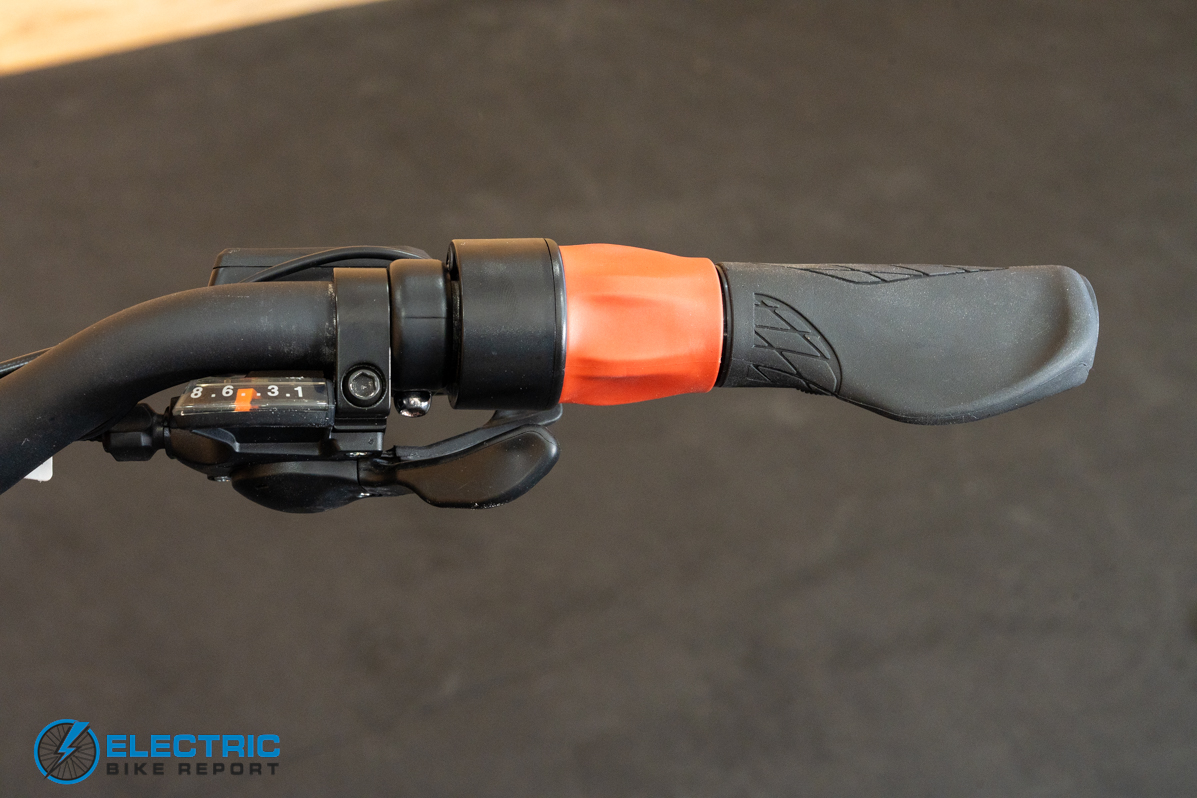
Our test bike came with the optional half-twist throttle on the right handlebar.
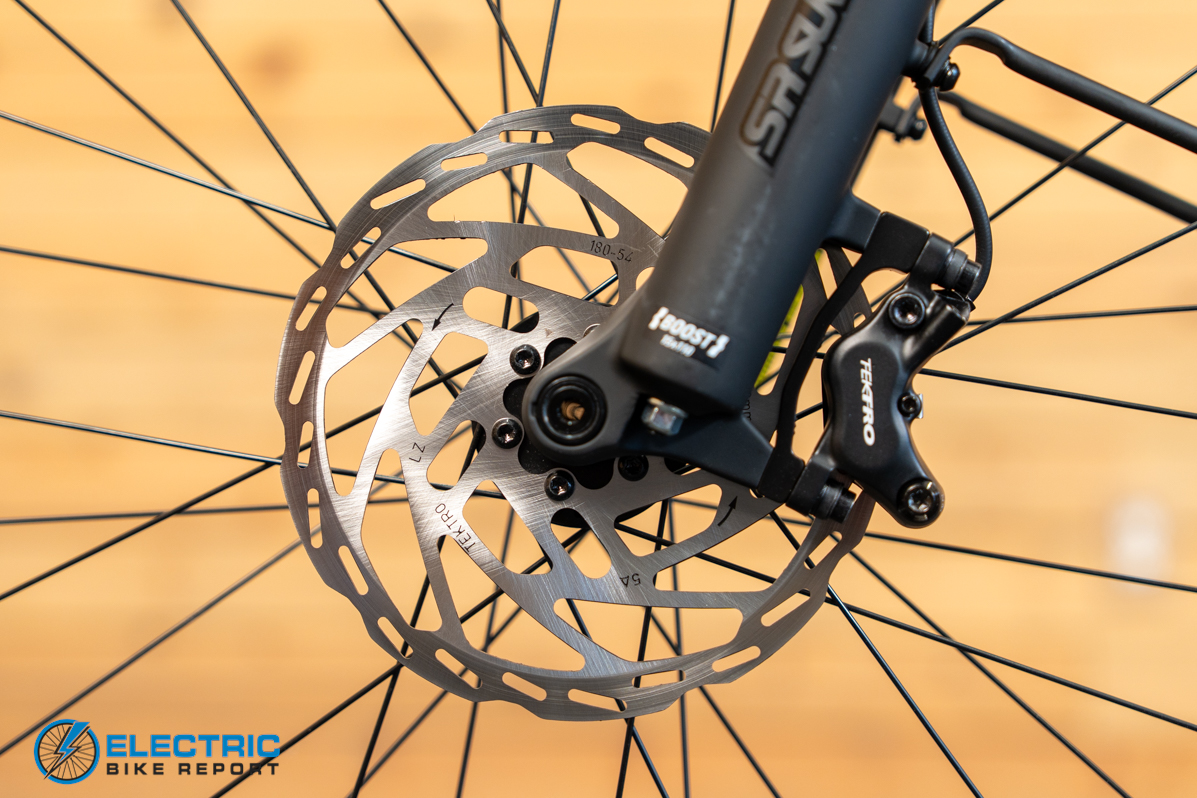
The stronger front brake setup uses a 4-piston caliper and 180×2.3mm rotor.
Momentum Vida E+ EX Review: Brake Test
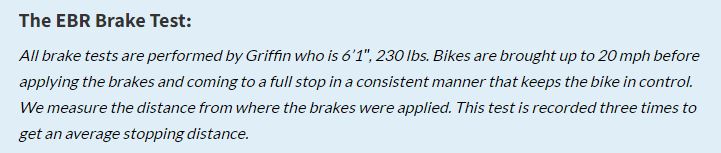
In our Brake Test, our test rider, Michael, applied the brakes at a marked line, coming to a quick but controlled stop. He measured his stopping distance from a speed of 20 mph, and averaged a distance of 17’7″ across three test runs. For context, the category average for similar commuter and cruiser e-bikes is 21’2″.
Holy smokes! That result puts the Vida E+ EX 3.5 feet shorter than average, proving that its brakes are remarkably effective.
Getting into the nitty gritty, the bike’s short stopping distance largely comes down to how its hydraulic brake system is set up. On the front wheel, Momentum paired a four-piston caliper with a 2.3mm-thick 180mm rotor. On the rear, the system has a two-piston caliper and a more standard 1.8mm x 180mm rotor.
More pistons means more brake pad contact area, which means stronger and more even clamping force when the lever is pulled. This division is smart; the front rightly gets the stronger setup because the bike’s/rider’s weight shifts forward when brakes are applied. Additionally, the thicker front rotor helps to dissipate heat, holding up to repeated hard stops without fading.
In my experience, braking force came on firm and fast when I pulled the levers. This is a powerful brake system; it came on stronger than I anticipated the first few times I squeezed the levers, though it didn’t feel unsafe. Once I had a feel for it, however, braking felt strong and predictable.
Overall, a stopping distance of 17’7″ makes the Vida E+ EX safe and easy to control. We consider the bike seriously well equipped for its size and weight!
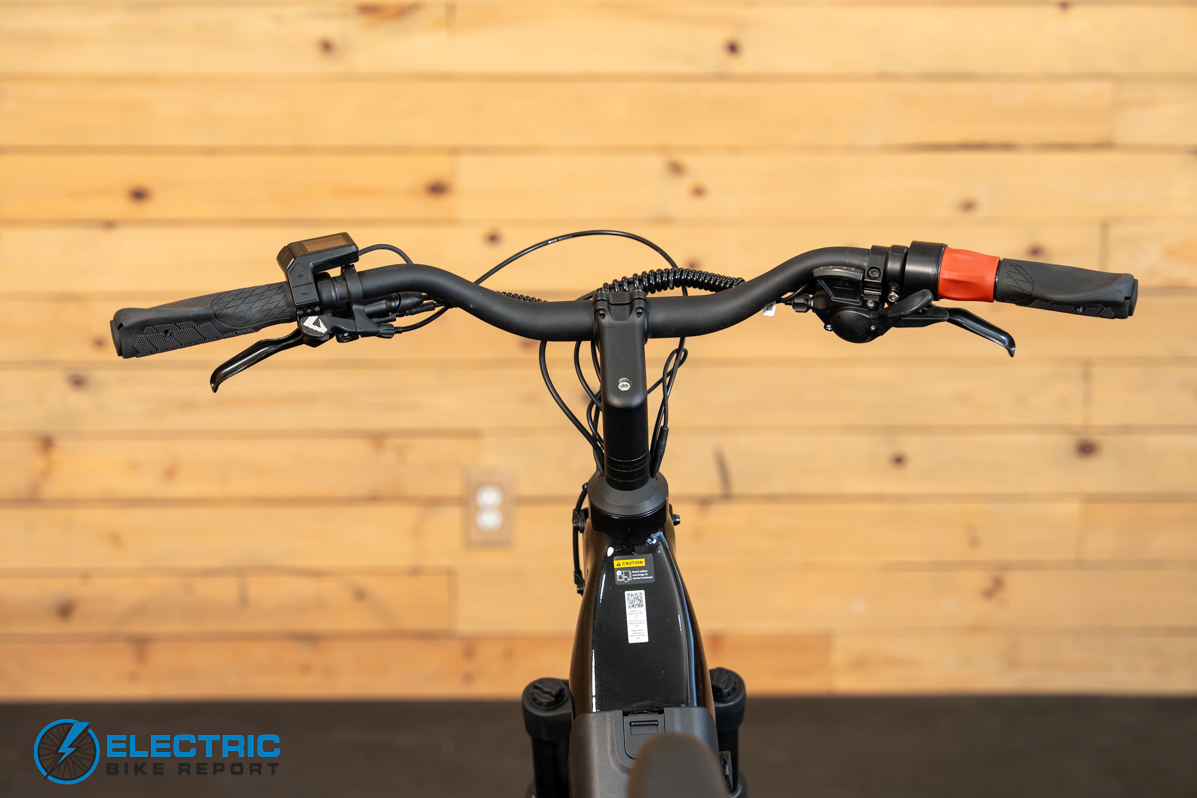
The wide, ergonomically curved handlebars provide comfort and steering control.
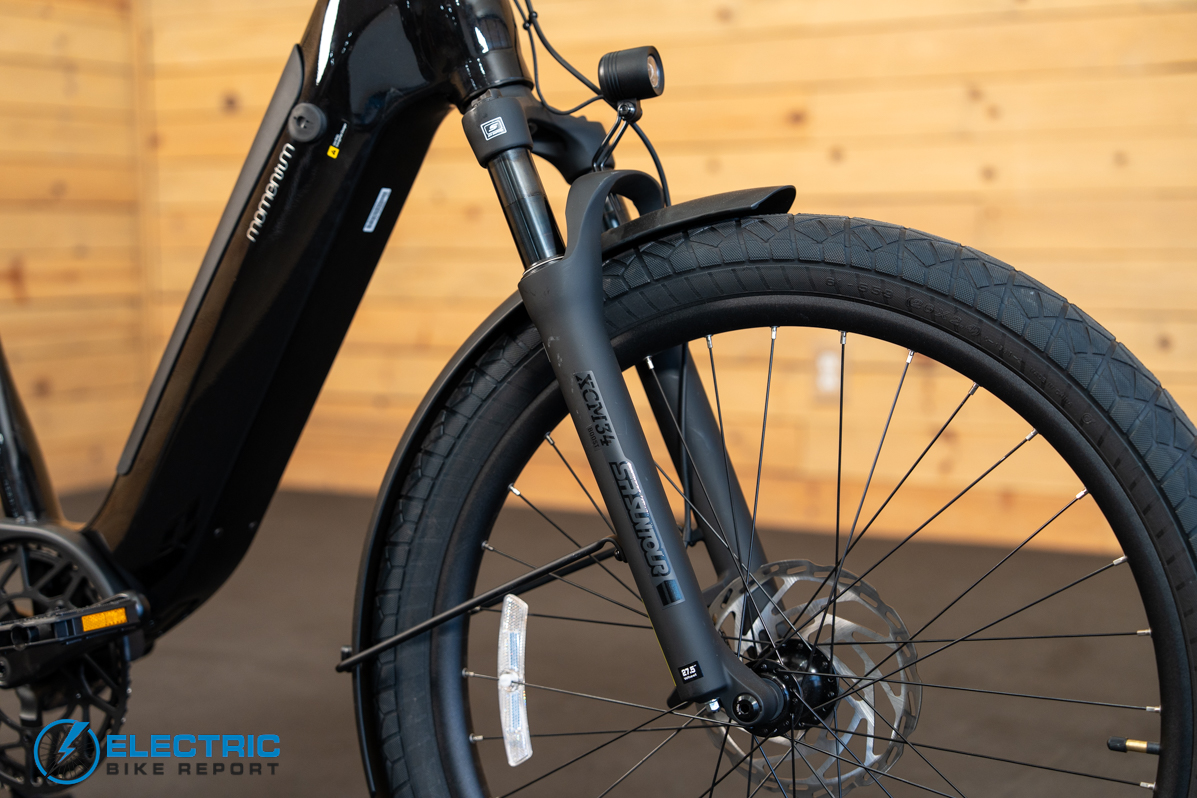
A coil suspension fork with 80mm of travel keeps the front end smooth.
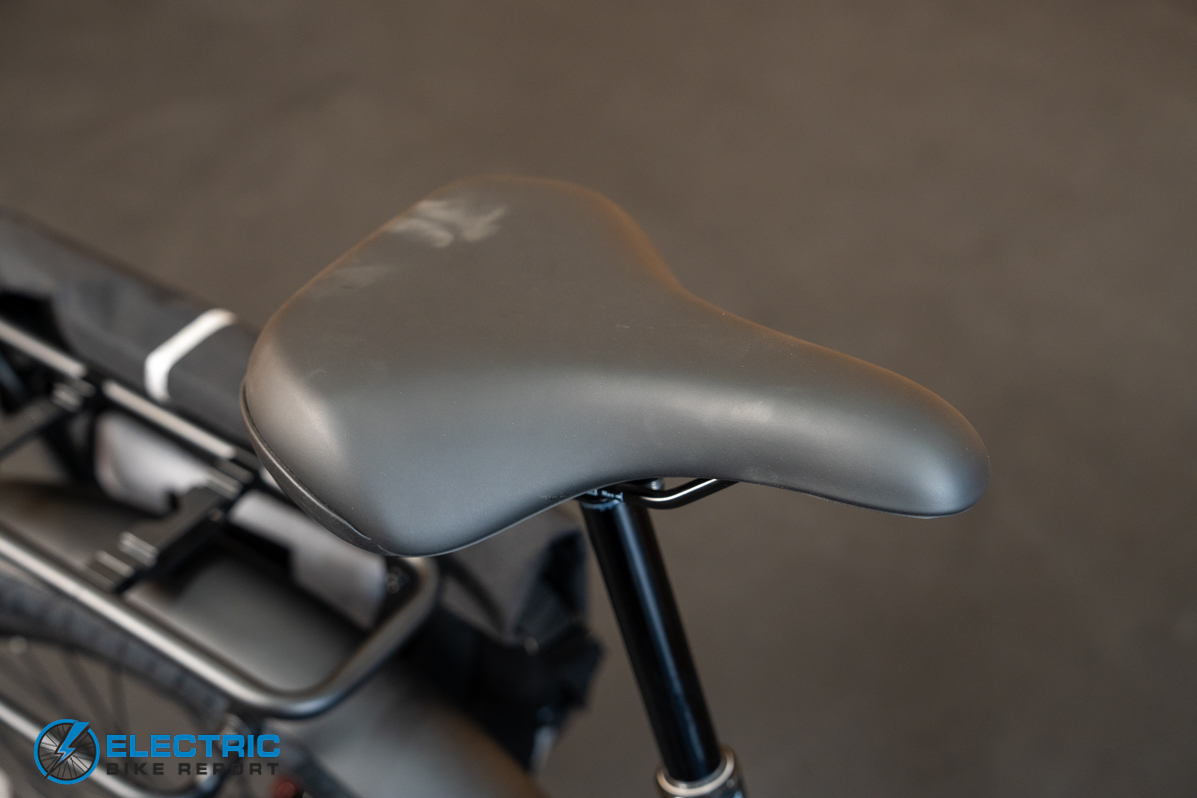
Momentum’s custom saddle is supportive and includes a handle to help move the bike around.
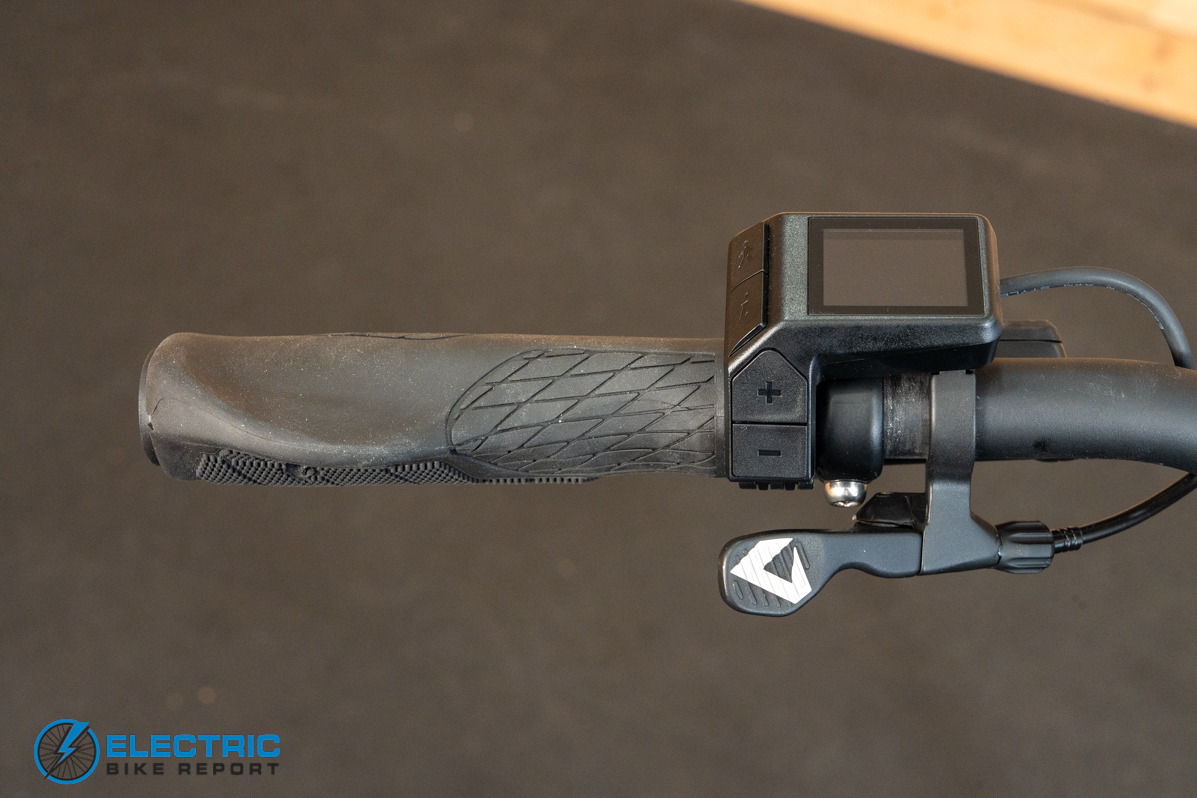
The bike’s display and dropper post lever are mounted to the left handlebar.
Momentum Vida E+ EX Review: Ride Quality
As I touched on in the introduction to this review, the Momentum Vida E+ EX felt great from the first ride. With more time in the saddle, I learned more of the bike’s subtleties, but my initial opinion never changed.
Momentum makes the bike in two sizes, each with a step-thru-only frame. I rode the large, and at 5’11”, I found the fit comfortable right from the start. Leg extension felt great, and while the reach was on the longer side, I didn’t feel overextended. The riding position was slightly forward-leaning, though I never felt like I was placing too much weight on the grips.
The swept-back handlebars were a highlight. At 720mm wide, they encouraged an upright posture, offered precise steering control, and also added to the bike’s stability. The ergonomic rubber grips felt soft and supportive throughout my testing, and the wide cushioned saddle gave me no complaints.
According to the bike’s webpage, the small frame covers 5’1″ to 5’9″, and the large fits those from 5’8″ to 6’3″. Both sizes feature a remarkably low standover height of just 16.5 inches, making the Vida friendly for those with limited mobility. In my experience, stepping through the frame is comfortable and takes little effort.
The dropper seatpost is another element worth diving into, as it isn’t something we see often on bikes of this style. Unlike this component’s purpose on an electric mountain bike, here it ensures that riders can reach the ground when coming to a stop. Its action was smooth and fast; an easy press of the lever allowed me to stand flat on the ground instead of balancing on my toes. The same action allowed me to quickly raise the saddle for efficient pedaling.
I referenced the bike’s great steering control, but it’s also worth acknowledging how crisp it felt when cornering. Its coil SR Suntour fork has 80mm of travel, Boost spacing, and a thru-axle, which helps keep the front end stable and sturdy.
In terms of smoothness, the Vida’s wide 26×2.4-inch tires absorb what the fork doesn’t. Together, the tires and fork kept the ride comfortable across the mixed pavement and light gravel I covered in testing. Some vibration got through on rougher sections, mostly at the seatpost, though this wasn’t out of the ordinary for a bike of this style.
Handling was livelier than the bike’s roughly 68-lb weight suggested, which I attribute to both the lively motor and the gearing. As I touched on in the Speed Test section, the bike delivered power incredibly smoothly and responsively, so it was truly a joy to pedal.
I spent most of my riding time in Active, which felt right for a moderate pace on flat ground. I appreciated that Eco provided a more analog-like feel, which some riders will surely enjoy. On the other end of the spectrum was Power, which was useful when a hill showed up or when I wanted to pick up speed quickly without much effort.
One point of critique I have concerns the throttle, which must be purchased separately on bikes sold in the US. I appreciate that Momentum revised the throttle’s programming to function from a dead stop—the effortless new cruise mode is also great—but considering the Vida’s price point of around $2k and marketing as a throttle e-bike, I feel it should be included.
Overall, though, the bike is well equipped. Integrated lights and fenders provide visibility and splash protection in inclement weather. The MIK-HD rack handles 59.5 pounds and is compatible with a wide range of standardized, locking third-party accessories.
I also appreciated that the Vida E+ EX was easy to use; right out of the box, it features a relatively basic control layout, an intuitive user interface, no complicated settings menus, and three easy-to-use assist levels.
For those who want more, the RideControl app offers a speed-adjustment feature, ride data tracking, navigation, and syncing with third-party apps like Strava. Most features worked well in our testing, though sometimes the navigation system’s search function couldn’t locate my destination. Hopefully this can be resolved via an update!
Minor critique aside, the Vida E+ EX rides like a bike designed for daily use. It’s comfortable, easy to grasp, generally user-friendly, and seriously enjoyable to cruise on.
Sponsor
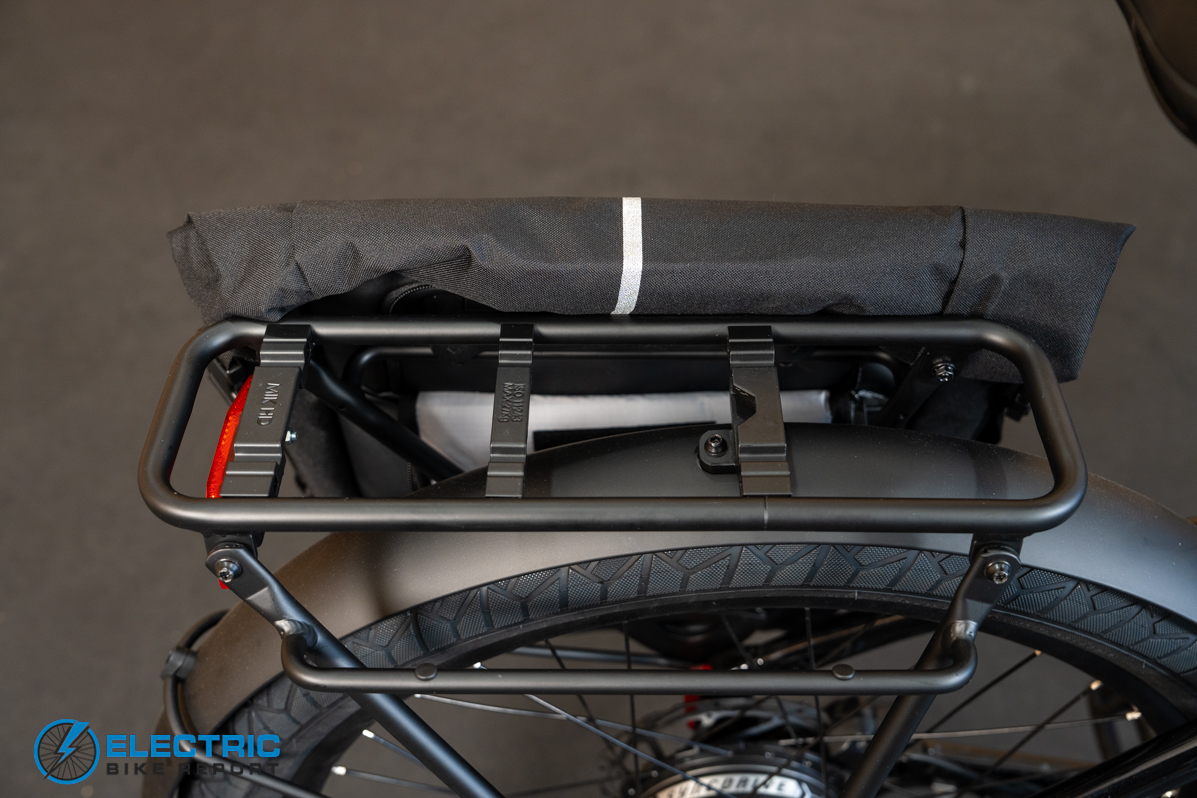
The bike’s MIK-HD cargo rack is compatible with panniers and a range of optional extras that lock into place.
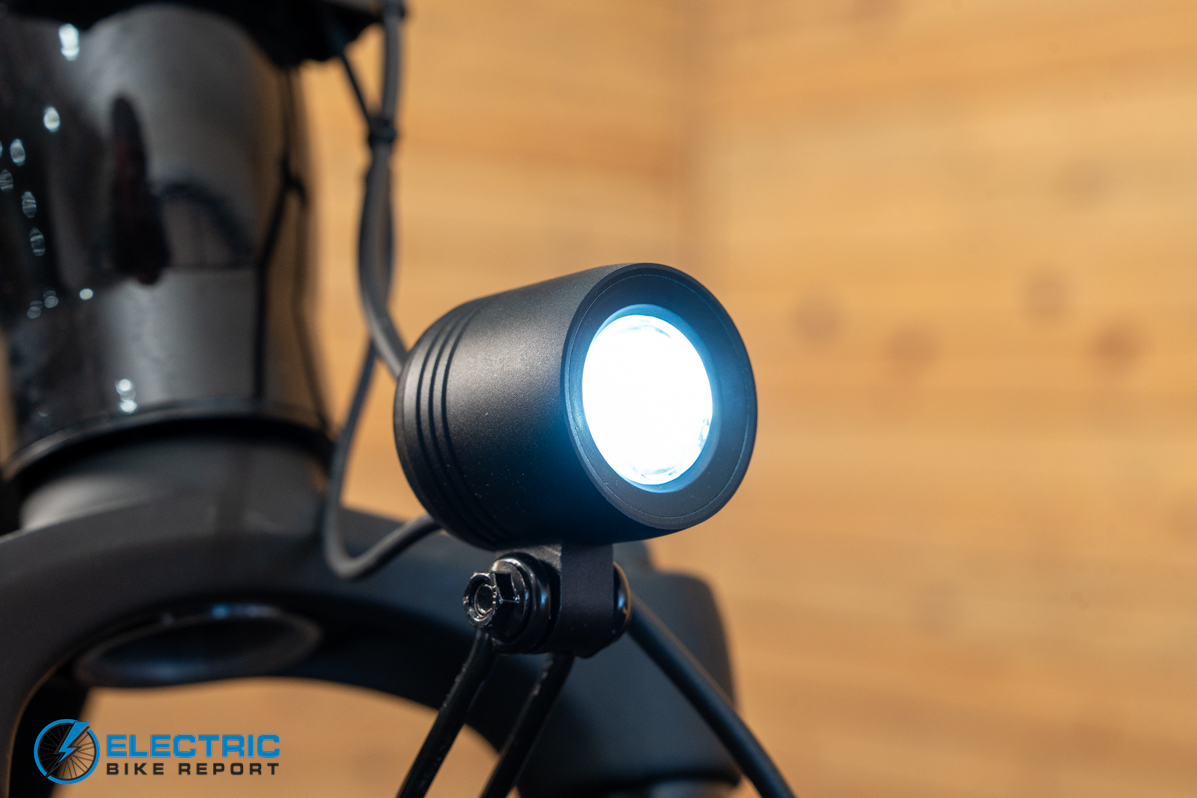
We liked that the small LED headlight was mounted to the fender to provides visibility when turning.
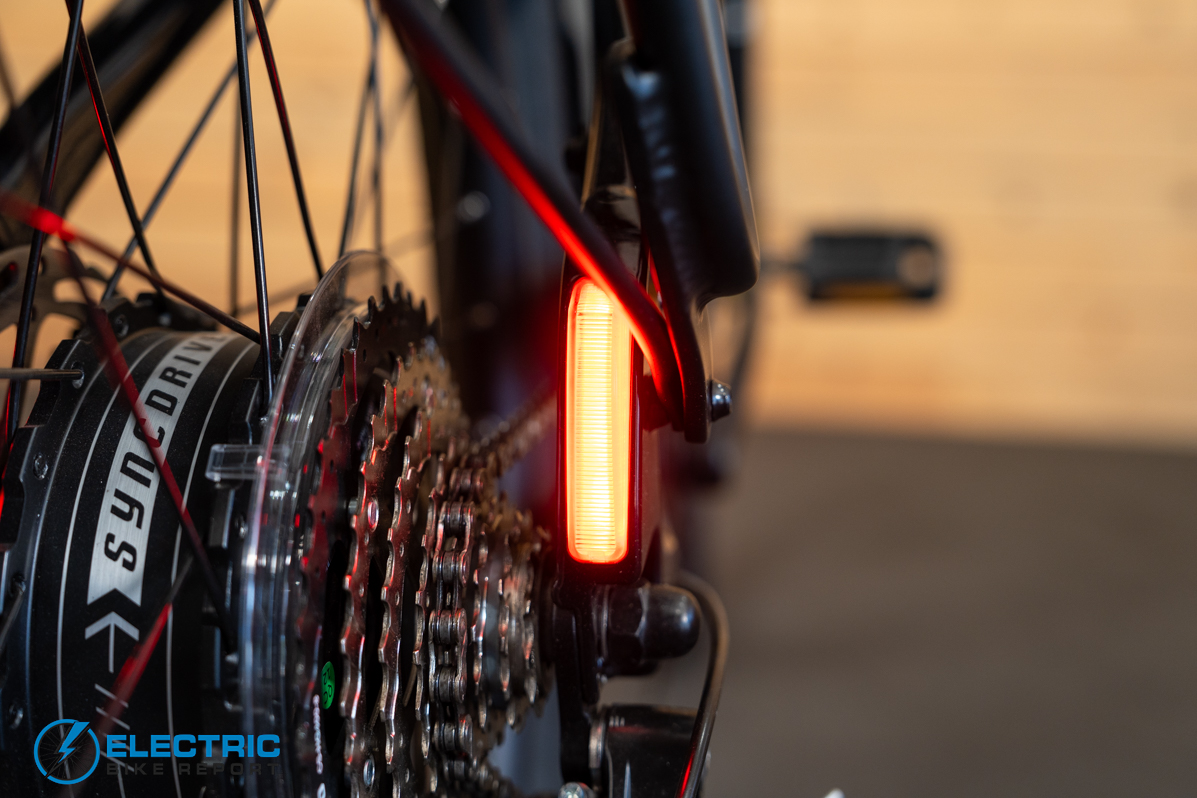
Tail lights with brake light functionality are integrated into the frame for a clean look.
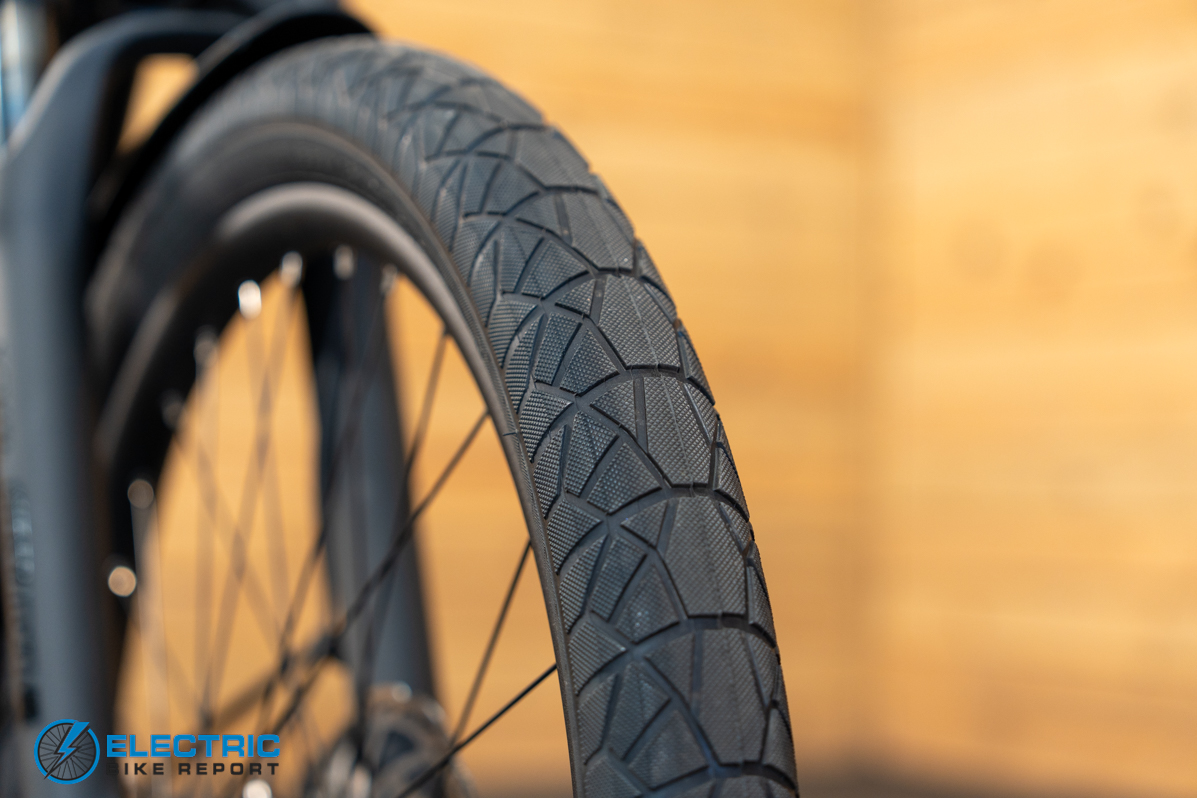
The Vida E+’s 2.4-inch tires help the ride feel stable and smooth.
Momentum Vida E+ EX Review: Summary / Where to Buy
Ultimately, when compared to the standard Vida E+, the EX model is more of a small update than an enormous refresh. Still, its new features are welcome; its default Class 3 settings offer high-speed travel to commuters, its dropper seatpost provides adjustability and stability while stopped, and its optional zero-start throttle helps with starting up again.
Our testing showed that the Vida E+ EX earns its place in the commuter/cruiser category by combining its comfortable riding platform with a generous and responsive pedal assist system, a user-friendly interface, and solid overall performance.
Its Brake Test result was, perhaps, its most impressive data point, finishing 3.5 feet ahead of the category average. The bike’s programming was generally intuitive, with three power levels and a high level of output at all times to grant easy pedaling. The Vida’s range and climbing speed landed a bit below category averages, though both are still plenty practical.
In our opinion, the absence of a throttle is our one sticking point. With the bike priced around $2,000, and considering its marketing as a “throttle e-bike,” we feel it should be included, not sold separately—even with its affordable $65 price tag.
Critique aside, we find the Vida E+ EX easy to recommend for daily commuters who want a smooth, easy pedaling, and comfortable step-thru e-bike. First-time e-bike buyers will find the interface approachable and the ride immediately rewarding, and even experienced riders may be surprised by the bike’s smoothness and refined feel.
Happy Riding! Make sure to let us know if you have any questions or if you think we left anything out in this review of the Momentum Vida E+ EX down in our comments section.
Sponsor
Sponsor
Reader Interactions
Leave a Reply