GOTRAX Tundra Review | Don’t Leave This Bike Out in the Cold
May 22, 2026
 0 Comments
 Share
Share
The Tundra is a cargo-ready, budget-friendly fat tire e-bike with comfort, sportiness, and style.
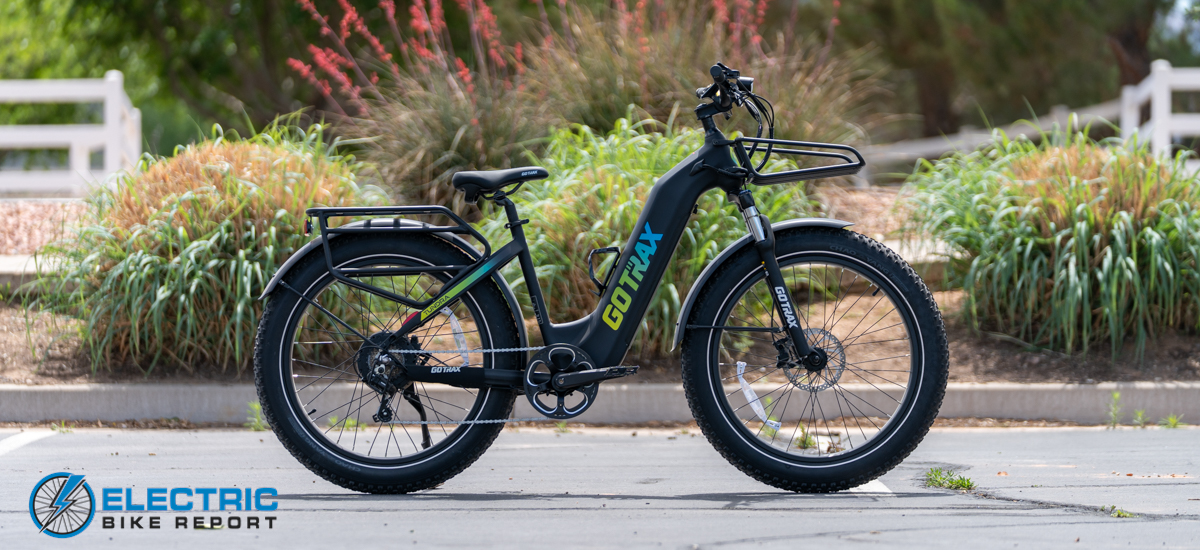
Whether cruising on paved paths through town, tackling rougher dirt or gravel roads through the countryside, or doing a bit of both, fat tire e-bikes can handle just about everything. Known for their powerful motors, high levels of comfort, and stable, planted rides, e-bikes of this style inspire confidence and enjoyment through their versatility.
Not all fat tire models are equal, however. Many are costly, overcomplicated, or overpowered, making them less accessible and approachable for new riders. Expensive e-bikes might seem unattainable, extremely complex bikes may be discouragingly hard to learn or understand, and those that are too fast can feel scary or tough to control.
The GOTRAX Tundra, on the other hand, aims to be safe, affordable, and easy to grasp. At around $1,500, it’s on the budget-friendly end of the spectrum—especially when more and more e-bikes are inching up toward the $2k mark. With no Bluetooth app or elaborate settings menus, it’s also straightforward and easy to understand.
Perhaps most importantly, the Tundra is equipped with a category-appropriate 750W motor that is capable of flattening hills without feeling unchecked. My first test ride showed me that the Tundra’s pedal assist system blends responsiveness with granular control, giving riders a range of options for speed, approachability, and ease of pedaling.
Another area where the bike impressed me was range. GOTRAX outfitted the Tundra with a massive 960 Wh battery, providing an estimated 74 miles of range. We exceeded this figure in our real-world testing, showing that the bike is capable of extended rides or many shorter trips between charges.
Of course, there’s much more to dig into. See our full review below to find out how the Tundra performed in our real-world testing!

Sponsor
E-Bike Category:Fat Tire
E-Bike Class:Class 1 (pedal assist to 20 mph)
Class 2 (throttle to 20 mph)
Class 3 (pedal assist to 28 mph)
Class 2 (throttle to 20 mph)
Class 3 (pedal assist to 28 mph)
Sponsor
GOTRAX Tundra Video Review
 Pros
Pros- The Tundra offers easily controlled power, with five speed-limited assist levels. Four are torque-based, with one additional cadence-based full-power mode.
- Its range is seriously impressive! We exceeded GOTRAX’s advertised range in our testing, with one of the longest results we’ve seen from a fat tire e-bike.
- At around $1,500, the Tundra offers affordability and excellent value. It’s one of just a handful of similarly-specced—and priced— models we’ve tested.
- It includes useful extras, including a bottle cage, phone mount, and both front and rear cargo racks.
- We found it both comfortable and sporty, with a forward-leaning riding position that doesn’t put too much weight on the wrists/handlebars.
- The Tundra has a low learning curve, with no app or complicated settings menus. This makes it easy to grasp and use.
 Cons
Cons- Motor engagement/re-engagement after coasting could be somewhat delayed. We encourage GOTRAX to implement more responsive pedal assist.
- A below-the-bar trigger shifter would provide improved steering control and would better fit the Tundra’s style.
ELECTRICAL SPECS & FEATURES
- Battery: 48V 960Wh (20 Ah)
- Charger: 54.6V 3.0A
- Display: Full-Color LCD
- Motor: 750 Watts (1,250W Peak), 85 Nm Torque
- Headlight: Integrated LED
- Taillights:Integrated LED
- Pedal Assist: 5 Levels
- Claimed Range: Up to 74 Miles
- Throttle: Thumb
- App:N/A
- UL Certification:Safety Certified In Accordance With UL 2849
Weight & Dimensions
- Claimed weight: 78.1lbs
- Tested Weight: 83.4 lbs
- Rider height range: 5’0” – 6’4”
- Total payload capacity: 300 lbs
Components & Accessories
- Brakes:NUTT Hydraulic Dual Braking on Front/Back Wheels, 180mm Rotors
- Fenders:Included
- Fork:Front Suspension Fork, 70mm travel
- Frame: Aluminum Alloy A6061
- Drivetrain: Shimano 7 Speed, 48T Chainring, 14-28T Cassette
- Grips: Lock-on rubber
- Saddle: Custom Sport Saddle
- Handlebar: 700mm
- Kickstand: Included
- Pedals: Platform
- Tires: 26″ x 4″
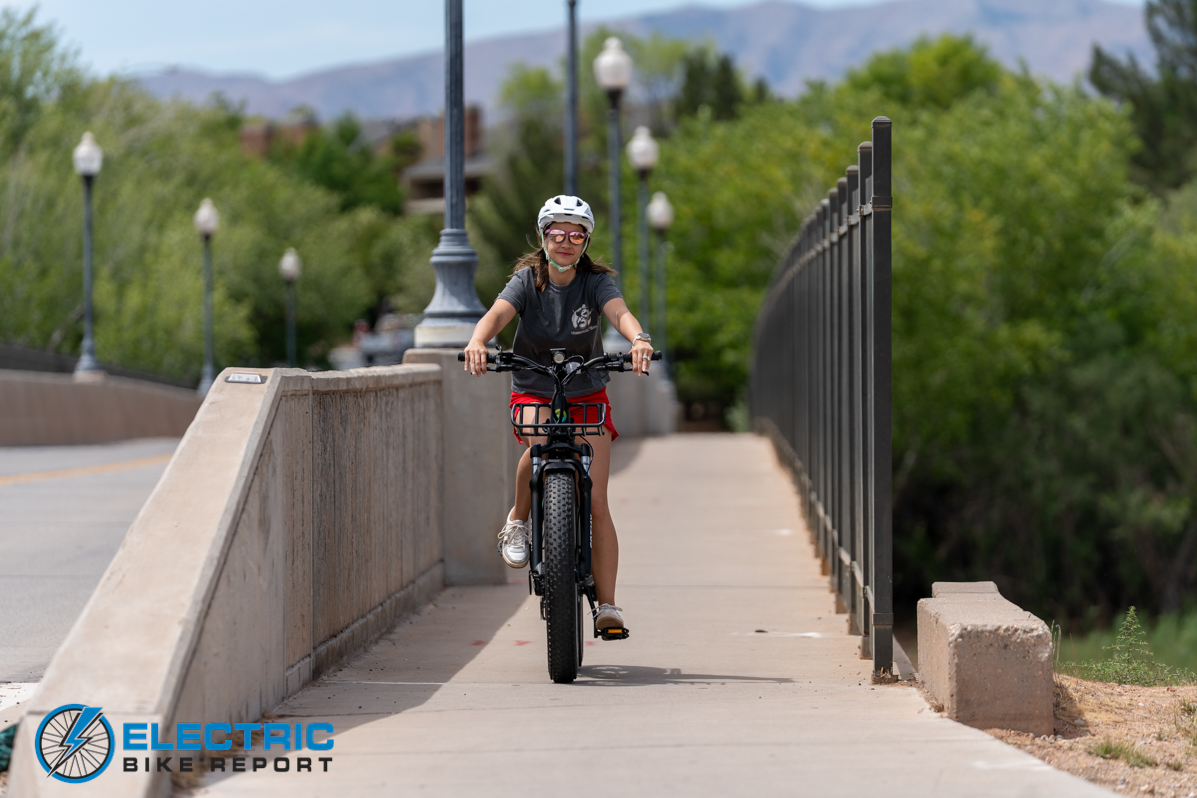
The Tundra’s ride is cushy and stable. It handles confidently and feels stuck to the ground.
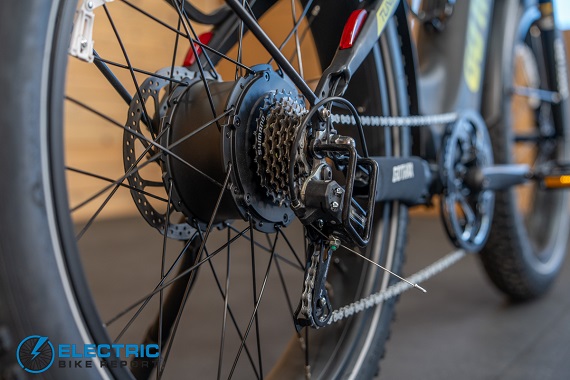
Like many fat tire e-bikes, the Tundra features a powerful but controlled 750W rear-hub motor.
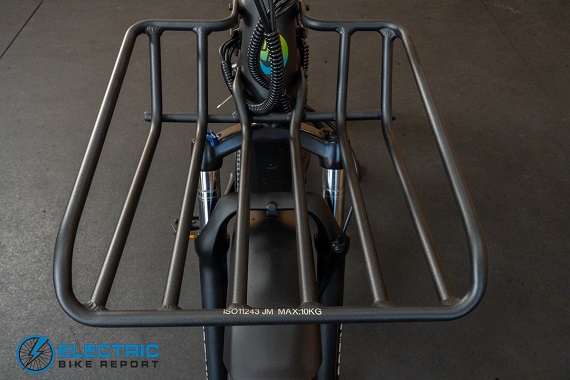
Unlike many similar models, the Tundra comes with both front and rear cargo racks to carry gear, groceries, etc.
GOTRAX Tundra Review: Speed Test
Our first and most basic test is the Speed Test, which has a few goals. First, we want to ensure that every bike can reach its advertised maximum speed. Second, we seek to understand how its power is balanced across each of its pedal assist system (PAS) levels and riding modes. Finally, we test its throttle to get a measure of its acceleration force.
To conduct this test, I rode the GOTRAX Tundra on a flat segment of paved shared-use trail. I performed separate tests with the bike’s maximum speed set to 20 mph (Class 2) and 28 mph (Class 3), monitoring my average speed in each of its five PAS levels as I pedaled. Right out of the box, the bike is set to Class 3 mode, but its speeds can be adjusted through its display.
As shown in the graph above, the bike’s programming was generally well-balanced, with incremental jumps in speed and power between most of its assist levels.
The Tundra’s PAS takes a somewhat uncommon approach. Its four lowest assist levels seem primarily torque-based, with power that fluctuates in response to the amount of pressure on the pedals.
The bike’s highest power level, however, felt entirely cadence-based, putting out maximum power regardless of pedal pressure—as long as I was moving the pedals. Additionally, each of its five assist levels had a different speed limit, carrying me up to around the speeds listed above.
When in Class 2 settings, PAS 4 felt the most responsive, due to the bike’s powerful motor and relatively low speed limits in PAS 1-3. Reaching each assist level’s maximum speed in the lower settings was quick and easy, but this felt somewhat limiting; the higher ceiling in PAS 4 felt more natural with more room to fluctuate. The same was true in PAS 3 and 4 when in Class 3 settings.
As such, I found myself riding mostly in PAS 4 to enjoy the most natural and responsive pedal assist when in Class 2 mode, and PAS 3 in Class 3 mode. In both tests, PAS 5 carried me up to the bike’s maximum speed powerfully, making even uphill travel feel relaxed and low-effort.
When using the throttle, I found that it started off the line gradually, then picked up speed steadily until reaching 20 mph. The resulting experience felt safe and approachable, yet practical and enjoyable.
Overall, the Tundra’s speed and power levels were well-balanced and easy to grasp. I appreciated that the PAS provided a granular level of control over my speed, though it sacrificed some of its natural, responsive feel to do so. For riders seeking restraint and safety, however, this setup is likely to be user-friendly and intuitive: a worthy tradeoff.
Sponsor
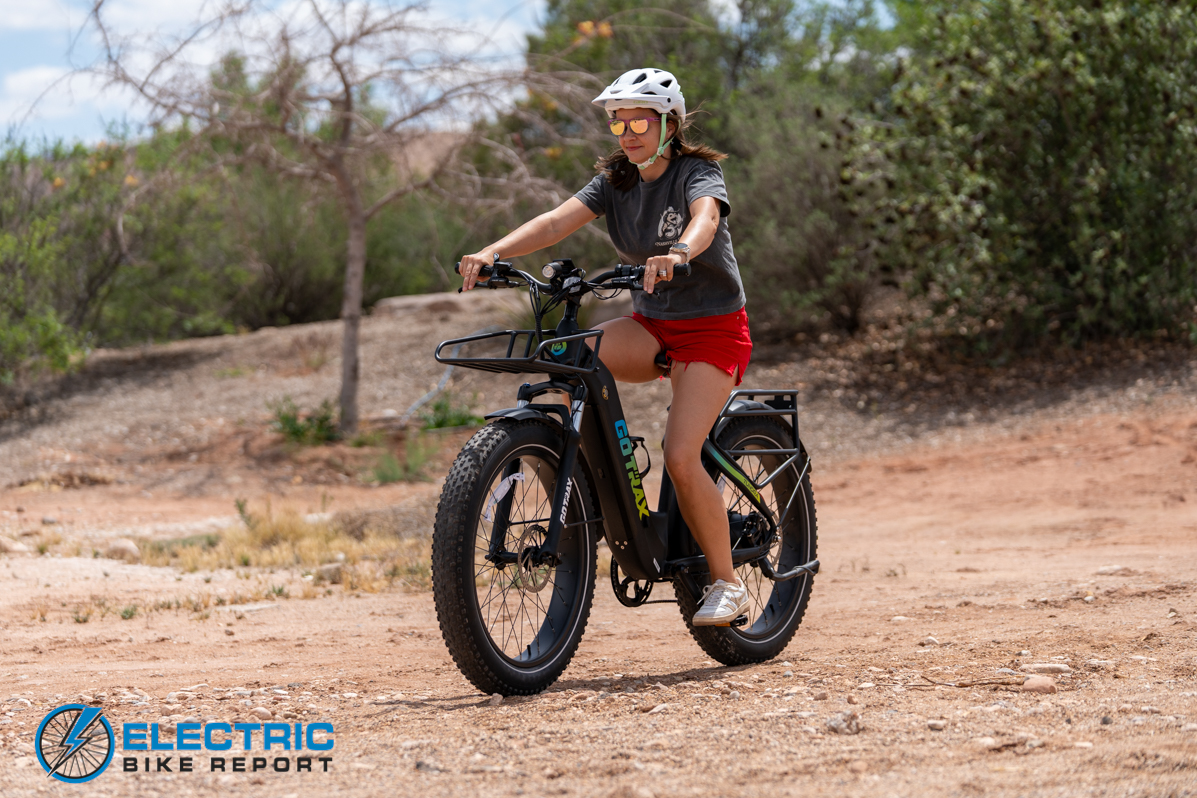
If you’re looking for an affordable e-bike that can do a bit of everything, the Tundra might be right up your alley. It rides on pavement, dirt, and gravel, while powering uphill or cruising on flats.
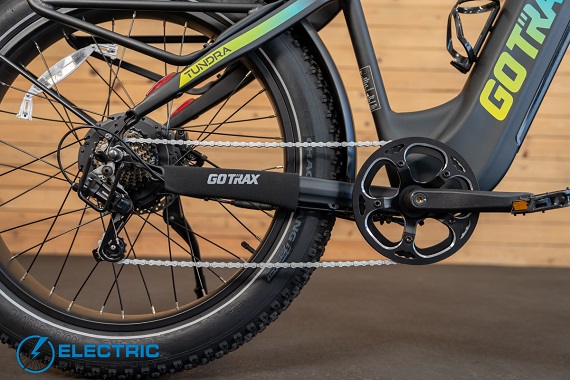
GOTRAX equipped a 7-speed Shimano Tourney drivetrain, which is tried and true.
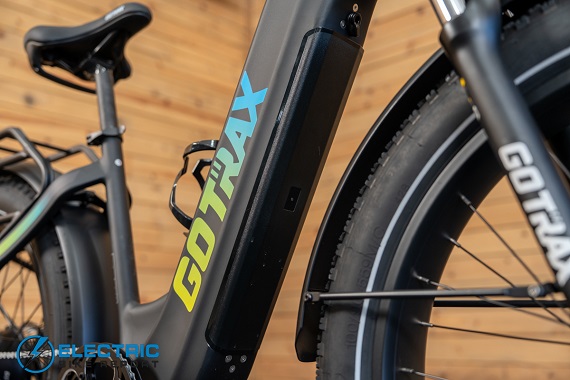
The Tundra’s massive 960-Wh battery is removable and fully hidden in the down tube.
GOTRAX Tundra Review: Range Test
As I mentioned in the introduction to this review, the Tundra set a high bar in our Range Test. Here, we used the process explained above to test its minimum and maximum range, with our test riders covering 44 and 99.6 miles from a single charge.
In comparison, a group of popular, comparable fat tire e-bikes averaged 36.4 and 74.7 miles in their high- and low-PAS tests, respectively. In all cases, we tested the bikes with Class 2 maximum speeds of 20 mph; riders traveling faster should expect fewer miles.
The Tundra had a couple of advantages in this test that helped it achieve such great results: a larger battery and a more energy efficient motor. In comparison to its peers, which carried batteries averaging 856 watt-hours (Wh), the Tundra’s 960 Wh power pack gave it more energy to use.
Additionally, its peers used an average of 24.6 watt-hours per mile (Wh/mi) in their high-power tests and 11.7 Wh/mi in their low-assist tests. In comparison, the Tundra used less energy—just 21.8 Wh/mi and 9.6 Wh/mi, respectively.
Another area where the Tundra differed from most of its competitors is in speed limits; most similar models had torque sensors that could fluctuate more widely in speed regardless of assist level. As such, we tested the Tundra in PAS 2 for its low-power test, as we feel most riders will find PAS 1’s 8-mph speed limit somewhat limiting. Those who are comfortable traveling at that speed, however, may be able to exceed the 100-mile mark!
We expect most riders will fall between the 44 and 99.6 miles we reached in our testing, which should be more than adequate for commuting, errand-running, adventuring, and leisure riding. Many riders should expect multiple trips from a single charge, especially when taking shorter cruises and/or using low assist levels.
With such a high-capacity battery, we appreciate that GOTRAX included a 3-amp charger. When plugged into a fully-drained battery, it should finish charging in under 7 hours.
Sponsor
Sponsor
GOTRAX Tundra Review: Hill Test
As a fat tire e-bike, the Tundra demonstrated strong climbing power in our Hill Test; see above for a description of this test and location. Our test rider, Justin, successfully completed both portions of the test, with a throttle time and average speed of 1:58 at 15.4 mph. The bike’s max-assist pedal test was faster, with a result of 1:50 at 16.5 mph.
Similar models, including the best fat tire e-bikes we’ve reviewed, fell between the Tundra’s two scores. The bikes in our comparison group averaged 1:56 on throttle power and 1:53 when pedaling in their highest assist levels.
For all intents and purposes, the Tundra is relatively average in a category that is known for its climbing strength. Many riders turn to fat tire e-bikes because of this power; their (most commonly) 750W motors are able to handle steep terrain, giving users the option to throttle or pedal uphill with little effort.
There are a handful of differences in specs between the Tundra and its peers that likely caused its results to vary somewhat from the category benchmarks. On average, the bikes we used for comparison weighed 81 lbs and had motors that produced up to 1,127W of peak power and 90 Newton meters (Nm) of torque.
In contrast, the Tundra weighed a slightly heavier 83 lbs. Its motor produced a higher 1,250W of peak power, but a somewhat lower 85 Nm of torque.
Interestingly, the Tundra’s specs and test scores differ slightly from the norm in other ways, too. Faster than average pedal times often correspond to higher than average torque ratings, while higher than average peak power commonly coincides with faster than average throttle performance.
Here, we see the opposite—but it’s also worth noting that the differences between the Tundra’s results and the category averages are within our margin of error for the test.
In any case, the Tundra proved itself more than capable in this test, making it expectedly suitable for areas with hilly terrain. My personal experience reinforces our test scores; the bike climbed confidently with easy pedaling and a controlled feel.
Sponsor
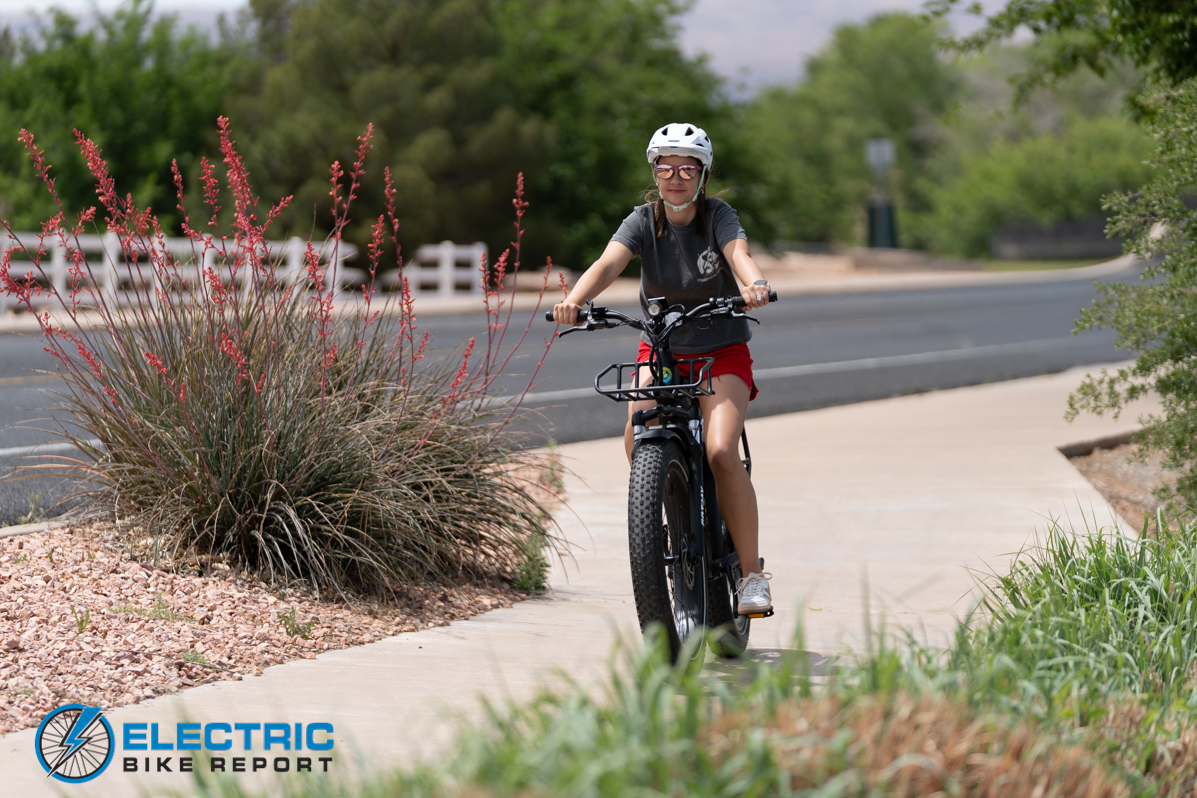
As a Class 2 and 3 e-bike, the Tundra can climb to 28 mph right out of the box via pedal assist, while its throttle is limited to 20 mph.
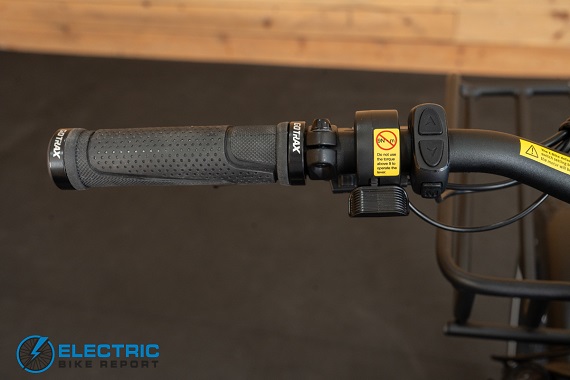
The thumb throttle sits next to the bike’s small button pad on the left handlebar.
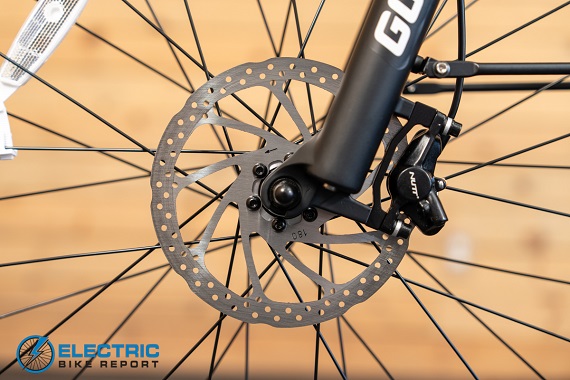
It comes with two-piston Nutt hydraulic disc brakes with 180mm rotors front and rear.
GOTRAX Tundra Review: Brake Test
With its Nutt hydraulic disc brakes, the GOTRAX Tundra averaged a stopping distance of 24’9” in its three test runs. While this result falls within the range we consider safe, it’s also near the point where we start to recommend changes; see below for details to consider.
As we’ve tested more and more e-bikes—we’re up to around four hundred at the time of writing—braking trends have improved over time. While fat-tire e-bikes used to hold one of the longest category averages for their stopping distances, the number has tightened up over the past couple of years. Our current average is 21’8”.
This places the Tundra just over three feet beyond the category average, so what gives? At 83 lbs, it’s just slightly heavier than the average fat bike, so it shouldn’t realistically be more difficult to slow down. Its two-piston brake system, while not made by an industry titan like Tektro, is common enough. It also uses category-appropriate 180mm rotors on both wheels.
Based on my experience, I’d attribute the Tundra’s longer-than-average stopping distance to its tires, brake pad material, or a combination of factors. During my test rides, I noticed that the brakes, while generally performing adequately and having decent modulation, lacked some bite. I had to apply fairly firm pressure to achieve fast braking, but even then, the tires skidded for a stretch before the bike came to a complete stop.
Overall, since the bike landed within our expected range of results, we don’t recommend any changes to its components. Those looking to reduce stopping time, however, may want to consider swapping the tires to a model made from a softer, grippier rubber compound or experimenting with other brake pad types.
As it is, we might also recommend that riders get some braking practice to understand the Tundra’s feel and limitations, being sure to give themselves the proper amount of distance/time when coming to a stop. When used correctly, the bike’s brakes should perform safely and effectively.
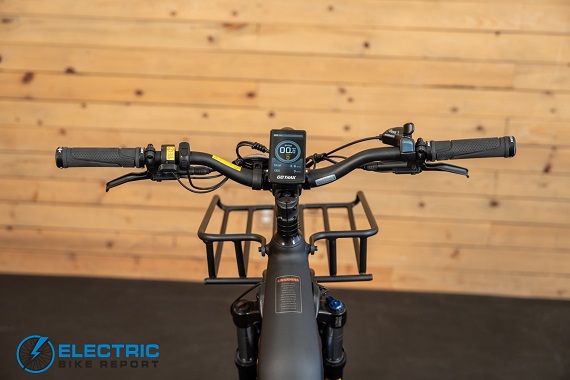
The 700mm handlebars are a bit wider than we usually see, giving the rider great steering control.
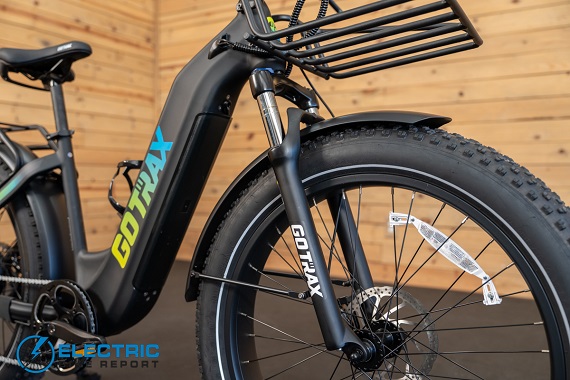
A coil suspension fork, with lockout and preload adjustment, provides 70mm of travel.
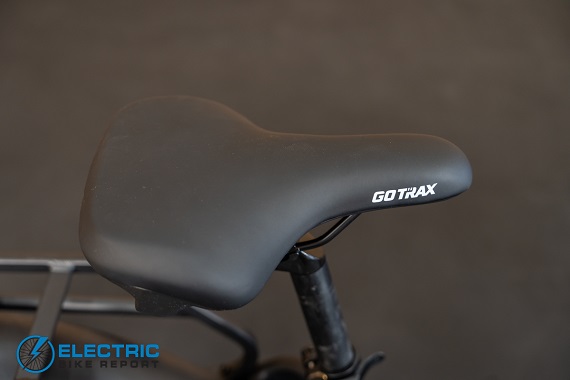
The bike includes a custom-branded sport-style saddle that matches its style well.
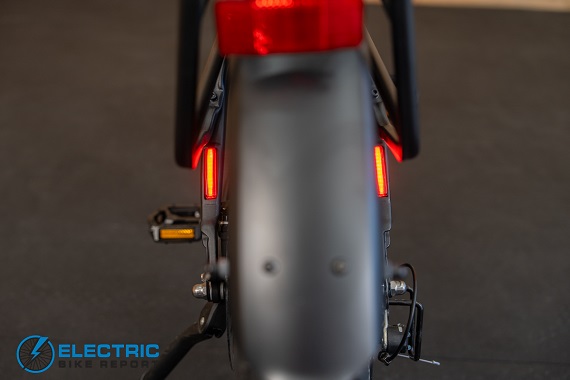
LED tail/brake lights are integrated into the Tundra’s seat stays.
GOTRAX Tundra Review: Ride Quality
Ride quality is a relatively complex subject that factors in a bike’s style, sizing, comfort level, responsiveness, handling, user interface, and more. Overall, I was impressed with what the Tundra brought to the table, though this section will also contain a couple of relatively minor points of critique.
Starting with the positives, I found the bike comfortable and enjoyable to ride. GOTRAX makes the Tundra in a single size, with both step-thru and high-step frame styles that fit riders from 5’0” to 6’4”. The bike’s sizing worked well for my height of 5’11”, offering comfortable and efficient leg extension and a sporty but relaxed forward-leaning riding position.
The bike offers roughly 9 inches of adjustment in saddle height, a respectable range that should accommodate most riders. Changes to the bike’s handlebar height, reach, or riding position will likely require swapping the stem and/or handlebars, which is easy and cost-friendly to do.
Comfort was a factor of many elements. I liked the bike’s sport-style saddle, which felt supportive without impeding pedaling. The rubber grips were soft and easy to hold on to. A suspension fork and the Tundra’s 26×4” fat tires combined for effective shock absorption, helping to make the ride smooth and plush.
In terms of handling, the bike felt relaxed and predictable. The Tundra’s weight of roughly 83 lbs prevents it from being remarkably nimble, but it does keep it feeling sturdy and stuck to the ground. To complement this plantedness, the 4-inch-wide tires provide a wide, stable platform that makes riding feel steady and balanced.
Despite the Tundra’s step-thru frame, I was pleased to note that I didn’t feel much frame flex when cornering. Inevitably, the frame is more compliant than it would be with a top tube, but overall, I’m glad to be able to comment that the bike felt much stiffer than I expected.
One area with room for improvement is the Tundra’s shifter. While the Shimano Tourney’s over-the-bar shifter is tried and true, it requires releasing your thumb from the right grip, which can sacrifice some control over the bike’s steering. For off-road-capable e-bikes like the Tundra, we recommend a below-the-bar trigger-style shifter so that riders can maintain better control when encountering bumps in their path.
Additionally, I appreciated the pedal assist system’s ability to adapt to my pedaling when in the mid-to-high power assist levels, but it wasn’t always the fastest to respond. I found that its re-engagement after coasting/braking could be delayed, sometimes taking a full rotation of the cranks or more to kick in. Riders can, of course, engage the throttle for faster pickup, but a more responsive pedal assist system would be more user friendly.
That critique aside, the Tundra is generally very approachable and easy to use. It is not overcomplicated by a Bluetooth app, a cockpit crammed with features and controls, or complex settings menus—all of which make for a straightforward experience friendly to new riders.
Sponsor
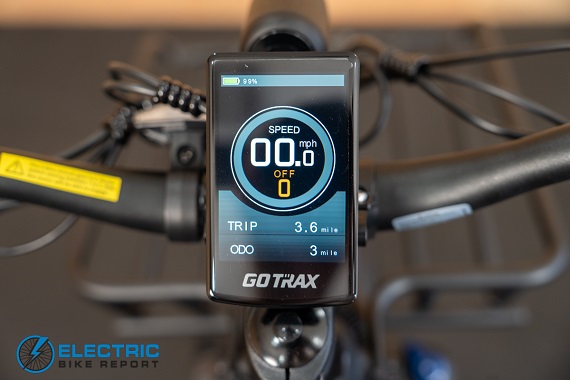
The color display is unique and cool-looking, with useful, well-presented metrics and ride data.
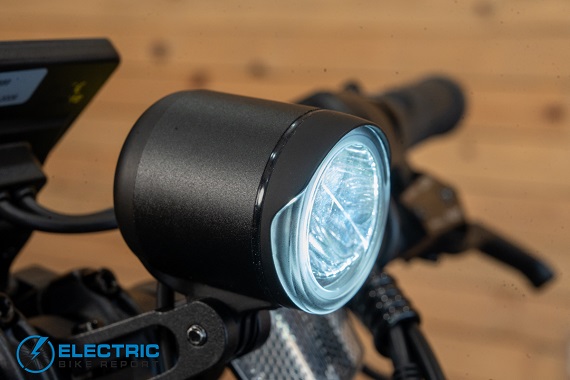
The Tundra’s integrated LED light keeps both you and the path visible in low light conditions.
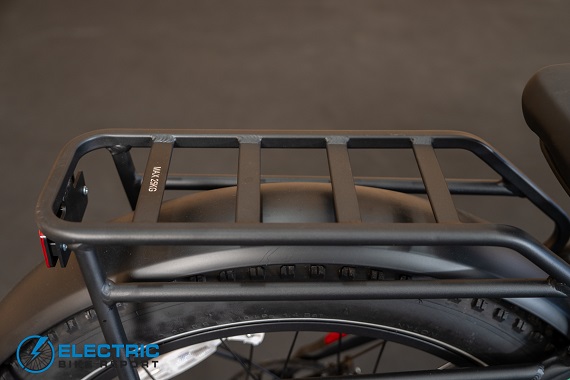
The included rear cargo rack can carry up to 55 lbs, while the front rack can hold an additional 22 lbs.
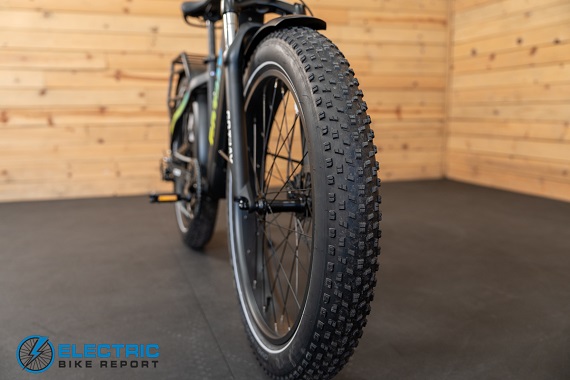
A set of 26×4” knobby tires adds cushion, keeps the ride stable, and allows for some off-road adventuring.
GOTRAX Tundra Review: Summary / Where to Buy
A good fat tire e-bike is easy to appreciate, and that’s exactly what I found with the GOTRAX Tundra. The bike doesn’t try too hard to do too much; instead, it mostly sticks to the basics and pulls them off well—while adding a small bit of its own flair. It successfully makes for a sporty, powerful, comfortable, stable, and user-friendly ride.
The Tundra did a great job in most areas of our testing, with its incredible long-range performance in our Range test being one of its strongest showings. Additionally, the bike had confident climbing power, a relatively unique blend of torque and cadence-sensing pedal assist, and generally solid braking.
Aside from the bike’s ability to flatten hills and ride for many tens of miles before needing to recharge, I think riders will appreciate its power and programming. With a variety of speed limits to choose from, four assist levels that offer responsive power, and an additional “easy mode” that doesn’t hold anything back, there’s a setting for handling just about anything in your path.
Our only real areas of critique were relatively minor, with the motor’s re-engagement and the Tundra’s over-the-bar shifter as the things we’d most like to see improved in the future. Faster re-engagement would give the pedal assist a more natural and engaging feel, while a trigger-style shifter would feel more confident and appropriate when riding off-road.
Otherwise, the Tundra is an easy and affordable bike to recommend. Whether used for everyday purposes such as commuting to work, grabbing a few groceries, and enjoying a leisurely cruise, or more adventurous uses like exploring multi-use trails and OHV areas, the Tundra offers a lot of bang for the buck without feeling like a chore to learn or operate. In our book, that makes for a winning combination.
Happy Riding! Make sure to let us know if you have any questions or if you think we left anything out in this review of the GOTRAX Tundra down in our comments section.
Sponsor
Sponsor
Reader Interactions
Leave a Reply