GOTRAX Mustang Review | Good Looks, Great Fun & Giddy Up
May 15, 2026
 0 Comments
 Share
Share
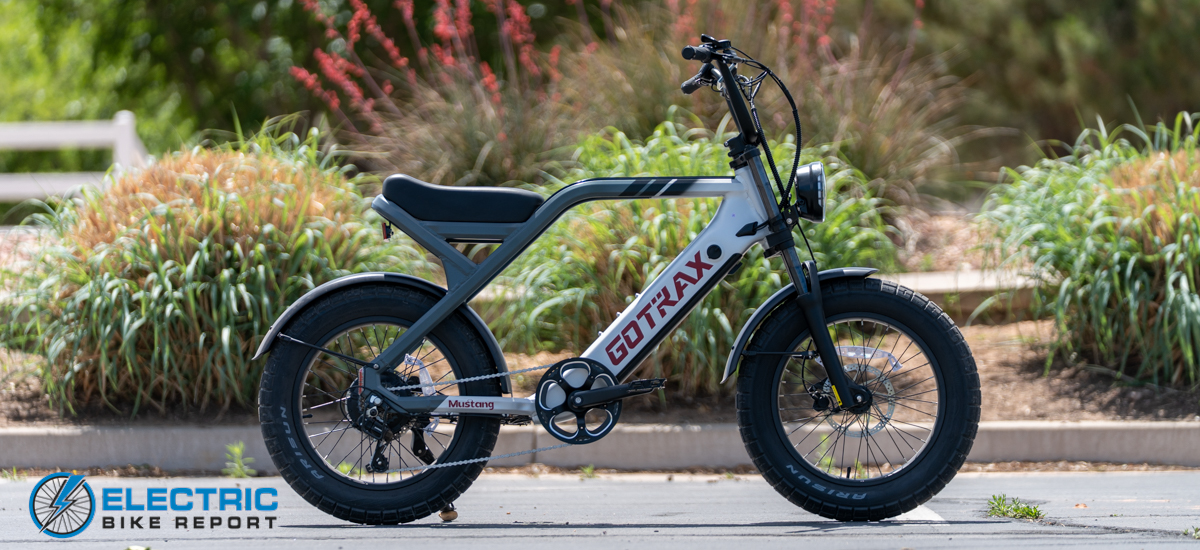
The Mustang is a flashy, value-forward moped-style e-bike with solid across-the-board performance, a fun yet safe ride, and an approachable price.
Finding the right amount of e-bike for a reasonable cost is often a challenge. If you don’t have the budget for a top-shelf model, you might feel like you’re making too much of a compromise in features or performance. Conversely, if you skimp out too much on the amount you’re willing to pay, you may end up with trade-offs in quality or safety.
E-bikes in the moped or moto-style category are no different. Fortunately, there are some solid options that strike a great balance between affordability and value—like the GOTRAX Mustang.
This e-bike, which is priced firmly between $1,000 and $2k, has the cool, aggressive styling that defines the category. It also aims to offer a high level of comfort, a functional set of features, and competitive performance when compared to similar models on the market.
I was impressed with everything the bike offered for its price, including a highly capable 750W motor, hydraulic disc brakes, a color display, and a dual crown suspension fork. Unlike many similar e-bikes, its large battery is also fully integrated into its frame’s down tube, making for a sleek-looking, streamlined, and head-turning ride.
My first test ride went smoothly, both in terms of usability and the ride quality itself. It was clear from the first takeoff that the Mustang could deliver the power and acceleration that moto-style enthusiasts enjoy, though it did so in a way that felt controlled and approachable. For new riders and parents of adrenaline-fueled teens, that’s a big win!
With further testing, I found that the Mustang was an impressive performer. Like any e-bike, however, it has a handful of areas with room for improvement. Continue reading our full review below to see how this bike compares with similar models we’ve tested!

Sponsor
E-Bike Category:Moped
E-Bike Class:Class 1 (pedal assist to 20 mph)
Class 2 (throttle to 20 mph)
Class 3 (pedal assist to 25 mph)
Class 2 (throttle to 20 mph)
Class 3 (pedal assist to 25 mph)
Sponsor
GOTRAX Mustang Video Review
 Pros
Pros- The Mustang is fun while also feeling safe and controlled. Its 750W motor has the muscle for hills and cruising at speed, but it doesn’t feel overpowered.
- It’s uncommonly nimble for a moped/moto-style e-bike, thanks to its relatively low weight and short wheelbase.
- The bike has great range, thanks to its sizable 720 Wh battery. Read below for details, but it exceeded most of its peers in our testing!
- At around $1,500, the Mustang is well-equipped and offers solid value and affordability. It features a unique frame, a powerful motor, a dual-crown suspension fork, integrated lights and more.
- The Mustang’s overall operation is simple and straightforward, making it easy for new riders to get the hang of using it.
- The color display is a nice touch, with a large, well-organized, and appealing interface.
- GOTRAX includes a small storage compartment for carrying limited cargo or personal belongings.
 Cons
Cons- While it’s possible to modulate throttle speed with the lever’s position, PAS-based limits for the throttle would make controlling speed more user-friendly.
- We were impressed with the bike’s range, but its bar-based battery readout can make estimating the remaining range difficult.
ELECTRICAL SPECS & FEATURES
- Battery: 48 Volt, 720 Wh (15 Ah) LG
- Charger: 48V 3A
- Display: Full Color Digital
- Motor: 750-Watt with 90 Nm Torque
- Headlight: Integrated LED
- Taillights:Integrated LED, Brake Light Function
- Pedal Assist: 5 Levels, Torque Sensor
- Claimed Range: 40-86 miles
- Throttle: Thumb
- App:None
- UL Certification:UL 2849 Certification Coming Soon
Weight & Dimensions
- Claimed weight: 76.6 lbs
- Tested Weight: 77.6 lbs
- Rider height range: 5’4″ – 6’2″
- Total payload capacity: 275 lbs
Components & Accessories
- Brakes:Dual Tektro Hydraulic Brakes, 180mm Front and Rear Rotors
- Fenders:Front and Rear
- Fork:Dual Crown Suspension Fork, Coil Spring, Lockout and Preload, 80mm Travel
- Frame: Aluminum Alloy
- Drivetrain: 7-Speed Shimano Tourney, 48T Chainring, 14-28T Cassette
- Grips: Lock-On Rubber
- Saddle: Fixed Moped-Style
- Handlebar: 29” Aluminum Alloy, BMX-Style
- Kickstand: Included
- Pedals: 9/16” Platform
- Tires: 20×4.0” Arisun All-Terrain Tires
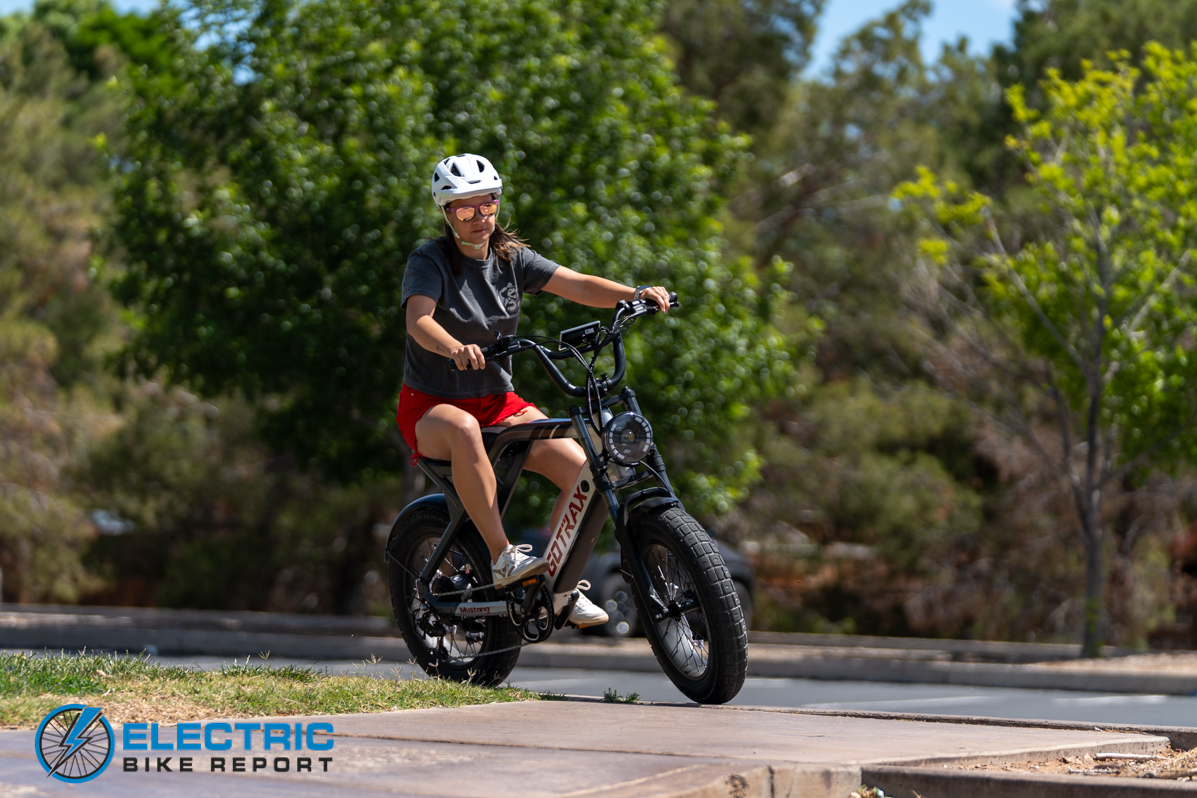
The Mustang’s handling is great, largely thanks to its below-average weight.
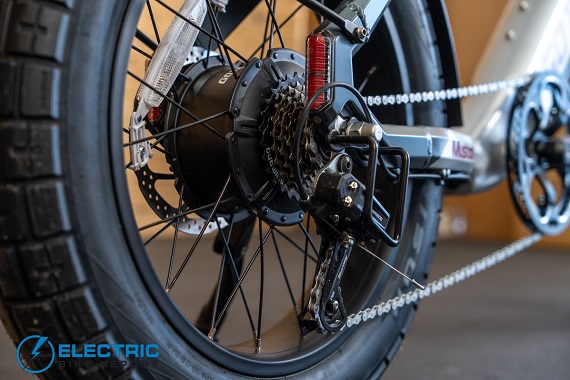
A 750W rear-hub motor propels the bike with controlled but helpful power.
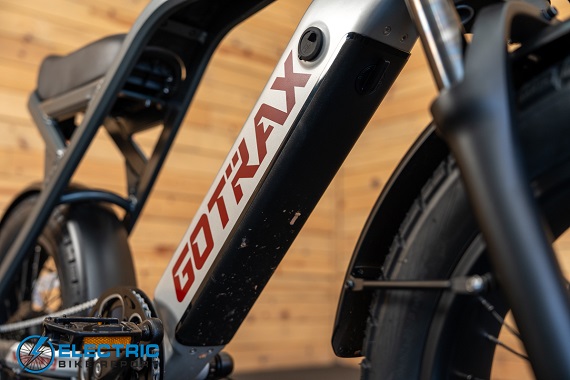
While most similar bikes have externally-mounted batteries, the Mustang has a fully-integrated power pack.
GOTRAX Mustang Review: Speed Test
As always, I pedaled the Mustang on a flat, paved section of our local shared-use trail for our Speed Test. While riding, I monitored my average speed without pedal assist, then in each of the bike’s five pedal assist system (PAS) levels. Finally, I tested the bike’s throttle acceleration separately.
A few caveats before considering my test results:
First, and most importantly, the Mustang is advertised to have an adjustable maximum speed of 25 mph. We tested a model from the first production batch that was limited to 20 mph, so I performed only a single Speed Test with this programmed speed. Our contact advised us that future batches will be able to reach 24.8 mph via pedal assist.
Second, as with most moped-style e-bikes, pedaling the Mustang is somewhat of a chore due to the bike’s low (and non-adjustable) seating position and its relatively short saddle. Riding without pedal assist is possible, but far from ideal, but once the PAS is activated, the ride is much easier and more enjoyable.
Third, the Mustang’s 750W motor uses a torque sensor that adapts its power output to match your pedal effort. The sensor is tuned so that it gives the rider great control over the bike’s acceleration force when pedaling, but doesn’t require much pressure to carry the bike up to speed. I liked this setup as much as I could, but I think a cadence sensor may be a more ideal match for the bike—more on this later.
Like many e-bikes with cadence sensors, the Mustang has preset speed limitations assigned to each of its five PAS levels; these can be clearly seen in the graph of my test results above. As the shape of the graph indicates, each assist level provides a measured, intuitive increase in speed and power. In my experience, this makes it easy to control and match your velocity to your environment.
The relaxed, easily-reachable speeds of PAS 1 and 2 felt appropriate for new riders, allowing them to get a feel for the bike’s balance and handling. PAS 3 and 4 were comfortable for casual cruising, while PAS 5 felt ideal for more urgent travel and climbing hills.
In my throttle test, I noticed that the bike could reach 20 mph in all assist levels. When engaging the throttle, the motor felt strong and steady, but still controlled. The Mustang accelerated quickly after a slower, more gradual start, then topped off at the legal Class 2 limit.
Considering the Mustang’s geometry and seating position, which many riders will likely find somewhat hindering when pedaling, we recommend that GOTRAX add PAS-level-based speed limitations to the throttle. This would make the bike more user-friendly by offering riders more control over their riding speed when relying on throttle power to get around.
Otherwise, the Mustang’s programming is an excellent foundation to build on. We appreciate its intuitive, balanced nature and the bike’s strong yet safe acceleration. Both are well-suited for the new riders and young riders this bike is sure to appeal to
Sponsor
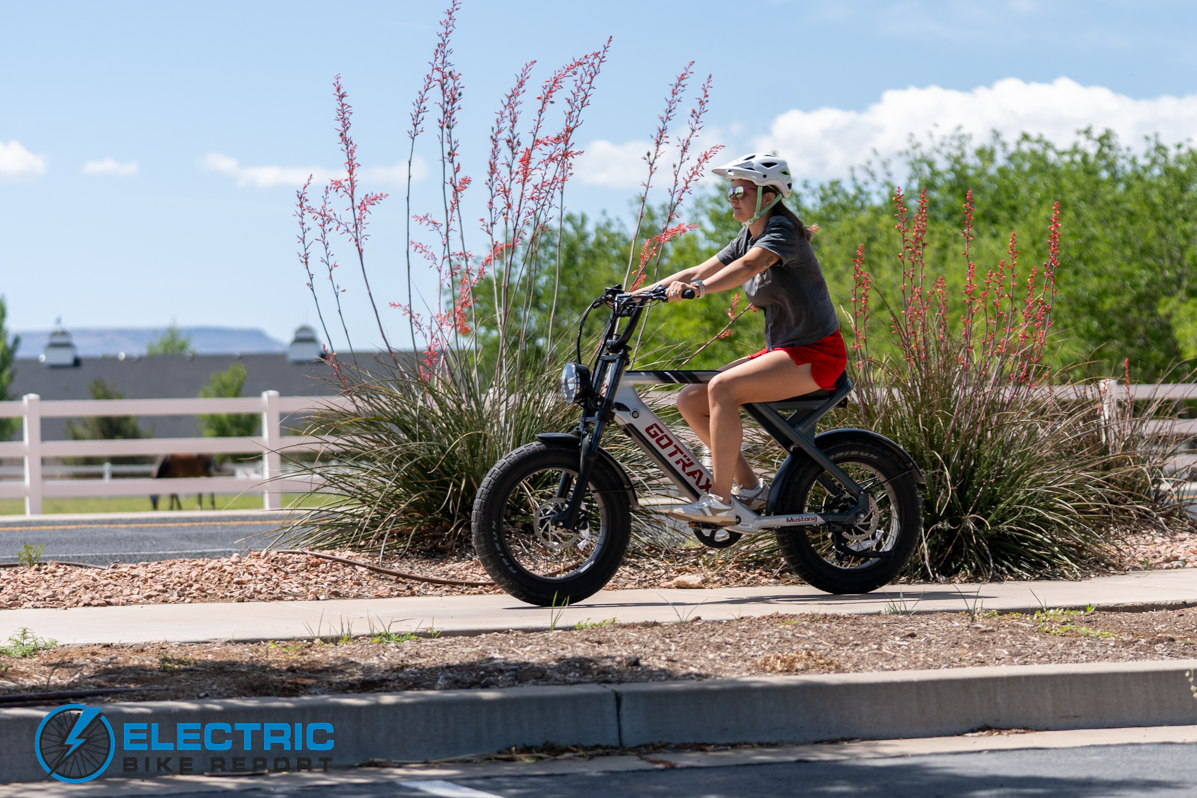
While our test bike was limited to 20 mph, new bikes can be set to a pedal-assisted speed of 25 mph.
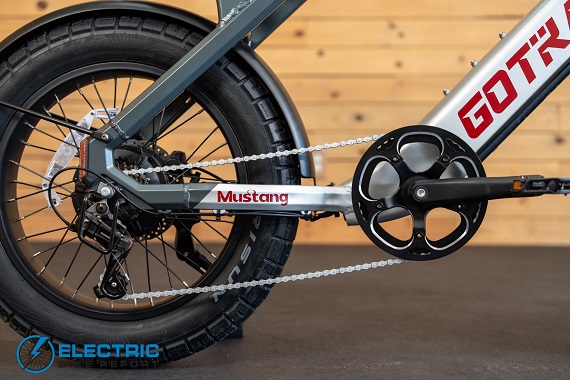
GOTRAX included a 7-speed drivetrain to complement the bike’s torque-sensing pedal assist system.
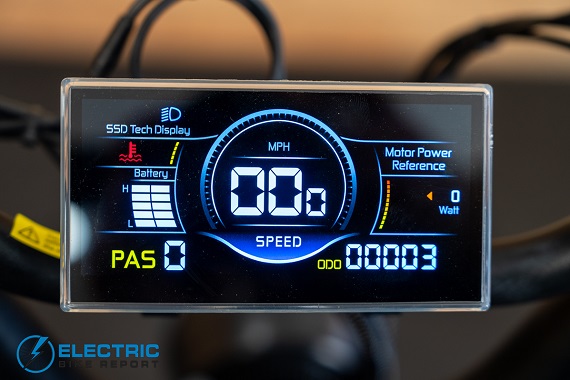
A large, full-color display is both effective and cool-looking, though it has a slight learning curve.
GOTRAX Mustang Review: Range Test
In case you missed our list of Pros and Cons above, the Mustang’s performance in our Range Test was particularly impressive, and the reason for its success is relatively simple.
We usually test e-bikes using both their highest and lowest (or lowest practical) PAS levels. With moped-style e-bikes like the Mustang, however, we test their range on throttle-only power, as described in the graphic above. Our test rider traveled 28.7 miles on a single charge—one of the longest results we’ve recorded from this style of e-bike.
While, at the time of writing, this is one of our smallest categories, a group of similar moped-style models traveled an average of 24 miles on throttle power under the same conditions.
On average, these e-bikes carried smaller batteries than the GOTRAX Mustang. In comparison to its 720-Wh battery, this group used power packs that averaged 608 Wh in capacity. As such, the Mustang had more energy to use, allowing it to stay on the path where we performed our testing for a longer time.
Interestingly, the Mustang’s energy consumption was similar to that of its peers. By dividing battery capacity by the distance each bike traveled, we can determine the watt-hours it used per mile (Wh/mi). The Mustang expended 25.1 Wh/mi, while other bikes averaged an even 25.0 Wh/mi.
Considering that most riders we interact with usually travel under 20 miles per round trip, the Mustang’s throttle range should accommodate users enjoying the bike for leisure, commuting, etc. Based on its status as one of the longest-range moped-style e-bikes we’ve tested, the Mustang is ideal for anyone seeking relief from range anxiety—this bike can go the distance!
Our only point of critique relating to this test is the bike’s bar-based battery charge indicator. While it matches the display’s power meter and motor temperature readout in appearance, we find that bar-based systems make it tough to estimate remaining range. As such, we feel that a percentage-based charge meter would be more user-friendly.
Otherwise, the Mustang performed well in this test. Additionally, it should charge in a manageable time frame; GOTRAX included a 3-amp fast charger that should recharge the 15 Ah battery in around 5 hours.
Sponsor
Sponsor
GOTRAX Mustang Review: Hill Test
Continuing its trend of strong performance, the GOTRAX Mustang matched the Hill Test averages among similar models we’ve reviewed, and showed some potential for even better results.
We tested the bike at our standardized location, called the Devil’s Backbone, as explained above. Our test rider, Justin, rolled to a stop after throttling uphill in 1:53, while pedaling in PAS 5 reduced his climbing time to 1:48. He maintained an average speed of 16.0 mph in the throttle portion of the test and 16.8 mph with the addition of leg power.
Similar e-bikes we’ve tested, including many of the best moped-style e-bikes on the market, completed their tests in 1:53 and 1:50—nearly identical to the Mustang.
This is an impressive showing of the Mustang’s power, especially when considering that its motor is slightly less powerful than average. The 750W motor GOTRAX selected peaks at 1000W and can produce 90 Nm of torque, while our relatively small group of comparison e-bikes averaged 1190W of peak power and 92 Nm.
A key factor seems to be the Mustang’s lower-than-average weight. Compared to similar models we’ve tested that weighed 85 lbs on average, the Mustang’s 78-lb weight meant that its motor had less bulk to move up the hill. As such, it was able to do more with less—equal or slightly faster climbing with a small step down in power.
Ultimately, our testing showed that the bike is just as capable as other, sometimes more expensive, models. Its 750W motor is powerful enough to give riders the option to pedal or throttle, but not so powerful that it’s intimidating to ride.
Sponsor
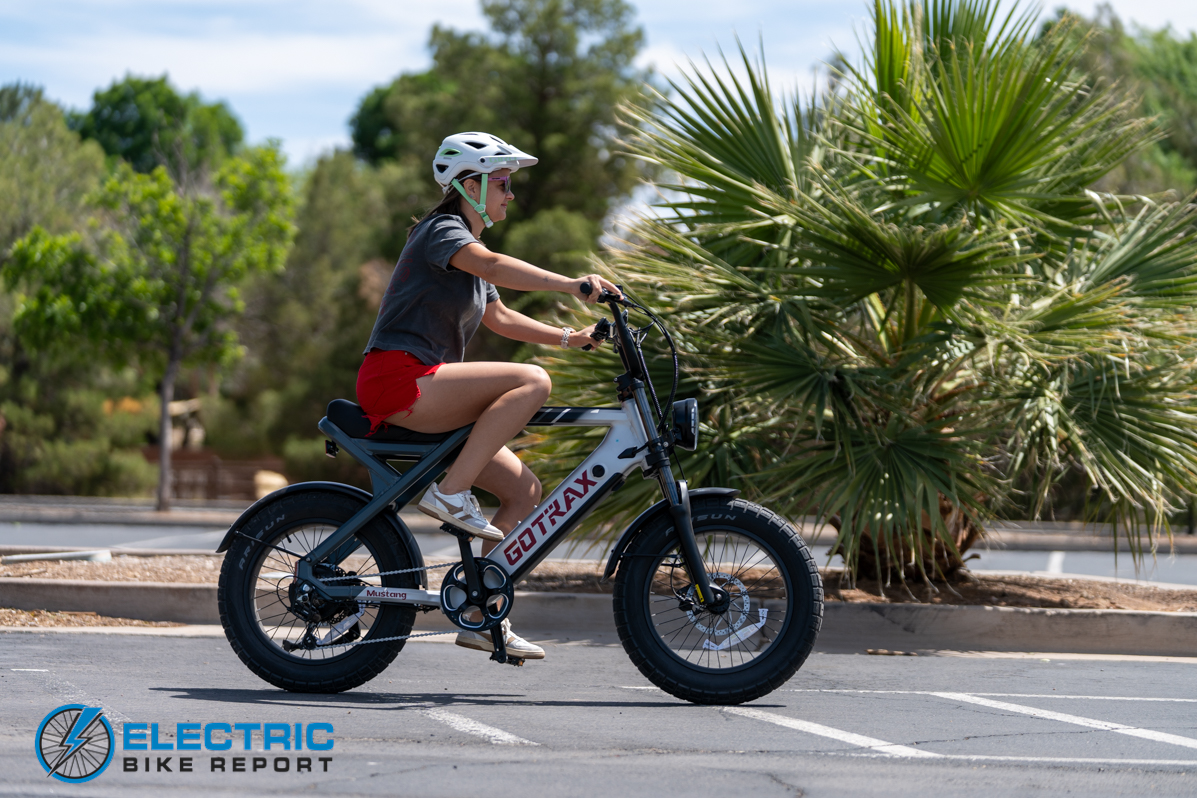
Whether you’re running errands or cruising, the Mustang is a sharp-looking e-bike that’s sure to turn heads.
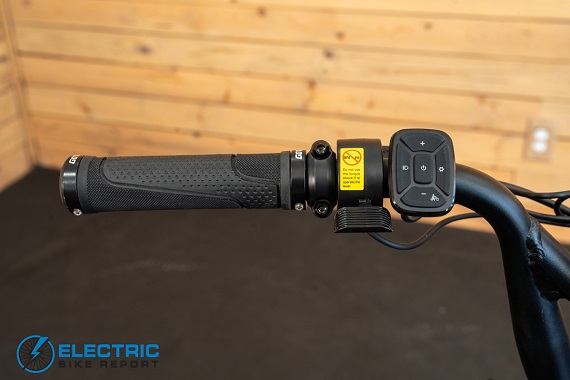
The bike’s thumb-throttle sits next to its control pad on the left handlebar.
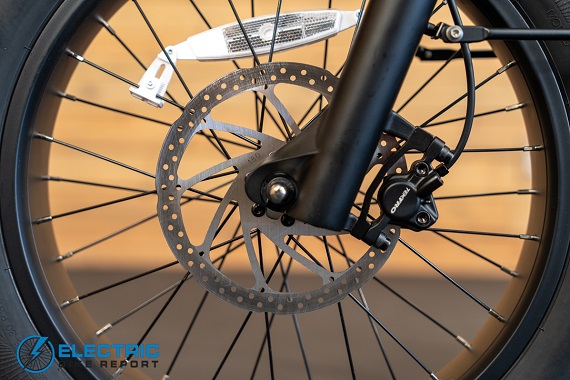
Tektro’s HD-E3520 brake system delivers dependable and safe stopping power.
GOTRAX Mustang Review: Brake Test
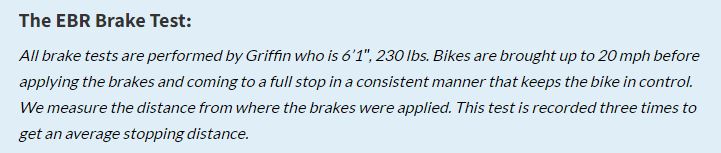
After three Brake Tests done using the method explained above, the Mustang’s average stopping distance was a solid 20’6”. This final result is exactly a foot beyond the moped category average of 19’6”, but still an excellent score. Let me explain.
The first point to cover is that the GOTRAX Mustang is equipped with a capable, common hydraulic brake system: the Tektro HD-E3520 model. This two-piston brake system, which includes a motor cutoff function and 180mm rotors on both wheels, appears often on e-bikes that we review. It has proved to be safe, reliable, and effective.
Second, our comparison group includes e-bikes with stronger 4-piston brakes; these systems have larger brake pads and apply more distributed force on them when engaged. As such, these bikes had significantly shorter than average stopping distances that skewed our average results somewhat.
Third, a bike’s feel is often more important than its data. In my experience, the Mustang’s brakes felt powerful, and even somewhat aggressive, but not so much that they were hard to control. The calipers applied plenty of force with a moderate squeeze of the brake levers, easily modulating speed when riding down hills and stopping the bike quickly on flats.
Finally, moped-style e-bikes are often great performers. Many e-bikes in other categories—that we consider safe—often exceed the 22’ mark, making the Mustang’s result well within our expectations.
In short, the Mustang is well-equipped and safe, with a common, easily-maintained system that provides effective stopping power.
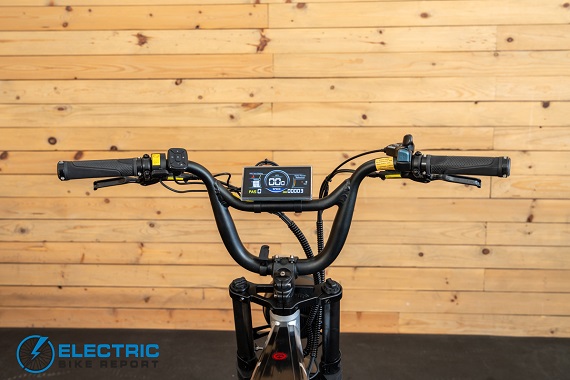
The bike’s BMX-style handlebars feel sturdy and easy to control while steering.
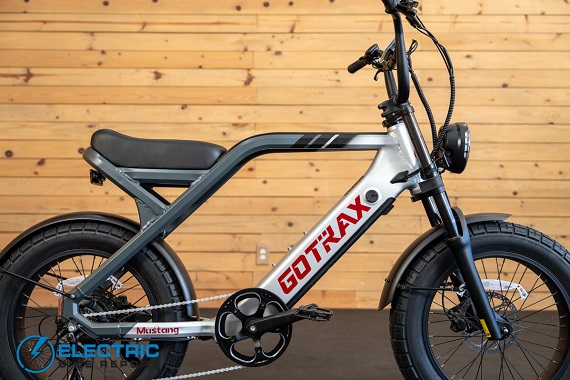
While it didn’t arrive in time for our review, the Mustang ships with a storage bin that mounts to its frame.
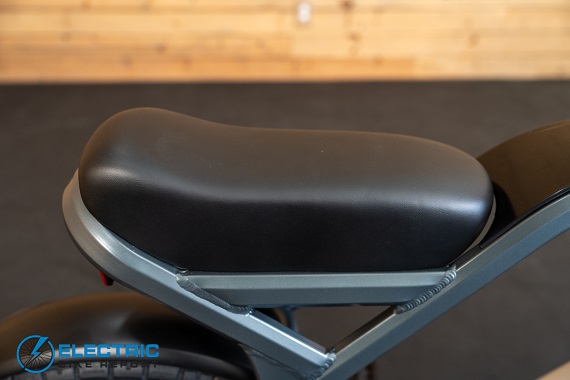
The Mustang’s saddle is relatively small, but well padded.
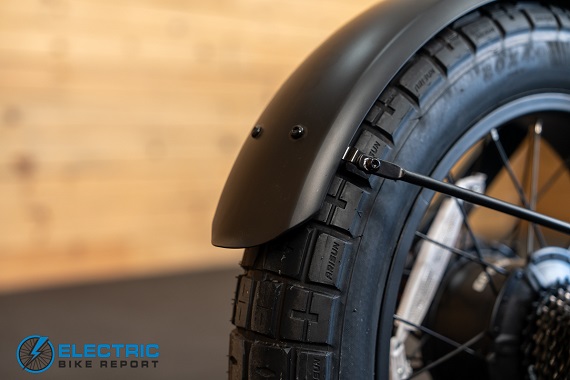
Both wheels have full-coverage fenders for when you need to ride in wet conditions.
GOTRAX Mustang Review: Ride Quality
The Mustang’s overall ride quality, which is a measure of its comfort, user-friendliness, responsiveness, etc., was generally solid. I found much to appreciate about the bike, including its overall simplicity and ease of use, though there may be some important considerations for some riders to keep in mind.
GOTRAX offers the bike in a single frame size that is designed to fit riders from 5’4” to 6’2”, so my height of 5’11” places me near the top end of its recommended range. I found the bike generally comfortable when throttling, though it could be somewhat cramped when pedaling.
As I mentioned previously in this review, e-bikes of this style often feel somewhat inconvenient to pedal due to their low positioning and non-adjustable saddle. In my experience, scooting back on the saddle improves comfort, but the Mustang’s flared, relatively short seat limited my ability to do this.
As such, riders on the taller end of the spectrum may find themselves in my shoes, but those on the lower end—or those who plan to throttle most of the time—should be fine.
I enjoyed the overall smoothness of the ride, made possible by a combination of the Mustang’s suspension, saddle, and tires. Its dual-crown fork, which matches the bike’s edgy aesthetic, offers a respectable 80mm of travel, while its thickly padded seat and 20×4” fat tires add an additional layer of cushioning.
Most moped-style e-bikes I’ve tested previously were larger and heavier than the Mustang, so I appreciated this bike’s uncommonly nimble, more playful feel. It’s not a lightweight e-bike by any means, but its size and weight create a great balance between agility, stability, and plantedness.
I primarily rode the bike on paved trails, but I also ventured off-road for some brief testing. The bike performed well on hard-packed dirt and loose gravel, making it appropriate for limited adventuring off the beaten path.
As I referenced previously, I found many qualities to appreciate about the Mustang’s torque-sensing pedal assist system and 7-speed drivetrain, including its controllable power and easy pedaling. That said, I believe a properly-programmed cadence-sensing PAS paired with a single-speed drivetrain could potentially deliver the same benefits while reducing cost and weight.
A setup such as this would also complement the Mustang’s already low learning curve and easy to grasp user interface. The display is probably the most complex aspect of the bike; its large color screen packs in a lot of data with bold, unique presentation and good organization.
I greatly enjoyed the bike’s overall simplicity. Many e-bikes on the market are loaded with an abundance of features (Bluetooth apps, complicated settings menus, etc.) that increase their functionality, but their higher learning curve may be intimidating to some riders. The Mustang takes the opposite approach by sticking to the basics and keeping its operation simple and effective.
This approach extends to its components and accessories; the Mustang is outfitted with just enough to be useful, not overwhelming or overcomplicated. It includes integrated lights and fenders, and a small, frame-mounted cargo box. GOTRAX offers a handful of additional accessories for those who wish to outfit their bike further
Sponsor
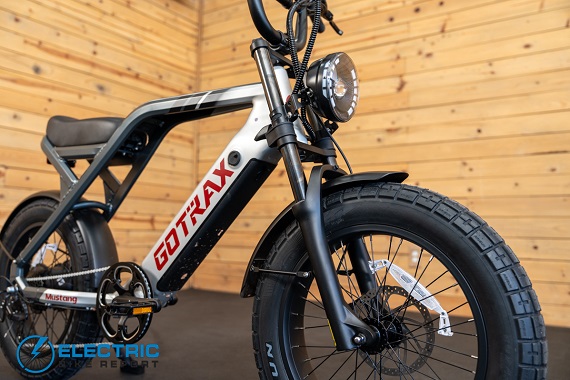
The Mustang’s dual-crown suspension fork features 80mm of travel.
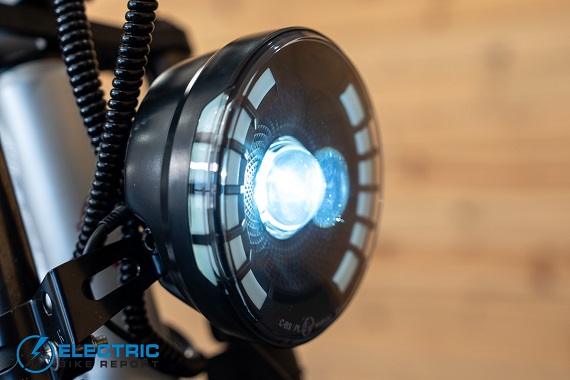
A bright moto-inspired headlight looks cool and keeps the road illuminated.
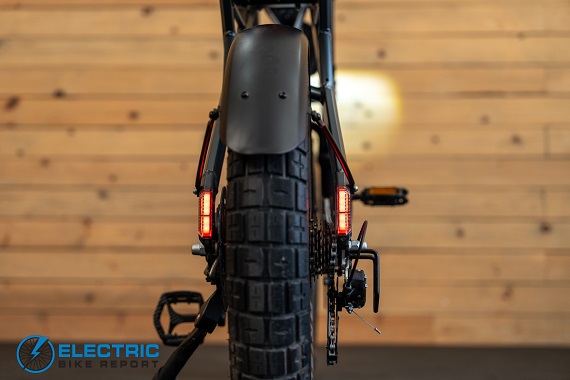
Seat-stay-integrated tail lights also light up when the brake levers are squeezed.
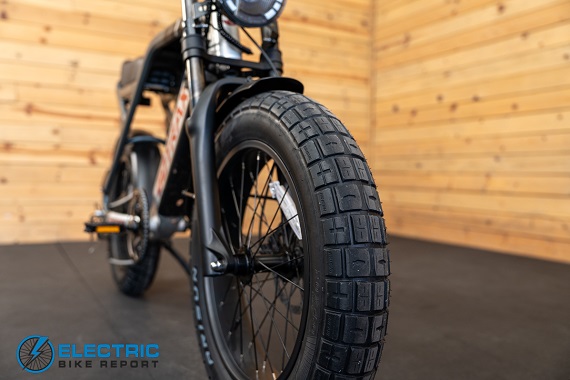
While they’re best suited for pavement, the 20×4” moped tires work well off-road, too.
GOTRAX Mustang Review: Summary / Where to Buy
An e-bike’s price often sets the bar for our expectations, and after testing the GOTRAX Mustang, I can confidently say that the bike offers strong value for its cost. It looks cool, it’s fun to ride, and it’s powerful enough to satisfy those riders who will likely find it appealing, while still feeling easy to manage, understand, and operate.
The bike demonstrated impressive performance capabilities in our testing, with five incrementally-spaced power levels and excellent throttle-only range. It also proved every bit as capable as its peers in its hill climbing power, and showcased safe, strong stopping ability.
Clearly, this is an e-bike for riders who want a moped-style ride with personality, power, and range without spending a boatload of cash. It’s backed by a relatively standard two-year warranty, and while it wasn’t UL certified at the time of our testing, our contact stated that consumers should expect to see this status changed soon after.
Our largest points of critique concerned the throttle’s speed control and the display’s battery charge readout—both relatively small potatoes in the grand scheme of things. Considering the bike’s geometry, we encourage GOTRAX to tie throttle speed to the same five limits as the pedal assist system. And, while the display looks cool, we tend to prefer percentage-based charge meters for easier estimation of remaining range.
Otherwise, the Mustang was a strong addition to the ever-growing list of models we’ve tested. I had a lot of fun riding, testing, and reviewing it! Based on my experience, I’d recommend it the most to riders of relatively average height who want a moped-style e-bike to commute and cruise on.
Happy Riding! Make sure to let us know if you have any questions or if you think we left anything out in this review of the GOTRAX Mustang down in our comments section.
Sponsor
Sponsor
Reader Interactions
Leave a Reply