

Flyer Loop Review | A Little Red Wagon for the Modern Age
Jul 03, 2026
 2 Comments
 Share
Share
An affordably-priced, highly adaptable, and well-engineered e-bike for families who prefer two wheels over four.
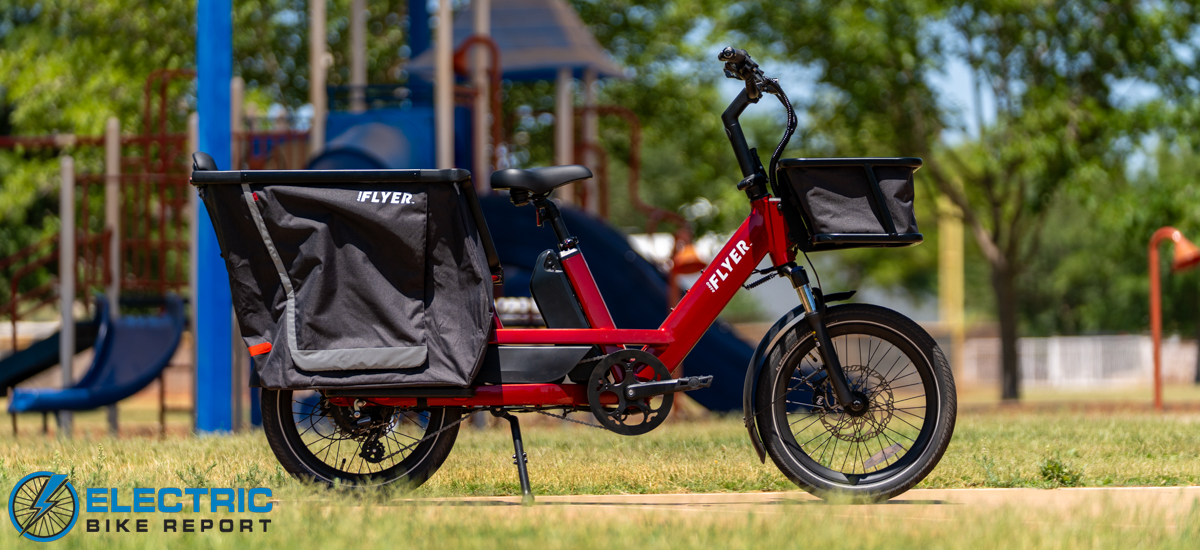
It’s a well-established principle of design that form follows function. That is, an object’s appearance generally coincides with its intended purpose. For this reason, most cargo e-bikes share a fairly utilitarian aesthetic. They have long wheelbases that allow for extended cargo racks, and their frames are highly reinforced to support a high payload.
Unfortunately, these requirements don’t usually leave a whole lot of room for style—but Radio Flyer is not most brands.
With well over a hundred years of experience behind it, the company has a knack for building things that work and look good doing it. The Flyer Loop is the brand’s latest attempt at a capable, cool-looking electric-assisted mover of freight and family members—and, based on our previous experiences with the company’s e-bikes, I was excited to see what it had cooked up.
Right away, I was impressed with the bike’s sleek design and iconic red paint job, but I was also extremely pleased to note that its ride feel and power delivery felt dialed-in and precise. On my first test ride, my biggest takeaways were that the bike was responsive, comfortable, remarkably customizable, and extremely easy to ride.
These days, many e-bike brands offer swappable torque- and cadence-sensing modes, but Flyer gave us one of our earliest experiences with the feature. The Loop continues the trend, allowing riders to experience either the relaxed, low-effort feel of cadence-based power or the active, analog-like responsiveness of torque-based pedal assist.
Combined with motor tuning via the Flyer app, a 440-lb total payload capacity, compatibility with a range of useful storage and passenger accessories, and much, much more, and the Flyer Loop seems positioned to be a strong contender in the cargo category. Its approachable price point of around $2,000 looks even better—so did the bike meet our high hopes?
Continue reading below to find out more.

Sponsor
E-Bike Category:Cargo
E-Bike Class:Class 1 (pedal assist to 20 mph)
Class 2 (throttle to 20 mph)
Class 2 (throttle to 20 mph)
Sponsor
Flyer Loop Video Review
 Pros
Pros- The Loop’s 750W motor delivers power rapidly and responsively in two ways: an analog-like torque mode and a lower-effort cadence mode.
- Pedaling feels comfortable, relaxed, and strain-free, thanks to the Loops’ pedal-forward design. This also helps riders keep their feet on the ground while stopped.
- The Loop’s brakes are among the most powerful we’ve seen. It gave us one of our best Brake Test results for a cargo bike—and placed #2 across all e-bikes we’ve tested.
- Users can customize many of the bike’s aspects, from speed and sensor mode to tail light behavior and turn signal duration.
- Flyer equipped the Loop with lots of small extras that add up: front and rear turn signals, a zippered storage compartment, integrated wheel guards, and more.
- The bike has a category-appropriate payload capacity of 440 lbs. It’s also compatible with a wide range of useful accessories, including custom passenger compartments and third-party child seats.
- It’s packed with safety certifications, such as UL 2271, UL 2849, UL 62368, and DIN 79010.
- While many cargo e-bikes are strictly utilitarian in design, the Loop has a clean, contemporary look with four color options.
 Cons
Cons- We liked the display’s overall design, but we found it easy to activate the turn signals by accident when adjusting assist levels. Separate buttons would help to prevent this.
ELECTRICAL SPECS & FEATURES
- Battery: Flight Speed 48V 14.7Ah 687Wh, Samsung 50E cells
- Charger: 2A
- Display: Full Color LCD with USB-C Charging, Bluetooth Enabled
- Motor: FlightSpeed® 750W Hub Motor, 1200W Peak, 87Nm Torque
- Headlight: 130 Lux with Integrated Turn Signals
- Taillights: Integrated Brake Light with Turn Signals
- Pedal Assist: Four Levels
- Claimed Range: 30-50 Miles
- Throttle: Left Thumb Throttle
- App: Flyer App
- UL Certification: UL2849: Ebike Drivetrain, UL2271: Li-Ion Battery, UL 62368: Battery Charger
Weight & Dimensions
- Claimed weight: 77 lbs
- Tested Weight: 80 lbs (including battery)
- Rider height range: 4’11” – 6’3″
- Total payload capacity: 440 lbs
Components & Accessories
- Brakes: Magura MT5 Hydraulic Lever, 203mm rotor
- Fenders: Front Fender and Rear Fender with Side Covers Included
- Fork: Zoom Cargo-Rated Suspension Fork, DIN 79010 Certified, Coil Spring, 60mm travel, 15mm thru-axle, Preload adjust with lockout
- Frame: Aluminum 6061, DIN 79010 Certified
- Drivetrain: 8-Speed Shimano Altus, 52T Chainring, 11-32T Cassette
- Grips: Radio Flyer Rubber/Aluminum Clamp On
- Saddle: Comfort Saddle Width, 8″
- Handlebar: 700mm Wide, 96mm Rise, 10° Back Sweep
- Kickstand: Rigid, 2 Leg Center Stand
- Pedals: Welgo Alloy – Integrated Reflectors, CrMo axle, 9/16″ x 20 TPI
- Tires: Kenda E-Venture Cargo Tread – 200kg Load Rating, 20″ x 2.4″ Puncture Resistant
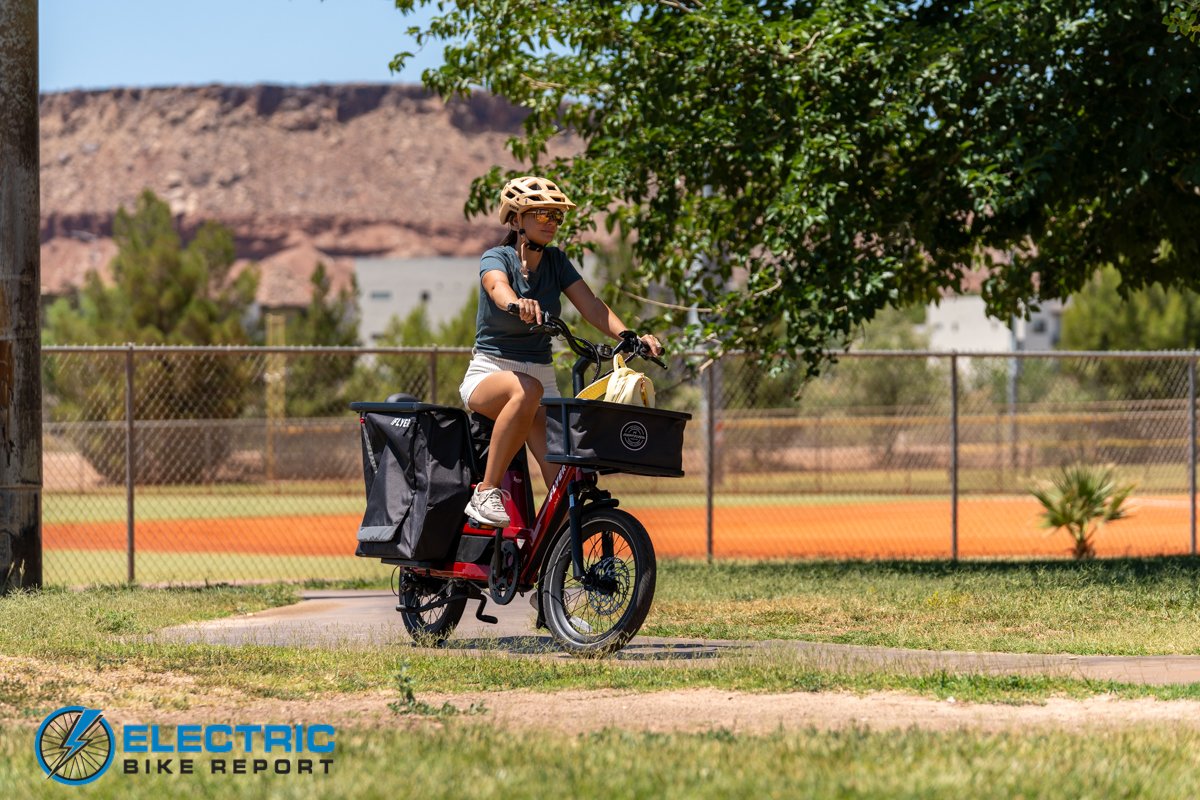
Cargo e-bikes like the Flyer Loop are great for grocery runs, bringing the kids to the park, and family outings on the weekends.
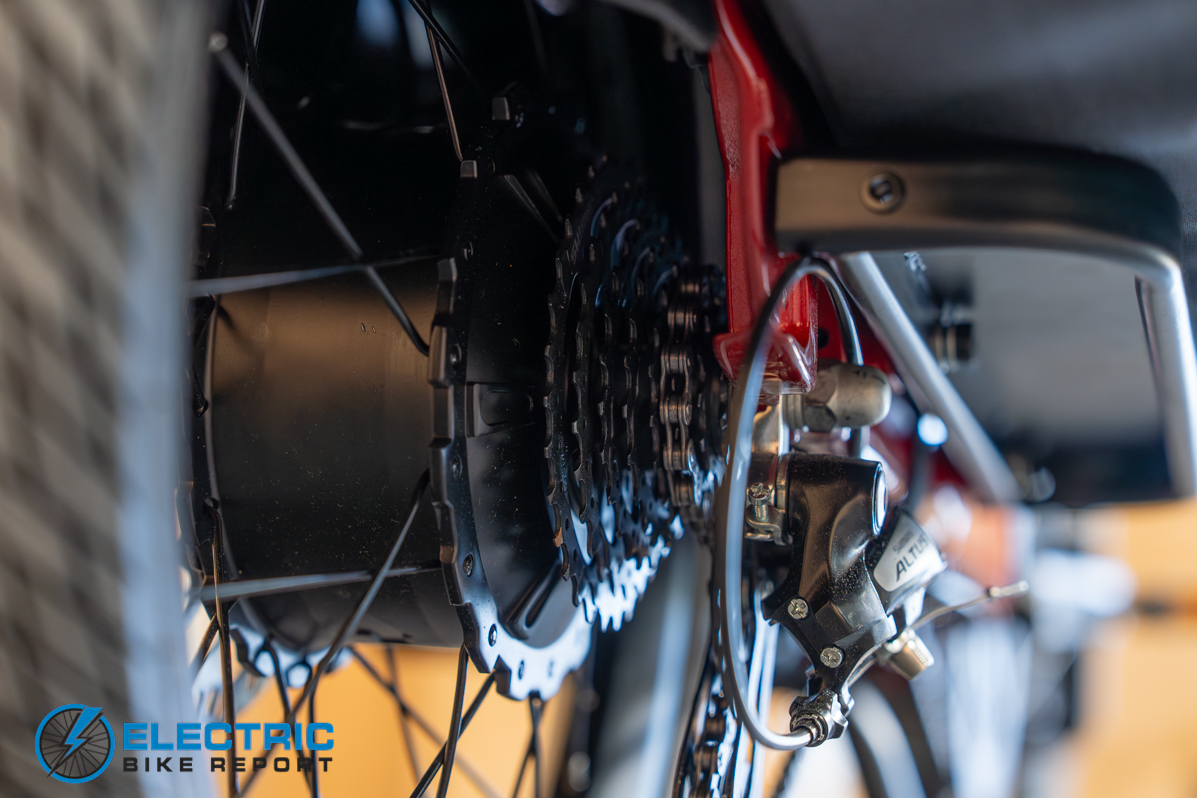
A powerful 750W motor with both torque and cadence sensing modes makes moving heavy loads a breeze.
Flyer sent its optional Cubby Kit and Kaboodle passenger compartment accessory with our test bike—it’s super cool and useful!
Flyer Loop Review: Speed Test
As shown in the graphic above, our Speed Test gives us raw numbers that reflect our average riding speeds in each pedal assist level. I collected this data by riding the Flyer Loop on a mostly-flat, paved network of our local shared-use trail system. I rode the bike in its torque-sensing and cadence-sensing modes to understand how each mode changed the feel of the ride.
More important than the numbers, however, is how well the bike’s programming creates meaningful differences between assist levels.
To start the test, I pedaled without power, and found the Loop generally comfortable and easy to ride—at least, without extra cargo weight.
Then, using torque mode, I noticed that the motor felt powerful and responsive right away. It also felt controlled throughout all four of its assist levels, but with three of its four assist levels compressed against the Class 2 ceiling, the distinctions between them nearly disappeared.
Fortunately, adding 60 lbs of cargo changed things considerably. The extra weight gave the motor something more to work for, and the programming suddenly felt intentional and well-matched to the bike’s purpose. Each assist level felt distinct and meaningful.
Cadence mode told a more balanced story across the board. The sensor engaged remarkably fast—in only about an eighth of a turn of the cranks. The steps between each assist level were distinct and meaningful, with and without cargo.
I noticed that the power levels in cadence mode weren’t hard speed caps either; there was room to push past them with leg effort, which gave the mode a more natural feel than I expected while also making it relatively easy to control my speed.
The throttle was controlled and approachable. It felt gradual off the line, then ramped steadily to 20 mph without feeling overly powerful or punchy.
One caveat worth noting: we were unable to connect the Loop with the Flyer app, which allows for motor tuning and sensor mode adjustments, so we performed all of our testing with the bike’s default settings. Based on previous (successful) experiences with the app, we know it to be useful and user-friendly, and we appreciate that it gives riders a lot of freedom to customize their bike to match their personality and preferences.
Fortunately, connecting with the app is not necessary for those who don’t wish to explore motor tuning. In contrast with many other bikes that bury adjustment features deep within the settings menu, the Loop’s display puts sensor mode selection front and center, so riders can switch modes without the app.
Sponsor
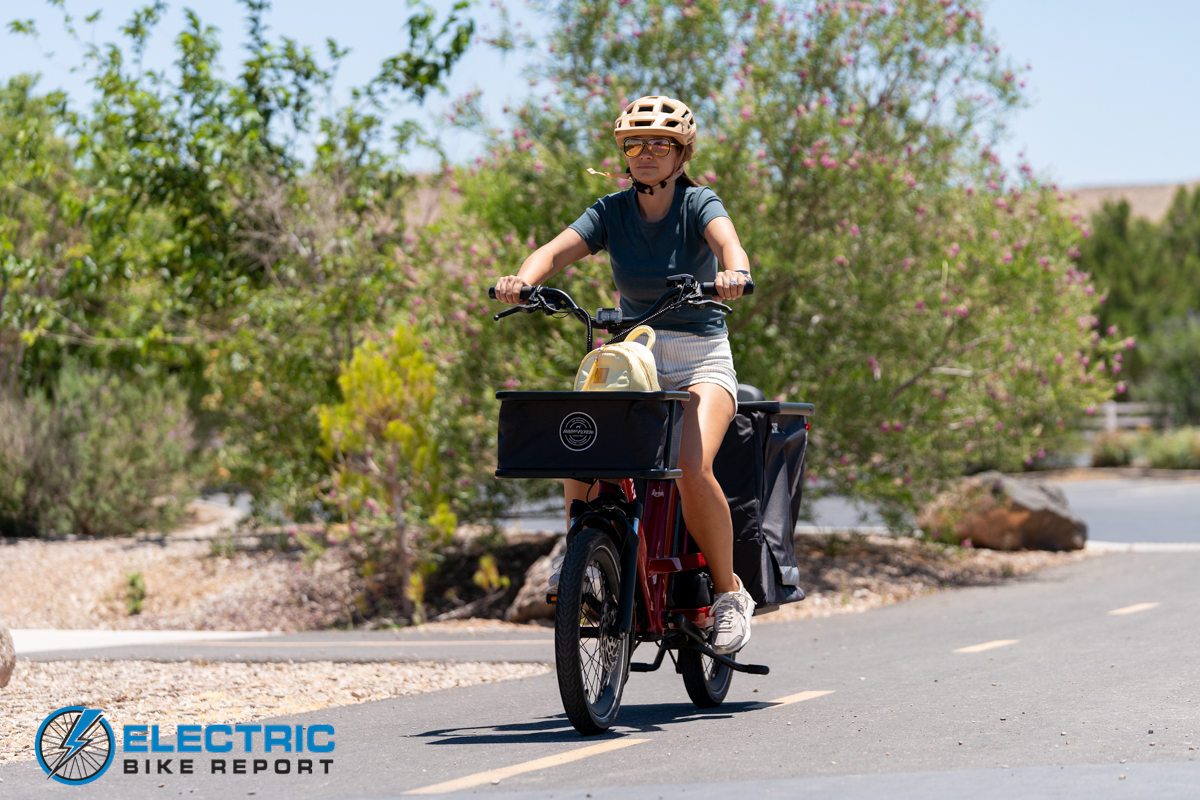
The Loop’s 440 lbs of total payload capacity is plenty for two kids, a load of groceries, a family pet, or a combination of cargo and passengers.
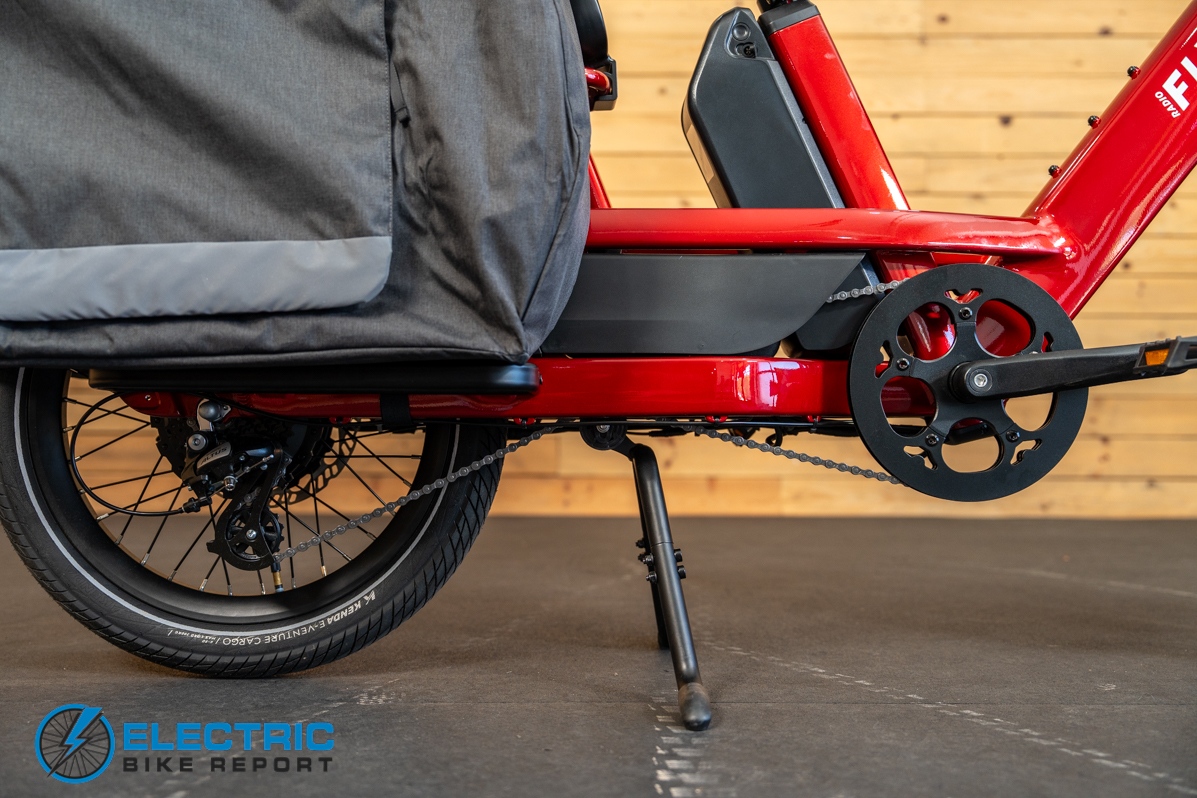
An 8-speed drivetrain keeps pedaling efficient on flats and hills in both sensor modes.
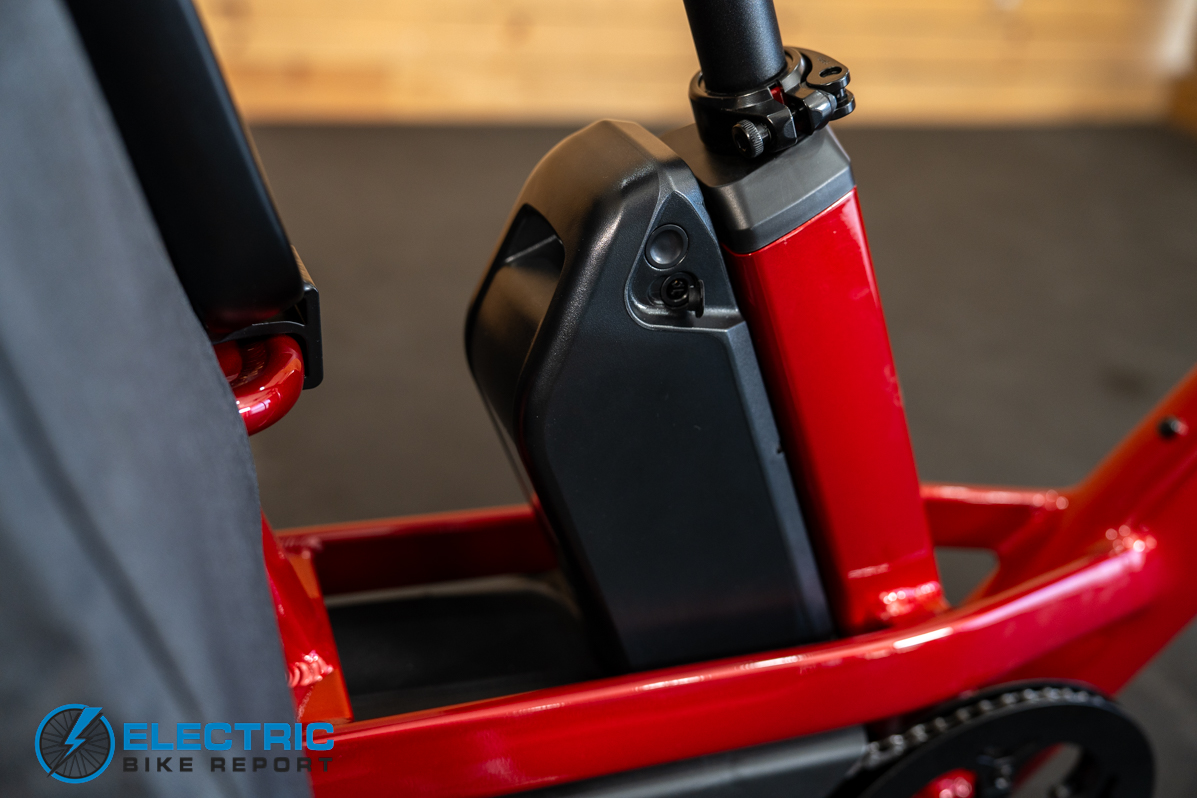
The Loop’s removable UL 2271-certified, 687 Wh battery docks behind the seat tube.
Flyer Loop Review: Range Test
Range is typically the first number prospective buyers look at, and the Loop’s results here require some context to read fairly. We test every bike to see how far it can travel on a single charge, riding in the lowest-power mode and then performing a second high-power test to find realistic bookend values of what riders can expect across different riding styles.
With a removable 687 Wh battery built from reliable Samsung cells, the Loop generally performed well. In our minimum-assist test, it covered 45.4 miles, while in the maximum-assist test, it covered 29.4 miles.
For context, the cargo e-bike category averages 77.6 miles in the low-power test and 36.5 miles at high power. The differences between the cargo averages and the Loop’s results are noticeable, but two factors explain most of the difference.
First, the Loop’s battery is smaller than average. At 687 Wh, it sits below the category average of 721 Wh, which puts it at a slight disadvantage before the bike even starts moving.
Second, and perhaps more telling, is the bike’s energy efficiency. Using 15.2 watt-hours per mile (Wh/mi) in Eco and 23.4 Wh/mi in Turbo, the Loop consumed roughly 5 Wh per mile more than competitors in the low-power test, and about 3.5 Wh per mile more in the high-power test.
Based on my experience, it seemed clear that this difference was intentional: the motor felt tuned to move extra weight easily, and it pushes out a lot of power to do so at the cost of some range.
Ultimately, Flyer claims 30 to 50 miles of real-world range, and our testing was close enough for us to deem the advertised window accurate. It is important to consider, however, that we performed our testing using the more efficient torque-sending mode while riding without cargo—carrying additional weight and/or using cadence mode will reduce achievable range.
Still, a 29 to 45 mile window is totally practical. Riders covering daily errands, school runs, or commutes locally should be able to manage comfortably on a single charge. Those planning longer loaded hauls may want to think more about charging access.
Admittedly, the included 2A charger is on the slower side. We’d love to see Flyer include a faster charger in the future—or offer one as an optional upgrade—but as it is, overnight charging is likely the most practical strategy here.
Sponsor
Sponsor
Flyer Loop Review: Hill Test
Considering that a loaded bike demands more from its motor, it’s fair to say that climbing performance is one of the most important metrics on a cargo bike. To test the Flyer Loop, we conducted two tests on the same measured grade (see above). The first used throttle power alone, while the second was done when pedaling in the highest assist level.
Our test rider, Justin, completed the throttle run in 1:52 at an average speed of 16.2 mph, and the Turbo mode pedal-assist test in 1:47 at 16.9 mph average. The category average for both tests is 1:44, putting the Loop a few seconds behind its peers in both cases.
There are a couple of plausible explanations for its somewhat slower results, though it’s worth noting that they are within our margin of error.
When it comes to outright power, the Loop’s 750W hub motor peaks at 1,200W and produces 87 Nm of torque. Both are similar to the cargo category averages of 1,237W and 85 Nm of torque.
Additionally, we weighed the Loop at around 80 lbs right out of the box, which is slightly lighter than many competitors (these average 82 lbs). The added weight of some of the optional accessories Flyer sent with our test bike likely pushed the Loop’s weight above the average, thereby slowing it down.
Another potential factor is programming: the motor appears tuned for smooth, controlled delivery rather than maximum climbing power, which fits with how the bike felt throughout our testing.
In my experience, the throttle felt steady and smooth when climbing, and the motor was notably quiet. Interestingly, pedaling in torque-sensing mode without cargo was the most physically demanding experience and produced my slowest individual result. Cadence mode was the easiest overall and gave me the fastest time.
The most interesting result came with 60 lbs of cargo loaded on the rear rack. In torque-sensing mode, the added weight actually sped up my time. The extra resistance seemed to give me something to push against, and the torque sensor responded to that increased input by delivering more power.
Overall, this experience reinforces that the Loop’s programming is tuned for carrying cargo, which makes perfect sense. Regardless, the bike’s performance shows it is more than capable of climbing hills using either its throttle and pedal assist system—both with and without additional weight.
Sponsor
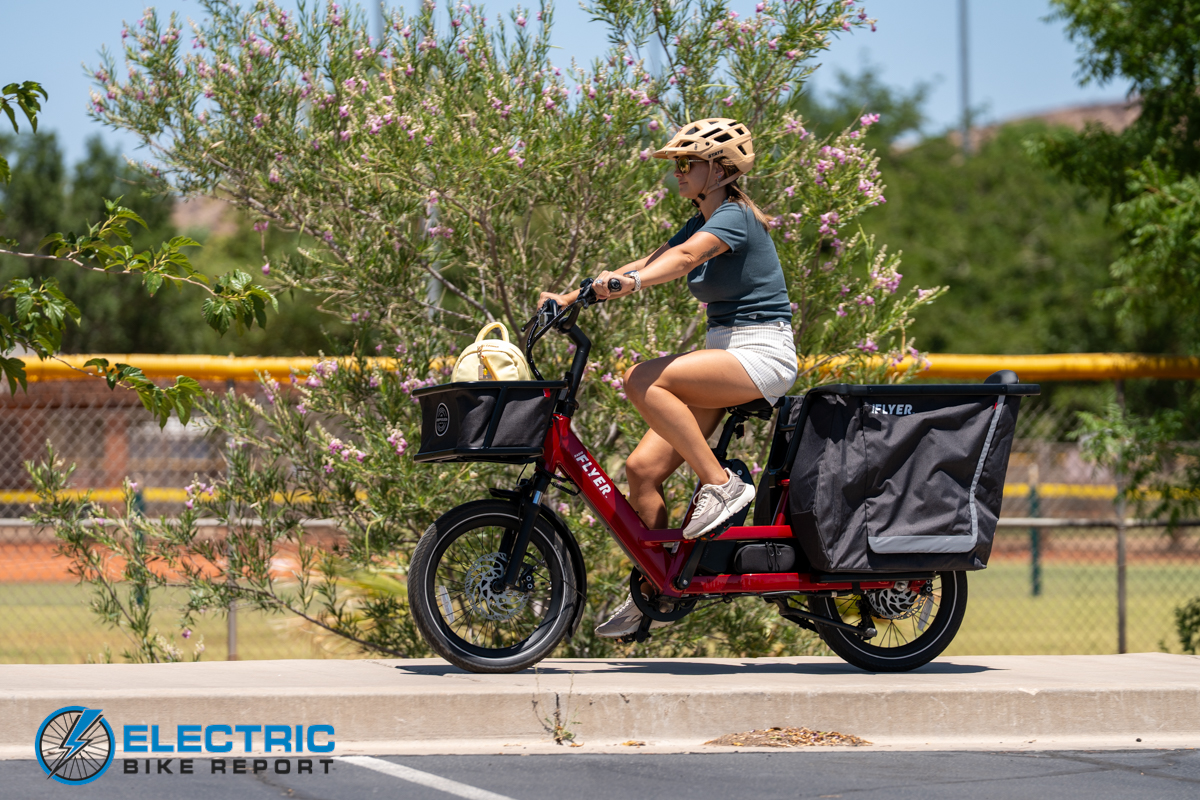
With a maximum speed of 20 mph via throttle and pedal assist, the Loop feels safe and controlled when unladen and when hauling cargo.
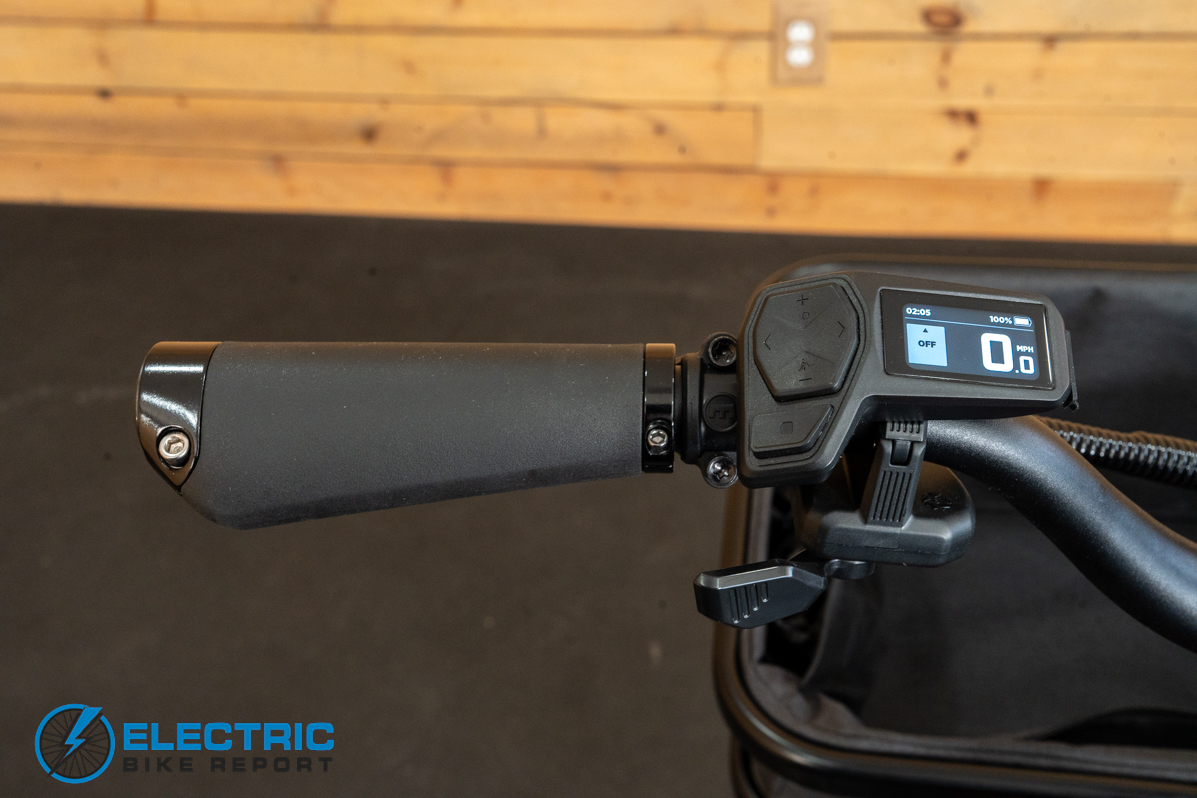
Riders can reach and operate the thumb throttle from the comfortable ergonomic rubber grips.
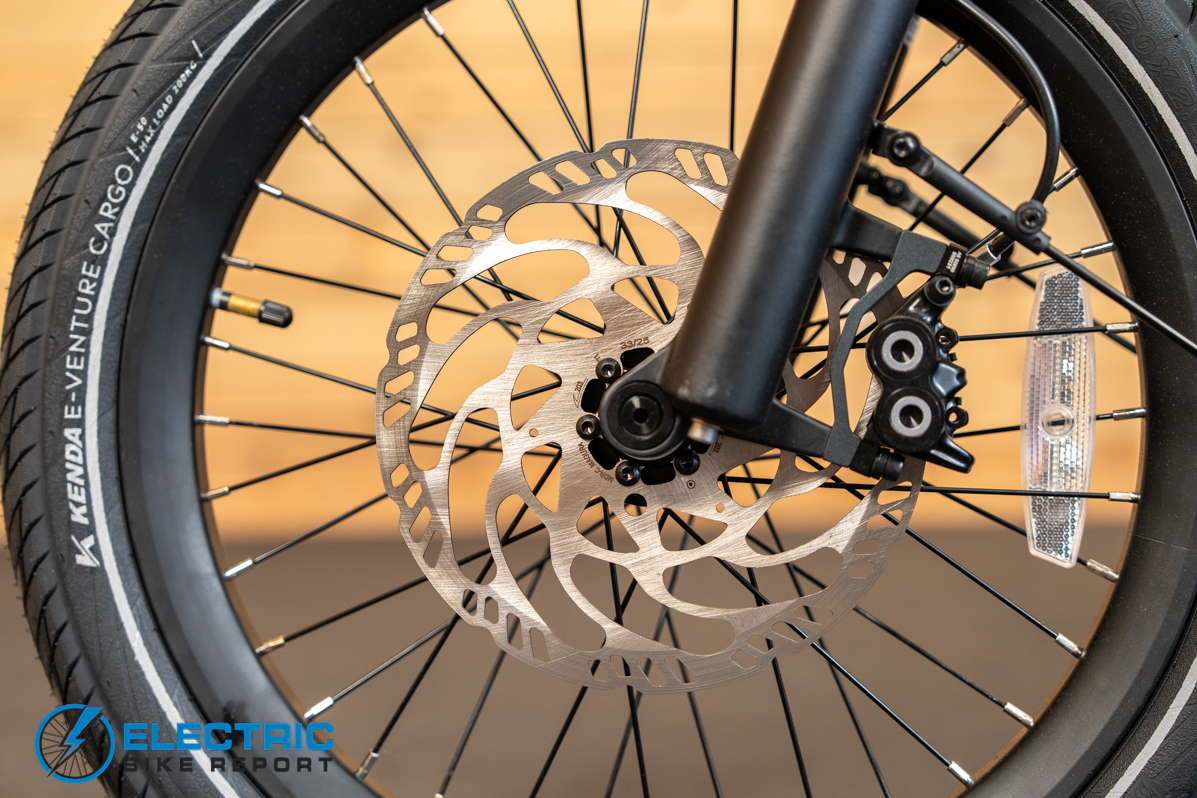
The Loop’s 4-piston hydraulic brakes use huge, heat-dispersing 203mm rotors on both wheels.
Flyer Loop Review: Brake Test
Stopping distance is another extremely important factor on a loaded cargo bike that can carry up to 440 lbs of rider and freight. Like every e-bike, we tested the Flyer Loop by cruising up to 20 mph on a flat, paved surface, applying the brakes, and measuring its travel before stopping. We averaged its three test results to account for variation.
The Loop stopped in an extremely impressive average of 15’4″, while similar models in the cargo e-bike category average 19’3″. That nearly four-foot margin makes the Loop the shortest-stopping cargo e-bike we have tested to date, and its result is also the second-shortest stopping distance across every e-bike from all categories in our database.
The Loop is equipped with Magura’s MT5 hydraulic brake system. Where most cargo bikes use two-piston calipers, the MT5 runs four pistons, applying more uniform pressure across the brake pad surface and increasing the total contact area against the rotor.
Additionally, the Loop’s 203mm rotors add another advantage over the 180mm rotors more common in this category, dissipating heat faster and preserving stopping power under repeated use.
In my experience, the brake system’s lever feel matched our test numbers. The MT5 delivered strong, somewhat aggressive braking power with only moderate grip pressure. Modulation was easy with only light pressure, and the system’s overall performance was consistent throughout testing, with no fade or sponginess under hard repeated stops.
It’s not an exaggeration to say that the MT5 system is among the best-performing hydraulic brake setups we’ve tested to date. It’s a safe, powerful, and effective system that is extremely well-matched to the Loop’s speeds, carrying potential, and purpose.
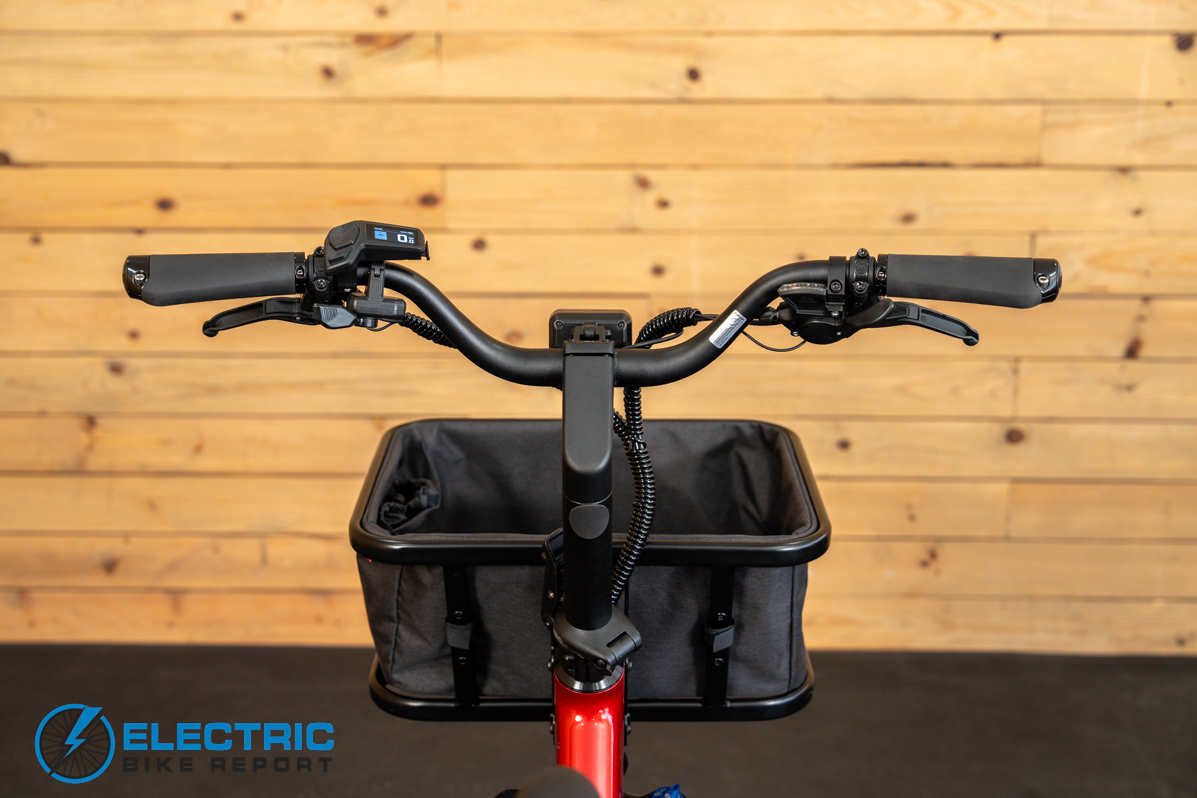
The 700mm mid-rise handlebars provide comfort, balance, and good steering control.
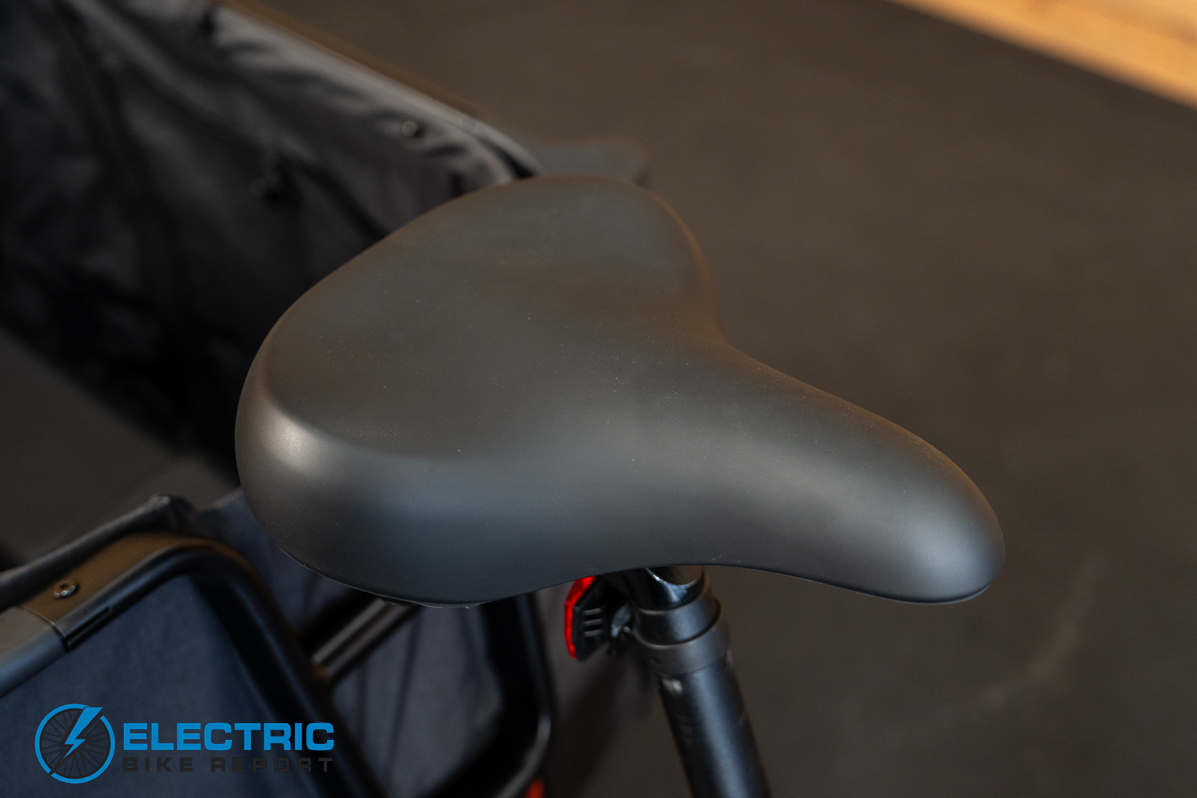
A soft, supportive saddle keeps the ride comfortable and smooth.
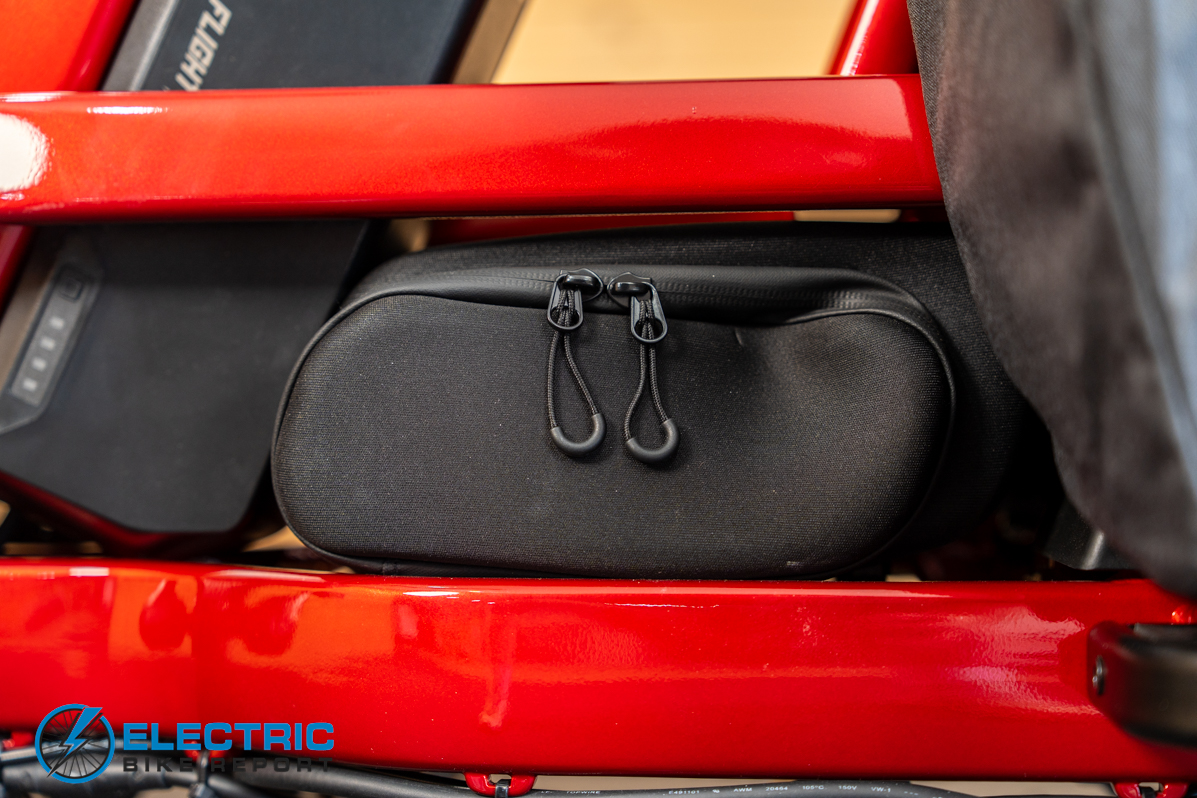
Flyer equipped the bike with a small frame-mounted zippered storage bag.
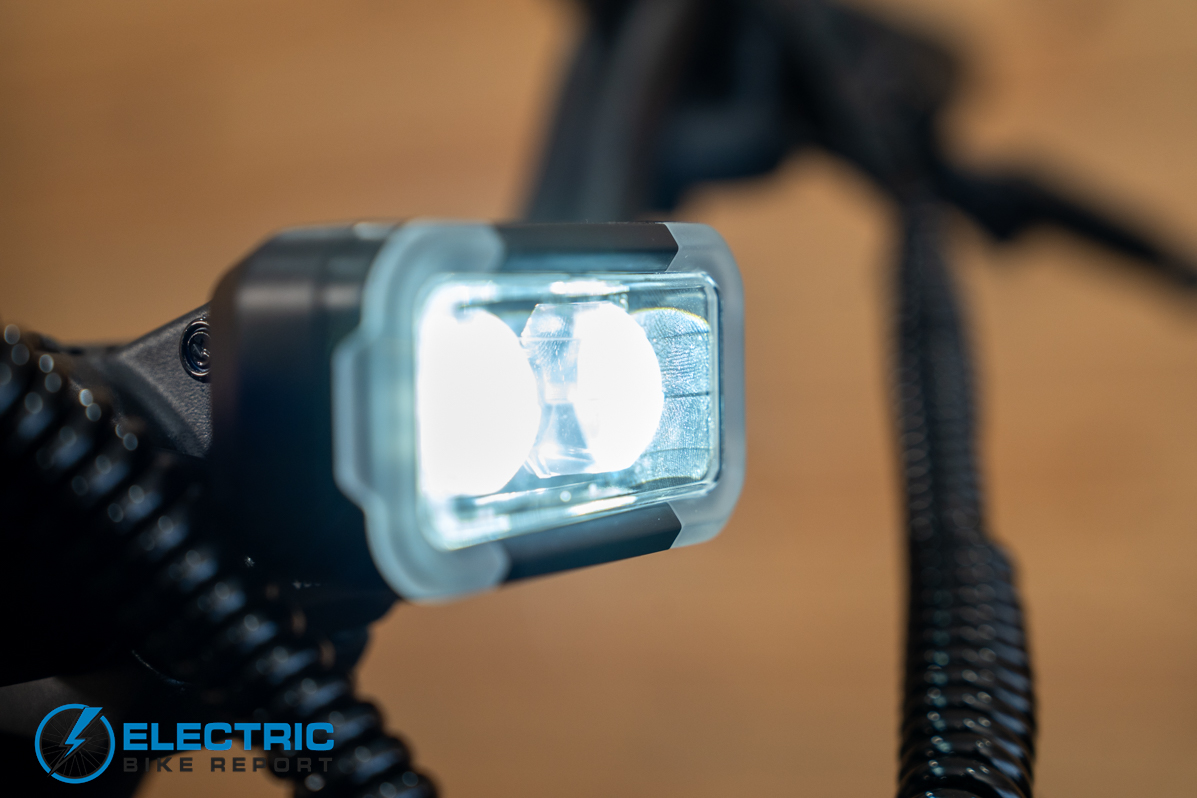
The Dual-LED headlight includes front-facing turn signals—an uncommon sight!
Flyer Loop Review: Ride Quality
Flyer makes the Loop in a single frame size with a recommended height range of 4’11” to 6’3″. At 5’11”, I sit near the top end of this range, which is worth keeping in mind as I describe the fit, because riders closer to the middle of that window may have a somewhat different experience than I did.
One thing I found immediately impressive about the Flyer Loop was its pedal-forward geometry. Compared to more traditional designs, the bike’s bottom bracket is shifted slightly forward. This opens up leg extension for comfortable, strain-free pedaling while making it easier for riders to touch the ground when stopped.
This second benefit is extremely useful, especially on a cargo bike where you may be starting and stopping frequently with weight on the rack. Touching the ground allows you to keep the bike’s cargo balanced and stable when you aren’t moving.
Overall, I found the bike comfortable and enjoyable to ride, though the handlebars felt a touch low for my height. I appreciated the good balance and steering control provided by the 700mm wide handlebars, and the fact that the stem does allow for angle adjustment, but I wouldn’t mind seeing more vertical adjustability with a quill-style stem.
The Loop’s ergonomic rubber lock-on grips were comfortable throughout, with no pressure points and no vibration transferring into my palms. Up front, the Zoom cargo-rated suspension fork offers 60mm of coil-spring travel with preload adjustment and a lockout. The lockout is particularly useful when the rear rack is loaded, as it can be turned on when you need precise, confident handling through turns.
The Kenda E-Venture 20×2.4″ tires are cargo-specific, rated to 440 lbs, and contributed to a stable, smooth feel when traversing paved surfaces.
Without cargo, the Loop felt maneuverable and reasonably nimble for its class. It still handles like a long-tail cargo bike (because it is one), but the wheelbase is on the shorter side for the category, and its 80 lb tested weight is lighter than many competitors. That combination makes it a bit more lively feeling and responsive when cornering.
Adding 60 lbs to the rear cargo rack changed the handling in ways that felt expected and normal. The extra weight showed up most at starts, on climbs, and through corners, where there was a noticeable counterweight sensation to compensate for. Frame flex under load was present but unremarkable, and after about 10 minutes of riding loaded, the adjustments became second nature.
The Loop’s motor engagement and programming are well done. In both sensor modes, the motor responds nearly instantaneously, delivering power responsively to make pedaling feel seamless. In the low assist levels, the bike feels natural and active, while higher levels provide ample power to make pedaling easy.
The display is clean and well-organized, though some riders may find its small text somewhat tough to read. My largest complaint about the bike concerns its interface; the pedal assist level buttons sit close enough to the turn signal buttons that I often triggered the signals while trying to adjust power. More separation between the buttons would alleviate this relatively minor frustration.
As I touched on above, I wasn’t able to connect the bike with the Flyer app, which enables motor tuning and deeper customization. I suspect this is due to other reviewers having tested and paired with our test bike, so I don’t consider it overly concerning, but I can’t comment on features that I wasn’t able to test.
One last thing to touch on is the Loop’s well-outfitted nature. It includes a zippered storage compartment, integrated wheel guards, front and rear turn signals, and integrated LED headlight and tail/brake lights.
It’s also compatible with a range of useful cargo and passenger accessories. We tested the optional Cubby Kit & Kaboodle, which combines passenger seating with a handrail and weatherproof compartment, as well as the XL Front Goodie Basket. The accessories seemed well-constructed, durable, and ideal for tailoring the bike’s uses to your needs.
Sponsor
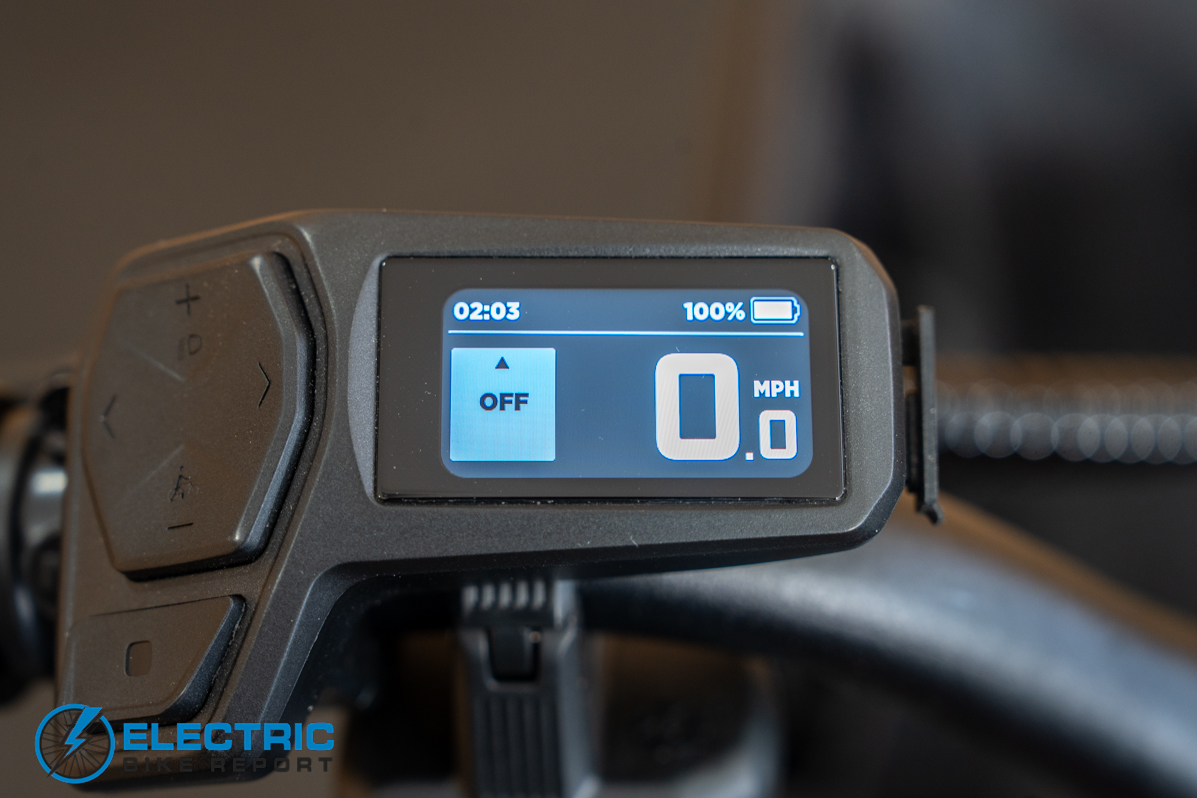
The Loop’s handlebar-mounted display is small but features all the necessary info.
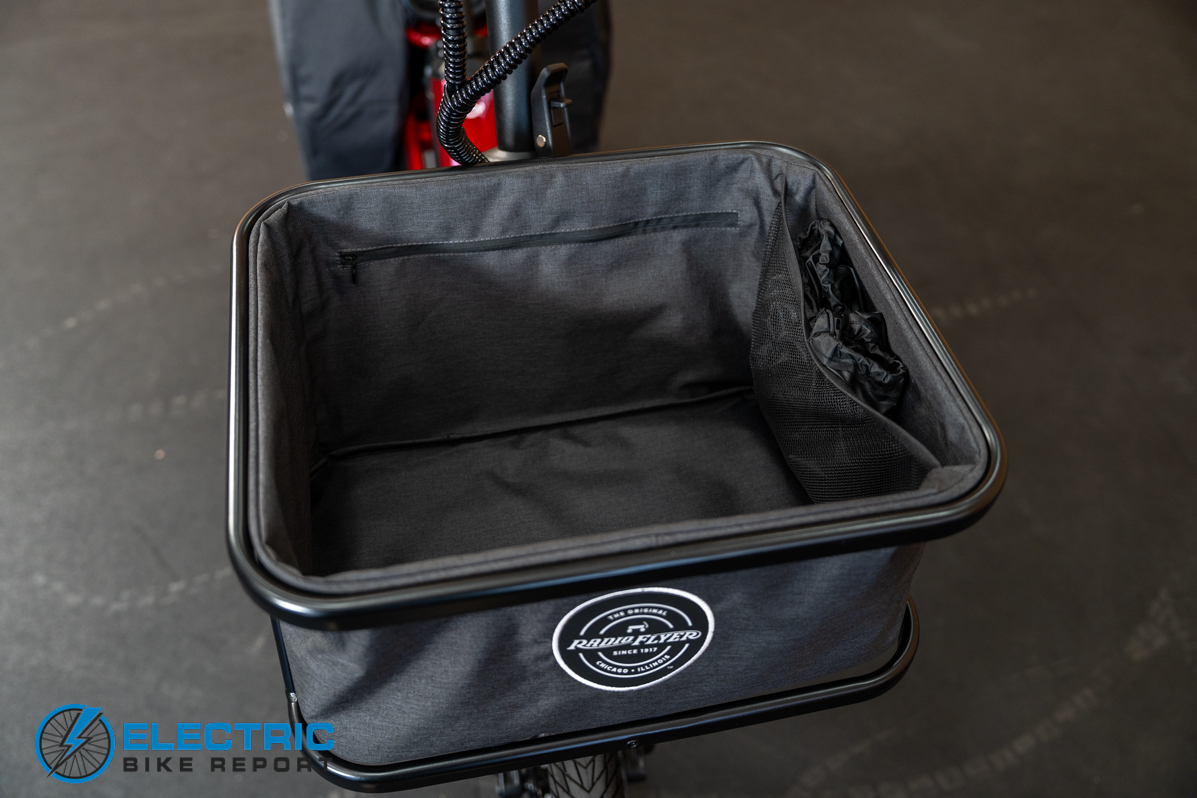
An optional front cargo basket can add additional utility to the bike.
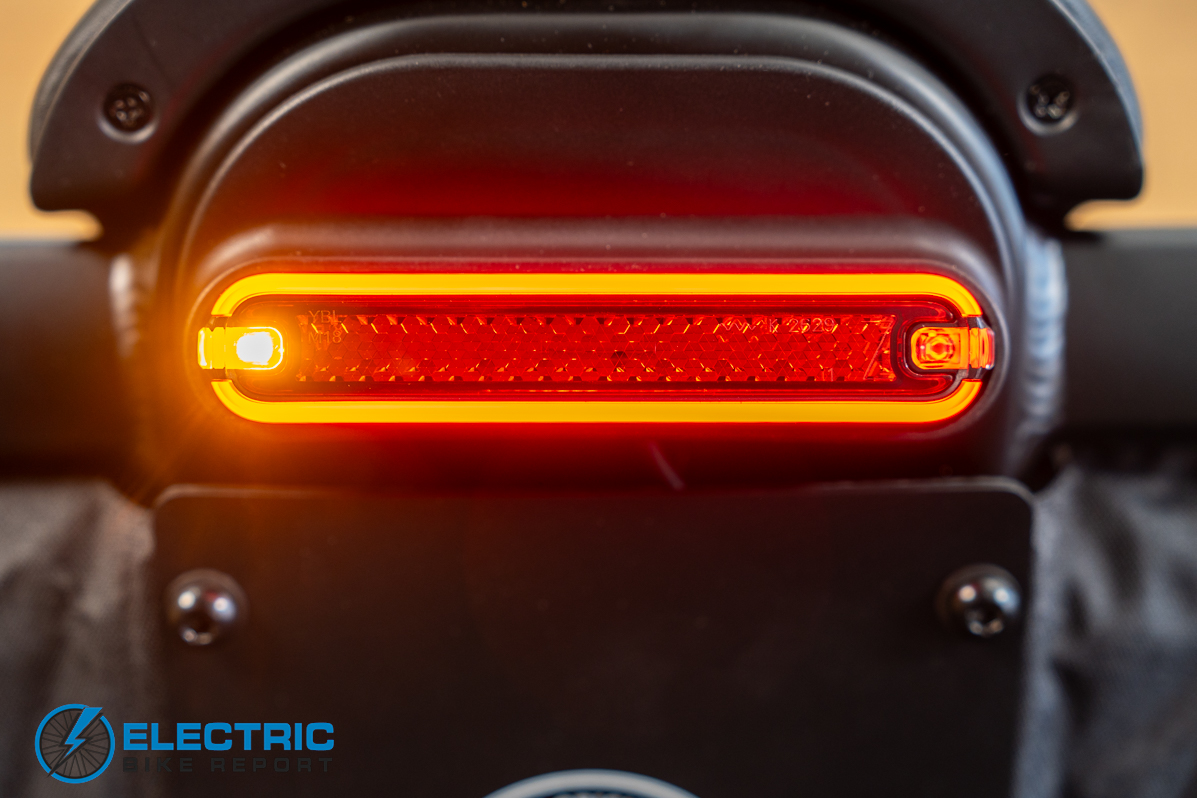
The included taillight functions as a brake light and turn signal indicator.
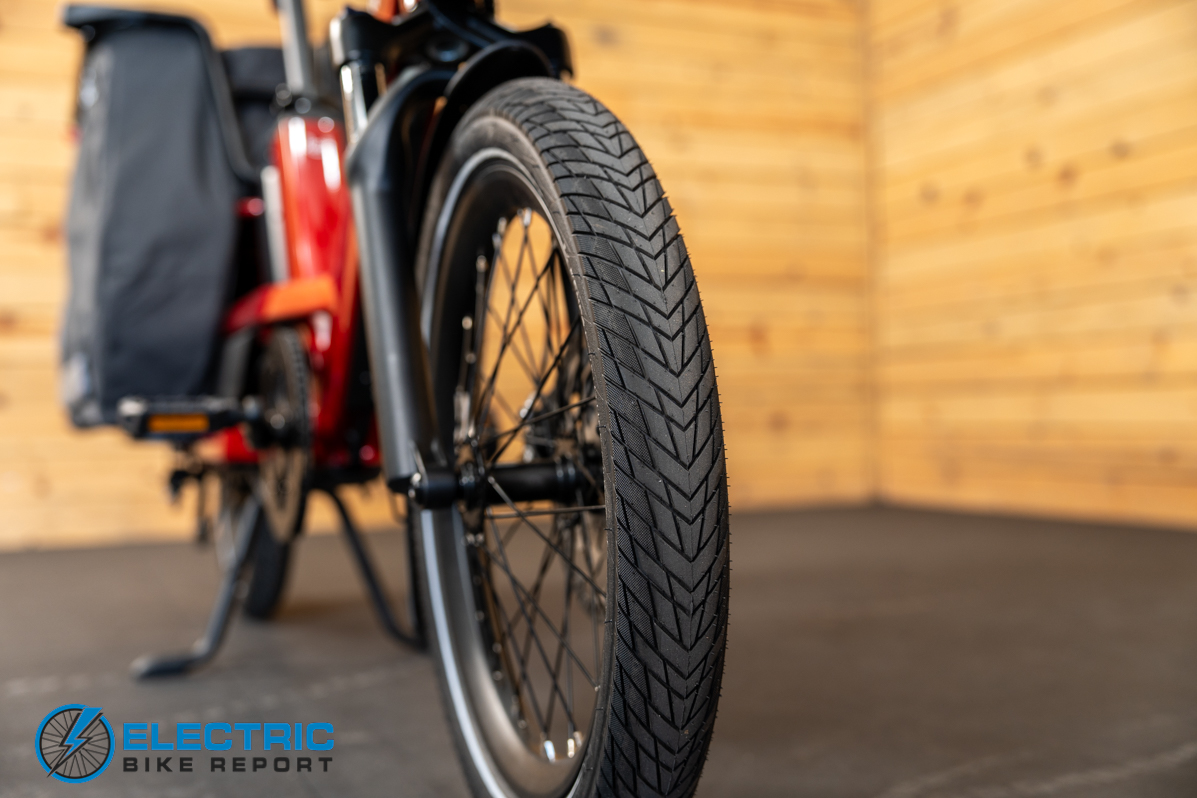
A set of 20×2.4″ cargo-rated tires provide stability, cushion, and traction on paved paths.
Flyer Loop Review: Summary / Where to Buy
Having previously tested the Flyer Via Pro, and finding it to be a great cargo bike, I looked forward to seeing Flyer’s progression with the Loop. The brand’s fingerprints were clear; it’s a well-built, well-priced cargo e-bike with comfort, responsive power, and solid real-world performance that speaks for itself.
The bike’s range of four power levels and two sensor modes allows it to match its feel to the preferences of nearly any rider. Its power delivery is smooth, controllable, and responsive, which makes it intuitive to use. Additionally, the Loop’s pedal-forward geometry makes daily riding comfortable and balancing a heavy load a breeze.
For riders who want a stylish, safety-certified cargo platform with lots of customization options via both accessories and programming, the Loop brings much to the table. In terms of performance, it offers outstanding stopping power, solid climbing performance, and plenty of oomph for moving extra weight.
Range may be a bit of a tradeoff for riders whose daily routes push beyond 25 to 30 miles under load, but the bike’s potential should work well for most folks. Realistically, our largest critique was its control panel’s button placement, though the bike is clearly doing a lot of things well for this to be our main area of focus for future improvement.
The bottom line is that the Flyer Loop looks great, rides very well, is extremely adaptable, and bears a solidly approachable price. This makes it easy to recommend for delivery workers, parents who want a fun and versatile way to spend more time with their families, and any rider who seeks the ability to do more with their e-bike.
Happy Riding! Make sure to let us know if you have any questions or if you think we left anything out in this review of the Flyer Loop down in our comments section.
Sponsor
Sponsor
Reader Interactions
Comments
Leave a Reply




I’m confused. The review and specs state the battery is 48v 14.7ah, with 687 total wh. Normally watt-hours are determined by voltage (times) ah. So 48*14.7= 706WH.
So a 687 watt-hour battery would be a 14.3ah, not 14.7. (687/48= 14.3). Which is correct? Or am I missing something? Thanks!
Specs are often states as nominal figures, so it’s common for there to be some slight discrepancies between advertised and actual numbers. We’d definitely prefer the advertised capacity to be conservative rather than inflated.