Amflow UE Carbon Review | This Bike Redefines Urban Riding
Nov 18, 2026
 0 Comments
 Share
This premium, carbon fiber city cruiser offers smooth, engaging pedal assist, great handling, and more customization options than you can shake a stick at.
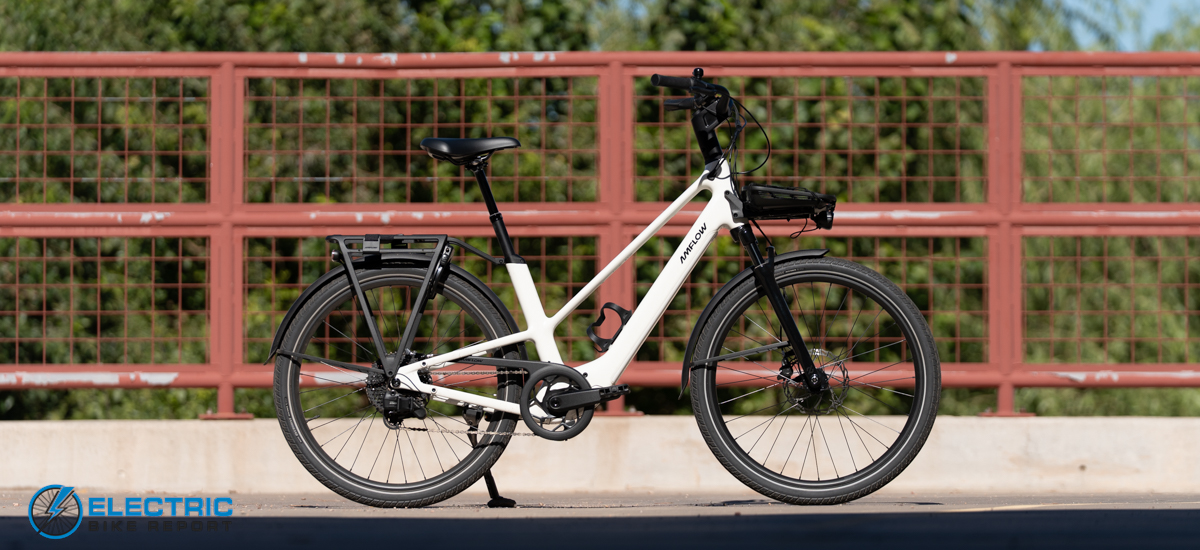
With relatively recent releases such as Amflow’s PL and PX electric mountain bikes and Avinox’s staggeringly powerful M2S mid-drive, both brands have proven that they are capable of redefining the eMTB market. But what happens when the two brands join forces on an urban e-bike?
That question was front and center when we began testing the Amflow UE Carbon.
This premium, high-tech commuter e-bike shares its name with its mission; UE stands for “Urban” and “Easy.” Judging by the bike’s long list of features and performance-focused components, it certainly appeared that Amflow focused on the right areas.
For example, the bike is equipped with an Avinox M2 mid-drive motor. Its 1100W of peak power and maximum of 125 Nm of torque are impressive—but it wasn’t until my first ride that I truly understood how easy and enjoyable it made the ride. The motor felt remarkably smooth, adaptive, and helpful, delivering ample power both intuitively and quietly.
Other components, such as the bike’s electronically-operated 10-speed TRP drivetrain and powerful 2-piston Magura hydraulic disc brakes offer a high baseline of reliability, but they’re far from being the stars of the show. Everyone’s opinions may differ, but we’d say that honor falls to the UE Carbon’s integrated security and customization technology.
Whether through the bike’s handlebar-mounted touchscreen display or a paired smartphone with the Avinox app, users can make use of the UE Carbon’s advanced, highly granular motor tuning features, track their bike’s location via Apple Find My, receive unusual motion alerts, connect with accessories such as cameras and heart rate monitors, track ride data, and more.
If that weren’t enough, the bike also comes decked out with lights, fenders, and both front and rear cargo racks.
At face value, it doesn’t get much more serious than the UE Carbon when it comes to e-bikes that are meant to substitute a car. Clearly, Amflow aims to offer a robust, premium experience to UE buyers. We set out to compare its performance against similar models we’ve tested to determine if it’s truly the best of its kind—see our full review below to find out!

Sponsor
E-Bike Category:Cruiser / Commuter
E-Bike Class:Class 1 (pedal assist to 20 mph)
Class 3 (pedal assist to 28 mph)
Class 3 (pedal assist to 28 mph)
Sponsor
Amflow UE Carbon Video Review
 Pros
- Pedal assist feels remarkably smooth, natural, and easy. The Avinox mid-drive delivers responsive and plentiful power—up to 1100W and 125 Nm of torque.
- The UE Carbon has great handling. Its weight is well-balanced, and its carbon frame gives it a light, airy feel that’s also planted.
- It’s one of the most high-tech and customizable e-bikes we’ve reviewed, with robust motor tuning, custom assist levels, advanced & auto shifting modes, and more.
- Comfort is one of the UE’s main priorities. It features upright geometry, a suspension fork, and quick-adjust dropper seatpost for comfort, along with two stems to adjust fit.
- The UE also includes a variety of security features. Integrated Apple Find My tech allows for location tracking, while a six-digit PIN, cafe wheel lock, and a motion detection & alarm system help to prevent theft.
- It has great components across the board, including a 10-speed TRP drivetrain, Magura MT A2 brakes, Maxxis Overdrive tires, and a host of custom Amflow or Avinox parts.
- At 58 lbs, it’s lighter than much of the competition—while being fully equipped with lights, fenders, a front cargo rack, and an MIK-HD rear rack.
- Extras such as electronic shifting, a touchscreen display, a magsafe-compatible phone mount/charger, etc., help the bike feel even more high-tech and premium.
- In addition to the Avinox app, the UE can easily pair with a heart rate monitor or DJI OSMO camera. The result is a hugely connected experience.
 Cons
- While we appreciated the integrated magsafe charger, the mount’s clamp mechanism wasn’t the smoothest. We encourage Amflow to employ a mount that’s easier to operate.
- It’s not an outright downside, but buyers should know that using all of the bike’s features comes with a relatively steep learning curve.
ELECTRICAL SPECS & FEATURES
- Battery: Avinox RS600 Battery (Removable), 600 Wh
- Charger: Avinox 4A Charger, 168W Output
- Display: Avinox DP200: 1.4-inch LCD Touchscreen Control Display
- Motor: Avinox M2 Drive Unit: Nominal 110N·m, Peak 125N·m, 1100W
- Headlight: Avinox Front Light
- Taillights: Avinox Rear Light
- Pedal Assist: 4 Assist Modes
- Claimed Range: Up to 82 mi
- Throttle: None
- App: Avinox Ride App
- UL Certification: UL 2271 & UL 2849 Certified
Weight & Dimensions
- Claimed weight: 46.1 lbs
- Tested Weight: 58.3 lbs
- Rider height range: 5’1″ to 6’3″
- Total payload capacity: 368 lbs (265 lbs max. Rider weight)
Components & Accessories
- Brakes: Magura MT A2 Hydraulic Disc Brakes, 2-Piston Caliper, 3-Finger Lever, 180mm Rotor
- Fenders: Amflow UE Series Mudguard
- Fork: Amflow Urban Fork, 65mm Travel, Lock Without Rebound, 15×110mm, 46mm Offset
- Frame: Carbon Fiber Frame, Lunar White
- Drivetrain: 10-Speed TRP E.A.S.I Electronic Rear Derailleur, 42T Avinox Direct Mount Chainring, 11-43T Cassette
- Grips: Amflow Urban Grip
- Saddle: Amflow Urban Saddle, Amflow Urban Dropper Post, 125mm Travel, 31.6mm Diameter, With Suspension
- Handlebar: Amflow Urban Alloy Handlebar, 40mm Rise, 660mm Width, 31.8mm Diameter
- Kickstand: Amflow UE Series Kickstand
- Pedals: Amflow Urban Pedals
- Tires: Maxxis Overdrive (M2003e), 26×2.0
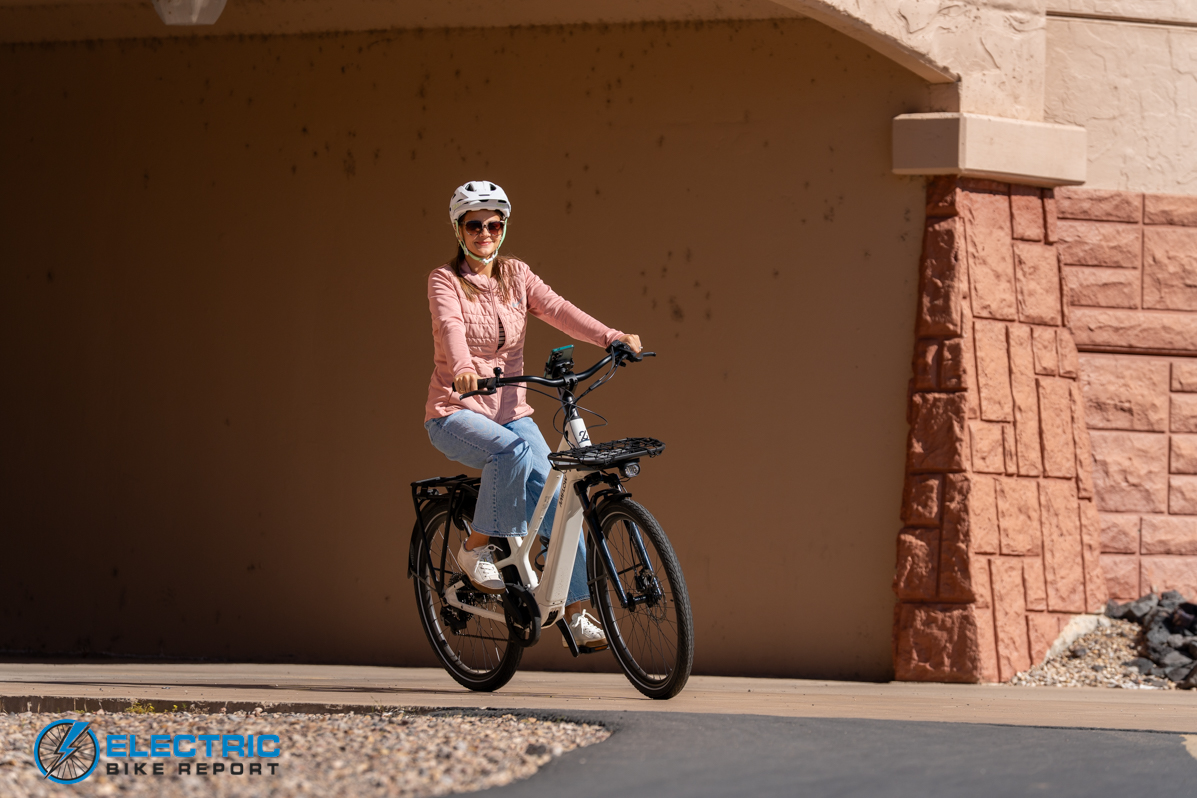
The Amflow UE Carbon’s design and component package makes it ideal for leisure rides, daily commuting, exercise, errand running, and beyond!
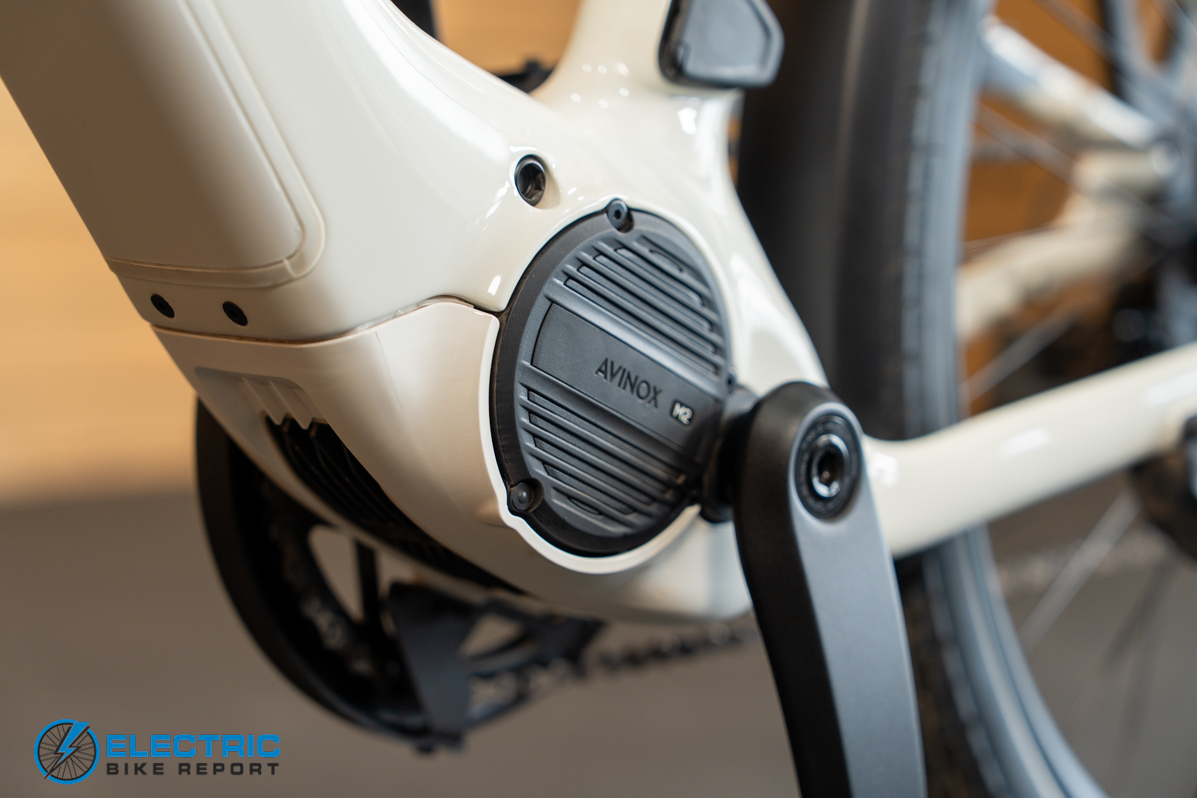
The Avinox M2 mid-drive can produce a whopping 1100W of peak power and 125 Nm of torque.
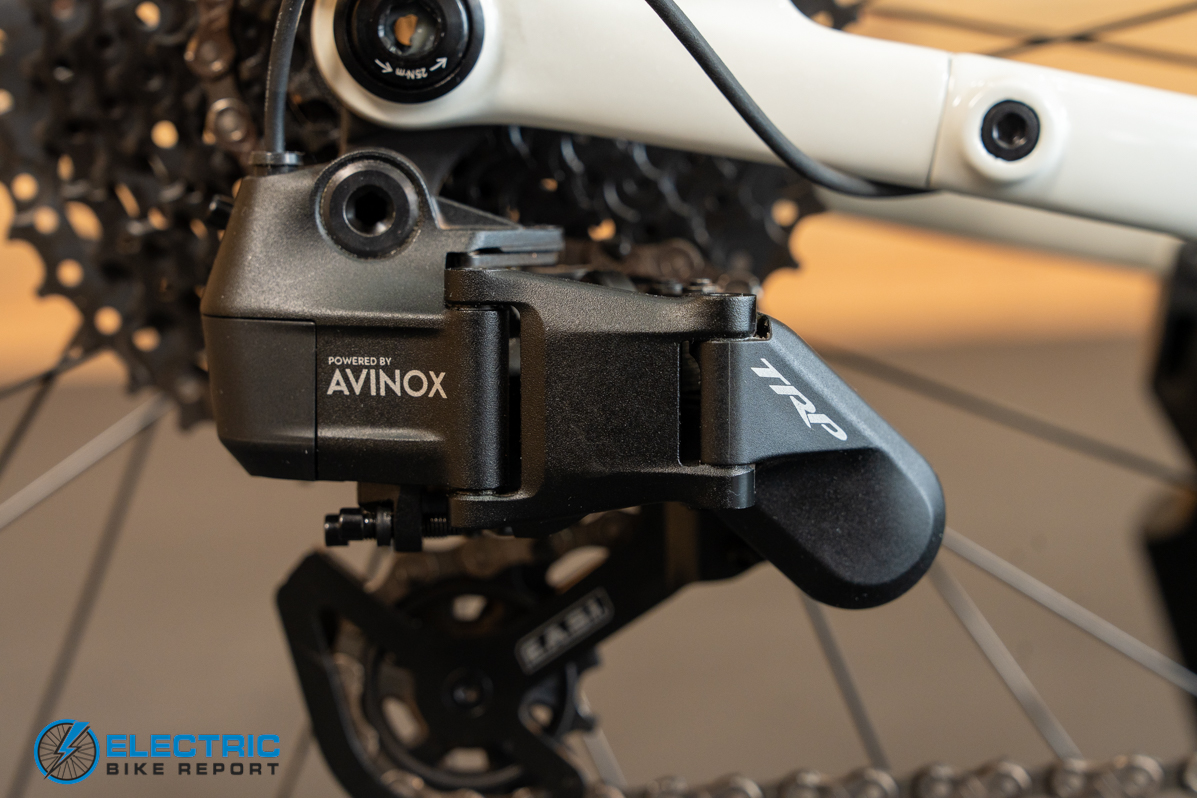
The UE Carbon includes a 10-speed TRP E.A.S.I derailleur with full automatic shifting capabilities.
Amflow UE Carbon Review: Speed Test
Our first test, the Speed Test, is exactly what it sounds like: a test to see how fast the e-bike in question can travel. I rode on a flat, paved path in each of its three standard power levels to get a sense of its programming and whether or not it could reach its maximum speed.
As a Class 1 e-bike by default, the Amflow UE has a maximum pedal-assisted speed of 20 mph. When the bike is officially released, the US version will be unlockable to a Class 3 mode with a 28 mph maximum speed, but we tested a “global” pre-launch version without this option, so I conducted testing only in the Class 1 mode.
I started my speed test with no motor power, and found the UE Carbon generally easy to pedal under human effort alone. While the bike isn’t exactly light—it weighs around 58 lbs in total—its weight is well-balanced and its gearing is sufficient to allow riders to comfortably move the bike if the battery were to expire before reaching their destination.
With the motor active, pedaling became significantly faster and easier. The bike’s lowest power level, Eco, delivered a helpful but subtle boost, while Auto served as a mid-level setting that felt appropriate for general riding. Turbo rewarded light effort with generous power and quick acceleration, making it ideal for those seeking the lowest effort, the sportiest feel, and/or the most help on hills.
The bike does have a fourth assist level, Boost, which temporarily increases the motor’s torque from its nominal output of 110 Nm to 125 Nm. This mode is only available in 30-second increments, though, so I didn’t include it in the test data graphed above.
I did, however, perform an acceleration test from 0-20 using Boost. I was able to reach top speed after starting from a complete stop in roughly 6 seconds, making the bike remarkably quick and easy to get up to speed.
It’s worth noting that Auto is the first assist level when stepping up through the pedal assist settings sequentially, followed by Eco, Turbo, and Boost. This default setup puts the power levels somewhat out of order, considering the assist ratios of 150% in Eco, 400% in Auto, and 800% in Turbo and Boost (with the latter offering the aforementioned jump in torque).
Users can, however, fully customize the UE Carbon’s pedal assist system to their liking. This includes reordering the assist levels, adding an optional Trail mode via the Avinox app, and adjusting six different parameters for each setting, including its responsiveness, peak power, torque, overrun, starting surge, and more.
By default, the three power levels are distinct and meaningful, offering generally intuitive steps in power, speed, and ease of pedaling (as evidenced by the generally linear graph above). The UE Carbon’s customization, however, pushes it into uncommon territory, as nearly all aspects of its feel and performance can be tailored to the rider’s preferences.
Ultimately, the bike was easily able to reach its 20 mph ceiling, with smooth, responsive, and impressively adjustable power output that is well-distributed between its standard assist levels. Based on this experience, and the overall power of the motor, I’d expect the same qualities and characteristics to extend to the bike in Class 3 mode.
Sponsor
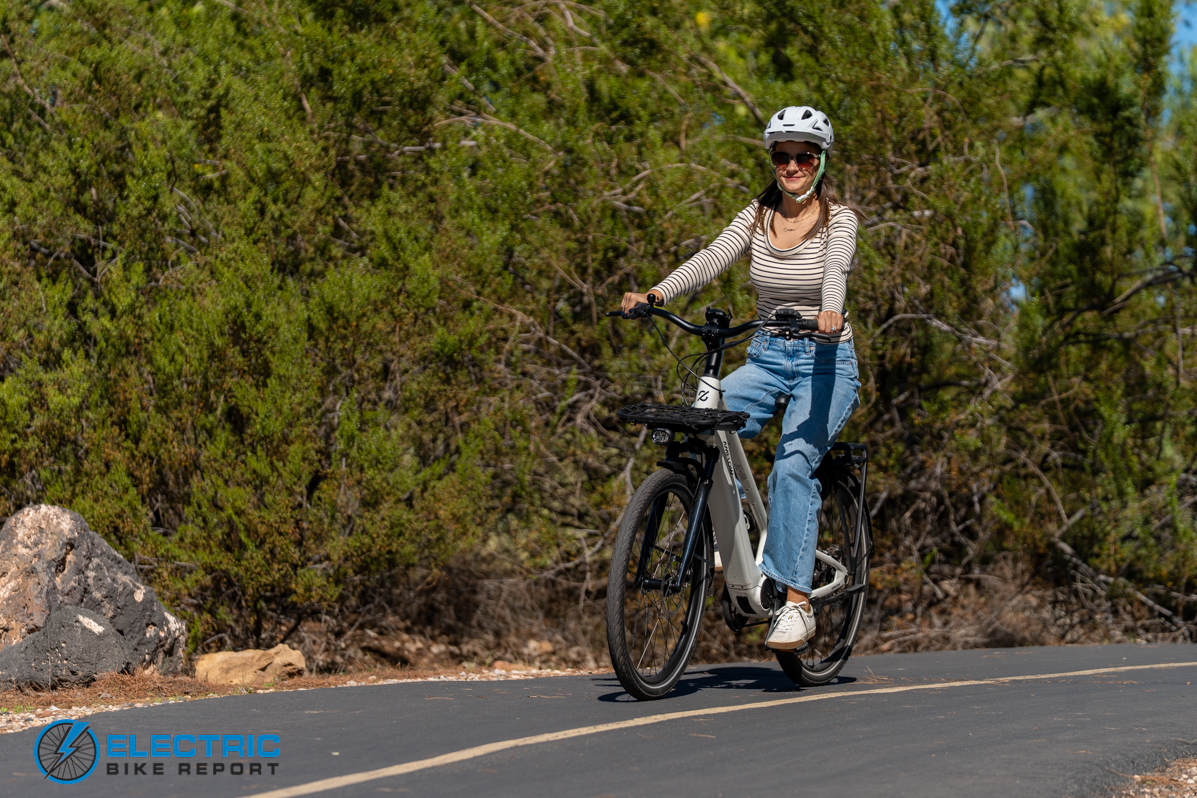
There’s no denying that the UE Carbon is loaded with tech, but at its heart, it’s also simply a fun, intuitive, and easy to handle cruiser.
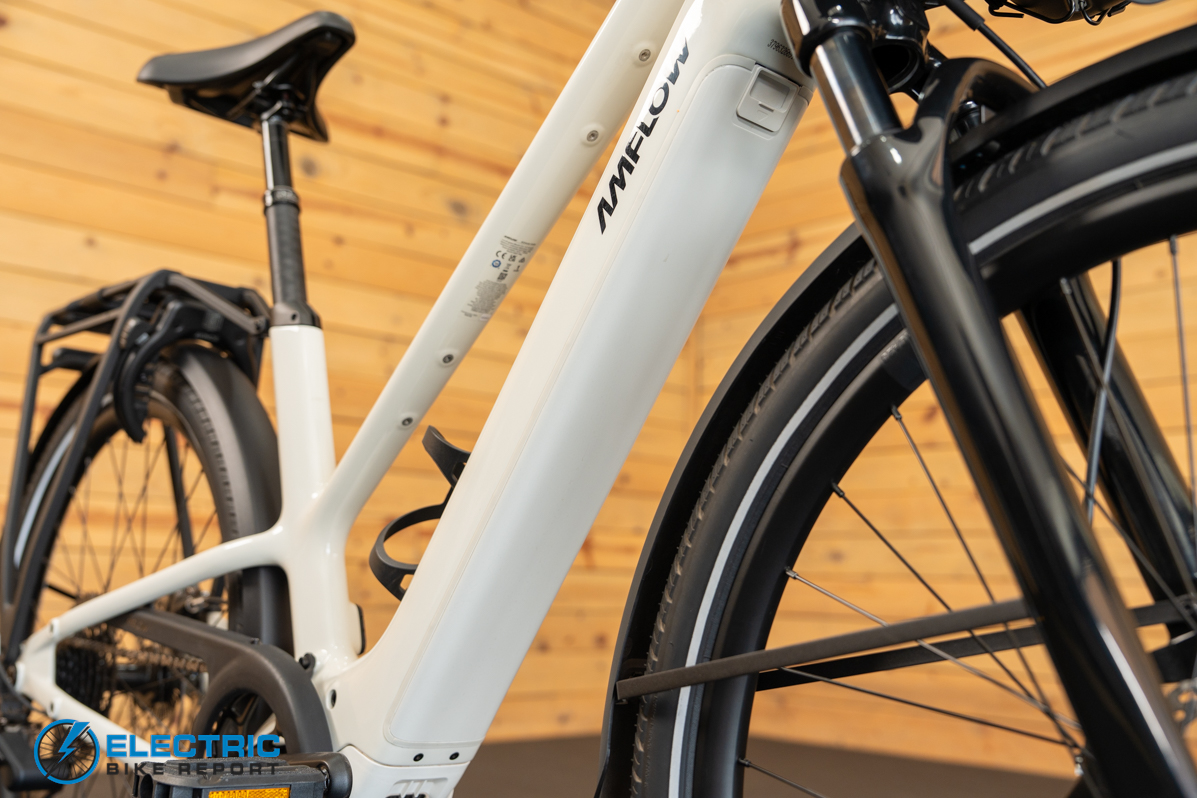
An easily removable 600 Wh battery is housed behind a cover in the underside of the down tube.
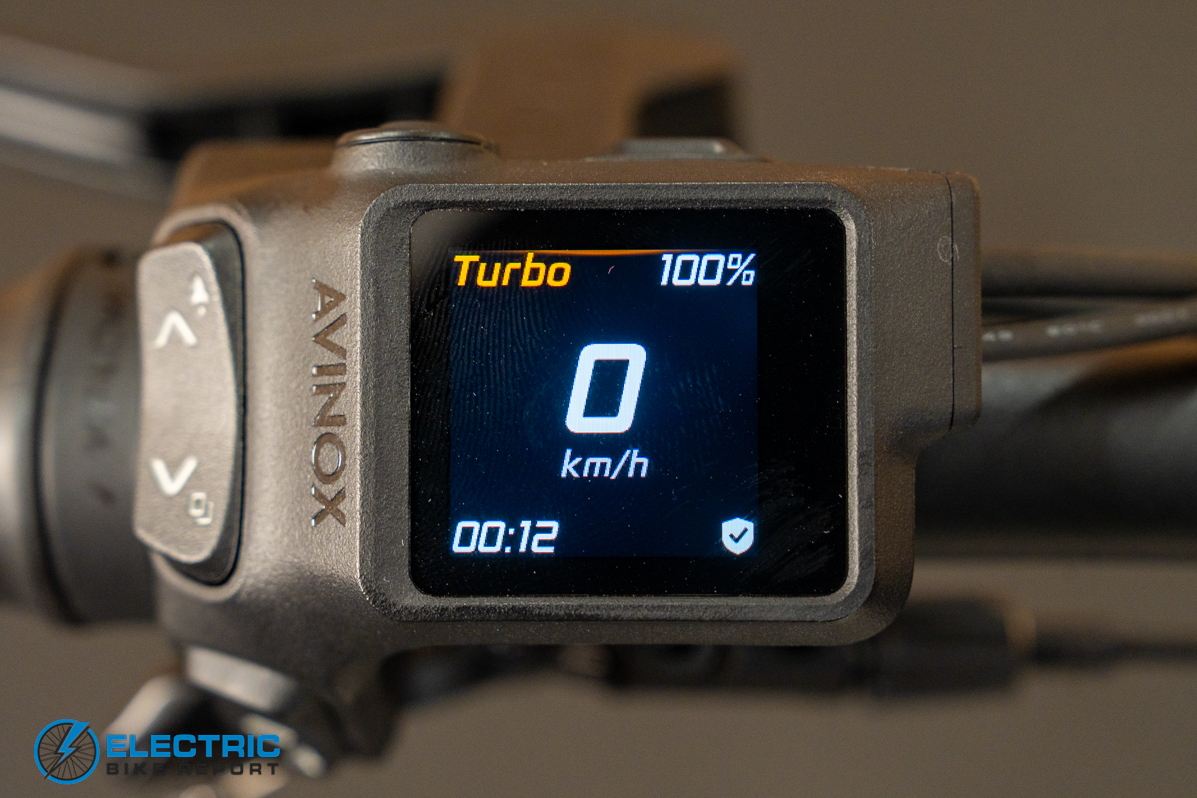
Many of the bike’s functions are quickly accessible via a swipe of the small color touchscreen display.
Amflow UE Carbon Review: Range Test
Our Range Test is designed to give consumers a realistic measure of the minimum and maximum distances a rider can expect to cover on a single charge of an e-bike’s battery. We perform two test rides on a relatively flat network of paved trails—one using the bike’s highest assist level, and another using its lowest. In each test, we start with a full battery and ride until its charge is depleted.
The Amflow UE Carbon traveled 44 miles in Turbo and 63.8 miles in Eco. For context, a group of similar mid-drive-equipped commuters we’ve tested averaged 36.4 and 79.2 miles in their testing, so the UE performed better than average in its high-power test and somewhat below average in its low-power test.
We dug deeper into the bike’s specs and performance data to understand why.
Starting with a look at its energy consumption, we divided the UE’s battery capacity in watt-hours (Wh) by its test results in miles (mi). This showed that it used significantly less energy than average in one test but slightly more than average in the other, expending 13.6 Wh/mi in Turbo and 9.4 Wh/mi in Eco, compared to the group average of 17.8 Wh/mi and 8.9 Wh/mi, respectively.
These figures made even more of an impact when considering the UE Carbon’s smaller-than-average battery. E-bikes in our comparison group carried batteries with 639.1 Wh of capacity, while the UE came equipped with a somewhat smaller 600 Wh battery.
What the data shows is this: the UE Carbon’s powerful motor expends more energy than many e-bikes in our comparison group in its lowest assist level, and with a smaller-than-average battery, its range is a bit more limited. In its highest power level, though, it manages to be significantly more efficient, stretching its charge beyond the abilities of many similar models.
So what does this mean for consumers? In short, while it is certainly possible to conserve power and reduce how frequently the bike will need to be recharged, there’s not much reason to hold back. Riders who prefer an easy, rewarding experience can take advantage of the UE Carbon’s power without suffering much loss of range.
We weren’t quite able to reach Amflow’s advertised range of up to 81 miles from a charge, but our results show that the UE Carbon’s potential is still generous and entirely suitable for its style. Most riders using the bike for commuting should be able to cover multiple round trips on a single charge, while those using it primarily for short leisure rides should rarely need to plug in.
Speaking of charging, the UE has a few great features that separate it from many similar models on the market. Riders can easily check the battery’s state of health through the Avinox app, and savvy users can also set a percentage limit for the battery when recharging. We recommend roughly 80% to reduce the number of charge cycles and extend the battery’s lifespan.
Additionally, we were pleased to note that the bike ships with a 4A charger advertised to fully charge a depleted battery in under 5 hours. We consider this duration very reasonable, but for those seeking even less charge time, Amflow also sells a compatible 12A fast charger that can take the battery from 0-100% in roughly 2.5 hours.
Sponsor
Sponsor
Amflow UE Carbon Review: Hill Test
Our Hill Test was one of our most anticipated trials for the UE Carbon, and we’re thrilled to state that the bike did not disappoint.
As with all e-bikes we review, we took it to our test course, called the Devil’s Backbone; see above for a description of this hill. Since the UE Carbon is a Class 1 e-bike, we performed a single test using Turbo mode. It completed this test successfully, climbing the hill in 1:45 while maintaining an average speed of 17.3 mph.
This ties it with the fastest mid-drive-equipped e-bike we’ve tested at this location (when excluding electric mountain bikes). For context, a group of similar urban-focused e-bikes with mid-drives averaged 2:15 in their testing—a full 30 seconds slower than the UE Carbon!
Higher-than-average motor output is the main contributor to the UE Carbon’s success, but its weight is also a potential factor. Our comparison group averaged 62 lbs with motors that produce an average peak of 740W and 91 Nm of torque. The UE had the advantage of lower weight (58 lbs) and more power (1100W and 110 Nm).
That’s not even considering the fact that we didn’t employ the bike’s temporary Boost mode for this test—simply because it would not have maintained its maximum torque output for the full duration of the test.
I personally tested the bike at our secondary location, Pilot Hill, to get a sense of this setting’s potential impact. In my Turbo test at this hill, I completed my climb in 1:09 at 16.4 mph. By adding in Boost’s temporary power increase, I shaved five seconds off this result; my time on this second run was 1:04, and my average speed increased to 17.7 mph.
In my experience, the bike felt remarkably and uncommonly relaxed and confident when climbing. Pedaling in Turbo felt enjoyable, low-effort, and easy. When adding the extra power of Boost, the bike felt like it effectively rocketed to the top of the hill with little work from me.
In short, the UE Carbon felt as powerful as any capable rear-hub-equipped e-bike, which is a real achievement for a mid-drive. The bike’s strong and impressive climbing performance makes it easy to recommend for riders living in hilly areas who want as little strain as possible when dealing with their environment’s ups and downs.
Sponsor
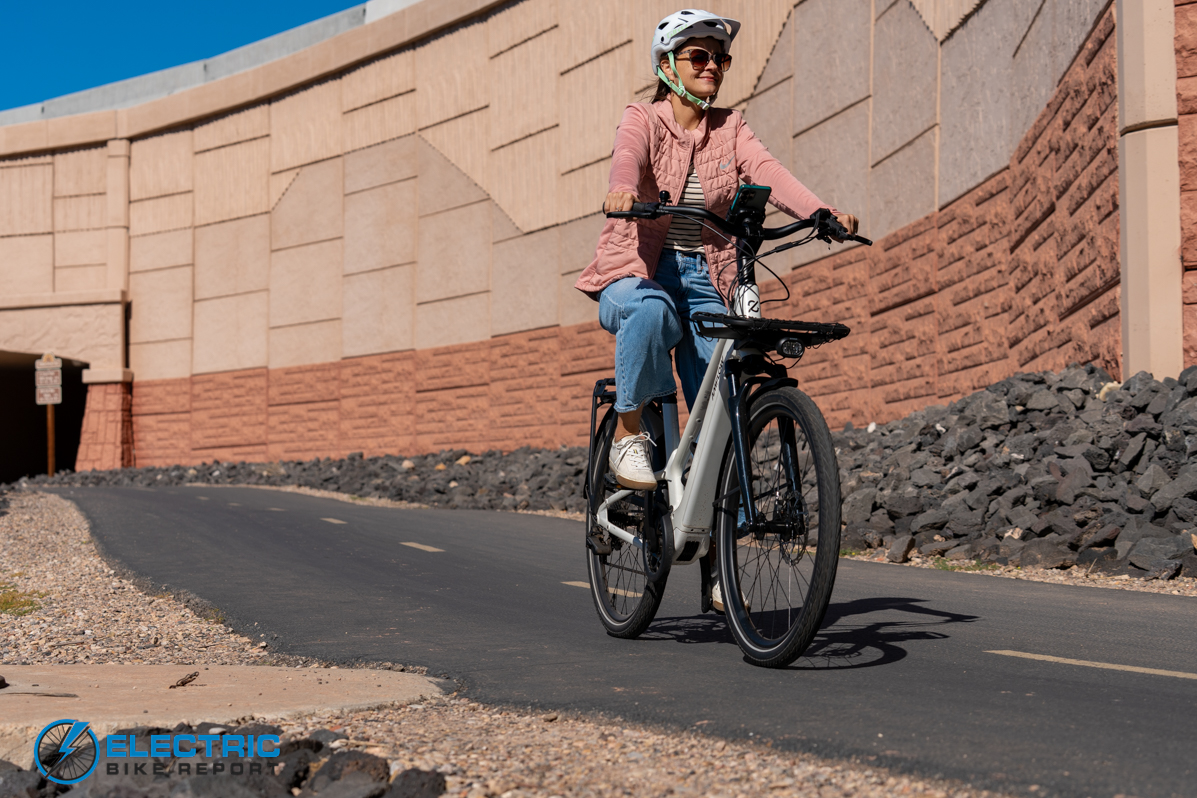
While the pre-launch model we tested was limited to 20 mph, production e-bikes in the US will be unlockable to useful Class 3 speeds of up to 28 mph.
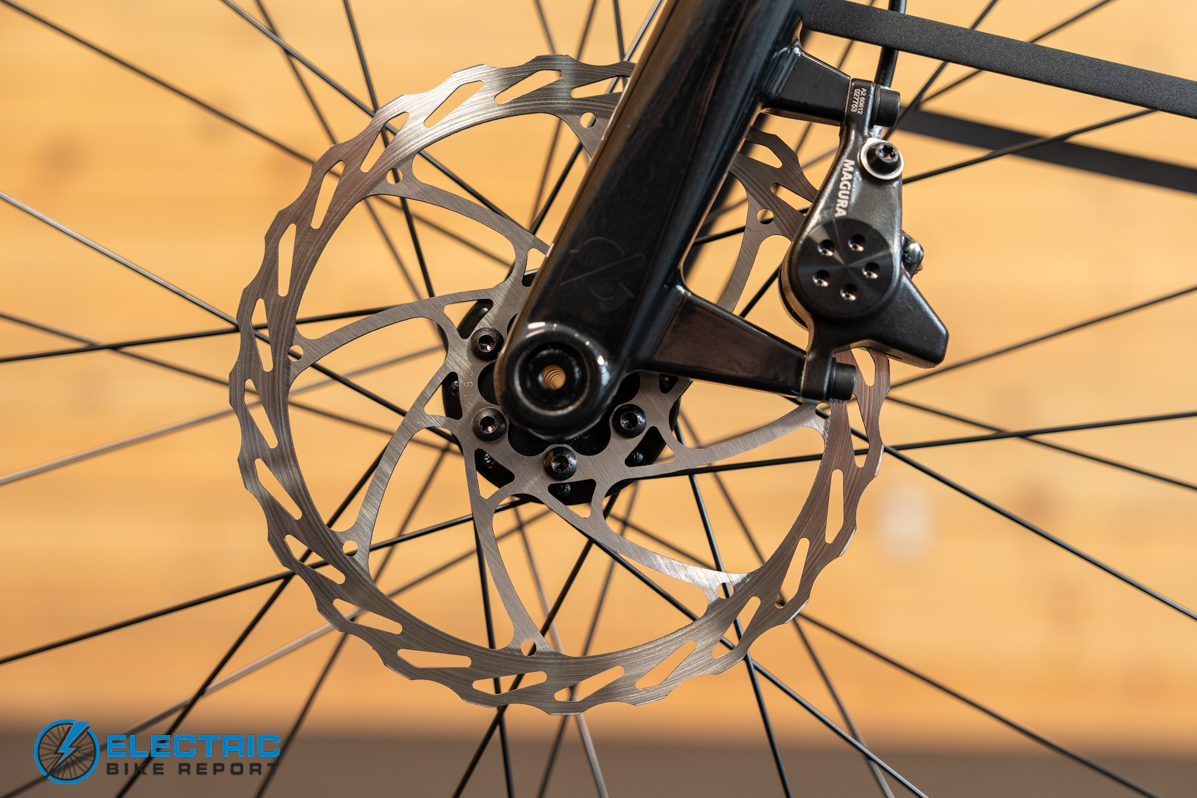
A set of Magura MT A2 two-piston hydraulic disc brakes provides stopping power.
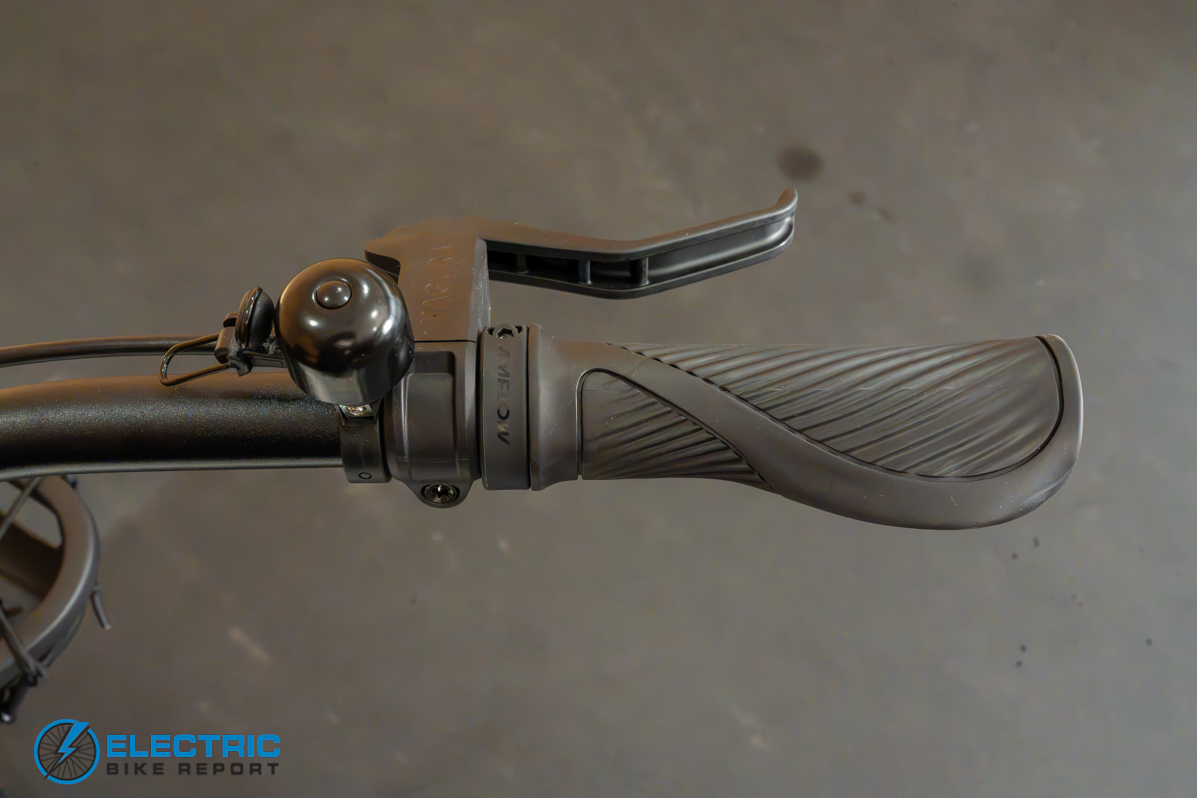
The brake levers are easily reachable from the custom ergonomic rubber grips.
Amflow UE Carbon Review: Brake Test
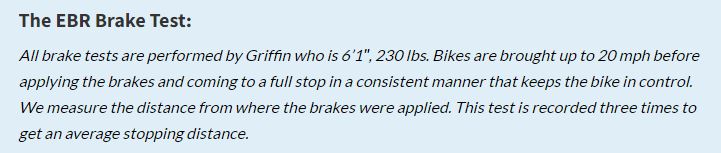
Finally, the UE Carbon finished strong in our Brake Test. We tested it by bringing the bike to its maximum speed of 20 mph, applying the brakes at a marked line, then measuring how far it traveled before stopping. Its average after three test runs was 18’1″, while similar models we used for comparison averaged significantly longer results of 21’1″.
There are likely a few reasons why the bike’s performance was three feet shorter than average for its category: its brake system, its weight, and its wheel size.
Starting with its hardware, the UE Carbon is equipped with the MT A2 hydraulic brake system from Magura. This setup pairs two-piston calipers with 180mm front and rear rotors. At face value, the system’s specs are relatively commonplace, but in practice, it has stronger bite and more overall power than many comparable entry-level models from other brands.
In regards to weight, as I mentioned above, the UE Carbon is a few pounds lighter than many of its competitors. This means that its brakes have less momentum to counteract when braking, so at least in theory, it should be easier to bring to a stop.
Finally, wheel size can have a large impact on braking performance, as brake calipers have more leverage on smaller wheels than they do on larger ones. Many similar models we’ve tested had 27.5″ wheels, so in cases where these bikes had 180mm rotors, the UE Carbon’s smaller 26″ wheels gave it an advantage.
In my experience, the UE’s Magura brakes felt forceful, safe, and remarkably effective. They modulated my speed well with only light to moderate pressure, and they brought the bike to a stop quickly when I needed them to—without feeling too aggressive. If I had to offer some critique, I’d say that I prefer sturdier metal brake levers to the MT A2’s somewhat flexible plastic levers, but I can’t deny that the system performed extremely well.
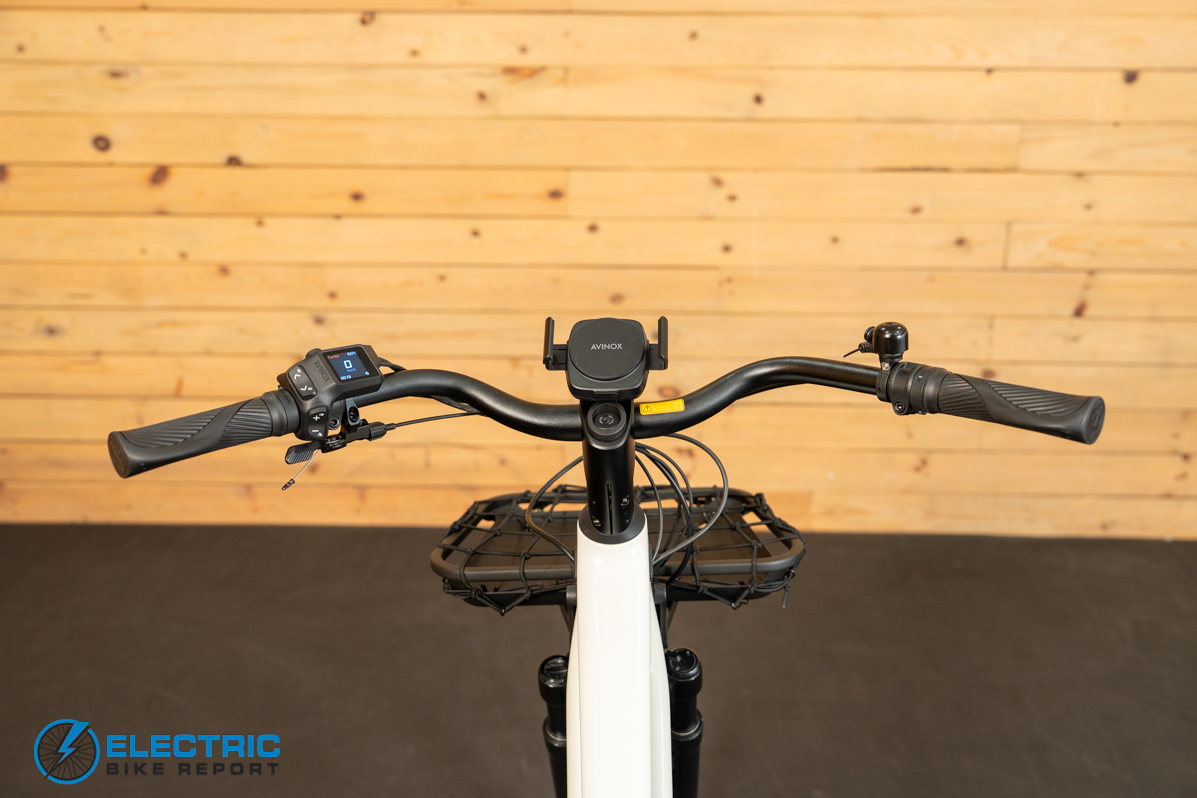
As a city cruiser, the UE Carbon has a set of ergonomically curved handlebars that promote upright positioning.
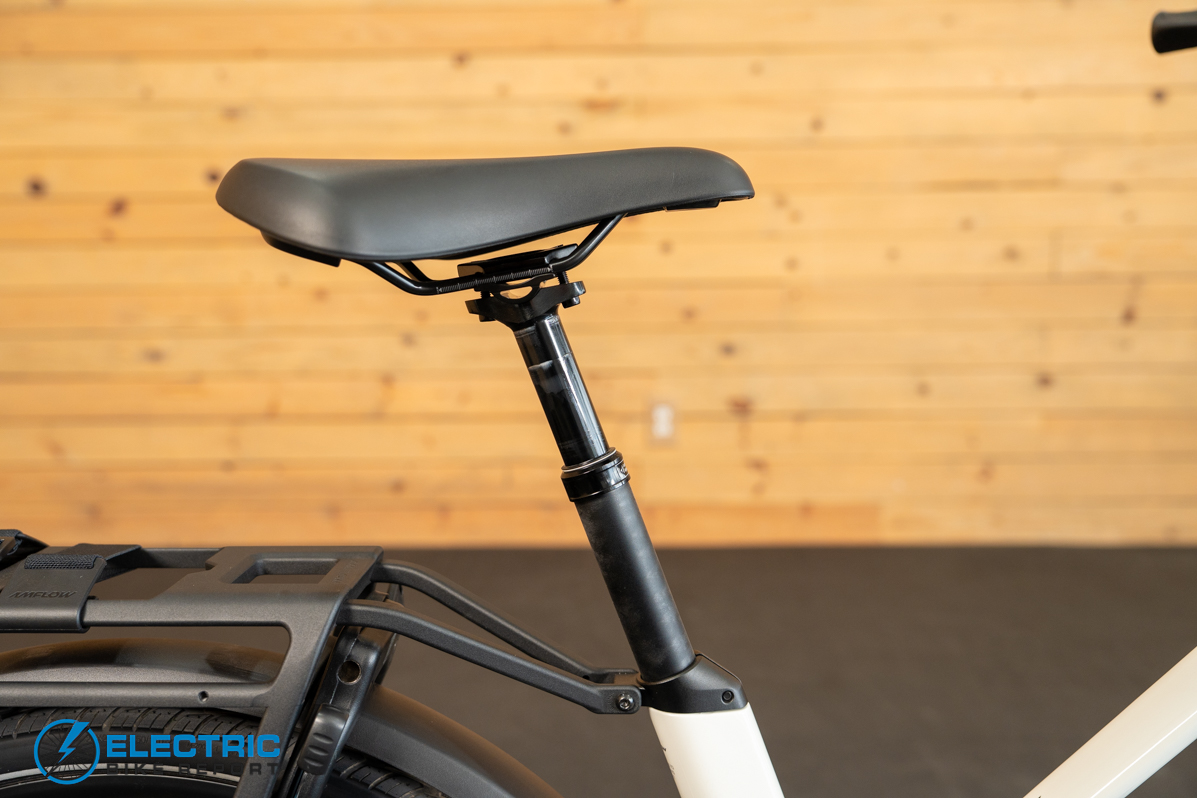
The bike includes a dropper seatpost with 30mm of suspension that can quickly be adjusted using a handlebar-mounted lever.
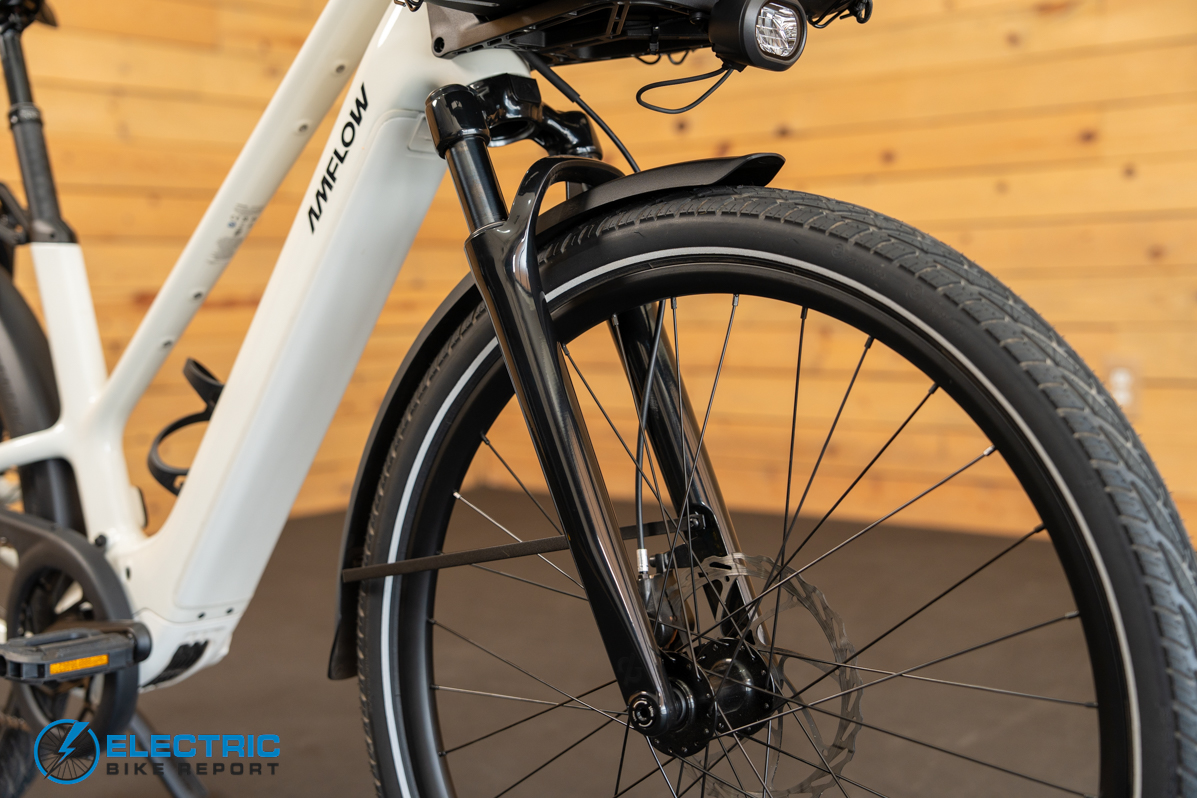
A custom coil suspension fork offers 65mm of travel, plus lockout and preload adjustment.
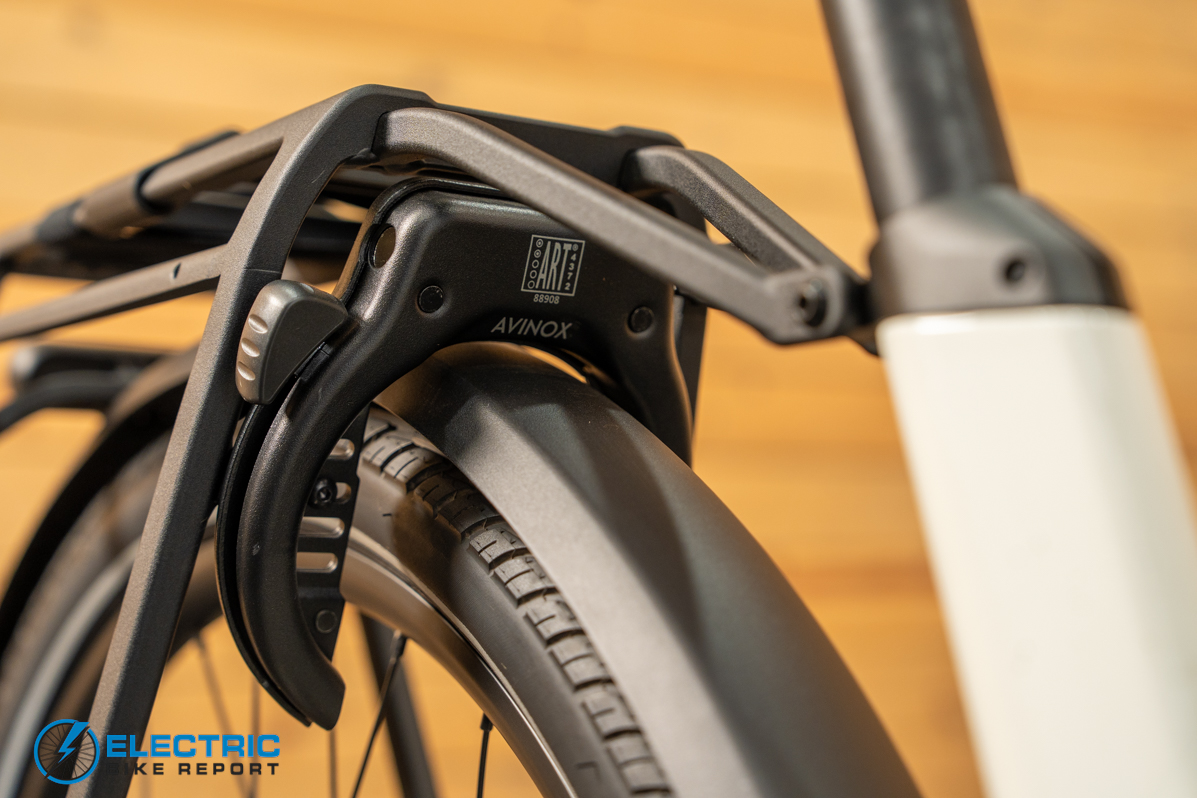
The included cafe wheel lock adds a relatively small but welcome layer of short-term security for quick stops.
Amflow UE Carbon Review: Ride Quality
While it’s not as directly measurable as the previous performance sections, the subject of ride quality—how a bike feels to use and operate—is every bit as important. In this section, we’ll detail aspects such as sizing, fit, handling, the UE Carbon’s user interface and app functionality, and other areas.
To avoid burying the lead, the UE’s overall ride quality is excellent. Like any e-bike, it has some areas with room for improvement, but in the grand scheme of things, these are relatively minor concerns that don’t largely affect its user experience.
In terms of sizing, the UE Carbon is made in a single mid-step frame size meant for riders from 5’1″ to 6’3″. Amflow went to uncommon lengths to maximize comfort and ergonomics, as the bike ships with two stem options—one with 82.4mm of rise, and another with 129.3mm. There’s also around 9 inches of saddle height adjustment, including 125mm of travel via the quick-adjust dropper seatpost.
At 5’11”, I found the bike well-sized and very comfortable. I preferred the taller of the two stem options, which encouraged a more upright posture for my height. I was able to set the saddle for full leg extension, making my pedaling both comfortable and efficient. Even with the taller stem, the handlebars were somewhat on the low side, but overall, the bike was comfortable and pleasant to ride.
When it comes to handling, the UE Carbon had a relatively unique mix of airyness and plantedness. At nearly 60 lbs, it’s not exactly light, but its carbon fiber construction does make a difference; a comparable aluminum e-bike would likely be at least 10 lbs more.
With the included cargo racks and mid-drive motor, the bike’s weight felt manageable and balanced. It felt stuck to the ground, while also feeling highly maneuverable, responsive, and easy to steer. I did notice some frame flex when cornering, but this wasn’t egregious or unexpected for the UE’s frame design.
In my experience, the ride felt remarkably smooth. The bike’s dropper seatpost includes 30mm of suspension travel, which, when combined with its 65mm suspension fork, carbon frame, and 2″-wide city tires, effectively softens and absorbs bumps and road chatter. I was particularly impressed with the custom coil suspension fork; it felt so smooth and robust that I thought it was an air fork after my first ride.
I’ve touched previously on the motor’s smooth and responsive power delivery, but it’s worth reiterating how seamless it feels. From how quickly it can get up to speed and how easy it can make pedaling, the UE Carbon is clearly an e-bike, but it’s tuned so that it responds instantaneously to changes in the rider’s pedaling, making it feel like a much faster and easier version of an analog bike.
The base model we tested includes a 10-speed TRP drivetrain with electronic shifting that functions quickly and consistently while feeling super high-tech. Adjusting to the fact that shifting and switching pedal assist levels are both done via the combination control panel and handlebar-mounted display took a couple of rides, but overall, the system functioned well. I was also happy to note that, even when the battery runs out of charge, enough “juice” is kept in reserve to allow shifting to function for those who need to pedal home.
I mentioned above that, especially for its weight, the UE Carbon is remarkably well-equipped. While it’s not uncommon for e-bikes of its style to be equipped with lights, fenders, and a rear cargo rack, the UE goes a step or two further than most.
For example, its rear rack is MIK-HD compatible, meaning that it can carry up to 59.5 lbs and will work with many locking third-party accessories, including cargo baskets and storage bags. The bike also includes a cafe wheel lock, which shares a key with the removable battery, adding a layer of security for quick stops and in addition to physical locks and other security measures.
The UE Carbon has an integrated security system that includes GNSS sensors for GPS tracking and compatibility with Apple’s Find My system (Google Find Hub compatibility is also reportedly coming soon). Users can track and get directions to the bike’s location, activate an alarm, and receive abnormal movement alerts directly from the Avinox app.
There’s also an optional 6-digit security PIN requirement on startup, but the app can be used to turn the bike on/off to bypass this requirement. The bike’s integrated GPS sensors also allow for automatic ride tracking, and this data can be set to sync with Strava and/or Komoot through the app, too.
Many of the bike’s features and customization options can be accessed through both the Avinox app and the bike’s touchscreen display. Through one or the other, riders can pair with the app, adjust motor tuning, sync accessories such as DJI OSMO cameras or heart rate monitors, customize the display’s various ride data pages, and more.
One of the bike’s most interesting features is its automatic shifting mode, enabled through the TRP E.A.S.I. derailleur. I’ve tested a few similar systems, but this was among the best; Amflow offers a variety of parameters to adjust its behavior, including your desired pedal pressure, the speed and reactivity of the system, your preferred cadence, whether to shift in anticipation of pedaling when coasting, etc.
This mode generally worked well, once I had the settings dialed to my preferences. It functioned best when pedaling on flat and gently rolling terrain, effectively becoming a “set it and forget it” mode where I could focus more on my surroundings. I see this being ideal for riders who want an ultra-relaxed and easy way to enjoy some fresh air and light exercise.
Of course, without the ability to sense the surrounding terrain, any automatic shifting system is reactive instead of predictive. I noticed some chain popping when riding uphill, especially in the Eco assist level. Turbo seemed to have enough power to offset the load on the drivetrain. Fortunately, riders can also manually shift when using the auto mode, which may help to prevent excess wear caused by hilly terrain.
All in all, the UE Carbon offers a hugely connected experience that rewards those who are comfortable with its technology. This is something that prospective buyers should be aware of; the bike functions well for those who simply want to hop on and ride, but to get the most out of it, users should expect to spend some time learning and adapting to its relatively high learning curve.
Considering its highly connected nature, I appreciated that the bike included a magsafe-compatible stem-mounted phone mount. This allowed me to always have my phone front and center—and ensured my phone was well-charged—but it did also have a couple of drawbacks.
For example, the clamp on the mount was somewhat stiff, and when my phone was in place, it had a tendency to interfere with the side buttons. A unit that clamped the top and bottom of the phone instead of the sides may be more user-friendly.
Otherwise, I have to say that the UE Carbon was truly a joy to test and ride. At the time of writing, the bike’s price is TBD, but based on its feel and robust suite of features, there’s no doubt that it’s a premium product that delivers a highly refined and enjoyable experience.
My points of critique are relatively minor, which goes to show how well put together the bike is; it’s fun, agile, comfortable, responsive, extremely functional, impressively customizable, and uncommonly well-equipped.
Sponsor
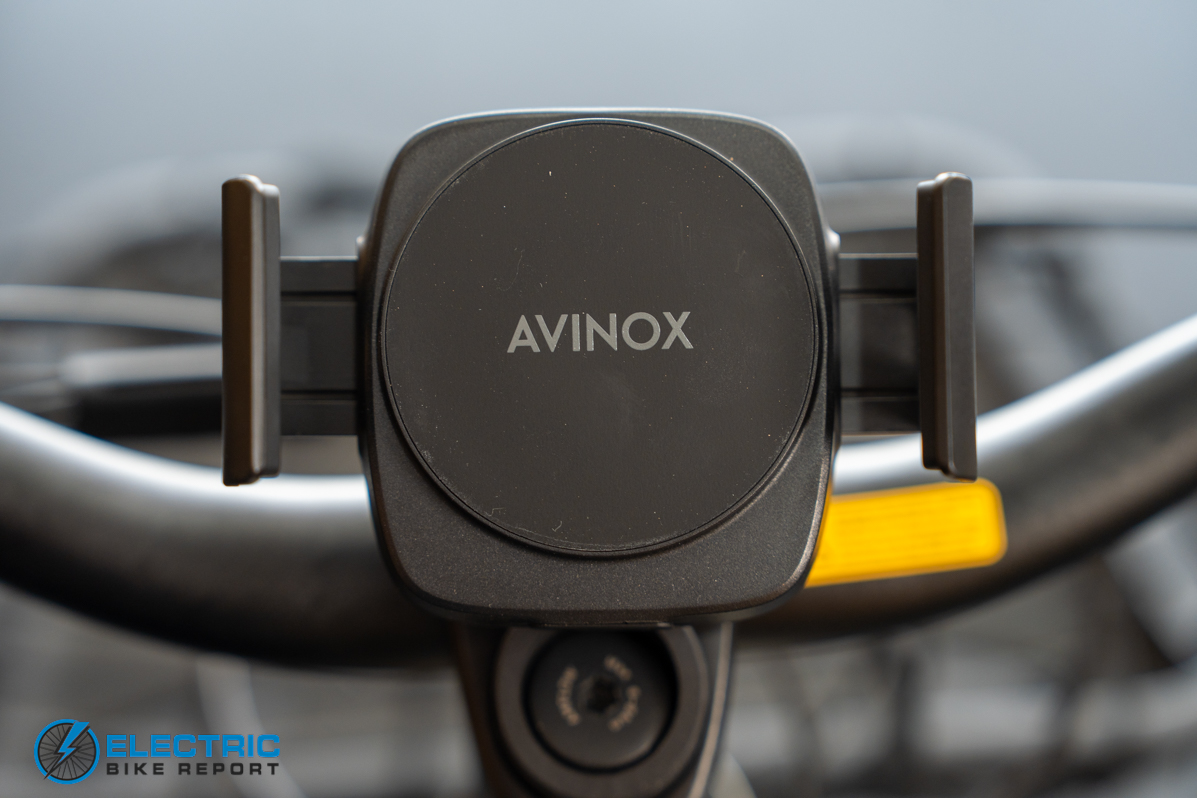
Amflow equipped the UE Carbon with a stem-mounted phone mount that offers magsafe charging.
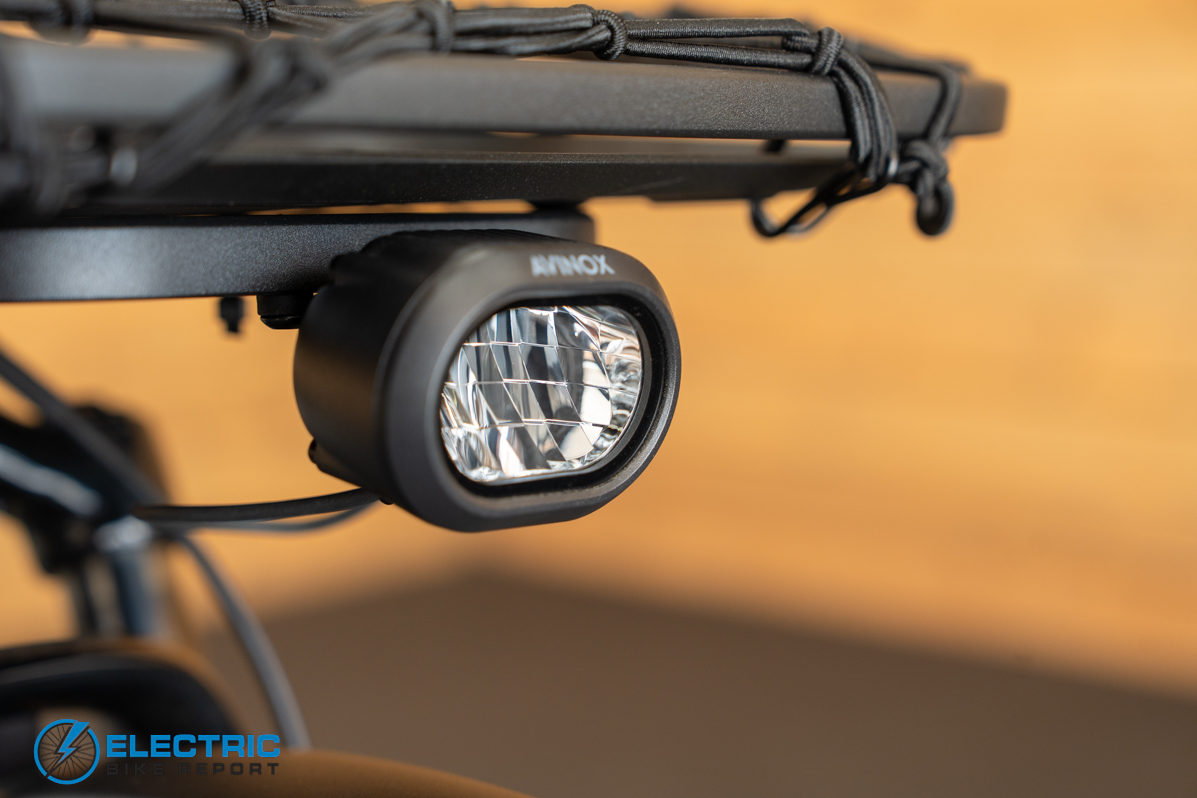
Even the integrated—and remarkably bright—LED headlights are custom!
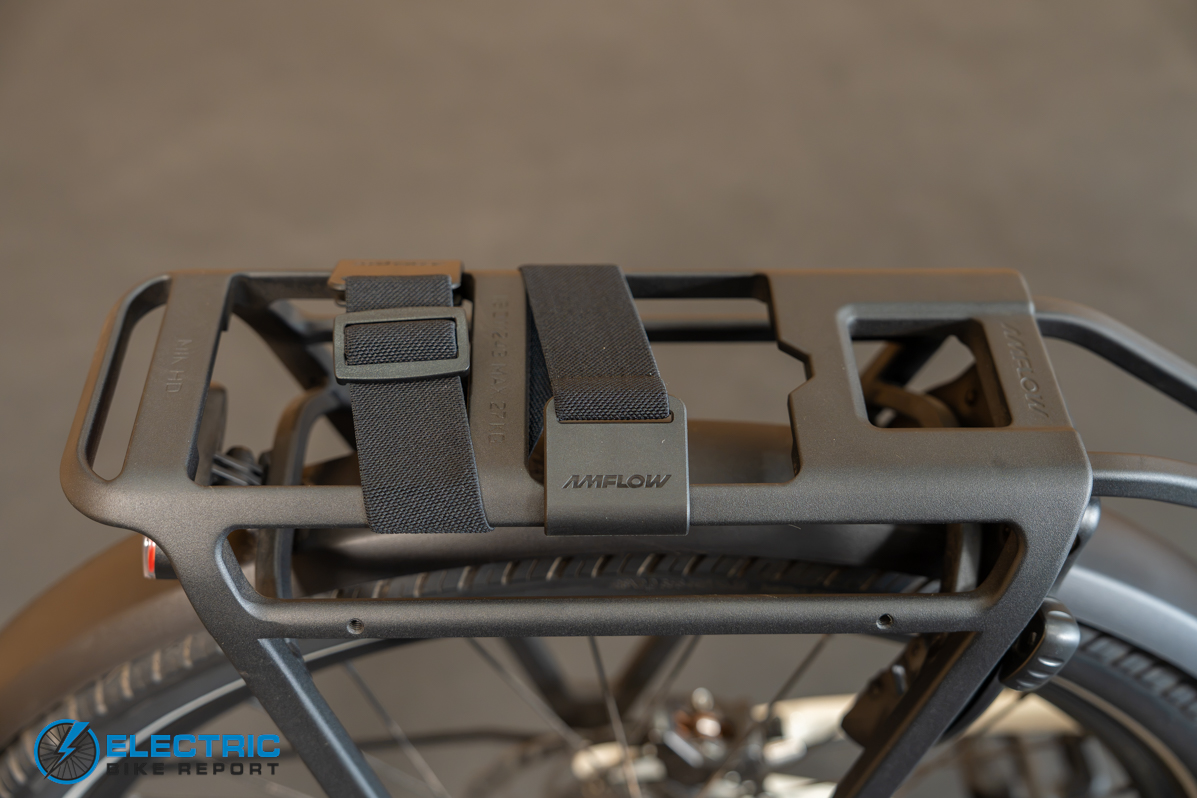
The MIK-HD cargo rack can carry nearly 60 lbs., and is compatible with many third-party accessories.
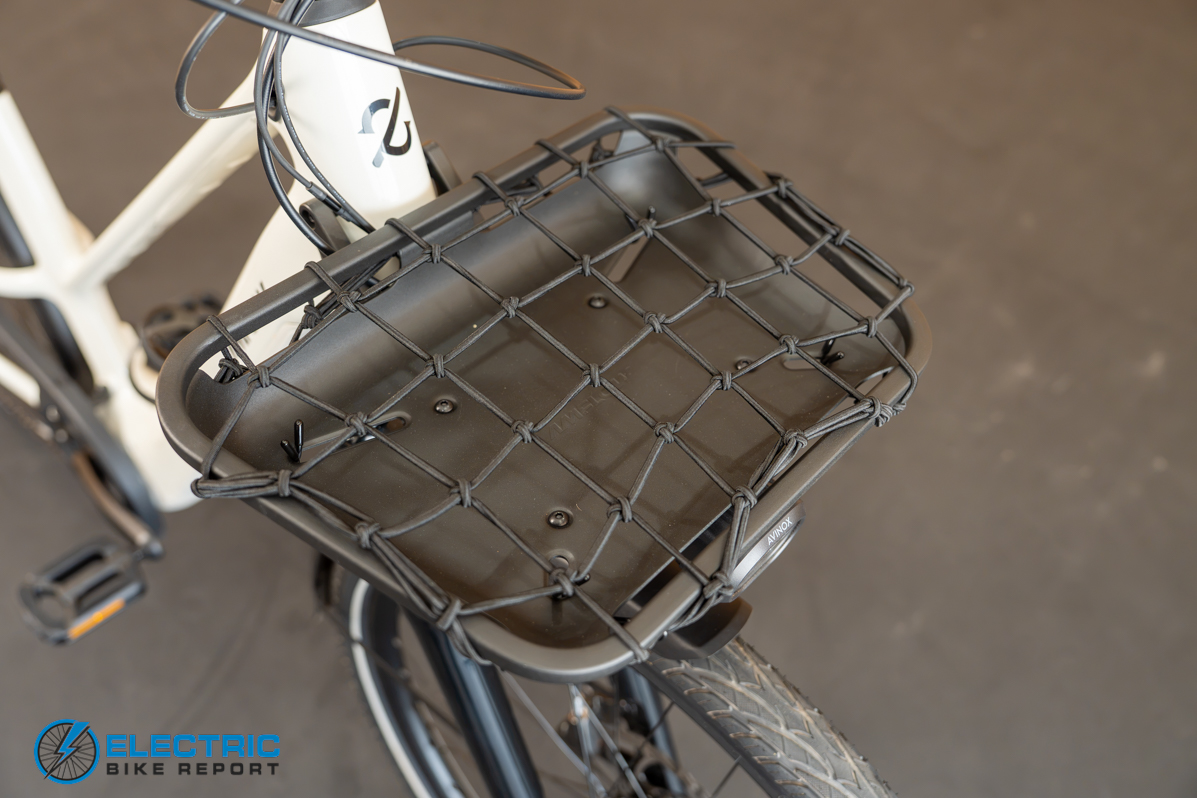
The UE Carbon includes a front rack and cargo net, making it especially practical for grocery runs right out of the box.
Amflow UE Carbon Review: Summary / Where to Buy
If it hasn’t been clear throughout this review, great things happen when Amflow and Avinox combine forces. The UE Carbon lives up to its “Urban” and “Easy” inspiration, but its name is deceptively simple; this e-bike is one of the most refined, functional, and feature-rich lifestyle e-bikes we’ve had the pleasure of reviewing.
From our perspective, the bike functions well on two levels.
At its core, it’s simply a great bike. The UE Carbon is a well-equipped and solidly-performing cruiser/commuter with a powerful motor, strong brakes, a crisp drivetrain, a smooth and comfortable ride, and responsive handling.
Built on top of that foundation is a rich, highly adaptable, impressively secure e-bike with a robust set of features that enhance its flexibility and functionality. The ability to fully tune the motor, track the bike’s location, enable automatic shifting, and carry both front and rear cargo allows it to serve as an effective car replacement or substitute.
Of course, the UE Carbon doesn’t have to be a daily driver; it could just as easily fill a role as a leisure bike for evening cruises, weekend rides around town, or other modes of getting fresh air and enjoying the scenery. Either way, it’s ideal for those seeking a premium, high-tech e-bike that can be fully personalized to the preferences of its rider.
Prospective buyers should be aware that the bike is among the more complex e-bikes of its kind, and that some time and effort are required to fully understand and set it up. Ultimately, there’s not much to critique—aside from a few small personal preferences, a somewhat stiff phone mount with potentially awkward clamp placement is the only real thing that may prove a bit of an annoyance.
Overall, we found the UE Carbon to be an impressive departure from Amflow’s previous performance-focused models. It checks all the right boxes for customization, comfort, security, and enjoyment. It also demonstrated intuitive programming, practical range, strong braking—and remarkably confident climbing power for flattening steep hills.
Happy Riding! Make sure to let us know if you have any questions or if you think we left anything out in this review of the Amflow UE Carbon down in our comments section.
Sponsor
Sponsor
Reader Interactions
Leave a Reply