AIMA Key West 2.0 Review | A Ride as Smooth as Calm Seas
Sep 08, 2026
 0 Comments
 Share
Share
This mid-weight city cruiser offers huge comfort, responsive and largely customizable pedal assist, and lots of utility—all at a great price.
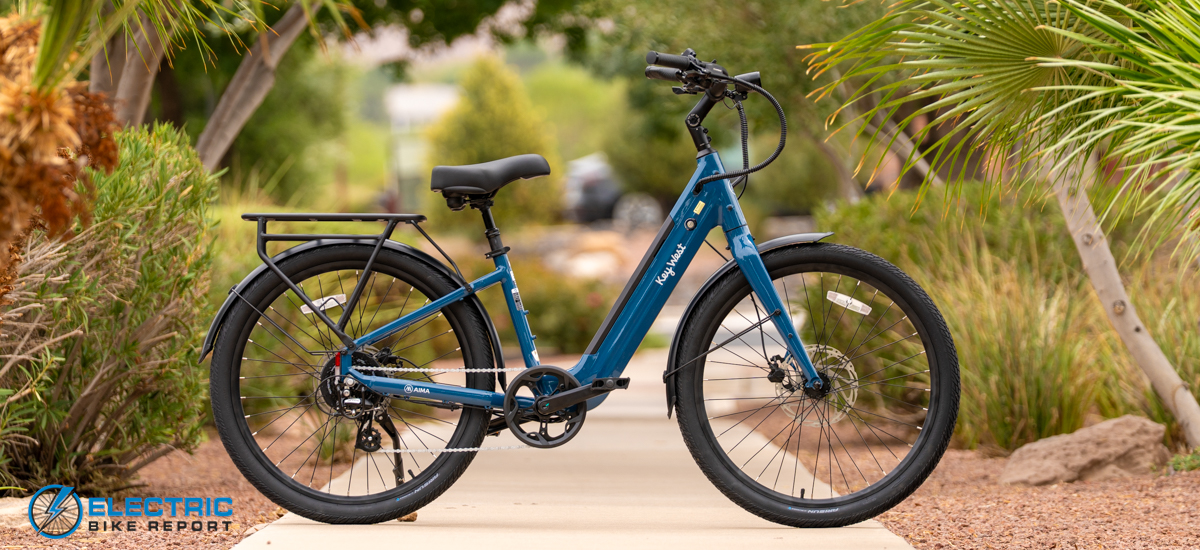
With its tropical-themed colors and name, the original AIMA Key West e-bike evoked a sense of calm and relaxation. Its step-thru frame made it easy to hop on, and its relatively low weight gave it easy handling and solid portability. The bike’s upright positioning made it comfortable, while its reserved 500W motor was ideal for casual leisure cruising.
Now, just a year after the first model’s release, the Key West 2.0 showcases some big updates and upgrades. So what’s different about the latest version of the bike?
AIMA upped the bike’s value significantly, with more power, a larger battery, a comfier ride, and an included cargo rack. The jump from a 500W to a 750W hub motor makes the riding experience more lively and energetic with easier pedaling. The 672 watt-hour (Wh) power pack should compensate for the extra power. A suspension seatpost smooths and softens bumps. And finally, the rack adds utility for users commuting or running errands.
Like other e-bikes from this brand, the Key West 2.0 is remarkably customizable in terms of both its fit and functionality. An adjustable stem lets riders change the reach and riding position. Users can also choose between torque- or cadence-based pedal assist and tune the bike’s motor output using the display menu and the Bafang Go app.
A smooth, comfortable ride and a responsive, rewarding pedal experience were among the first things I noticed about this bike. Another was the tech integration; in addition to a sharp TFT color display, there’s also a control module for the lights, horn, and turn signals on the right handlebar. In short, it’s well equipped, functional, and enjoyable to ride right out of the box.
Clearly, the Key West 2.0 made a strong first impression, but there’s much more to the story. See our full review below to find out how the bike performed in our series of standardized performance tests!

Sponsor
E-Bike Category:Cruiser / Commuter
E-Bike Class:Class 1 (pedal assist to 20 mph)
Class 2 (throttle to 20 mph)
Class 3 (pedal assist to 28 mph)
Class 2 (throttle to 20 mph)
Class 3 (pedal assist to 28 mph)
Sponsor
AIMA Key West 2.0 Video Review
 Pros
Pros- The Key West 2.0 feels great to pedal, with highly responsive, natural-feeling torque-based pedal assist or an easier, more relaxing cadence mode.
- It’s comfortable and cushy, thanks to its suspension seatpost, swept-back handlebars, and upright positioning.
- The Bafang Go app offers a range of useful features once paired with the bike, including motor tuning, ride tracking, navigation, and more.
- AIMA equipped the Key West 2.0 with great brakes for its weight and price point. As shown in the Brake Test section below, they performed very well in our testing.
- It comes with appreciated extras, including integrated turn signals, a high/low beam headlight, an MIK-HD cargo rack, a color display, etc.
- The bike is adaptable for a wide range of riders between 4’11” and 6’1″, with two frame sizes that each have an adjustable stem and a XX-lb payload capacity.
- As with many e-bikes of its style, the Key West 2.0 has remarkably quick acceleration and agile handling.
- AIMA offers three color options for the Key West 2.0, including unique options such as Deep Sapphire and Sage Green.
 Cons
Cons- Adjustments to the bike’s speed must be made through AIMA’s dealers, which can be inconvenient for those who live far from one.
ELECTRICAL SPECS & FEATURES
- Battery: 48V 672 Wh (14Ah)
- Charger: 48V, 3A
- Display: C010 BAFANG E-system TFT Display (Find My, Sensor Selection Function)
- Motor: Rear Hub Motor, BAFANG, 750W (900W Peak), 65 Nm Torque
- Headlight: Integrated LED
- Taillights: Integrated LED with Rear Turn Lights
- Pedal Assist: 5 PAS Levels
- Claimed Range: Up to 60 miles
- Throttle: Throttle on Demand
- App: Bafang Go
- UL Certification: UL 2271 & UL 2849 Certification
Weight & Dimensions
- Claimed weight: 56.6 lbs
- Tested Weight: 60.0 lbs
- Rider height range: 4’11”-5’10” (Regular), 5’4″-6’1″ (Large)
- Total payload capacity: 320 lbs
Components & Accessories
- Brakes: Tektro HD-E3520 Hydraulic Disc 203 mm Brakes
- Fenders: Front And Rear Fender
- Fork: 6061 Single-Butted Aluminum Alloy Fork
- Frame: 6061 Single-Butted Aluminum Alloy Frame
- Drivetrain: Shimano 8 Speed, 46T Chainring, 11-32T Cassette, Shimano Altus Derailleur
- Grips: Ergonomic Comfort, Lock-On
- Saddle: AIMA Enlarged Comfort Saddle
- Handlebar: Aluminium Alloy 680mm
- Kickstand: Aluminum Alloy Kickstand
- Pedals: PP
- Tires: 27.5”*2.1 Arisun K-Rubber
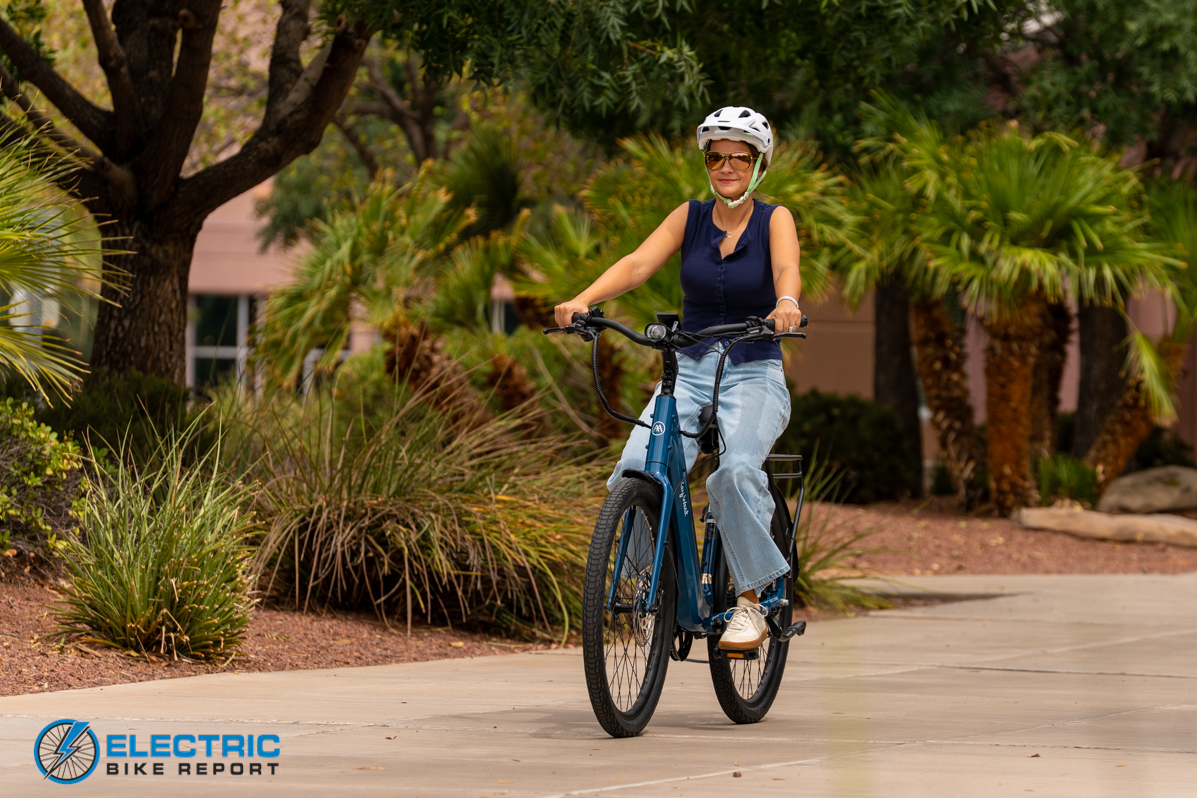
As a mid-weight city cruiser, the Key West offers a comfort-focused ride with a relaxed posture and plenty of support.
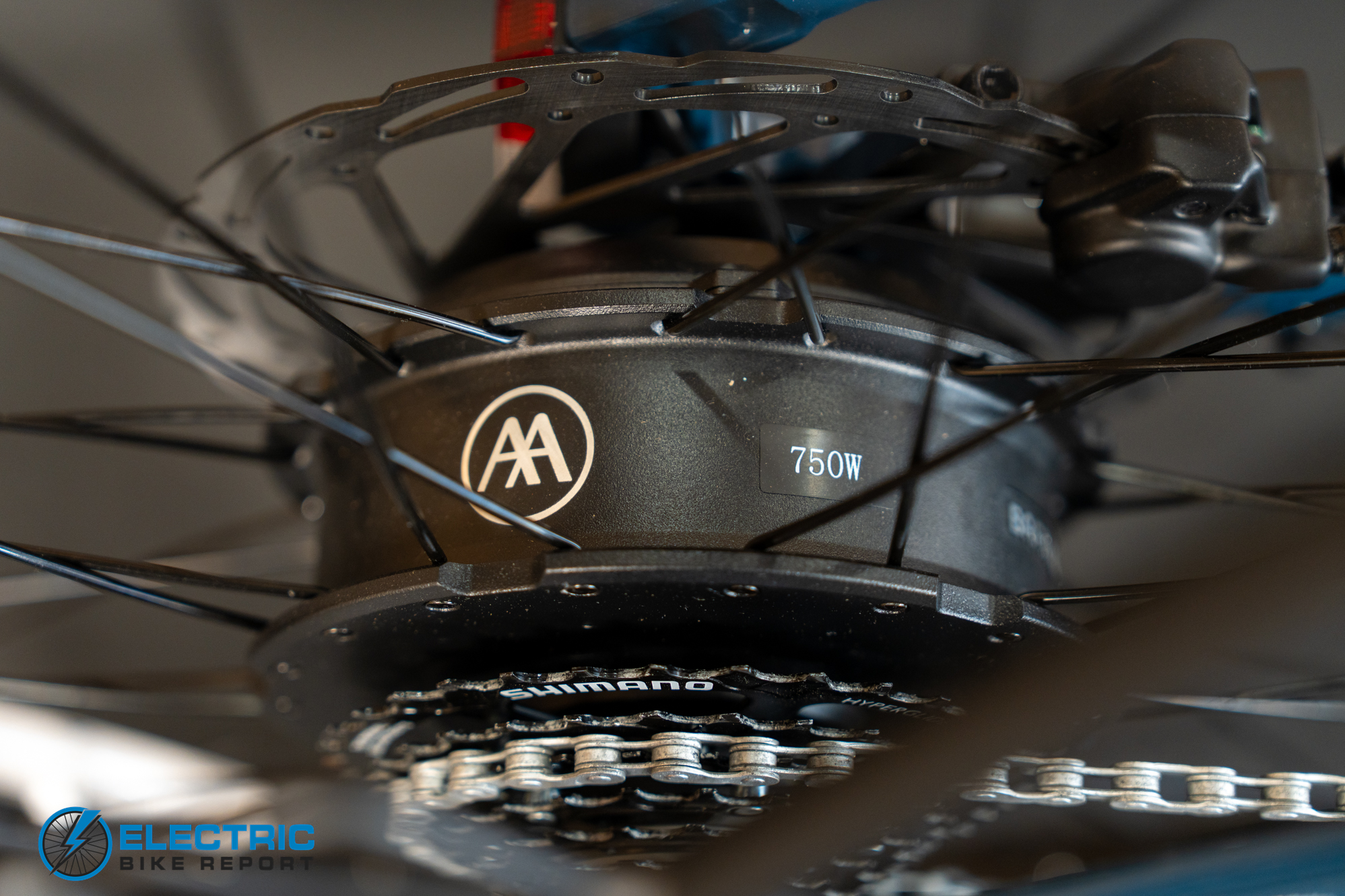
This second version of the bike features a capable—but not overpowering—750W motor.
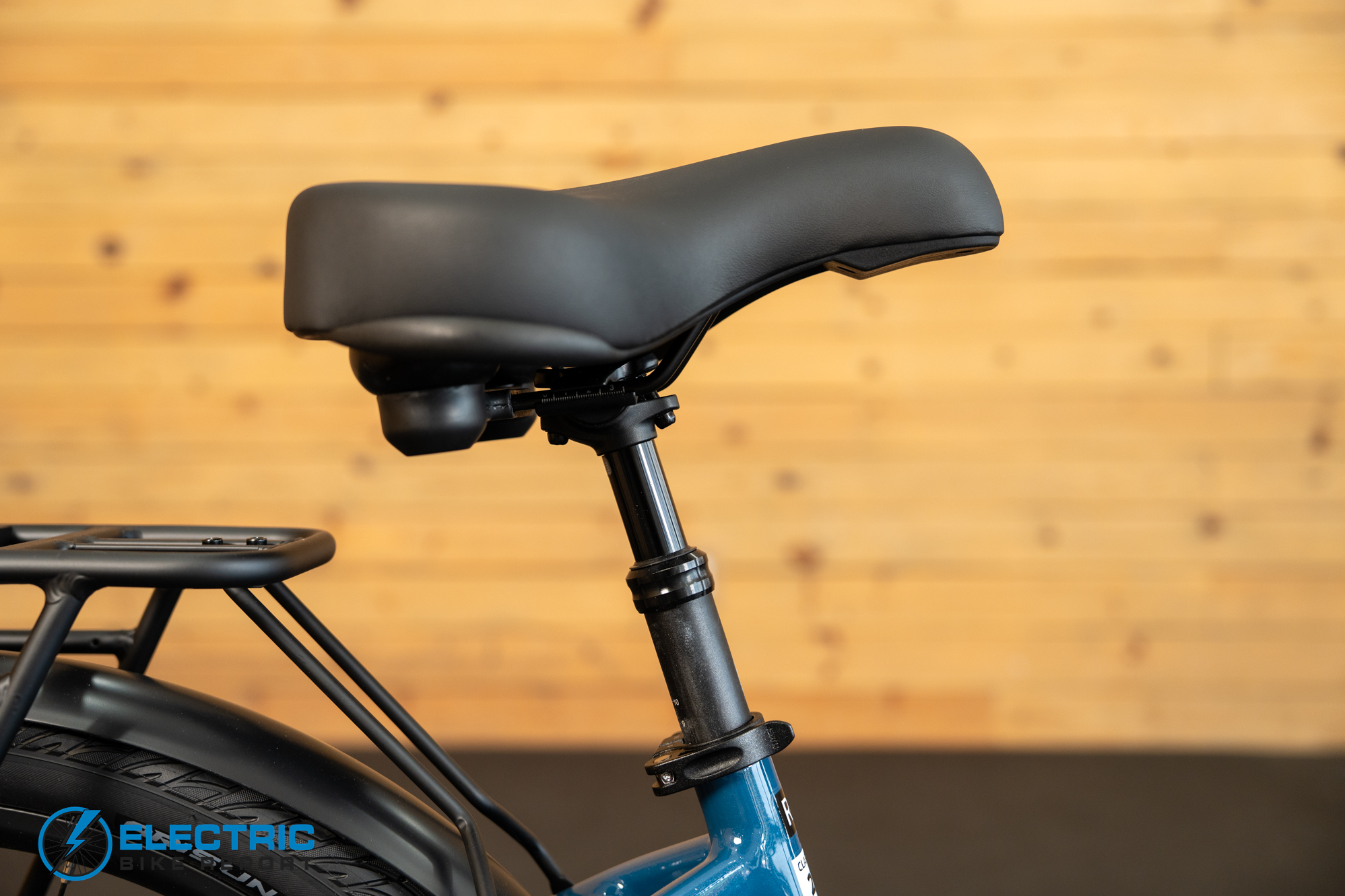
The bike’s cushy cruiser-style saddle is mounted on a suspension seatpost to smooth and soften the ride.
AIMA Key West 2.0 Review: Speed Test
I rode the Key West 2.0 on a segment of our local paved multi-use path, the Virgin River Trail, for our Speed Test. Starting without motor power, I pedaled in each of the bike’s five assist levels using both torque and cadence-sensing modes with Class 2 and Class 3 speed settings; see my results above.
By default, the bike is set to Class 2 torque mode, and one of the first things I noticed about the bike with this configuration was its responsive feel. When the pedal assist system (PAS) was active, the motor delivered ample power in response to the amount of pedal pressure I applied. This power ranged from natural-feeling to remarkably low-effort, depending on the PAS setting I selected.
In cadence mode, the motor put out steady power as long as I kept the pedals moving—its output did not change if I pedaled without force or with as much energy as I could muster. In the test, I pedaled with only light effort, as my goal was to observe what impact the motor had in each assist level.
Interestingly, my results in both the torque and cadence modes were very similar, though the bike’s feel was much different. In my Class 2 tests, I saw two measured and impactful jumps in speed and power before approaching the 20 mph ceiling; PAS 3, 4, and 5 all shared similar results near the Key West’s maximum speed in this Class setting.
In the Class 3 tests, I recorded three consistent jumps in speed and power. My results in PAS 4 and 5 showed some differentiation (more than in the Class 2 tests), though they still clustered near the bike’s maximum speed.
With similar speeds, the only real difference was the Key West 2.0’s pedal feel; in the bike’s torque mode, I felt some resistance on the pedals, and my effort had an impact, even if it required only light pressure to maintain speed. In cadence mode, I kept a more relaxed pace with less force—the action of rotating the cranks replaced the effort of applying downward pressure on the pedals.
While the clustering of results suggests that there may be some room for improvement in the bike’s default programming, the reality is that it works quite well. I found torque mode to be the most intuitive, and spent the majority of my ride time using only PAS 2. Heavier riders, those new to e-bikes, or those in hilly areas may prefer higher power levels.
The beauty of the Key West 2.0’s programming is that it is largely customizable. We tested the bike without altering the default motor output, but riders who want to fine-tune its feel and power can make adjustments through the display’s settings menu or the Bafang Go app. Riders can change the power and speed percentage of each assist level, along with the specific crank angle that causes the motor to engage.
In short, if the default speed/power of the PAS settings aren’t to your liking, you can fully customize each mode to suit your preferences. On the other hand, if you don’t want or need this granular level of control, you should still be able to find a combination of sensor modes and programming settings that works for you.
In addition to testing the bike’s PAS, I also tried out its throttle to gauge its acceleration force. When starting from a complete stop, the bike eased off the line before picking up steadily to 20 mph. In my opinion, this approach fits the Key West 2.0’s personality well, making it both useful and approachable for leisure-minded riders.
Sponsor
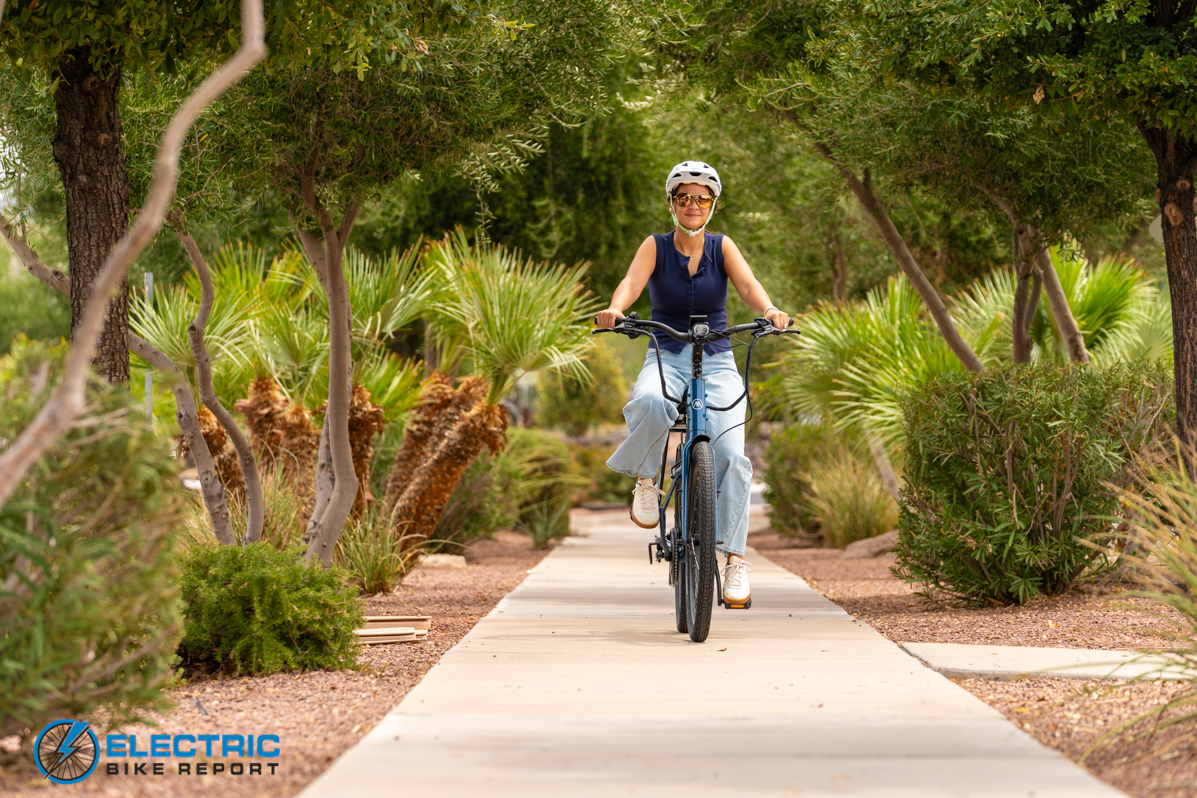
The Key West 2.0’s torque sensing mode provides responsive power that adapts to your effort, while the cadence mode gives steady output for a more relaxed feel.
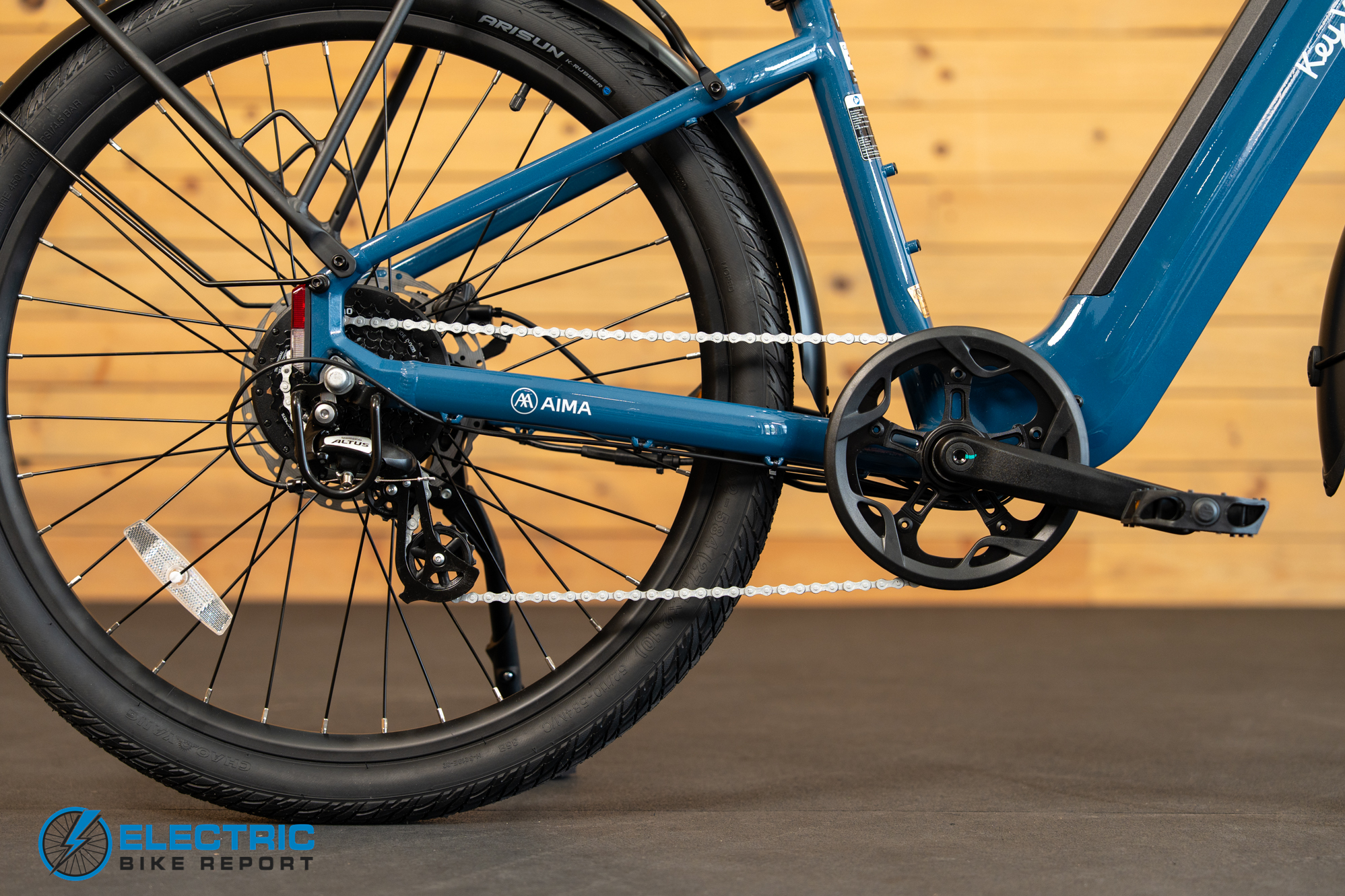
AIMA equipped the Key West 2.0 with an 8-speed Shimano Altus drivetrain.
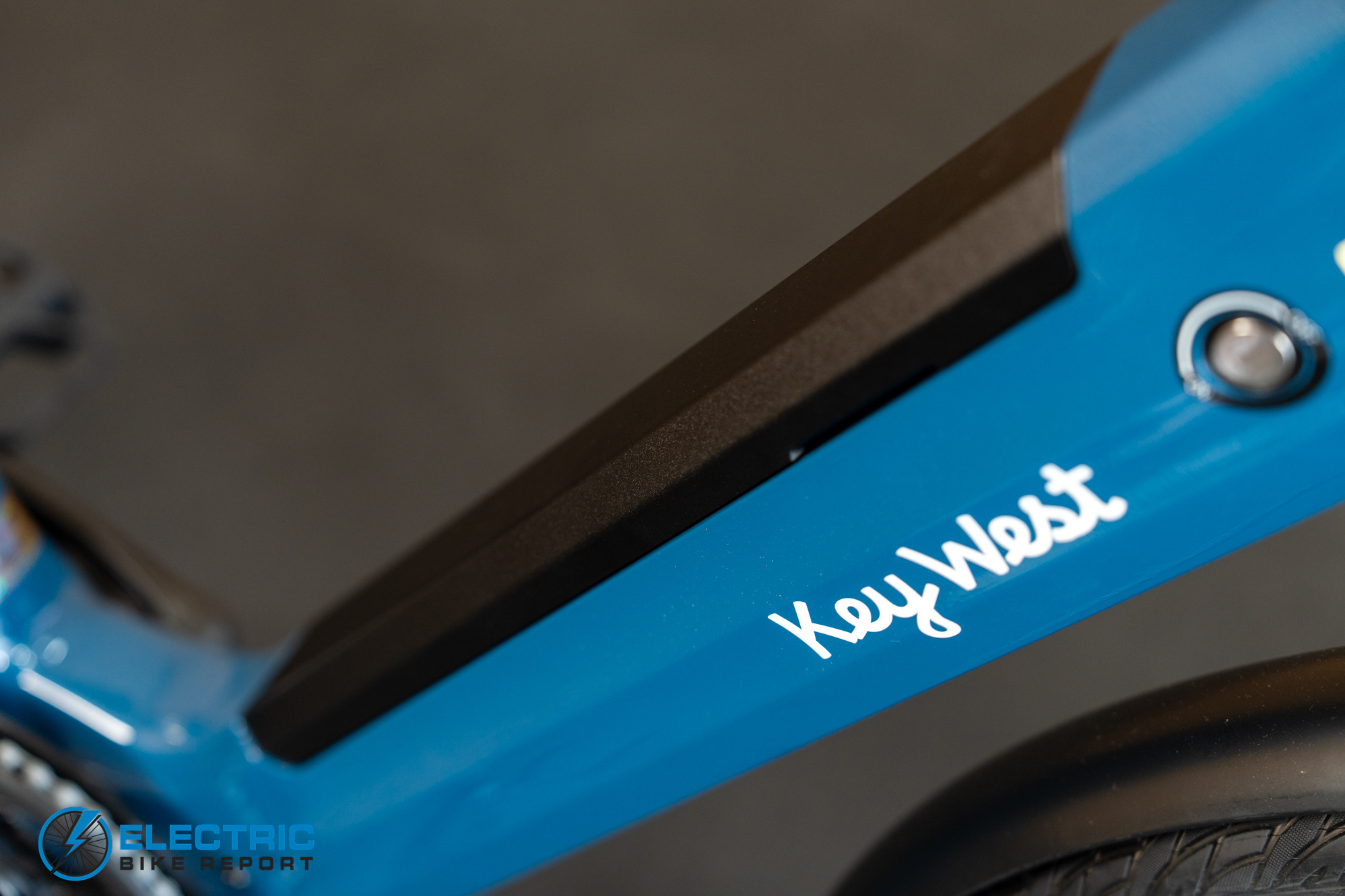
The bike’s 672-Wh battery locks securely in the down tube, but is removable for charging.
AIMA Key West 2.0 Review: Range Test
Our Range Test process is simple: we start with a fresh charge, then ride until the battery is fully depleted. We perform one test using the highest PAS level and a second using the lowest setting that still delivers practical power.
With its 48V, 672-Wh power pack, our test riders traveled 32 and 56.6 miles on a single charge. Similar mid-weight city cruisers we’ve tested covered somewhat higher results of 34.5 and 66 miles from batteries averaging 640 Wh.
It is easy to wonder why the Key West 2.0 traveled fewer miles than its peers despite having a smaller battery. While we don’t have exact figures in terms of motor output, we can consider the bike’s energy efficiency when dividing its battery’s capacity in watt-hours (Wh) by its mileage (mi) in our tests.
In short, the group of comparison models, which includes many of the best cruiser-style e-bikes we’ve tested, proved to be more energy efficient. On average, this group used 10 watt-hours per mile (Wh/mi) in their low-power range tests and 19.1 Wh/mi in their max-assist tests. The Key West 2.0 used 11.9 Wh/mi and 21 Wh/mi, respectively.
Touching back on the results of our Speed Test in the section above, the bike’s motor puts out an ample amount of power by default. Riders looking to extend the bike’s range may want to consider lowering its output, but given the fact that the lower assist levels are plenty useful, we expect most riders to land near the far end of our results.
Realistically, a range of 32 to roughly 57 miles should cover multiple leisure rides or even a few relatively long commutes on a single charge. With this potential, the Key West 2.0 offers serious practicality to a variety of riders using the bike for exercise, enjoyment, or everyday rides to work or school.
One thing to note is that we performed our testing in the bike’s torque-sensing mode with Class 2 speed limits. Those using higher speeds and/or cadence mode will likely see reduced range. Riders who alter the default settings may also have different results.
We were pleased to note that the Key West 2.0 includes a 3A fast charger, which isn’t always a guarantee on e-bikes in its price range. This charger should fill a fully-drained battery in under 5 hours.
Sponsor
Sponsor
AIMA Key West 2.0 Review: Hill Test
The Key West 2.0’s rewarding pedal assist system was front and center in our Hill Test. To evaluate its climbing power, we tested both its throttle and highest pedal assist level at our test hill, the Devil’s Backbone, as explained in the graphic above.
Our test rider, Justin, recorded a throttle result of 2:07 with an average speed of 14.3 mph. His pedal time quickened to 1:55 with a faster speed of 15.8 mph. These results straddled the averages we’ve recorded from similar models; our comparison group finished the test in 2:03 on throttle and 1:58 using pedal assist.
Where the bike was strongest was in its feel; pedaling uphill was active, but it required only light effort. Justin was impressed by the smoothness of the pedal assist system; as I touched on previously, it delivers power intuitively and responsively while still feeling steady.
My experience at our secondary test location, called Pilot Hill, lined up well with Justin’s perspective and his test results. There, I tested the Key West 2.0 in much the same way, though I also added a pedal test using cadence mode, whereas Justin stuck to the default torque-sensing mode.
As with our formal test, my throttle result was the most leisurely; I climbed the hill in 1:30 at 12.6 mph. Unusually, my torque-mode result was the fastest at 1:18 and 14.5 mph. My cadence-mode result fell between the other two scores, though it didn’t differ significantly in feel from my torque-mode test.
All of this boils down to the following: the Key West 2.0 is well-equipped to help with hills. Riders who want to handle them fastest will want to pedal, but they shouldn’t expect to feel tired or out of breath when the job is done. Those who prefer a more relaxed experience can rely entirely on the throttle, though doing so may add a few seconds to the climb.
Sponsor
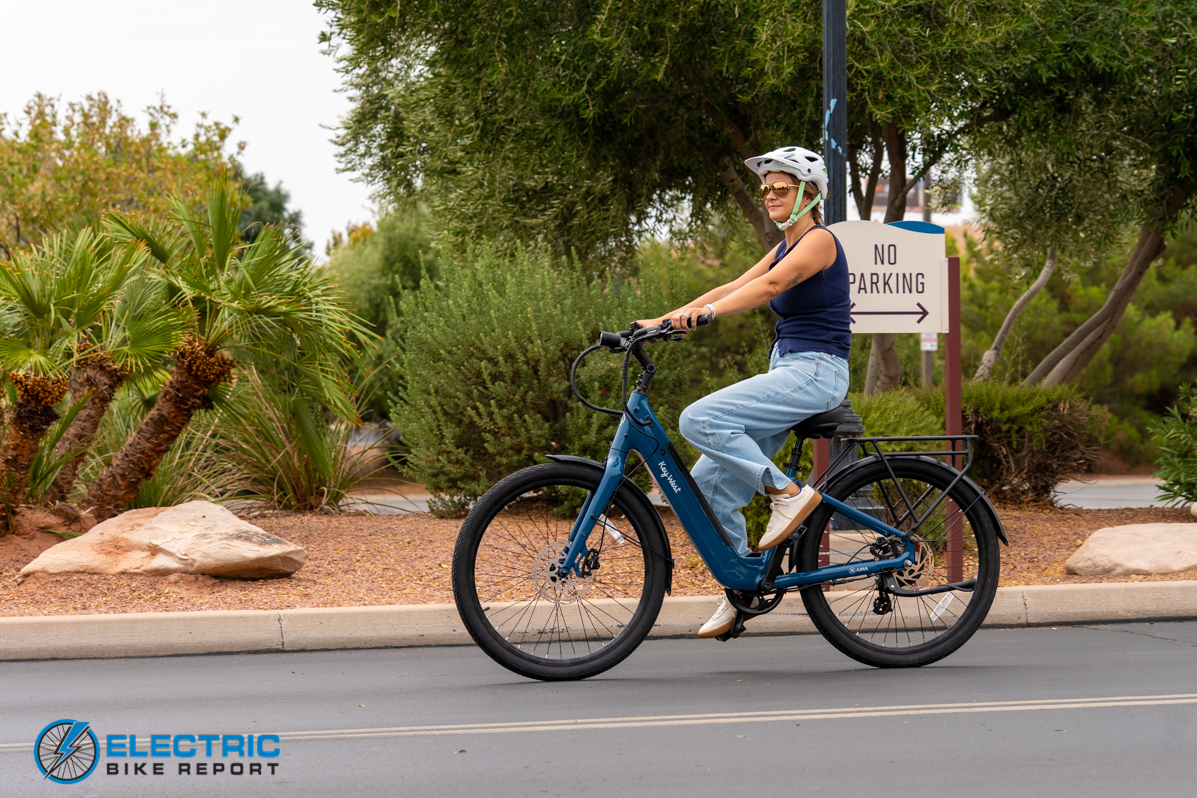
The Key West 2.0 is ideal for leisure cruises, but it’s also well-equipped for daily commuting, errand-running, etc.
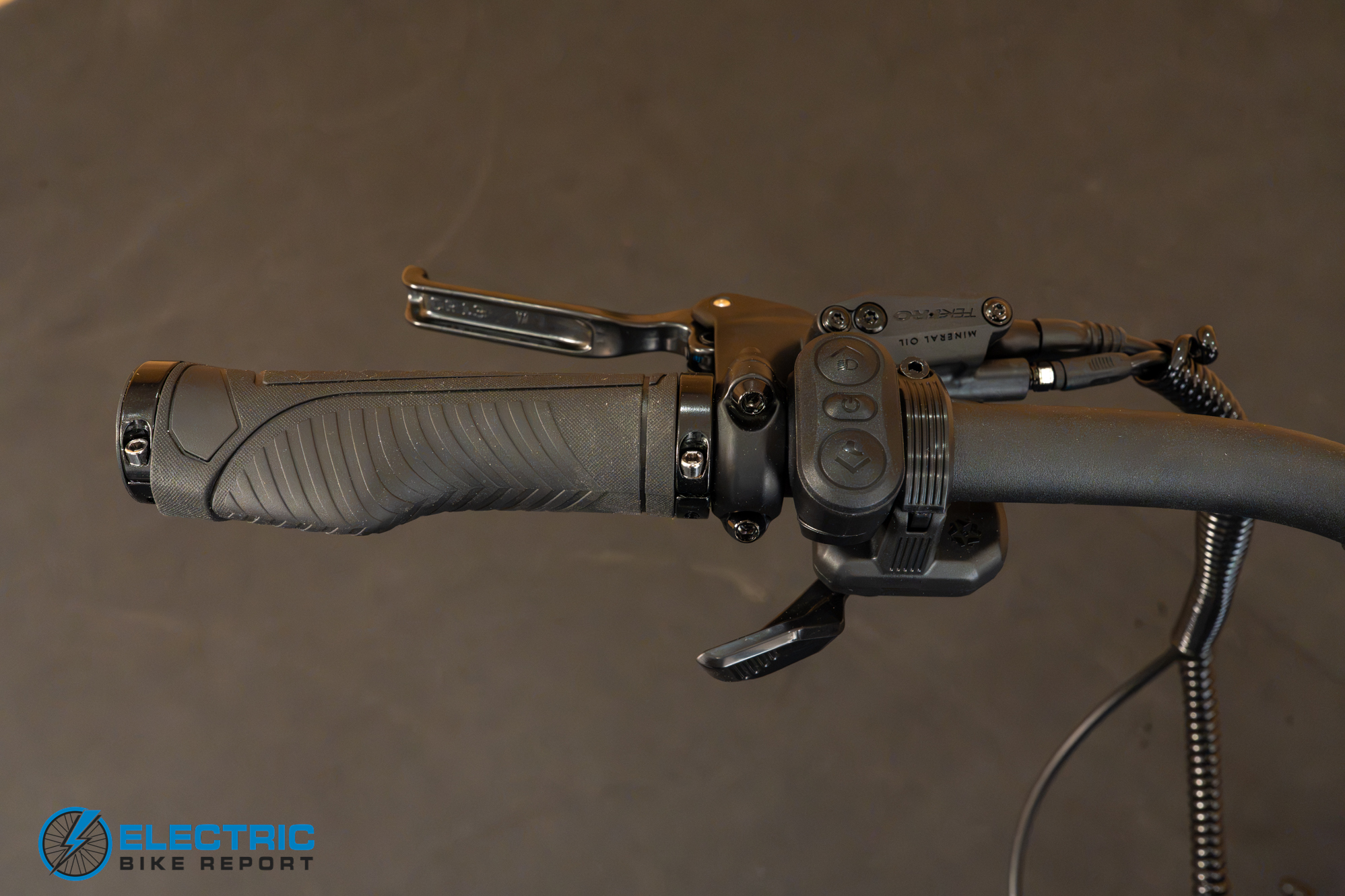
A thumb throttle rests on the left handlebar near the bike’s remote/button panel.
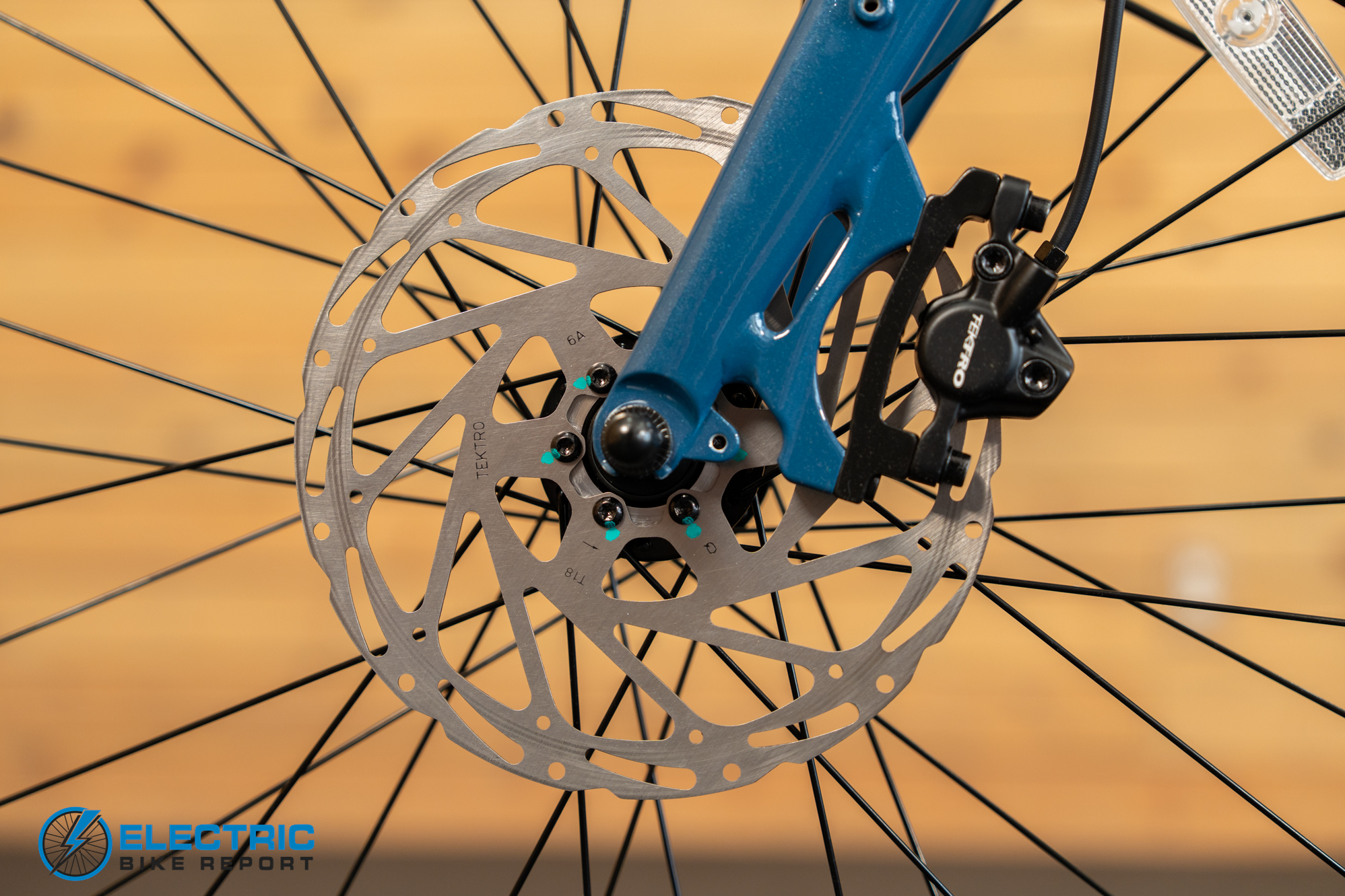
Tektro hydraulic disc brakes provide excellent speed control and stopping power.
AIMA Key West 2.0 Review: Brake Test
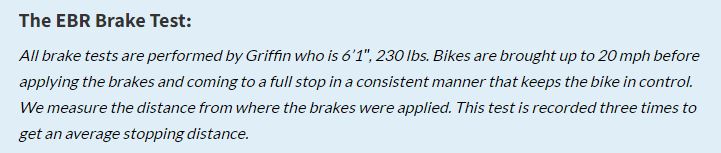
The AIMA Key West 2.0 did a great job in our Brake Test, where our tester, Michael, brought it to 20 mph before applying the brakes. In each of three test runs, he measured the distance the bike traveled before stopping. We averaged those results for a score of 18’9″, which falls nearly three feet shorter than the category average of 21’8″.
It’s relatively obvious why AIMA’s city cruiser performed so well in comparison to many of its peers. While its brakes, the two-piston Tektro HD-E3520 hydraulic system, are not uncommon on e-bikes we’ve subjected to this test, the rotor size stands out. Many other e-bikes use 180mm rotors, but AIMA equipped the Key West 2.0 with larger 203mm rotors, which provide more leverage and are more effective at dissipating heat.
Ultimately, when compared with many similar models, the Key West’s brakes are stronger and perform more consistently with repeated use.
In my experience, the brakes felt powerful and highly effective without seeming aggressive. When riding downhill, modulating speed required steady, moderate pressure on the levers. Stopping on flat ground was quick and predictable.
All in all, this setup is well matched to the Key West 2.0’s speeds and weight, easily counteracting its momentum. Its score is among the shortest we’ve seen from e-bikes of this style, so it easily earns our approval for brake safety and performance.
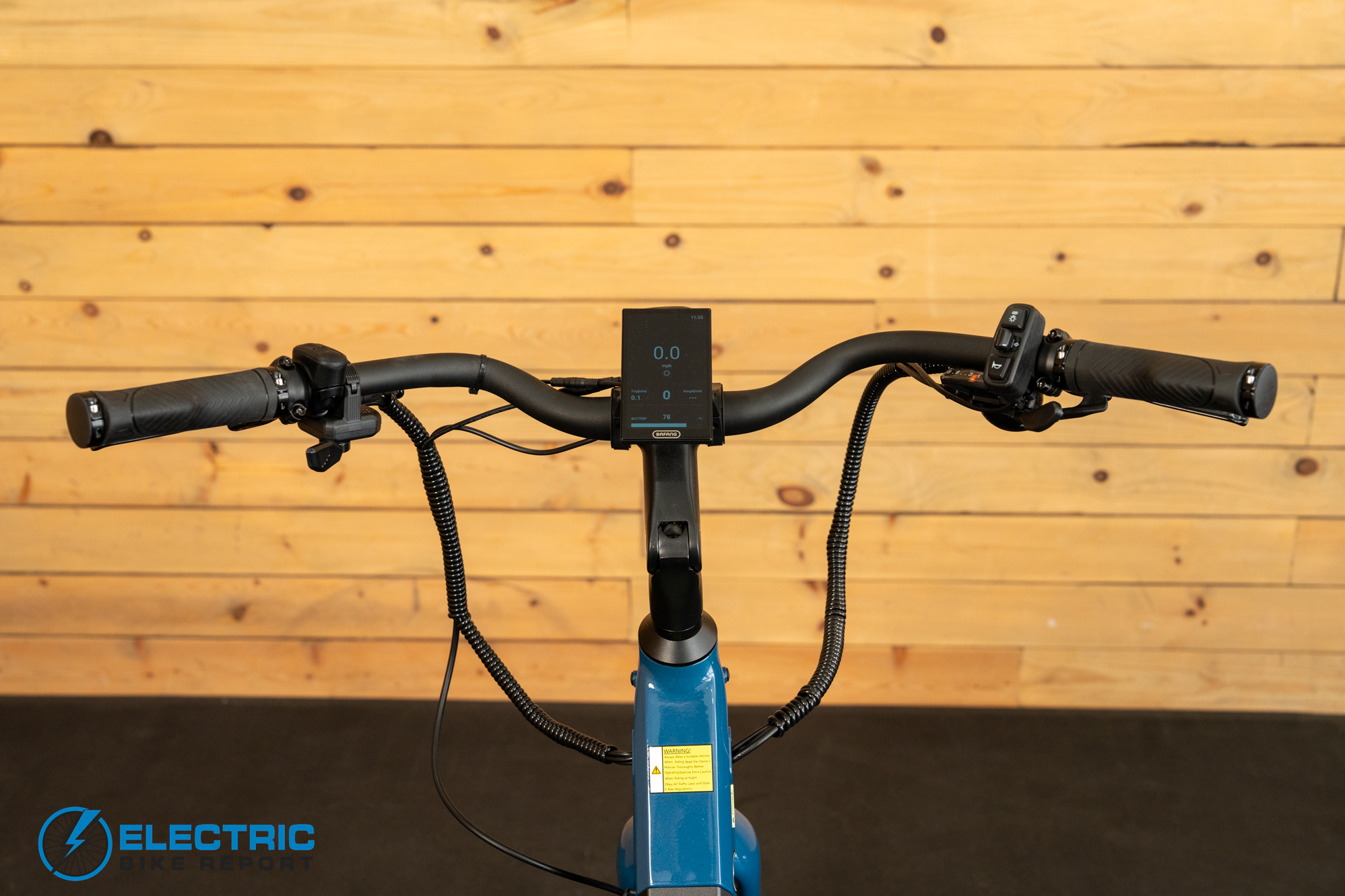
A set of wide, swept-back handlebars offer a comfortable and ergonomic feel.
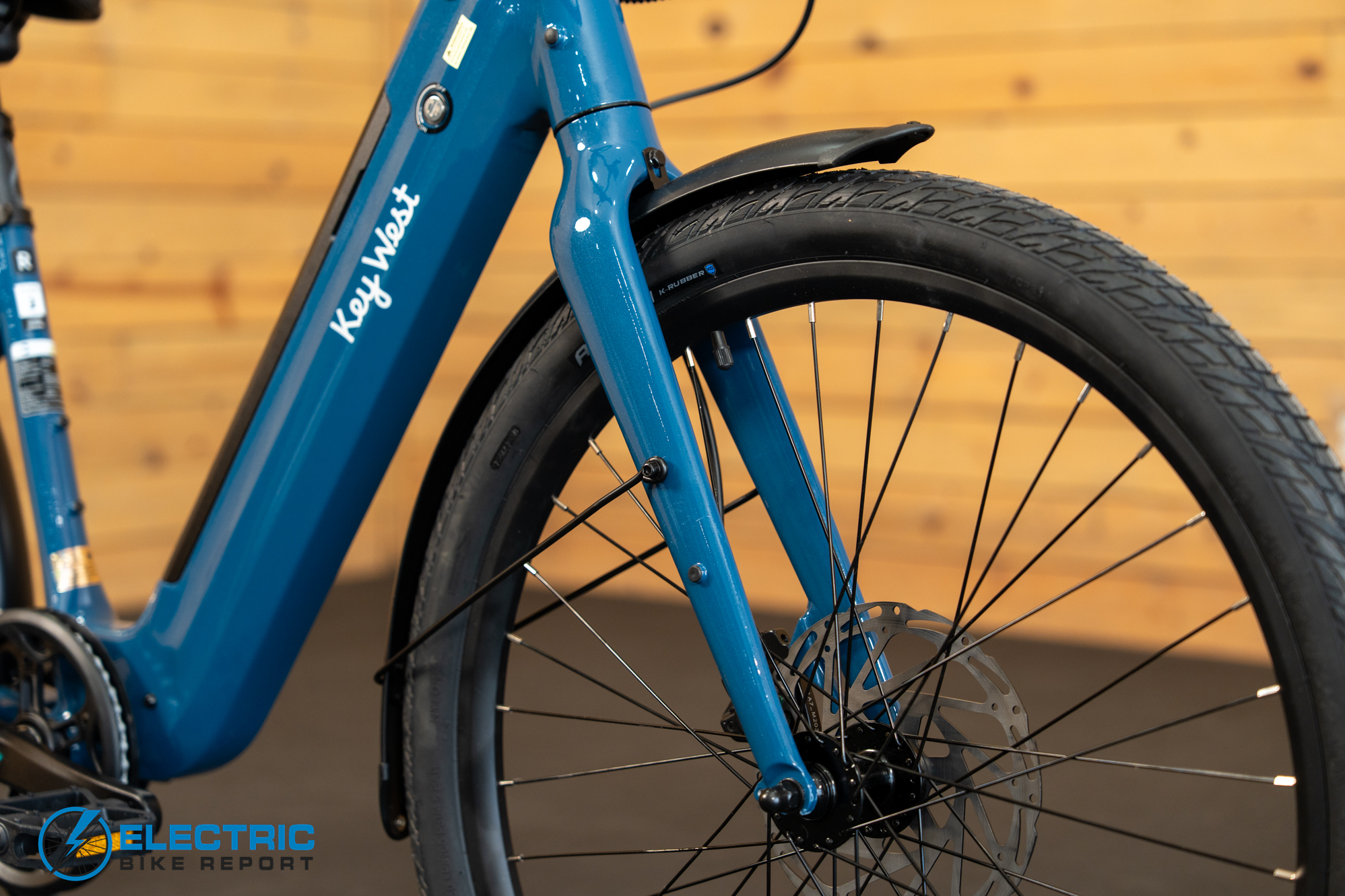
The bike’s rigid aluminum fork keeps steering precise and handling predictable.
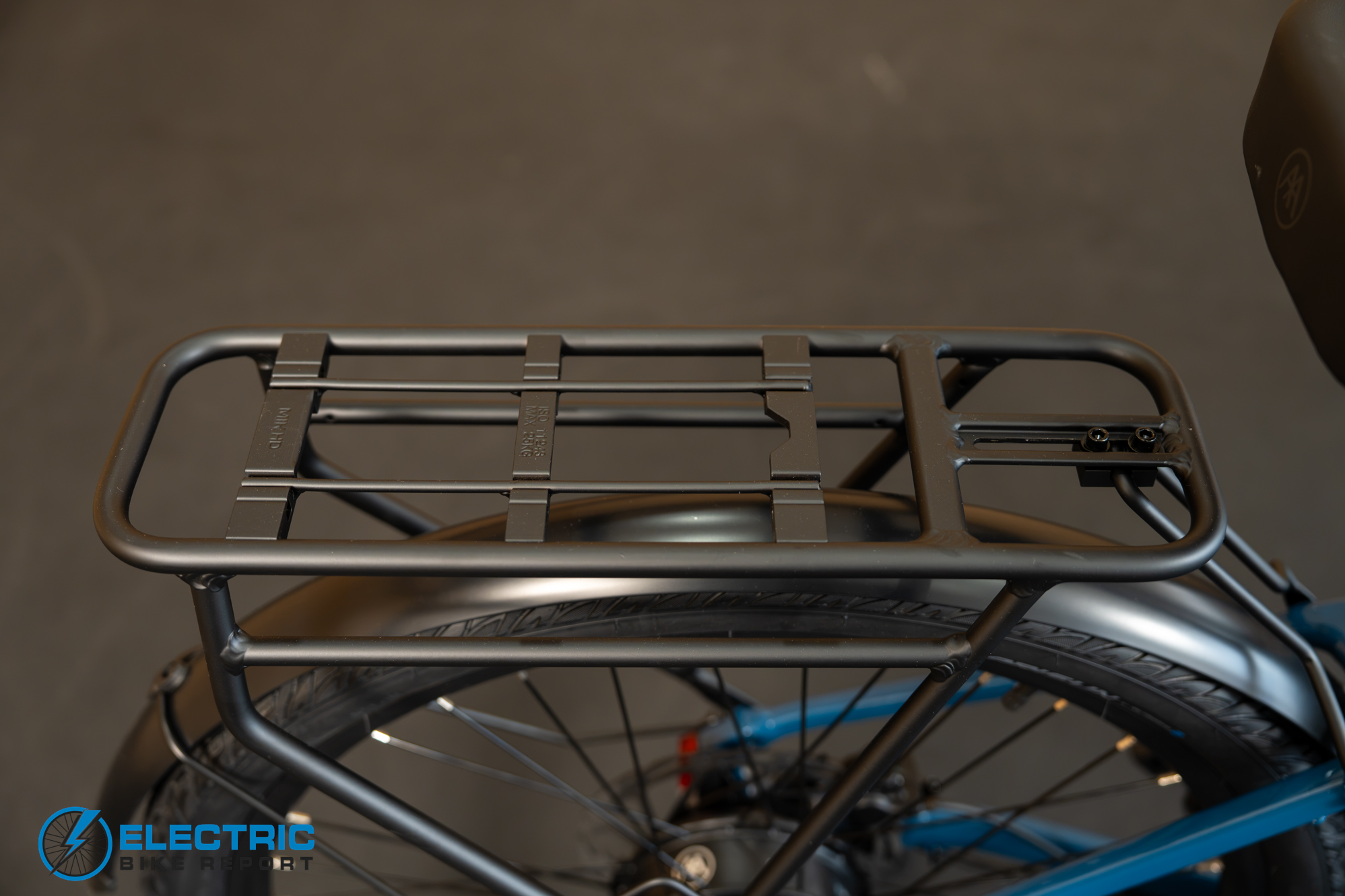
An MIK-compatible cargo rack can support up to 55 lbs of carrying capacity.
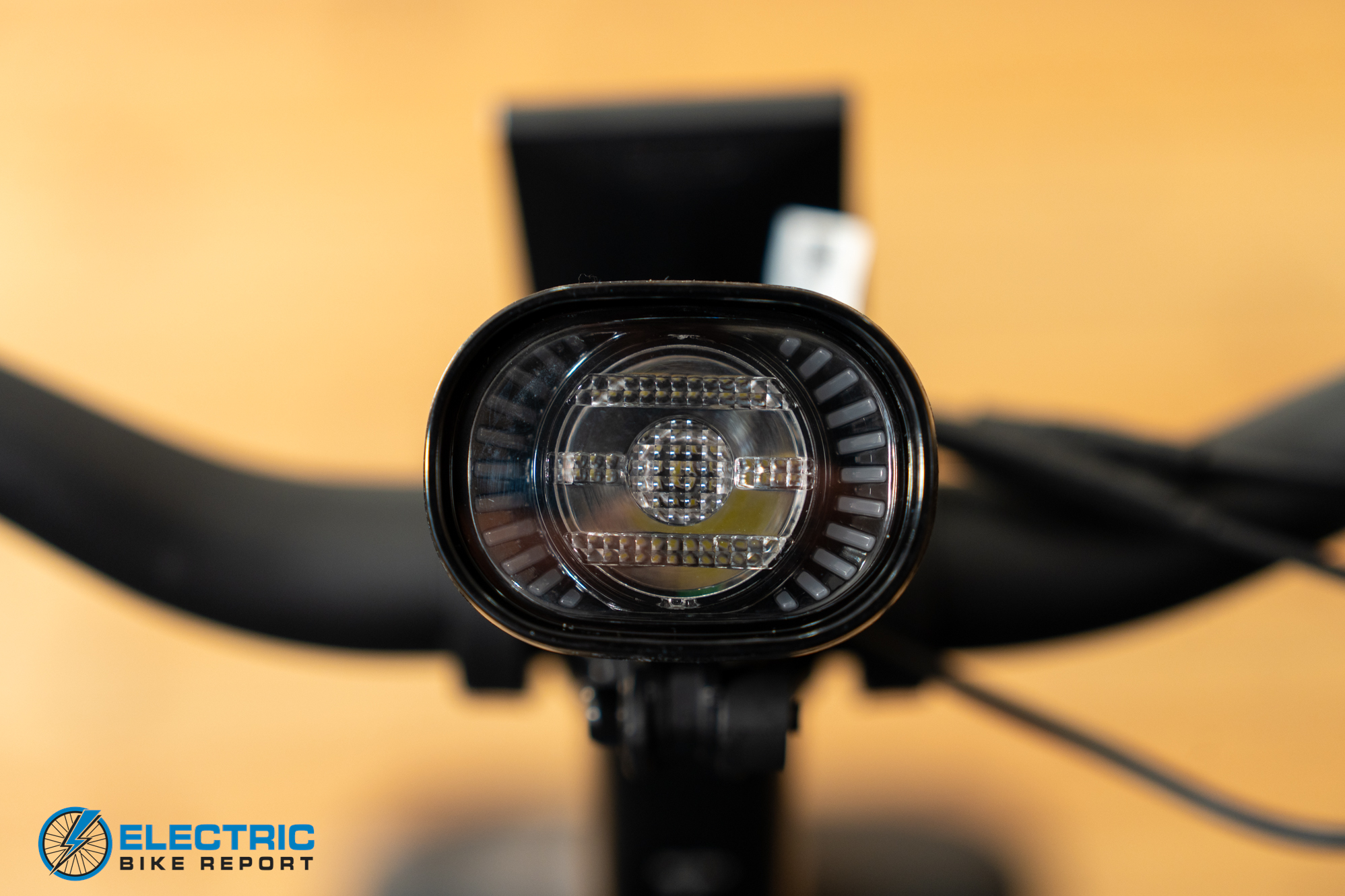
The Key West’s integrated light system includes an LED headlight with automatic light sensors.
AIMA Key West 2.0 Review: Ride Quality
E-bikes like the Key West 2.0 often prioritize comfort and agility, but AIMA’s model is among the most successful in these areas. Its relaxed geometry, adjustable fit, included suspension seatpost, and balanced weight help it to be nimble and enjoyable to ride.
AIMA offers the bike in two sizes: a Regular that fits riders from 4’11” to 5’10”, and a Large that accommodates those between 5’4″ and 6’1″. We tested the smaller model, and despite being outside the recommended height range (I’m 5’11”), I found the ride comfortable and ergonomic.
The bike offers a fair amount of adaptability, with a seatpost that has around 6″ of adjustment in saddle height and an adjustable stem that alters handlebar height and reach.
Since our test bike was a bit on the small side, I set the stem to roughly 45 degrees and set the saddle somewhat lower than I typically would to keep the riding position comfortable. I was relieved that the motor offset the difference in leg extension by giving me enough power to prevent any strain.
The wide, swept-back handlebars, ergonomic rubber grips, and supportive spring saddle felt great, keeping me in a comfortable and relaxed upright position. I found myself easily slipping into the cruiser mindset, pedaling at a casual pace so I could enjoy my surroundings and the ride experience.
Thanks to the suspension seatpost and 27.5″ wheels, rolling over bumps felt smooth—more like gliding or floating than anything else. Steering was relaxed but also responsive, so the bike was easy to control without feeling sharp or aggressive. Accelerating was fast and efficient, feeling well-suited for both commuting and cruising.
Speaking of those two uses, the Key West 2.0 is decidedly a cruiser first, but it still has plenty of commuter DNA. In addition to its place in the mid-weight category, it’s well-equipped for functionality. The bike includes integrated lights, fenders, turn signals, and a high-capacity MIK-HD cargo rack, so it’s set up for utility in addition to daily transport.
As I’ve mentioned previously, I was impressed by how seamlessly and quickly the motor engaged; it felt intuitive and dialed-in.
The Key West’s level of customization was appreciated, though I do have one area of critique. Adjustments to the bike’s Class setting must be made by authorized technicians at AIMA dealers, which means that riders who make a change but want to return to previous settings will need to go through the ordeal of going back to the bike shop. This may present an inconvenience to those who live far from a dealer location.
Otherwise, I appreciated that many changes can be made from the display’s settings menu, including switching between torque and cadence modes.
Additionally, the Bafang Go app is worth a mention. In addition to also offering motor tuning and serving as a hub for important ride data, it also can be used to track rides or get turn-by-turn navigation to specific destinations.
Overall, the experience of riding, using, and customizing the Key West 2.0 was great, and I’m impressed with how much the bike offers at its price point between $1,500 and $2,000.
Sponsor
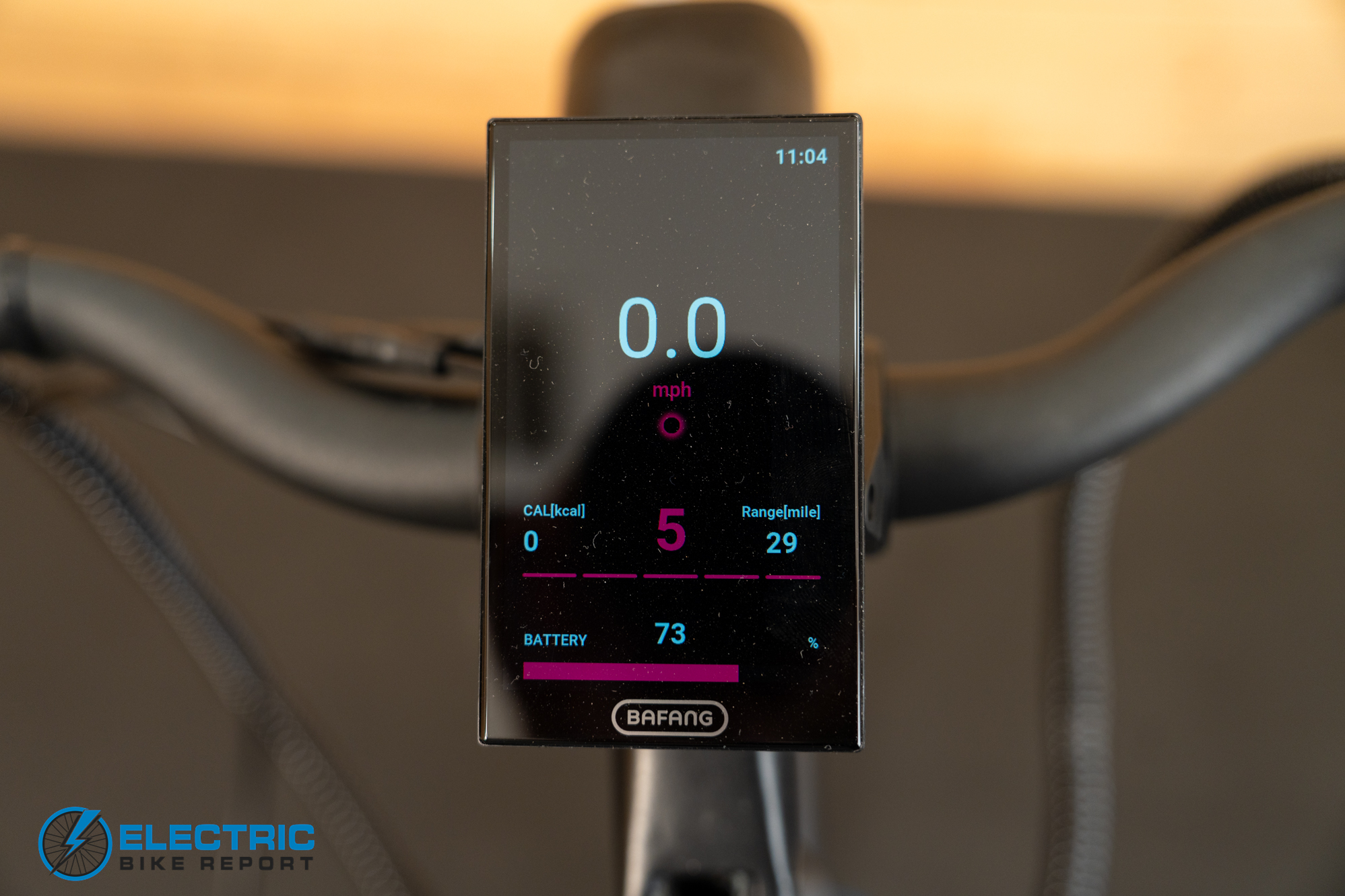
The color TFT display looks clean and well-organized—plus it has multiple visual styles to choose from.
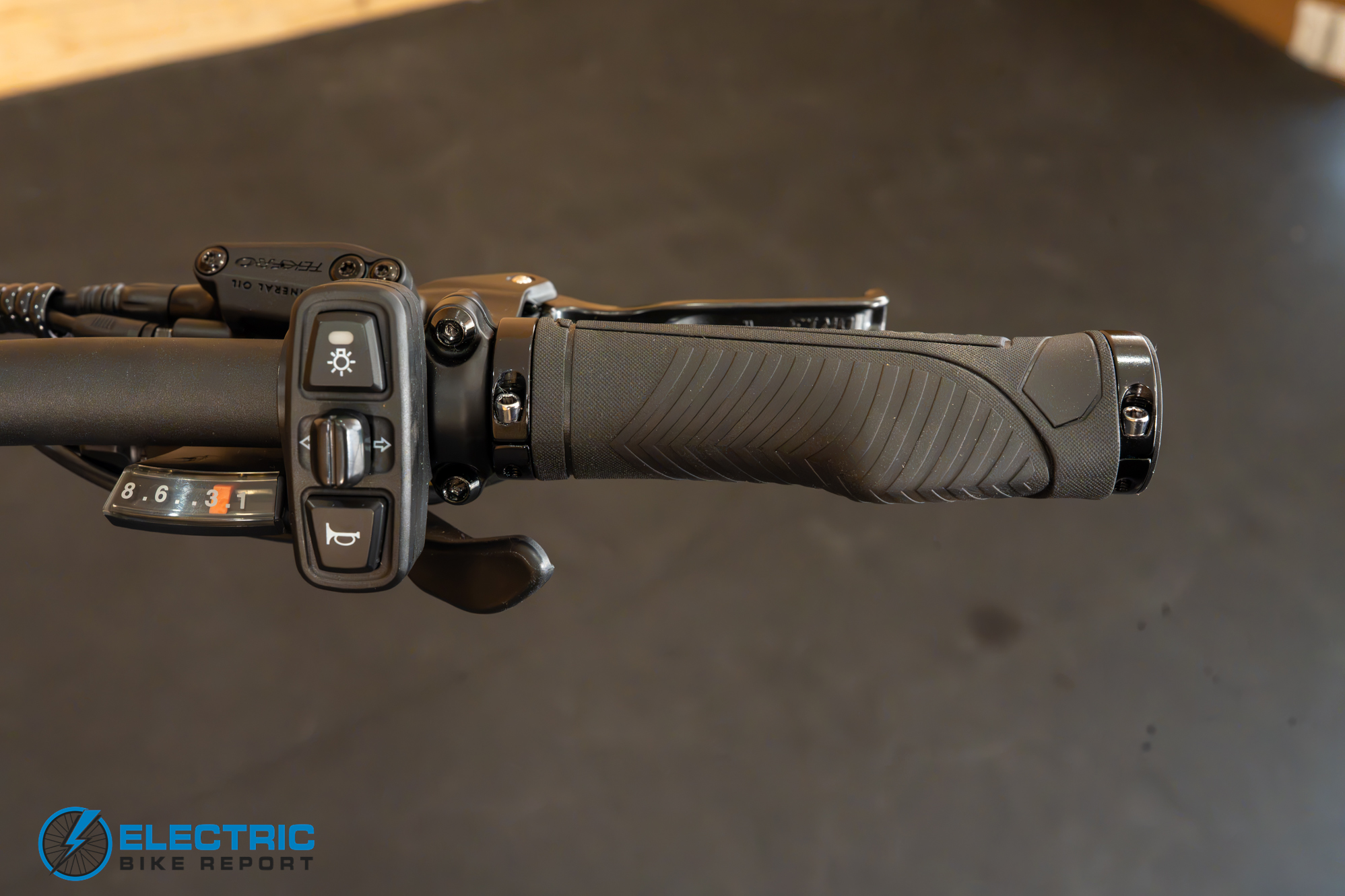
A control module on the right handlebar offers buttons for the lights and horn, plus a toggle for the turn signals.
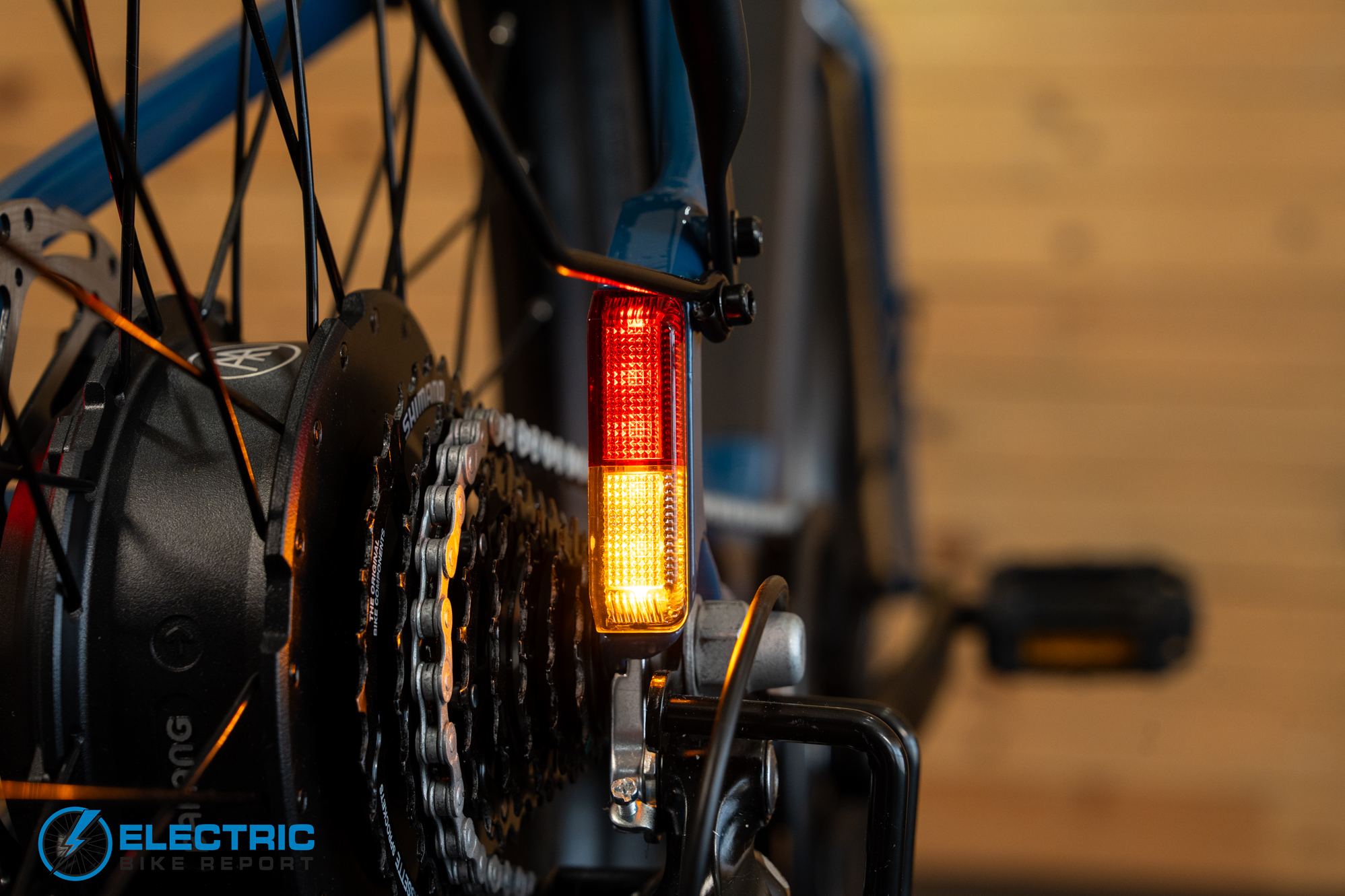
Rear turn signals are integrated into the seat stays with the bike’s brake/tail lights.
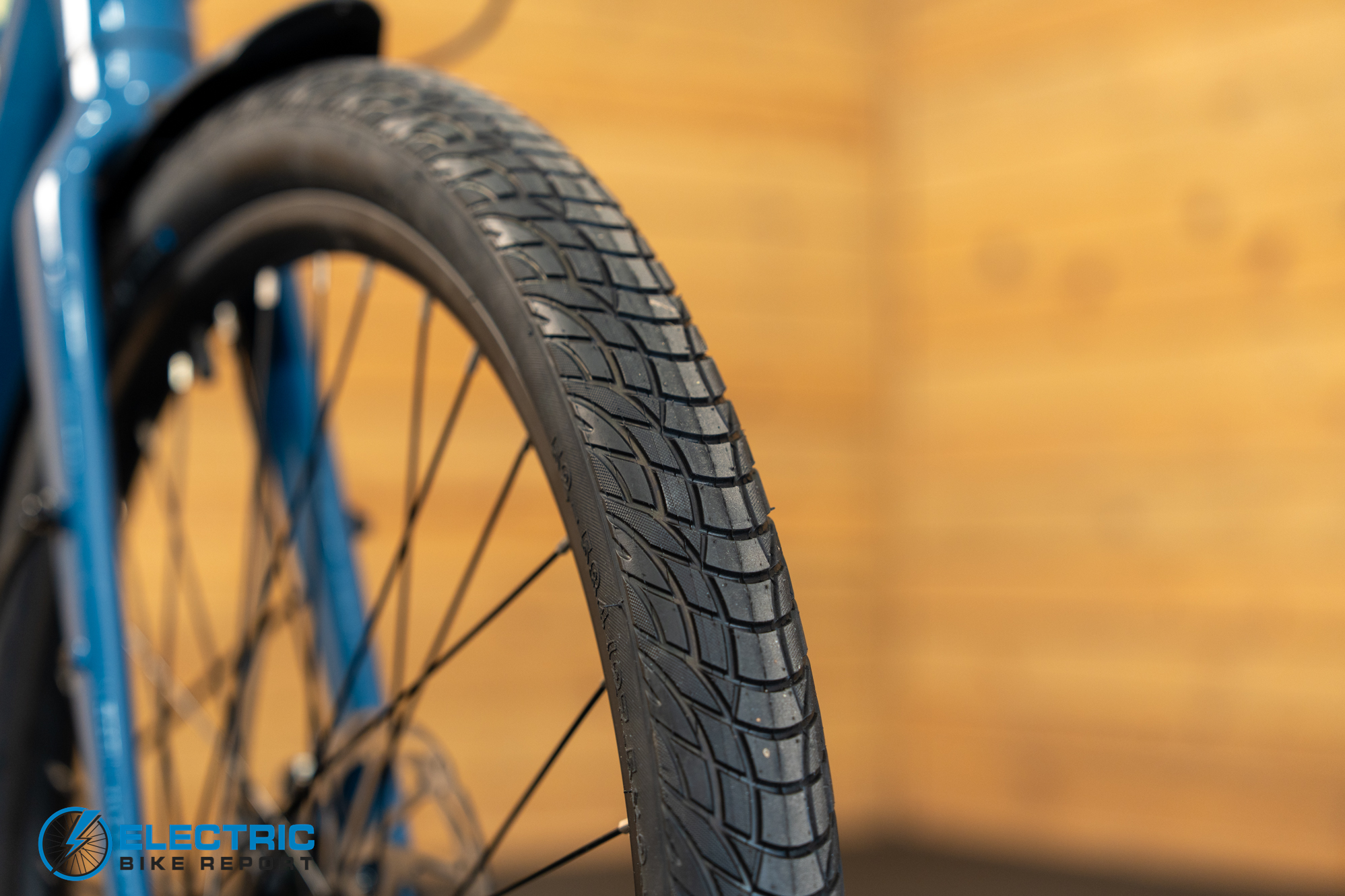
27.5×2.1″ Arisun K-Rubber tires roll smoothly on pavement and add a bit of extra cushion.
AIMA Key West 2.0 Review: Summary / Where to Buy
Alongside a handful of other e-bike companies, AIMA is firmly in the camp of brands that simply do things right. As a professional tester and reviewer, this makes my job easy—and it’s truly a delight when I have the opportunity to review one of AIMA’s products.
Considering that the brand only recently released the original Key West, I was surprised to see a follow-up so quickly, but the update is worthwhile. We considered the brand’s first city cruiser to be a great bike, but this version offers a much smoother and more comfortable ride along with a more rewarding experience via pedal assist.
This e-bike did an excellent job in most areas of our testing, with smooth, responsive, and ample power, practical range, solid climbing power, and safe braking. The Key West 2.0 proved to be well-specced, outfitted properly for both comfort and daily use, and visually appealing to boot.
There is only one area of critique worth mentioning: AIMA’s e-bikes are sold only through brick-and-mortar dealers, and any adjustments to the Key West’s speeds must be done on-site by the company’s technicians.
Otherwise, the Key West 2.0 is remarkably easy to recommend for urban and suburban riders seeking a highly comfortable cruiser-style e-bike with a manageable weight.
It would also be a great fit for those who want a maneuverable and easy-to-pedal daily-use commuter, as well as for buyers who want a smooth, enjoyable leisure bike. Finally, it’s great for those who need an e-bike that’s easy to mount and riders who enjoy diving into settings menus and customizing their ride to match their preferences.
Happy Riding! Make sure to let us know if you have any questions or if you think we left anything out in this review of the AIMA Key West 2.0 down in our comments section.
Sponsor
Sponsor
Reader Interactions
Leave a Reply