Avinox Justifies High-Power Mid-Drives, Amazon Trying E-Quadricycles, Fidlock’s Theft Tracker | TWR Ep 84
May 24, 2026
 0 Comments
 Share
Share
Plus SGS Opens New Testing Lab in Bentonville, the Genessee Riverway Trail, Tips for Beginners, Moped E-Bikes on Mountain Bike Trails, & More!
It was a relatively relaxed—but still very interesting—week in e-bike news. Amazon has partnered with the District of Columbia’s Department of Transportation to deploy a test fleet of electric cargo vehicles. If the program is successful, Amazon could use the vehicles for last-mile delivery in dense urban environments to reduce congestion.
Additionally, Avinox has issued a public statement in response to industry concerns about its powerful mid-drive motors. Some high-profile voices advocate for more restraint on motor power, but Avinox frames power as a tool that can make cycling more inclusive. Which side of the line do you fall on?
Finally, Litelok has launched a map-based tool showing real-time bike theft data around the world. Do you live in an area where bikes are prone to being stolen? Check out the map to see useful data that can inform you on whether you should invest in some additional security measures.
See below for more on these stories, as well as a selection of great e-bike deals for Memorial Day. We also highlight a variety of products from Fidlock, including phone mounts, water bottle mounts, and more!
Sponsor
Sponsor
This Week’s E-Bike News Headlines
An E-Bike Bill in Hawaii Seeks to Define E-Bikes and Ensure Rider Safety
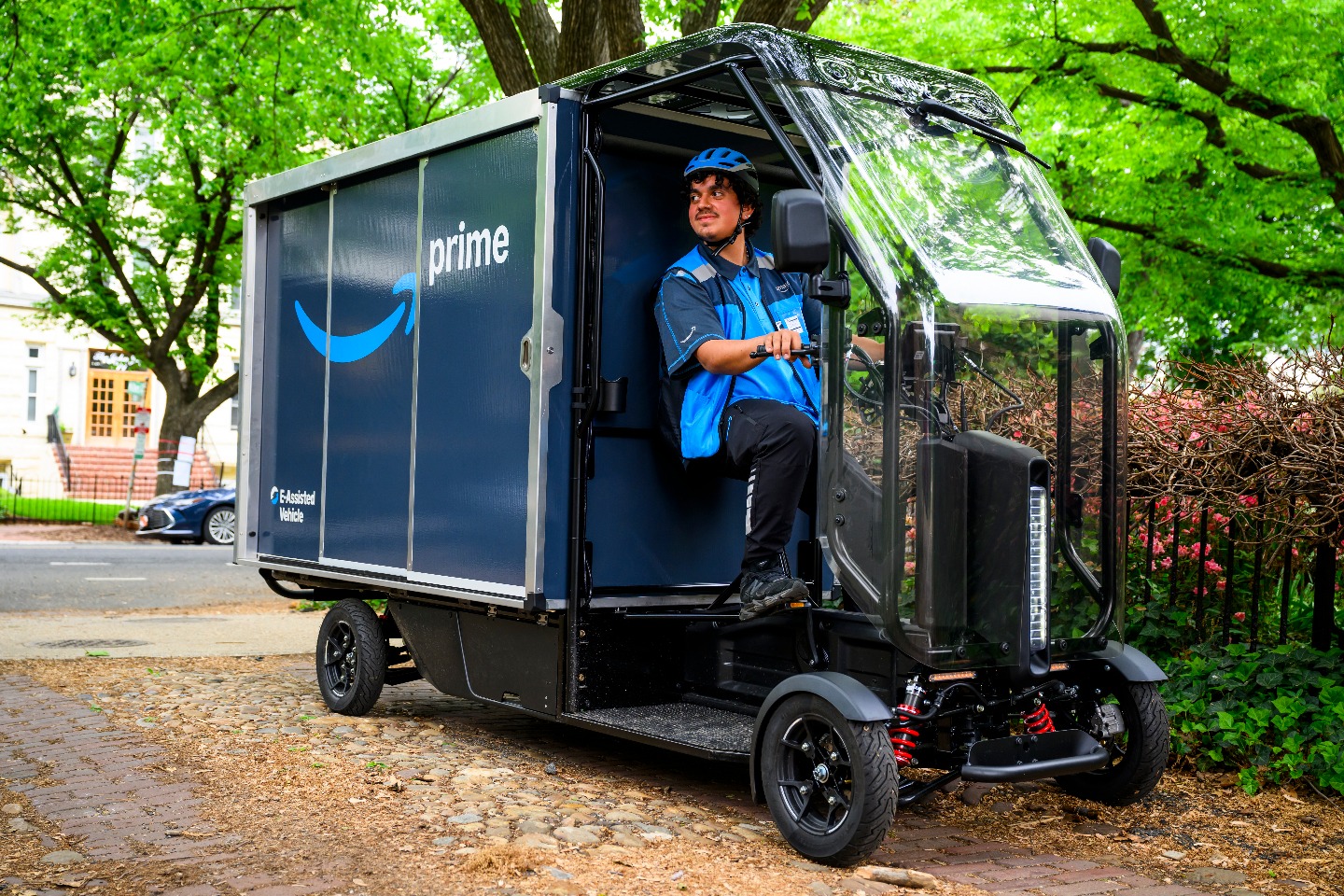
Image Source: Amazon
This program formed by Amazon’s partnership with the District Department of Transportation (DDOT) is called MicroFreight DC. It is a 10-month trial to replace delivery vans with battery-powered electric cargo vehicles for last-mile deliveries, and is planned to include up to 15 vehicles in the southwestern part of Washington, DC.
Other sources online refer to the vehicles as cargo e-bikes, but of course, they have four wheels instead of two. This makes them quadricycles instead of bicycles. The vehicles use a pedal-by-wire system to move, where the rider’s pedaling engages the motor instead of helping to propel the vehicle via a mechanical drivetrain.
The e-quadricycles look like mini delivery vans, with an enclosed cab (including a windshield with wipers) and a secure cargo area. They are limited to 15 mph and cannot be ridden on sidewalks, but are intended for use in bike lanes and commercial loading zones.
The goal of MicroFreight DC is to study the effectiveness of small electric cargo vehicles—specifically, whether they can reduce traffic congestion, emissions, and noise in crowded cities. Throughout the length of the program, the DDOT will collect data about packages and routes monthly, then publish a final report summarizing their findings.
Regarding the program, Amazon’s Vice President of North America Last Mile Transportation, Dave Alperson, said, “We’ve seen the benefits e-cargo bikes bring to urban deliveries around the world, and we’re excited to launch this pilot alongside DDOT to help ensure we get it right here in DC. We’ll continue working alongside community partners in the National Capital Region who understand the local needs best— combining their insights with our expertise in delivery, technology, and innovation to make a real difference in people’s everyday lives.”
Our Take:
The idea of using e-cargo vehicles for last-mile deliveries definitely has some merit, especially if these smaller vehicles are successful in taking up less space. As some groups have pointed out, the quadricycles are still large enough to block a bike lane, but fortunately, bikes are more maneuverable than cars, so getting around them should be manageable.
What we’re most curious about is the brand manufacturing the vehicles. As we reported, Amazon relatively recently partnered with the Rivian spinoff ALSO for e-quadricycles that could be used in deliveries. The units deployed in Washington DC, however, are different in appearance from the concepts shown last fall by ALSO. For the moment, we still have some questions—with any luck, more information will be available within the next year.
Avinox Responds to Concerns About Its High-Power Mid-Drives
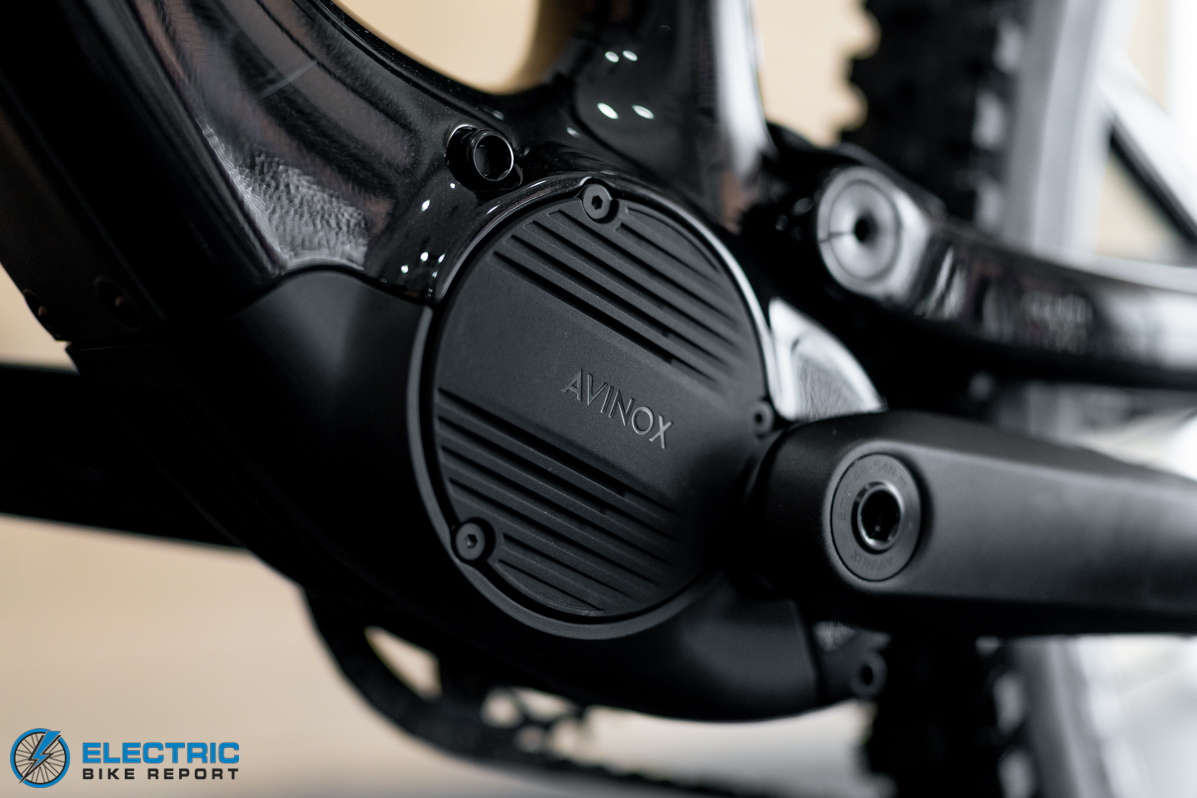
The publishing of Avinox’s statement follows widespread industry upheaval after the release of its M2S motor, which can produce a staggering 1500W of peak power and 150 Nm of torque.
One example comes from Mountain Bike Hall of Fame inductee and Bosch/Santa Cruz Ambassador Hans Rey. The 90s mountain biking icon made a public statement urging more strict limitations, saying “In order to protect what we have, we must stop asking how much power we can get away with – and start asking how much power is too much.”
Peter Eland, the technical and policy director for a UK-based Bicycle Association, also said something similar. To quote Eland, “As the UK trade body, we recognise concerns that peak power can be very high within the 250W continuous rating, and would support calls for restraint from both manufacturers and riders.”
The heart of Avinox’s statement is that power and speed are very different, and that speed is the main factor affecting rider safety. The company explains power as a tool that can be used to help riders perform beyond their normal limits, especially when it is delivered in a controlled, predictable way.
The statement reads, “Power is the force that helps riders accelerate, especially at low speeds and in demanding situations such as steep climbs, technical ascents, and navigation around obstacles. Avinox systems comply fully with all applicable speed regulations, and we strongly support the implementation and enforcement of speed limits. That means our high power output is not designed to make riders go faster than allowed. It is designed to make difficult terrain more manageable. Whether it is clearing a rocky ledge, climbing a steep incline, or helping a less experienced rider maintain momentum, more power can make mountain biking both easier and safer.”
The company also reinforces that high power output can enable heavy riders, those with disabilities, and those moving a lot of extra cargo weight to ride when they otherwise might be limited. Its statement urges that motor output limits that are too strict might unnecessarily exclude these groups of riders.
Avinox continues, stating that customization is an important part of the equation, and it designed its systems to be tailored to match their users’ riding styles and environment. It also defends its commitment to safety by explaining its comprehensive approach when designing bikes to support high power output. Elements such as the frame, wheels, brakes, tires, chargers, and more, are to handle the high power output and hold up over time.
Regarding legality, the company states “Some argue that offering more powerful motors could invite regulatory scrutiny or harm the industry. We believe that view oversimplifies a much more nuanced issue. Avinox supports responsible regulation and strict compliance with all applicable laws. At the same time, we believe innovation should not be constrained by arbitrary power limits that lack a clearly explained basis.”
Our Take:
Generally speaking, we agree with Avinox’s take. As the company’s statement points out, e-bike motor power limits are currently arbitrary; the widely-accepted 750W limit in the US is based on its equivalence to 1 horsepower. To our knowledge, no studies were done to establish the appropriateness of this limit.
It is important to acknowledge that there are still a lot of vague or undefined areas surrounding the legality of e-bikes and their power limits. With legislation surrounding e-bikes and other types of EVs and micromobility devices being a hot topic in recent months, we’ll have to see what laws get passed, and how the dust settles.
In the meantime, we believe it is more appropriate to regulate speed rather than power, just like we do with automobiles.
Bike Lock Company Litelok Launches Map-Based Theft Monitoring Tool
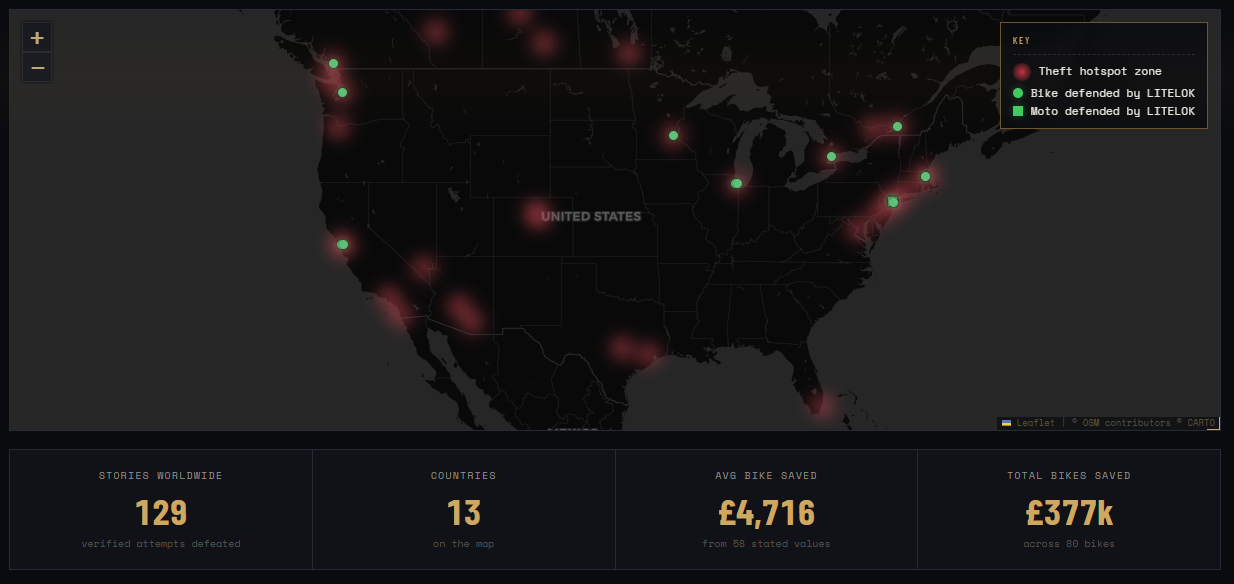
The tool, called Theft Intelligence, displays a map showing real-time data for locations of bike thefts. It is assembled from a combination of data from government agencies, Litelok customers, and communities. Importantly, the map also shows locations of incidents where Litelok products prevented theft.
The website displays a variety of useful metrics, including the number of bikes stolen today, the number stolen per hour, the percentage-based recovery rate, and the average value of each loss. As one might expect, most hotspots seems to be in densely populated major cities; New York City and Los Angeles are the two highest-theft cities shown in the US.
The tool also shows the seasonal trend, reflecting the highest number of thefts in July and August. It focuses on the UK, the US, Germany, France, and the Netherlands, but a global view is also available.
Litelok’s goal with this website is to help riders know where they should be the most cautious when leaving their bikes.
The company’s founder, Neil Barron, explained, “We built this to help riders stay informed about bike theft activity and locations; and to share it around. If an area has no reported hotspot or story on the map, it should not be assumed to be free from risk. Our mission is for riders to worry less and ride more.”
Our Take:
There is no doubt that this is a helpful and informative tool, though one flaw stands out. Instead of showing precise theft locations within cities, the hotspots are displayed city-wide. As such, it doesn’t necessarily show bad neighborhoods, just “bad” cities, which is somewhat unrealistic—and a bit less helpful than more granular data would be.
Still, the message is clear: if you live in a big city, you should probably take extra care. Those interested in investing in extra theft prevention might consider the Litelok X1 or X3 that we reviewed recently.
Gear Highlight – Fidlock Products
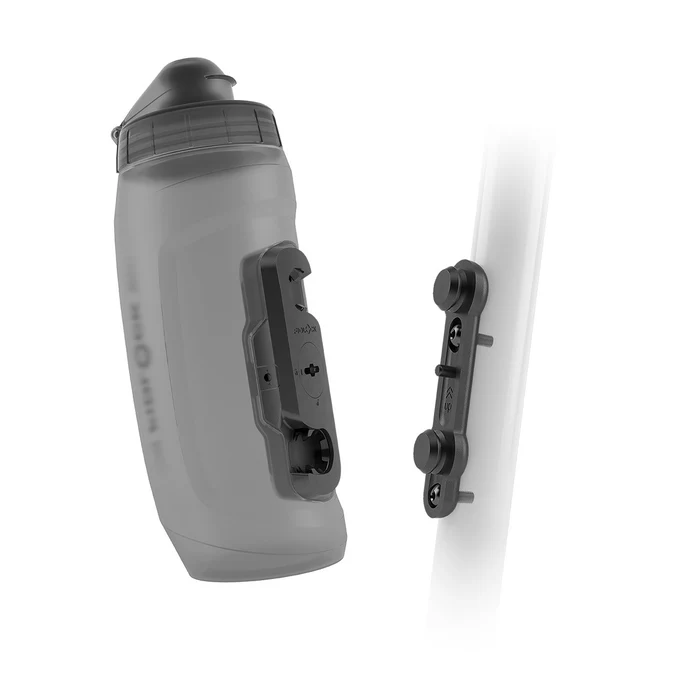
Image Source: Fidlock
Fidlock makes a variety of products, including hydration bladders, phone and camera mounts, storage bags, and more. Many of these use a proprietary mounting system that uses a combination of magnets and a twist-lock mechanism to hold items securely in place.
The Twist Bottle 590 + Bike Base is one such item. Along with a 590 ml (20 fl oz) plastic bottle, the unit includes a base plate that attaches to the bottle cage mounts on your bike frame. It’s essentially a quick-attach and release system for a water bottle. With it, riders can quickly and easily snap it into place, where it is held securely with magnets, then twist it to release and use.
There are lower- and higher-capacity bottles available as well, plus they have a universal mount that can attach to any bottle to make it compatible with the twist system. The Twist Bottle 590 is made from BPA-free polyethylene, is dishwasher safe up to 122 deg. F, and costs $39.99.
Riders can attach a bottle, or anything else that uses Fidlock’s Twist system, using the Twist Uni Base. This universal attachment plate for the Twist system doesn’t require bottle cage mounts; instead, it uses silicone straps to secure to your bike’s top tube or seatpost (or anywhere else it fits, really). This base plate is priced at $21.59 at the time of writing, though its MSRP is $26.99.
Among the items that can connect to the Twist Uni Base or Bike Base is the Twist Force Connector. This attachment system is designed specifically for TQ external range extender batteries, mounting to the exterior of the unit to make it Twist system compatible. It is priced at $21.59 upon the writing of this post.
The last product sent to us by Fidlock is the Vacuum Handlebar Base, a suction-based phone holder that secures to your bike’s handlebars. In addition to the suction cup, which includes a release ring, it also uses built-in magnets to attach to MagSafe rings on the phone or case.
The Vacuum Handlebar Base includes two mounting clamps for different sizes of handlebars. It also comes with universal cable tie adapters so you can attach it to just about anything. This product is priced at $29.99.
Sponsor
Sponsor
You Asked, We Answered. Questions Covered In The Weekly Recharge
- Can I use moped-style e-bikes like the Juiced Scrambler Full-Suspension on mountain bike trails?
- Why do some e-bikes like the Electra Townie Go! S use fully-internal batteries?
- What should you look for when shopping for a safe, reliable bike helmet?
- What should a beginner do to get a feel for riding their e-bike?
E-Bike Deals Found This Week
- Retrospec’s Summer Sale
- Beaumont Rev+ – $200 off, down to $1,400.
- This city cruiser blends Dutch styling with a torque-sensing 500W motor, a straightforward set of features, and great overall performance.
- Roo Rev XL – $400 off, down to $1,600
- This longtail cargo bike offers simple but sturdy construction, a powerful torque-sensing 750W motor, and surprisingly nimble handling for its style.
- Aventon’s Memorial Day Sale
- Pace 4 – $200 off, down to $1,599
- This sporty city cruiser provides responsive power, tons of integrated security and ride tuning features, at an incredibly low price
- Level 3 – $200 off, down to $1,699
- A speedy, sporty commuter with sharp handling, natural-feeling pedal assist, and the same integrated security and ride tuning features
- Lectric’s Memorial Day Sale
- XP4 750 – $473 in free accessories, priced at $1,299
- This affordable, sturdy, and well-equipped folding e-bike includes a phone mount, side mirrors, pannier bags, and a bike lock
- Lectric ONE – $500 off, down to $1,899
- A compact commuter with a Pinion gearbox that offers electronic, semi-automatic shifting.
Make sure to tune in to the full episode to see the e-bike trail system highlight and rider of the week! Want to be featured in future episodes? Comment on any YouTube video or page of the website, or send to [email protected].
*Please help support our efforts at Electric Bike Report. We work hard to provide the highest quality content, news, and reviews for our readers – and our sponsors make all of this possible. Please visit our sponsors from their ads on our website and let them know that you appreciate what they do for the e-bike industry and Electric Bike Report
Sponsors
Sponsor
Reader Interactions
Leave a Reply