

A Fitness E-Bike That Tracks Your Heart Rate? Velotric Tempo Review – Fully Tested
Mar 18, 2026
 3 Comments
 Share
Share
A lightweight, affordable, and highly customizable urban fitness e-bike that comes loaded with tech.
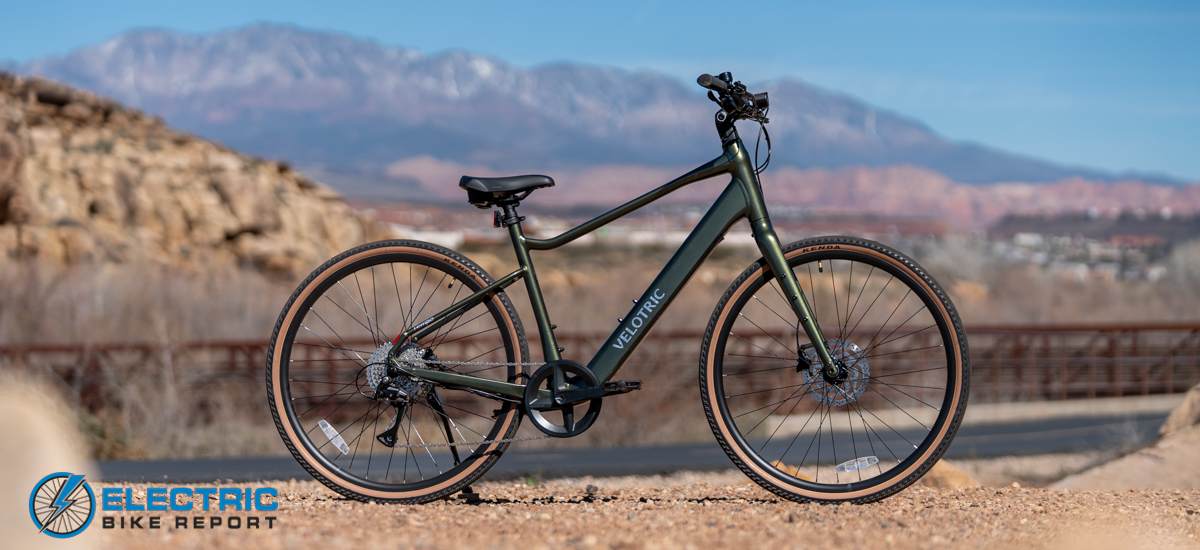
Some e-bikes do their best to mimic the look and feel of analog bicycles, offering smooth, subtle, and responsive pedal assist through a minimal user interface. In many cases, they’re tough to distinguish from their unpowered cousins—except, of course, that their motors elevate speeds and climbing performance to superhuman (or pro athlete) levels.
Others e-bikes take the Swiss Army Knife approach, with loads of features, controls, modules, settings, and points of adjustment. These models lean into their powered, electronic nature, existing as multifunctional tools with robust interfaces to enhance the lives and riding experiences of their users.
As a fully-loaded, fitness-focused e-bike with more ride tuning and customization options than you can shake a stick at, the Velotric Tempo attempts to occupy a balanced middle ground.
Many of these features are elements we’ve come to expect from Velotric, including the company’s SensorSwap function, which gives riders options for an active ride using a torque sensor or a chill, low-effort experience based on cadence sensor input. Some newer features from the brand are quick Class selection and personalized motor tuning.
The Tempo offers one additional feature not found on many other Velotric e-bikes: Pulse Mode. Once connected to the included heart rate monitor, this function automatically adjusts power output to keep you within your desired heart rate zone while riding.
We tested all of the bike’s features, its modestly-powered pedal-assist system (PAS), and its real-world speed, range, hill climbing, and braking performance during our review process. See below for a deep dive into our thoughts and experiences, as we help you decide if the Velotric Tempo is the right e-bike for you!

Sponsor
E-Bike Category:City/Urban
E-Bike Class:Class 1 (pedal assist to 20 mph)
Class 2 (throttle to 20 mph)
Class 3 (pedal assist to 28 mph)
Class 2 (throttle to 20 mph)
Class 3 (pedal assist to 28 mph)
Sponsor
Velotric Tempo Video Review
 Pros
Pros- The Tempo offers smooth, responsive power with an active ride, or steady, easily controlled output with little effort—you decide between torque & cadence modes.
- It has an impressively comfortable ride for a city bike, with relaxed geometry, a soft and supportive saddle, 700x42c tires, and soft rubber grips.
- Like all Velotric e-bikes, the bike is hugely customizable via the display or app. Tune motor output, switch Classes, set acceleration force, and more.
- While most city bikes are stripped down, the Tempo is loaded with uncommon features. It offers a throttle, cruise control mode, brake lights & turn signals, NFC card security, etc.
- It’s fitness-focused, including a heart rate monitor and Velotric’s helpful new Pulse mode to help you reach and maintain your target zone.
- The bike has some of the greatest range potential among city e-bikes we’ve tested, exceeding 70 miles in our testing.
- It likes urban and more adventurous environments! The Tempo includes versatile hybrid tires for efficient travel on paved paths and grip when riding off-road.
- There’s an option for nearly anyone, with multiple frame sizes / styles and a range of nice color options.
 Cons
Cons- We like the removable battery, but the Tempo’s power pack was creaky under hard pedaling; we encourage Velotric to add vibration damping.
ELECTRICAL SPECS & FEATURES
- Battery: 36V, 10.14Ah(374Wh), IPX7, Certificated by UL 2271
- Charger: 36V, 2A Fast Charger
- Display: 2.0″ Left-mounted full-color display with high brightness, Bluetooth, NFC
- Motor: 36V, 350W, 650W(Peak Power), 45Nm
- Headlight: 500 LM high-output integrated LED, adjustable angle
- Taillights:Brake highlight, turn signal
- Pedal Assist: 4 Riding Modes+Pulse Mode /Ride Tuning
- Claimed Range: Up to 60 miles
- Throttle:Trigger-control, removable
- App:Velotric App
- UL Certification:UL 2271 & 2849 certified
Weight & Dimensions
- Claimed weight: 39 lbs (including battery)
- Tested Weight: 42 lbs (including battery)
- Rider height range: 4’10” – 6’5”
- Total payload capacity: 330 lbs
Components & Accessories
- Brakes:Shimano hydraulic disc brakes with 180mm rotors
- Fenders: Not included
- Fork:6061 Aluminum alloy, internal brake routing, 12x100mm thru-axle
- Frame: 6061 Triple-butted Aluminum alloy frame
- Drivetrain: 8-Speed Shimano Acera, 46T chainring, 11-40T cassette
- Grips: Durable ergonomic grips, lockable
- Saddle: VELOTRIC ergonomic seat
- Handlebar: 670mm
- Kickstand: Aluminum Alloy, included, rear mount
- Pedals: Plastic Platform
- Tires: KENDA 700×42c eBike puncture resistant gravel bike tires

A heart rate monitor comes with the bike, allowing riders to engage Pulse Mode to reach and maintain target fitness zones.
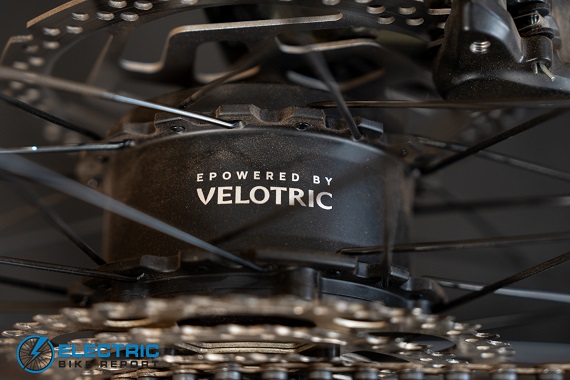
The Tempo’s 350W rear-hub motor is paired with both torque and cadence sensors riders can switch between.
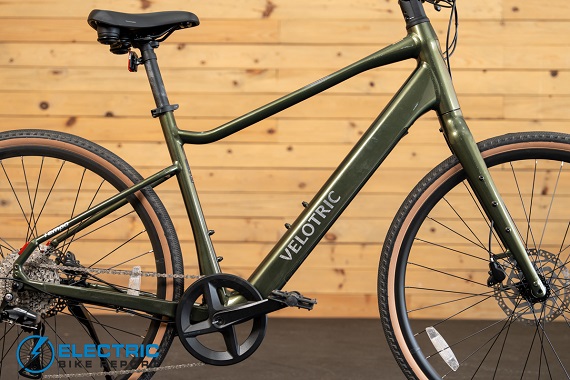
We tested the high-step frame, but Velotric also offers a mid-step model with different colors and a lower standover height.
Velotric Tempo Review: Speed Test
In the case of the Velotric Tempo, our speed test consisted of five components. First, two pedal tests in the bike’s torque-sensing mode, with my initial run in the bike’s Class 2 mode and my second in its faster Class 3 mode. Next, I repeated the Class 2 and Class 3 tests in cadence mode, tracking my average speed in each assist level throughout each test.
The final component of this test was an evaluation of the Tempo’s throttle acceleration. Before we discuss that, however, please reference the graph of my pedal test results above.
As shown, I started the test by riding without pedal assist, which was a relatively easy task considering the Tempo’s low total weight of around 42 lbs. As with most city e-bikes we’ve tested, riding without power feels akin to pedaling an analog bike; the Tempo’s gearing was more than adequate to make pedaling comfortable and efficient.
In the torque sensing mode, the bike’s four assist levels delivered measured jumps in smooth yet responsive power that gave me increasing returns for my pedal effort. The motor’s output in Eco felt light and natural, with the same feel of pedaling a non-electric bike running up through Sport mode.
Boost kicked the power up noticeably, though this was only really apparent in the Class 3 test. In the Class 2 riding mode, I reached the 20 mph ceiling in Sport, meaning that increasing the power level made no measurable difference when riding on flat ground; it’s possible that riding uphill would have felt easier.
In the cadence-based mode, the bike delivered steady power output as long as I kept the cranks moving; it was not dependent on pedal pressure. Each assist level had a pre-set speed limit at which the motor output would cease, making it easy to control my speed. As shown above, each mode had a low-power/low-speed mode (Eco), with three balanced, faster settings with incremental steps in pedal assist.
It’s worth noting that, in the Class 3 cadence test, the motor seemed to need a bit of help to reach the 28 mph limit. With the same relaxed pedaling I maintained throughout the rest of the test, the bike remained steady at around 25-26 mph. After putting in a bit of legwork to reach the Class 3 ceiling, the motor kept me cruising at that speed with lower effort.
As an additional caveat regarding these results, I tested the Tempo with its default programming. Owners can fine-tune the bike’s motor output via the display menu or the Velotric app (more on those later), adjusting the torque, assistance, and sensitivity of each of the bike’s four power levels.
Riders can also choose from three acceleration (or “experience”) settings, with separate adjustments for the throttle and pedal assist system. By default, the throttle engages with moderate strength, accelerating relatively gradually but steadily up to 20 mph.
I spent most of my testing time riding in Sport with torque-based pedal assist, but each mode has value for different riding styles and environments. Those wanting a fitness-focused experience might prefer Eco in the torque-sensing mode, while those seeking an invigorating but easy commute might opt for boost.
New riders hoping to get a feel for the bike without working hard may start with Eco or Trail in the cadence-sensing mode, while many riders encountering many hills will likely jump up to Boost for some added kick.
Overall, the bike’s default programming is a great starting point, with any minor critique being a matter of my personal preference instead of anything detrimental to the ride experience. The ability to tune and customize power output allows users to personalize how the bike feels and behaves, but the standard settings are well-suited for an active, fitness-oriented style.
Sponsor

The Tempo is ideal for riders who enjoy the active ride of a non-electric bike, just with less strain and more return for their effort.
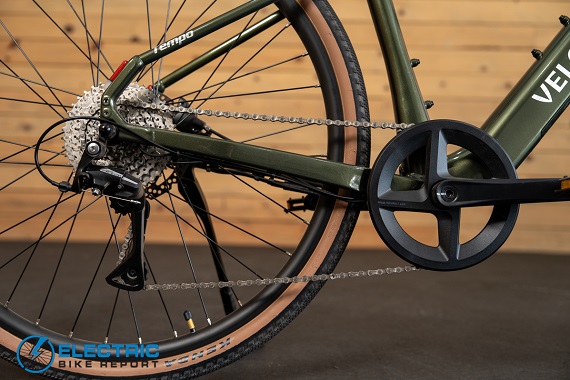
Velotric equipped the Tempo with a quality mid-tier Shimano Acera drivetrain that offers a wide gearing range.
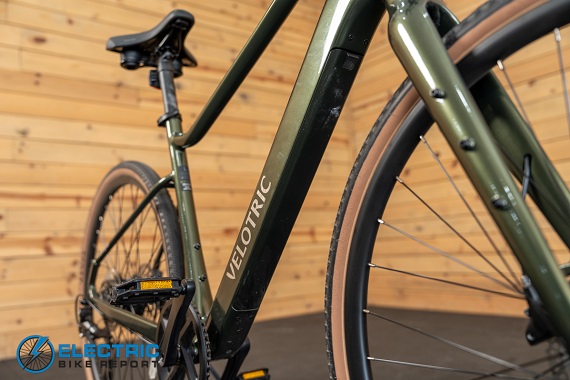
A fully-integrated 374 Wh battery sits tucked into the down tube and is removable for charging.
Velotric Tempo Review: Range Test
The Velotric Tempo gave an impressive performance in our Range test! Here, we used the process explained above to find its real-world minimum and maximum range from a single battery charge. Our test riders covered 22.1 miles using Boost and 72.4 miles in Eco, which is one of the longest distances we’ve recorded from a city e-bike.
A group of similarly-styled and equipped models, including many of the best urban e-bikes we’ve reviewed, covered an average of 27.2 miles using their highest assist levels and 53.1 miles using their lowest. This places the Tempo slightly below average in Boost, but significantly beyond the norm in Eco.
While the Tempo’s battery is a bit larger than average when compared to similar bikes (374 Wh vs an average of 361 Wh), the difference in results seems to be more a factor of motor output and energy efficiency.
By dividing each bike’s battery capacity in watt-hours (Wh) by its distance covered in miles (mi), we can see how much energy the bike used per mile. Our group of comparison e-bikes consumed an average of 6.8 Wh/mi in their low-assist tests and 14.2 Wh/mi in their max-assist tests.
The Tempo used just 5.2 Wh/mi in Eco, making it able to stretch the charge of its slightly larger than average battery for more miles. It used 16.9 Wh/ mi in Boost, which expended the battery’s charge somewhat faster than average in its highest-power mode.
Based on my testing, the Tempo’s feel mirrored its results. Eco felt helpful but relatively subtle—appropriate for a fitness-oriented e-bike—while Boost gave plenty of power for a fast, easy, and relaxing experience. The bike’s low-resistance hybrid tires may have given it a slight edge, offering a smooth central band of tread for efficiency on paved paths.
We tested the bike in its torque-sensing mode, which is naturally more efficient than its cadence mode due to its adaptive power output. We also used the bike’s default Class 2 mode, with a 20 mph maximum assisted speed, so riders using cadence mode and/or Class 3 settings should expect fewer miles.
Even in its highest power level, however, the bike should cover most round-trip commutes with a single charge. Its excellent energy efficiency in Eco should allow those taking extended exercise rides to get a great workout, while those taking shorter trips should expect a battery charge to last much longer.
The Tempo includes a 2A charger that takes around 5 hours to refill a depleted battery. As with all current-gen Velotric e-bikes, the bike’s display shows an estimated remaining charge time, making it easy to know when it is ready to ride once again.
Sponsor
Sponsor
Velotric Tempo Review: Hill Test
Continuing its trend of great performance, the Velotric Tempo met and surpassed our expectations in our Hill Test. As shown above, it posted a successful 3:29 throttle test, with an average speed of 8.7 mph. In Boost mode, our test rider shaved its climbing time down to 2:18 while maintaining 13.1 mph on average.
Starting with the Tempo’s throttle result, it is uncommon for a bike of this style to have a throttle (many are Class 1 e-bikes with pedal-assist only). Of those we’ve tested that are equipped with throttles, only a couple of models have completed this portion of the test.
Therefore, the fact that the Tempo reached the top of the Devil’s Backbone on motor power alone is noteworthy. It’s also one of the few e-bikes of any style with a 350W motor to finish the test.
Its Boost mode result is relatively average for the city/urban category, but nonetheless impressive. Similar models reached the top in 2:21, so with three seconds of difference, the Tempo’s result shows that it is appropriately specced to keep pace with (and potentially surpass) its peers.
For the sake of comparison, the main factors that affect performance in this test are a bike’s weight, peak motor power, and maximum torque output. The Tempo’s 42 lbs line up well with the style’s average of roughly 42.7 lbs. At 45 Nm, its torque output is slightly below the average of 49 Nm, while its 650W peak exceeds the 608W average.
These factors seemed to all balance out, allowing the Tempo to complete its throttle test and slightly outpace its competition in the pedal portion.
From firsthand experience at our secondary test location, Pilot Hill, I can reinforce our formal results. The throttle felt expectedly slow, but impressively capable. Pedaling to the top in Boost was much faster and more invigorating, though I never felt exhausted upon reaching the top.
I’d caution most riders that the Tempo’s throttle is best used for taking a break from pedaling or getting started when stopped at a traffic light. Based on Justin’s formal test and my experience at Pilot Hill, however, it did prove capable of at least contributing to uphill travel.
With a 350W rear-hub motor, riders should expect active uphill pedaling. Torque mode provides an engaging and responsive feel, while cadence mode offers a slightly more relaxed vibe.
In summary, the Velotric Tempo effectively reduces strain when tackling hills, making the experience enjoyable without being exhausting.
Sponsor
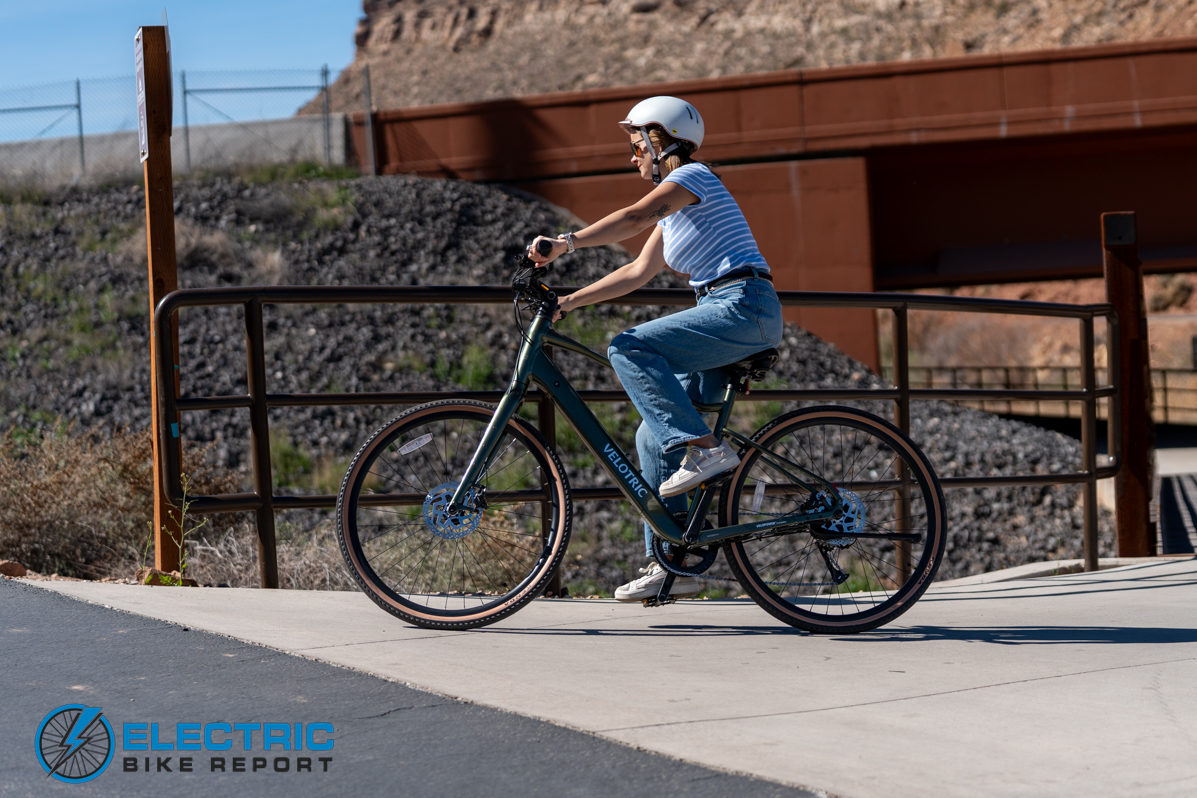
Riders can quickly switch between Class 1, 2, and 3 settings—or adjust heart rate zones in Pulse Mode—with the press of a button.
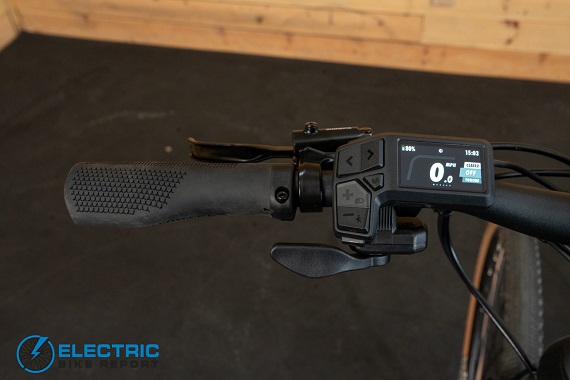
The bike’s throttle lever sits just below the handlebar-mounted display/control pad.
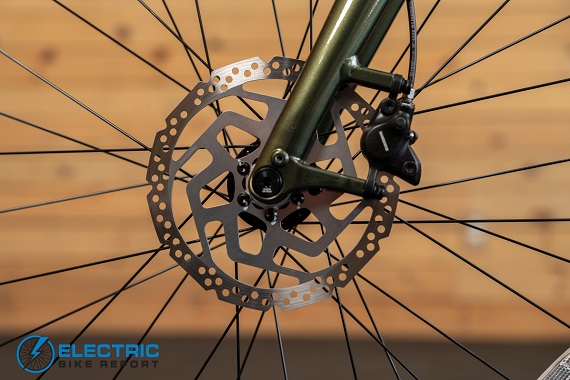
We found the Tempo’s braking performance safe and effective in our testing.
Velotric Tempo Review: Brake Test
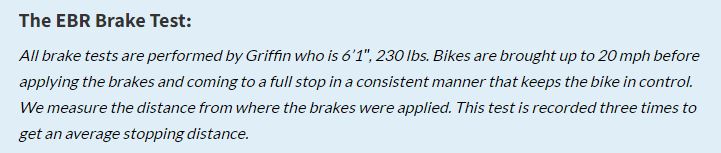
After three tests using the method above, we calculated the Tempo’s average braking distance to be 22’0”. This score surpassed the results of similar models we’ve tested (in performance, not distance), proving the Tempo to be well-specced and safe.
Velotric equipped the Tempo with Shimano’s MT200 hydraulic brakes, a two-piston system paired with 180mm front and rear rotors. This familiar setup offered good bite and modulation, making it easy to manage speed when braking on flats and when cruising downhill.
Hydraulic brake systems with 180mm rotors are becoming more common on city e-bikes, but many lightweight models still come equipped with somewhat less-effective 160mm rotors. Velotric chose well in equipping the Tempo with a capable, common, and controlled brake system that can meet and exceed the performance of similar e-bikes.
While this system should be easily serviced by bike shop technicians, it’s worth noting that Shimano recommends using its proprietary brake fluid to “maintain seal integrity.” This could make brake maintenance somewhat more expensive than when dealing with other brake systems that do not require a specific brand.
Based on the numbers, however, the tradeoff is worthwhile. The Tempo’s braking was strong, safe, and reliable, easily earning our approval.
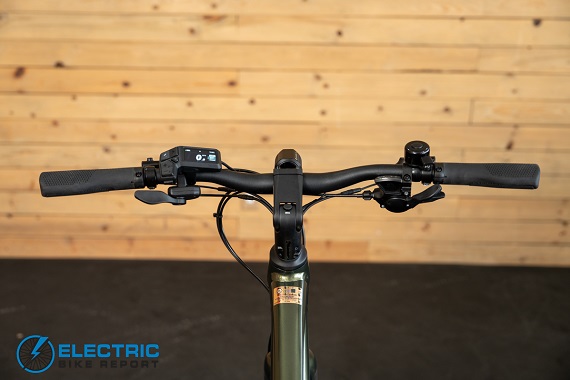
The cockpit strikes a nice balance between clean and functional.
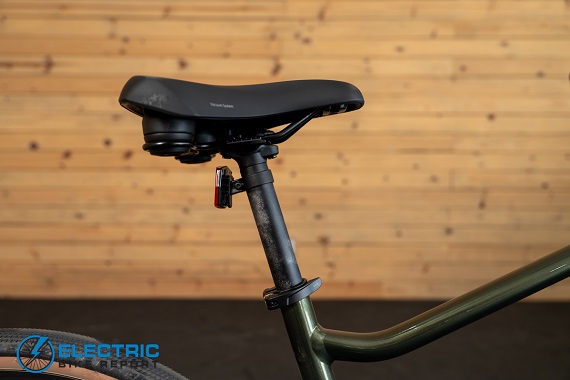
While relatively slim, the custom saddle is comfortable and well-padded.
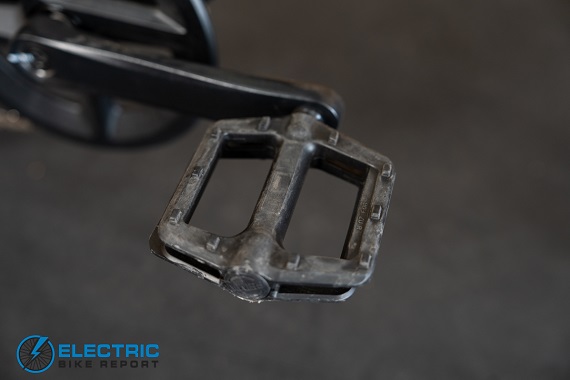
The Tempo includes plastic platform pedals.
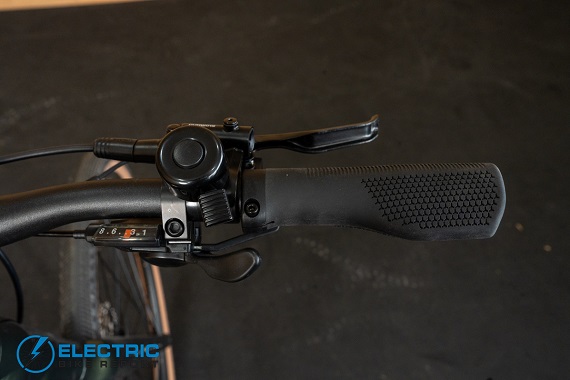
Soft lock-on ergonomic rubber grips keep your hands and wrists supported.
Velotric Tempo Review: Ride Quality
Ride quality is a summary of a bike’s overall feel. This is a complex blend of sizing, positioning, suspension, motor engagement, the user interface, and more. As you might imagine, the addition of an abundance of features and customization options makes the subject even more granular—though it’s also easy to say that the Tempo is well-rounded.
Sizing
Velotric offers the bike in multiple frame sizes and styles, with both a high-step and mid-step design in both a Regular and Large.
With a lower standover height, the mid-step frame is ideal for short/average riders; the Regular accommodates those from 4’10” to 5’5”, while the Large fits riders between 5’3” and 5’11”. The high-step is intended for taller riders, with the Regular intended for those between 5’1” and 5’9” and the Large for folks between 5’7” and 6’5”.
We tested the Large high-step frame, so my height of 5’11” placed me firmly in the middle of its range. I was able to set the saddle height for full and efficient leg extension. Additionally, I liked the default stem position, which placed me at a mostly upright posture, though riders can raise the bars or bring them closer with angle adjustments.
Ride Comfort
Overall, the Tempo felt remarkably comfortable, which is not something I can say about most city e-bikes that prioritize low weight over plushness. I found its saddle well-shaped and padded and its ergonomic rubber grips soft and supportive.
Like most similar models, the Tempo does not include a suspension, but these contact points, the bike’s frame, and its tires all seemed to help reduce impacts and vibrations. The addition of a suspension seatpost would soften the ride further, but I didn’t find myself missing suspension components when cruising paved roads, sidewalks, and paths.
Handling
As expected for a lightweight urban commuter/exercise bike, the Tempo handled sharply and responsively. Thanks to its rigid aluminum frame and fork, cornering felt crisp and steady, while normal cruising was lively, energetic, and stable. The end result is a bike that is fun, agile, and highly maneuverable.
Equipment
As I mentioned in the introduction to this review, the Velotric Tempo is nowhere near as minimalistic and stripped-down as many other city e-bikes on the market. While serious commuters may want to consider adding fenders and a cargo rack separately, the bike comes well-equipped for daily use with many uncommon features.
For starters, the integrated lighting system includes a bright 500-lumen LED headlight, and seat-stay-mounted tail/brake lights and turn signals—which I always appreciate for safety. The combination color display/control panel has a slight learning curve, but it’s bright, robust, and easy to read.
While many e-bikes in this category carry batteries fully sealed in their down tubes—not removable for charging—the Tempo features a more user-friendly removable battery. Under hard pedaling (the kind you do during fitness-centric rides), the battery/down tube creaked and groaned noticeably, so I encourage Velotric to add vibration damping material to reduce noise.
But finally, the Tempo also features hybrid tires that I’ve mentioned briefly above. These 700x42c Kenda tires feature a central band of smooth tread with small knobby shoulders, allowing for fast and efficient rolling on paved surfaces and the versatility to grip loose dirt or gravel when riding off-road. In my experience, they performed great on smooth dirt/gravel paths.
Integrated Tech
The Tempo’s integrated technology is one of its biggest strengths. As I mentioned previously, riders can switch between torque and cadence-sensing modes to drastically change the feel of the ride. Instead of forcing new riders to choose between e-bikes offering just one style of pedal assist, this ability allows the Tempo to adapt to changing preferences, uses, and environments.
Like nearly all of the brand’s models, the Tempo is compatible with Apple Find My™ technology, which can help owners to track its location and retrieve it in the event of theft. In similar fashion, the bike also supports Android’s Find Hub. I found the setup relatively quick and easy, offering peace of mind with the bike’s safety and security.
Speaking of security, a relatively new feature among Velotric e-bikes is the Tempo’s optional NFC card pairing/unlocking. While this system can’t prevent a thief from riding away with the unpowered bike, it can ensure that they won’t be able to turn the bike on or engage the pedal assist system—another welcome addition to such an investment.
Another new feature is the Tempo’s Pulse Mode, an optional riding mode that references your heart rate while using the included heart rate monitor arm strap. Fitness-minded cyclists can select their target heart rate zone via the control panel, then reference the display for guidance on how to maintain this level of effort. The bike also adapts power output to match.
Velotric App/Display
As I touched on previously, the Velotric app and the Tempo’s display menu both offer robust customization options over the bike’s feel and performance. Riders can use either to adjust the bike’s maximum speed/Class setting, switch sensor modes, and select from three “Experience” settings to adjust its acceleration force.
Those who are comfortable with experimentation and granular adjustments can also explore the Ride Tuning feature, which allows for adjustments to pedal assist power, torque, and responsiveness for each of the Tempo’s four PAS levels.
The Throttle Sync function offers an option that links the throttle’s speed to pre-set limits in each assist level—see the results of my cadence sensor pedal tests in the Speed Test section above for a better understanding of how this works. By default, this is set intuitively to be active in cadence mode, while allowing the throttle to reach 20 mph in all assist levels in torque mode.
There are additional personalization options for the automatic low-light sensors, the auto-off function, and even the brake light behavior. Altogether, these options make the Tempo one of the most customizable e-bikes of its kind that we’ve tested, though the list of things the bike offers continues.
Users of the Velotric app can use the “Start Riding” button to track rides and see a GPS map. Ride data can also be synced with Apple Health and summarized/broken down into various periods of time for fitness tracking.
Sponsor
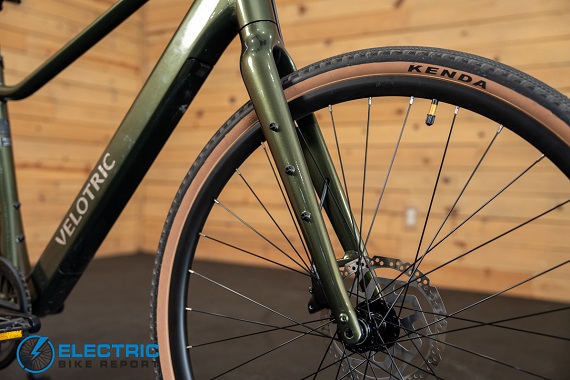
The Tempo’s handling is sharp and crisp thanks to its rigid fork and low total weight.
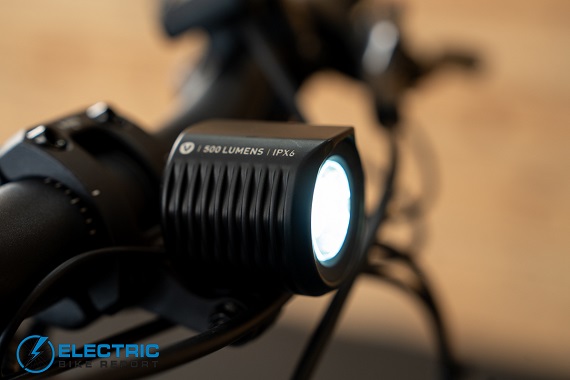
A 500 lumen headlight provides bright illumination in low-light conditions.
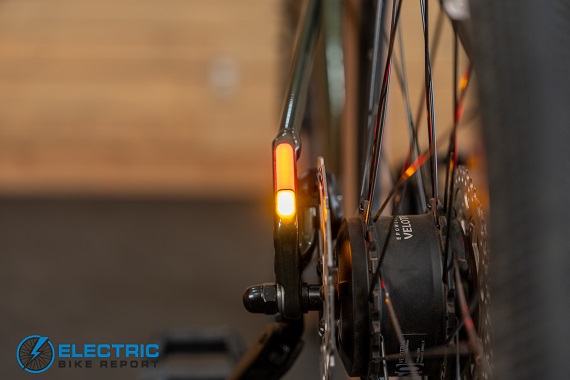
Tail/brake lights and turn signals are mounted to the Tempo’s seat stays.
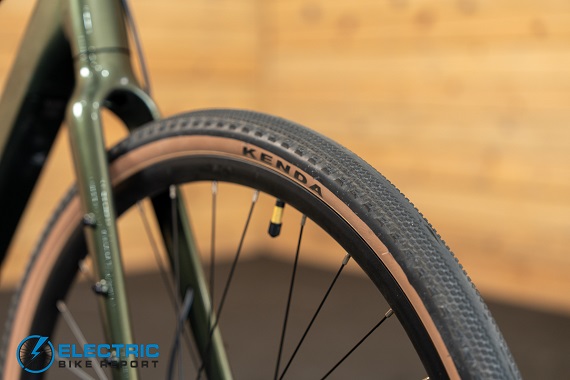
The 700x42c hybrid Kenda tires offer both rolling efficiency and off-road stability.
Velotric Tempo Review: Summary / Where to Buy
While we liked the model overall, Velotric’s last-gen city e-bike, the T1ST Plus, seemed to struggle somewhat in deciding what it wanted to be. Early versions offered a simple but comfortable experience, while later models built on that foundation and added more robust functionality. The Tempo feels like a redesigned, fully-realized evolution of the T1.
In short, it’s a city e-bike that wants to satisfy riders of all styles: daily commuters seeking a complete feature package without much weight, fitness enthusiasts looking to reduce strain without giving up their hobby, new riders who don’t want to be overpowered by a huge, heavy e-bike, and adventurous riders looking to explore smooth dirt/gravel paths and trails.
With a myriad of power levels, responsiveness settings, and riding modes to suit cyclists of all experience levels, ages, and styles, we can confidently say the Tempo succeeds. Its many frame sizes, styles, and colors only serve to expand its appeal—but the bike’s extremely competitive price point of around $1,500 is likely to be among its biggest draws.
Our only real point of critique revolves around the battery and its housing; we recommend that Velotric add some vibration-absorbing material inside the down tube to reduce or eliminate creaking while pedaling intensely.
That relatively minor concern aside, the Velotric Tempo is easy to recommend for fitness, leisure, daily travel, light off-road adventure, errand running, and beyond. It’s a remarkably customizable, uncommonly comfortable, robustly equipped, value-forward city e-bike with style. In our opinion, that’s a recipe for mass appeal.
Happy Riding! Make sure to let us know if you have any questions or if you think we left anything out in this review of the Velotric Tempo down in our comments section.
Sponsor
Sponsor
Reader Interactions
Comments
Leave a Reply




Great review – I am concerned about the clicking noise that you described – Have you been able to offer this feedback to Velotric – and if so would you know of any work around? This will greatly affect whether to purchase this bike at this time. Many Thanks !!
Great Review. What other bikes would you recommend to go test ride to compare to this?
Any update on the creaky battery housing while pedaling hard? A few reviews have mentioned the same thing.