New Legislation Supports Federal E-Bike Definitions, Bosch Allows 3rd Party Flow App Integration, CA Frame Part Supplier Closes | TWR Ep 77
Apr 06, 2026
 0 Comments
 Share
Share
Plus Blaupunkt Opens NC Factory, Aventon Level 4 REC vs Velotric Discover 3 Comparison, Our Best Hill-Climbers, & More!
This week’s e-bike news includes some hopeful steps toward better e-bike regulation, an update to a popular app, and the unfortunate closing of a California-based manufacturer.
A group of four bipartisan congressional representatives has introduced a new bill that could standardize e-bike definitions and classes at the federal level. The Safe SPEEDS Act is being backed by big names in the industry, but will it become law?
Bosch is now allowing third-party manufacturers to integrate content directly into their eBike Flow app. The company seems to be building a multifunctional hub for consumers, brands, and rental companies to streamline their technology use and operations.
Finally, the frame part manufacturer Paragon Machine Works is shutting its doors after 43 years of operation. Is this the latest casualty of high import taxes?
Continue reading the full stories below—or see our video/audio podcast above—for more information!
Sponsor
Sponsor
This Week’s E-Bike News Headlines
A New Bill Could Create Federal Regulations for E-Bikes & E-Motos
This bill, called the Safe SPEEDS (Standards for Personal E-Bike and E-Moto Device Specifications) Act, was introduced to Congress by a bipartisan group of representatives. Democratic representatives Jared Huffman and Dave Min from CA and Republican representatives Mike Lawler and Brian Fitzpatrick from Pennsylvania and New York, respectively, were involved.
According to an article from Bicycle Retailer, “the bill would direct the Consumer Product Safety Commission to gather and analyze data about incidents involving the many e-mobility products under its jurisdiction, and adopt clear classification and labeling requirements for these devices, including consideration of the three recognized classes of low-speed electric bicycles.”
So, in essence, the CPSC would study incidents where e-bikes, e-scooters, e-motos, and other devices were involved, then figure out how to divide them. Currently, e-bikes are categorized and regulated at the state and local levels, but this bill could establish the widely adopted 3-Class system at the federal level.
The Safe SPEEDS Act has gained support from many cycling groups, including People for Bikes, the League of American Bicyclists, and the National Bicycle Dealers Association.
It’s also supported by the Rails-to-Trails Conservancy, the Safe Routes Partnership, Consumer Reports, Advocates for Highway and Auto Safety, and others.
Jenn Dice, the president and CEO of People for Bikes, said, “The bill also directs the CPSC to adopt clear classification, age guidelines and labeling requirements for these devices, including consideration of the three recognized classes of low-speed electric bicycles.”
She continued, saying, “This legislation marks an important step towards understanding and mitigating the hazards posed by e-motos: higher speed electric motorized vehicles that are sold as electric dirt bikes, but often end up being inappropriately used on public roads by young riders.”
The bill also sets aside funding for law enforcement, emergency response services, and local-level governments to better track and report e-mobility devices. This data would then be collected and published by the CPSC, allowing for a broader understanding of how e-bikes and similar products are used.
Our Take:
Along with the cycling industry and other groups mentioned above, we strongly support this bill. Over the past year, we have reported on a number of states creating laws to regulate e-bikes, but these rules are far from consistent between locations.
Such inconsistencies make it more difficult for e-bike brands to ensure that their products are legal in all areas. They also make it harder for consumers to understand which e-bikes meet their wants and needs.
A federal level of regulation would help to standardize definitions. This would help e-bike companies by making bikes easier to produce without having to account for all the differences in various places. It would also better allow consumers to understand what they’re getting when making a purchase.
Bosch’s eBike Flow App to Synergize with Third-Party Content
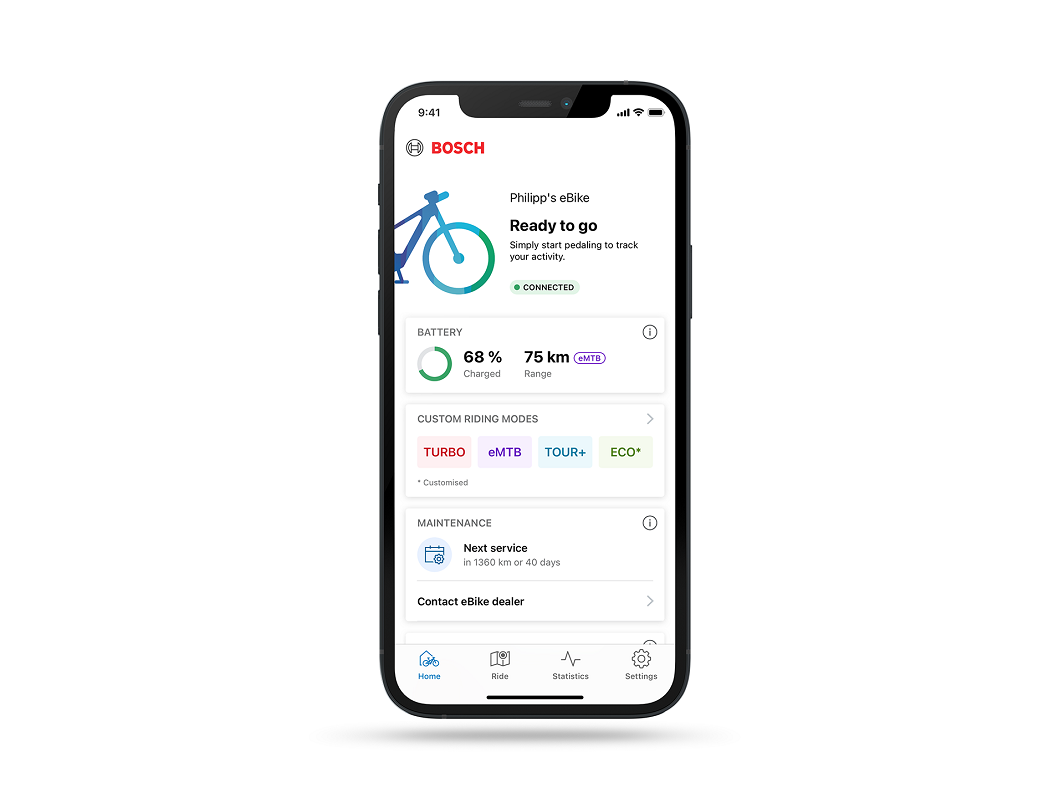
Image Source: Bosch
On March 24th, Bosch announced that it now allows third-party e-bike manufacturers to nest their apps or subscription services within its eBike Flow App. The company also now allows other apps and service providers to receive data from the Flow app.
As an example, the route-planning app Komoot is already connected to Bosch’s app, so users can access its functions straight through the Flow’s interface
Claus Fleischer, the CEO Bosch eBike Systems, said “Our Connected Biking platform is becoming a central component of the digital ecosystem around the eBike. We are creating opportunities for industry players to develop their own digital offerings. The first partners are already connected and are shaping connected eBike mobility together with us.”
Bosch’s ConnectModule is another central aspect of future app integration. This device can be attached to an e-bike and includes GPS, a SIM card, and motion sensors. The company also provides tools for third parties to use data from the Flow app or ConnectModule in their own software.
This connectivity will allow bike shops with rental fleets to monitor their status and location.
It will also allow manufacturers to access anonymized data about the use of their e-bikes.
A Cycling Electric article states that “Fleet operators can manage their e-bikes more efficiently and minimise breakdowns, leasing providers can transparently track the value retention of their models, and insurance companies can minimise damage risks.”
Our Take:
Over the past year, we’ve seen Bosch’s eBike division start to branch out a lot more—this shouldn’t be a surprise considering that the company also makes dishwashers and power tools.
For example, it invested fully in the aftermarket service and parts company Magura Bosch Parts & Services, which it previously shared ownership of with Magura.
These moves seem to indicate that Bosch is trying to integrate its technology as widely and in as many aspects of e-bikes as possible, making it an easy decision for retailers and consumers to use their products and services. This seems like smart business, but we’ll see how brands and Bosch e-bike riders respond as more third-party content pairs with the Flow app.
Frame Part Supplier Paragon Machine Works is Winding Down Operations

Image Source: The Radavist
Paragon, which is based in Richmond, California, was started in 1983. Throughout its 40+ years of operation, it has served the cycling community as a producer of frame components such as dropouts, headtubes, derailleur hangers, etc.
According to the Radavist, Paragon sent out an email on March 27th to its dealers, stating that it would be “ceasing all major operations, effective immediately. The business is no longer viable due to industry and economic forces beyond our control.”
The company followed this email up with a public statement saying that it would continue to make parts and ship existing inventory until its material stock runs out. Until that point, orders must be placed via the company’s website, and they will ship parts on Mondays, Wednesdays, and Fridays.
Paragon is working to find other vendors to take on at least some of its product lines to support customer demand. Additionally, it is either selling or sharing its intellectual property (including CAD, CAM, and CNC files), its CNC machinery and tooling, and its shop supplies and tools.
In its statement, Paragon stated that it is not able to process backorders. Sales going forward are final, but the company will refund any orders they can’t supply.
As a goodbye to the community, Paragon’s statement also read, “Thank you so much to our amazing staff and customers who’ve supported us through 43 years of innovation, challenges, and fun. It’s been a great ride, and we’re forever grateful.”
Our Take:
Since the expiration of the Section 301 tariff exemption on e-bikes in June of 2024, we have often discussed the impact of tariffs. While Paragon’s statement did not outright attribute its closure to tariffs, it is possible that this development is further evidence of their harm.
Tariffs have been touted as beneficial to domestic manufacturers, ideally setting up independent US-based businesses, like Paragon, for success. They are meant to encourage domestic production and consumer reliance on US-based companies—but unfortunately, we haven’t seen much of that happening. Instead, the list of companies closing their doors has grown once more.
Sponsor
You Asked, We Answered. Questions Covered In The Weekly Recharge
- Which bike has the fastest hill climb result at our test location, the Devil’s Backbone?
- What is a realistic budget-friendly price range for electric tricycles?
- Is the Aventon Level 4 REC’s cooldown feature a benefit or a hindrance?
- How does the Level 4 REC compare with the Velotric Discover 3?
E-Bike Deals Found This Week
- Ride1Up’s Spring into High Gear Sale on Revv 1 e-bikes
- Revv 1 FS – fast, comfortable, well-equipped moto-style e-bike – $400 off, down to $2,095
- Heybike’s Spring E-Bike Sale
- Mars 3.0 – powerful & responsive full-suspension folding e-bike – $1,300 when we reviewed it, now going for $1,199
- Alpha – powerful, affordable mid-drive fat-tire e-bike – just $1,299
Make sure to tune in to the full episode to see the e-bike trail system highlight and rider of the week! Want to be featured in future episodes? Comment on any YouTube video or page of the website, or send to [email protected].
Sponsor
*Please help support our efforts at Electric Bike Report. We work hard to provide the highest quality content, news, and reviews for our readers – and our sponsors make all of this possible. Please visit our sponsors from their ads on our website and let them know that you appreciate what they do for the e-bike industry and Electric Bike Report
Sponsors
Sponsor
Reader Interactions
Leave a Reply