Salsa Notch C (GX Eagle Transmission) Review | Take It Up A Notch
Feb 06, 2026
 0 Comments
 Share
Share
The frame and motor are the stars, with terrific performance from a supporting cast of top-tier components. The Notch C is a composed machine that can tackle the toughest downhill lines.
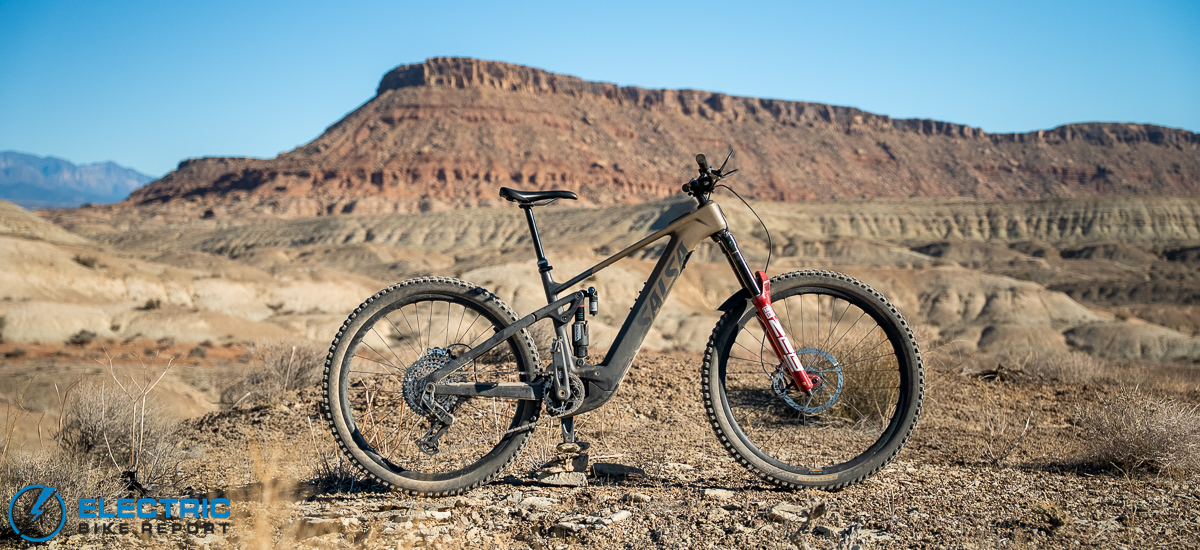
The Salsa Notch eMTB is a big bike built for big, adventurous rides. It’s equipped with a murderer’s row of tech designed to let you get as rowdy as you want, starting with 170/180mm of top-tier RockShox suspension and a split-pivot platform that keeps braking confident without interfering with suspension performance. Add in the sharp-stopping Maven brakes and a stable, precise frame that’s built to plow through chunk, and the Notch starts to feel like a downhill weapon at heart.
But what about the climb back up? It handles that just fine, too. The latest Gen 5 Bosch CX motor jumps out of the gate with 85Nm of torque, and if that’s not enough, you can custom-tune it up to 100Nm to charge the steepest grades. You don’t have to worry about wearing down the transmission with that power either. The GX Eagle Transmission manages shifts electronically, delivering precisely timed gear changes even under load.
This is undeniably a big build. The frame feels confident and planted, but sizing does run large. Be sure to study the sizing chart carefully, as our tester landed in one of the largest medium sizes we’ve seen.
Value is always a tricky conversation at the premium end of the market, but with a carbon frame, bar, and wheels paired with truly top-shelf components, it’s hard to complain about how much bike you’re getting for the money in today’s climate. The ability to convert this over to a dual-crown DH monster is the cherry on top, too.
Salsa’s ride quality is, well, top Notch. It’s a bike for riders who like their trails the way they like their salsa: picante.

Sponsor
E-Bike Category:eMTB
E-Bike Class:Class 1
Sponsor
Salsa Notch Video Review
 Pros
Pros- Bosch CX Line motor performs great. Power for uphills, smooth integration with pedaling.
- Frame design. Burly build meant for Enduro and downhill riding. The carbon design is rock solid and has flip chip adjustability.
- Value for what you get. Top tier suspension and transmission, full carbon setup, and under $9K where many similar builds are charging $10k+
- Split Pivot design. Optimal performance from the suspension and brakes, with the ability to finetune and alter your suspension if you want to upgrade to a coil shock.
- Heavy duty application, relatively light
- Powerful brakes. The SRAM Maven’s have terrific bite for quick and effective braking.
- The bike can add on the Bosch Powermore 250 for another 40% battery capacity
 Cons
Cons- Sizing runs large. Consult the sizing chart carefully before committing.
- Battery is on the small size these days, but it keeps weight low, and the system is range extender compatible if you need more capacity.
ELECTRICAL SPECS & FEATURES
- Battery: Bosch PowerTube 625Wh lithium ion
- Charger: Bosch standard 4A, 110V, smart system
- Display:
- Motor: Bosch Performance Line CX, 20 mph / 32 km/h max assist (25 km/h max assist in EU and APAC), 750W max, 100Nm max torque (600W, 85Nm standard)
- Headlight:No
- Taillights:No
- Pedal Assist:Eco, Tour, eMTB, Turbo (Smart systems offers customizable mode settings via the Bosch Flow App)
- App:Bosch Flow
- UL Certification:2849, 2271
Weight & Dimensions
- Claimed weight: 49 lb 2 oz (MD frame)
- Tested Weight: 49.34 lbs (size M)
Components & Accessories
- Brakes:SRAM Maven Ultimate Stealth, SRAM HS2 (6-bolt, 220mm front and rear)
- Fork:RockShox ZEB Ultimate, 180mm
- Shock: RockShox Vivid Ultimate, 170mm
- Linkage: Split Pivot
- Frame: Carbon, 4 sizes
- Drivetrain: SRAM GX Eagle Transmission, 10–52t, 12-speed
- Grips: WTB Wavelength
- Saddle: WTB Solano, Medium, Steel SL, Fusion Form
- Seatpost: TranzX REVERSE, SM: 160mm travel; MD: 180mm travel; LG–XL: 210mm travel
- Handlebar: Salsa Guide Carbon, 810mm
- Cranks: SRAM GX Eagle E-MTB ISIS Arms w/ SRAM XX 34t T-Type Direct Mount Chainring. MRP 1x CS2 32-36t chainguide for Bosch BDU38
- Wheels: WTB CZR Carbon i30, 32h
- Tires: Teravail Kessel 29×2.5″, Durable Plus casing, WTB TCS Sealant included F/R
- Hubs: WTB HTZ, 15x110mm front, WTB HTZ, 12x148mm
- Spokes: Double-butted, black
| Metric (mm) | S | M | L | XL |
|---|---|---|---|---|
| Head Tube Length | 95.0 | 100.0 | 110.0 | 120.0 |
| Head Tube Angle | 63.4 | 63.4 | 63.4 | 63.4 |
| Effective Top Tube Length | 590.2 | 612.1 | 633.8 | 655.6 |
| Seat Tube Length | 405.0 | 430.0 | 455.0 | 480.0 |
| Seat Tube Angle | 78.9 | 78.9 | 78.9 | 78.9 |
| Stack Height | 628.4 | 632.8 | 641.8 | 650.7 |
| Reach | 466.3 | 487.4 | 507.3 | 527.3 |
| Chainstay Length | 444.1 | 444.1 | 444.1 | 444.1 |
| Wheelbase | 1260.5 | 1283.8 | 1308.2 | 1332.7 |
| Standover Height | 748.3 | 746.9 | 746.9 | 746.9 |
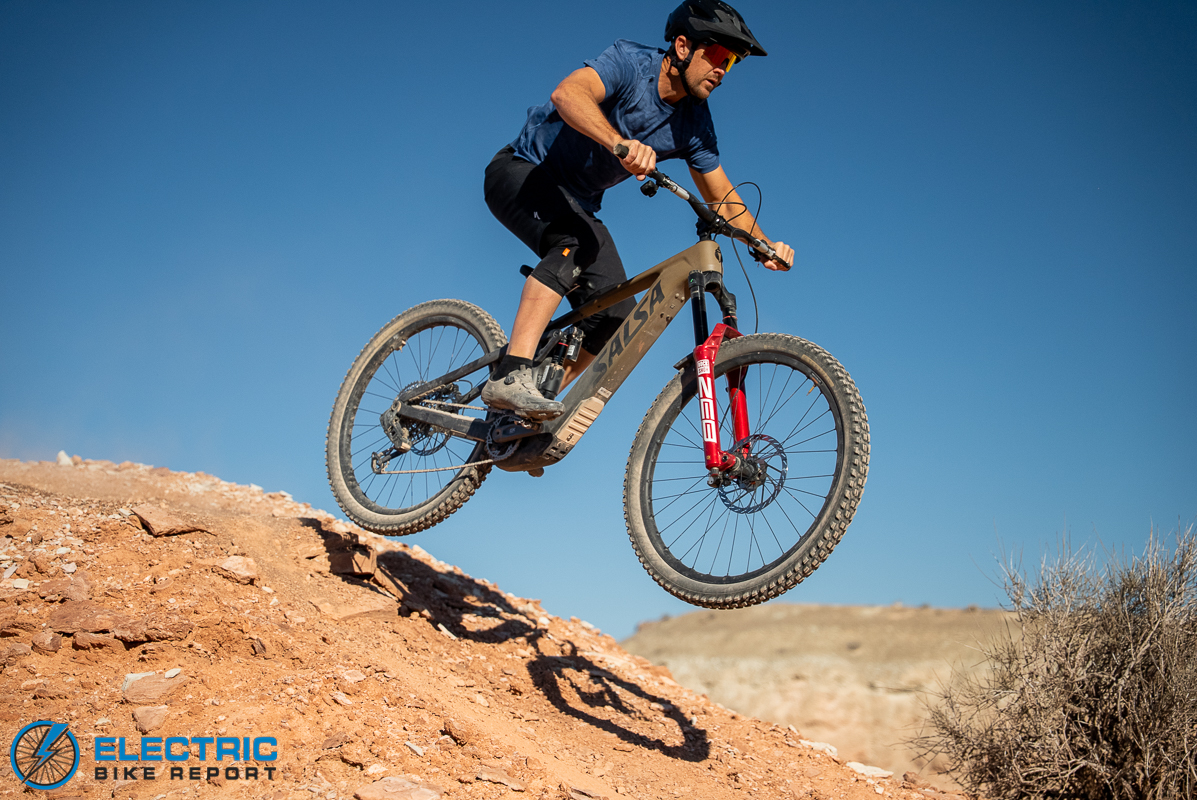
The Notch C in its element.
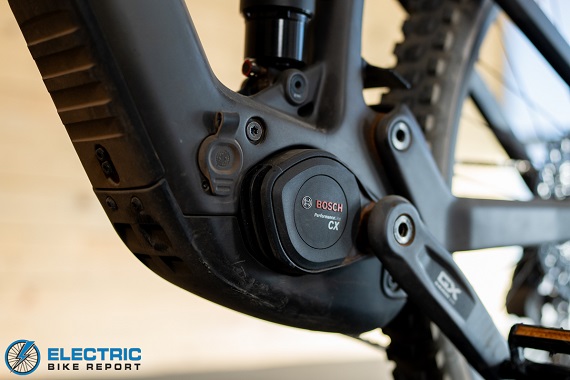
Bosch’s Performance Line CX Gen 5 motor delivers up to 100Nm of torque for serious climbing muscle.
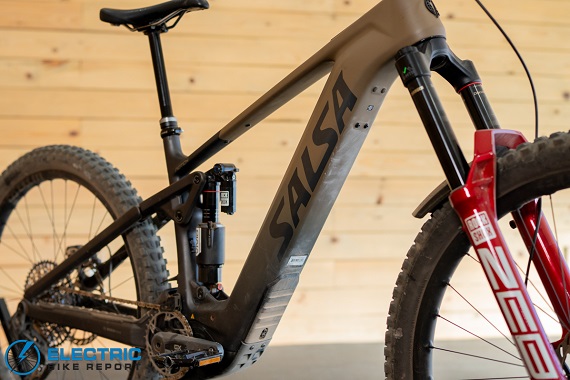
The 625Wh battery doesn’t bulk up the downtube too much, letting the aesthetic of the ride shine.
Salsa Notch Review: Motor & Battery
The Bosch CX motor remains a top performer. Now in its fifth generation, it’s a well-dialed system that delivers a consistently strong riding experience. Bosch’s “uphill flow” tagline isn’t just marketing either. Climbing still doesn’t match the thrill of pointing downhill, but the motor is tuned in a way that lets you find a real rhythm when charging uphill, especially on smoother terrain.
The bike also handles technical climbs well. I’ve ridden Bosch systems for years and appreciate the small amount of overrun that helps you finish moves over obstacles. Riders new to the platform tend to adapt quickly, and that predictability goes a long way when traction and timing matter.
One of the more interesting updates here is the expanded power tuning. Out of the box, the motor is set to 600 watts of peak power and 85Nm of torque. Bosch calls this the sweet spot, and for many riders, that will be true. At the same time, Bosch clearly recognizes the growing demand for higher output. Through software, you can unlock up to 750 watts of peak power and 100Nm of torque. The difference is noticeable. Personally, I’m comfortable riding in either configuration, though the higher setting takes a bit of adjustment to avoid overshooting lines on punchy sections. As always, more power comes with a tradeoff in range, so it’s worth dialing things in based on what you actually need.
The 625Wh battery is on the smaller side by current full-power standards, where 720Wh packs are becoming more common. In this case, smaller isn’t necessarily a drawback. The bike is clearly trying to keep overall weight under the 50-pound mark, which our test bike managed without pedals. The battery still delivers solid range in practice, and it’s compatible with Bosch’s Powermore range extender. For longer days, adding the 250Wh extender boosts capacity by roughly 40 percent, though it does take the place of your bottle cage.
Sponsor
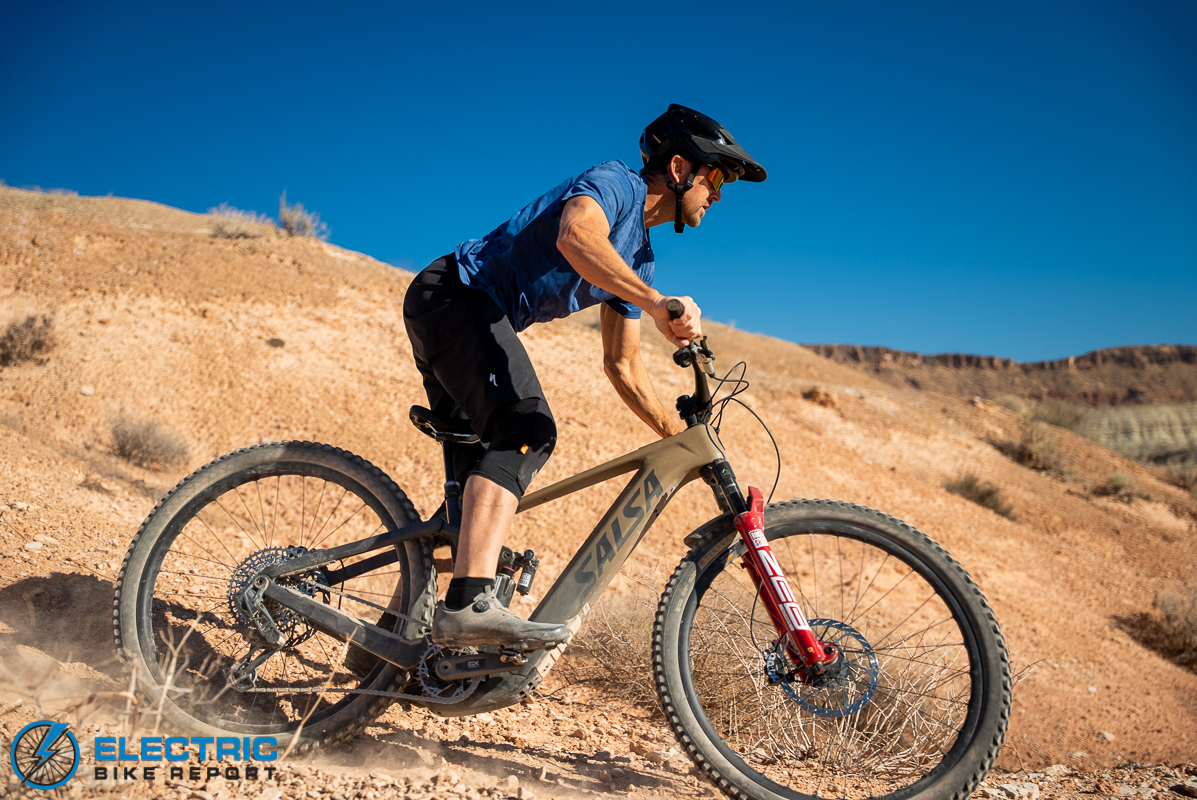
Rocky, rooty, whatever-y, the Notch C stays composed over most anything.
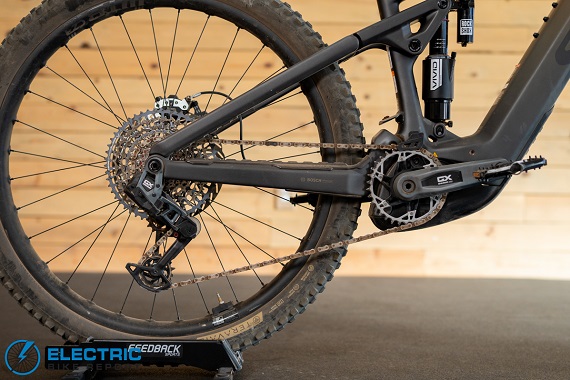
444mm chainstays help give the bike some nice maneverability.
insert caption
Salsa Notch Review: Display & App
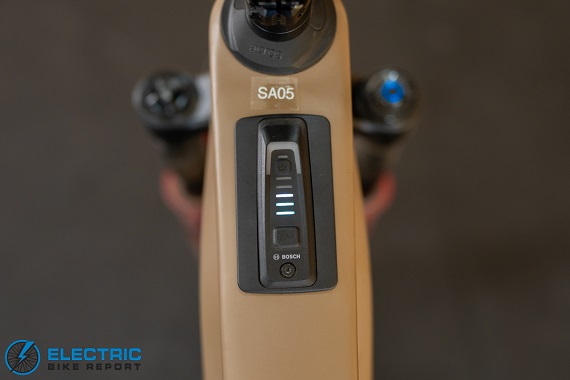
The Bosch ecosystem is clean and refined, and on the Notch, Salsa chose a minimalist approach with just the system controller and mini remote. There’s no large or frame-integrated display here. On a premium bike, I’ll admit I usually appreciate premium niceties, so I was a little bummed to skip a screen. That said, once I’m in the flow of a ride, I rarely look at a display anyway, so the clean setup makes sense.
The controls are responsive enough, though I do wish the buttons were just a bit larger. Still, it’s easy to bump power levels up or down on the fly. The controller uses LED bars to show remaining battery in broad increments, and for more detailed information, the Bosch Flow app fills in the gaps.
In the app, you get a more precise battery readout along with the ability to customize all four ride modes: Eco, Tour+, eMTB, and Turbo. You can adjust things like response, peak power, and torque to better match your riding style. It’s also useful for tracking how much time you spend in higher assist levels if you’re trying to manage range more deliberately. Ride planning and Strava syncing are built in as well.
Overall, the Flow app is one of the better motor ecosystems I’ve used. And if you really miss having a display on the Notch, a simple phone mount turns your smartphone into a fully featured screen with far more data than most dedicated bike displays. Let’s be honest, most of us are riding with our phones anyway.
Sponsor
Sponsor
Salsa Notch Review: Range Test
To test range, we used our local loop that mixes green, blue, and black singletrack. In real-world riding, most people vary assist levels throughout a ride, but to establish a clear baseline, we run the entire course in Turbo. In this case, that meant the motor set to its maximum output with 750 watts of peak power and a 100Nm torque limit.
On the Notch C, I recorded 24.9 miles of range while climbing 1,760 feet of elevation. That’s a respectable result for a 625Wh battery.
A 625Wh pack sits slightly below today’s full-power average. It’s not small by any means, especially considering my last two eMTB reviews used 360Wh batteries, but many brands are moving to larger packs to offset rising motor power. The tradeoff is added weight and higher cost. Salsa chose a balanced approach here, keeping weight and price in check while still offering solid capacity.
The battery works efficiently with the Bosch motor and the rest of the lightweight carbon build. Broken down by efficiency, the bike averaged 25.2 watt-hours per mile, which is nearly two watt-hours per mile better than the eMTB class average we’ve tested. In other words, it’s making very good use of the energy it has available.
In practice, most riders should find the Notch C delivers plenty of range for longer rides. With more typical usage that leans on mid-level assist and taps into Turbo only when needed, you could realistically stretch that distance close to double our Turbo-only result.
For riders with consistently high power demands, Bosch’s Powermore range extender is worth considering. The additional 40 percent capacity would push total range to at least 35 miles based on our test data, making it a solid upgrade for bigger days in the saddle.
Sponsor
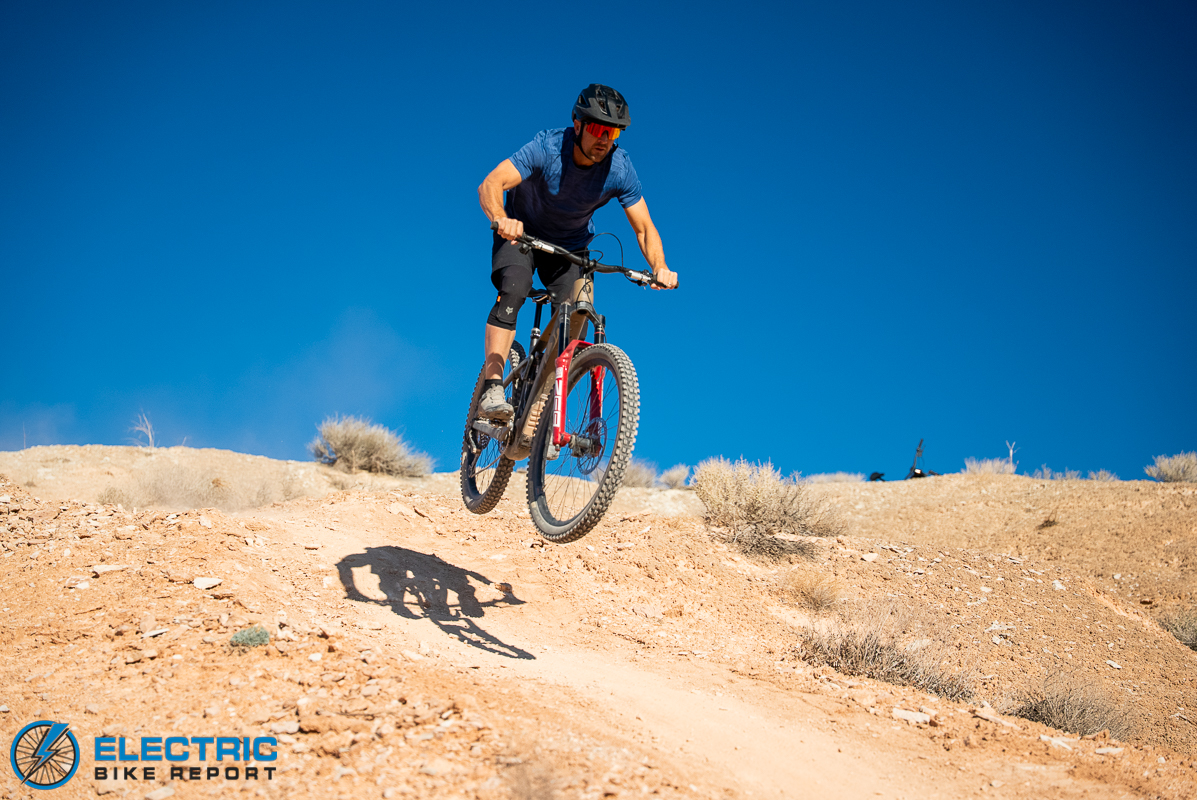
The Notch’s lightweight carbon build has some serious benefits.
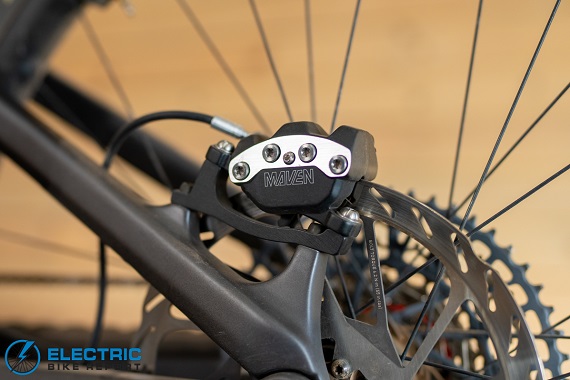
SRAM Maven Ultimate brakes offer serious stopping power.
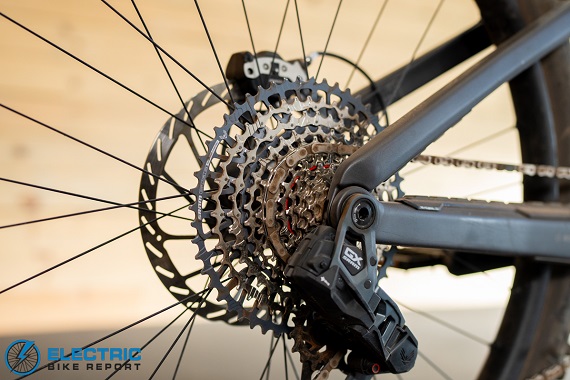
The GX Eagle Transmission’s 10–52T range keeps you spinning efficiently across steep climbs and fast descents.
Salsa Notch Review: Hill Test
All eMTBs we review go through two hill climb tests. The first is our standard benchmark at Devil’s Backbone, which we use across all bikes. The second is our eMTB-specific proving ground at the Water Tower climb.
At Devil’s Backbone, the Notch C posted a climb time of 1:55 with an average speed of 15.8 mph. That ranks as one of the fastest eMTB results we’ve recorded on this hill since establishing the test nearly a year ago.
On the Water Tower climb, which has been part of our testing program for a couple of years now, the Notch C delivered the fourth-fastest time we’ve ever recorded. It completed the climb in 3:19 with an average speed of 15.7 mph.
We’ve tested the Gen 5 Bosch motor several times at this point, and consistency continues to be its calling card. Unsurprisingly, it delivered its best showing yet here, helped by the full carbon build and relatively low overall weight.
Riding a longer-travel bike like this really highlights how much motors have changed mountain biking. A 170/180mm bike would be a slog to pedal uphill on a traditional setup, where geometry and travel can work against you. With a motor this capable, the climb becomes part of the fun and leaves you fresher and more ready to enjoy the descent.
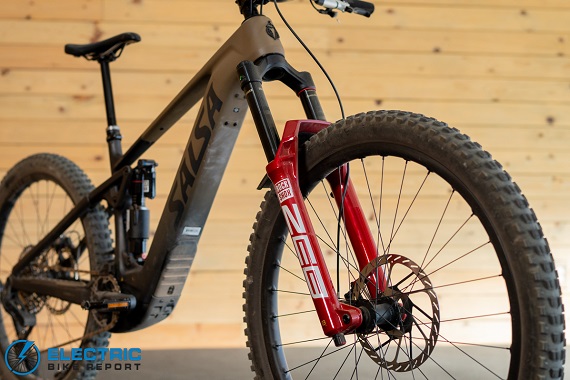
Not only does the Zeb Ultimate fork do a great job, it adds a pop of color to the earthtones of the bike.
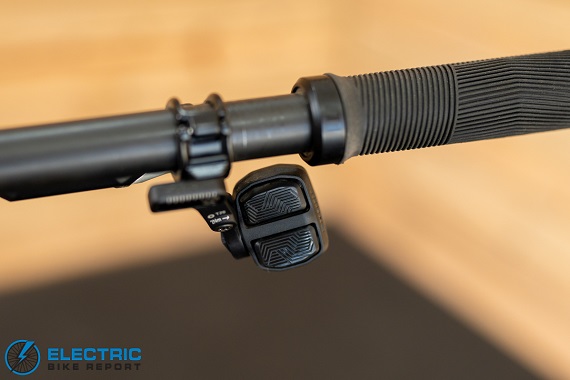
The SRAM AXS pod shifters can be programmed to suit your shifting preferences.
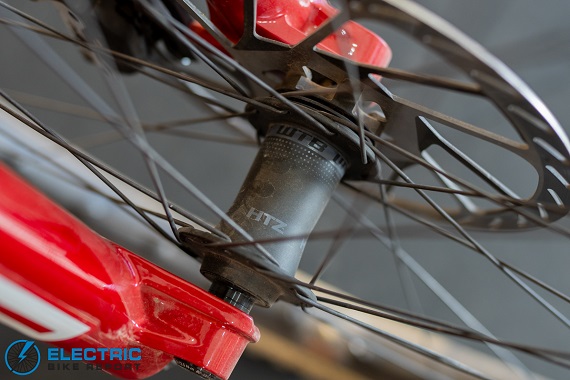
WTB HTZ hubs to go with the WTB wheels.
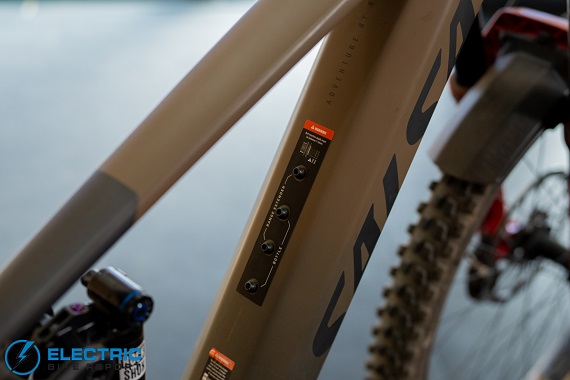
Bottle cage or range extender fits within the triangle.
Salsa Notch Review: Ride Quality
The Notch C earns its name, with the “C” standing for carbon. The frame, handlebar, and wheels are all carbon, giving the bike a stable, vibration-dampening, and lightweight foundation. From a performance standpoint, it’s an excellent starting point and helps keep the usual weight penalties of an eMTB from becoming a major complaint.
Salsa’s split-pivot rear suspension design plays a big role in how the bike rides. By allowing braking and suspension forces to operate independently, the system delivers strong control and consistency. The overall ride feel is firmer than I initially expected, but not harsh. With some tuning, it’s easy to find a sweet spot. The suspension leans more supportive than plush, which works in the bike’s favor when grinding through technical climbs without excessive sag, then charging downhill on a platform that feels stable and predictable.
The RockShox suspension setup is a strong match for the bike’s geometry. All that travel, combined with the frame design, gives the Notch a true enduro personality. It feels comfortable railing steep descents while staying composed through corners. The stock 170/180mm setup is more than enough for our local terrain, but the platform can be pushed even further if you want. The bike is compatible with up to 200mm of travel and a dual-crown fork for riders chasing a more downhill-focused build.
The split-pivot design also pairs well with the braking system. Keeping the suspension active under braking is only part of the equation, and the SRAM Maven brakes deliver the stopping power to match. This is the year I’ve fully come around on what Mavens bring to the table. They’re extremely powerful and inspire confidence when things get fast, steep, or unpredictable and you need quick, controlled stopping.
The GX Eagle Transmission remains a favorite here at Electric Bike Report. Electronic shifting isn’t a necessity, but it’s a genuine luxury on an eMTB. More importantly, it’s practical. The system manages shifts under load, helping ensure the Bosch motor’s high torque doesn’t prematurely wear chains or cogs.
The bike rolls on full 29-inch wheels with Teravail Kessel tires, which feel rugged and offer solid grip across a range of conditions. If you prefer a mullet setup, the Notch is mixed-wheel compatible with a 27.5-inch rear wheel. A flip chip allows you to make the necessary geometry adjustments to match that configuration.
The 444 chainstays with 27.5-inch rear would give you a fairly maneuverable setup. As is with the full 29-inch tires and the bike’s fairly long wheelbase, it’s more of a blanted experience, but one that feels relatively light and agile for it’s size.
Sponsor
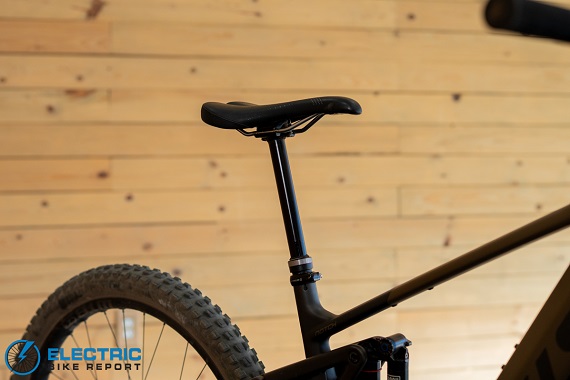
160-210mm of travel depending your frame size.
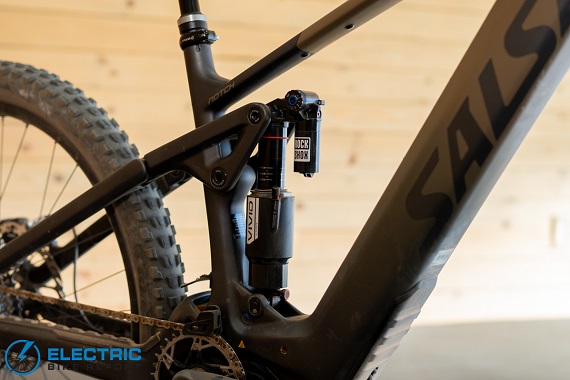
The suspension isn’t the most plush, but it’s not harsh either. It’s more about keeping things composed when trails got rough.
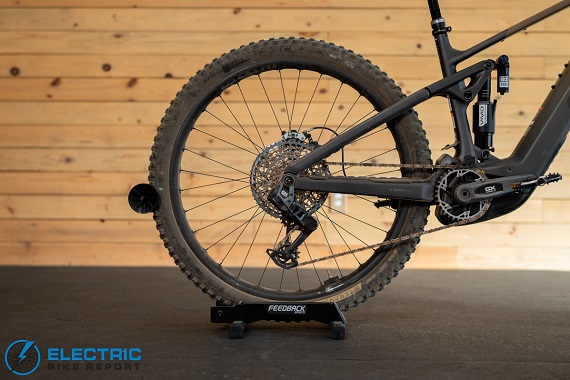
A full 29” rear wheel, but it can be ran as a 27.5” with flip chips adjustment for optimization.
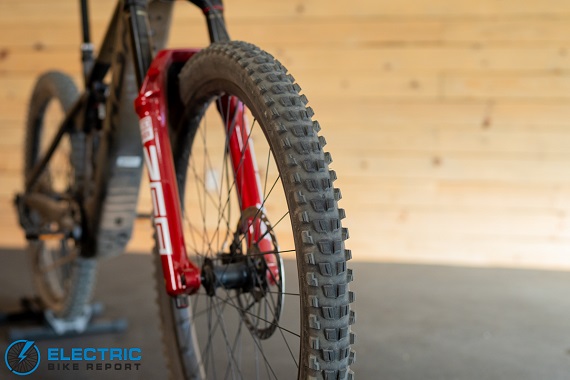
Travail tires were perfect for this bike. Good blend of grip, speed, and balance.
Salsa Notch Review: Summary / Where to Buy
After spending time on the Notch C, it’s clear this is a bike that knows exactly what it wants to be. It’s unapologetically big, confident, and aimed squarely at riders who prioritize descending performance but don’t want to dread the climb back to the top. Salsa didn’t try to soften or water this bike down. Instead, they leaned into what modern eMTB tech does best and built a machine that feels composed, capable, and intentionally aggressive.
The ride quality reinforces that focus. The supportive suspension tune, split-pivot design, and long-travel RocksShox setup give the Notch C a planted, predictable feel when things get fast or rough. It’s not the plushest ride out there, but that firmness works in its favor, especially when pushing hard through technical climbs or loading the bike into corners on the eway down. The carbon frame, wheels, and cockpit help keep weight in check, which goes a long way toward making this feel like a true performance build rather than a freight train.
Bosch’s Gen 5 performance Line CX motor is a big part of what makes the Notch C work so well. The power delivered feels natural, predictable, and strong, in either standard tuning or tapping into higher levels of power. The GX Eagle transmission helps handle all the torque and shift with ease, letting you focus on line choice instead of mechanical sympathy. It’s a setup that feels refined and purpose-built for aggressive eMTB riding.
Value is where the Notch C becomes even more compelling. In a segment where prices climb fast, Salsa delivers a full carbon build with top-tier suspension, brakes, and drivetrain for under nine grand. Sure, that’s not cheap, but it’s competitive for what it is if you want a no-compromise enduro/downhill machine, and it keeps you out of five-figure territory.
If your idea of a good ride involves technical climbs, aggressive descents, and pushing your limits without getting beaten up in the process, the Notch C is built to be ridden exactly that way.
Happy Riding! Make sure to let us know if you have any questions or if you think we left anything out in this review of the Salsa Notch down in our comments section.
Sponsor
Sponsor
Reader Interactions
Leave a Reply