

Mokwheel Onyx Review | A Bike Full of Surprises
Jan 24, 2026
 2 Comments
 Share
Share
The Mokwheel Onyx is a powerful, confidence-inspiring bike built around muscle rather than outright speed. Its motor favors brute strength over quick-twitch acceleration, and the suspension helps encourage rides that wander off the beaten path.
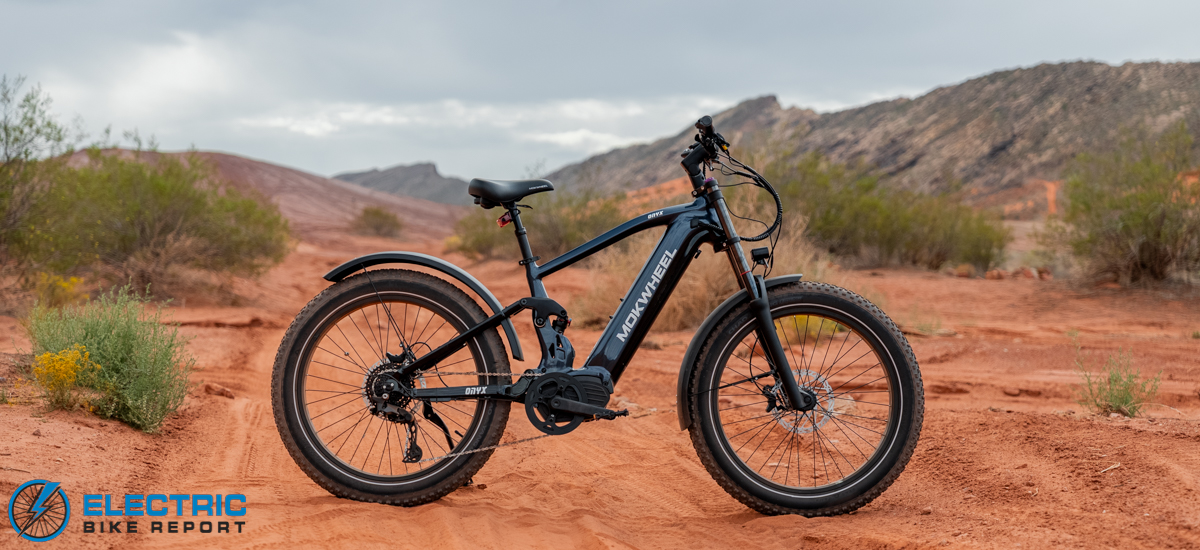
Mokwheel is a staple in the fat tire community, but the Onyx is the burliest build we’ve seen from the brand to date. It draws attention with the highest-torque motor our review team has ever tested, a full-suspension setup capped with a dual-crown fork, and a handful of thoughtful tech and component upgrades. Overall, it largely sticks the landing on its goal of being a powerful, go-anywhere, do-anything machine, though there’s still a little room for refinement.
Strong motors aren’t hard to come by, but a mid-drive capable of 1300W peak output and a staggering 210Nm of torque is rare territory. Power is often confused with speed, and while the Onyx can move quickly, its real focus is raw muscle. The tuning prioritizes climbing ability, letting riders grind their way up just about anything with steady, determined effort.
Mokwheel has long championed full-suspension fat tire bikes at relatively approachable prices, but the dual-crown fork is a new move for the brand. Its performance is solid and arguably more about visual impact than unlocking entirely new capabilities, yet it still works well in concert with the rear shock, oversized tires, and adjustable stem to create a comfortable, confidence-boosting ride platform.
The frame feels stout and well-built, particularly around the four-bar linkage. You’ll also find nicer components than we typically see on fat tire e-bikes, including four-piston hydraulic brakes with large 203mm rotors, a Shimano CUES drivetrain that pairs well with the high-torque motor, and a unique stem-mounted display that delivers a crisp, high-definition experience. Like other Mokwheel models, it also supports solar panel or power inverter hookups for charging external electronics.
It’s undeniably a bulky ride, and while the fork does its job, it comes with some limitations. Still, the Onyx stands out as a unique option with strong appeal for outdoors-focused riders and larger riders in particular. For a deeper dive into how it performed, head down to the testing sections in the full Mokwheel Onyx review below.

Sponsor
E-Bike Category:Multi-use path / Fat tire
E-Bike Class:Class 2 / 3
Sponsor
Mokwheel Onyx Video Review
 Pros
Pros- Powerful motor. One of the highest torque mid-drives we’ve seen, with surprising control and refinement.
- Excellent range. The bike had one of our longest recorded range tests (double impressive given its size).
- Stable handling. The long wheel base and whide tires feel planted when riding, and the frame is stiff and confident.
- Comfort. The suspension is nice to have and smooths rough roads.
- Nice display. One of the few stem displays with flexibility for handlebar adjustment, and swapability if you ever need to.
- Great brakes. One of the best brake results from a bike of this class.
 Cons
Cons- The bubble grips aren’t our favorite for longer rides.
- The dual crown fork is effective, but entry-level, and it’s unbranded so longevity is unknown.
ELECTRICAL SPECS & FEATURES
- Battery: 48V 19.6A (941Wh), Complies with UL standards
- Charger: 48V 3A
- Display: 3.1” HD Stem Display
- Motor: 750W rated, 1300W peak, 210Nm torque
- Headlight: Dual LED
- Taillights:Included, battery powered
- Pedal Assist: torque + cadence sensor
- Claimed Range: 60-80 miles
- Throttle:Thumb throttle
- App:No
- UL Certification:compliant, not certified
Weight & Dimensions
- Claimed weight: 89 lbs
- Tested Weight: 89 lbs w/battery
- Rider height range: 5’7″ – 6’9″
- Total payload capacity: 560 lbs
Components & Accessories
- Brakes:Tektro HD-E3940 4-Piston Hydraulic Brake, 203mm rotors f/r
- Fenders: plastic
- Fork:Unbranded 135mm Dual Crown, 36mm stanchions, Adjustable Suspension
- Shock:DNM 50mm
- Frame: 6061 Aluminum Alloy with Internal Battery (ST option available), six total colors
- Drivetrain: Shimano Cues 10-Speed, 44T crank, 11-39t cassette
- Grips: Feax leather, bubble grip.
- Saddle: Mokwheel custom, features a Hidden Manual Adjustable Seatpost
- Handlebar: Aluminum Alloy 31.8mm, 720mm
- Kickstand: 6061 Aluminum Kickstand
- Pedals: Aluminum, pins, reflective strip
- Tires: Choayang 26×4.0″ Puncture-Resistant Fat Tire
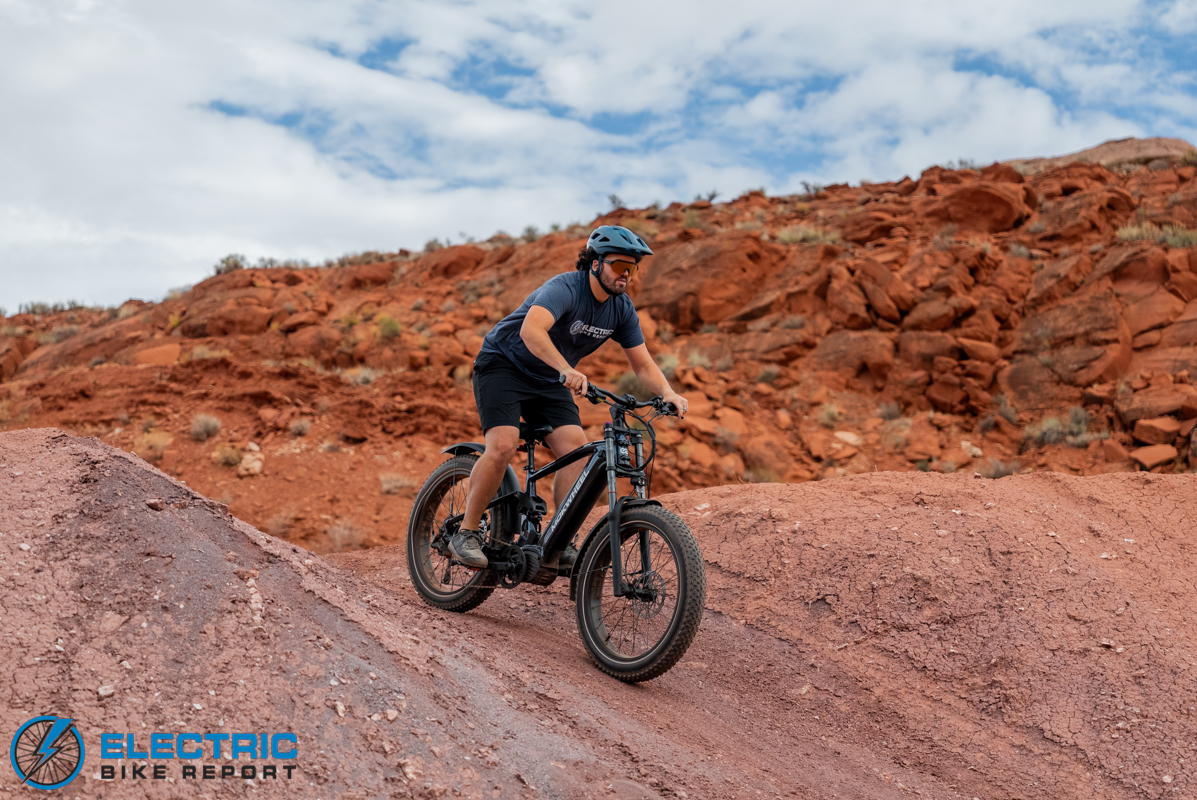
The Onyx feels planted and confident off-road, using its long wheelbase, fat tires, and massive torque to encourage exploring beyond pavement.
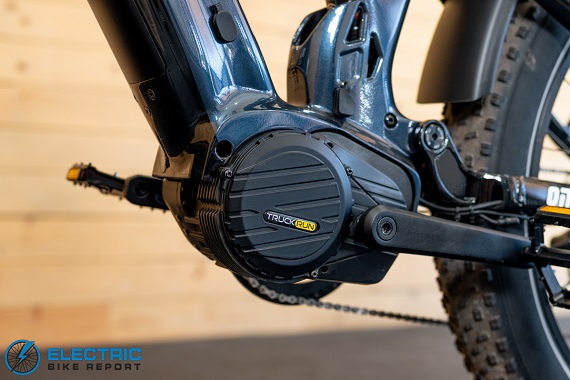
The mid-drive motor features a staggering 210Nm of torque, making it the most powerful motor we’ve officially tested to date.
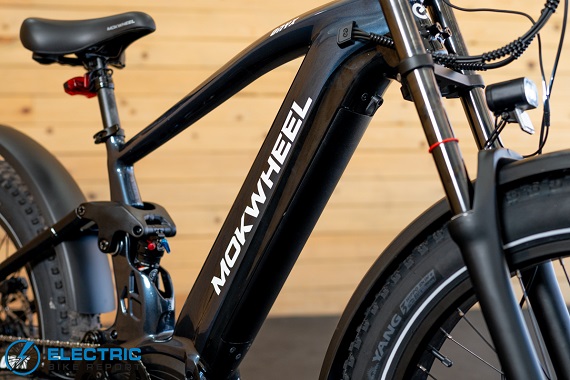
The 941Wh battery is generously sized, and its compatibility with Mokwheel’s power inverter allows it to charge external electronics.
Mokwheel Onyx Review: Speed Test
*Note: There isn’t a dedicated Class 2 or Class 3 mode to select, but you can assign a target mph to each PAS level. Out of the box, the bike was spaced in five-mph increments, with PAS 1 set to 10 mph and PAS 5 topping out at 30 mph which is how we tested it.
The testing sections were full of surprises, mostly in a good way. Surprise number one showed up in the speed test, where the speed profile broke down like this:
- No: 8.7 mph
- PAS1: 10.5 mph
- PAS2: 15 mph
- PAS3: 19.8 mph
- PAS4: 24.3 mph
- PAS5: 28 mph
Overall, that’s a clean, well-spaced spread on a line graph, and each PAS level felt meaningfully different from the next. The real surprise, though, was how natural the acceleration curve felt when climbing to those speeds.
Make no mistake, this bike is powerful and quick. I wasn’t pedaling an 89-pound bike to those speeds on leg power alone. But given the 1300W peak output and massive 210Nm torque figures, I was bracing for something that felt more like a purebred speed machine. Instead, the delivery was far more controlled and predictable than expected.
I actually liked that balance. You get plenty of power, but it’s metered in a way that makes the speeds feel pleasant and earned. The mid-drive uses a torque sensor that, out of the box, requires deliberate input to fully unlock its potential. You can adjust the sensitivity in the settings, but I appreciated the default tune since it keeps the bike from feeling like a wild stallion.
I was also impressed with the shift sensor and the Shimano CUES drivetrain. The shift sensor introduces a brief delay during gear changes to prevent the motor’s torque from hammering the cassette. The timing could maybe be shortened just a touch, but overall it’s one of the better shift-sensor executions I’ve ridden.
The drivetrain itself is Shimano’s CUES system. While it isn’t technically e-bike-specific, it might as well be. The thicker chains and gears are designed for durability, which is exactly what you want on a high-torque mid-drive. And with a 10-speed setup, I never felt under-geared, even while cruising up near the bike’s 28 mph ceiling.
Sponsor
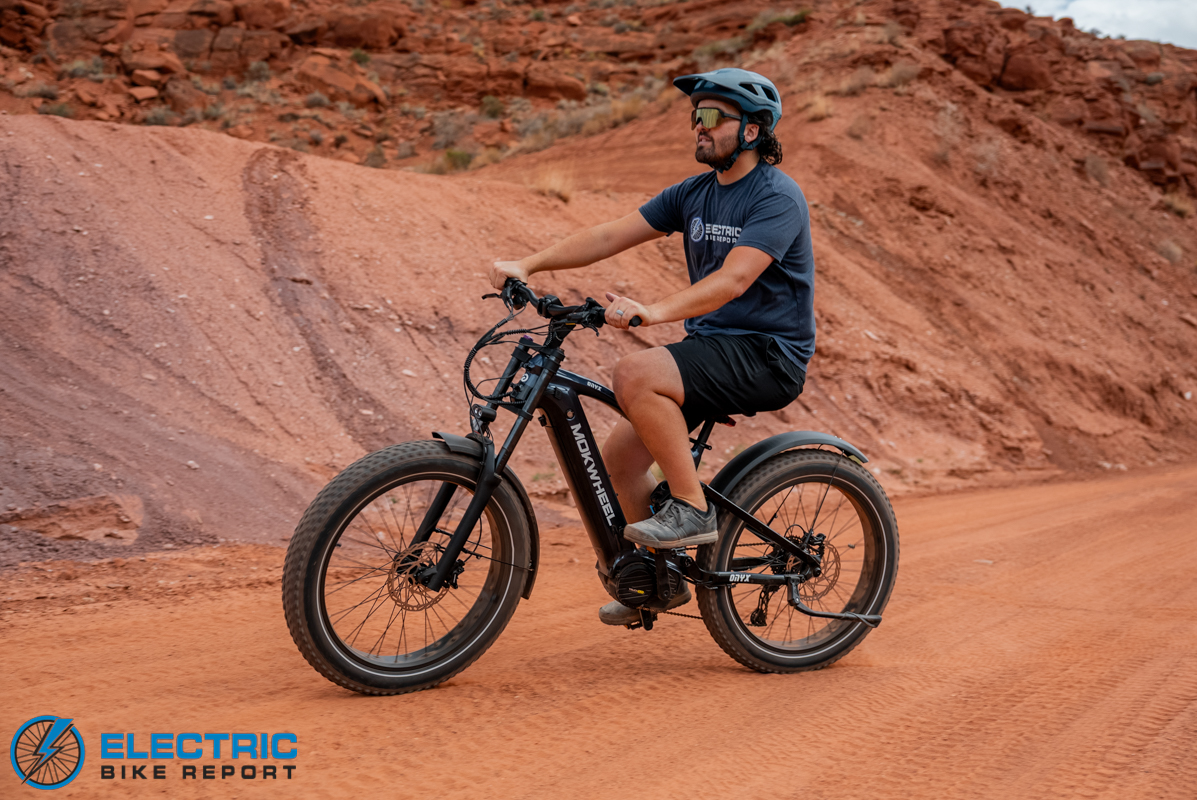
Despite its size and power, the Onyx delivers smooth, controlled acceleration that feels earned rather than abrupt.
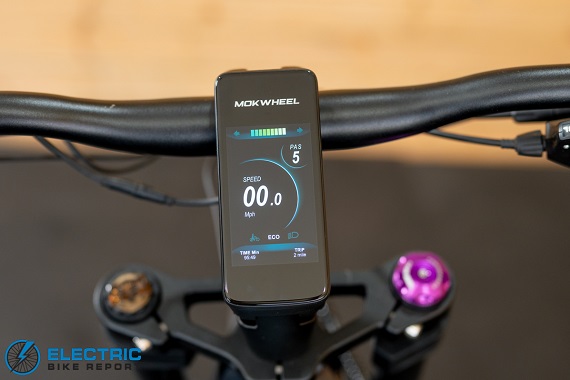
The stem display is one of the most unique we’ve seen, and unlike some others, would be easier to replace if it were to ever break.
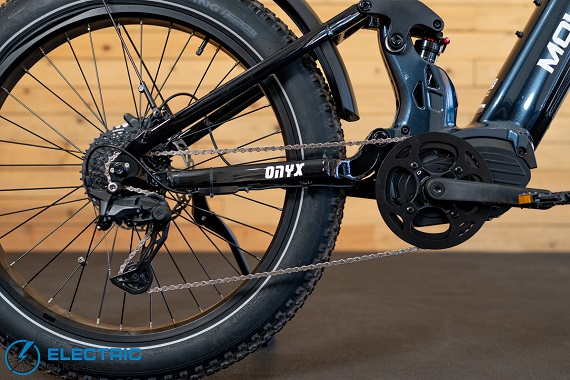
We appreciated the guard to protect the paint along the chainstays.
Mokwheel Onyx Review: Range Test
Surprise number two came in the range test, and it was a big one. This was one of the best range performances we’ve ever recorded. Seriously. One of the heaviest e-bikes we’ve tested turned in one of our longest range results to date—go figure.
The Onyx uses Mokwheel’s familiar 941Wh battery, a pack we’ve seen on several of the brand’s models. Mokwheel has already done a good job pairing this battery with efficient programming and torque-sensor tuning to stretch mileage beyond what we usually expect, but the Onyx managed to break new ground.
In our testing, it delivered 41.8 miles in PAS 1. Then, when set to PAS 5—with the top speed limited to 20 mph for local compliance and testing consistency—it went an astonishing 109.5 miles. That’s a genuinely jaw-dropping result.
That said, it’s worth tempering expectations just a bit. Mokwheel advertises a 60–80 mile range, which is a realistic starting point for most riders. As we note in the range test, PAS 1 is fairly mellow at roughly 10 mph. While the bike makes that kind of efficiency possible, many riders will naturally opt for PAS 2 speeds or a custom-programmed setting that’s a bit quicker. Even so, we test every bike the same way, and by those standards, these are excellent results.
Part of the explanation lies in the mid-drive motor. Mid-drives tend to extract more miles from the same battery compared to hub motors because they work with the rider through the drivetrain, rather than spinning the rear wheel independently. That efficiency puts big range numbers firmly on the table.
Even at higher, more realistic riding speeds, these results suggest a bike that can comfortably go one to three days between charges for most riders, which is impressive by any standard.
Sponsor
Sponsor
Mokwheel Onyx Review: Hill Test
Surprise number three showed up in the hill test. Despite being the torquiest motor we’ve ever tested, it didn’t post the single fastest pedal-assist hill-climb time we’ve ever recorded—though it came very close for its category. It also had to “ settle” for a tie as the fastest throttle result.
On our test hill, the Onyx climbed using throttle alone in 1:53 with a 16 mph average speed. On pedal assist, it completed the climb in 1:56 at an average of 15.6 mph.
Either result is excellent on a climb like our Devil’s Backbone test hill. Given the massive torque figures, I half-expected it to rewrite the record books on the pedal test, but it ultimately finished second to a bike that weighs roughly half as much. Similarly, its throttle time tied with a much lighter competitor. Those are the tradeoffs that come with sheer mass.
Setting aside the obvious “this motor is ridiculously powerful” commentary, the takeaway here is that the Onyx is more about muscle than outright speed. It’s a bit like a bull: fast enough on its own, but defined more by strength and its ability to pull almost anything you ask of it.
That character makes this motor especially appealing for larger riders who want confidence that the bike can fully support their weight, as well as for anyone planning to push payload limits by towing or hauling gear. It delivers serious grunt when you need it, while remaining surprisingly composed in the process.
Sponsor
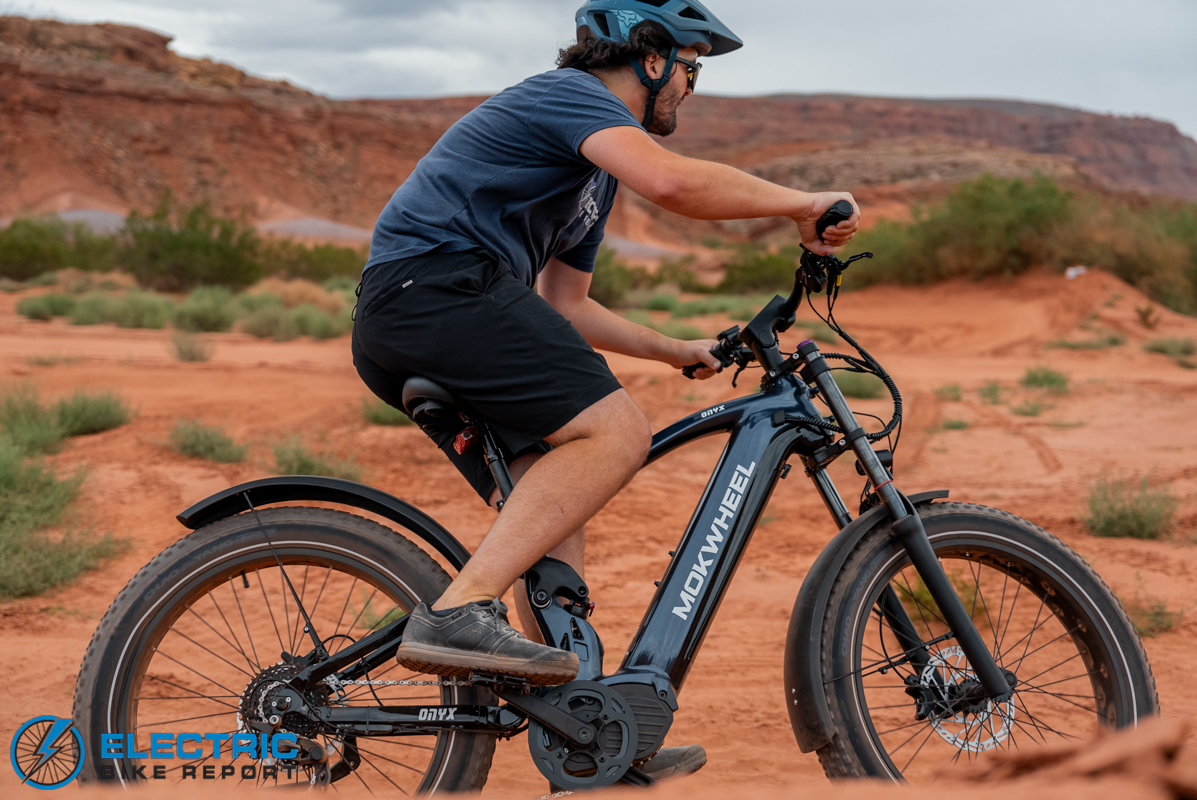
Ripping over loose terrain? No problem for the Onyx.
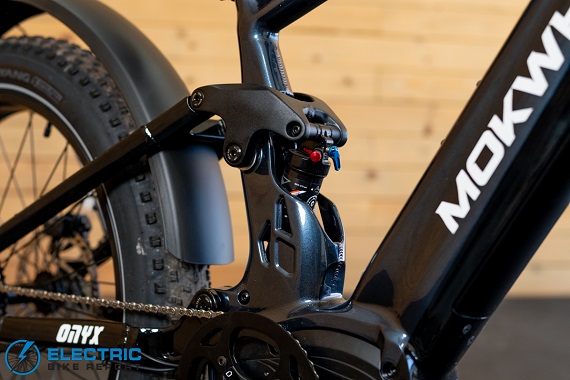
The DNM rear shock provides 50mm of travel and works well for smoothing out pavement and moderate off-road terrain.
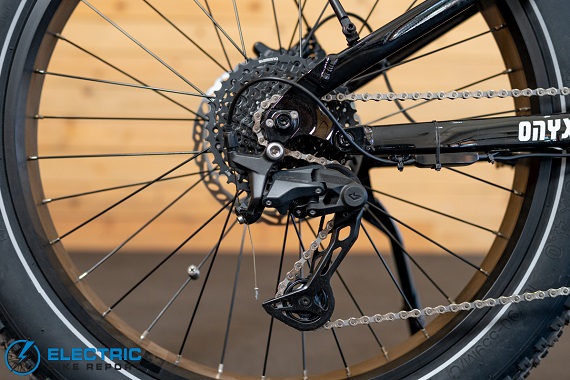
Shimano’s CUES 10-speed drivetrain is built for durability and pairs well with the bike’s high-torque mid-drive motor.
Mokwheel Onyx Review: Brake Test
Surprise number four came in the brake test. At first glance, the results looked solid, but with a bit more context, they’re actually very good for a bike of this size and weight.
The Onyx is equipped with four-piston Tektro hydraulic brakes paired with 203mm rotors front and rear. For a bike this big and heavy, that’s exactly the kind of braking setup you want to counter all that mass once it’s in motion.
In our testing, the Onyx stopped in an average distance of 22 feet, 9 inches. Our overall e-bike average—which includes everything from lightweight commuters to bikes with more street-friendly tires—comes in at 22 feet flat, so the Onyx is slightly longer than that broader benchmark. However, when you compare it to its true peer group of all-terrain heavyweights hovering near the 90-pound mark, the average stopping distance jumps to 24 feet, 3 inches. Against those bikes, the Onyx clearly outperformed the class.
A big part of that comes down to the hardware. Most e-bikes at minimum use two-piston hydraulic brakes with 180mm rotors. Some step up to four-piston calipers but keep the smaller rotors. The Onyx combines both four-piston calipers and oversized rotors, and that pairing makes a meaningful difference. In fact, it delivered the second-best brake test result we’ve seen in this category.
Out on the trail, the brakes were consistently reliable across all riding conditions, from dirt sections to longer downhill stretches. No drama, no complaints—just a strong, confidence-inspiring stopping setup.
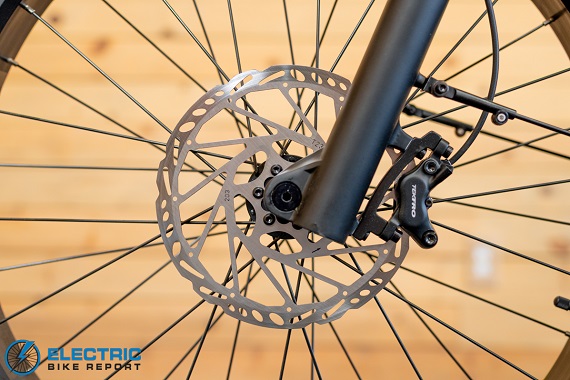
Four-piston Tektro hydraulic brakes and oversized 203mm rotors help manage the Onyx’s weight with confident stopping power.
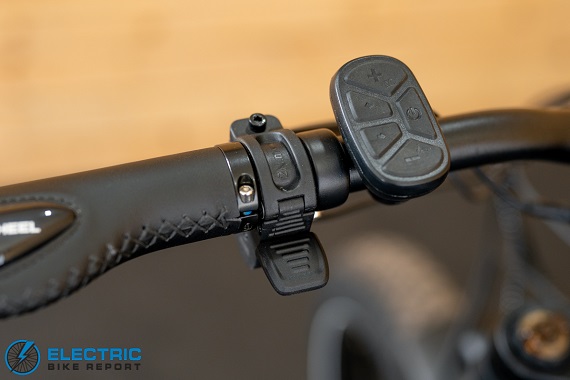
The control pad provides quick access to menus and settings, though the integrated turn-signal buttons are non-functional outside menus (they flash a turn signal that isn’t there).
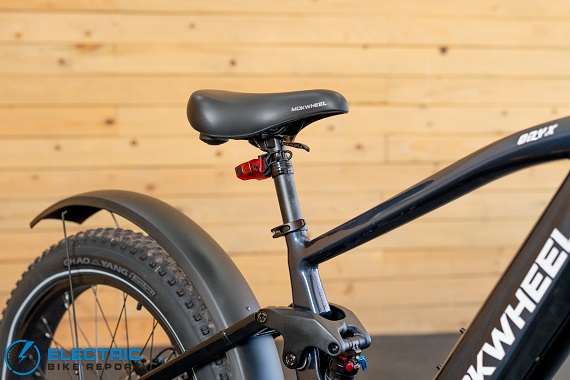
A cushioned saddle and manually adjustable seatpost make quick height changes easy without tools.
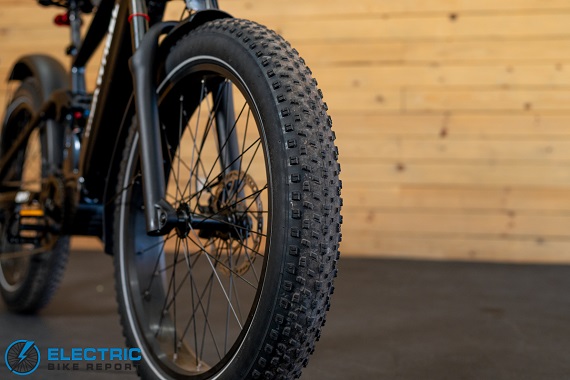
The 26 x 4.0-inch fat tires contribute heavily to the bike’s stability and planted ride feel on mixed terrain.
Mokwheel Onyx Review: Ride Quality
Some brands dabble in fat tire bikes, but Mokwheel is an established veteran in the category, and that experience shows in how the Onyx is set up. It hits many of the right notes for what fat bikes are meant to be: stability, confidence, and a planted ride feel.
The sizing is mostly excellent. I liked the long wheelbase, which contributes heavily to the bike’s stable, confident character. That stretched-out length does a lot for balance, and the 4-inch-wide tires only reinforce that sense of security on the bike.
The frame itself felt solid. It’s impressively stiff, which isn’t a given on a bike that weighs what this one does. The linkage hardware is beefy and well reinforced, easing any concerns I’d normally have about durability or flex on a heavier full-suspension platform.
The suspension is effective, though clearly on the budget end of the spectrum. The DNM rear shock works well with its 50mm of travel and doesn’t readily bottom out on pavement. You’ll find its limits when pushing harder off-road, and mine developed a bit of squeak, but overall it does its job. The same general theme applies to the fork. The dual-crown design looks aggressive, and the compression adjustments help with dialing in feel, but it’s springy, can generate some noise, and—as is typical with this design—limits the turning radius. Personally, it feels like the fork is more about aesthetics than dramatically expanding the riding scenarios compared to something like the Mokwheel Obsidian. That said, it’s still perfectly serviceable and undeniably eye-catching.
The 720mm handlebar pairs well with the 26 x 4-inch tires. On many bikes that width might feel narrow, but here it strikes a nice middle ground, keeping steering predictable without feeling twitchy or overly wide.
The stem-mounted display looks sharp and adds to the bike’s premium feel. I appreciated the adjustability for dialing in fit, and the screen itself is clear, high-definition, and easy to read. There’s a good amount of customization accessible through the control pad. The turn-signal icons don’t actually function, but the controls do give you quick access to menus and settings. I still have mixed feelings about Mokwheel’s signature gel bubble grips, but they’re worth trying before writing them off—they may agree with your palms more than they did with mine. And if not, grips are an easy and inexpensive swap.
You also get some nice extras, including a dual-LED headlight and plastic fenders. The manual dropper-style lever under the cushioned saddle was handy for quick height adjustments, though I didn’t find myself using it mid-ride the way I would a traditional dropper post.
There are mounting points for both front and rear racks, and Mokwheel’s optional power inverter and solar panel system make an appearance here as well. Those accessories are optional, but if you’re the type of rider who likes getting off the grid for a day or two, being able to recharge the bike—and power other electronics from the same battery—is a standout capability that very few e-bikes offer.
Sponsor
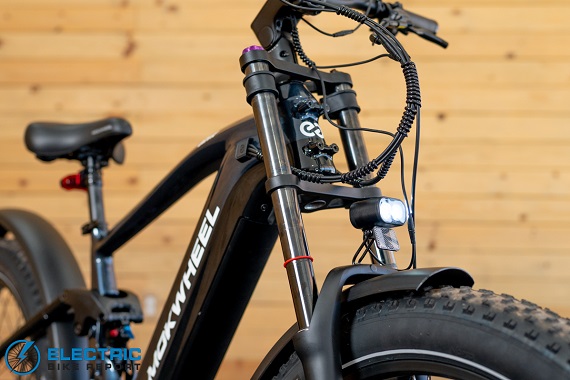
The dual-crown fork gives the Onyx an aggressive look and adjustable compression, though it limits turning radius.
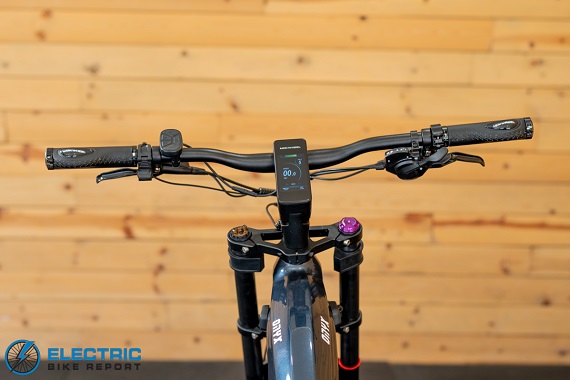
A 720mm handlebar and adjustable stem strike a good balance between control and comfort for a bike of this size.
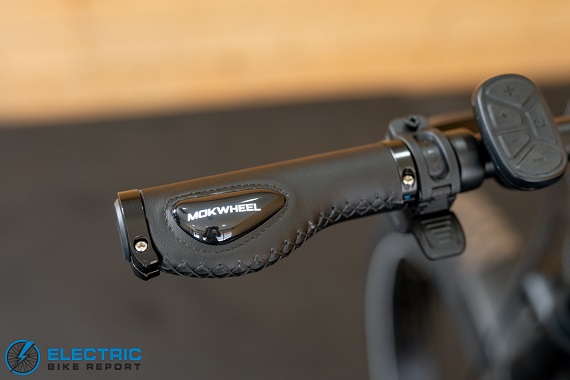
Mokwheel’s signature gel bubble grips are unique and comfortable for some riders, though they won’t be everyone’s favorite.
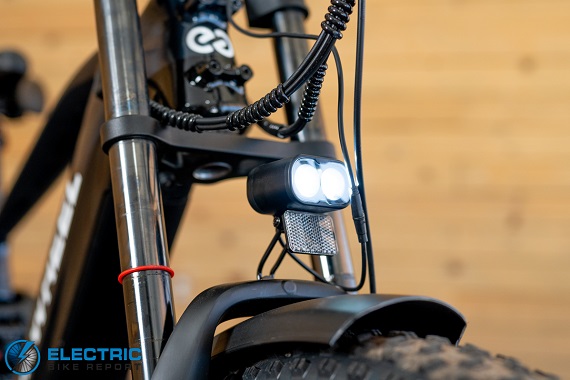
A dual-LED headlight setup improves visibility and adds to the Onyx’s adventure-ready design.
Mokwheel Onyx Review: Summary / Where to Buy
I’ve tested a few hundred e-bikes at this point, so it’s rare for one to truly surprise me. Usually, a quick look at the spec sheet tells me exactly what kind of ride I’m in for. The Onyx managed to break that pattern, consistently outperforming expectations in our tests and delivering a level of control that I didn’t anticipate from such sky-high power numbers.
The Onyx is something of a rarity: a super-powerful, full-suspension fat tire e-bike that—when you account for its components and features—is fairly well priced from a value standpoint. I would have personally preferred a more traditional air fork and would likely swap the grips, but at that point we’re firmly in personal-preference territory.
At its core, the Onyx is a true powerhouse, with very few places on the map it can’t roam or seasonal conditions that are likely to slow it down. If you’re comfortable with a heavyweight riding experience and want maximum muscle paired with surprising composure, it’s absolutely worth a closer look.
Happy Riding! Make sure to let us know if you have any questions or if you think we left anything out in this review of the Mokwheel Onyx down in our comments section.
Sponsor
Sponsor
Reader Interactions
Comments
Leave a Reply




Great review! I am seriously considering this bike due to the 210Nm and 19.6A…I have a steep incline to return home after rides and need a work horse to help me back up! This seems like a great solution, especially without forgoing other great aspects in a fat tire bike! The only other similar, fat tire bike that I feel is remotely close is the Velotric Nomad 2x with 105Nm 16.7A.
Thanks again for such a through review!!
Glad we could help! Let us know if you have any questions about either bike.