E-Moto vs. E-Bike: How Illegal E-motos Are Threatening the Legitimate E-Bike Market
Apr 15, 2026
 0 Comments
 Share
Share
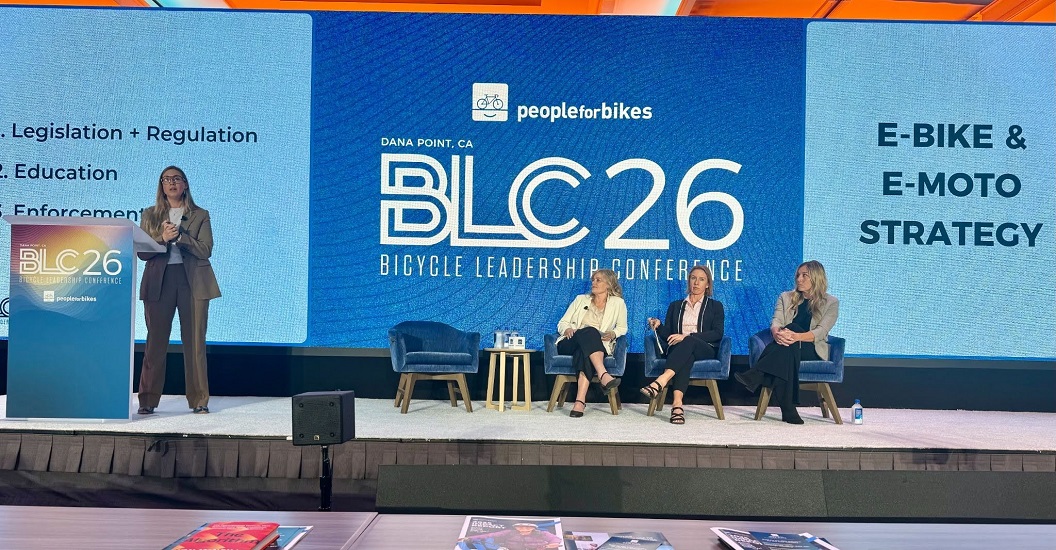
A session titled “E-moto: The Phantom Menace” brought together Dr. Ash Lovell of PeopleForBikes, California State Senator Catherine Blakespear, Tarrell Kullaway of the Marin County Bicycle Coalition, and Christie LaCarrell from the Motorcycle Industry Council. The message from the panel was direct.
“The biggest threat to the future of E-bikes right now is not anti-bicycle politicians. It’s not city councils. It’s not cars. The biggest threat to E-bikes right now is vehicles that are not E-bikes being called E-bikes. If we don’t solve this problem as an industry, someone else will solve it for us. And we won’t like the result.”
-Dr. Ash Lovell, Vice President of Government Relations, PeopleForBikes
If you have gone to any suburban neighborhood in the past two to three years, you’ve likely noticed the problem that Dr. Lovell is talking about – people (mostly under the age of 18) speeding around on bikes that look like dirtbikes. These bikes easily go over 28 mph, require no pedaling, and produce well over 750 watts of power.
In other words, these ARE NOT electric bicycles and they are threatening the hard-fought victory the industry (led by PeopleForBikes) won in creating the 3-class e-bike framework that is currently the standard adopted by 36 states + Washington DC.
Our goal at Electric Bike Report is very simple: get people on bikes. And while we don’t take a negative stance towards any two or three-wheeled vehicle, we do take a stance against bikes that go beyond what is legal and safe for consumers.
This is why we fully agree and support the movement by PeopleForBikes to define these non-ebikes as ‘E-motos’. This clarified definition allows lawmakers to focus their attention and energy on these E-motos that are not currently well-regulated under the 3-class system.
Editor’s Note: If you are a cyclist and/or just love riding bikes, we recommend you support PeopleForBikes in their mission to make the United States the best place in the world to ride bikes.
Sponsor
Sponsor
The Problem with E-Motos
The 3-class framework was designed for bicycles with electric motors – not motorcycles with pedals. Under federal and state definitions, a legal e-bike cannot exceed 750 watts of motor power, and it cannot travel faster than 20 mph on motor power alone. Those are the lines that separate a bicycle from a motor vehicle.
This framework took years of industry advocacy to build, and it gave the modern e-bike market its legal legitimacy.
Unfortunately, a growing category of products is blowing past both.
Machines weighing well over 100 pounds, powered by 5,000-watt motors, and capable of hitting 40 or 50 mph, are being marketed and sold online as E-bikes. Manufacturers exploit a straightforward loophole: attach a pair of functionally useless pedals to a dirt bike frame, and the vehicle can technically be classified as a bicycle. “That’s not innovation,” Dr. Lovell said. “That’s regulatory laundering.”
For years, the industry referred to these products as “out-of-class E-bikes” – a term Lovell acknowledged never really landed with the public. Last year, PeopleForBikes began promoting the term “eMoto” as a cleaner, more intuitive label for these vehicles. The definition, she said, is simple: if a vehicle exceeds 20 mph on throttle alone, or is powered by a motor larger than 750 watts, it belongs in the moped or motorcycle category.
Moped-Style E-bikes vs. Electric Dirt Bikes
There are two main categories of bikes that tend to push speed limits beyond what is legal: e-moped style E-bikes, and electric dirt bikes like Surrons.
At Electric Bike Report, we believe the distinction between these two styles of bikes is important so legislatures can create effective legislation to properly govern both styles of bikes.
Moped-Style E-Bikes
Moped-style E-bikes are designed to look like cafe racers, a very popular style of motorcycle from the 1960’s:
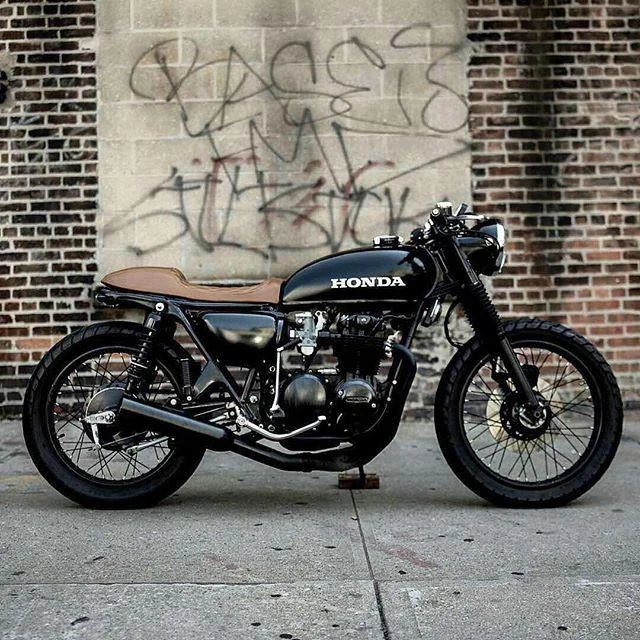
When you look at a Super73, you see the resemblance:
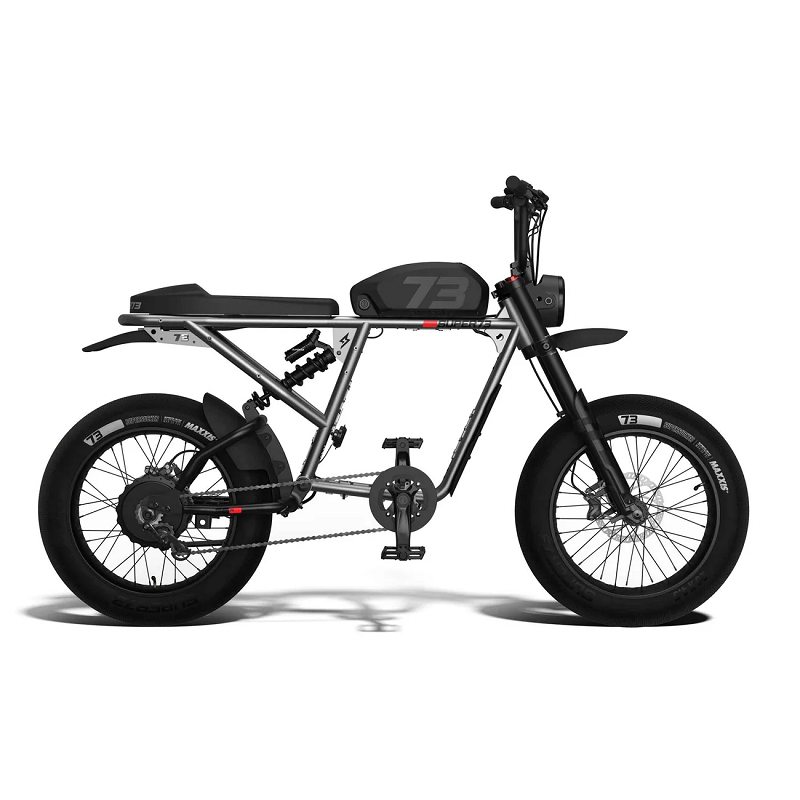
These moped-style or cafe racer style E-bikes are incredibly popular with teenagers. The bikes look cool, and they are fun to ride. Some brands follow the Class 3 guidelines and limit the speeds of these bikes to 20 mph on throttle and 28 mph while pedaling (although to be honest, pedaling this style of bike is not fun).
However, many brands that sell this style of bike notoriously allow riders to unlock the bike via an app or code, allowing them to speed beyond the allowed limits of a class 2 or 3 e-bike. Some brands require the consumer to verify / sign a waiver stating that they will be riding these vehicles off-road and aren’t subject to state regulations. This waiver may protect the brand’s backside legally; however, these waivers don’t help keep unlocked E-motos off public sidewalks and trails designated for E-bikes.
Given that these bikes could go faster than 28 mph, we naturally see people riding faster than 28 mph. Many of these riders are not licensed to drive a car and have very little to no understanding of how to operate a vehicle safely on the road. But, their parents bought them the E-moped because the bike shop told them they were buying and E-bike.
Major brands like Super73 appear to be doing all they can to backtrack and limit their bikes to safe speeds. However, we continue to get requests by brands who want us to review their moped-style e-moto. These brands still openly flaunt their bikes’ abilities to be unlocked and go 30+ mph – it’s a great selling point for a lot of people who love to ride fast.
Because so many of these E-motos continue to have motors that exceed 750 watts and go faster than 28 mph, legislators often place these bikes right alongside more powerful E-motos, such as ones from Surron and Talaria.
The issues with classifying both styles as one is that the legal, class 2 or 3 E-mopeds get thrown out with the bathwater. This also presents certain challenges to law enforcement officers.
Law Enforcement Challenges
Currently, electric vehicles that propel riders beyond Class 2 and 3 speeds are in a legal grey zone that is often undefined and not governed by the CPSC or NITSA.
This loophole has created a challenge for law enforcement. When an e-Moto passes a police officer at 35 mph in a bike lane or on a sidewalk, the responding officer faces ambiguity – the vehicle may or may not have pedals, no license plate, and no obvious motor vehicle markings. Classification stickers, which are supposed to identify these products, are frequently absent or deliberately placed out of sight, under the seat or near the bottom bracket.
LaCarrell, representing the motorcycle industry, pointed out that the confusion cuts both ways. “At the scene of one incident they’ll say it’s a bicycle,” she noted. “The next incident – same type of unit – they’ll say it’s a motorcycle.” Both industries absorb injury and fatality statistics that don’t accurately reflect their own products.
In many jurisdictions, particularly in California, officers are effectively prohibited from pursuing riders on these vehicles. If a rider crashes during a chase, the resulting liability falls on the department. “So they just don’t respond,” LaCarrell said.
Ground Zero: Marin County, California
No community has felt the impact of this challenge more than Marin County, California. As a high-income area with many early adopters of E-bikes, it became an instructive – and cautionary – case study.
Kullaway, who serves as both executive director of the Marin County Bicycle Coalition and as an elected official in San Anselmo, described watching the problem unfold over five years. Early enthusiasm about E-bikes quickly gave way to a different reality. Middle schoolers were posting footage of themselves riding Super 73s standing up, hands off the handlebars, on main arterial roads. The local press started calling them “the E-bike gangs of San Anselmo.” Community meetings that were supposed to address infrastructure and other community issues had to instead focus their attention on E-motos. Standing-room crowds of parents had no idea what they had actually purchased for their kids – because they had been told something different at the point of sale.
The downstream consequences have been significant:
- Schools banned all E-bikes from campus because administrators couldn’t distinguish legal models from illegal ones. Campus audits claimed to find that 80 to 90% of the vehicles students were riding, all sold as E-bikes, were actually illegal E-motos. That number hasn’t changed meaningfully despite years of sustained education efforts. Furthermore, it’s difficult even for experts to recognize if a moped-style e-bike is an illegal e-moto based solely on looks. They have to power on the bike and check the actual settings and speeds.
- A community e-bike safety program was shut down after insurance providers dropped coverage. The liability exposure from E-motos showing up to classes made the program uninsurable.
- Infrastructure advocacy has been derailed. “Every time I go in and talk about creating better infrastructure,” Kullaway said, “the chorus is always: what are you going to do about kids on E-bikes?”
The media has compounded the problem. Kullaway described a New York Times story headlined “An E-Bike Almost Killed Her, and Now She’s Fighting for Regulation.” She had been interviewed for the piece and said the reporter did solid work. An editor added the headline at the last minute. The vehicle involved was an e-Moto, not an e-Bike. Kullaway stated that “[I] interview with live journalists, I have them repeat things back to me, I think they get it, and then the article ends up being wrong every single time.”
Part of the reason why journalists incorrectly classify E-motos as E-bikes is because the Associated Press doesn’t have a word the reporters can officially use for E-motos. Everything falls under the ‘e-bike’ umbrella.
The New Jersey Warning
When lawmakers are inundated with constituent complaints about 40 mph “E-bikes” on sidewalks and bike paths, the policy response tends to be blunt rather than surgical.
New Jersey has emerged as the clearest example of what happens when legislatures act without drawing a distinction between E-motos and legitimate E-bikes. The state introduced sweeping policies that apply equally to both.
Kullaway described the consequence: “If you’re in New Jersey, and you are a mom on a cargo bike, with two kids on the back, you have to be registered, you have to have insurance, you have to have a license, and then each of you have to be wearing a motorcycle helmet.”
Under those requirements, a parent using a Class 1 cargo bike for the school run faces the same DMV obligations as a rider on a 500cc motorcycle. The panel’s position was uniform: that kind of blanket legislation does not solve the e-Moto problem. It eliminates the accessibility that makes legitimate E-bikes viable as a transportation and climate tool in the first place.
Kullaway noted that E-bikes are responsible globally for replacing at least one million barrels of oil emissions per day – a number that depends on continued, frictionless adoption.
Sponsor
The Path Forward: Legislation, Education, Enforcement
The panel outlined a three-part strategy to move forward to increase consumer safety while also ensuring that license and registration are required for E-bikes across the nation – and made clear that none of the components work without the others:
- Legislation – draw a clear legal line between E-bikes and E-motos, and give law enforcement the tools to enforce it.
- Education – ensure the public, media, parents, and retailers understand the difference between an e-bike and an E-moto.
- Enforcement – equip officers with the clarity and legal authority to act when they encounter an out-of-class vehicle.
On the legislative front, Senator Blakespear’s SB 1167 was held up as the model. The bill does five things:
- Reconfirms the legal definition – any device with a motor exceeding 750 watts is not an e-bike.
- Requires point-of-sale disclosure – manufacturers and sellers must inform buyers when a vehicle doesn’t meet the e-bike definition.
- Closes the loophole – prohibits any two- or three-wheeled device capable of exceeding 20 mph on motor power alone from bypassing standard motor vehicle laws.
- Standardizes label placement – classification labels must appear visibly on the frame, where law enforcement and school officials can actually see them.
- Creates a reckless riding citation – gives law enforcement a practical enforcement tool that stops short of full DMV involvement.
Blakespear credited the bill’s traction to the industry’s willingness to self-regulate. “Part of the genius of this bill is that we’re saying we have to regulate ourselves and come up with these guidelines,” she said. “That kind of collaboration is what allows a bill like this to be successful.”
On education, Kullaway named a specific benchmark: getting the Associated Press to officially add “E-moto” to the AP Stylebook. Until journalists consistently use the correct term, she argued, the misidentification problem persists regardless of how much outreach the industry does. “Every time we educate people and they still use the word E-bike, I have less time to actually fight for safer streets and save lives.”
On enforcement, LaCarrell offered an alignment that surprised some in the room. The Motorcycle Industry Council, through its nonprofit arm the Motorcycle Safety Foundation, has already partnered with PeopleForBikes to launch a youth-focused e-bike education program. Her industry wants these vehicles properly classified and regulated. “I see this as the biggest opportunity we’ve been given in so long,” she said. “There are so many people out there riding two wheels. We need to educate them and figure out how to make this work.”
Call to Action
Dr. Lovell closed the session by drawing a direct line between the current moment and the industry’s past victories. “We have solved problems like this before,” she said. “We built the three-class system. We passed e-bike legislation across the country. We expanded trail access and transportation policy. And we did it by working together – brands, retailers, advocates, policymakers.”
California was the first state to adopt 3-class legislation. If SB 1167 fully passes, the panel argues it can serve as the first effective eMoto regulatory model – and other states will follow, just as they did before (since the panel, the bill passed the California Senate Committee and is now going to the Senate Natural Resources and Water Committee for consideration).
The immediate ask from PeopleForBikes is straightforward: sign the letter of support for Senator Blakespear’s SB 1167. The industry built the framework that made the modern e-bike market possible. According to the leaders on that stage, protecting it will require the same unified effort that created it.
Electric Bike Report’s Take
-
We are proponents of the 3-class system, support SB 1167, and encourage all our readers to sign the letter of support for the legislation.
At Electric Bike Report, we have a unique view into what’s coming across the ocean and landing at the ports here in the USA. We receive daily requests from E-bike brands and manufacturers to review their bikes. What’s disheartening is that we have seen an anecdotally significant increase in requests from brands for us to review E-motos that are trying to be sold as E-bikes.
These brands lean heavily into their power, torque, and speed capabilities. Sometimes these bikes will even come with two 1,000+ Watt motors but look almost just like a Super73.
We are also happy to see the CPSC doing more to prevent E-motos from entering the country and being sold to consumers. The new mandatory e-filing rule and the potential passing of the Safe SPEEDS Act (H.R. 7839) have the potential to stop new E-motos from being sold. However, we still need to find a solution for the thousands and thousands of illegal E-motos already on the streets.
In addition, as an industry, we need to use proper language and incorporate the term ‘E-moto’ into our vocabulary immediately. Local bike shops need to stop telling parents that the Surron they just bought for their 15 year old is ‘just an E-bike’, and all of us need to educate as many people as possible about the problems E-motos present. We also hope to see any brands stop programming their E-bikes so they can be unlocked to E-moto speeds.
Finally, we recognize the E-motos are being sold for a reason – they are fun to ride! Because of that, I’m sure we will continue to have people figure out ways to hack and unlock motors. Because of this, we would love to see local governments create dedicated E-moto parks where people can ride these vehicles safely.
Sponsor
*Please help support our efforts at Electric Bike Report. We work hard to provide the highest quality content, news, and reviews for our readers – and our sponsors make all of this possible. Please visit our sponsors from their ads on our website and let them know that you appreciate what they do for the e-bike industry and Electric Bike Report
Sponsors
Sponsor
Reader Interactions
Leave a Reply