Himiway D5 2.0 20″ Review | Full-Suspension Comfort & Fun
Nov 27, 2026
 0 Comments
 Share
This highly customizable utility-style e-bike makes commuting, running errands, and family adventures remarkably comfortable and easy to love.
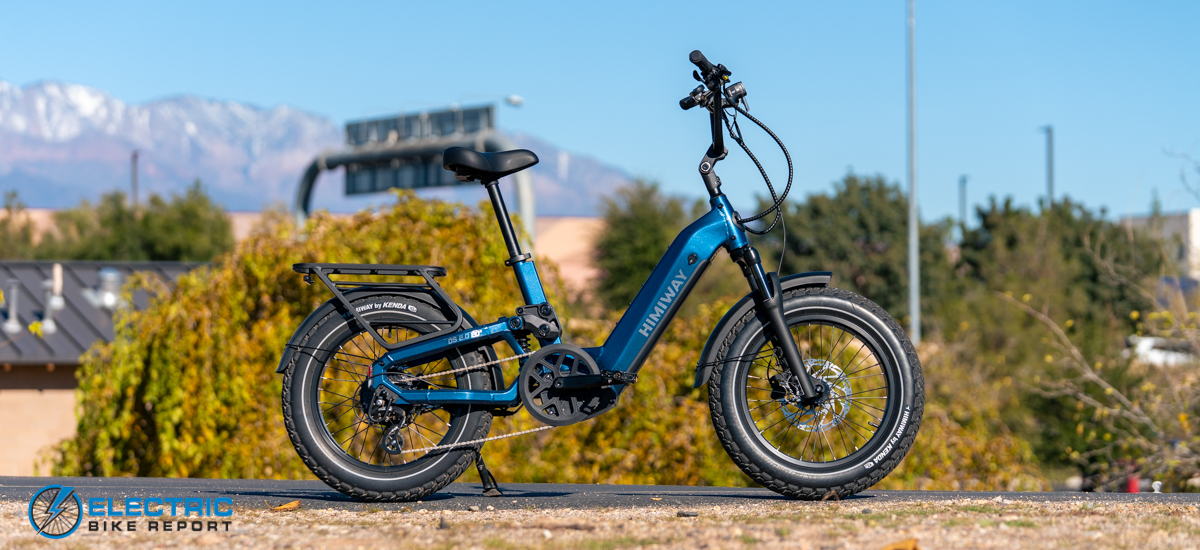
Similar to commuters, utility e-bikes are multi-purpose in nature. Their cargo racks and powerful motors make them useful for picking up a small load of groceries or carrying a child passenger on family outings. Unlike full-size, long-range commuters, however, they’re often a bit smaller, more maneuverable, and geared towards medium-distance travel.
In short, they’re seriously versatile machines, with enough broad appeal to earn a place in most garages. Many folding e-bikes also cross into this category, allowing riders to get the most out of camping trips, cross-country RV adventures, and other journeys where space is limited and portability is key.
Many of the utility e-bikes we’ve tested have been great, but few have been as comfortable and adaptable as the Himiway D5 2.0 20″.
Before we get into the details about this bike, it’s worth mentioning that this brand has a handful of models with the D5 designation, including larger high-step and step-thru fat-tire versions of its second-gen e-bikes, plus a standard and Pro model of the first-gen D5. The model this review covers is specifically the smaller, second-generation utility e-bike.
So what makes this e-bike unique?
Two of its most obvious features are its full suspension and its hybrid tires. The former consists of a coil suspension fork with 90mm of travel and a coil shock with 100mm of travel, softening bumps and generally making the ride smooth and remarkably pleasant. The latter, a set of custom 20×4″ fat tires, have a chunky chevron tread pattern that rolls efficiently on pavement, while offering enough grip and stability for moderate off-roading.
On top of that, this e-bike has one of the most customizable pedal assist systems we’ve seen, with speed adjustments, torque and cadence-sensing modes, and the ability to set torque and assist ratios for each of the bike’s five power levels. Additionally, riders can choose how the bike’s power is delivered when starting up, during riding, and when letting off the “gas.”
One of our biggest questions about the D5 2.0 20″ was whether this adaptability extended to other parts of the bike’s functionality. Additionally, we were curious to see how well its performance matched up against similar models we’ve tested. Continue reading our full review below to see our findings!

Sponsor
E-Bike Category:Utility
E-Bike Class:Class 1 (pedal assist to 20 mph)
Class 2 (throttle to 20 mph)
Class 3 (pedal assist to 28 mph)
Sponsor
Himiway D5 2.0 20″ Video Review
 Pros
- The D5 2.0 20″ is remarkably smooth and comfortable to ride, thanks to its full suspension, including 90mm of front travel and 100mm of rear travel.
- Its pedal assist system adapts to riders of all styles, with torque and cadence modes, five assist levels, and fully customizable power delivery.
- This e-bike is uncommonly capable for its style on off-road terrain, thanks to its full suspension and custom 20×4″ fat tires with hybrid tread.
- The D5 2.0 20″ is stable and planted, while also offering playful, responsive steering and easy control.
- Its fit is hugely adaptable, primarily due to its adjustable stem with 60 degrees of rotation and its positionable BMX-style handlebars.
- The bike has an impressive payload capacity of up to 440 lbs, with an MIK-HD-compatible cargo rack that can carry 120 lbs of passengers or cargo.
- Features like a full-color display, cruise control, integrated turn signals, and a robust settings menu offer excellent functionality and solid value.
 Cons
- Estimating range with the bar-based battery readout was tough; we encourage Himiway to use a more accurate percentage-based meter instead.
- Pedal assist wasn’t as responsive when using Auto mode as it was with the standard assist levels. We’d love to see it refined to match.
ELECTRICAL SPECS & FEATURES
- Battery: 48V, 720 Wh (15Ah), IPX6, Samsung/LG 21700 cell
- Charger: 48V, 3.0A Fast Charger
- Display: 3.5″ Full color, High brightness, Bluetooth, Adjustable angle
- Motor: 48V, 750W (1300W Peak), 90Nm
- Headlight: 130 Lux/800 LM High-Output Integrated LED, Adjustable Angle
- Taillights: Braking Indicator, rear light steady/flash, integrated with the frame
- Pedal Assist: Auto Pedal Assist + 5 PAS Levels
- Claimed Range: Up to 40 miles (throttle), Up to 70 miles (Pedal assist)
- Throttle: Ergonomic Thumb Throttle
- App: N/A
- UL Certification: UL 2271 & UL 2849 Certified
Weight & Dimensions
- Claimed weight: 80 lbs
- Tested Weight: 87.7 lbs
- Rider height range: 4’11” – 6’3″
- Total payload capacity: 440 lbs
Components & Accessories
- Brakes: Tektro HD-3120 Hydraulic Disc Brake with power cutoff, 203mm Front/180mm Rear Rotors
- Fenders: Plastic, Front and Rear Full Coverage
- Fork: Trama Hydraulic Suspension 90mm Travel with Lock-out
- Frame: Aluminum Alloy
- Drivetrain: SHIMANO 8-speed, 52T Narrow Wide Chainring, 11-34T Freewheel
- Grips: Durable ergonomic grips, lockable
- Saddle: Memory Foam comfort ergonomic seat
- Handlebar: Aluminum Alloy, Φ31.8mm, 700mm
- Kickstand: Aluminum Alloy, included, rear mount
- Pedals: Aluminum alloy
- Tires: 20×4.0 Kenda×Himiway, K-Shield Punch-Resistant, Reflective Sidewalls
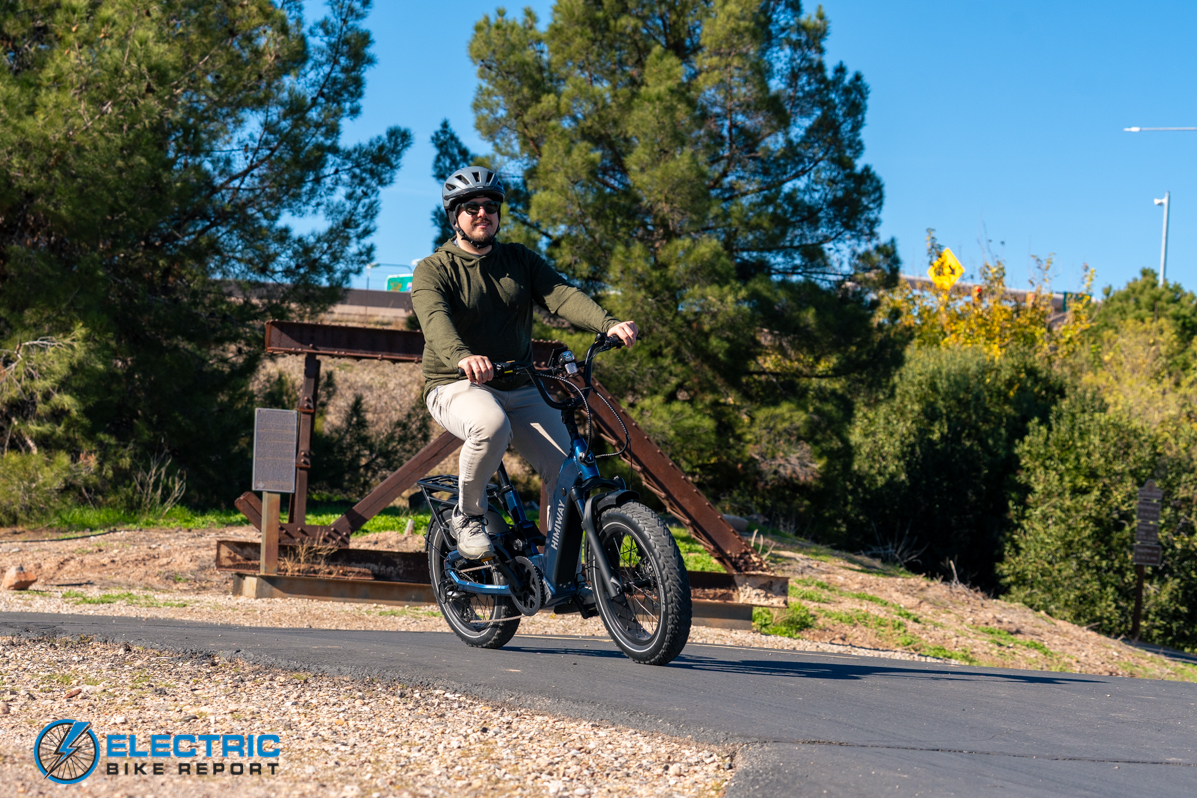
Riders can switch between torque and cadence-sensing modes with the push of a button (as long as the bike is moving).
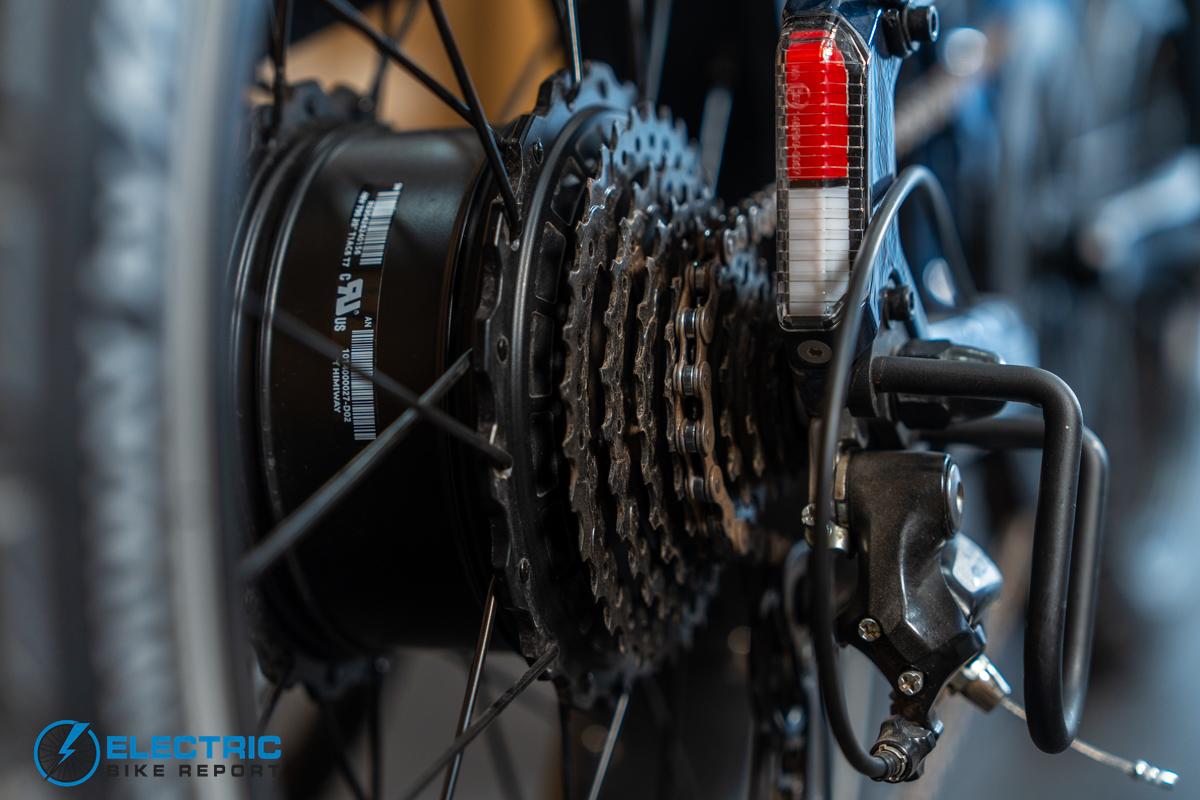
The 750W rear-hub motor packs controlled power for getting around, handling hills, and carrying cargo.
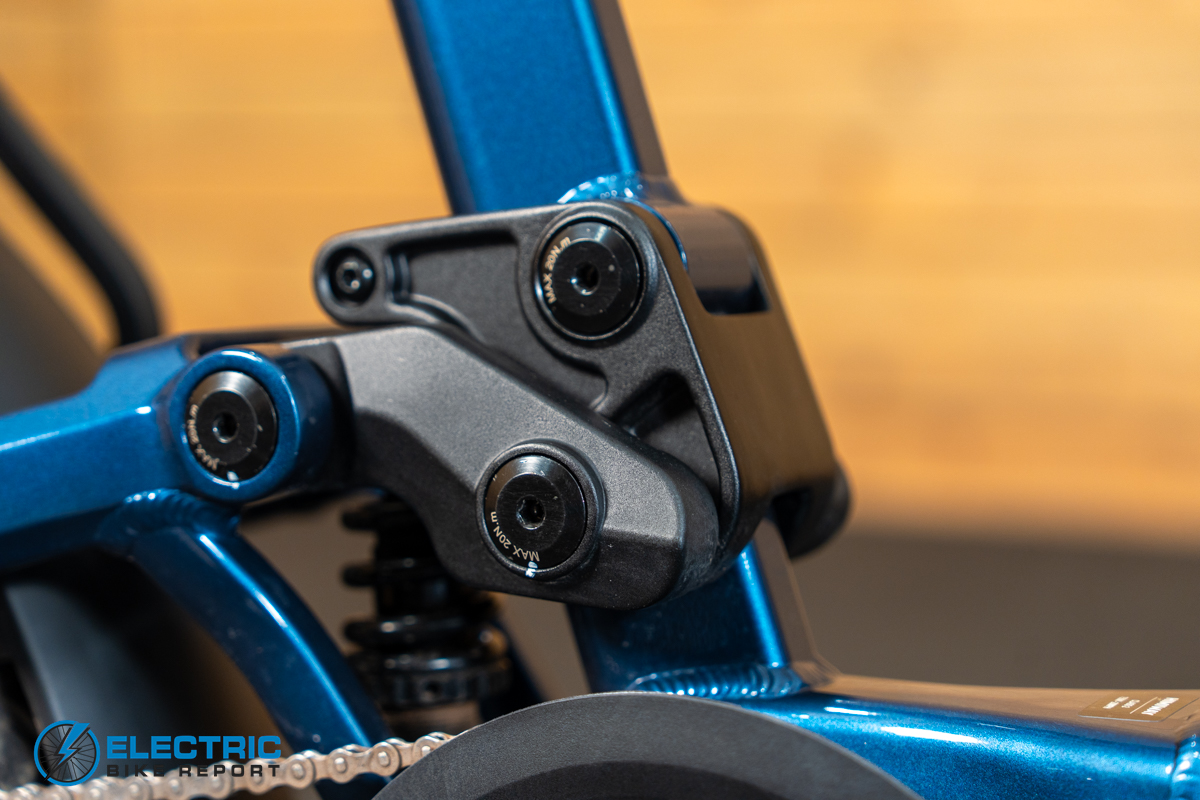
A robust rear suspension is one of this bike’s highlights, making the ride smooth and relaxed.
Himiway D5 2.0 20″ Review: Speed Test
As it ships, the D5 2.0 20″ is a Class 1 and 2 e-bike, offering throttle and pedal assist up to 20 mph. The bike can also be unlocked to a Class 3 mode, offering pedal assist up to 28 mph. We tested its ability to reach these speeds in both torque and cadence modes by riding on a flat, paved multi-use trail.
I began my testing by taking a quick spin without power. As a nearly 88-lb bike, the weight of the D5 2.0 20″ was noticeable; starting from a dead stop required me to push, but once the bike was rolling, keeping it going was much more comfortable.
In the torque-sensing mode, the motor responded to my pedaling by pumping out more power when I pushed harder and less when I relaxed. The lowest assist level, Eco+, delivered a relatively subtle boost that made the bike feel lighter, while Eco’s more generous output felt well-balanced with a relatively active, analog-like feel.
By the time I reached Tour, pedaling felt seriously easy and low-effort; this mode felt similar to many other e-bikes I’ve tested in their highest assist levels, so I had a hard time imagining the D5’s two remaining settings. Pedaling in Sport and Turbo felt extremely relaxed and rewarding.
Overall, the bike’s power output seemed well-distributed in torque mode. When using its default Class 2 settings, it was clear that the motor had no trouble pushing out enough power to propel me to the 20 mph ceiling. Once unlocked to Class 3, I had to work a bit more to reach maximum speed—even in the highest assist levels—though the bike still had ample power for both flats and hills.
In cadence mode, the motor produced a constant push as long as I turned the cranks, which I could do with only light effort. The individual power levels determined the strength of the steady force it delivered, so Eco+ gave me a gentle but useful flow, while Turbo had much more muscle behind it.
In Class 2 mode, since the motor output was limited by power and not speed, I was able to climb to a relatively high velocity even in the low assist levels. I reached the 20 mph cap in the second assist level and maintained it through the three higher settings. Once I switched to Class 3, my results were divided more across the five power levels, with relatively incremental jumps in speed.
In both sensor modes and Class settings, the bike had no trouble reaching its maximum speed. Additionally, the bike’s programming was generally intuitive, though it could benefit from some refinement in the Class 2 cadence mode. Personally, I wouldn’t mind seeing the option to add speed limits to each assist level, which would give riders more granular control over their speed in that mode.
As a second portion of the Speed Test, I also tried out the bike’s throttle. It eased off the line for a moment before picking up in acceleration, then steadily built up to 20 mph. All in all, it felt safe while being completely usable for getting rolling from a stop or taking a break from pedaling.
Ultimately, the D5 2.0 20″ performed well in this test. Its highly adaptable pedal assist system is among its greatest strengths, offering users a wide range of options over how the bike rides. Its motor is also powerful, making pedaling fun and easy for those who want plentiful power—and responsive and active for those who prefer to be more involved.
Sponsor
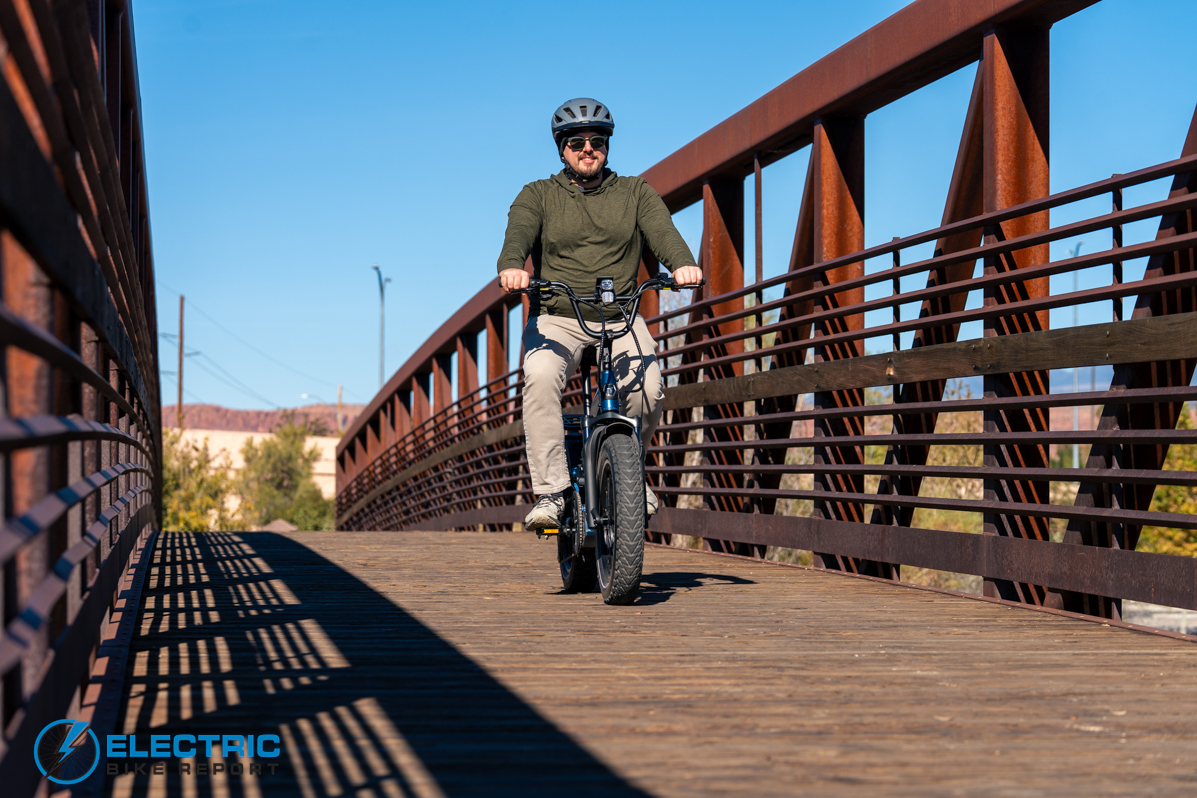
This e-bike is well suited for errand runs and commuting, but it’s also remarkably comfortable and easy to ride for leisure.
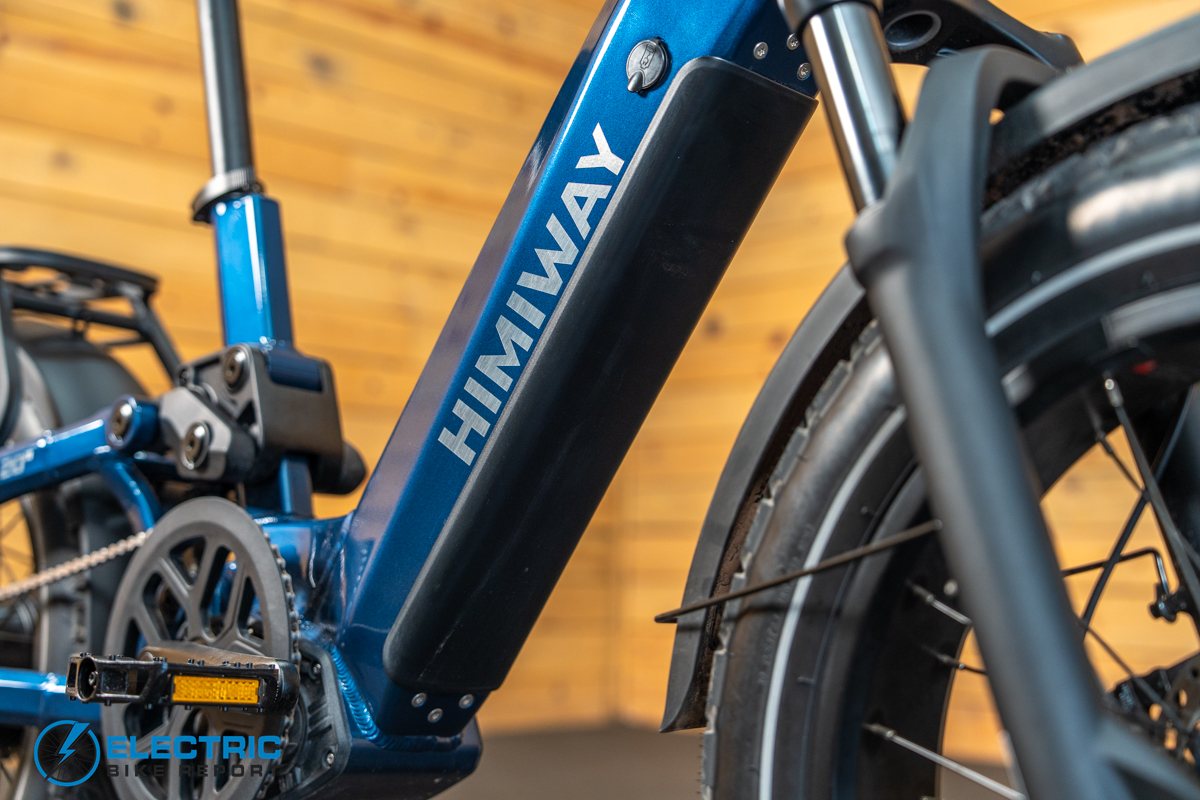
The D5 2.0 20″ has a fully integrated but removable 720 Wh battery in the down tube.
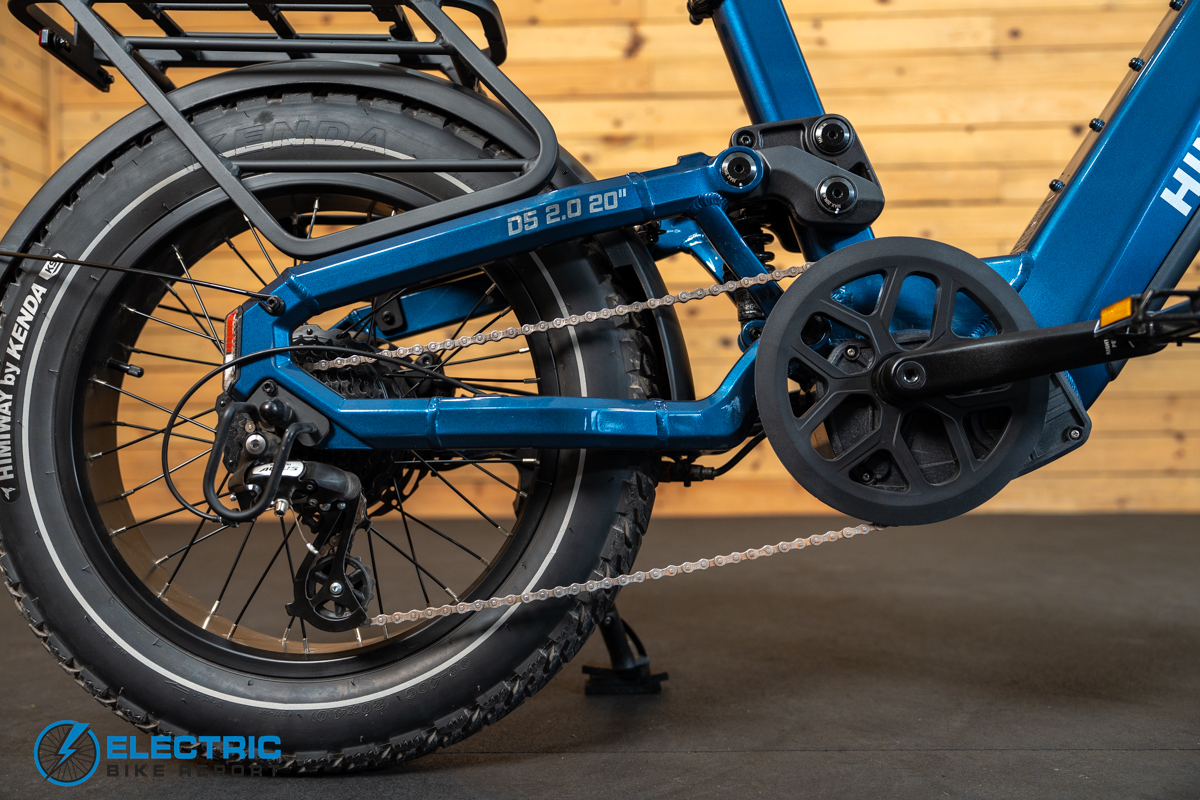
An 8-speed drivetrain supports Class 3 speeds and riding on both flats and hills.
Himiway D5 2.0 20″ Review: Range Test
We tested the D5 2.0 20″ twice to determine its real-world minimum and maximum range. In the first test, we started with a freshly charged battery, riding on a paved multi-use trail using only the Turbo assist level until its charge was depleted. In the second test, we repeated the process using Eco+. Both tests used torque-sensing mode in Class 2.
Our test riders managed to cover 32 miles in Turbo and 59.2 miles in Eco+, which places the D5 right around average when compared to similar models we’ve tested. This group of bikes covered 33.2 and 65 miles in their high- and low-power tests, respectively.
Himiway’s D5 2.0 20″ is similar in more ways than its appearance; these bikes carried batteries of similar capacity (736 Wh, compared to the D5’s 720 Wh power pack). They also used roughly the same amount of energy—22.6 watt-hours per mile (Wh/mi) in their max-assist tests and 11.7 Wh/mi in their low-power tests, compared to the D5’s 22.5 and 12.2 Wh/mi.
When it comes to e-bikes, average or near-average performance is great! This means the bike in question is generally well-specced and capable of matching most similar models. In the D5’s case, Himiway’s advertised range of up to 70 miles may be slightly hopeful, but its range potential is plenty usable for a wide range of purposes.
Considering that, in my experience, the second and third-highest power levels felt plenty practical, I think it’s likely that many riders will find themselves in the middle of our two bookend results. This is likely to cover multiple round-trip commutes, leisure and family trips, grocery runs, etc., though it is important to note that adding cargo weight will reduce the bike’s range.
One of the D5 2.0’s few downsides was apparent in this test; the bike’s battery charge level is shown through a bar-based readout on the color display. Without a percentage to gauge remaining charge accurately, this approach can make estimating range somewhat tricky. We liked the overall appearance of the display, but we encourage Himiway to use a more granular method of showing the battery’s charge level in the future.
On the plus side, I want to give the company kudos for including a 3A charger with the bike. This charger can refill a depleted battery in about 5 hours, which we consider a reasonable time to wait.
Sponsor
Sponsor
Himiway D5 2.0 20″ Review: Hill Test
We expected strong results from the Himiway D5 2.0 20″ in our Hill Test—primarily due to the bike’s powerful 750W motor—and we were not disappointed! Our test rider, Justin, tested the bike once using throttle-only power, and again using its highest level of pedal assist, at our standard test hill. See above for a description of this location, called the Devil’s Backbone.
Justin tested the bike in Class 2 mode using the default torque-sensing mode and standard power output. Depending on the settings you choose, your results may vary, but our test should give you a reliable idea as to how the bike should perform.
The D5 2.0 20″ completed its throttle test in 1:55 at an average of 15.8 mph and its pedal test in 1:54 at 15.9 mph. Both results compared well with similar models we’ve tested; our comparison group averaged 1:57 on throttle and 1:52 when pedaling, placing the D5 slightly faster than average in the first portion of the test, and slightly slower in the second.
These numbers are relatively unsurprising when considering the D5’s weight and peak power output—two of the major factors that influence an e-bike’s performance in this test. At 88 lbs, the D5 2.0 20″ is more difficult to move uphill than many of its peers, which average 74 lbs.
Its motor, however, is seemingly powerful enough to counterbalance that fact. It peaks at 1300W with 90 Nm of torque, compared to the average of 1176W and 81 Nm in our comparison group.
Clearly, the D5 is a confident climber, but for more context, I can explain my personal experience at our secondary test location, Pilot Hill. There, the bike felt relatively quick and breezy on throttle.
When pedaling in the default torque-sensing mode, the bike felt active and engaging. It climbed rapidly, requiring only a moderate level of effort from me at the steepest part of the hill. When using cadence mode, the experience was remarkably easy and the bike moved with a steady, moderate pace.
E-bikes of this style typically perform well in this test, and the D5 2.0 20″ is no exception; it’s clearly suitable for riders who live in hilly areas, and it gives riders multiple options for how to tackle hills. The bike’s throttle provides the easiest experience, while pedaling in torque mode feels more active. Cadence is a happy middle ground, as it requires only light pedaling to get the job done.
Sponsor
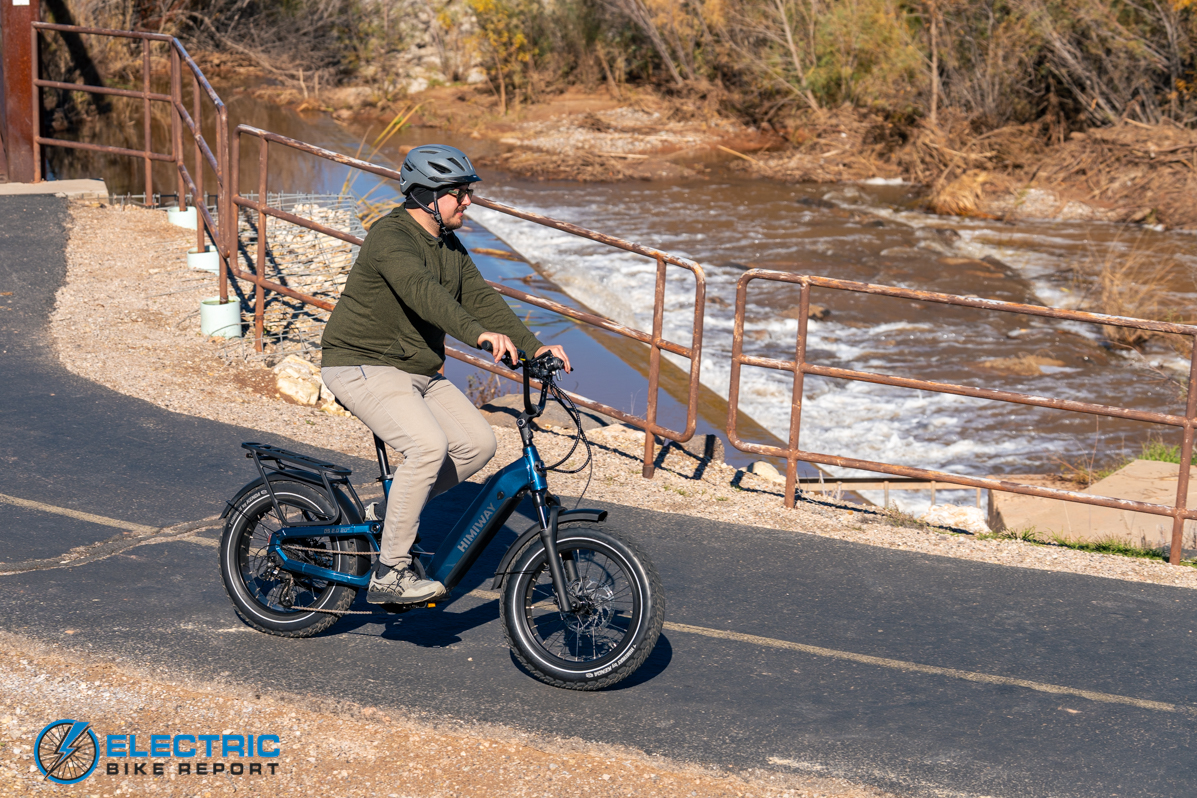
As the smallest of the D5 models, the 2.0 20″ feels planted while riding, but also much more agile than a full-size fat-tire e-bike.
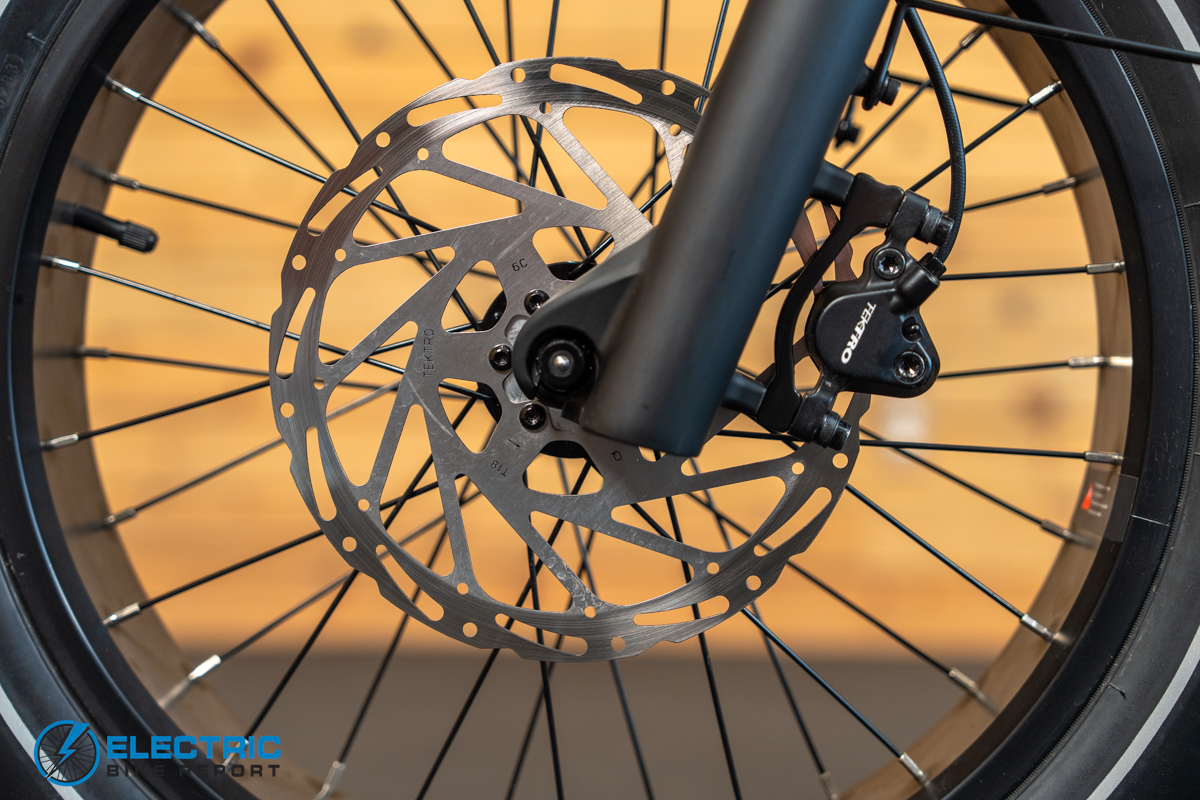
Tektro hydraulic disc brakes provide consistent and reliable stopping power.
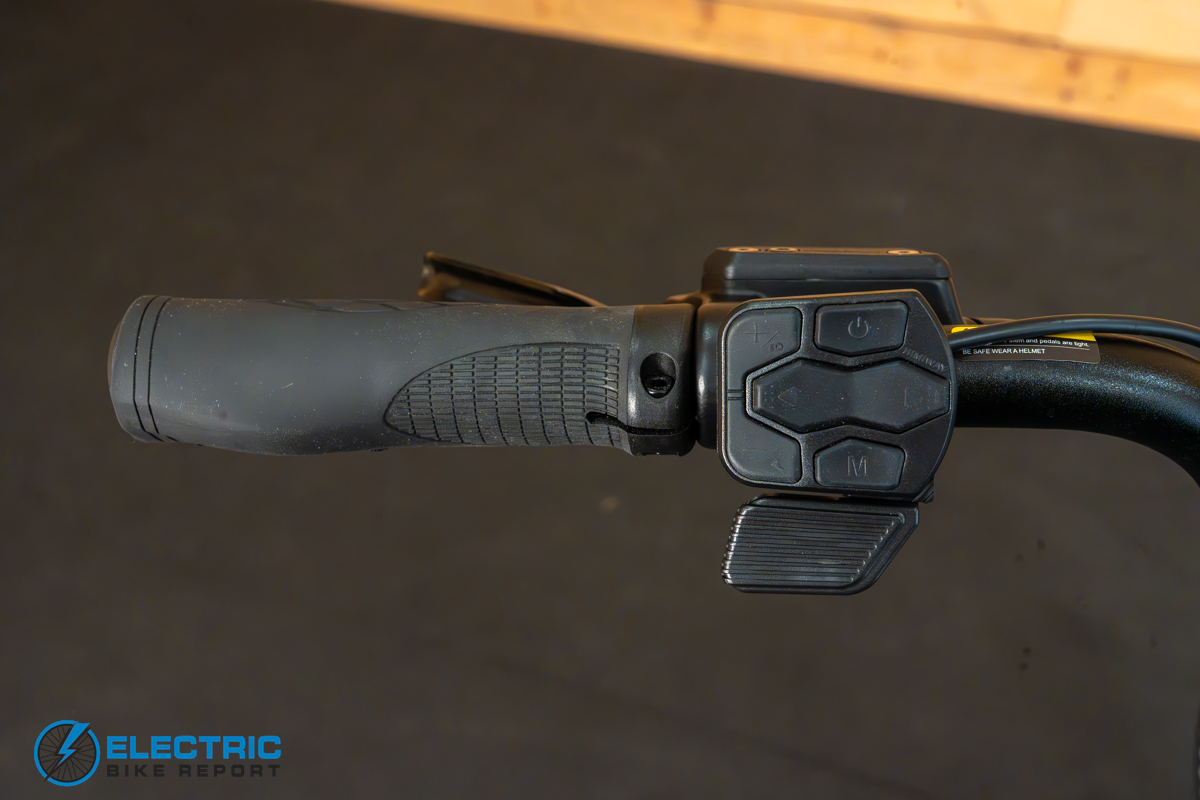
Riders can activate the throttle via the lever on the bike’s handlebar-mounted button pad.
Himiway D5 2.0 20″ Review: Brake Test
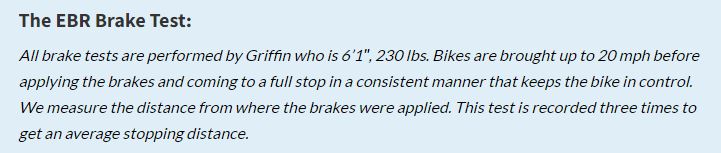
Continuing a trend of similar performance, the D5 2.0 20″ did a solid job in our Brake Test, where we evaluated the stopping power of its Tektro hydraulic disc brakes. To do so, our test rider, Michael, brought the bike to 20 mph, applied the brakes upon crossing a marked line, then measured the distance he traveled before stopping completely.
The bike’s average stopping distance after three tests was 19’3″ – just three inches beyond the average of 19’0″ among similar models we’ve tested. This is particularly impressive considering that Himiway’s utility e-bike is significantly heavier than the average of our comparison group. While it weighs roughly 88 lbs, the average is around 74 lbs, so the D5 2.0 20″ has noticeably more momentum for its brakes to overcome when slowing down.
The bike’s Tektro HD-3120 hydraulic disc brake system is clearly up to the challenge. This relatively common e-bike-specific brake set pairs two piston calipers with a 203mm front rotor and a 180mm rear rotor.
While not out of the norm for this style of e-bike, the larger front rotor was a smart move; its larger diameter provides better leverage and heat dissipation when compared to rotors of a smaller diameter. This effectively improves braking force and consistency, which, possibly in combination with the D5’s fully 4-inch-wide tires, landed the bike right around average despite its relatively high weight.
In my experience with the bike, its momentum and braking power were noticeable; applying the brakes with urgency and force brought the bike to a halt quickly, though it felt like it wanted to keep rolling. The tires could lose traction and squeal fairly easily (nothing abnormal or alarming), so modulating my force on the grips to avoid this was important.
Ultimately, the D5 2.0 20″ is specced well and capable of quick, effective stops, so it passes this test with our approval.
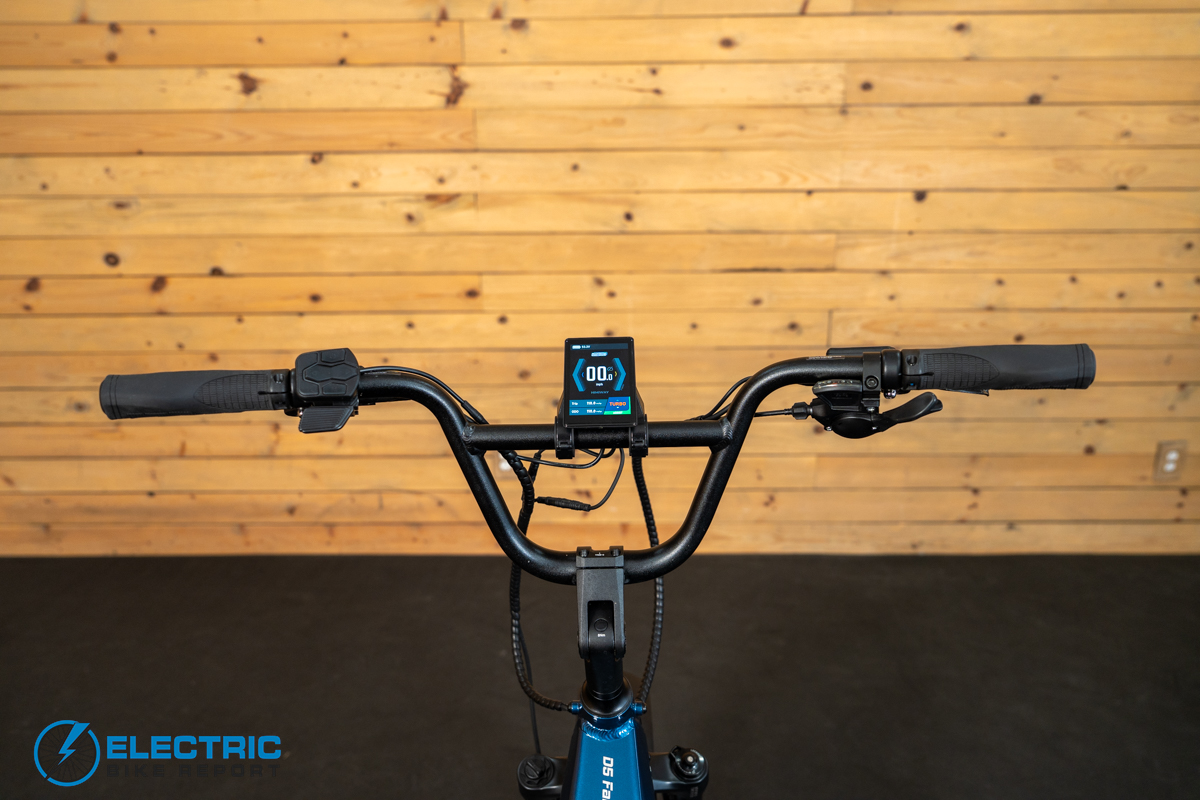
A set of wide BMX-style handlebars provides both comfort and confident steering control.
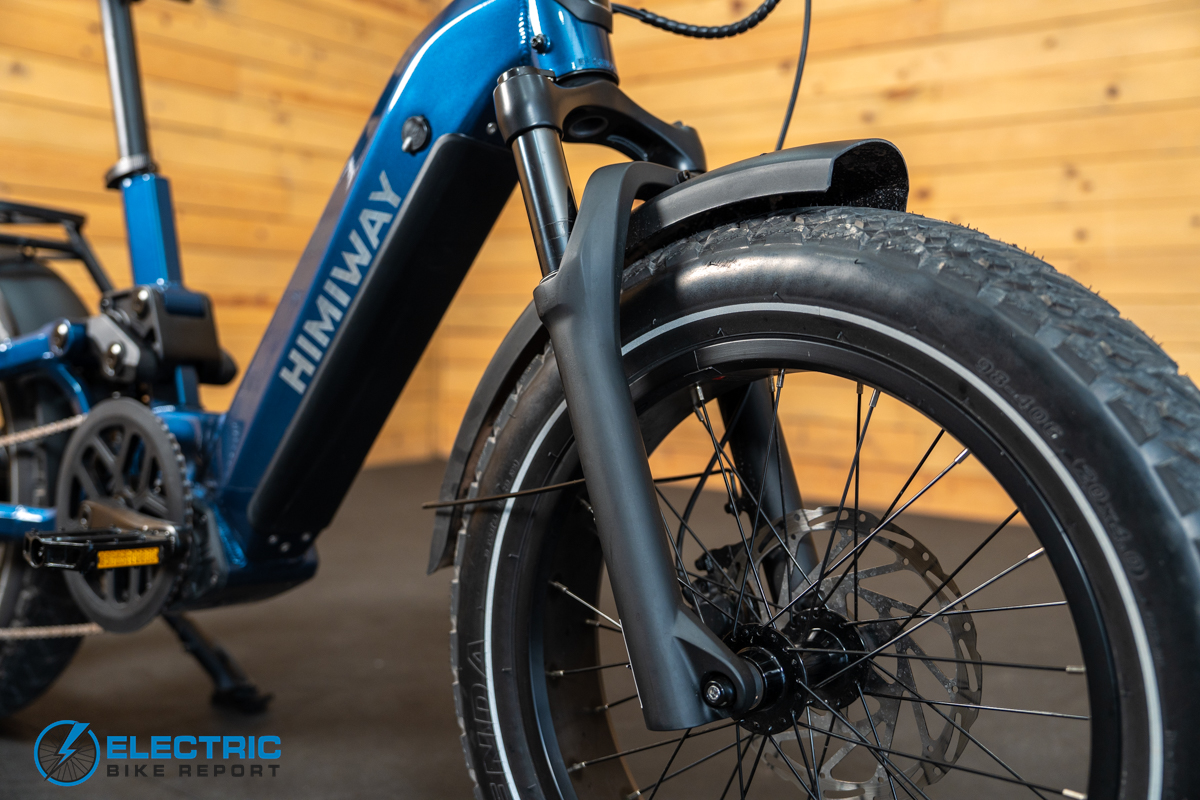
Himiway equipped the bike with a 90mm coil suspension fork with lockout and preload adjustment.
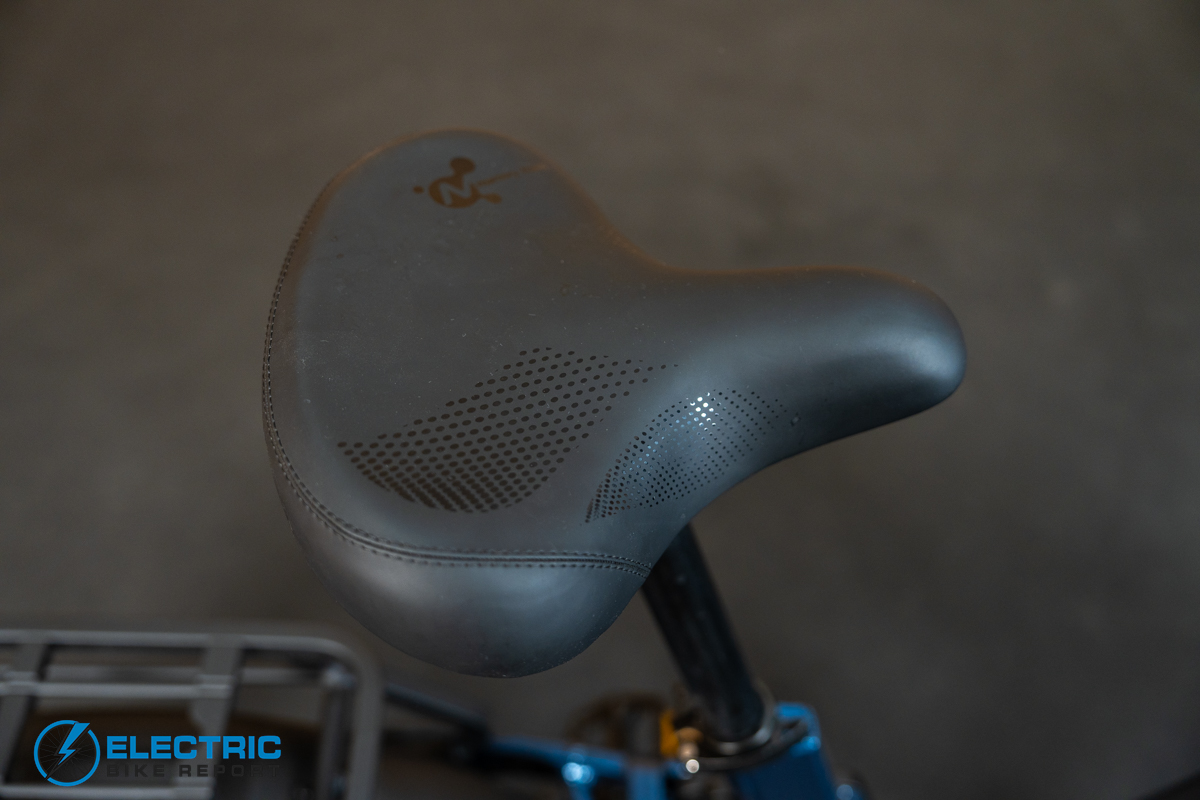
The large foam saddle is supportive without impeding movement when pedaling.
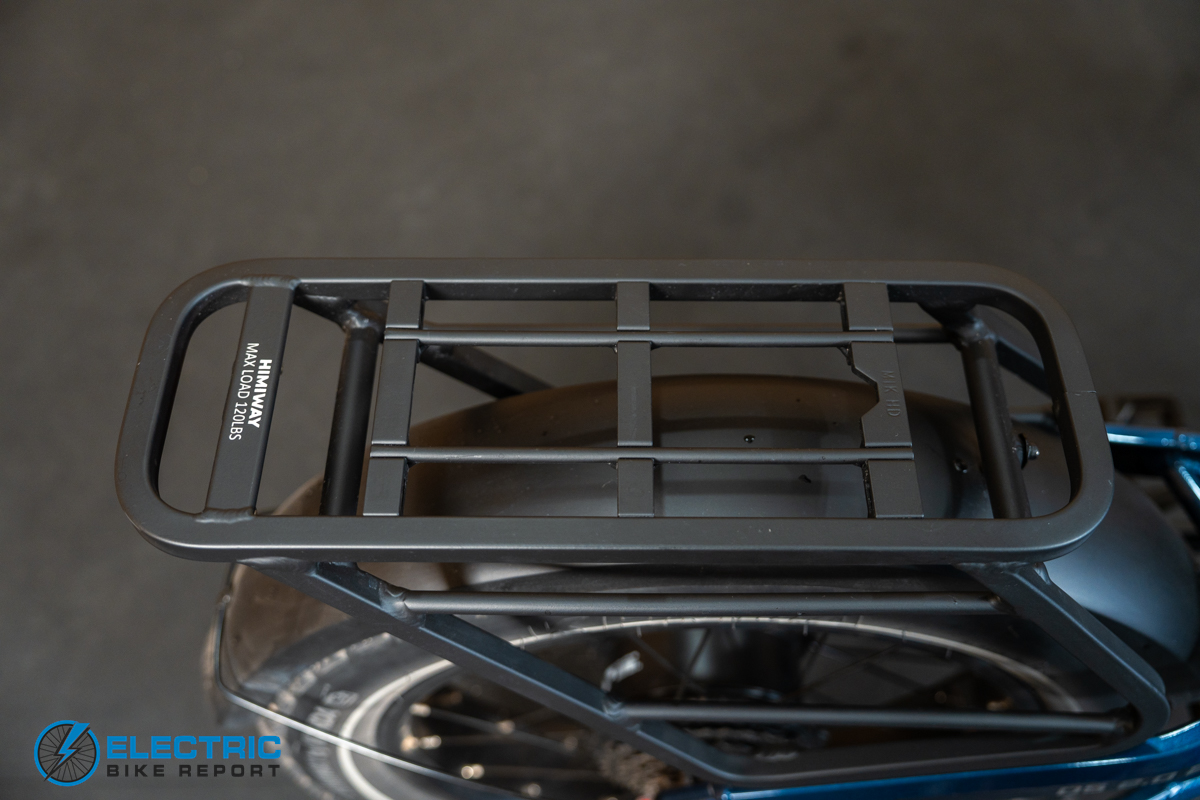
The rear MIK-HD cargo rack holds up to 120 lbs, making it ideal for cargo or a passenger.
Himiway D5 2.0 20″ Review: Ride Quality
A bike’s ride quality is a measure of how it feels to ride and use. It’s easy to quantify this aspect of a bike by saying things like “great” or “generally good,” but in truth, the subject is much more complex and nuanced. In this section of our review, we’ll consider the D5 2.0 20″‘s sizing, adjustability, user interface, handling, etc.
Like many similar models we’ve tested, this e-bike is offered in a single frame size that is meant to accommodate a fairly wide range of riders—Himiway states that it is appropriate for those between 4’11” and 6’3″. Its riding position is mostly upright, with a somewhat low seat and a fully adjustable set of handlebars that can be raised, lowered, and/or rotated to adjust their position.
At 5’11”, I generally found the bike comfortable to ride, though I also typically prefer more leg extension than this style of e-bike often provides. The D5 2.0 20″ is fairly characteristic of fat-tire utility e-bikes in that it keeps its riders’ knees somewhat bent at all times, so it’s important that the bike’s motor is able to make up for this to avoid causing strain or pain.
Fortunately, it handles this like a champ. As I’ve touched on in previous sections (specifically the Speed Test), all but the lowest power level (in the default torque mode) provides ample power that results in low-effort pedaling. Cadence mode is also ideal for those who want a relaxed experience, as it features a steady flow of power regardless of how much pressure the rider applies to the pedals.
Handling is one of the D5 2.0 20″‘s most defining characteristics. The bike’s relatively low stature and high weight keep it firmly stuck to the ground, while its wide tires make general riding and cornering feel confident and stable. It blends these aspects with easy, predictable steering and a high degree of maneuverability that adds a playful element to the ride.
To reiterate a point I made in the introduction to this review, this e-bike offers one of the smoothest, most comfortable, and most enjoyable riding experiences I’ve encountered on a utility model. Its full suspension felt well-tuned to match a rider of my weight (around 215 lbs), so bumps felt softened and the general ride felt lightly bouncy and pleasantly forgiving.
The D5’s contact points were also comfortable and supportive. I was somewhat concerned that I’d find its large memory foam saddle too wide, but I was happy to note that it was pleasant to sit on and did not impede my pedaling. The soft ergonomic rubber grips also remained comfortable to use on my longer test rides.
Motor engagement was generally quick and responsive, though I noticed it was somewhat less reactive at times in the optional Auto assist mode. When starting up, I had to push into the pedals more so than at other times to get the bike to respond. Once moving, this mode was remarkably user-friendly, effectively functioning as a “set it once and ride” setting.
The bike also has an optional cruise control mode, which must be enabled through the bike’s settings menu. Once this is done, the mode can be activated either by maintaining a constant throttle speed for at least 3 seconds or by manually holding the left turn arrow button for at least 1 second. Like a car, the bike will continue to hold this speed until cruise is deactivated.
Speaking of settings, the bike has an uncommonly robust menu that allows for customization of speeds, sensor modes, motor output, and power delivery. I found the menu to be well-organized and easy to navigate. It was also nice to be able to tailor the bike’s feel and function this comprehensively—especially without having to pair with an app.
Power delivery customization was one of the bike’s most unique options, and, perhaps, my personal favorite of the bunch. Riders can choose between five different settings that determine the rapidity or smoothness of the pedal assist system as the bike starts, during general riding, and when the power ends. After testing various combinations, I settled on the most rapid delivery up front, standard delivery while riding, and the smoothest delivery at the end.
As for other features and included accessories, the D5 holds up well when compared to many of its peers. It features integrated LED lights (with customizable taillight modes) and rear turn signals, fenders, a color display, and an MIK-HD cargo rack that can support up to 120 lbs. As such, it can be outfitted with a variety of locking accessories, including a child seat, cargo baskets, storage bags, etc.
All in all, the D5 2.0 20″ has great ride quality, checking the boxes we were looking for in almost all areas. The only area with some room for improvement is the sensitivity of Auto mode, but otherwise, the bike offers a hugely comfortable ride, easy pedaling, and a largely adaptable fit and pedal assist system.
Sponsor
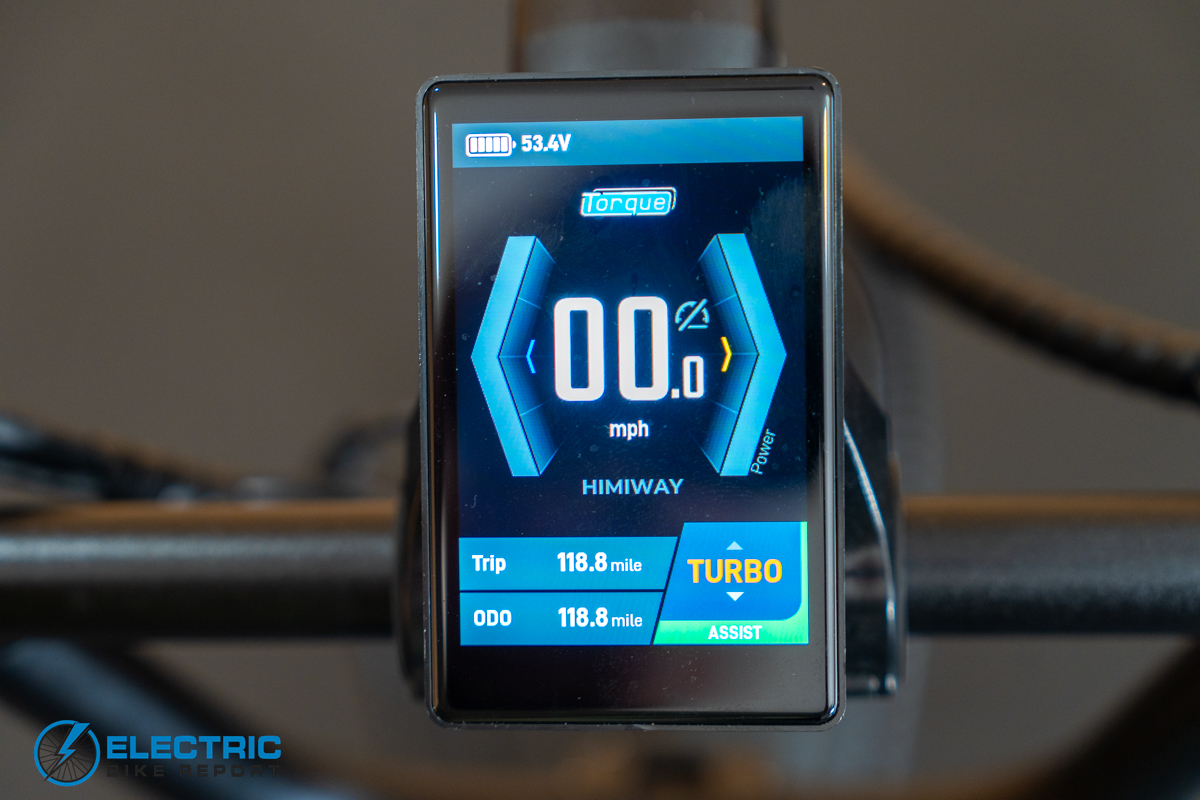
The large color display is relatively complex but well-organized and pleasant to look at.
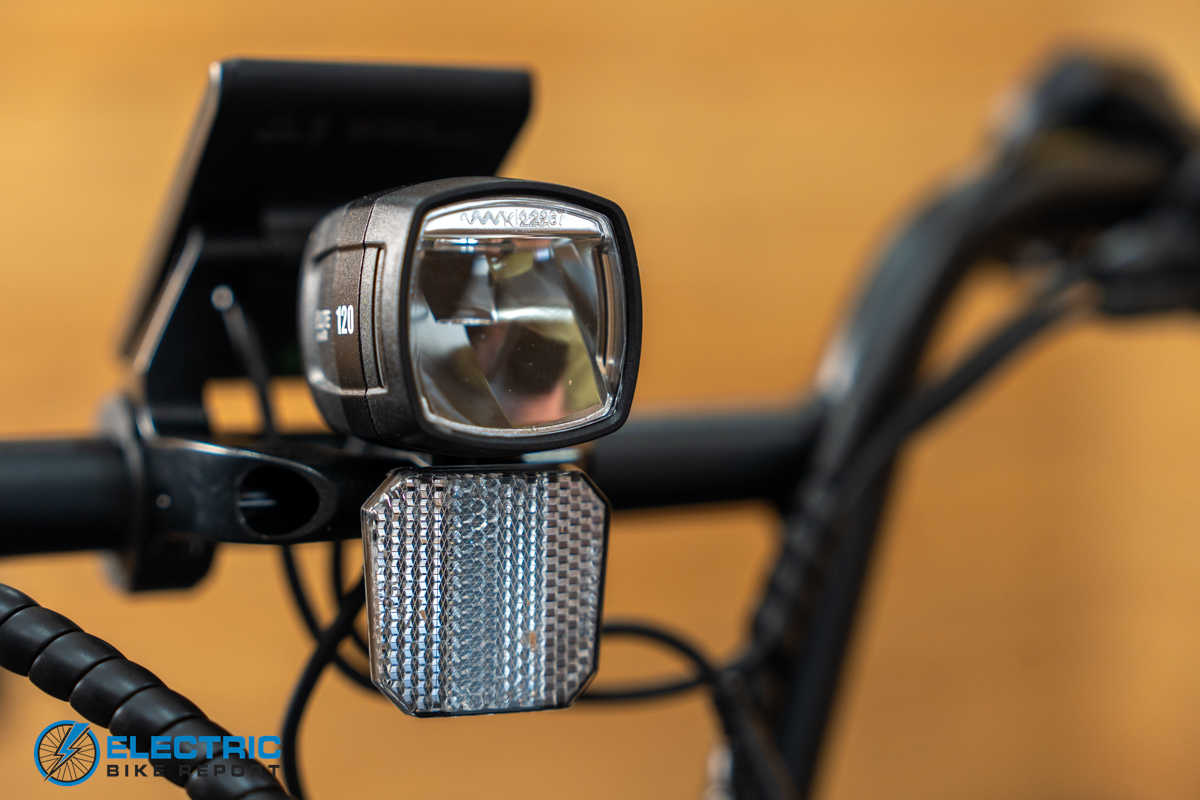
Up front, the D5 has a large LED headlight mounted to the same bracket as the display.
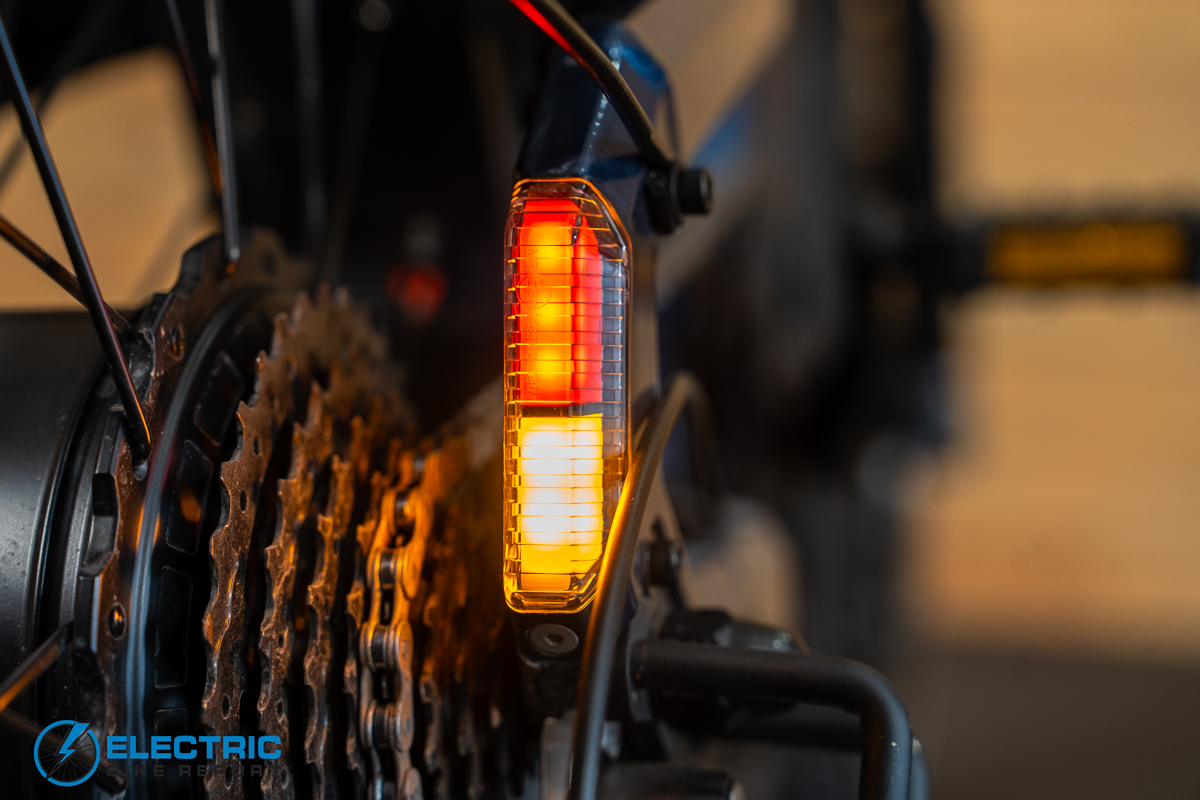
Chainstay-integrated taillights and turn signals make riders (and their intentions) more visible.
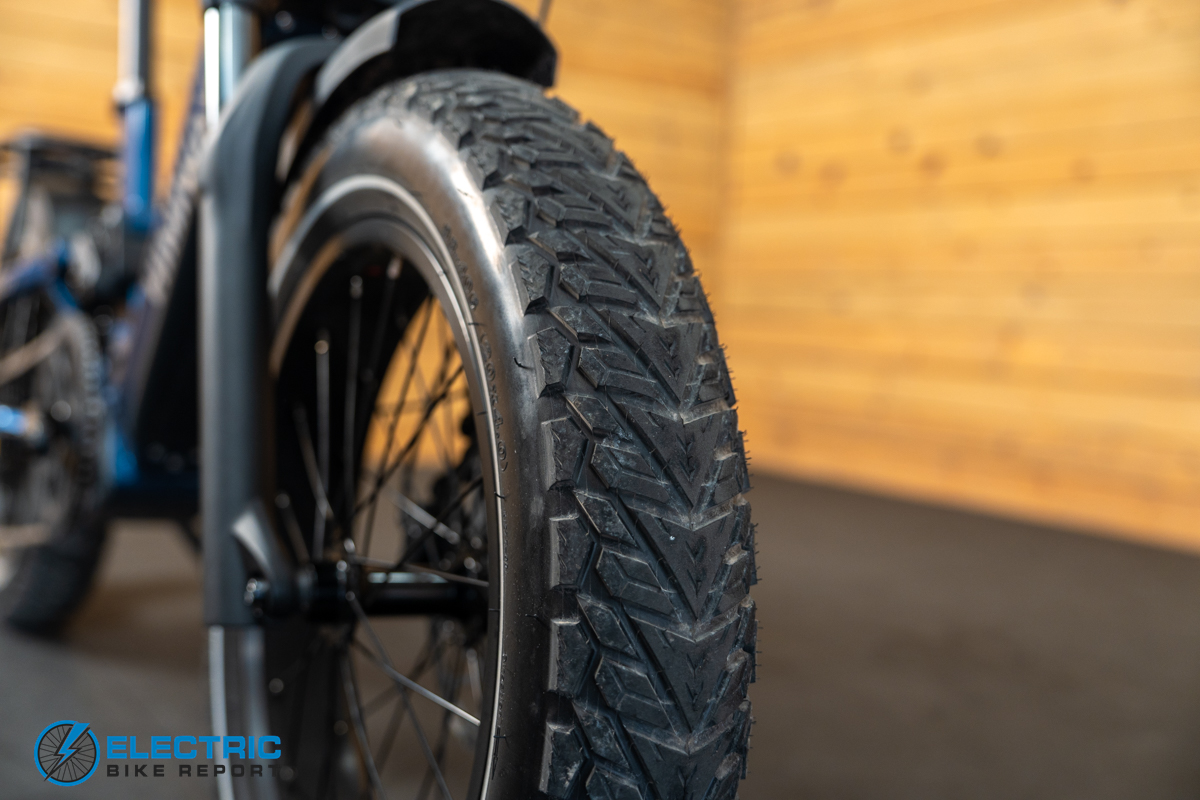
The custom 20×4″ fat tires feature a chunky tread pattern for on and off-road riding.
Himiway D5 2.0 20″ Review: Summary / Where to Buy
At the time of writing, my last experience with Himiway’s e-bikes was a couple of years ago, when I tested and reviewed the brand’s A7 Pro commuter. That e-bike made a strong and lasting impression, but given the span of the interim between reviews, I was not sure what to expect from the D5 2.0 20″.
I’m happy to report that this e-bike has the same solid performance, impressive ride quality, and overall high-quality feel as the previous model we tested. It also generally scored well in our testing, with range, climbing abilities, and braking power that all hold up well when compared with similar e-bikes on the market.
To reiterate a statement I mentioned above, average performance in the context of similar e-bikes is great! It’s not necessary for new models to constantly raise the bar; being able to keep pace with similar models is enough to prove that a bike is well put together and equipped to meet most riders’ needs.
If you’re considering a utility-style e-bike, the D5 2.0 20″ is a great option for riders wanting a remarkably comfortable and customizable experience. Whether used for casual fun, daily travel or delivery work, or regular family outings and errand running, this e-bike proved it can handle just about anything most riders will throw at it.
Our only areas of critique were minor, and included the bar-based battery charge meter and somewhat stiff feel of the Auto assist mode. In the grand scheme of things, neither should be a dealbreaker; they’re both small inconveniences that don’t greatly affect the bike’s performance, ride quality, or overall usability.
Ultimately, the D5 2.0 20″ proved easy to recommend for riders who prioritize fun, comfort, adaptability, and overall versatility. We’re also pleased to note that, despite a couple of years passing since our last experience with Himiway, the brand has continued moving in the right direction!
Happy Riding! Make sure to let us know if you have any questions or if you think we left anything out in this review of the Himiway D5 2.0 20″ down in our comments section.
Sponsor
Sponsor
Reader Interactions
Leave a Reply