Lectric XP Lite3 Review | More Features & Options Than Ever
Oct 27, 2026
 0 Comments
 Share
This relatively lightweight and value-packed e-bike balances simplicity and usability, with options for just about any rider and budget level.
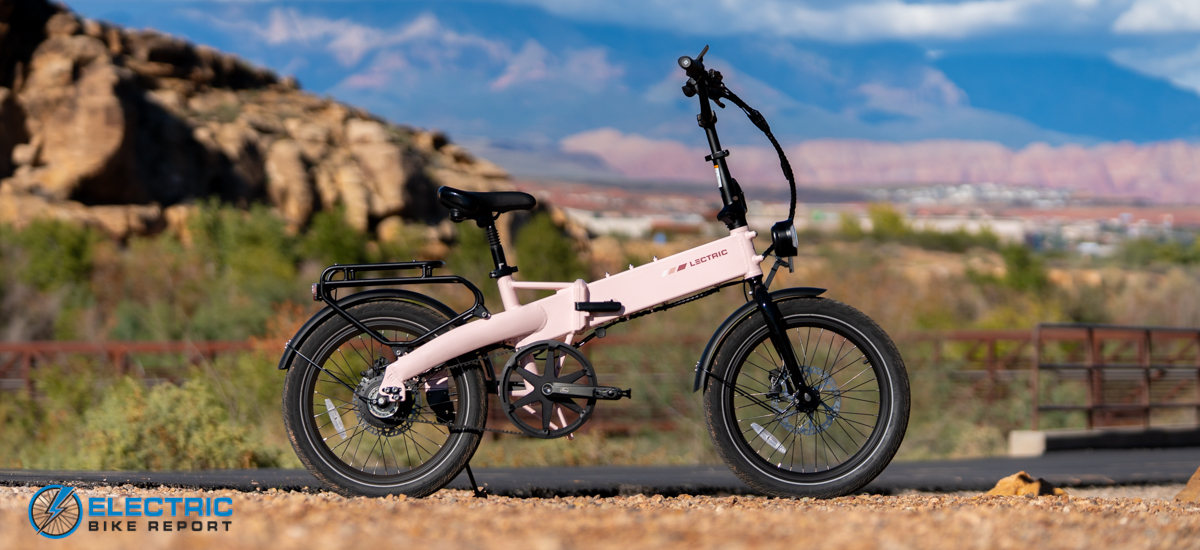
As Lectric has grown to be a titan of the US e-bike industry, one of the company’s core values has remained exactly that: value. At the beginning, Lectric’s goal was simply to make quality, affordable e-bikes. Each subsequent generation of its products has improved upon the last, offering more and/or better features and a lower price than the competition.
With the third-generation XP Lite3, the brand has proven once again that riders on a budget don’t need to settle for scraps. This highly affordable folding e-bike—which starts at around $800—brings its A-game and punches above its price point.
Compared to the previous iteration of the Lite, this new-and-improved model shares a similar foundation. It’s still powered by a cadence-sensing 300W rear hub motor and a simple, single-speed drivetrain. It also remains a Class 1 and 2 e-bike offering both throttle and pedal assist up to 20 mph.
The white-only base model is relatively spartan, with a 374 Wh battery, a chain drive, and no included rack or fenders. It does, however, have a handful of upgrades from the previous version of the bike, with a new color TFT display, a custom hydraulic brake system, and integrated rear turn signals. These are uncommonly premium touches for a sub-$1k e-bike.
Upgraded versions of the XP Lite3 include a host of extras, such as a larger 672 Wh battery, a suspension seatpost, aluminum fenders, and, at the top end, a Gates Carbon belt drive and a 50-lb-capacity cargo rack. These features expand its range and add everyday usability to a bike that already covers its bases well.
One other standout feature on all versions of the Lite3 is the addition of three power profiles, which allow riders to choose whether their riding speed is tied to the selected pedal assist level or not. As we’ll cover below, this has a huge impact on how the bike feels and functions.
We tested the fully upgraded version of the XP Lite3, which is priced at $1,099. Our bike included the belt drive, all of the aforementioned accessories, and the largest battery. As always, our review will focus on its performance in our standardized Speed, Range, Hill, and Brake Tests, but we’ll also discuss its overall ride quality and user experience.
Continue reading below to see how it stacks up against similar folding e-bikes we’ve tested—and decide if it’s the right e-bike for you!

Sponsor
E-Bike Category:Folding
E-Bike Class:Class 1 (pedal assist to 20 mph)
Class 2 (throttle to 20 mph)
Class 2 (throttle to 20 mph)
Sponsor
Lectric XP Lite3 Video Review
 Pros
- It’s simply a great bike at a fantastic price! Starting at around $800, there are three spec levels offered, with Long-Range battery and/or belt drive options (in addition to the base model).
- Weighing 53 lbs with its battery and all of its accessories, the XP Lite3 is one of the more portable e-bikes we’ve tested.
- The bike offers multiple power profiles with distinct feels. Riders can choose to control their speed with limits in each assist level, or opt for a more natural-feeling power-based mode.
- New upgrades (uncommon at this price point) include a color TFT display, powerful custom hydraulic disc brakes, and integrated turn signals.
- With a recommended height range of 4’8″ to 6’2″, the XP Lite3 fits a wide range of riders—and some of the shortest we’ve seen an e-bike accommodate.
- On mid- and top-tier spec levels, the ride is made smooth thanks to the combination of a suspension seatpost and 2.5-inch-wide tires. A zero-degree stem on all models also adds comfort.
- The XP Lite3 comes in a total of six cool colors, with the selection dependent on the chosen spec level.
 Cons
- The requirement to leave a key inserted in the bike while riding is dated; we encourage Lectric to change this in the future.
- While it may have been limited to our test bike, the battery rattled when rolling over bumps. Some internal padding would reduce or eliminate this noise.
ELECTRICAL SPECS & FEATURES
- Battery: 48V, 374 Wh (we tested a Long Range 672 Wh battery)
- Charger: 2A
- Display: 3.5-inch full color TFT display
- Motor: 300W Stealth M24 rear-hub motor, 819W Peak, 28 Nm Torque
- Headlight: Integrated LED
- Taillights: Integrated LED with turn signals
- Pedal Assist: 5 Levels (Eco, Tour, Sport, Sport+, Turbo)
- Claimed Range: Up to 80 miles
- Throttle: Twist throttle
- App: None
- UL Certification: UL 2849 and UL 2271 Certified
Weight & Dimensions
- Claimed weight: 49 lbs
- Tested Weight: 53 lbs
- Rider height range: 4’8″ – 6’2″
- Total payload capacity: 275 lbs
Components & Accessories
- Brakes: Star Union 602 hydraulic disc brakes, 180×2.3mm rotors
- Fenders: Aluminum
- Fork: Rigid Aluminum
- Frame: Aluminum
- Drivetrain: Single-speed; 56T chainring, 16T freewheel (Chain version); 70T chainring, 22T freewheel (Belt version)
- Grips: Lock-on ergonomic rubber
- Saddle: Custom Lectric sport saddle
- Handlebar: 660mm BMX-style handlebar
- Kickstand: Aluminum
- Pedals: Quick-release Aluminum
- Tires: 20×2.5″
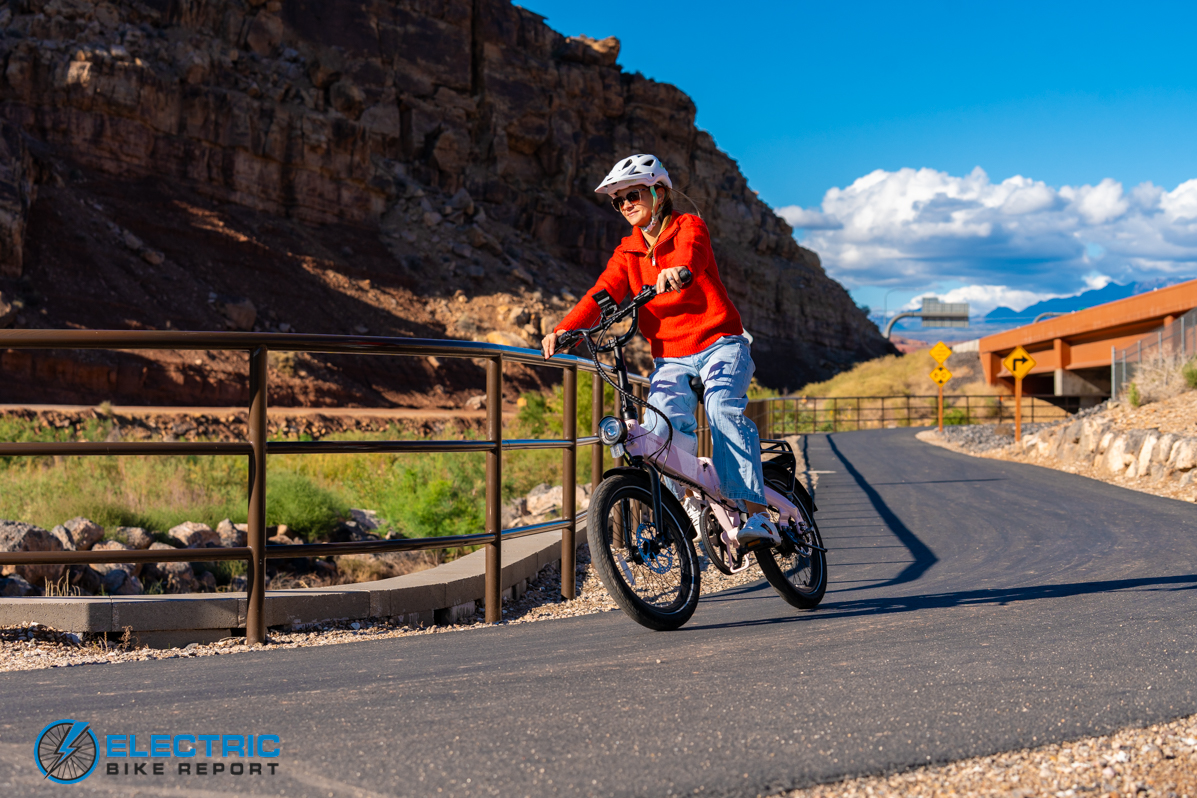
Whether via throttle or the XP Lite3’s five levels of pedal assist, the bike can cruise at a comfortable speed of 20 mph.
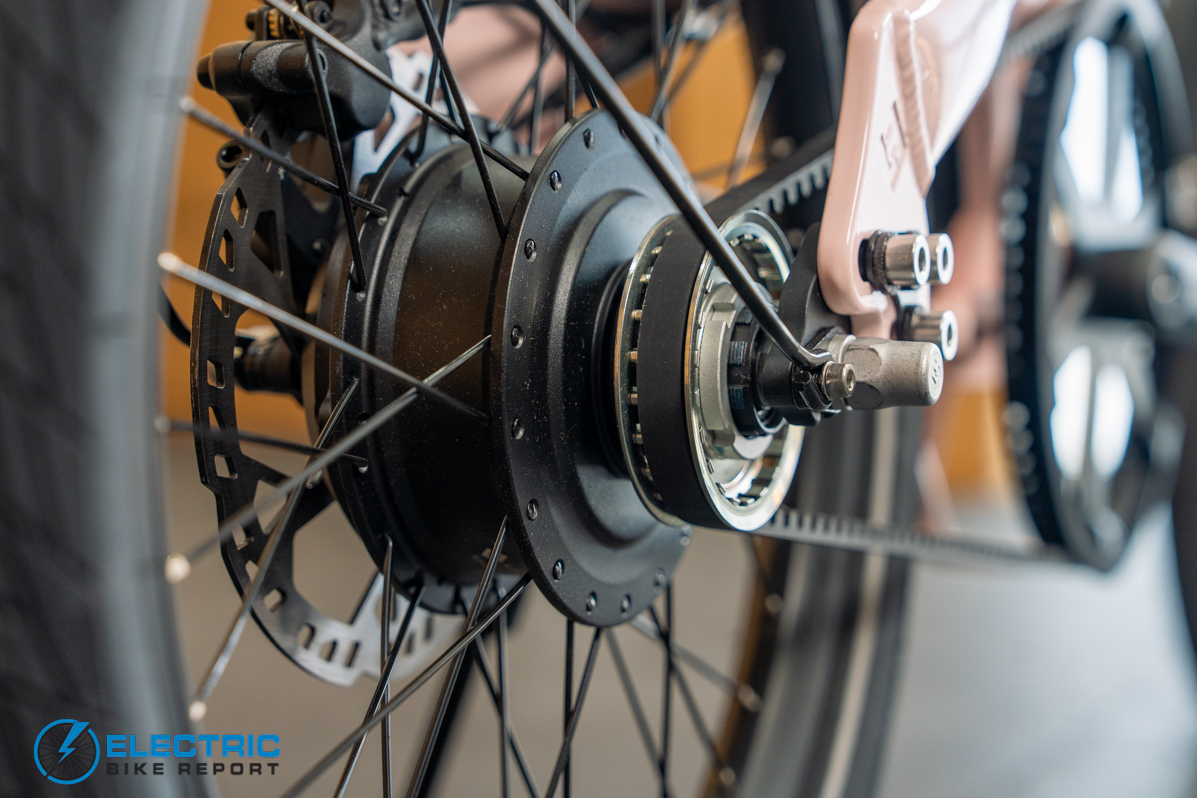
Like previous versions of the bike, it is propelled by a 300W rear-hub motor with 819W of peak power and 28 Nm of torque.
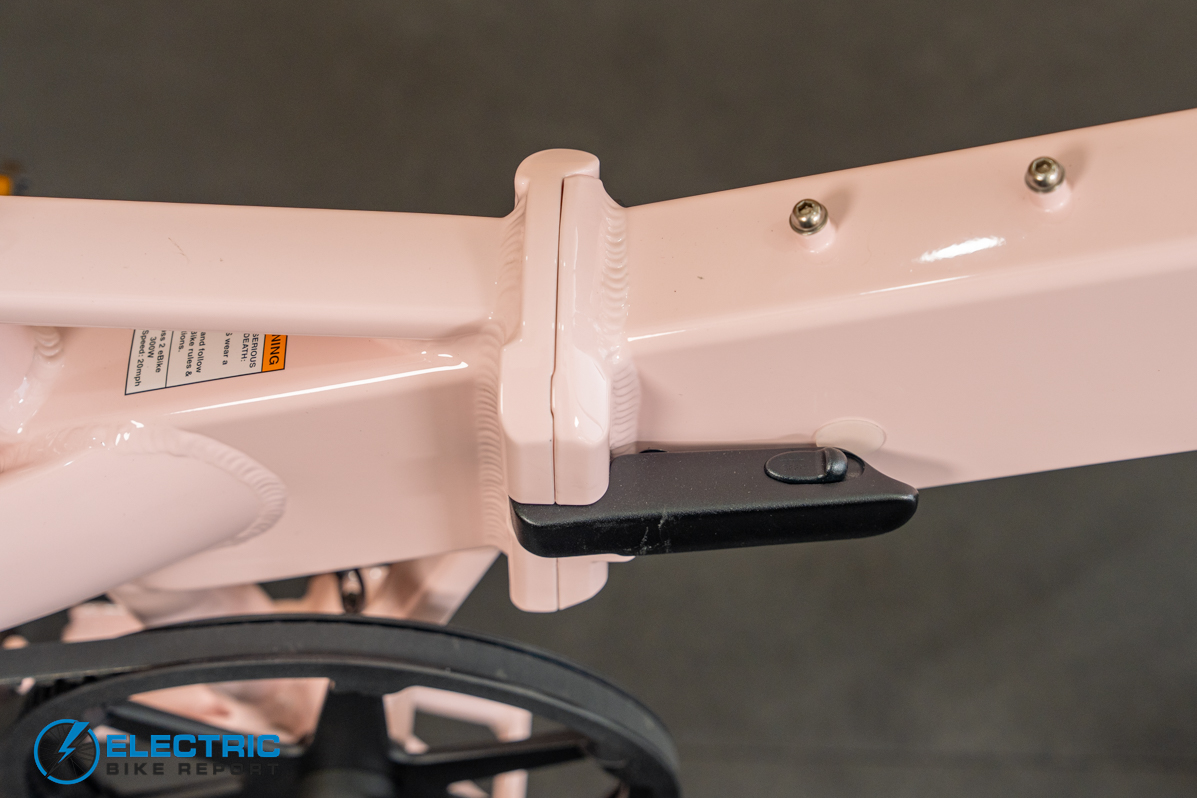
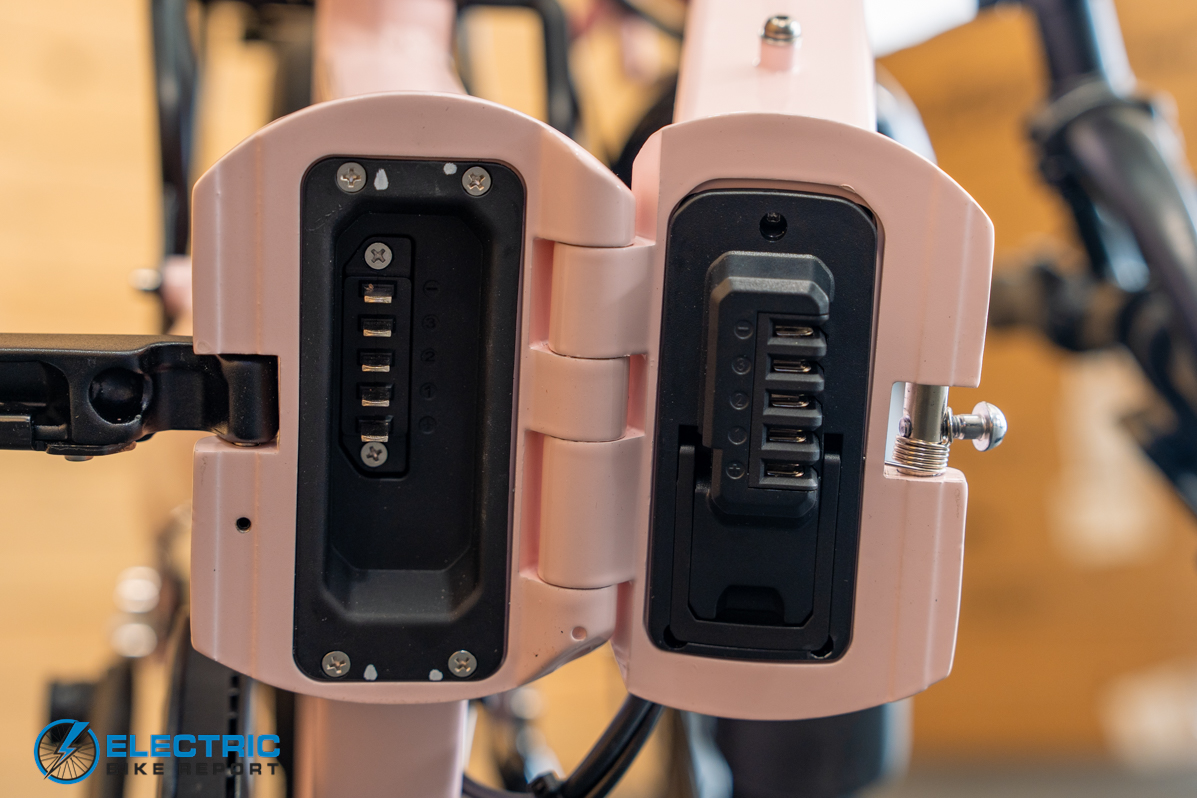
For this version, Lectric redesigned the frame and used the same hinge mechanism as the larger XP4.
Lectric XP Lite3 Review: Speed Test
As a cadence-sensing Class 1 and 2 e-bike with throttle and pedal assist topping out at 20 mph, the XP Lite3 is fairly straightforward. We tested its ability to reach this maximum speed, along with the speeds of each of its five pedal assist levels, by riding on a flat, paved network of multi-use paths.
The power profiles I mentioned in the introduction to this review added an additional layer of customization to the bike that hadn’t existed previously. It’s also the first time we’ve seen this ability on such an affordable e-bike. While other, more costly models from Lectric offer both true torque- and cadence-sensing pedal assist modes, this is a way to provide a similar experience on a more budget model.
In the default mode, where both speed and power are limited by the pedal assist settings, my test results marked well-spaced, intuitive, and incremental jumps in power. This is clearly shown in the graph above by the linear pattern in yellow. I found the roughly 5-mph speed of Eco to be a bit too low, as I could pedal above this speed without power, but the four higher levels were much more practical and useful.
As a side note, I didn’t experience much of a difference in feel when using the bike’s second power profile, where only its speed is tied to its pedal assist level. I didn’t record a separate test with this mode for that reason.
The third mode, where only power output is limited, was a different story. This mode made Eco completely usable, since it provided a steady boost to my pedaling, which gave the bike a less restricted analog-like feel.
Higher settings increased power (and therefore, my speed) significantly, as shown by the blue line on the graph. Two large but measured jumps in speed were followed by two smaller increases. I reached 20 mph in PAS 4 when riding on flat ground, leaving the highest power level to provide some extra muscle for hills.
In addition to the two pedal tests, I also tried out the XP Lite3’s throttle. Like the pedal assist system, throttle acceleration force/speed are tied to the bike’s power level. Even in Turbo, the throttle picked up gradually and safely, then accelerated steadily up to 20 mph.
Overall, the bike performed well in this test. The lowest assist level’s speed could be raised to be more practical in the default power profile, but otherwise, the XP Lite3 offers useful and intuitive programming with an uncommon level of customization for a bike at its price point.
Sponsor
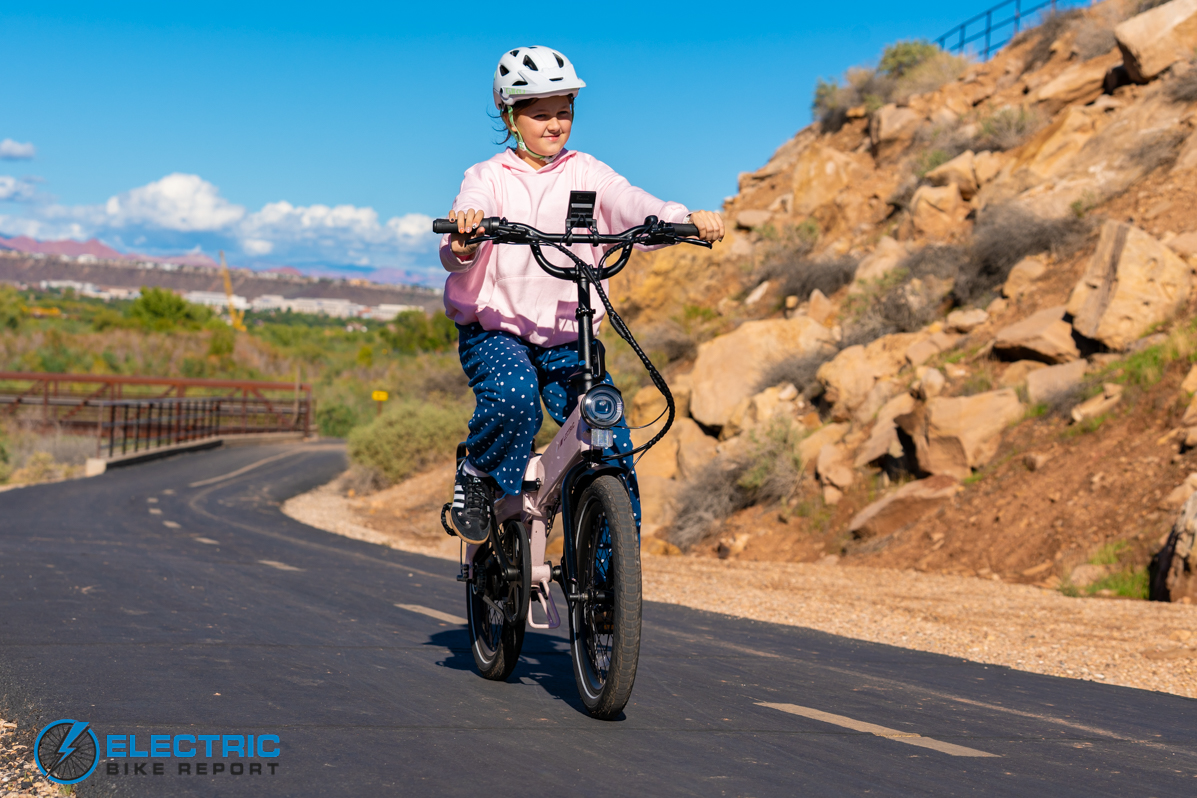
With a recommended height range as low as 4’8″, the XP Lite3 is suitable for young riders, adults, and seniors alike.
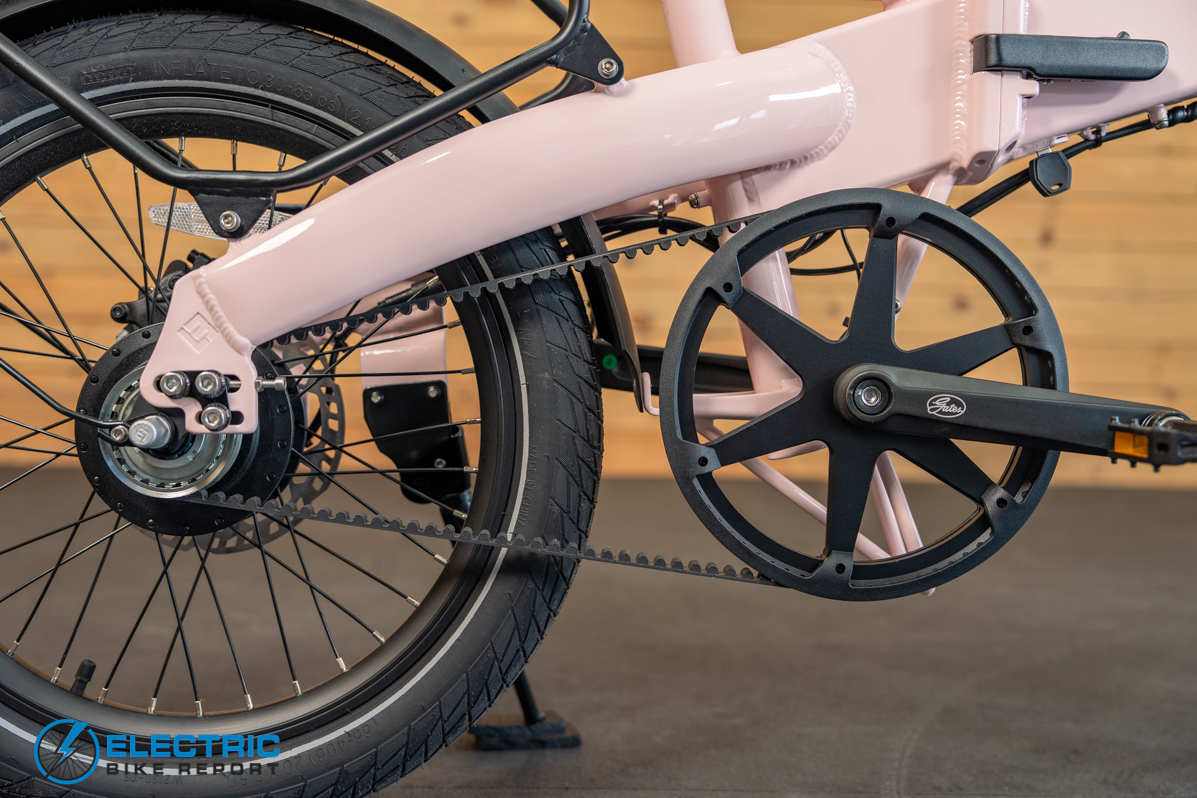
The top-tier model features a quiet, low maintenance Gates Carbon belt drive.
While the base model features a 374 Wh battery, we tested the larger 672 Wh unit.
Lectric XP Lite3 Review: Range Test
As I mentioned in the introduction, we tested the fully upgraded long-range belt-driven version of the XP LIte3. This model boasts a claimed maximum range of up to 80 miles. We tested the bike’s minimum and maximum range in the real world by riding in its highest and lowest pedal assist levels, starting both tests with a full charge and riding until the battery charge reached 0%.
Importantly, we performed our high-power range test with the pedal assist system set to the default mode, where both maximum speed and power output are tied to Turbo mode. In the low-power range test, we used the power-only limit for Eco, since we found the speed limit of this setting in the default mode too slow for practical use.
Our test riders covered a respectable 25.8 miles using Turbo and 44.5 miles in the Eco test. A group of similar folding e-bikes we tested averaged 28.8 and 59 miles, so the XP Lite3 was roughly average in its high-power range test and well below average in its low-power test.
Breaking down these results is somewhat complicated, as the XP Lite3 had a larger-than-average battery coupled with a less-powerful-than-average motor.
Additionally, the XP Lite uses a cadence sensor, which helps keep it at a highly affordable price point. Many of the relatively recently-tested models in our comparison group offer more energy-efficient torque-based pedal assist systems—and are often also more expensive for this reason.
To dig deeper, we can examine the Lite3’s energy consumption by dividing its battery capacity (672 Wh) by its mileage.
In Turbo, the bike used 26.1 watt-hours per mile (Wh/mi), while other folding bikes we’ve tested averaged 22.1 Wh/mi. In Eco, the difference was similar; the XP Lite3 expended 15.1 Wh/mi, while other folding e-bikes used 11.3 Wh/mi. In both cases, Lectric’s folding e-bike used roughly 4 watt-hours per mile more than its peers.
It is possible that we would have been able to cover more miles in our Eco mode test had we used the default setting where the bike’s speed was limited to around 5 mph. Considering that we were able to pedal the bike above this limit comfortably without power, however, we believe most riders would opt for a higher assist setting with a faster and more practical speed.
While Lectric’s advertised 80-mile maximum range seems hopeful, and the bike may benefit from some revision to this number, we still consider the mileage of our real-world tests to be both usable and useful.
Importantly, most riders of the upgraded version of the bike should expect to cover multiple trips on a single charge, regardless of which pedal assist setting they use. Of course, those who are willing to share their effort with the motor when using Eco (with the power-limit-only profile) should expect both practical speed and range.
We can also use our test results to estimate mileage for the base model of the XP Lite3. By the numbers, riders should expect roughly 14.3 to 24.8 miles of range with the standard 374 Wh battery. Clearly, this version of the bike is somewhat more limited when using maximum power, and there is some incentive to upgrade, but it should still work well for riders covering modest distances who also want to save some extra cash.
Sponsor
Sponsor
Lectric XP Lite3 Review: Hill Test
Given its 300W rear-hub motor, we didn’t anticipate that the XP Lite3’s performance in our Hill Test would be all that remarkable, but we were happy to be proven wrong. We tested its climbing power at two locations: our main test hill, called the Devil’s Backbone (explained above), and our secondary hill, Pilot Hill.
Our test rider, Justin, performs each formal hill test for the sake of consistency. On throttle-equipped e-bikes like the XP Lite3, he performs one throttle-only test followed up with a second run using the highest level of pedal assist.
At the Devil’s Backbone, he completed both climbs successfully, finishing the throttle test in 3:11 with an average speed of 9.5 mph. His pedal test was significantly faster, with a time of 2:17 and a speed of 13.2 mph.
Credit where it’s due: e-bikes with motors under 500W rarely complete a throttle test at this location, but the XP Lite3 proved to have enough muscle to finish the climb. At the time of writing, it’s one of only a handful of low-powered models that proved so capable.
When compared to many other folding e-bikes we’ve tested, the Lite3’s 300W motor does come into focus. Our comparison group, which includes many more powerful models, completed their tests in 2:16 on throttle and 1:55 when pedaling.
With 819W of peak power and just 28 Nm of torque, the Lite is on the slower side in comparison to these bikes, but this is completely understandable when considering that they averaged significantly higher output of 1119W and 78 Nm of torque. At around 53 lbs, the Lite3 also weighs noticeably less than these other bikes (which averaged 68 lbs); this likely gave it a bit of help in completing the climb.
I personally performed our Pilot Hill tests, using the same approach that Justin did with our “official” test. While this hill is less extreme than the Devil’s Backbone, I weigh significantly more than Justin, and I was thrilled when the XP Lite3 completed its throttle test at this location. Admittedly, the bike wasn’t particularly fast on throttle power alone, but it didn’t struggle, shut down, or overheat, which is a huge win in my book.
When pedaling, the limitations of the bike’s single-speed drivetrain were noticeable, but it performed well overall. Without the ability to shift to a lower gear, the climb required a moderate level of effort from me, but as with Justin’s test, my time was significantly faster, and the process was generally smooth and easy.
In short, the XP Lite3 can climb hills better than it has any right to when simply looking at the numbers. It’s capable enough to give most riders the option to throttle or pedal uphill, with impressive power for its price point and specs.
Sponsor
The XP Lite3 offers multiple riding modes that change the feel of the ride. The default Speed & Power Limit mode offers easy control with incremental steps in speed, while the Power Limit mode has a more analog-like feel.
We were highly impressed with the bike’s throttle-only climbing power!
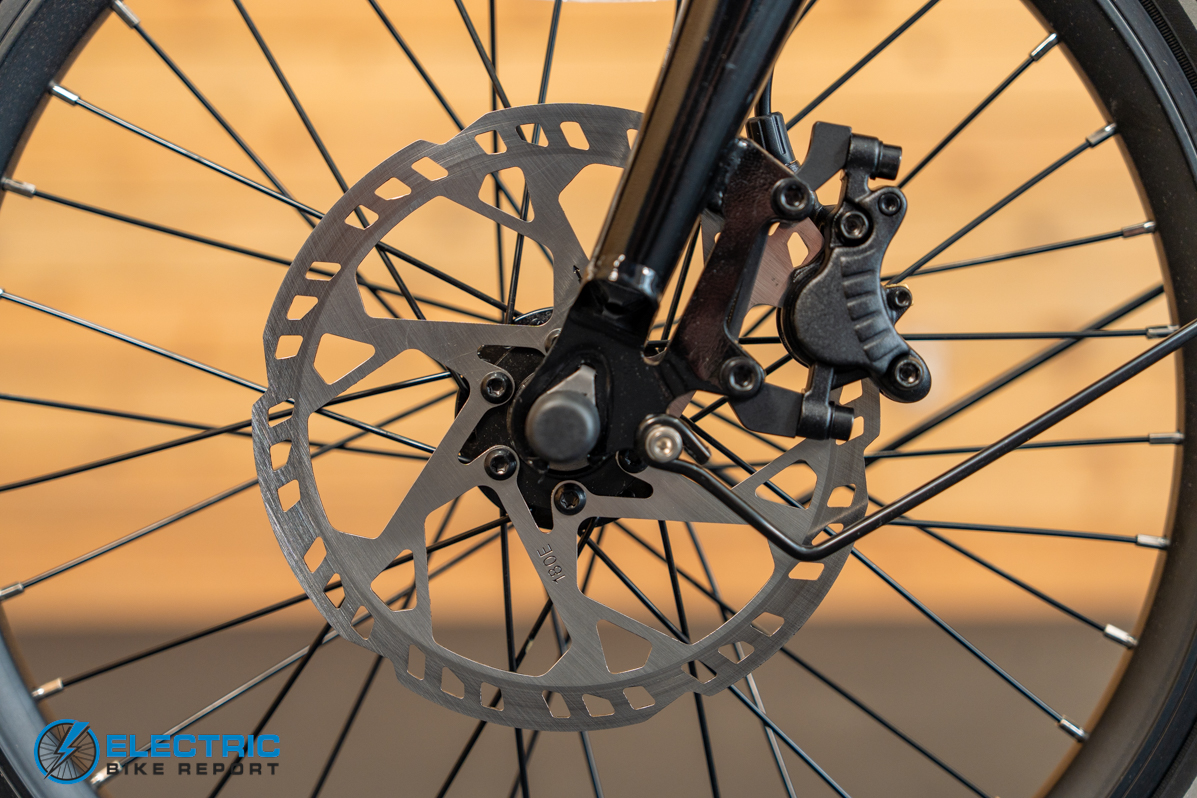
Lectric equipped the bike with a custom brake set that was both safe and effective.
Lectric XP Lite3 Review: Brake Test
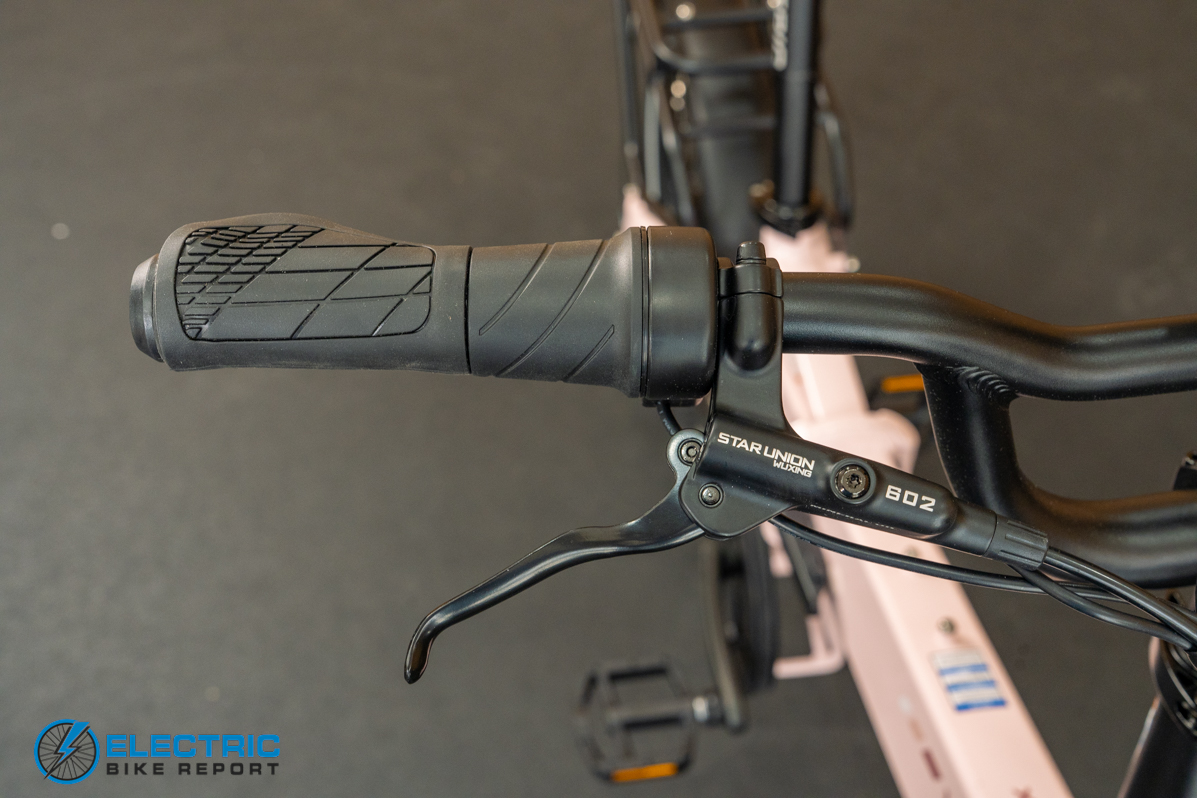
One of the XP Lite3’s most noticeable upgrades from the previous model is its brake set. Like most other models in its current lineup, Lectric equipped the bike with hydraulic disc brakes it developed in conjunction with Star Union: the 602 model, which pairs two-piston calipers with 2.3mm-thick 180mm rotors.
We tested the bike’s stopping power by bringing it to 20 mph, applying the brakes as its front wheel crossed a set of traffic cones, then measuring the length of its travel before stopping. We performed three tests in this fashion, taking all of its results and averaging them for a final score of 19’3″.
For context, our comparison group averaged 19’1″, so the Lite3 fell right in line with similar models we’ve tested.
Our previous experiences with the bike’s brake set showed that it is uncommonly robust—especially when compared to the performance of other budget-tier models, which often use unbranded components or those from less-established brands.
Based on this history, and the XP Lite3’s low weight, we anticipated a slightly shorter result, but the bike’s tire width may have offset these factors to some degree. At 2.5 inches wide, they offer slightly less grip than the 3-inch or wider tires that we often see on comparable folding e-bikes.
Still, the bike performed very well; results near to the category averages show that it is specced well for its size, weight, and speed. For greater perspective, e-bikes of all categories we’ve tested average around 21’3″, so the XP Lite3—and the entire folding e-bike category—tends to do well in this test.
In my personal experience, the brakes did indeed feel powerful and highly effective. The Lite3’s street tires did have somewhat of a tendency to skid when braking, so finding the right amount of pressure was important. Overall, though, the brakes modulated my speed with only light pressure on the levers and they brought the bike to a stop quickly and relatively forcefully.
We’re completely satisfied with the XP Lite3’s braking performance; it’s safe, reliable, and well-specced.
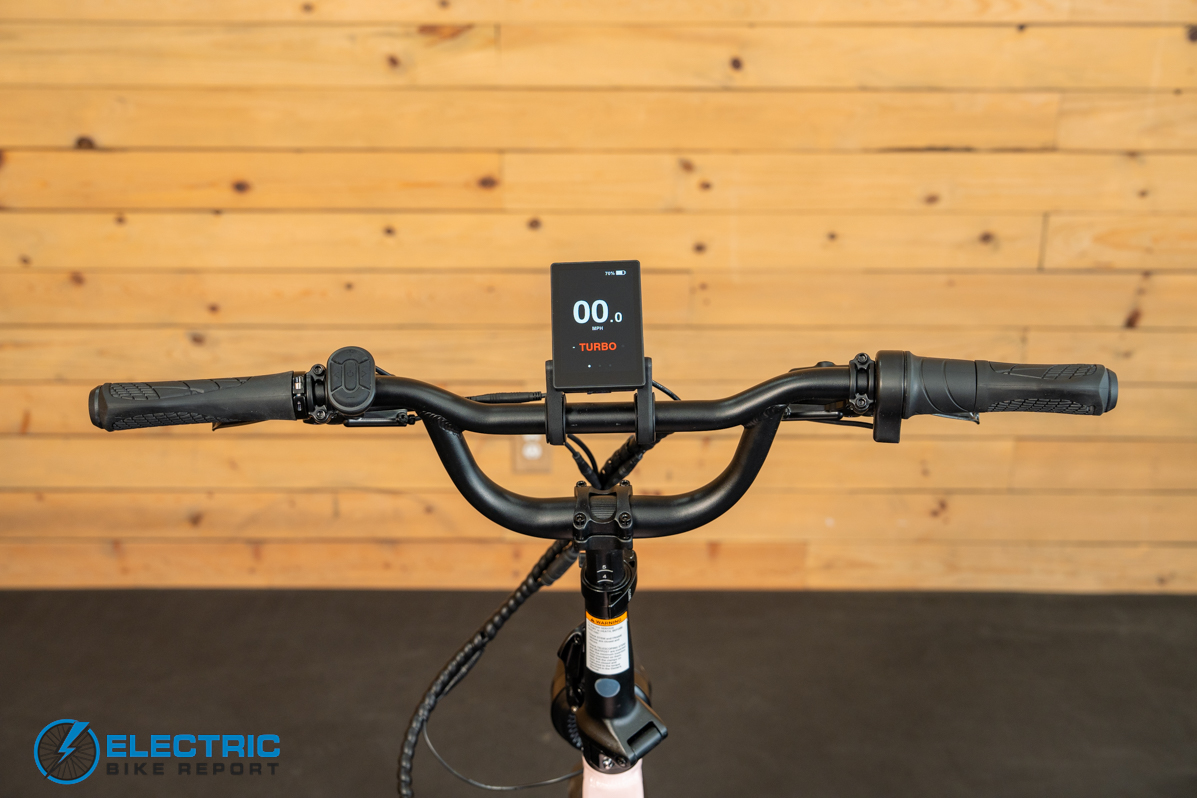
Riders can adjust the angle of the 660mm BMX-style handlebars to tweak the Lite3’s fit and comfort.
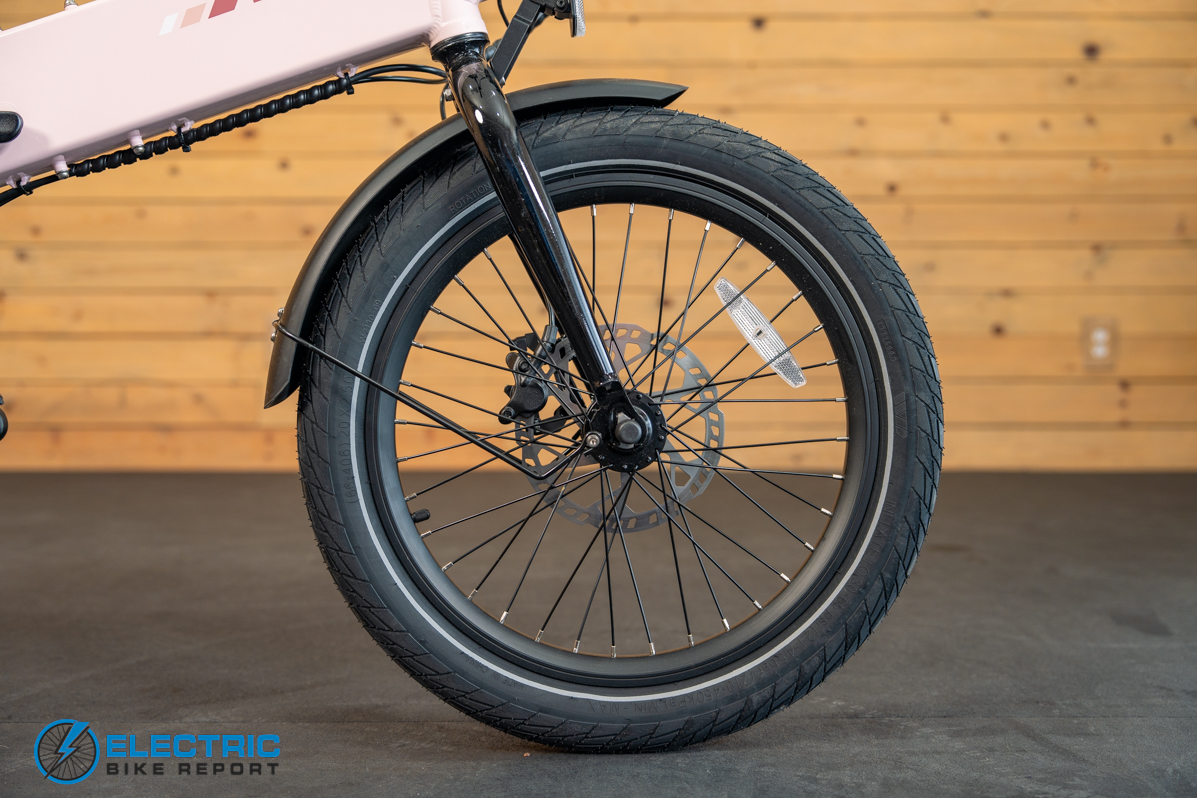
A rigid aluminum fork keeps steering precise and reduces weight to increase portability.
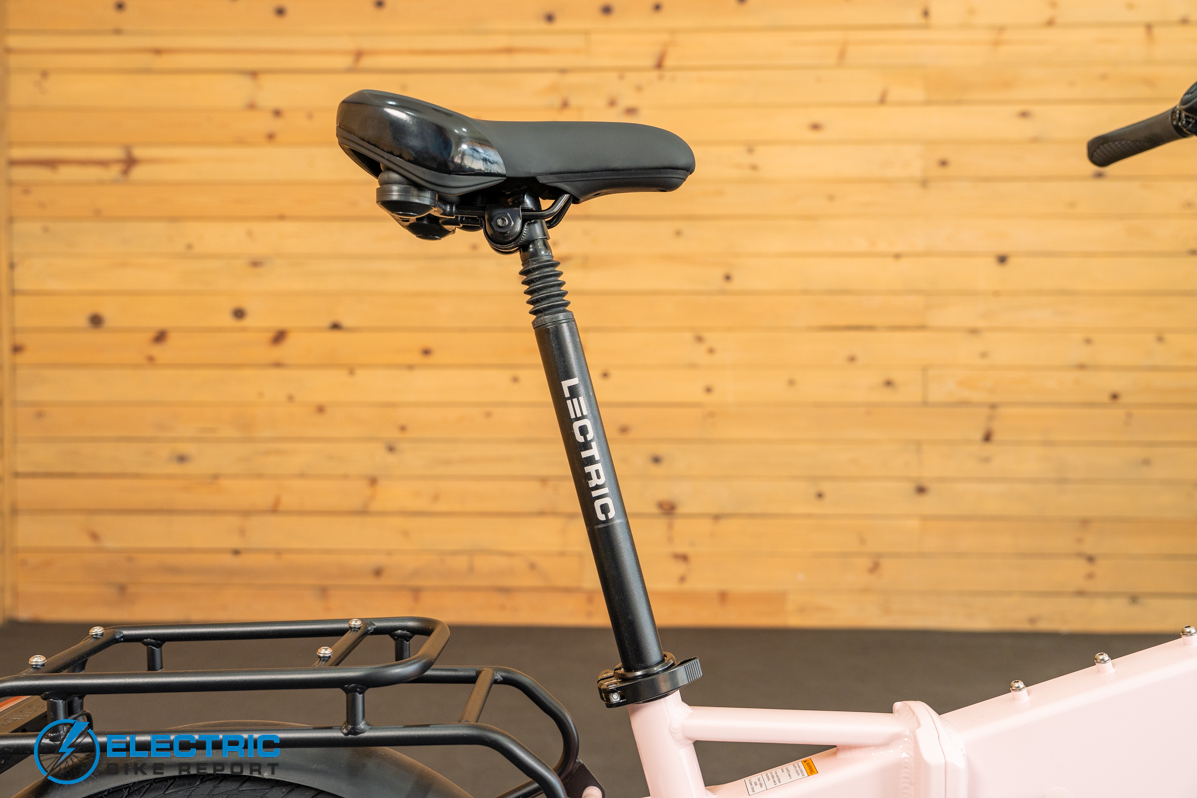
Mid- and top-tier versions of the Lite3 feature a suspension seatpost to smooth bumps.
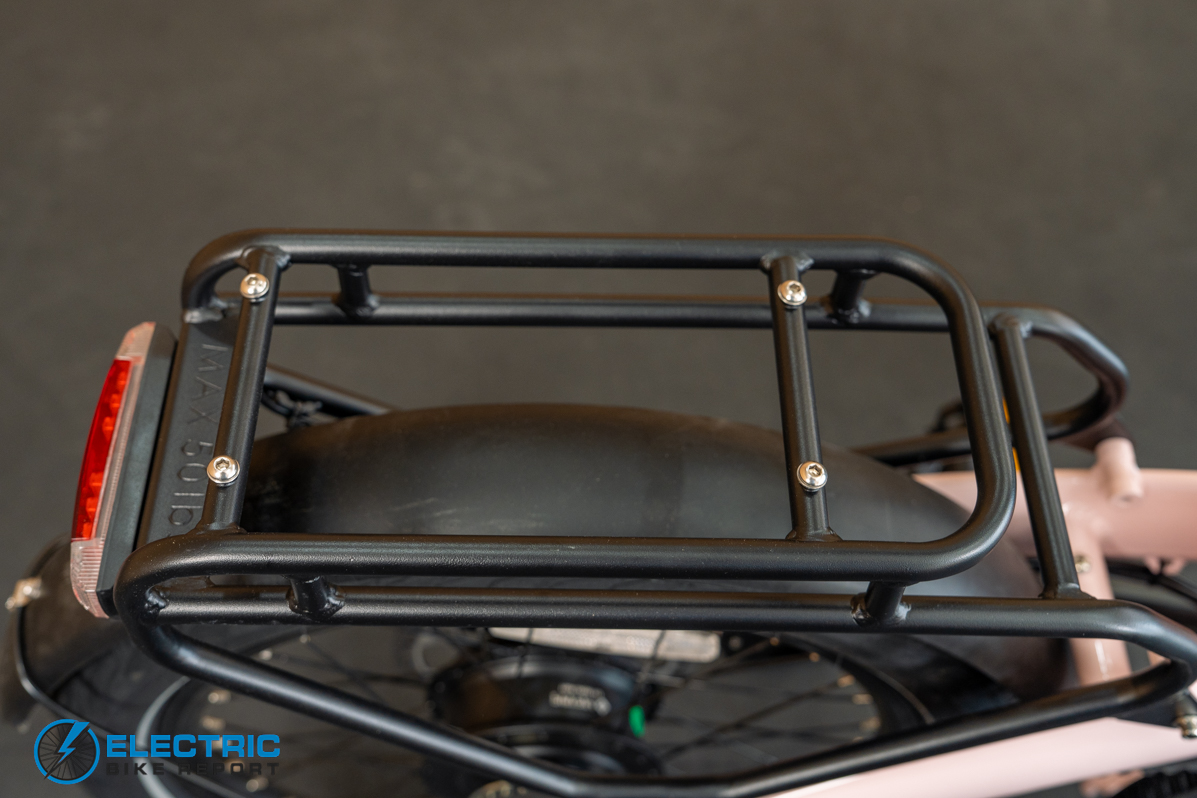
An optional cargo rack with 50 lbs of capacity is included with the $1,099 model.
Lectric XP Lite3 Review: Ride Quality
It’s not uncommon for budget-tier e-bikes to make noticeable tradeoffs in ride quality to meet certain price points, but as I’ve touched on previously, the upgraded version of the XP Lite3 we tested makes no such compromises. In this section, we’ll examine how the bike feels to ride and discuss its overall user experience.
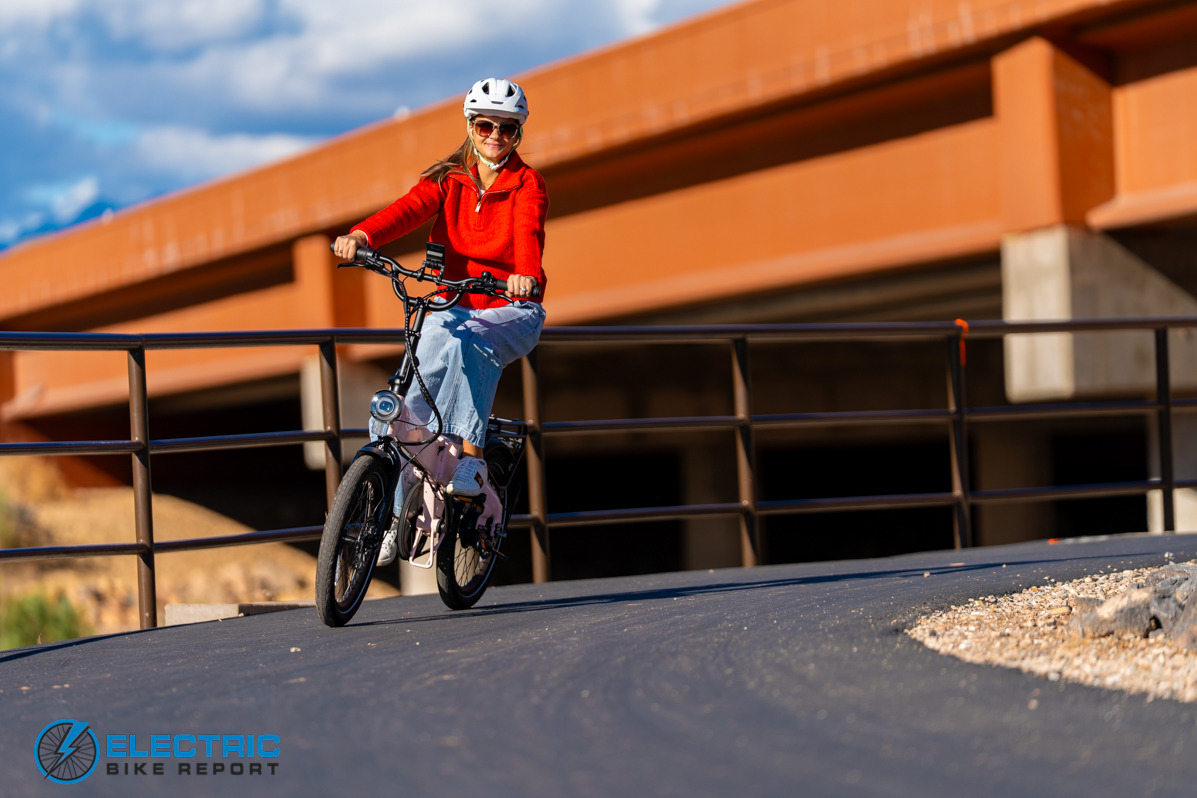
As with previous versions of the Lite, this model comes in a single frame size intended for riders from 4’8″ to 6’2″. This is a generous recommended height range, and it is uncommonly accommodating for folks on the shorter end of the spectrum; e-bikes regularly fit riders just below 5′ tall, but few go as low as 4’8″. In theory, this makes the Lite3 suitable for younger riders in addition to adults (wherever this is legal, of course).
The bike also has an uncommonly wide range of adjustability. Its long seatpost offers nearly a full foot of adjustment in saddle height, its telescoping stem provides a few inches of handlebar height adjustment, and the mid-rise BMX-style handlebars have the ability to be angled to adjust reach. With this combination of adjustment points, most riders should be able to find a comfortable fit.
As a 5’11” rider, I found myself in a slightly forward-leaning riding position with full leg extension and a comfortable at-rest position for my arms. Like Lectric’s flagship model, the XP4, the Lite3 has a zero-degree stem, which provides more dialed-in ergonomics than previous models of the bike. In my experience, this made a noticeable difference in its overall fit and feel, marking a solid improvement over the XP Lite2.
With no standard suspension, riders of the base model should expect to notice bumps, though the bike’s 20×2.5″ tires do provide some cushion—especially when riding with the low end of the recommended tire pressure. Our upgraded test bike included a suspension seatpost, which added an extra layer of comfort that helped to smooth and soften the ride.
The contact points were solid enough, with Lectric’s custom sport saddle, lock-on ergonomic rubber grips, and the brand’s custom quick-release pedals. I found the saddle somewhat on the firm side, so I’d likely swap that component out, but the grips felt more plush than those often found on sub-$1k e-bikes, and the aluminum pedals are a noticeable step up, too.
I liked that Lectric offers so many options in specs and price for the XP Lite3. The base model, which prioritizes affordability and basic functionality is somewhat limited in its features and accessories, but not all riders want or need more—it’s a completely functional and usable e-bike at a price point that’s tough to argue with.
It also still comes better-equipped than many similarly-priced models on the market, with Lectric’s custom hydraulic brake set, a clean-looking color TFT display, and an integrated lighting system with rear-facing turn signals, though it is only available in a single color option called Arctic White.
The upgraded models make their higher prices worthwhile, coming equipped right out of the box with many items that are often limited to more expensive models and/or only available as add-ons.
On the $999 chain drive version, this list includes alloy fenders and the aforementioned suspension seatpost. This version of the bike includes the same 672-Wh battery we tested, though it does not include a cargo rack. It’s available in four color options: Arctic White, Matte Grey, Blue Mist, and Lavender.
The fully upgraded model we tested includes a rear cargo rack with 50 lbs of carrying capacity and a Gates belt drive. The belt drive is often preferred by riders wanting a quiet, low-maintenance experience. Belts typically last at least twice as long as a traditional chain and they require no lubrication, so they’re both clean and long-lasting. This version, priced at $1,099, is available in JW Black and Ballerina Pink.
All together, the Lite3’s upgrade options greatly expand its functionality, making it much more versatile and feature-rich—not just limiting it to a means of getting from points A to B.
Like other Lectric models, the settings and customization options I’ve mentioned can all be accessed through the bike’s display menu. I like the presentation and layout of this menu; it’s intuitive, attractive, and easy to use and read.
There are really only two blemishes on the XP Lite3’s ride quality. First, like previous versions of the bike, a key must remain inserted in the underside of the down tube, turning the battery to its “on” position. E-bikes have largely moved away from this approach in recent years, so it feels dated here, and we recommend that Lectric remove this requirement on future models—as they have done with the XP4.
Additionally, we noticed that the internal battery on our test bike rattled when riding over bumpy pavement. This can be fixed on the consumer’s end with some added shim material—we stopped the noise by inserting some packing foam in the down tube—but we encourage Lectric to add some internal padding or use another method to help quiet the ride if this is a common occurrence on other Lite3s.
Otherwise, there is much to celebrate about the XP Lite3. This new version of the bike expertly balances affordability with mass appeal through the bike’s adjustable fit, customizable pedal assist, and uncommonly robust feature package for a bike starting at around $800.
Sponsor
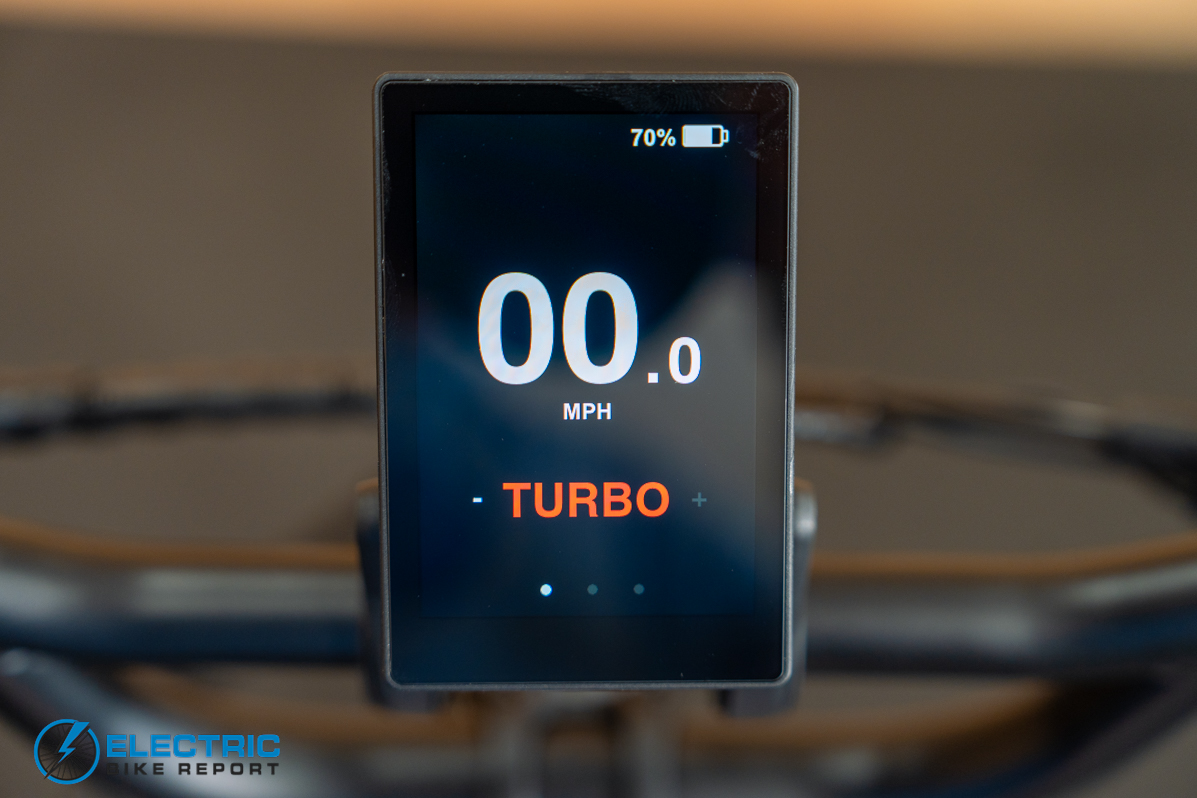
The XP Lite now has Lectric’s clean-looking, custom color TFT display.
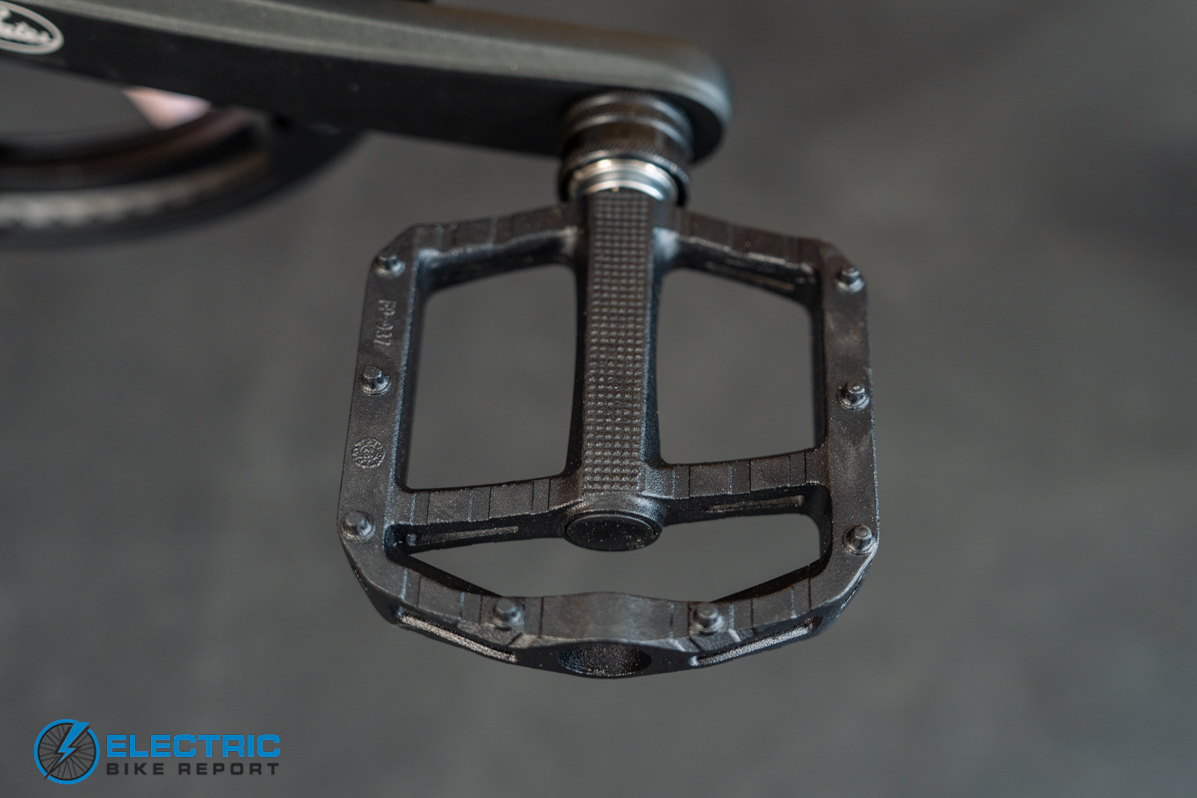
Removable aluminum pedals help to reduce the bike’s width when folded.
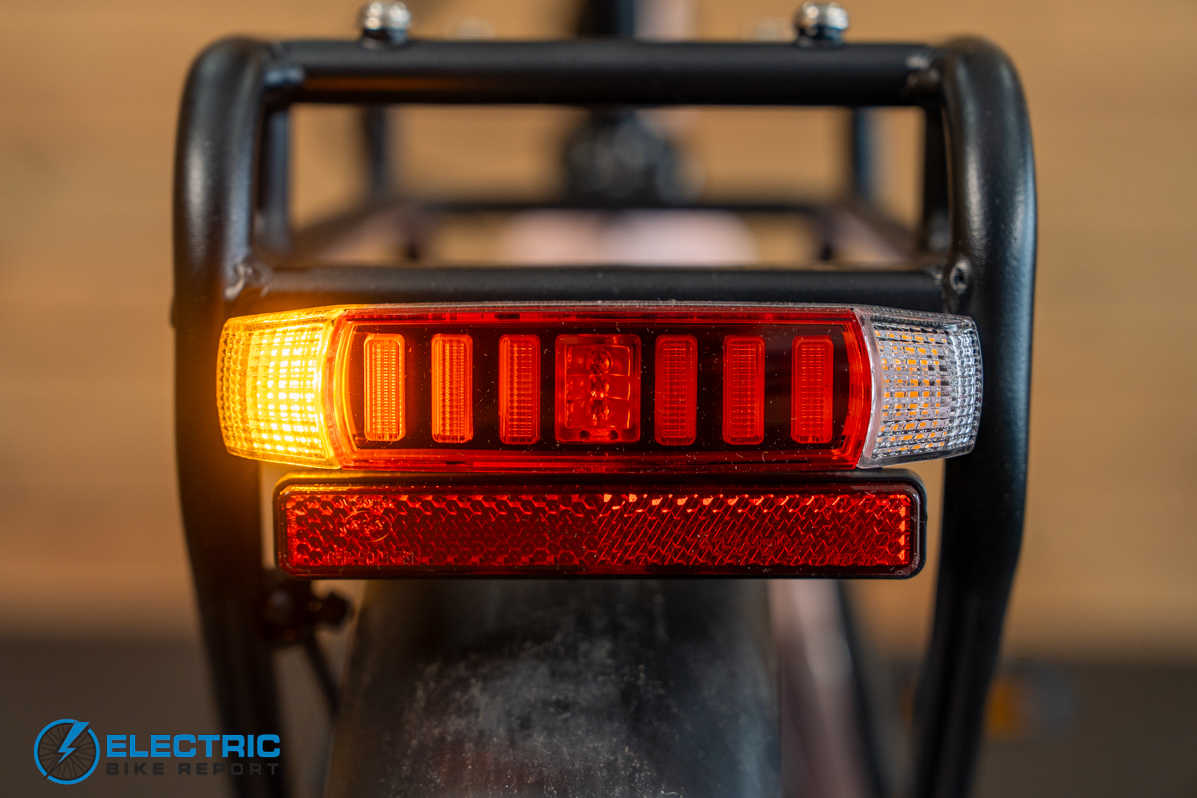
Rear turn signals are another of the XP Lite3’s upgrades—it’s rare to find them on a bike this affordable!
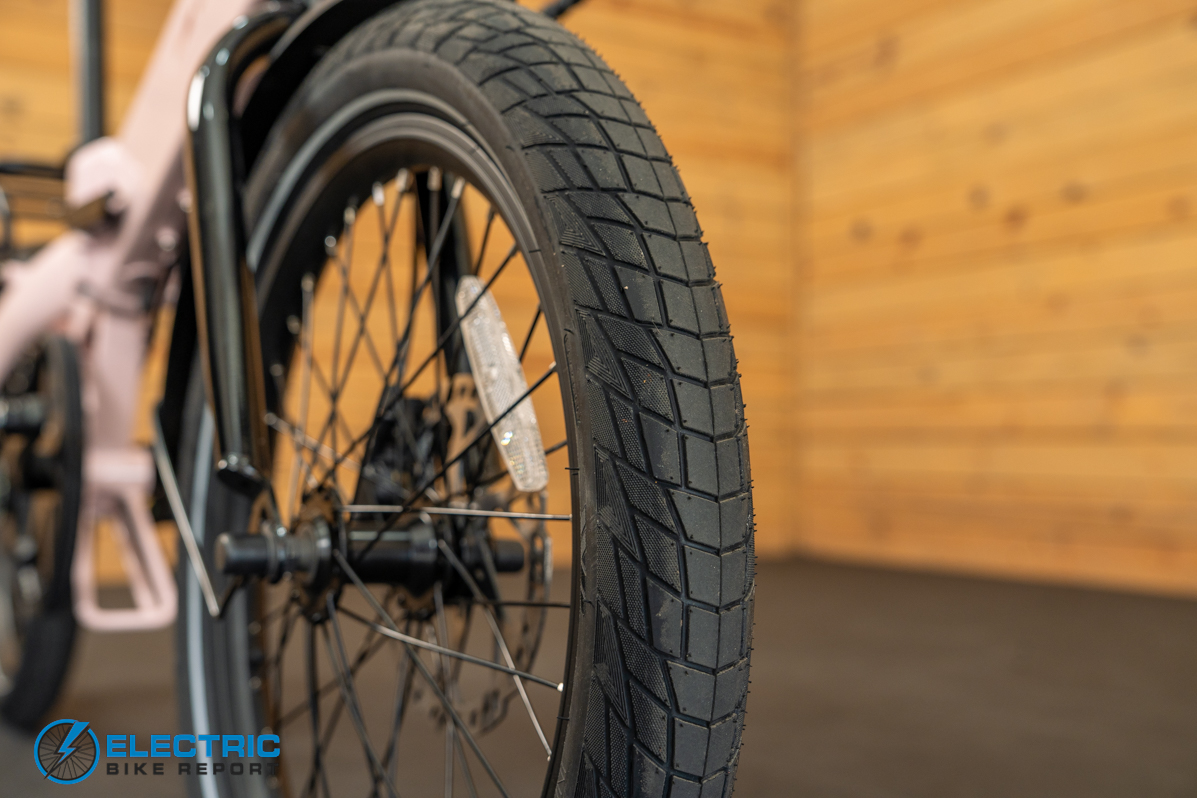
The bike rolls on 20×2.5″ street tires, which offer a great balance between stability, cushioning, and low weight.
Lectric XP Lite3 Review: Summary / Where to Buy
When it comes to recommending specific products, we understand that an e-bike is a serious investment for many who read and watch our reviews. Understandably, most shoppers want to ensure that they’re getting the best bang for their buck. For quality and longevity purposes, however, it’s often relatively tough to recommend e-bikes below the $1,000 mark.
The XP Lite3 may be one of the most notable exceptions to that rule. Of course, the bike has price points below, at, and above this threshold—but all three models share the same core experience. They’re straightforward, easy to use, and completely practical for those who want an affordable e-bike that works.
The top-tier model we tested is the most capable and well-equipped of the bunch, with an impressive feature package, expanded battery capacity, and a low-maintenance drivetrain. While its range didn’t quite meet Lectric’s advertised claim, it still proved capable of covering more than most riders need. Additionally, it demonstrated strong braking power, and uncommonly impressive climbing capabilities for its specs.
We also liked that, despite being equipped with only a cadence sensor, it offers multiple riding modes that provide vastly different riding experiences for the pedal assist system.
Our points of critique were few: we’d love to be able to use the bike without keeping its key inserted in the battery, and we recommend Lectric add some internal padding to keep the battery from rattling inside the down tube. Considering that neither of these points affects the bike’s overall performance or largely impacts its ride quality, however, we consider the XP Lite3 very easy to recommend.
Who is this bike best for? Depending on the chosen spec level, it’s appropriate for a wide range of potential riders. It might make a great first e-bike for young riders or those looking to outfit the whole family without spending a fortune. It would also be ideal for those seeking an affordable and uncomplicated e-bike and riders wanting something capable but still highly portable. The possibilities are many!
When considering this model and the Lectric XP4, we recommend the Lite for riders who prefer a lighter, simpler, and lower-powered option—and those who don’t mind the limitations of a single-speed drivetrain. The XP4 may be a better choice for those who want more power for faster climbing and greater range, as long as they don’t mind that bike’s higher weight.
Happy Riding! Make sure to let us know if you have any questions or if you think we left anything out in this review of the Lectric XP Lite3 down in our comments section.
Sponsor
Sponsor
Reader Interactions
Leave a Reply