Ride1Up Portola 02 Review | It’s Back and Better Than Ever
Aug 18, 2026
 0 Comments
 Share
Share
With two frame and battery options, and some of the best specs we’ve seen in this price range, the Portola 02 is a strong contender for the folding e-bike crown.
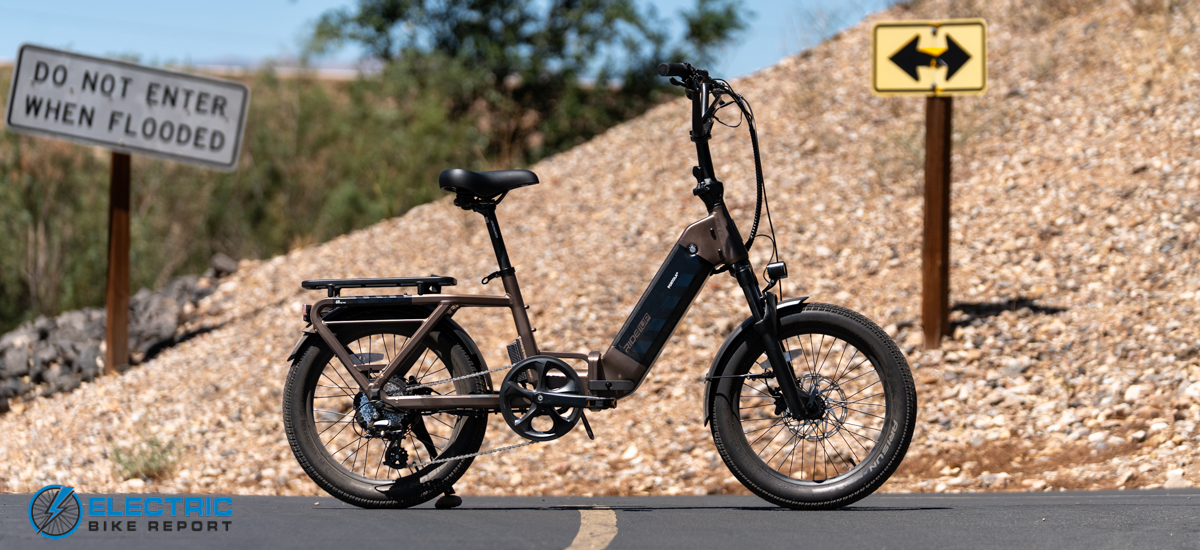
An important life lesson is that you can’t spend too much time planning and thinking about something—you just have to jump in and do it. Your first attempt at anything may not be perfect, but considering that experience is the best teacher, getting your proverbial feet wet will put you in a better position to make improvements down the road.
The same lesson applies to making e-bikes, and Ride1Up seems to have taken this approach to heart. The company hasn’t always been the first to market with new concepts, but it has developed a proven formula—after studying its competition, it consistently releases compelling, value-driven products.
The original Ride1Up Portola, for example, debuted nearly three years prior to this writing. At the time, folding e-bikes were nothing new, but the Portola one-upped (pun intended) the competition with a step up in many of its specs. Still, it wasn’t perfect—and with time, its flaws became more apparent.
Now, with the Portola 02, Ride1Up aims to revitalize its folding e-bike. The new model improves on the original’s excellent foundation, with refinements in build, performance, its feature package, and its user interface.
Standouts include swappable torque and cadence-sensing modes, customizable motor tuning, a new color display, and rear turn signals. The Portola 02 also features a more adaptable fit, thanks to a sturdier stem and a set of high-rise handlebars.
Additionally, Ride1Up offers the bike in multiple configurations—both with the same 750W rear-hub motor. The standard model has a welded, high-capacity cargo rack and is priced to undercut much of its competition. There’s also a stripped-down “Lite” model with no rack that is even more affordable! Both are compatible with either 10 Ah or 15 Ah batteries.
We had two big questions going into this review. Could this bike match or outperform both the original model and its higher-priced competitors? And does it really bring as much value to the table as it appears? Continue reading to see how it performed!

Sponsor
E-Bike Category:Folding
E-Bike Class:Class 1 (pedal assist to 20 mph)
Class 2 (throttle to 20 mph)
Class 3 (pedal assist to 28 mph)
Class 2 (throttle to 20 mph)
Class 3 (pedal assist to 28 mph)
Sponsor
Ride1Up Portola 02 Video Review
 Pros
Pros- The Portola 02’s 750W motor gives it controlled, capable power. It feels natural in low assist levels and rewarding in higher settings.
- It comes in multiple styles and price points: one has a cargo rack and fenders, the other does not. Both can be paired with two battery sizes.
- Both versions are incredibly affordable for what they offer. Prices range from $895 to $1095—much lower than you’ll see elsewhere for similar specs.
- The bike offers custom motor tuning and swappable torque and cadence sensing modes—all without an app.
- Its handling is playful and fun, thanks to the bike’s compact size, 20″ wheels, and high-rise handlebars.
- Ride1Up loaded the Portola 02 with features, including turn signals, a color display, Apple Find My compatibility, an optional security PIN, and more!
- With a rear rack that can carry up to 150 lbs, the bike can carry groceries, packages, passengers, etc. Its capacity rivals many full-size utility e-bikes.
- The bike’s design is both stylish and practical. It has a sharp two-tone paint job, and its frame includes a convenient carry handle.
 Cons
Cons- While we generally like the new stem, BMX-style handlebars with a top bar would add stiffness and more real estate to the cockpit.
- We’d like to see the option for speed limits in cadence mode to better differentiate the five assist levels.
ELECTRICAL SPECS & FEATURES
- Battery: 48V, 720 Wh (Regular), 48V, 480 Wh (Lite), Reention Flamingo with LG cells, 21700 cells, IPX6 TUV Certified to UL 2271
- Charger: 2A
- Display: Ride1Up 2.2in large color display with iOS FindMy tracking and USB-C accessory charging
- Motor: 750W AKM hub motor with 90nm of torque
- Headlight: 100 Lux Front Light
- Taillights: Brake Light with integrated turn signals
- Pedal Assist: 5 levels
- Claimed Range: Up to 60 miles
- Throttle: Left hand thumb throttle
- App: N/A
- UL Certification: UL 2271 Certified
Weight & Dimensions
- Claimed weight: 59 lbs
- Tested Weight: 70.9 lbs
- Rider height range: 4’10” to 6’4″
- Total payload capacity: 342 lbs
Components & Accessories
- Brakes: Dual Piston Hydraulic Brakes, Electric Cut-Off Sensor, 180mmx2.3mm rotors
- Fenders: Included on Regular model
- Fork: 100mm Suspension Travel, Hydraulic Lockout, 100mm dropout
- Frame: 6061 Aluminum
- Drivetrain: 8-Speed Shimano Altus, 52T Chainring, 11-32T Cassette
- Grips: Lock-on ergonomic rubber
- Saddle: Double Spring Comfort Saddle
- Handlebar: BMX Style: 31.8mm Bar Clamp, 6° Sweep, 170mm Rise, 650mm Width
- Kickstand: Included
- Pedals: Folding Plastic
- Tires: 20″x3″ Arisun Low-tread Puncture Resistant Tires
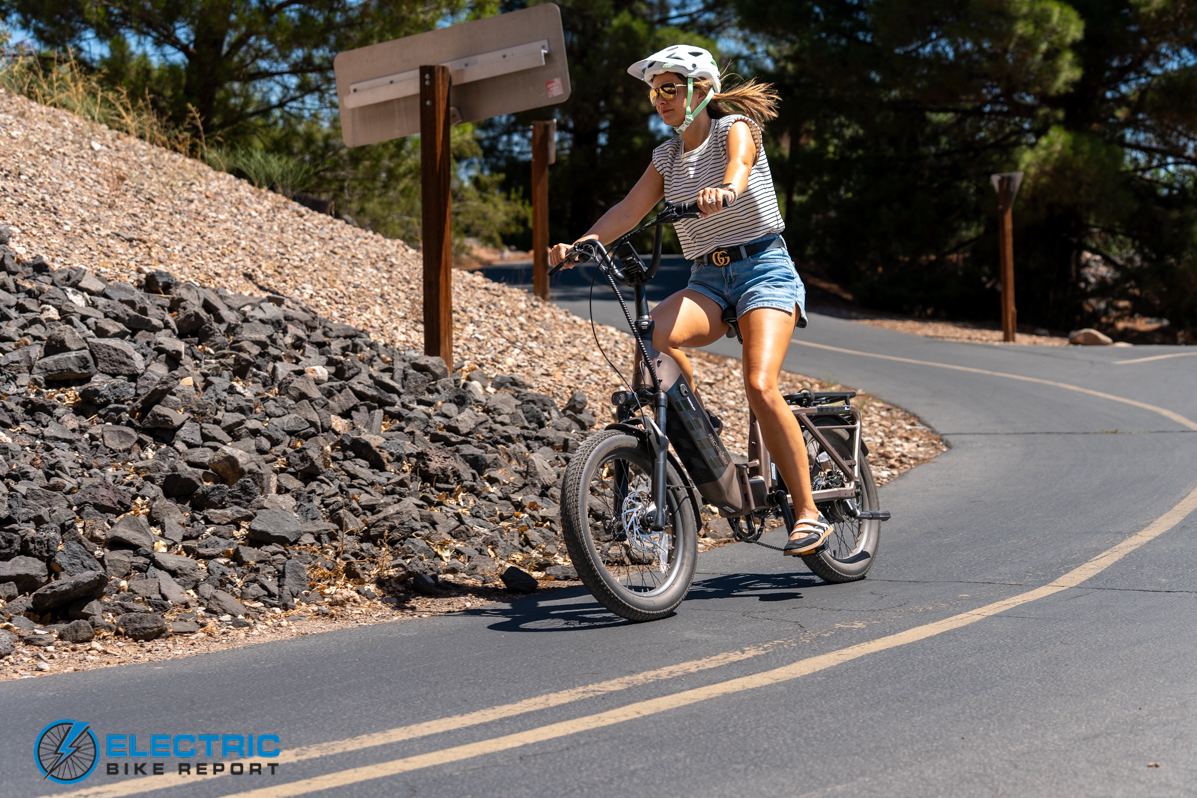
The Portola 02 is hugely adaptable, with two frame options, two battery sizes, four colors, a programmable pedal assist system, and wide range of fit adjustment.
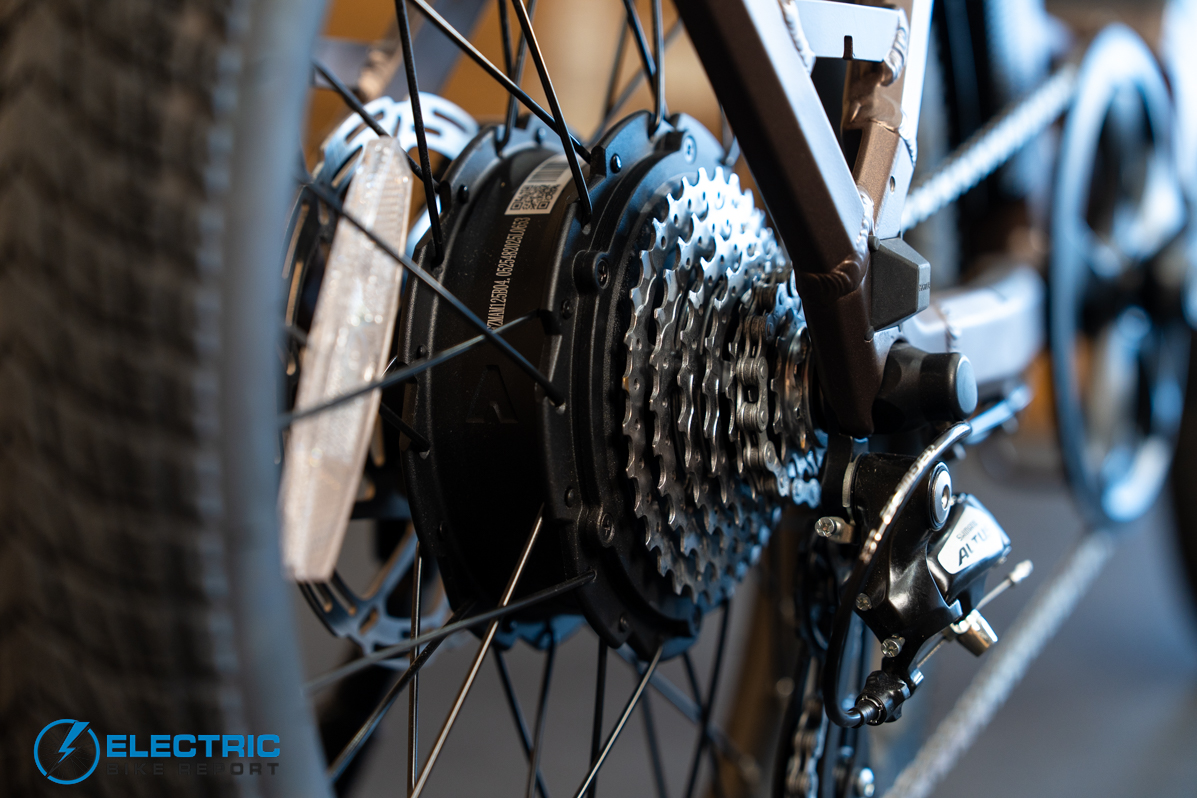
A 750W rear-hub motor produces up to 90 Nm of torque, and offers both torque and cadence modes.
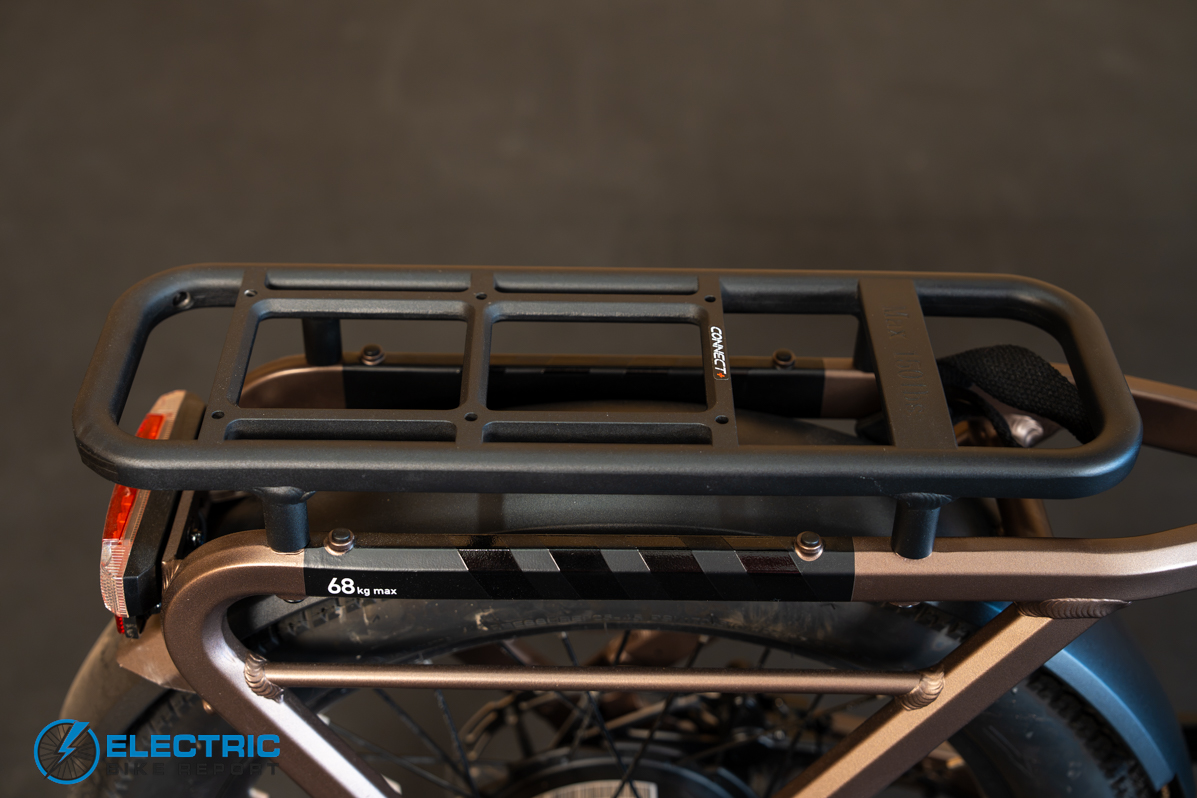
The standard model’s included rack can support up to 150 lbs and is expandable in length.
Ride1Up Portola 02 Review: Speed Test
Our speed test measures the average speed of each assist level, which tells us how usable a bike’s power range is by default. The Portola 02 ships as a Class 2 e-bike, though users can switch it to Class 1 or Class 3 and swap between torque and cadence sensing modes through the display menu. We tested both sensor modes in both Class 2 and Class 3 settings, using each assist level as we rode on a paved path.
I started the test without pedal assistance, pedaling under only my own leg power. There, the bike felt comfortable and properly geared, though the bike’s weight was somewhat noticeable.
The Portola 02’s torque sensing mode responds to pedal pressure, and scales the motor output to match. With this type of assist, the two class settings tracked each other closely throughout most power levels, as shown in the graphs above. Eco, Tour, Sport, and Turbo all felt remarkably natural and responsive, with incremental steps up in assist.
In the Class 2 test, Turbo and Boost shared similar speeds, though I appreciated that the highest level reserved an extra push and easier pedaling to distinguish it from Turbo. In the Class 3 test, I had to pedal with a significantly faster cadence to reach the bike’s maximum speed, but it successfully reached the top-end limit of 28 mph.
In contrast with torque-sensing mode, cadence sensing only registers that the cranks are turning, putting out steady power regardless of pedal pressure. In Class 2, every assist level landed at roughly the same speed slightly above 20 mph. In Class 3 mode, my average speeds were spread further apart, though the highest settings still all hovered around 29 mph.
Cadence mode is programmed around power output rather than a speed cap per level, which leaves five settings doing the work of three—at least on flat ground. In my testing, I noticed that each power level had slightly different acceleration force, but for better control over speed, I’d like the option to have a range of speed limits tied to the five assist levels.
It’s worth noting that we tested the bike with its default programming, but riders can adjust the power and torque output of each assist level independently via the settings menu. Doing so may give riders the chance to better modulate their speed in cadence mode.
In addition to testing the pedal assist modes, I also tried out the Portola 02’s throttle. It eased off the line gradually and safely before building steadily to 20 mph. Overall, I found that it was both approachable and effective, neither feeling too punchy nor delayed.
The bottom line is that, in torque mode, this bike is ready to ride as delivered. Riders who prefer cadence mode may want to consider visiting the tuning menu to adjust the bike’s power levels to match their weight, riding style, and environment.
Sponsor
Riders can quickly switch between Class 1, 2, and 3 modes via the bike’s display.
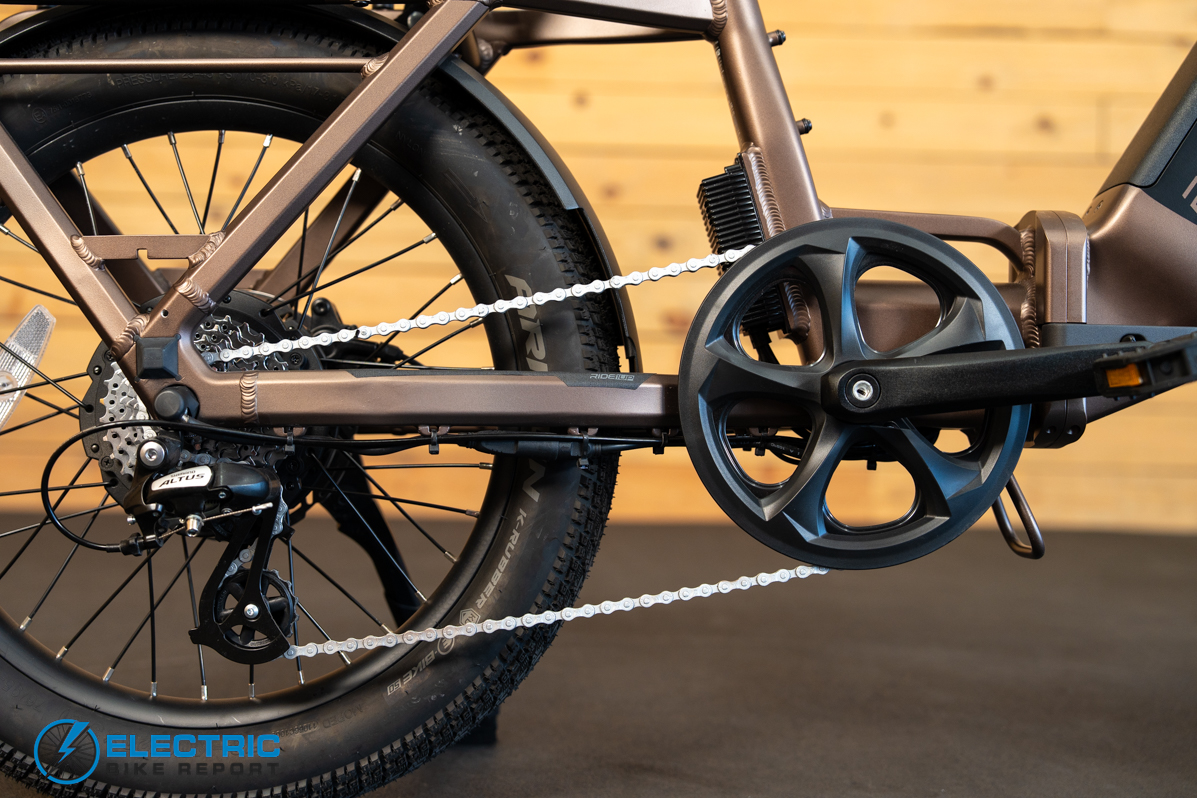
An 8-speed Shimano Altus drivetrain offers a comfortable gearing range with quality parts.
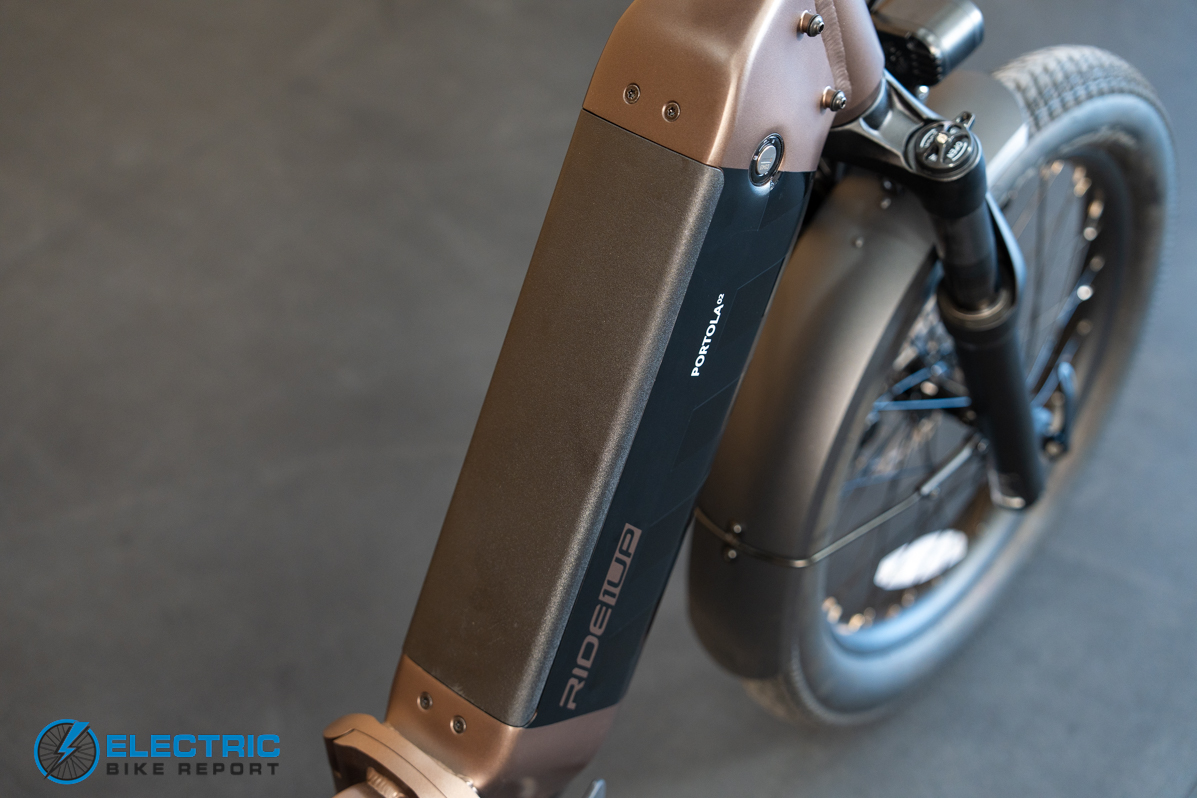
Our test bike came with the upgraded 48V, 720 Wh battery.
Ride1Up Portola 02 Review: Range Test
Range is an important factor that can (rightly so) be the deciding factor in a purchase. To evaluate every bike’s advertised range, we ride it with a full battery until reaching empty twice: once in its lowest assist level and once in its highest.
With the Portola 02, we set the bike’s settings to reflect the best and worst case from a single charge. In Eco with torque-sensing pedal assist, the Portola 02 returned 49.9 miles; in Boost with cadence sensing, we traveled 29.7 miles. Ride1Up sent the largest battery size with our test bike, which gave us 720 Wh (15 Ah) of capacity to work with.
Similar folding e-bikes have averaged 60 and 28.9 miles, which puts the Portola right at average in its high-power run and a bit under at the low end. Ride1Up advertises up to 60 miles, and our testing fell a bit short, though riders of the stripped-down Lite model may be able to squeeze a few extra miles without a cargo rack, fenders, or rear lights.
The upgraded 720 Wh carries almost exactly 100 Wh more than the 619 Wh category average, and a bigger “gas tank” often yields more miles, so I was somewhat surprised that the bike gave us a bit less distance than some of its peers.
When I calculated the bike’s energy efficiency by dividing its battery capacity by its mileage, the picture became clear. The Portola 02 expended 14.4 watt-hours per mile (Wh/mi) in Eco and 24.3 in Boost, against averages of 10.6 and 21.5 Wh/mi. In both cases, Ride1Up’s e-bike used a bit more energy than average.
Ultimately, the Boost figure tracks, since we used the bike’s less-efficient cadence sensing mode to maximize energy consumption. The Eco number comes down to programming; the lowest setting feels reserved, but the bike’s settings menu shows that it dishes out more power than that feeling suggests—a whopping 50% of the motor’s potential output.
In practice, the Portola’s tests show very usable results. Thirty to fifty miles covers a couple of round trips for a long commute, and potentially many shorter rides. The 02’s large battery even gives it an edge over the original Portola, at least in its highest assist level, as it managed 49.6 and 22.7 miles.
Note that we performed both test runs with the bike set to 20 mph, so anyone cruising at 28 mph in Class 3 should plan on fewer miles. Ride1Up sent both frame styles but only the 720 Wh battery, so we can estimate that the Lite would achieve 33.3 and 19.8 miles with the same energy consumption.
While it’s not unexpected at the Portola 02’s price point, buyers should note that the bike ships with a 2A charger. This should power up the 10 Ah battery in 5 hours and the 15 Ah battery in around 7.5 hours. We’d love to see a 3A charger included with the upgraded battery, but we also understand that some compromises have to be made.
Sponsor
Sponsor
Ride1Up Portola 02 Review: Hill Test
Folding e-bikes get bought for convenience, but they still have to climb whatever sits between you and your destination. Our Hill Test puts their motors through their paces; this hill presents a sustained slope averaging an 8% grade over half a mile.
As with every model, we rode the Ride1Up Portola 02 up the Devil’s Backbone twice: once on throttle alone and once in its highest pedal assist level. Our test rider, Justin, ran both in Boost with the bike set to Class 2 and torque output at 100%. He reached the top in 2:10 on throttle at an average of 13.9 mph, then cut that to 1:59 at 15.2 mph when pedaling.
Similar folding e-bikes have averaged 1:56 and 1:54 on the same climb, putting this model 14 seconds behind on throttle and 5 seconds behind on pedal assist.
Three main things influence results here: weight, peak power, and torque. Weight is a wash, since the Portola’s roughly 71 lbs sits just under the 71.5 lb category average.
Our comparison group averaged 1,210W of peak power and 79 Nm of torque; the Portola’s motor produces an impressive 90 Nm of torque, but considering its results, we’d expect its peak power to fall a bit below average.
I tested the bike personally at our secondary test location, Pilot Hill. When pedaling in Boost, torque mode required a moderate level of effort, while cadence sensing asked less of my legs and proved the faster of the two sensor modes. I found the motor’s engagement smooth and natural, giving me more back as I pushed harder.
On throttle power alone, the bike felt steady to me rather than quick. I noticed that the motor also ran quieter when pedaling, which made some sense since it divided the work with me.
In summary, our testing shows that the Portola 02 is a competent climber rather than a supremely powerful one. It makes hills easier, so it does its job effectively, giving riders three methods of approach. Buyers should note, however, that hills don’t disappear entirely, and at this price, we consider that a fair trade.
Sponsor
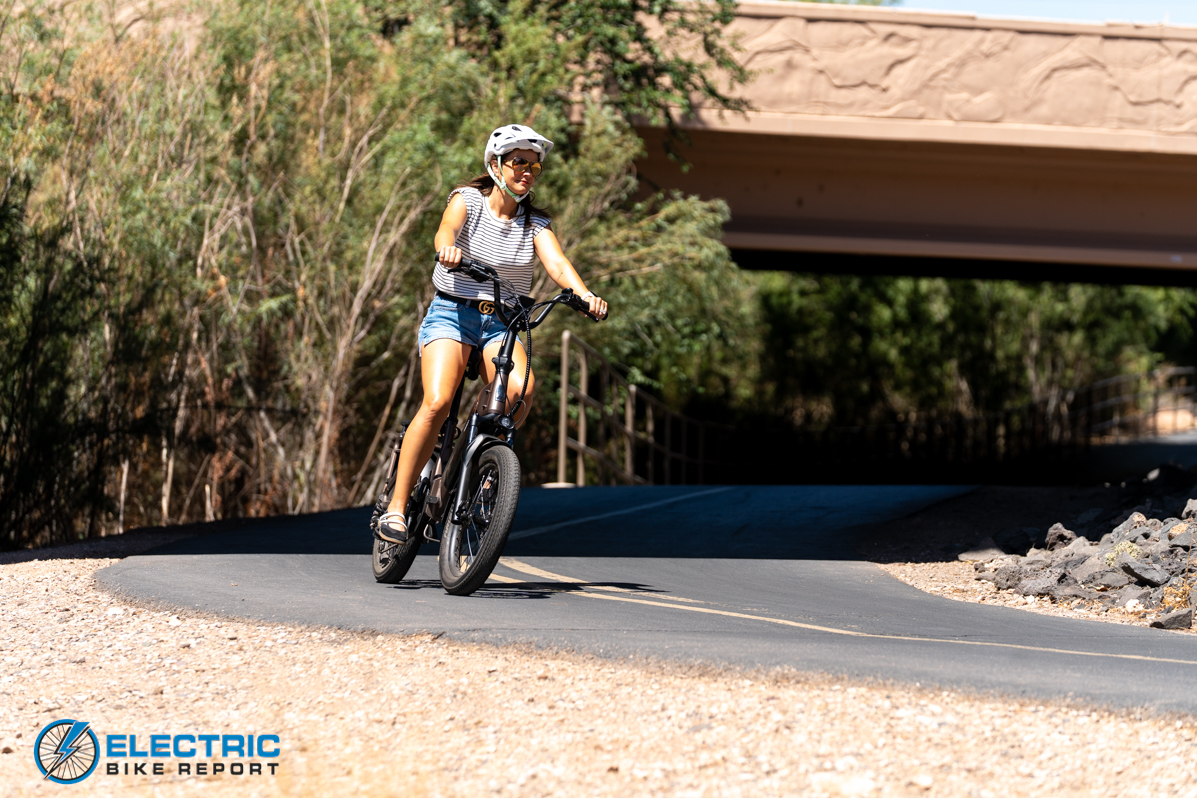
Handling feels more nimble than the bike’s roughly 71 lbs would suggest; it accelerates confidently, steers quickly, and generally feels playful and fun.
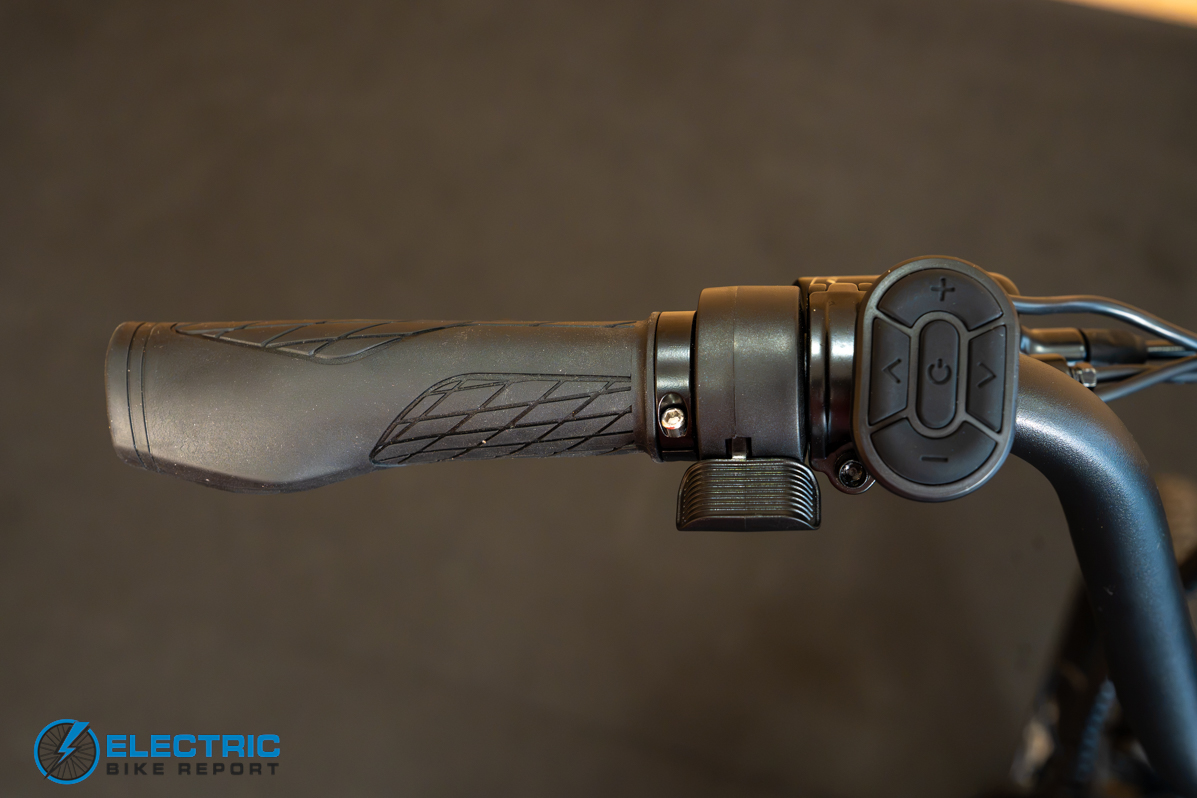
A thumb throttle sits on the left handlebar between the ergonomic rubber grip and the control panel.
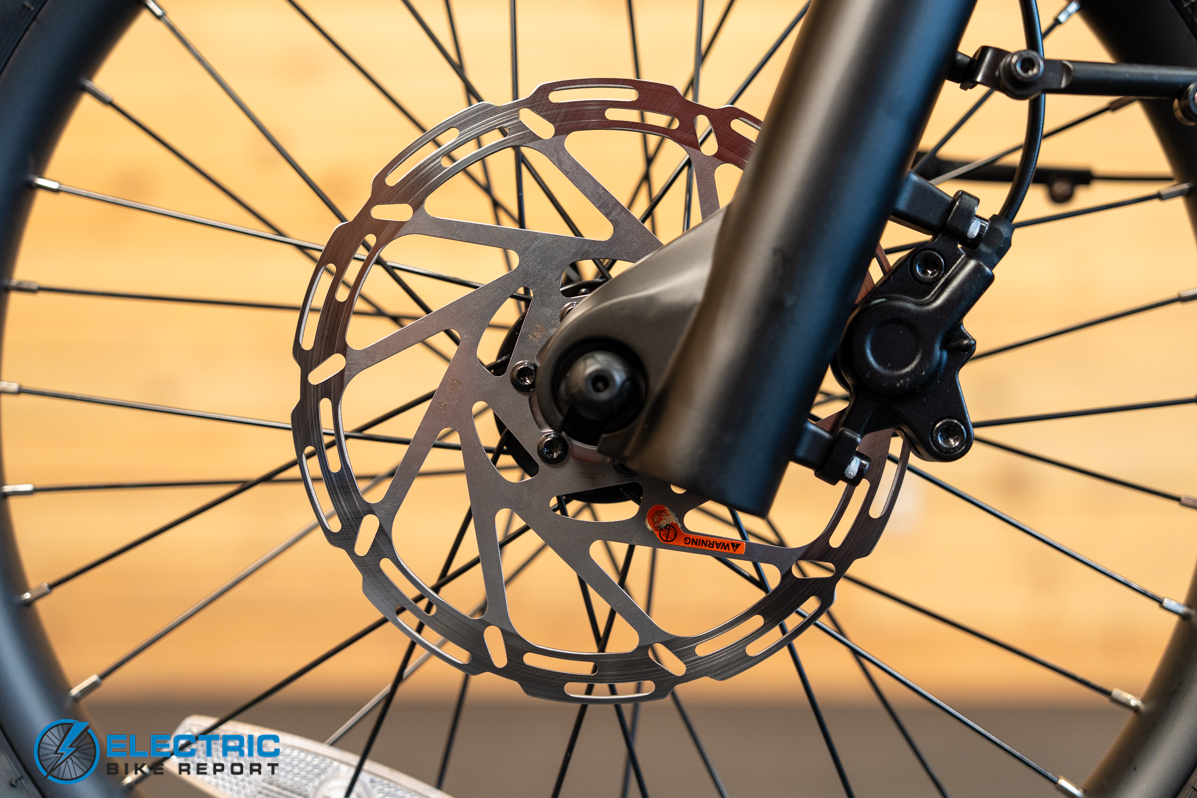
The 180mm brake rotors are 2.3mm thick, helping to dissipate heat and stop the bike effectively.
Ride1Up Portola 02 Review: Brake Test
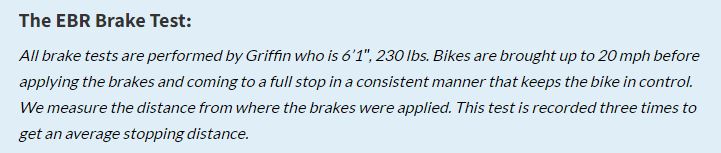
A bike’s stopping distance is a direct measure of one of its most important safety features. We test every e-bike by braking after reaching 20 mph, measuring how far it travels before stopping completely, then averaging the results of three attempts. Our test rider, Michael, brought the Portola 02 to a halt in an average of 17’4″.
Similar folding e-bikes currently average 19’5″, which is already a strong baseline. Still, the Portola managed a result that is more than two feet shorter than its competition. We’ve noticed that bikes in this category have been improving on this test in recent years, and this result is a clear example of that trend.
The bike’s brake components explain most of its success. The Portola 02 is equipped with a hydraulic brake system that pairs two-piston calipers with 180 mm rotors—both relatively standard, at face value.
In contrast with many similar models, Ride1Up selected 2.3 mm thick rotors, where 1.8 mm is the more common figure. The extra material gives the heat produced by braking somewhere to go, which results in faster and more consistent stopping.
My experience was that the bike’s feel backs up its test numbers. The Portola 02 stopped confidently every time, and allowed me to modulate my speed with moderate pressure at the lever. I was highly impressed by how quickly I could bring the roughly 71-lb bike to a halt. As with any e-bike, however, it’s important to apply lever pressure progressively to reduce skidding.
What I can’t tell you is how this system ages. The calipers carry no brand name, so there’s no service record to point to and no telling whose parts you’d eventually be chasing down. Fortunately, the system uses standard mineral oil, so servicing should be relatively straightforward and easy.
Overall, though, we can’t debate the system’s effectiveness—especially on a bike this affordable.
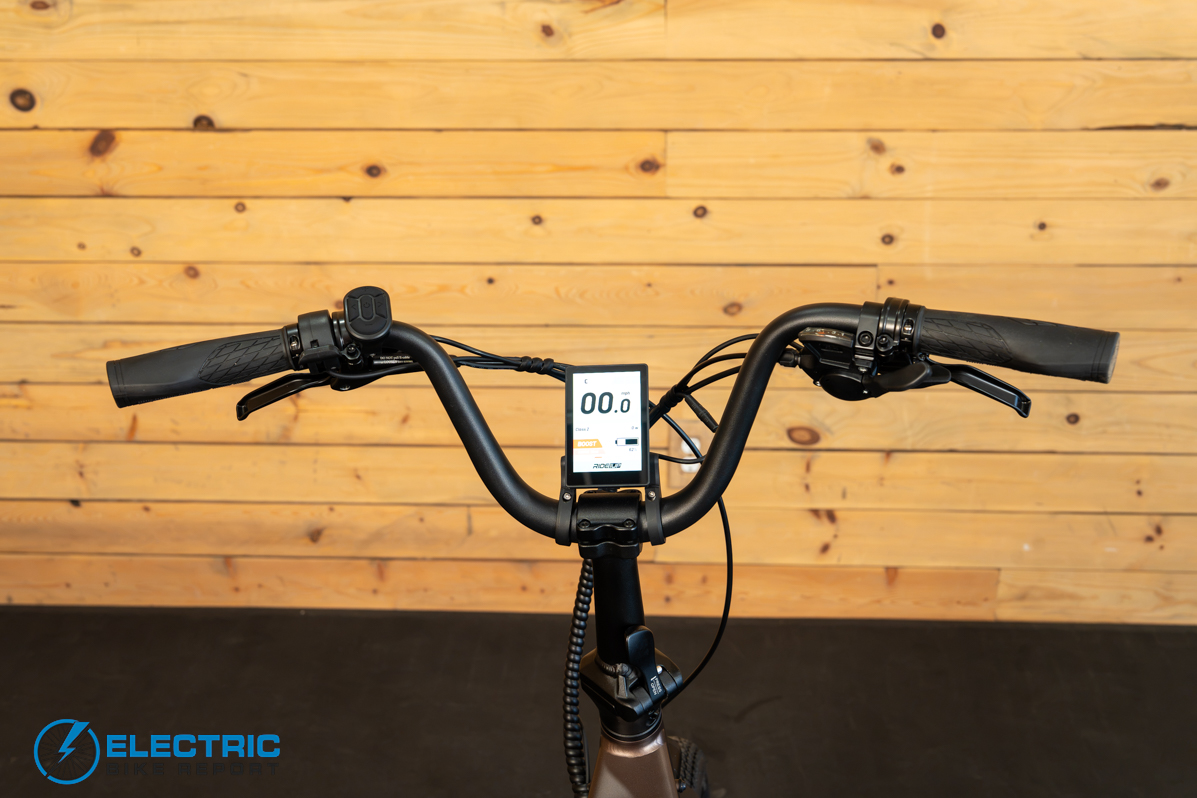
A set of high-rise handlebars offers reach adjustment—just loosen the stem, rotate until you’re comfortable, and tighten again.
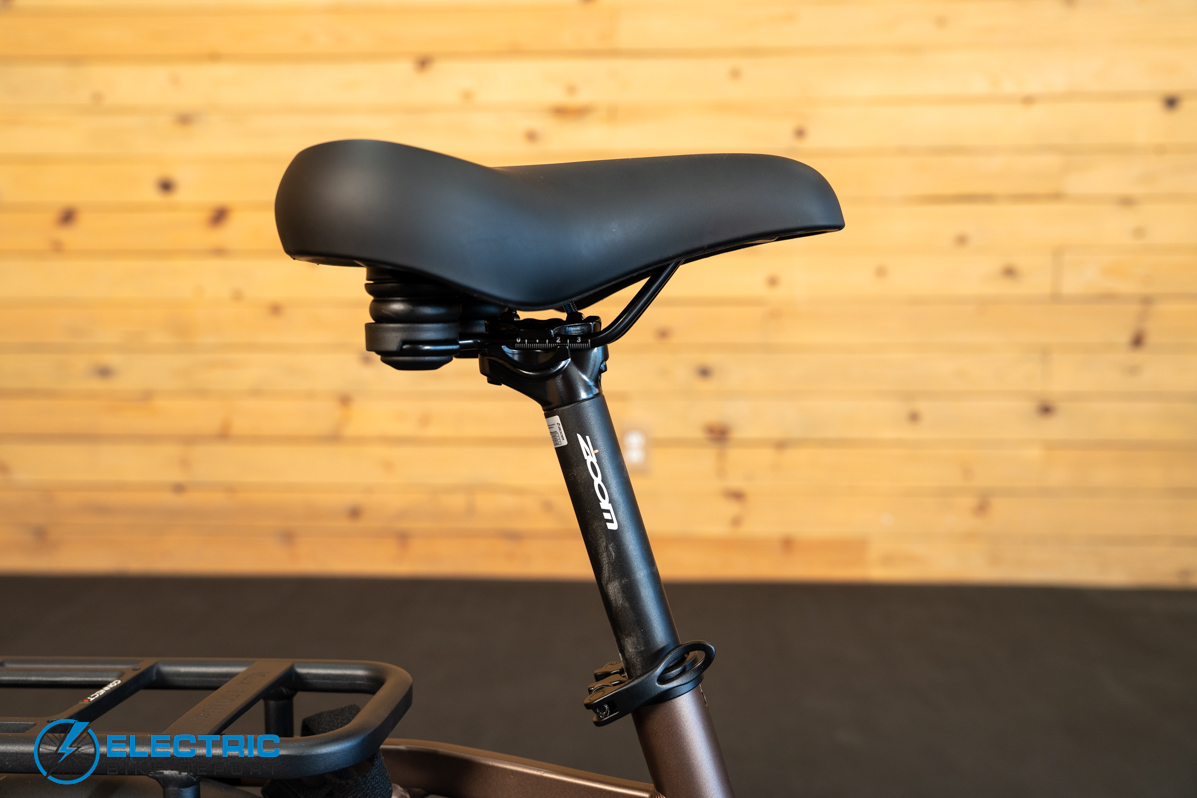
The bike’s spring saddle is extremely comfortable, softening most bumps before they reach your backside.
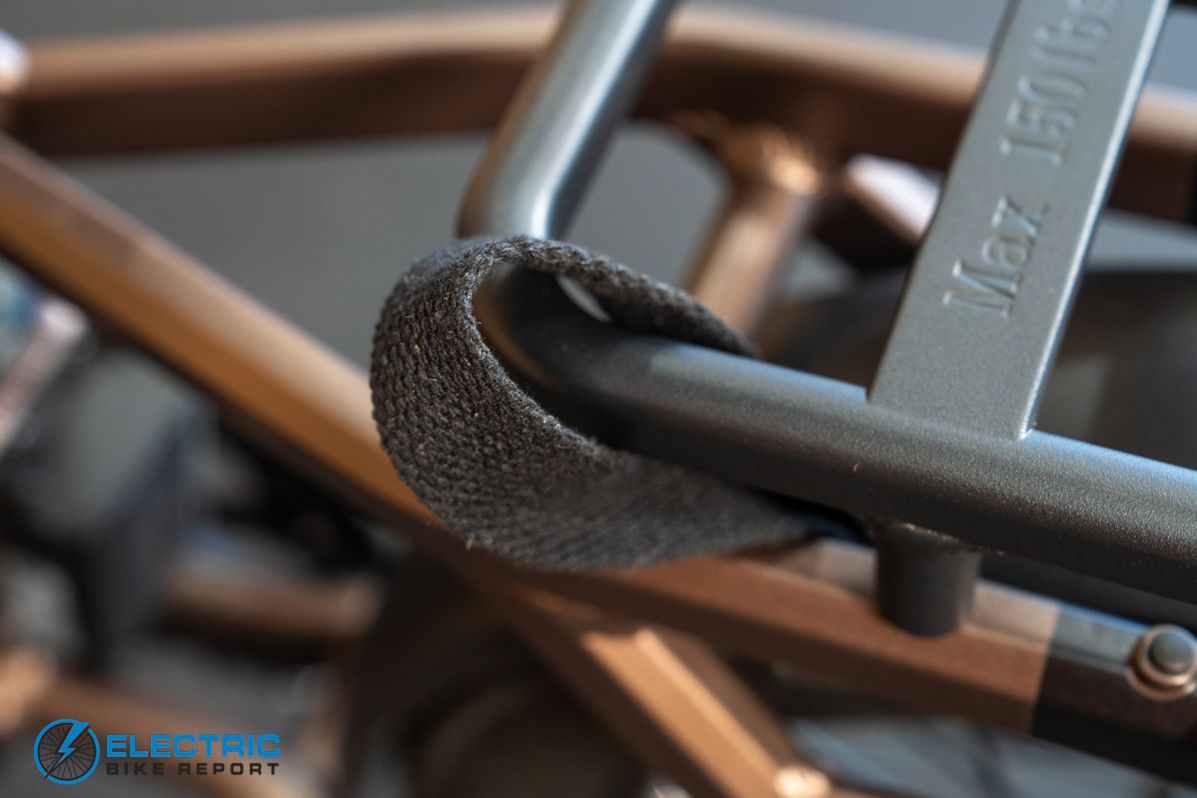
We’re always happy to see an included strap, which helps keep the folded halves of the bike secured together.
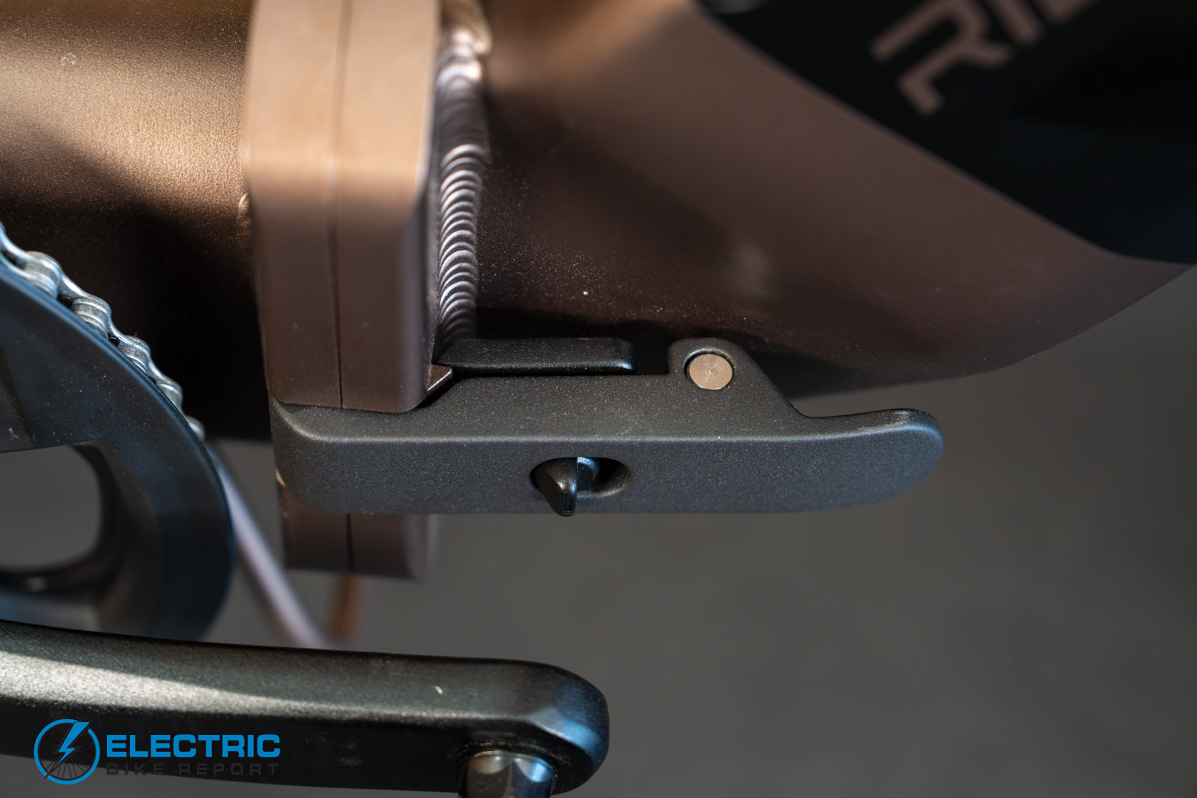
Like many folding e-bikes, the Portola 02’s aluminum frame splits in the middle via a central hinge.
Ride1Up Portola 02 Review: Ride Quality
Reviewing a bike on its own merits is always my goal, but the Portola 02 is hard to look at without also considering the original model. The first version of the bike was good at launch and, as things happen, grew dated as time moved on, but this version brings it back to life.
The aluminum frame is largely carried over from the original, though it is now sold with (Portola 02) or without (Portola Lite) a welded rear cargo rack. I primarily rode the version with a rack, which also includes fenders and an integrated tail light with turn signals.
Like the original, the 02 is advertised to fit riders from 4’10” to 6’4″, though this new version is better suited for taller riders. At 5’11”, I sat well inside this range, and found the bike appropriately comfortable and accommodating.
The seatpost gives about 10 inches of adjustment, and I deliberately set mine below the point of full leg extension, since I wanted to maintain an upright position. In my experience, the pedal assist more than covers the difference; pedaling stayed comfortable throughout.
The bike’s BMX-style high-rise handlebars are an impactful change. While the previous bike paired a telescoping stem with flat bars, these sit higher and rotate, so the angle you set also sets your reach. I remember feeling somewhat cramped on the original Portola, but here I appreciated the extra room.
The bike’s contact points also felt great. The ergonomic rubber grips were supportive and comfortable, while the spring saddle absorbed many of the bumps that would otherwise have felt somewhat jarring. This was complemented by the 100mm suspension fork, which adds a bit of extra travel when compared to the original Portola.
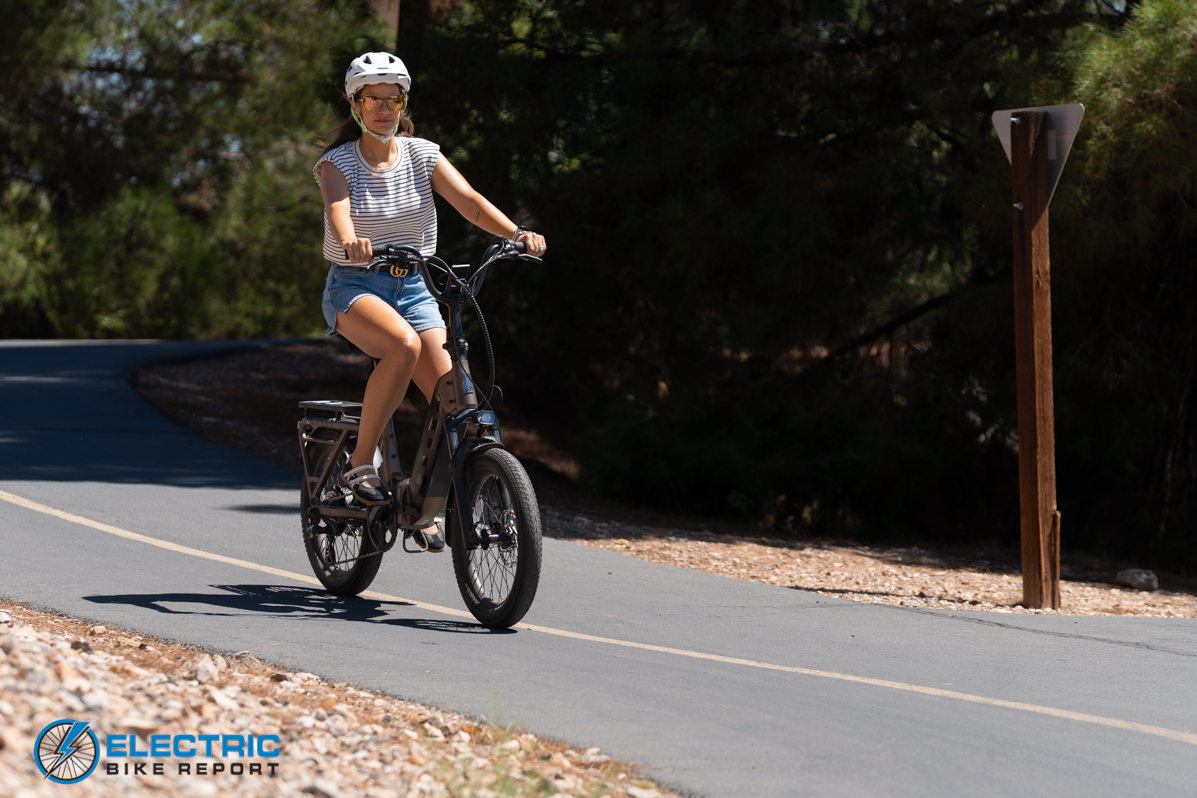
Handling is a big strength, too. Realistically, this bike is rather heavy, but it doesn’t ride that way; it moves quickly and feels playful, helped by its compact size and 20-inch wheels. I did notice some frame flex through corners, which isn’t unusual here but stopped the steering short of feeling crisp.
As a minor point of critique, the Portola’s handlebars play into that. Without a crossbar up top, there’s less structure to provide stiffness. Additionally, as it is, the cockpit felt a bit short on space for adding accessories. BMX-style bars with a top bar would buy stiffness and real estate at the same time, giving riders the option to add a phone mount, bell, speaker, and/or move the display higher.
The 20×3″ hybrid tires felt appropriate for the bike’s style. With small knobs on the shoulders and a relatively smooth band of tread down the center, they’re built for pavement first but they can also handle light off-roading. Anyone planning to ride often in loose terrain, however, should consider swapping to knobbier tires.
As our Speed Test showed, the Portola’s 750W rear hub motor is controlled rather than overpowered. It felt impressively responsive and dialed in when using torque-sensing pedal assist, with four of the five power levels behaving much like an analog bike.
Speaking of the torque sensing mode, I was thrilled to see the bike’s level of customization, including both sensor options and per-level tuning of output. While many similar models require an app to access all of their functions, I appreciated that this was handled from the display. This makes the bike appropriate for new riders and those who don’t want complexity.
Since the Portola 02 is a folding e-bike, we also have to evaluate its folding design and overall portability. The bike’s folding pedals, hinged frame, and collapsible stem are nothing new; most folding e-bikes use a similar method of folding. I found the process quick, intuitive, and easy, though I’d likely recommend pulling out the battery for ease of lifting.
With our test bikes’ upgraded 15 Ah/720 Wh power pack, the rack-equipped Portola 02 weighed a relatively hefty 70.9 lbs, while the rackless Lite model tipped the scales at a more manageable 66.6 lbs. Ride1Up advertises that the bike weighs 59 lbs, which we found more consistent with the battery removed.
For planning purposes, we measured the folded dimensions of the bike at 35″ L x 21″ W x 30″ H.
One final thing to note about the version with the cargo rack. The standard version of the bike is compatible with Connect+ accessories; items such as cargo baskets, panniers, and passenger seats snap into place securely. Additionally, like the Ride1Up Vorsa, the rack can be extended to give the bike true utility/cargo e-bike capabilities.
Overall, this is a comfortable bike that is seriously accommodating for various riding styles, and its compact size makes it easy to recommend for those who value playful handling and a fit that works for both tall and short riders.
Sponsor
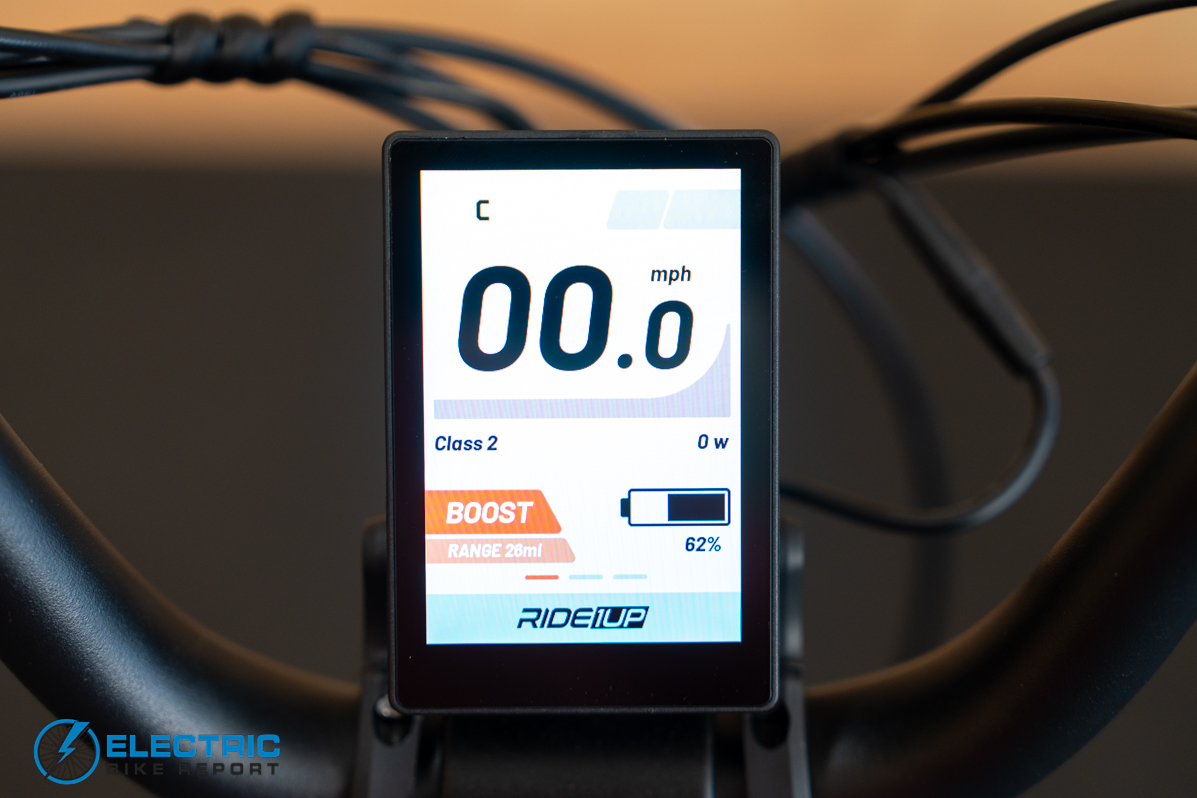
The Portola 02’s color display packs in a lot of info, but does it clearly and admirably.
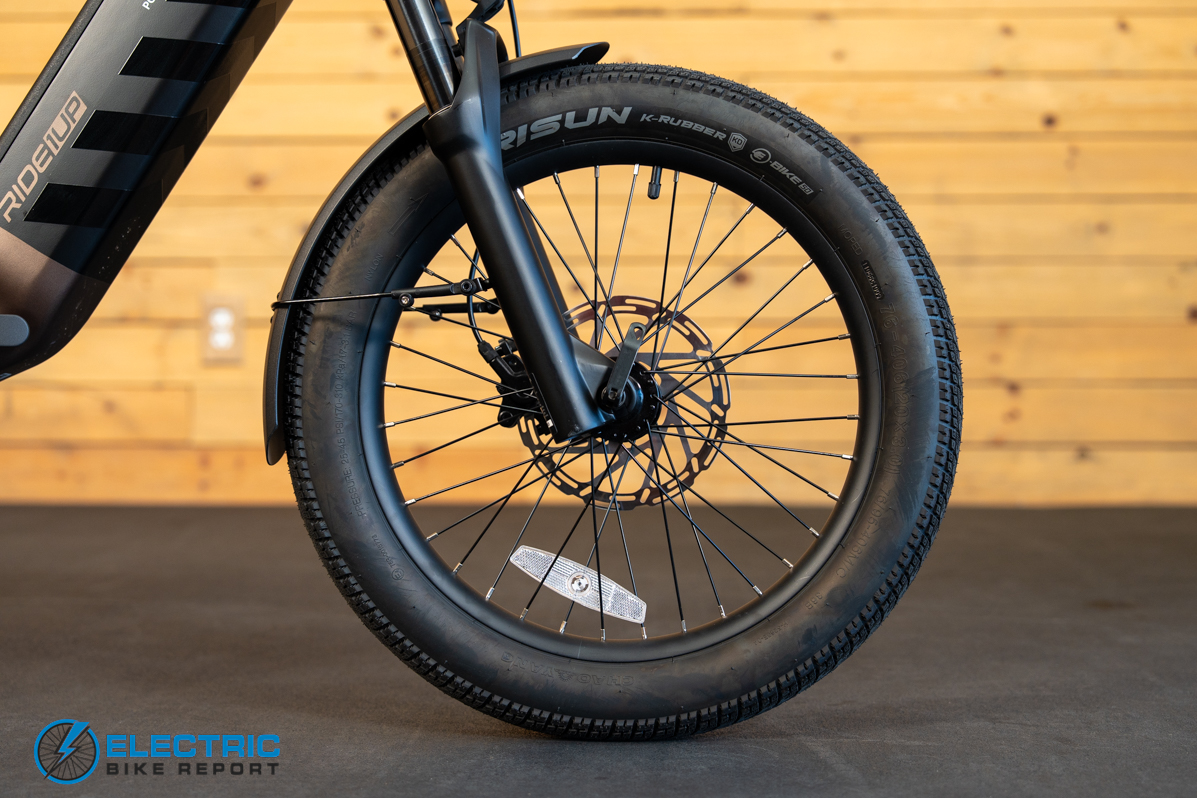
Even the suspension fork is an upgrade, with 100mm of travel over the original’s 80mm.
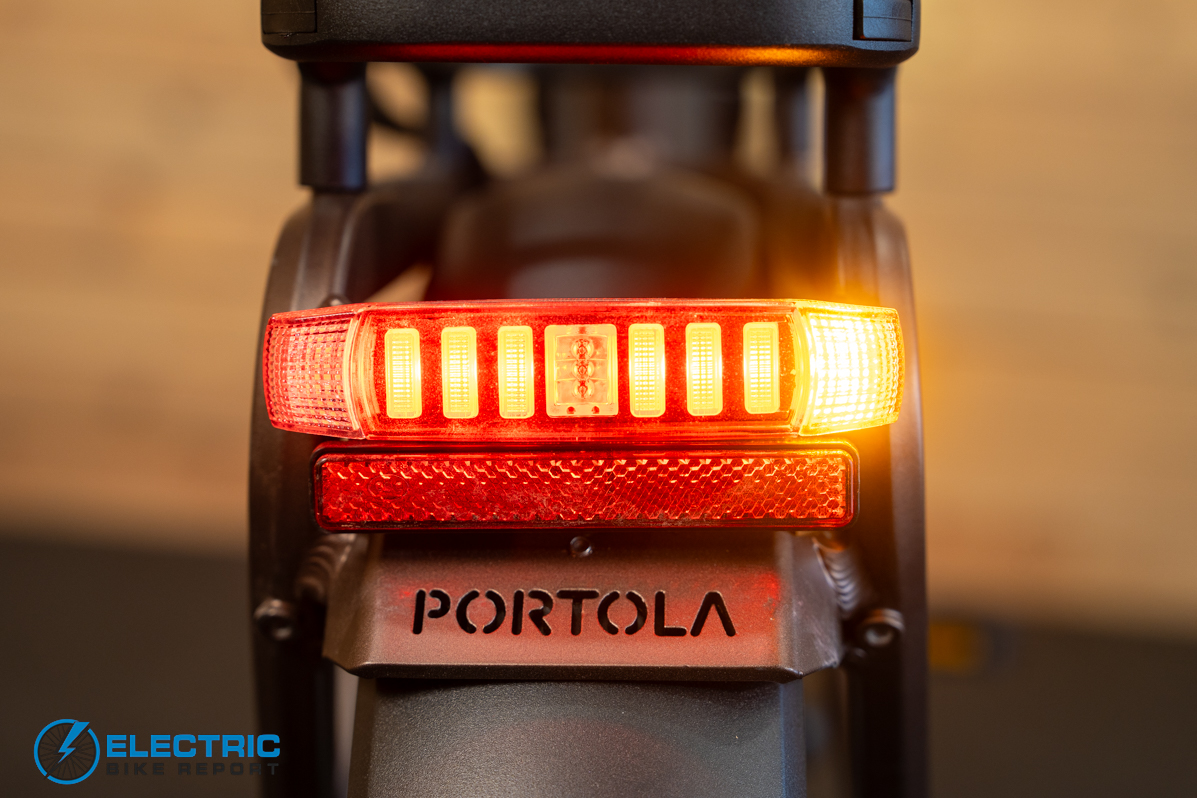
The standard model includes a rack-mounted taillight with brake lights and integrated turn signals.
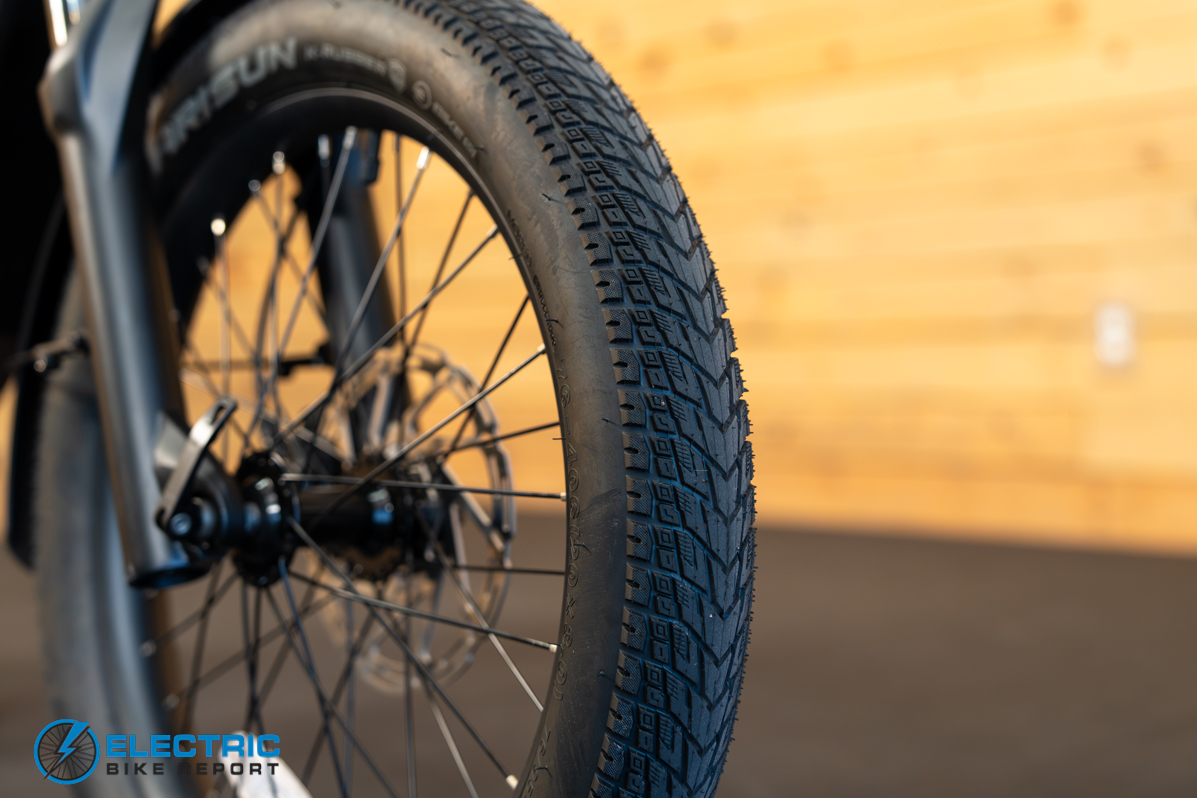
Ride1Up equipped the bike with a set of 20×3″ hybrid tires that roll smoothly while having enough grip for light off-roading.
Ride1Up Portola 02 Review: Summary / Where to Buy
Each time I review an e-bike from Ride1Up, I’m reminded why the company remains one of the top dogs in the e-bike industry. It consistently produces thoughtfully crafted, value focused, great performing products regardless of what style they are. The Portola 02 exemplifies the brand’s growth and experience—it’s an impressive, highly affordable folding e-bike that largely improves upon the previous model.
Our testing shows that the bike performed well—especially when its potentially sub-$900 starting price point is taken into account. Additionally, its range stretches from adequate to generous, depending on which battery size it carries. The bike is a steady, competent climber, though it won’t likely break any speed records. Finally, its braking power is substantial, proving that it is both safe and well-equipped.
To top it all off, the bike is, indeed, compact and portable. Its ride is comfortable and adaptable, its feel and performance are largely customizable, and its default torque-sensing mode feels both helpful and remarkably natural, with a balanced distribution of power levels.
The only real points of critique we identified are more wish list items instead of actual problems; a more reinforced set of handlebars would add both stiffness and extra room for items like a phone mount or a bar bag. Additionally, the option to add assist-level-based speed limits in cadence mode would give riders easier control over their speeds.
Otherwise, the Portola easily earns itself a top spot in our list of folding e-bike recommendations due to its comfort, responsiveness, feature package, adaptability, and overall value. Whether used as a stowable adventure bike in the family RV or a daily driver for commuting to work or school, the bike is ideally suited for those who want spectacular bang for the buck.
Happy Riding! Make sure to let us know if you have any questions or if you think we left anything out in this review of the Ride1Up Portola 02 down in our comments section.
Sponsor
Sponsor
Reader Interactions
Leave a Reply