

Urtopia Carbon Atom Review | Fun is a Fundamental Element
Jun 25, 2026
 4 Comments
 Share
Share
This SUV-style commuter e-bike is comfortable, approachable to both new and experienced riders, and is made for adventuring on and off the beaten path.
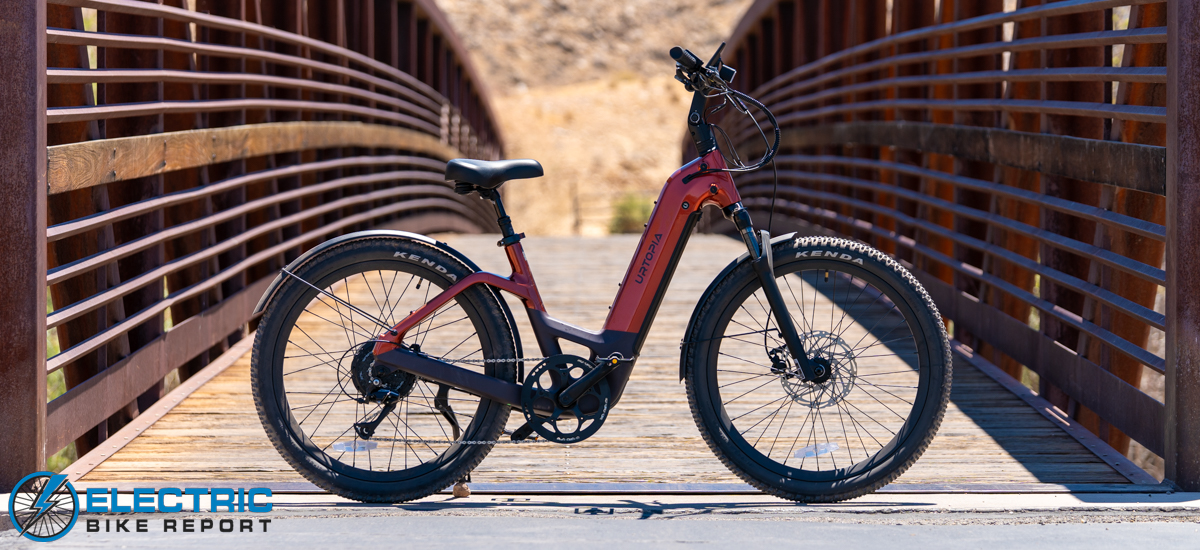
There’s a big difference between e-bikes that aim to give you the world and those that simply give you enough. Those in the former camp often trip over themselves to deliver a long list of features, accessories, and flashy specs. But, in my experience, quality is better than quantity; a basic, well-executed e-bike is often better than one that tries too hard.
That’s not to say that the Urtopia Carbon Atom is a basic e-bike—to the contrary, it offers many steps up from entry-level. It’s made from high-quality Toray® T1000 carbon fiber, which is also used for aerospace and Formula 1 racing applications. It features an intuitive, responsive pedal assist system with programmable power levels. The bike also puts a big focus on versatility with many of its components.
As an SUV-style e-bike, the Carbon Atom is designed for comfortable commuting and off-road adventuring alike. It’s not an e-mountain bike, but it’s also not limited to pavement alone; its combination of a suspension fork and seatpost, knobby tires, a cushy saddle, and wide handlebars makes this hybrid e-bike suitable for dirt roads, gravel paths, etc.
I was impressed with the bike even after my first brief test ride across a parking lot, and that’s saying something. After all, many e-bikes take some warming up to, but others don’t quite stick even after a couple of days of testing. But what matters more is how it performs in relation to its peers, how it feels to ride, and whether it brings enough to the table to meet your needs.
In our full review below, we’ll examine the Urtopia Carbon Atom’s real-world test performance, its ride quality, and its overall user experience. Continue reading to learn more about this comfortable, multipurpose machine!

Sponsor
E-Bike Category:Commuter
E-Bike Class:Class 1 (pedal assist to 20 mph)
Class 2 (throttle to 20 mph)
Class 3 (pedal assist to 28 mph)
Class 2 (throttle to 20 mph)
Class 3 (pedal assist to 28 mph)
Sponsor
Urtopia Carbon Atom Video Review
 Pros
Pros- The bike’s programming is great, with responsive, natural-feeling pedal assist and an intuitive selection of power levels. There are modes for active and extremely relaxed riding.
- Comfort is a huge focus here, with both a suspension fork and seatpost, a remarkably cushy saddle, and a broadly customizable fit.
- The Carbon Atom’s performance was great across the board, with strong results in braking performance and our Hill Climb test, and a solid showing in the range department.
- Urtopia takes a relatively unique approach with the pedal assist system, offering customizable power levels, three torque-based assist modes, and one high-powered cadence-based mode.
- It handled well, with controlled, responsive steering and a lively, maneuverable feel.
- Extras like the 4.5A fast charger, turn signals with alarm, optional Smart and Turbo modes, etc., add value and practicality.
- As an SUV-style commuter, the Carbon Atom is usable for commuting and adventuring, thanks to its combination of knobby tires, suspension fork, and suspension seatpost.
 Cons
Cons- While its overall sizing and range of adjustability should work for most riders, additional frame sizes would make for a more personalized fit.
ELECTRICAL SPECS & FEATURES
- Battery: 48V, 835 Wh, 21700 LG Li-ion, removable
- Charger: 4.5A
- Display: Color Display
- Motor: Customized rear hub, 48V, 750W, 90 Nm torque
- Headlight: External front light, 100 Lux
- Taillights: Integrated rear light with turn signal and brake light functions
- Pedal Assist: 5 Levels
- Claimed Range: Up to 95 miles
- Throttle: Up to 20 mph
- App: N/A
- UL Certification: UL 2849 & UL 2271 certified
Weight & Dimensions
- Claimed weight: 58 lbs
- Tested Weight: 65 lbs
- Rider height range: 5’3″ – 6’3″
- Total payload capacity: 330 lbs
Components & Accessories
- Brakes: Tektro HD-E3520 hydraulic disc brakes with power cut-off sensor, 203mm front rotor, 180mm rear rotor
- Fenders: Alloy front and rear
- Fork: 80mm suspension fork
- Seatpost: 30mm suspension seatpost
- Frame: Toray® T1000 Carbon Fiber
- Drivetrain: Shimano 8-speed, 52T chainring, 12-32T cassette
- Grips: Ergonomic Rubber
- Saddle: Foam Comfort Spring Saddle
- Handlebar: Aluminum, 700mm, with angle adjustable stem
- Kickstand: Included
- Pedals: Platform
- Tires: 26″ x 2.4″ all-terrain tires
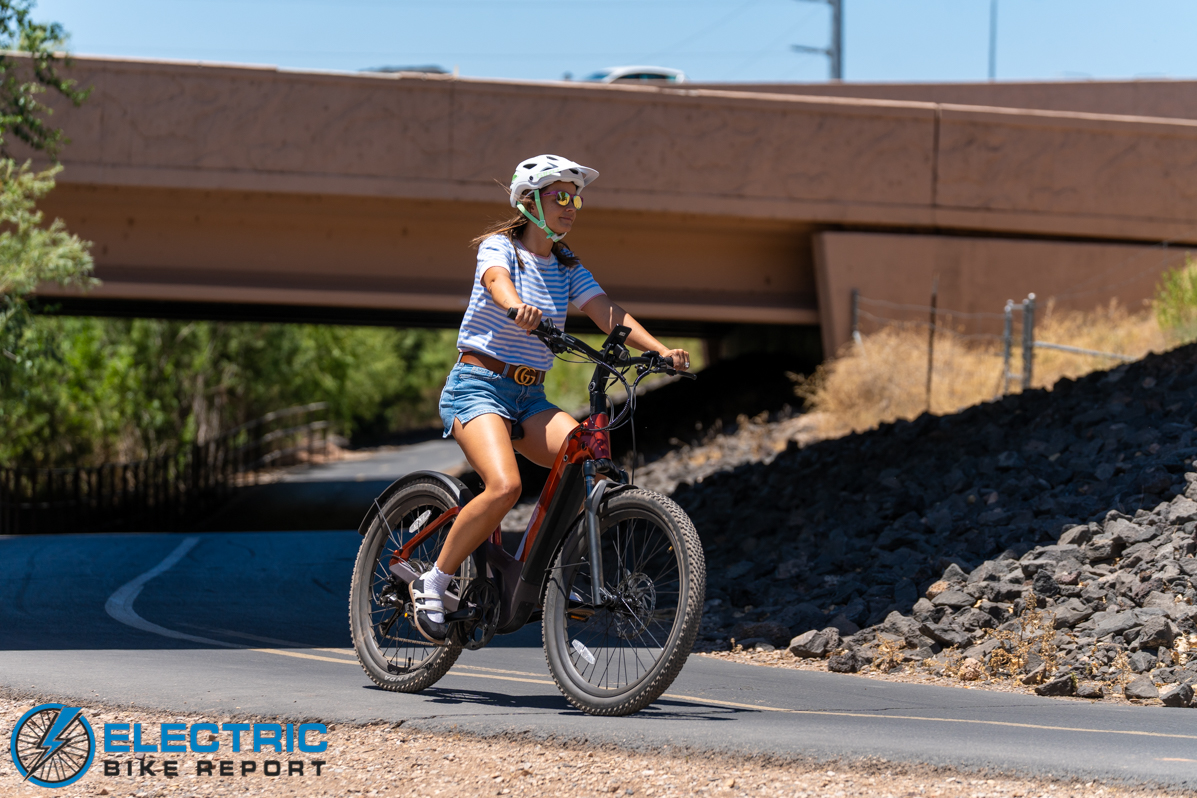
Even the lowest of the Carbon Atom’s assist levels delivers meaningful, responsive power.
A 750W hub motor provides plentiful, controlled power for low-effort pedaling.
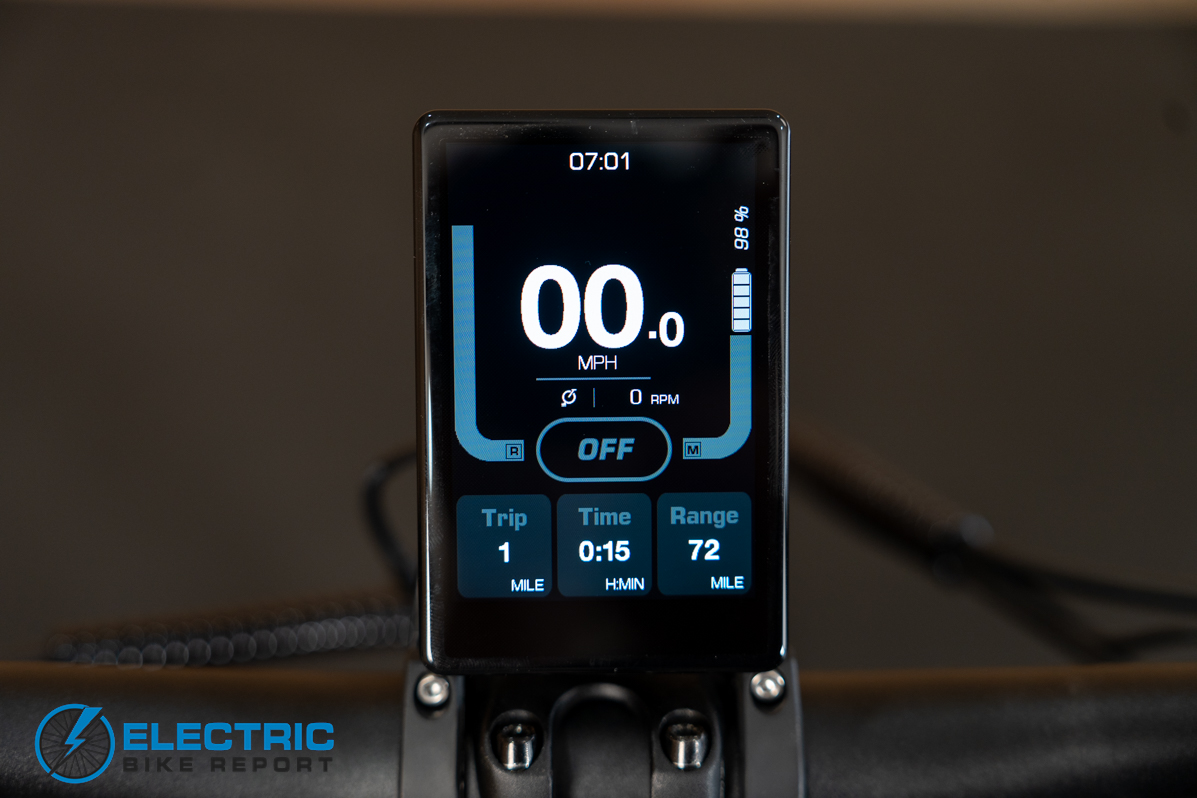
Users can fully adjust the power levels of each pedal assist level through the display.
Urtopia Carbon Atom Review: Speed Test
How an e-bike feels across its full range of assist levels matters as much as how fast it goes at the top end of its limits. A well-programmed pedal assist system should give you something useful at every level—and that’s exactly what we found when testing the Urtopia Carbon Atom on a flat, paved shared use path.
As a Class 1 and 2 e-bike with four default modes (Eco, Tour, Boost, and Turbo), the bike has a maximum speed of 20 mph right out of the box. Users can adjust it to be a Class 2 and 3 e-bike, however, with throttle to 20 mph and pedal assist up to 28 mph. I tested the bike in both configurations and recorded my average speed in each assist level.
One quick note: our test bike included a Smart mode that fluctuated between Tour and Boost output, but Urtopia decided to remove this from the production version of the bike. Additionally, Turbo had to be enabled through the display on our test bike, but our contact shared that it will be present on production models to replace Smart mode.
Without assist, the bike’s weight was noticeable, but not overbearing. In Eco, Tour, and Boost, the bike delivers torque-based pedal assist, with smooth, responsive power that gives the Carbon Atom an analog-like feel. Eco felt natural and meaningful right away, which isn’t a given at a bike’s lowest level. Tour felt strong and controlled, while Boost felt extremely relaxed and rewarding.
Unlike the other assist levels, Turbo is cadence-based rather than torque-based, so, the motor holds a steady output regardless of pedal pressure. There, I was ghost pedaling — turning the cranks without any real pressure — and the motor held me at maximum speed without much effort.
By default, the throttle requires a double press to activate, which is something to be aware of before your first ride. It eases into power gradually rather than snapping to full output, which feels controlled and approachable, but costs a second on acceleration. The feature wasn’t available on our test bike, but an OTA update will be available on production models for those who want to disable the double-press requirement.
Overall, the bike performed extremely well in this test. It offers a handful of intuitive assist levels with balanced power distribution, though the output of each assist level can be customized via the bike’s display. It also offers three torque-based modes for a natural-feeling ride, and one more relaxed cadence-based option for those who want an easy cruise or lower-effort climbing.
Sponsor

As a Class 2 e-bike, the Carbon Atom comes with a 20 mph speed limit, though it can be unlocked to higher pedal-assisted speeds.
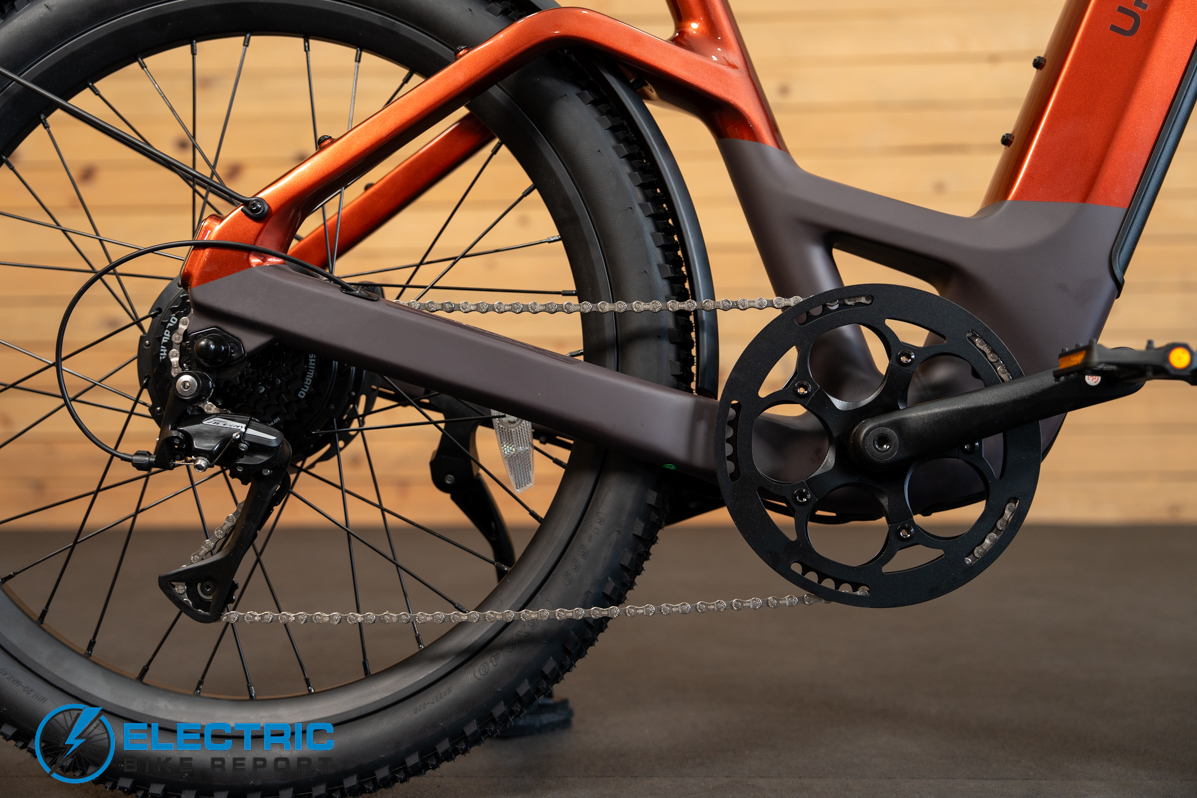
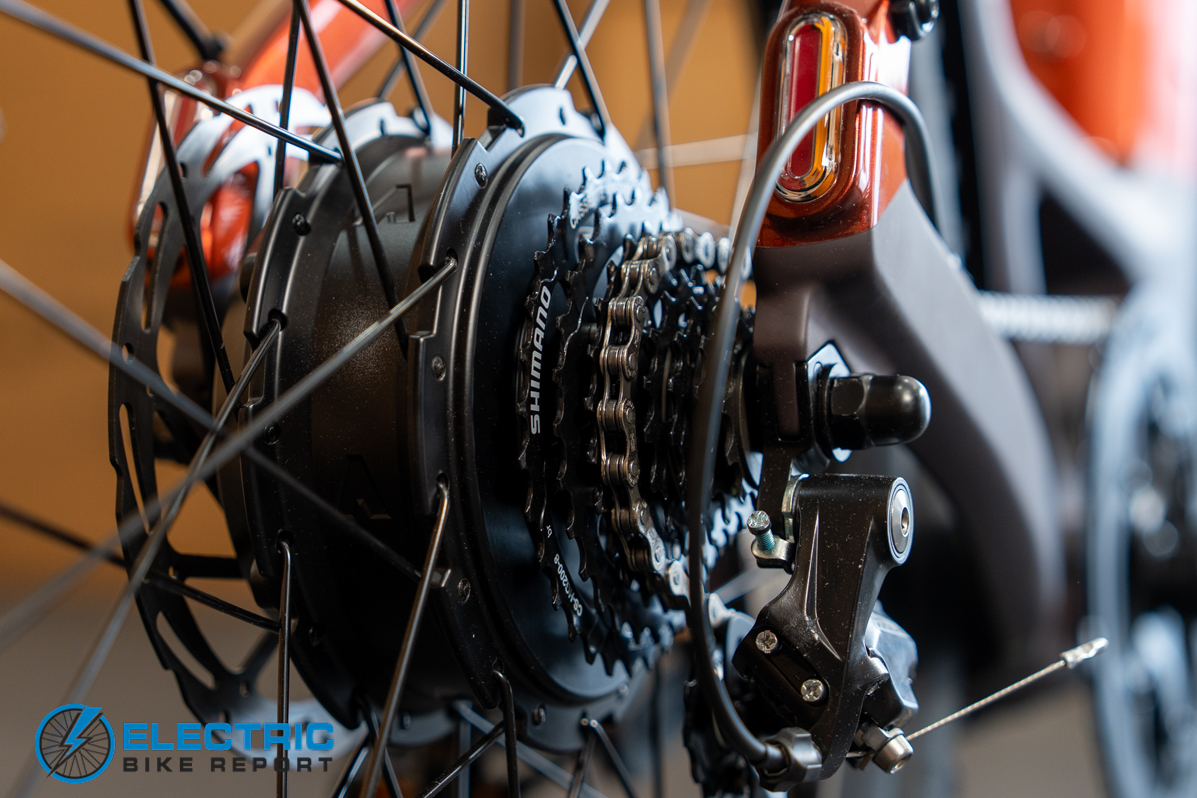
Urtopia specced the Carbon Atom with an 8-speed Shimano Altus drivetrain.
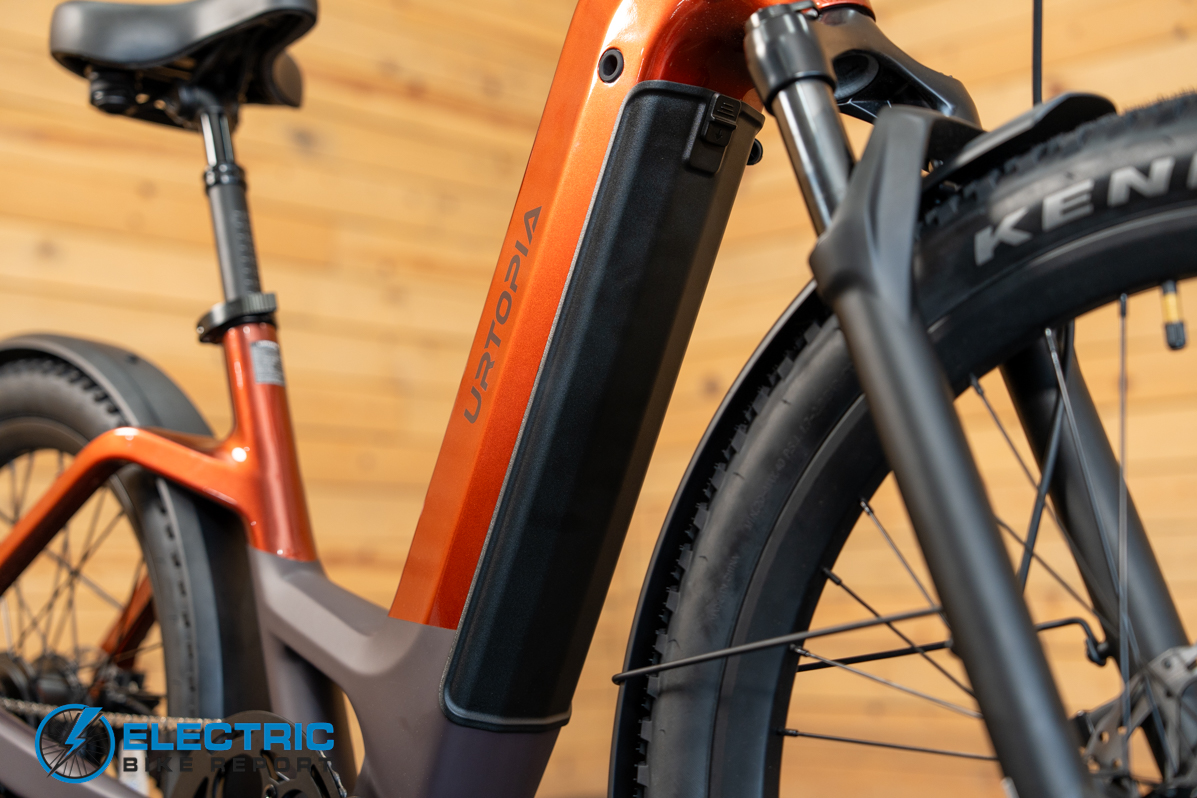
The bike’s massive 835 Wh battery is fully integrated into the down tube.
Urtopia Carbon Atom Review: Range Test
A bigger battery doesn’t automatically mean more miles. The Carbon Atom carries an impressively large 835 Wh battery, which is meaningfully higher in capacity than the category average of 729 Wh among similar commuter e-bikes. How the motor uses that capacity, though, shapes the results in ways worth understanding.
When testing the bike in its highest and lowest pedal assist levels to find its minimum and maximum range, our results came in at 71.2 miles in the Eco test and 45.3 miles in the Boost test. Urtopia claims up to 95 miles, and while we landed about 24 miles short in low-power testing, we consider the bike’s range to be entirely practical for daily use.
The category average for low-power range is 79.3 miles, which means the Carbon Atom came in somewhat below average on that test, despite carrying a significantly larger battery. The reason for this difference is the Carbon Atom’s higher energy consumption. In the low-power test, the bike used 11.3 Wh per mile against a category average of 9.5 Wh/mi — roughly 2 Wh/mi more than its peers.
As I touched on in the Speed Test section above, the Carbon Atom’s Eco mode is an uncommonly well-powered assist level. Many comparable bikes can feel underpowered in their lowest setting, but this one doesn’t—and that’s something we appreciated about it.
The Carbon Atom’s Boost mode test result flips the story. At 45.3 miles against a category average of 36.8 miles, the Carbon Atom outran its peers by 8.5 miles. There, its energy consumption was lower than its peers at 17.7 Wh/mi, compared to a category average of 20.3 Wh/mi — about 2.5 Wh/mi more efficient than its peers. The larger battery and slightly lighter weight both helped, but so did the motor’s tuning at high output.
Practically speaking, a window of roughly 45 to 71 miles should cover most riders in the real world. Those with a 10-mile daily commute should expect multiple round trips between charges. Additionally, the fact that the bike is more efficient than average in Boost makes it a great option for riders who prefer fast and easy pedaling with plenty of help from the motor.
One thing to keep in mind; Turbo was not active on our test bike by default. Since it is cadence-based, its output does not fluctuate as with the other three assist levels; riders using this setting should expect to get fewer miles from a charge. Additionally, we tested the bike in Class 2 mode; higher speeds will also expend battery charge faster.
A final note: the 4.5A fast charger is a genuine asset here, cutting recharge time down to about four hours. It makes a real difference when considering that the Carbon Atom comes with a significantly larger-than-average battery!
Sponsor
Sponsor
Urtopia Carbon Atom Review: Hill Test
Climbing a steep hill puts an e-bike’s motor under real load, and details such as the speed you lose, the noise you start to hear, and how hard you’re still pedaling by the time you reach the top can tell you a great deal about how well the bike can handle hills.
Our test rider, Justin, completed his throttle test at the Devil’s Backbone in 1:50 at an average speed of 16.5 mph. The category average for this portion of the test is 1:55. In his max PAS test, he reached the top in 1:42 at 17.8 mph, against a category average of 1:47.
Both results landed exactly 5 seconds faster than average, which we attribute to both the bike’s somewhat higher-than-average motor output and slightly lower-than-average weight.
For reference, the Carbon Atom’s AKM rear-hub motor is rated at 750W nominal, with a peak of 1250W and a maximum of 90 Nm of torque. Its torque figure sits about 8 Nm above the category average of 82 Nm for similar commuter e-bikes, while its peak power exceeds the average of 1171W by 79W.
At 65 lbs, a few pounds lighter than the 68 lb category average, the Carbon Atom is easier to move uphill. Its motor output also helped to make the process of climbing the hill faster.
One thing that stood out on the hill: the motor stayed remarkably quiet under load. Climbing at speed on throttle, you could hear the clicking of the hub more than the motor itself, which is about as good as it gets on a rear-hub bike working hard up a grade.
As I touched on in the throttle portion of our Speed Test above, the Carbon Atom’s power delivery eased on gradually rather than snapping to full output. That may have cost a second or two on our timed Hill Test, but it also gave the bike a controlled, easily managed feel on the way up the hill.
In my personal testing at our secondary location, Pilot Hill, the cadence-based Turbo mode made for the fastest and easiest climb I had when pedaling. There, the motor did nearly all the work and I only needed to pedal lightly to keep the cadence sensor active. Boost mode felt active but relatively low effort, and I reached the top without feeling tired or out of breath.
My takeaway from this test is that the Carbon Atom has ample power to help riders who live in areas with steep hills. With a throttle, three torque-based assist levels, and a cadence-based mode, it gives riders plenty of options for how to tackle them.
Sponsor
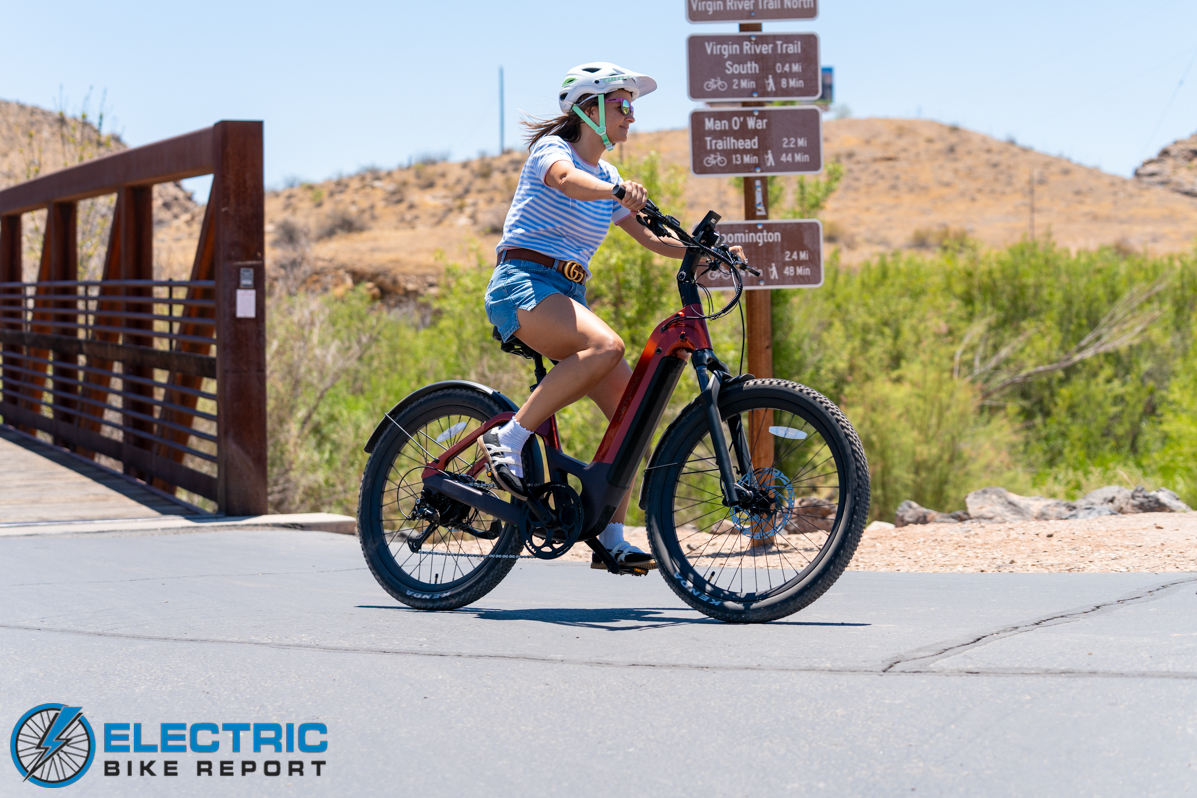
There are three color options for the Carbon Atom: Copper (pictured), Moonlight, and Olive.
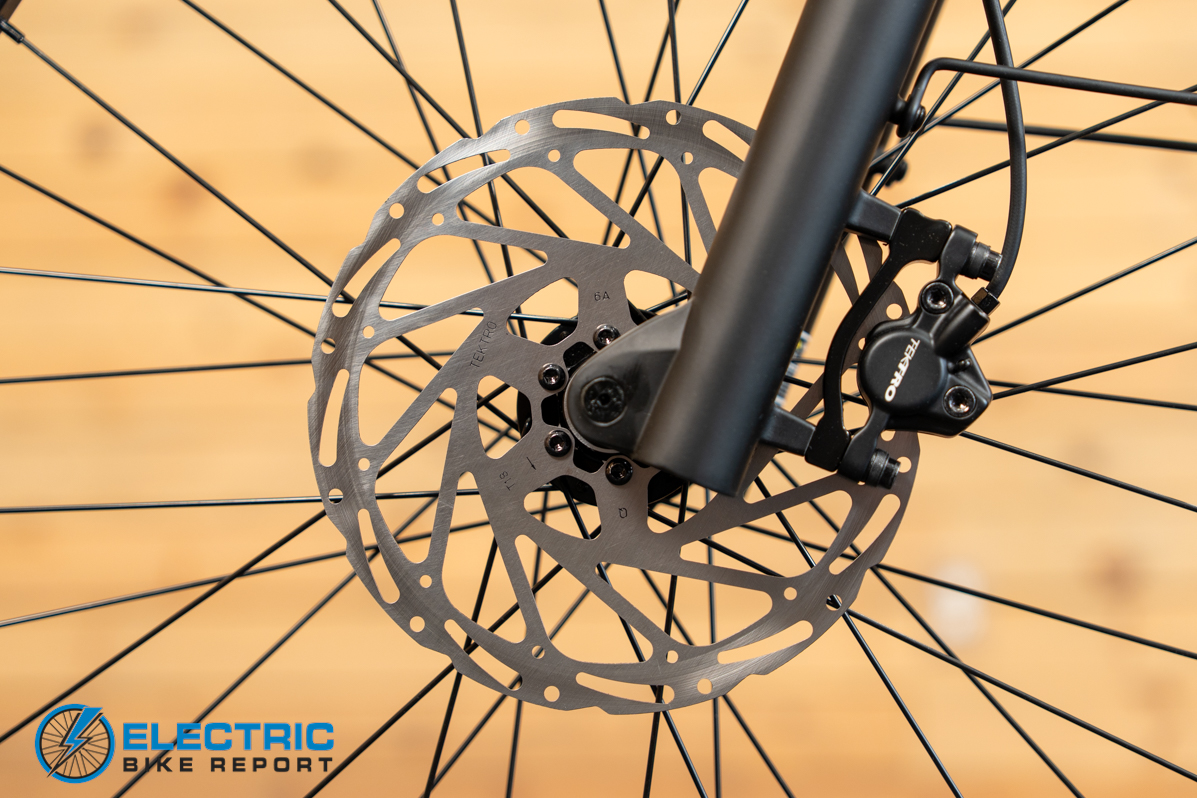
Urtopia specced a 203mm front rotor to go with the bike’s Tektro hydraulic brake system.
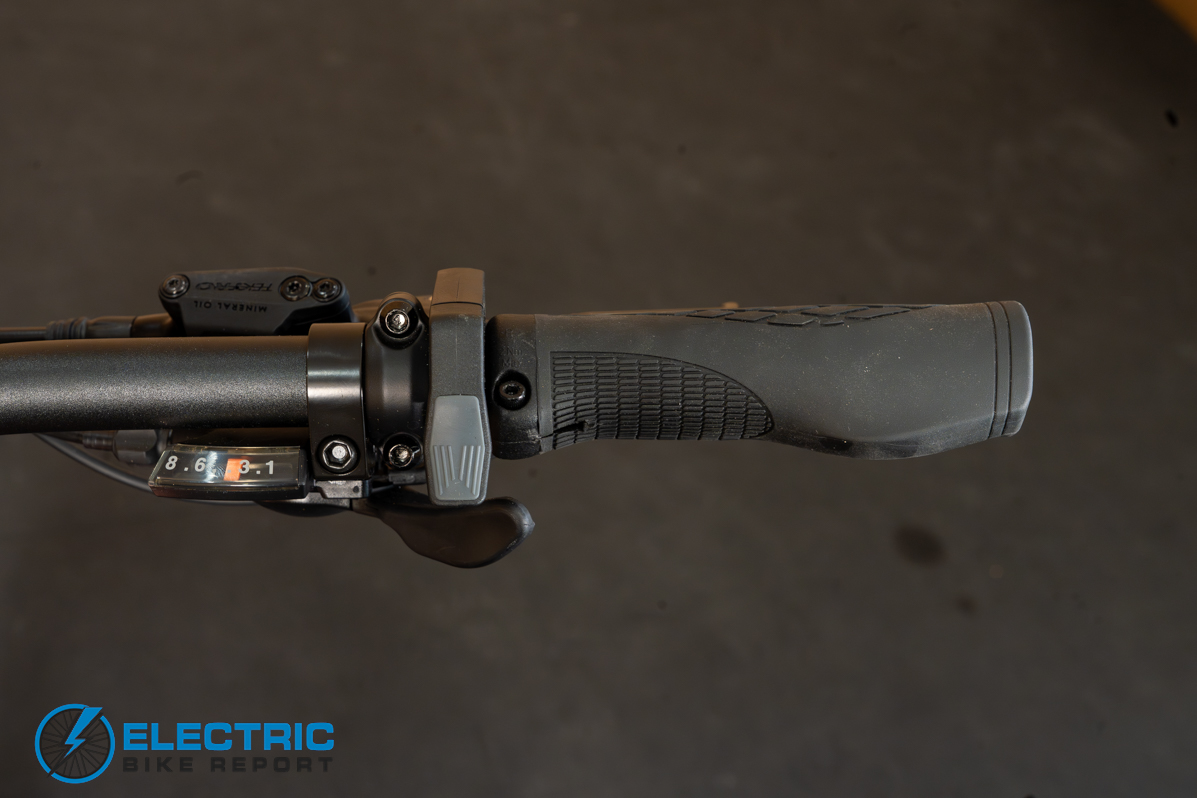
The Carbon Atom’s thumb throttle sits next to its shifter on the right handlebar.
Urtopia Carbon Atom Review: Brake Test
The Carbon Atom’s braking result was one of the stronger numbers in our testing. When our test rider Michael applied the brakes after reaching 20 mph, then measured its stopping distance across three trials, the bike’s average came in at 18’11”, against a category average of 21’6″, making it over two and a half feet shorter than its peers.
The Tektro HD-E3520 is a two-piston hydraulic brake system we’ve seen on several bikes at this level. What sets the Carbon Atom’s setup apart is its rotor specs. While its rear rotor measures 180mm in diameter, the front rotor is a larger 203mm. In contrast, many similar models use a less effective setup with dual 180mm rotors.
Since braking force is shifted to the front wheel when the brakes are applied, a larger front rotor dissipates heat faster and increases the leverage of the brake pads and calipers. This translates directly to shorter stops.
The Carbon Atom also comes in a few pounds lighter than the category average of 68 lbs, which also makes it easier to slow down.
Based on our formal test and my personal experience outside of it, the brakes felt powerful and well-matched to the bike’s weight. Stopping happened fast with only a moderate pull on the levers. Riding downhill at speed, they kept my pace in check without requiring heavy pressure, and modulation felt predictable throughout.
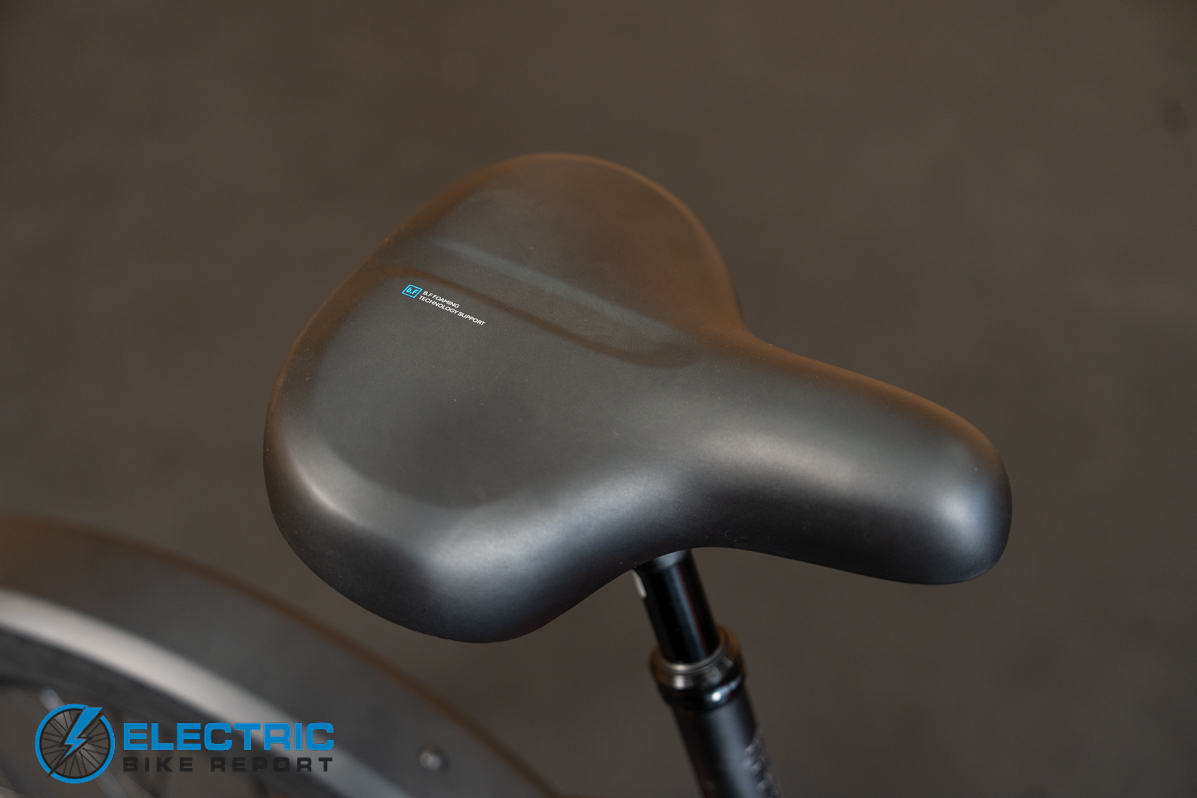
This saddle is remarkably cushy and plush, adding comfort and support.
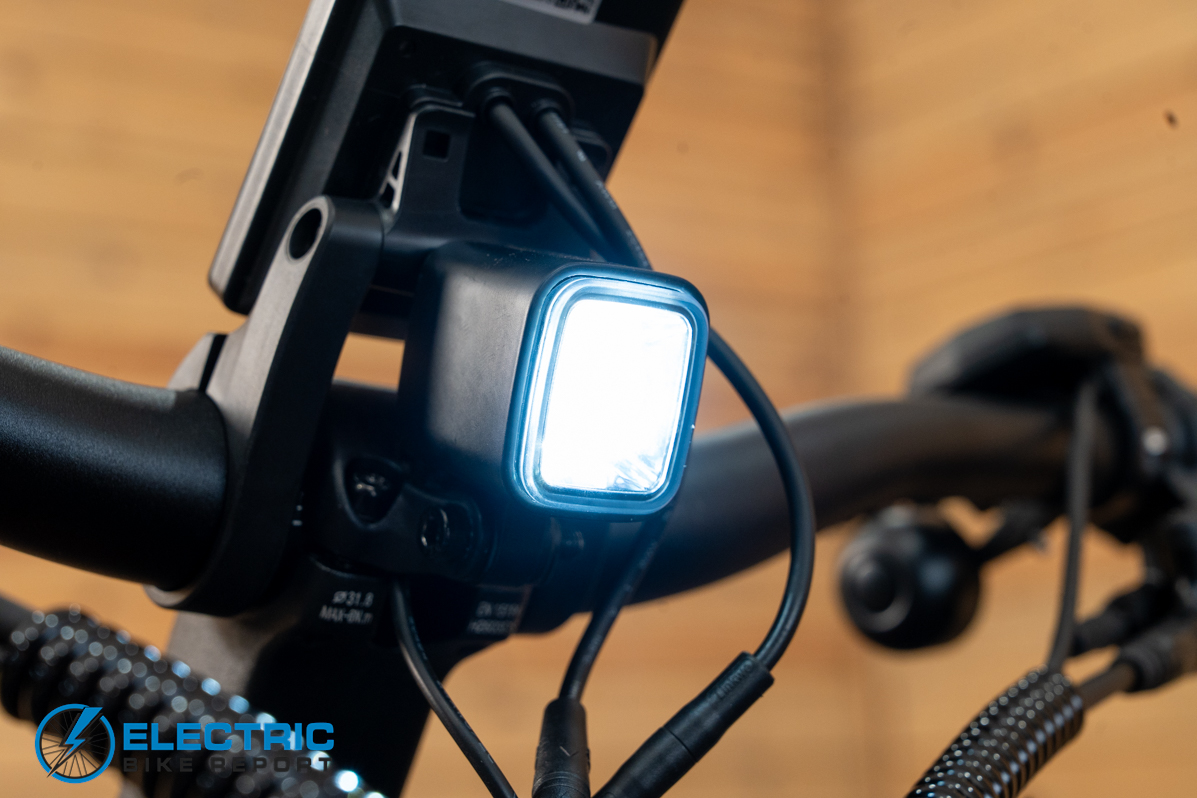
The integrated LED headlight is relatively small, but quite effective.
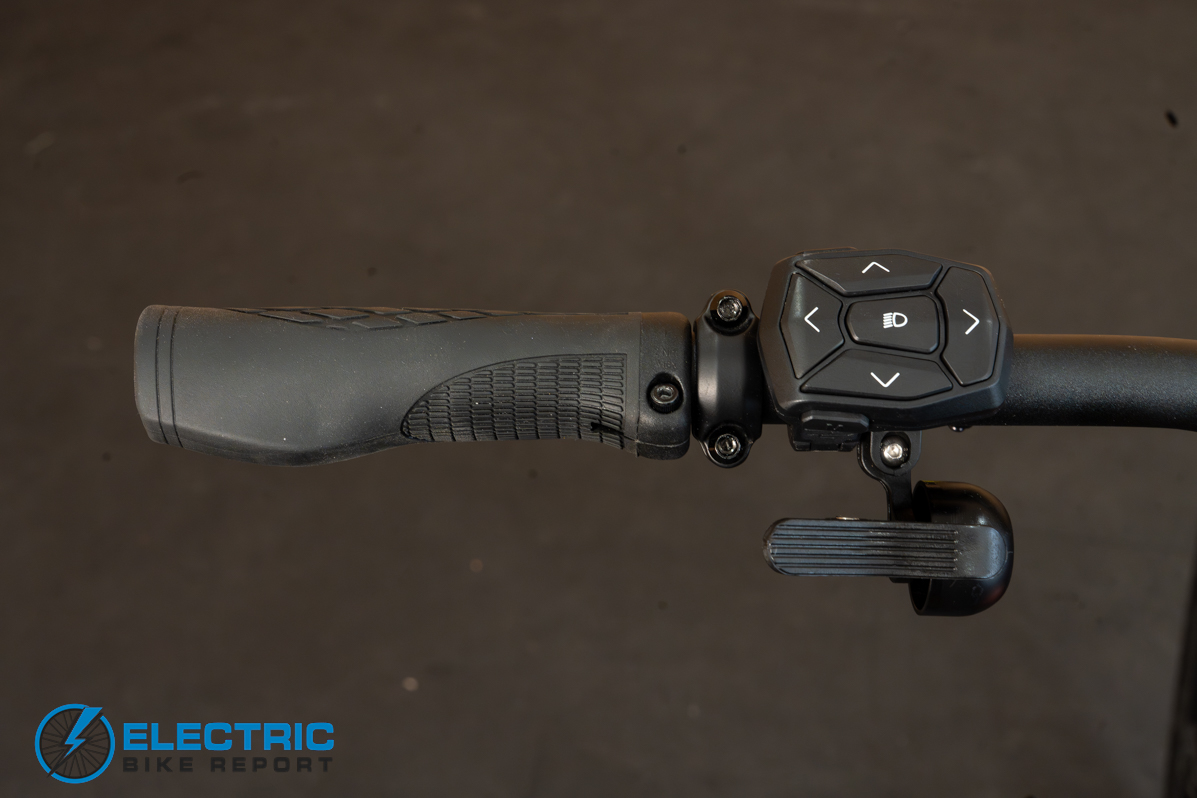
Ergonomic rubber grips cap both ends of the 700mm handlebars.
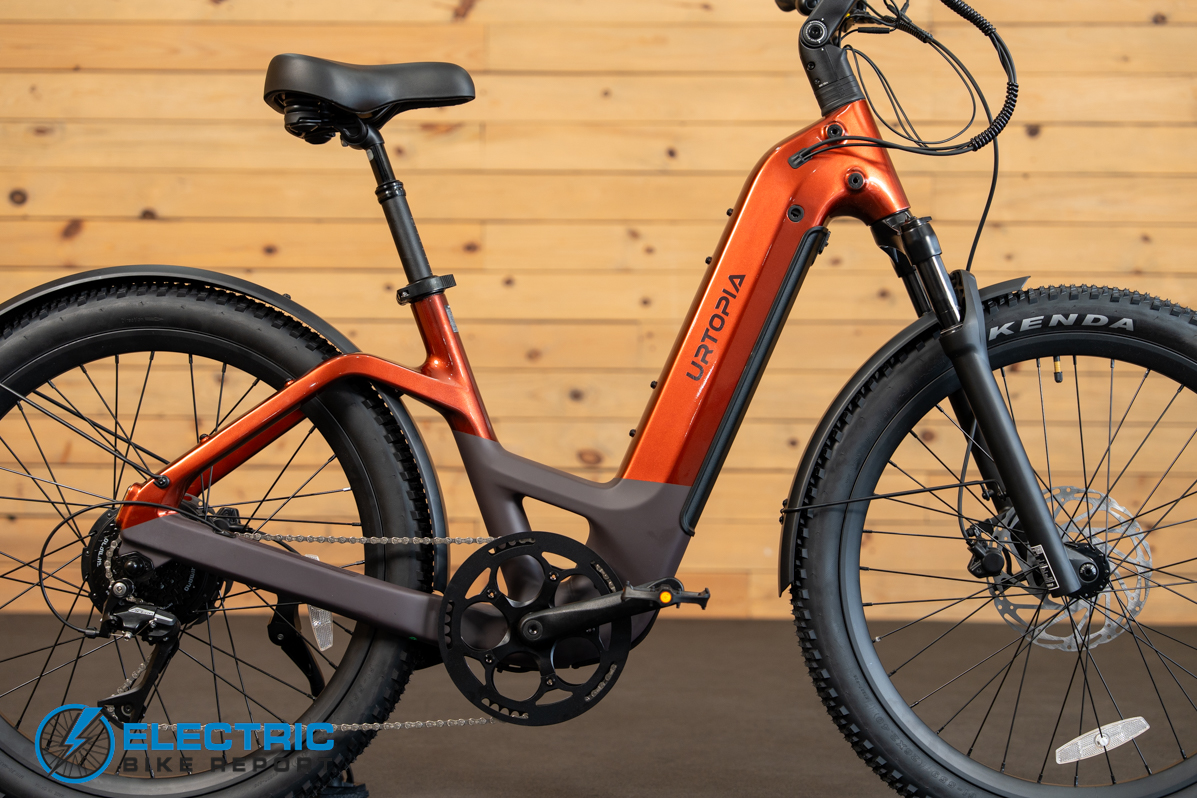
The Carbon Atom’s frame has a huge amount of style, with angled lines and no welds.
Urtopia Carbon Atom Review: Ride Quality
The Carbon Atom suits two very different kinds of rider, and that’s not something I can say about all e-bikes. Experienced cyclists will likely find the torque-based pedal assist settings familiar, responsive, and natural. Riders who want a near-effortless experience, however, can enable Turbo mode and let the motor handle most of the work.
Most bikes—even those that offer both torque and cadence-sensing modes—ask you to pick one or the other. The Carbon Atom’s different approach is both cool and highly appreciated.
Fit and adjustability are generally handled well for a single-size frame designed to fit those from 5’3″ to 6’3″. At 5’11”, I found comfortable leg extension for efficient pedaling, and the upright position suited longer riding without putting pressure on my wrists. The reach felt slightly short for my preference, and I’d want to push the stem a bit further forward on a longer outing, but that’s exactly the beauty of the bike’s adjustable stem.
This setup will likely work for most folks, but multiple frame sizes would help dial in fit more precisely for riders at either end of that range.
The Carbon Atom’s Kenda 26×2.4 tires are a highlight, giving the SUV-style bike its trademark versatility. Their width gives the bike a stable, planted feel without adding the weight and rolling resistance of a 4-inch fat tire. Their knobby tread gripped well on gravel and packed dirt, and their volume added cushion to smooth out bumps.
Urtopia’s Toray carbon fiber frame is worth acknowledging, too. This material, while plenty stiff and sturdy, flexes more than aluminum. As such, it’s able to absorb road buzz and small bumps before they reach the rider’s hands and wrists, so the ride is ultimately more comfortable than it would be on an alloy frame.
In my experience, frame flex was present but not egregious, feeling relatively consistent with what you’d get from a comparable step-through aluminum frame.
The Carbon Atom’s suspension fork and seatpost worked extremely well in concert; this bike rides extremely smoothly and comfortably! The 80mm fork handles larger hits up front, while the 30mm seatpost absorbs smaller ones that travel straight up through the saddle.
Those who don’t need the suspension seatpost can swap to a standard one to lower the bike’s height range by around two inches, though I greatly appreciated the included feature for the sake of comfort.
In terms of handling, the bike balanced plantedness and agility well. Steering felt balanced and controlled, thanks to the Carbon Atom’s wide 700mm handlebars. The 26″ wheels made the bike maneuverable, while its weight helped it to feel stable and stuck to the ground.
I appreciated the color display and all of the ride data it presented. The customization available through the display is worth mentioning, as well. Motor tuning, Turbo mode activation, speed adjustments—all of it lives in the display rather than an app. This approach feels robust but also approachable; learning the bike’s features and making changes is relatively straightforward without extra steps and the potential for complications.
Overall, the Carbon Atom is completely functional right out of the box, though it also offers a wide range of adaptability for riders of different styles. It’s remarkably comfortable, intuitive, and familiar, while still providing plenty of options to change its feel and behavior.
Sponsor
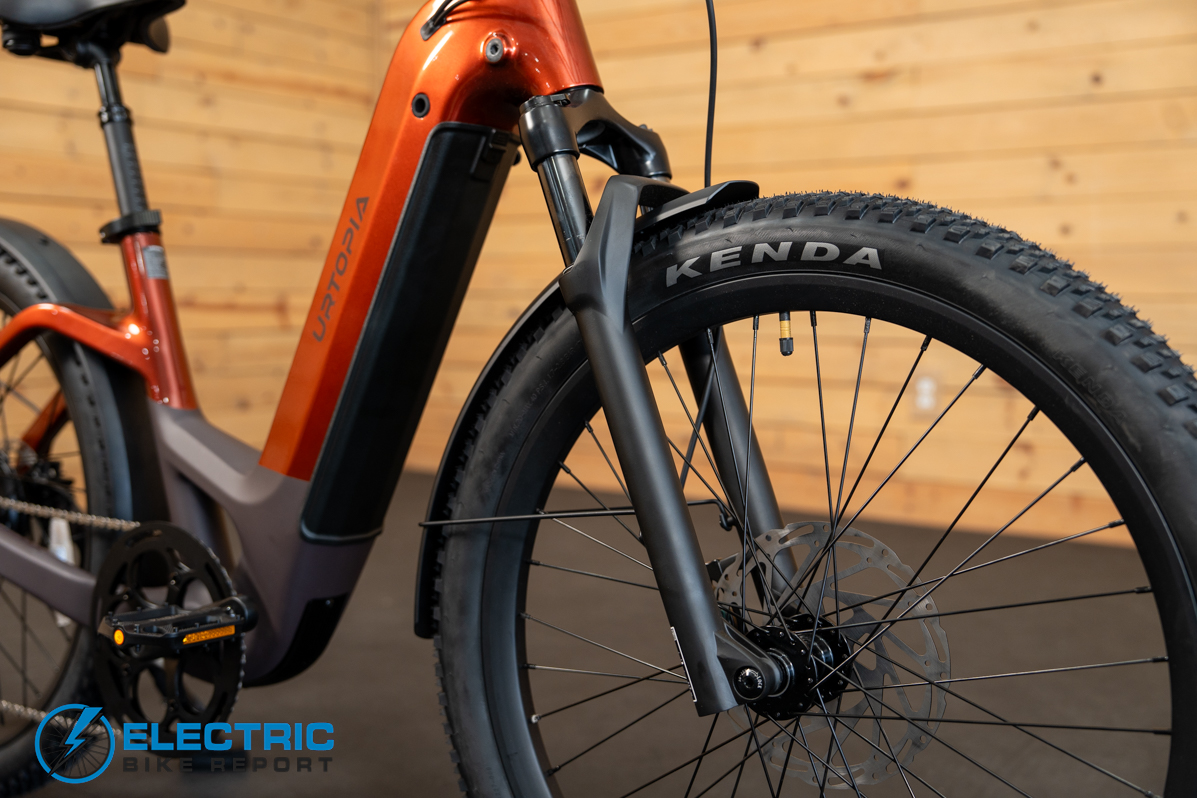
With 80mm of travel in its suspension fork, the bike has a smooth and comfortable ride.
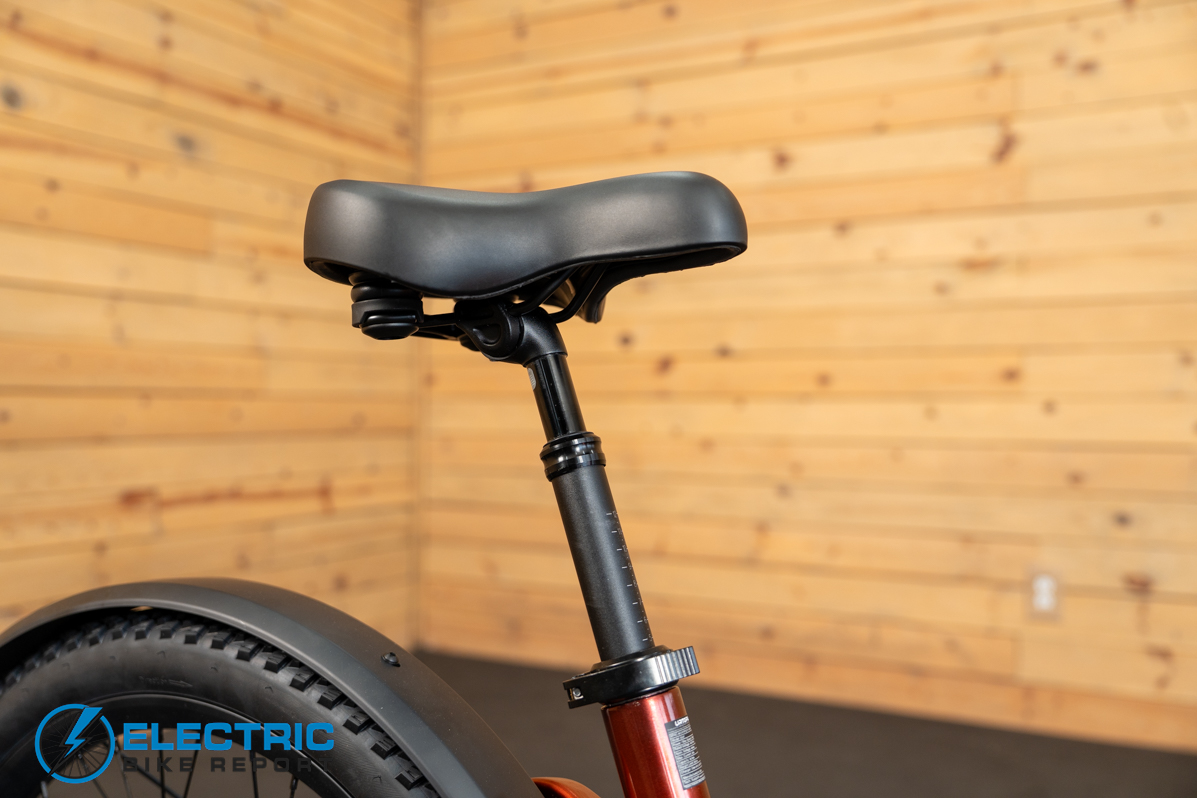
A suspension seatpost with 30mm of travel absorbs bumps before they get to you.
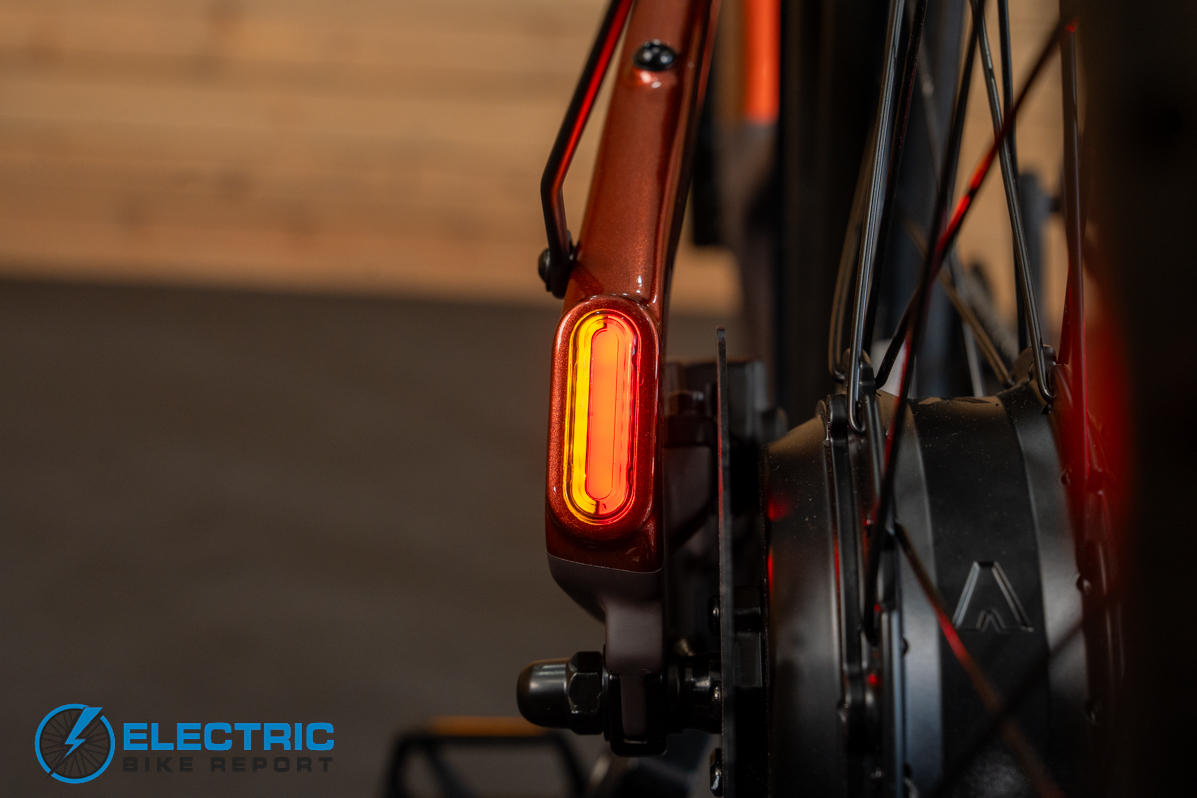
The bike has tail/brake lights and turn signals integrated into its carbon frame.
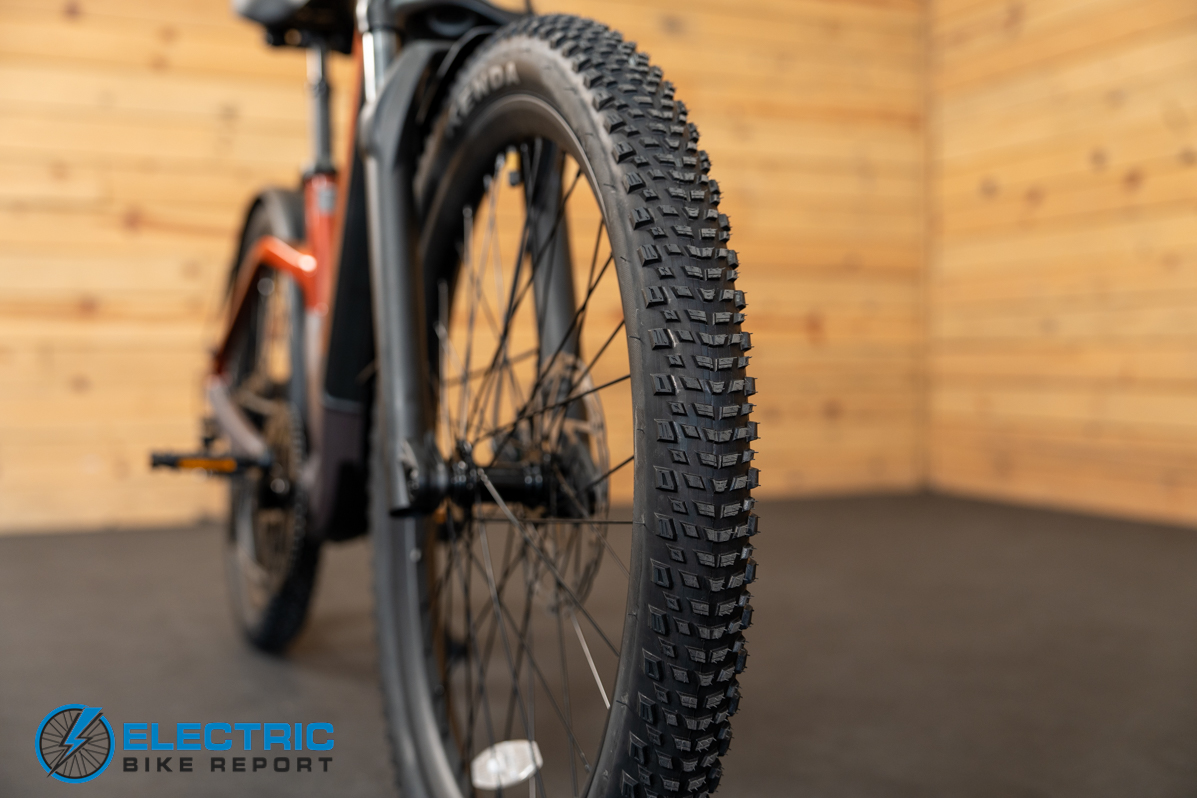
Knobby 26×2.4″ Kenda tires give the Carbon Atom plenty of off-road capability.
Urtopia Carbon Atom Review: Summary / Where to Buy
SUV-style e-bikes like the Carbon Atom are often among the easiest to recommend, simply due to their sheer versatility. This bike is no exception, and Urtopia clearly did an excellent job putting together a ride with lots of mass appeal.
Comfort is clearly one of the bike’s greatest areas of focus; the combination of suspension fork, suspension seatpost, and a cushy saddle allows for smooth rides and long trips.
The pedal assist system earns its own mention here. Three torque-sensing modes and one cadence-based Turbo option give riders a range of experiences to choose from, and the motor tuning accessible through the display means that anyone can adjust how it all feels without needing a phone or an app.
Riders who want strong across-the-board performance alongside that comfort and adaptability will find that the data backs the feel. The Carbon Atom’s braking and hill climb results both came in above average. Our range test showed that the bike prioritized usable power and practical distances, while our brake test proved its stopping capability is well-matched to its speed and style.
The Carbon Atom’s turn signals, fast 4.5A charger, and off-road-ready tire and suspension setup round out a package that covers commuting and light adventuring without asking you to choose one or the other.
The bike’s single frame size is our largest point of critique. Its adjustability range is broad, and it will work for most riders, but those at the shorter or taller ends of the 5’3″–6’3″ window may feel somewhat limited. Additional frame sizes would make the fit more precise and accommodating.
Overall, this is an easy bike to recommend for those who want a solidly put together, versatile, and comfortable all-rounder. It’s likely to be approachable for new riders, familiar to those with a cycling background, and appealing to anyone who doesn’t want to feel limited when the pavement ends.
Happy Riding! Make sure to let us know if you have any questions or if you think we left anything out in this review of the Urtopia Carbon Atom down in our comments section.
Sponsor
Sponsor
Reader Interactions
Comments
Leave a Reply




Why did you gloss over the fact that there is no rear rack available for this bike? That’s an important feature for a lot of riders. Seems Urtopia rushed the bike out before they thought about the accessories. Did you ask them about this?
You guys do a great job with your reviews. Keep up the good work. Thanks.
Compared to the Aima Santa Monica would this bike have better performance and smoother?
By the numbers, the Carbon Atom performed slightly better than the Santa Monica, but both are excellent e-bikes that you really can’t go wrong with. See our AIMA Santa Monica review here: https://electricbikereport.com/aima-santa-monica-review/
I just noticed you tested this in class 2 where most of your tests are in class 3, what was the reason for this and what do you think the range would have been in class 3?