

This SUV E-Bike Crushed Every Test We Threw At It! Monarc Tracer Review
Jun 23, 2026
 1 Comments
 Share
Share
This well-equipped SUV-style commuter offers two batteries, a next-level component package, and more integrated tech than most similarly-priced e-bikes.
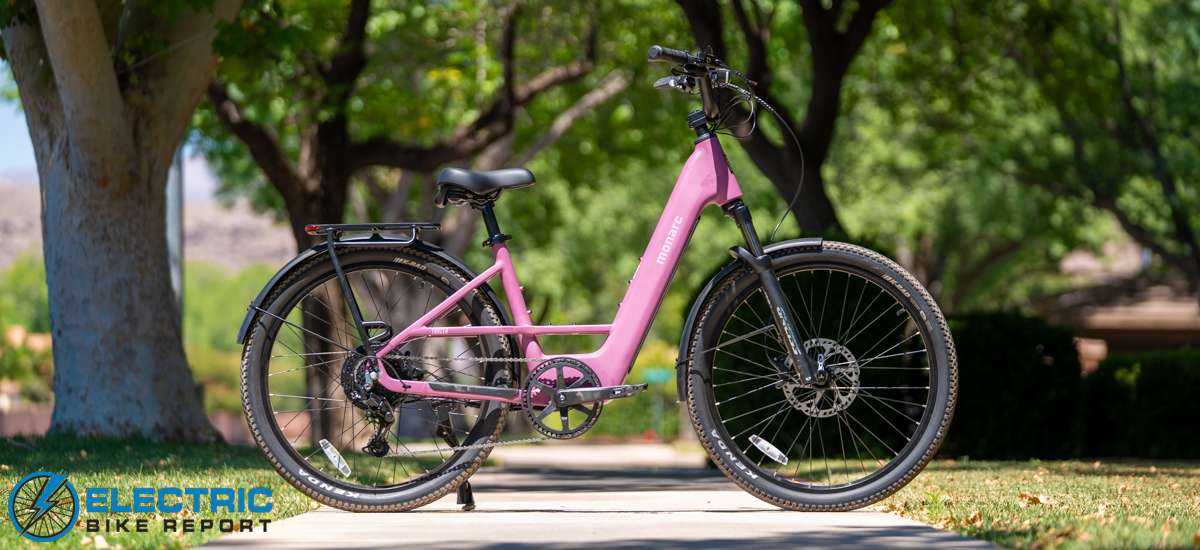
Monarc, the latest value-forward brand in Lectric’s growing family, recently made a strong first impression with the Marker, a tech-savvy fat-tire e-bike that arrived loaded with features most buyers wouldn’t expect at its price point.
The company’s second model, the Tracer, showed up at our office just days after the Marker’s launch. At first glance (and after my first ride), it was clear that the two share a family resemblance, though the Tracer trades the fat-tire model’s wide, all-terrain riding platform for something a bit leaner and more maneuverable.
The Tracer falls into what the industry calls the SUV e-bike category. It’s built primarily for urban environments, but it’s capable and confident on unpaved paths and roads, too. In short, the Tracer is suitable for a rider who commutes to work during the week, runs errands on the way home, and ventures off the beaten path on the weekend.
To handle this variety of riding environments, the bike comes equipped with a relatively category-standard combination of a 750W rear-hub motor, an 80mm suspension fork, and knobby 27.5-inch tires. What sets the Tracer apart, however, are the specs, components, and integrated technology built on top of that foundation.
Each Monarc e-bike ships with two batteries, effectively giving it twice the range of many competitors. The Tracer’s brakes are four-piston hydraulics. The drivetrain is a nine-speed Shimano Cues with an uncommonly wide gearing range. The display is a 3.5-inch color touchscreen with full motor customization built in. In other words, it comes stacked with components that put a focus on longevity and performance.
Optional accessories, including a smart helmet, a rear vehicle detection radar, tire pressure monitors—and an upcoming mobile app that aims to connect them all—point toward a connected riding ecosystem that the brand is clearly building toward, even if they weren’t available for testing during our review.
For an SUV-style commuter e-bike priced below $2k, the spec sheet reads like something assembled for a category above. Whether the bike’s real-world performance holds up to that promise is what the rest of this review is here to answer. Continue reading below to find out how the Monarc Tracer compares to similar models we’ve tested!

Sponsor
E-Bike Category:Commuter
E-Bike Class:Class 1 (pedal assist to 20 mph)
Class 2 (throttle to 20 mph)
Class 3 (pedal assist to 28 mph)
Class 2 (throttle to 20 mph)
Class 3 (pedal assist to 28 mph)
Sponsor
Monarc Tracer Video Review
 Pros
Pros- The Tracer is lively and easy to pedal, thanks to its powerful 750W motor and rewarding pedal assist system (PAS) programming.
- Its sturdy frame steers predictably and feels stuck to the ground, while granting greater maneuverability than Monarc’s heavier, fat tire Marker model.
- This bike is a huge win for value. Among other things, Monarc ships each Tracer with two batteries to double its already solid range!
- Many of the Tracer’s specs and components go above and beyond the norm for this price point: the bike includes a 9-speed drivetrain, 4-piston hydraulic disc brakes, and up to 1638W of peak motor power.
- Users can switch between torque- and cadence-sensing modes to change the bike’s feel, but both modes can be remarkably low-effort.
- Included features like the touchscreen display, programmable PAS, 5-amp fast charger, and MIK-HD cargo rack elevate the overall user experience.
- Monarc offers a range of affordable, high-tech add-ons to enhance the ride, including a smart helmet, a rear vehicle detection system, and tire pressure monitors.
- While it wasn’t yet available for testing during our review, our contact shared that a Bluetooth app will be available for navigation, ride tracking, motor tuning, etc.
 Cons
Cons- While we expect the bike to work well for most riders, its sizing and weight limit may exclude some folks on the short and/or heavy side.
- A downside of the Tracer’s solid construction is its 76-lb weight; it’s likely to be less portable than some similar models.
ELECTRICAL SPECS & FEATURES
- Battery: 48V, 720 Wh (15Ah) x2
- Charger: 5 amp Fast Charger
- Display: 3.5″ Color Touch
- Motor: Bafang B750, 1638W Peak Hub, 85Nm Torque
- Headlight: Integrated Front LED
- Taillights: Integrated Tail Light with Turn Signals
- Pedal Assist: 5 Levels
- Claimed Range: Up to 120 miles (60 miles per battery)
- Throttle: Right, Thumb
- App: Monarc App (Coming Soon)
- UL Certification: UL2271 / UL2849
Weight & Dimensions
- Claimed weight: Unknown
- Tested Weight: 75.5 lbs
- Rider height range: 5’2″ – 6’3″ (Step-Thru), 5’4″ – 6’5″ (Step-Over)
- Total payload capacity: 330 lbs
Components & Accessories
- Brakes: Talon P4 (4 Piston), 180mm Rotors
- Fenders: Plastic Front and Rear
- Fork: 80mm Gneiss Reverse Arch Fork
- Frame: Hydroformed Aluminum
- Drivetrain: Shimano Cues 9 speed, 48T Chainring, 11-36T Cassette
- Grips: Lock-on Ergonomic Rubber
- Saddle: Custom Sport Saddle
- Handlebar: 710mm
- Kickstand: Included
- Pedals: Plastic Platform
- Tires: Kenda 27.5″ x 2.1″
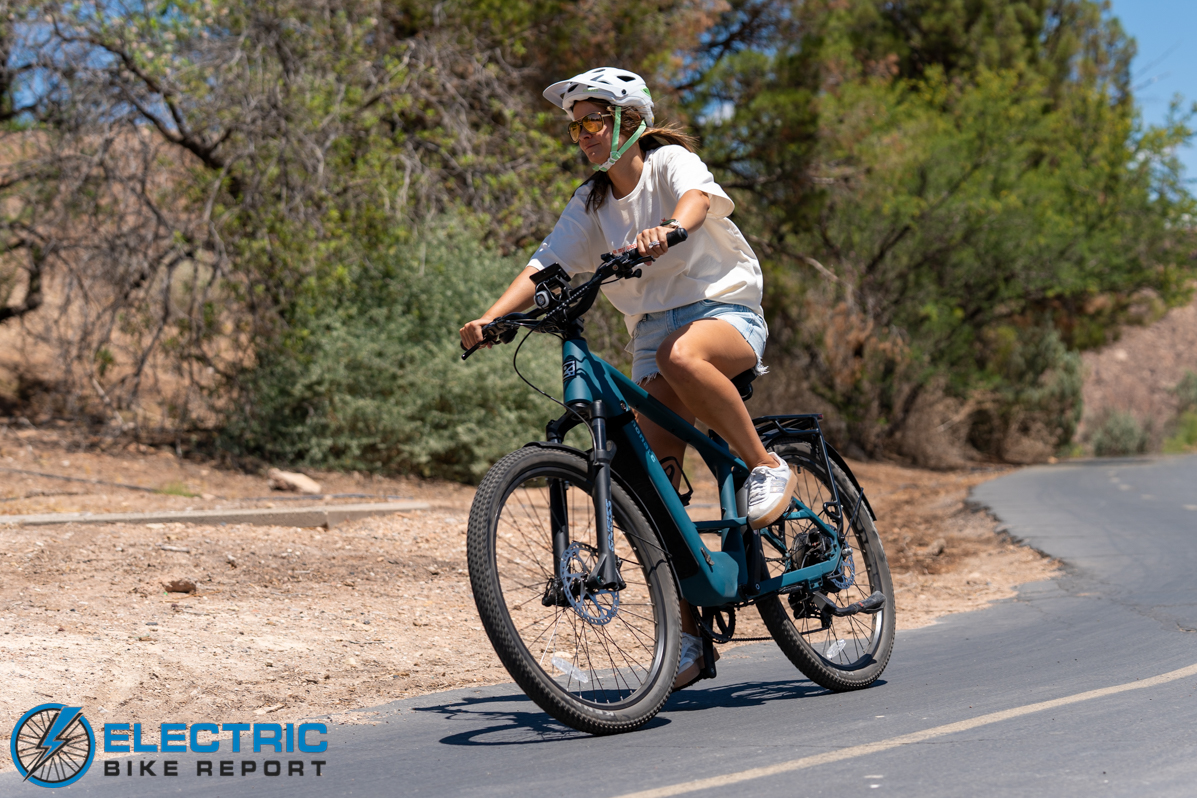
As an SUV-style commuter, the Tracer is suitable for on-road riding and light off-road adventuring.
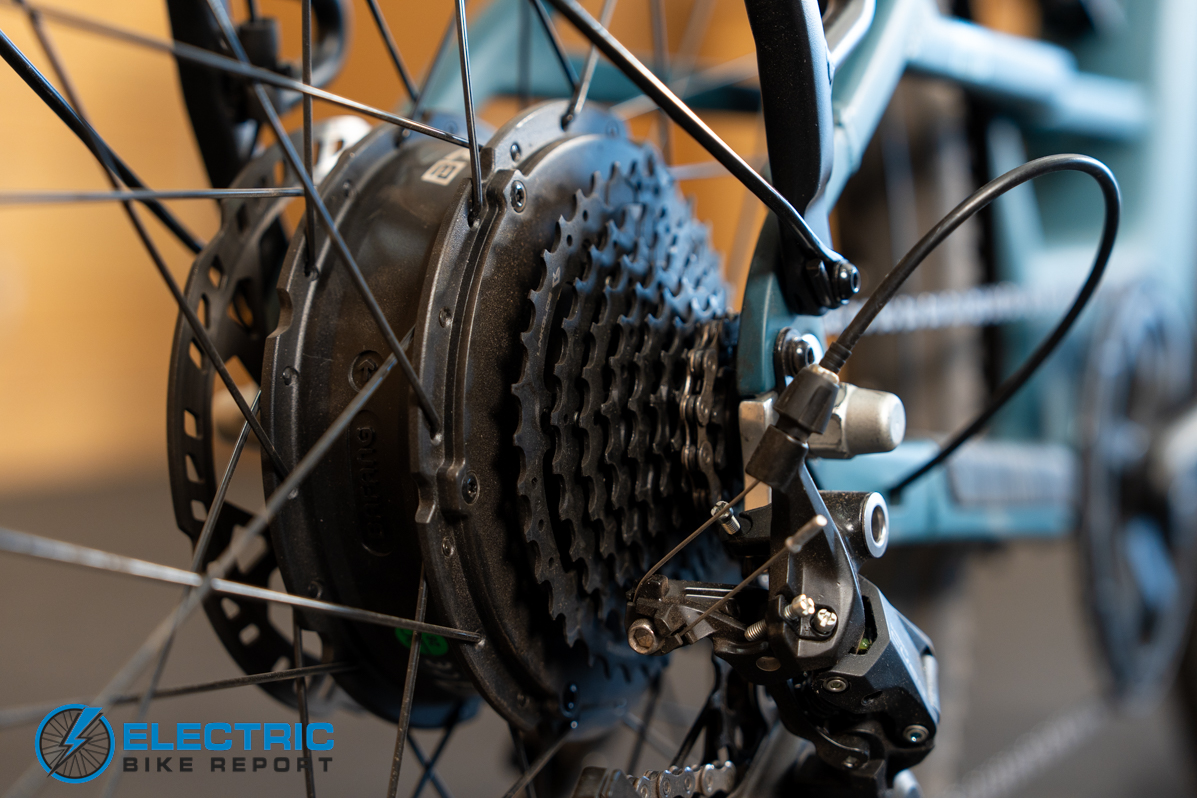
The Tracer features an uncommonly powerful 750W motor with 1,638W of peak power and 85 Nm of torque.
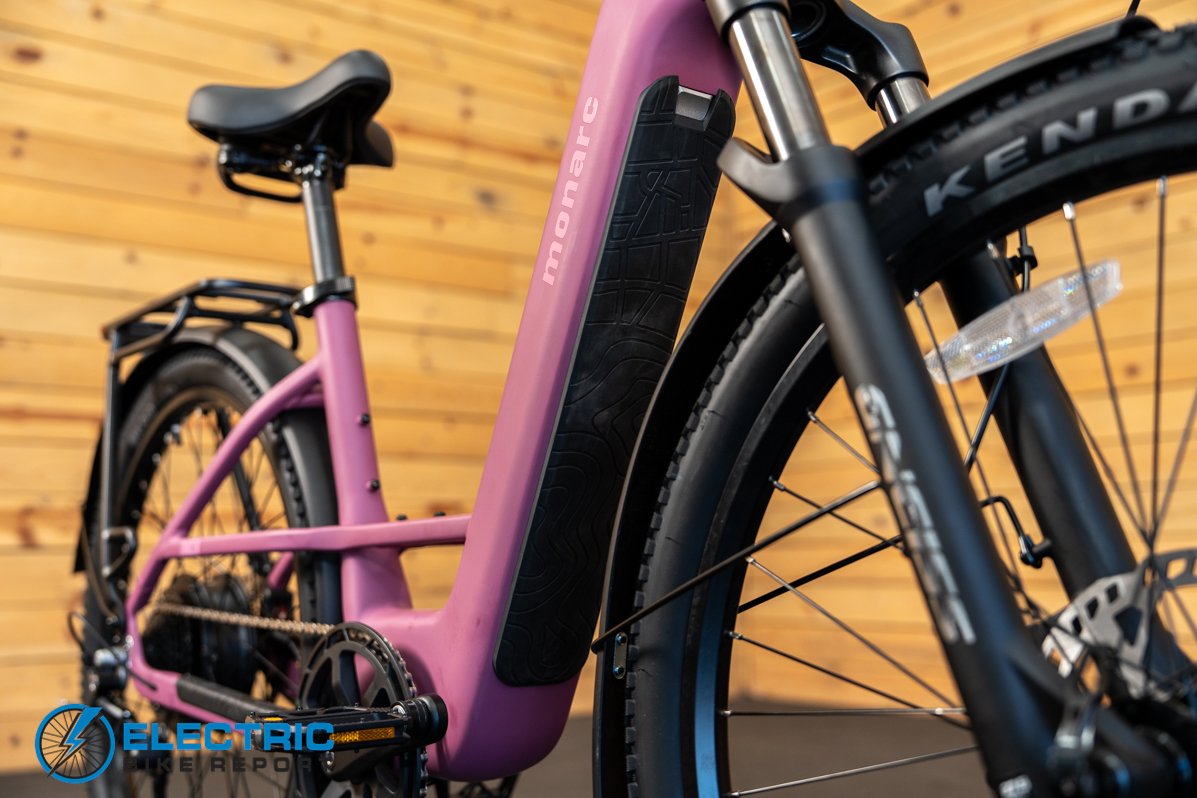
Monarc ships each bike with two 48V, 720 Wh batteries, giving riders potentially double the range of similarly-priced competitors.
Monarc Tracer Review: Speed Test
A bike’s speed programming tells you a lot about how its manufacturer expects it to be ridden. The Tracer offers five assist levels, torque- and cadence-sensing pedal assist modes, and Classes 1, 2, and 3 capabilities. We tested four combinations of sensor modes and maximum speeds on a flat, paved path to understand how the motor behaves out of the box and what it can do when fully unlocked.
Without any assist, the Tracer pedaled relatively comfortably. The wide gearing range of its nine-speed Shimano Cues drivetrain and what felt like well-balanced weight distribution made unassisted pedaling more manageable than the bike’s 75.5 lbs might suggest on paper.
In the bike’s cadence-sensing mode, the motor puts out steady power as long as the pedals are turning; you get the same output if you pedal softly or with gusto.
In Class 2 mode, I reached the 20 mph ceiling in the second assist level, showing that the motor had more to give, but the class setting was holding it back. As a result, the two lowest assist levels felt powerful, but there wasn’t any noticeable difference between the higher modes, at least on flat ground.
In the Class 3 test, I experienced more noticeable differences in speed, since the 28 mph ceiling gave the motor more room to breathe.
When using the Tracer’s torque-sensing mode, the motor’s output fluctuates in proportion to your pedal effort; pedaling harder gives you more power, while pedaling softer causes the motor to ease off somewhat.
In the Class 2 test, my results were roughly the same as the cadence-mode test, with the four highest assist levels reaching the bike’s maximum speed. Again, in Class 3 mode, the motor had more room to flex, so there was more differentiation between assist levels.
By feel, the torque sensor carries a high baseline of power across most assist levels, which keeps pedaling easy and consistent throughout, though slightly less natural than some comparable bikes. Cadence mode works well for relaxed commuting, though preset speed limits per level could help to better differentiate the five settings from one another.
It’s worth noting that we performed this test with the Tracer’s default settings, but the bike’s motor output and the sensitivity of its assist system can be fully tuned through the display. Our contact at Monarc also shared that this feature will be available through the upcoming app, though we weren’t able to try it at the time of testing.
Another thing that can be tuned is the Tracer’s throttle acceleration. Users can pick between a steadily-building Low setting or a faster, but still approachable, High mode.
In all cases, it was clear from this test that the Tracer is impressively powerful. It has a range of assist levels suitable for those who want a more natural, analog-like feel to riders who want a remarkably easy, speedy experience. The bike could benefit from some programming refinement to make some of its settings more meaningful, but overall, it delivers a solid starting point that riders can tune further if desired.
Sponsor
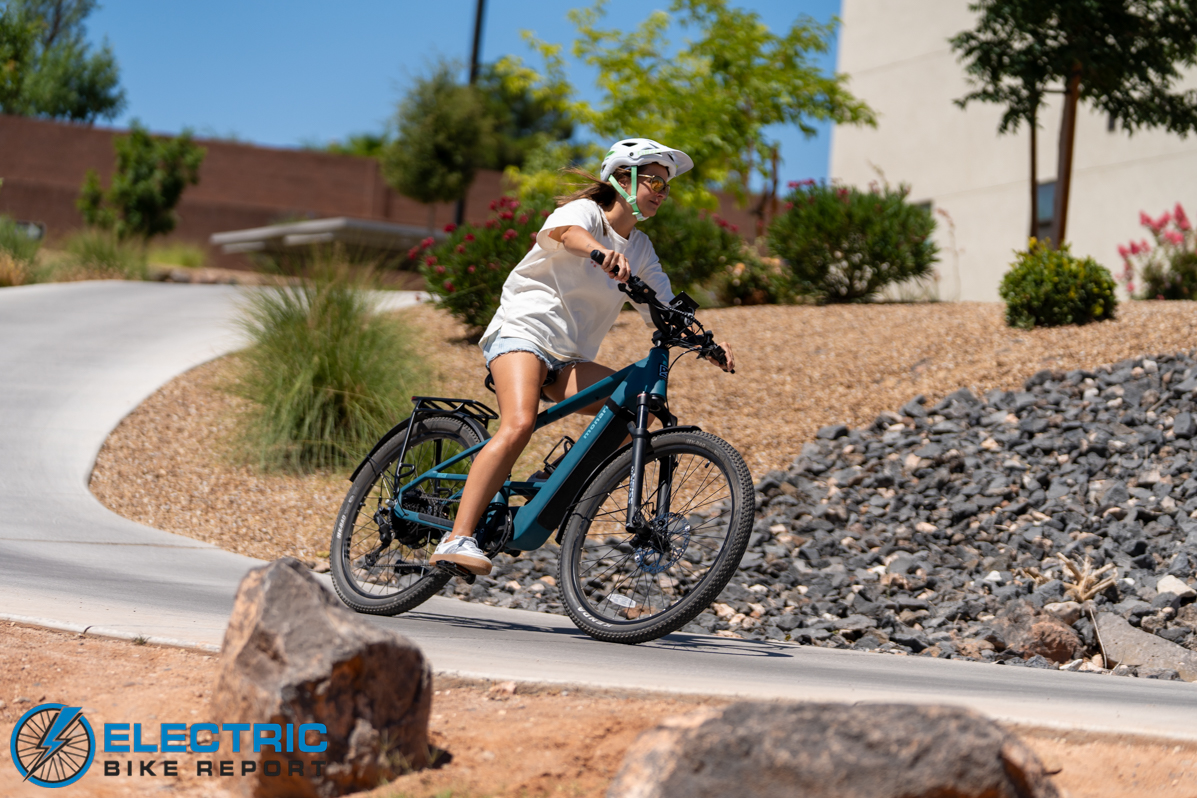
While the Tracer weighs a relatively hefty 75.5 lbs, it feels energetic and agile while riding.
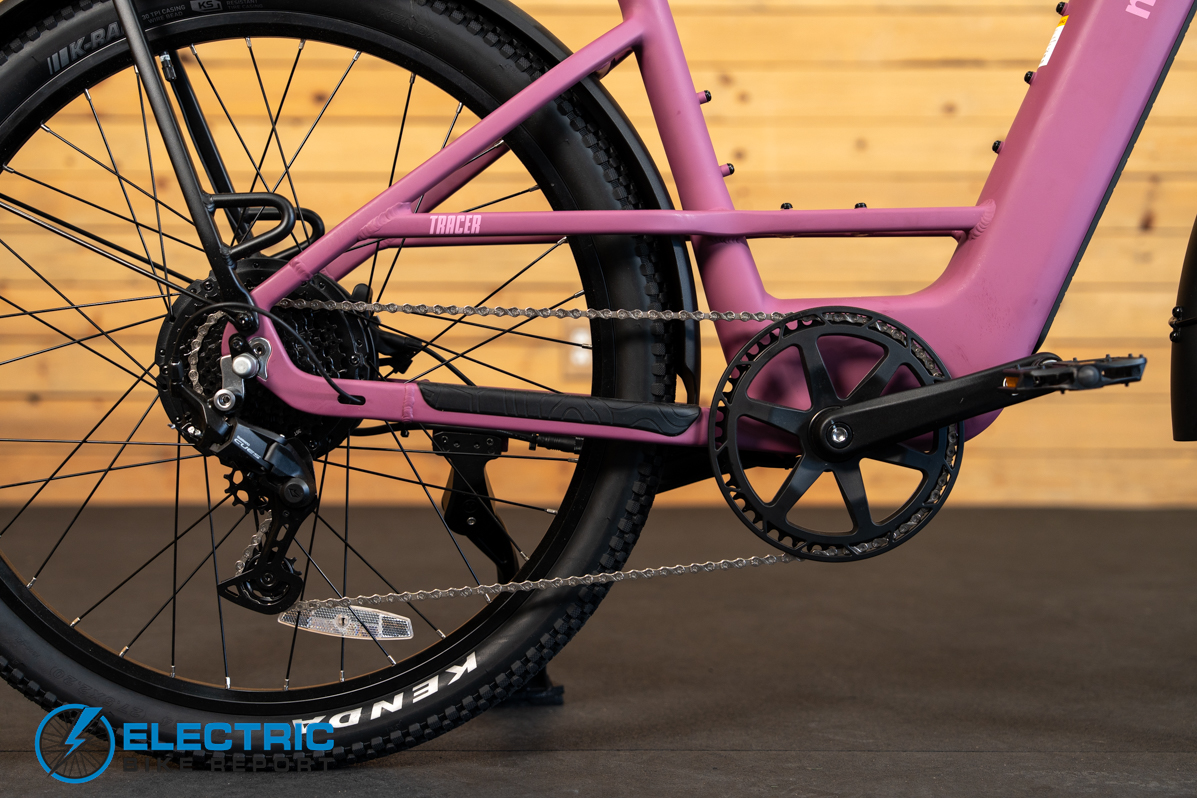
The 9-speed Shimano CUES drivetrain is a step above the 8-speed models we typically see at this price point.
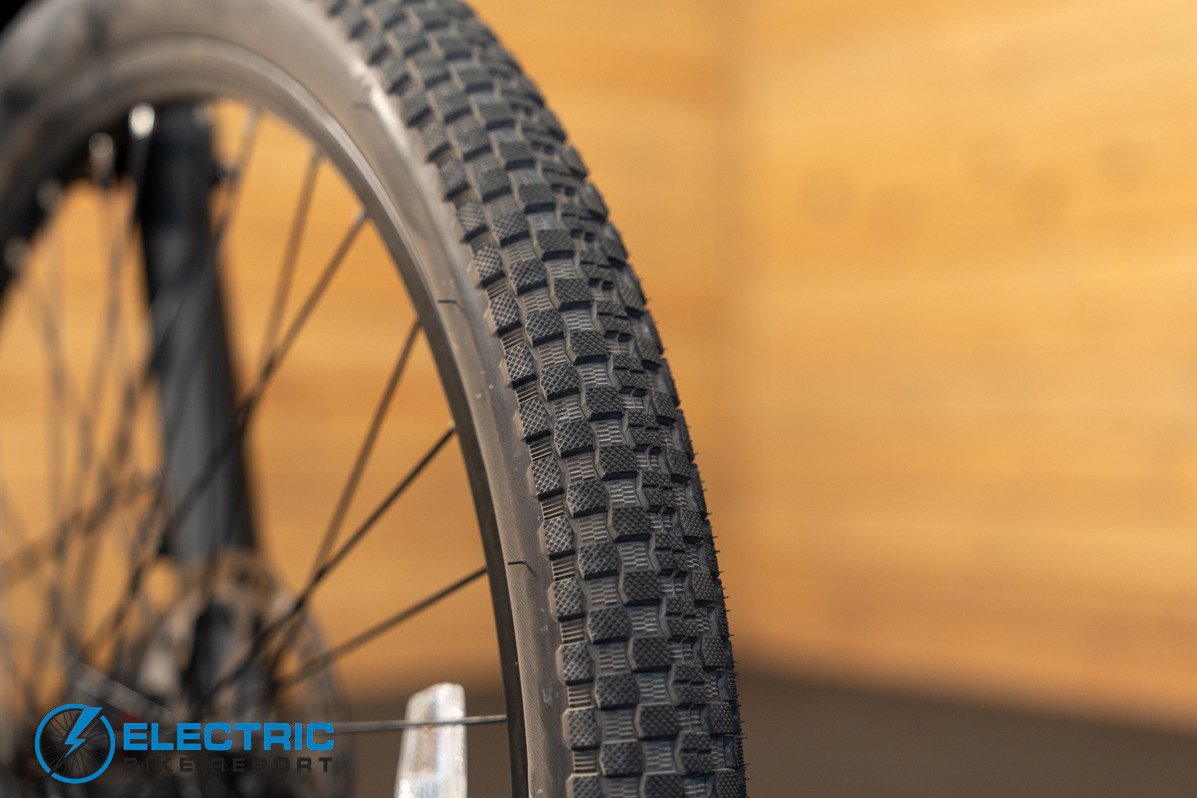
Kenda’s K-Rad tires provide a balanced blend of off-road traction and relatively high rolling efficiency for paved paths.
Monarc Tracer Review: Range Test
Range is one of the most practical subjects an e-bike buyer might ask about, and it’s also one of the hardest to respond to accurately. After all, real-world results depend heavily on rider weight, terrain, assist habits, weather, and beyond.
To give a realistic starting point for a bike’s range capabilities, we run two tests: one at maximum assist to establish a realistic floor, and one at minimum assist to establish a ceiling. Both tests are completed on a single battery while riding on paved paths with a few hills. We also conducted the test using the torque-sensing mode with Class 2 speeds.
On one battery, the Tracer covered 34.8 miles in Boost and 67.5 miles in Cruise. Category averages for comparable commuter e-bikes sit at 38.5 and 77.3 miles respectively, putting the Tracer slightly below average in both tests—but realistically, riders carrying the bike’s second battery can expect to roughly double our results.
Comparing single-battery test results, the gap between the Tracer’s mileage and that of its competitors has an explanation.
Our comparison group, which included similar models with both 500W and 750W motors, averaged a nominal output of 667W. The Tracer’s Bafang rear hub motor runs at 750W nominal with a jaw-dropping 1,638W peak—well beyond the average among similar SUV-style commuters.
Put simply, a more powerful motor draws more energy per mile. The Tracer used 20.7 Wh/mi at max assist and 10.7 Wh/mi at minimum assist, compared to category averages of 19.0 and 9.6 respectively. This shows that Monarc’s e-bike isn’t inefficient; instead, it’s just running harder than most of its competitors.
With two batteries in the box, the practical picture changes considerably. A rider commuting primarily in lower assist levels could realistically approach or exceed the advertised 120-mile combined figure under favorable conditions. Heavier riders or those tackling hillier routes should expect to land lower, but we’d still expect the second battery to give the Tracer a significant advantage.
While conducting the test, we appreciated that the Tracer’s battery readout tracked accurately throughout testing, depleting at a reliable and predictable rate. At around 10%, there was a noticeable drop in power output, which is a relatively common phenomenon. As such, riders may want to treat that final 10% as a reserve rather than something to dip into on every ride.
A couple of additional notes: we noticed that the lowest assist level’s output is on the modest side. Riders who never explore the display’s customization options may find the second assist level a more functional starting point, but those who are comfortable with tuning motor output could change its output to suit their preferences.
Additionally, while we tested a pre-production version of the Tracer, the batteries we were sent did not always seem to seat properly in the down tube, which effectively made the lock non-functional. Whether an issue of manufacturing tolerances, or something else, we hope to see Monarc address this before the final production run.
One thing that we greatly appreciated was the fact that the Tracer ships with a 5-amp fast charger. This charger can power up each of the included batteries in roughly three hours, generally matching the charge time of similar models with single batteries that come with slower chargers—and adding even more value to the Tracer’s purchase.
Sponsor
Sponsor
Monarc Tracer Review: Hill Test
Hill climbing is one of the most revealing tests for any e-bike, because it puts the motor under sustained load and reveals the real-world translation of its rated output. For the Monarc Tracer, our test hill barely registered.
In both the standard throttle and maximum pedal assist tests at our Devil’s Backbone test location, the Tracer climbed with an ease that is uncommon among similar e-bikes of its style.
On throttle, our test rider, Justin, finished in 1:37 with an average speed of 18.7 mph. On maximum pedal assist, we posted a time of 1:36 at 18.9 mph. The category averages for comparable commuter e-bikes are 2:01 on throttle and 1:54 on pedal assist, so the Tracer beat both by a significant margin.
The differences in results largely come down to the Tracer’s motor. It produces 85 Nm of torque and peaks at 1,638 watts, compared to a category average of 78 Nm of torque and a peak of 1,051W. Despite weighing approximately 6.5 lbs more than average, the Tracer’s power advantage was more than enough to overcome its additional weight.
In my experience at our secondary test location near our office, the bike climbed confidently and steadily using its throttle. Using pedal assist, engaging with the drivetrain in the torque-sensing mode required a small amount of effort, but the motor was clearly doing most of the heavy lifting. In the higher assist levels, the experience felt only marginally different from riding on flat ground.
Ultimately, for a rear-hub motor to outperform the category average by this margin—especially while carrying above-average weight—is unusual in the best possible way. Clearly, this e-bike is well-suited for riders tackling steep hills regularly, and it grants options for easy pedaling or effortless throttling.
Sponsor
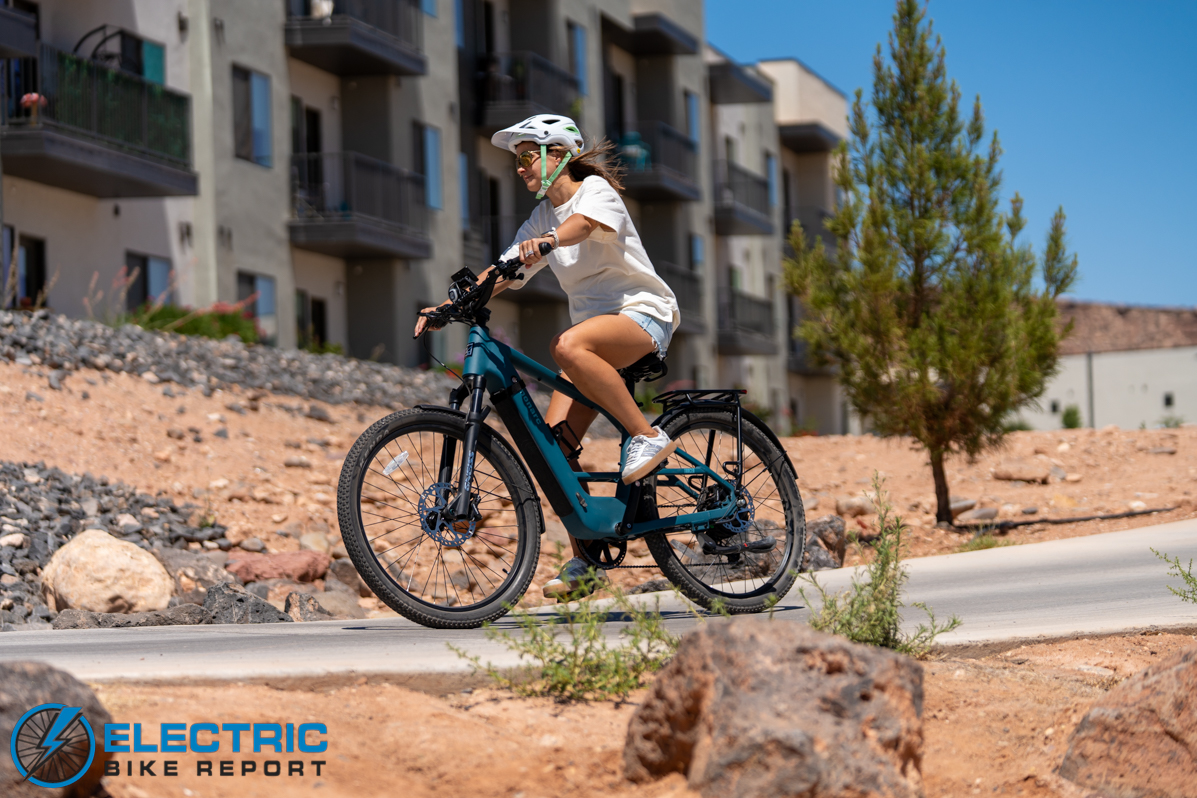
The Tracer can accommodate a variety of speed and style preferences: the cadence-sensing mode feels extremely relaxed, while the torque mode is a bit more responsive and engaging.
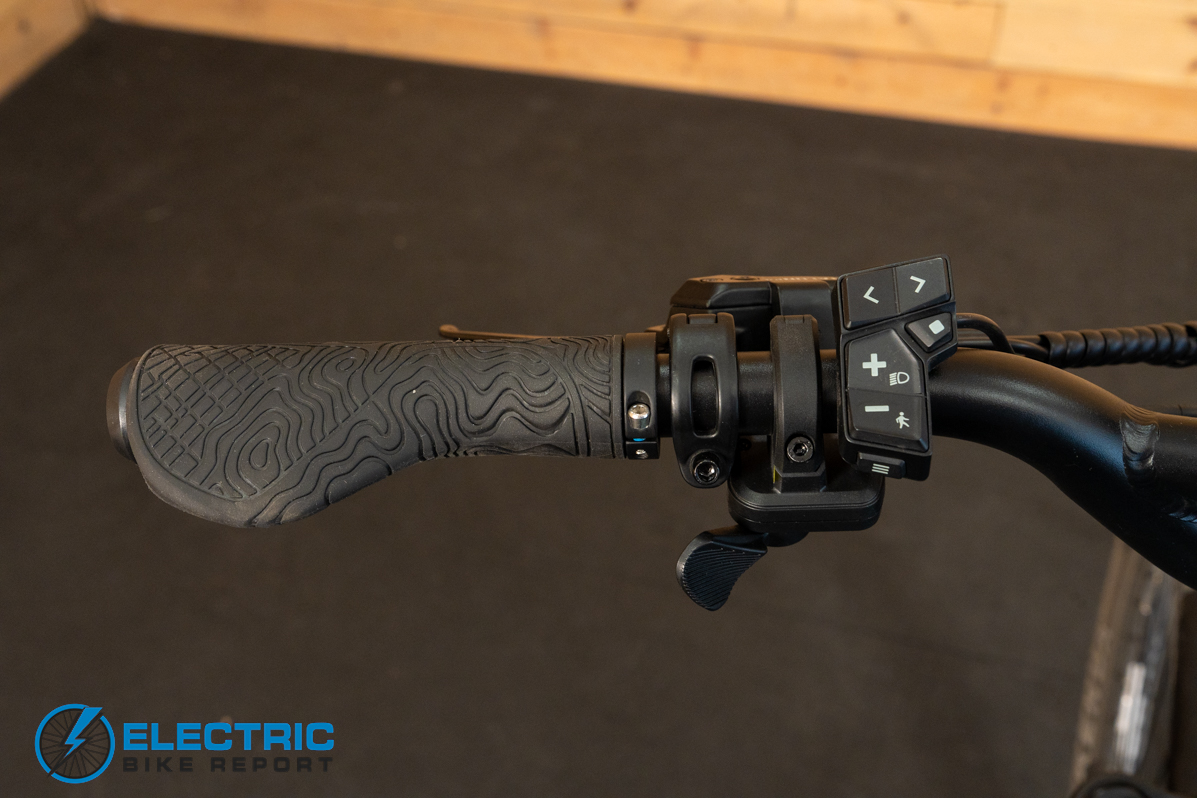
A thumb throttle on the left handlebar can power the bike without pedaling.
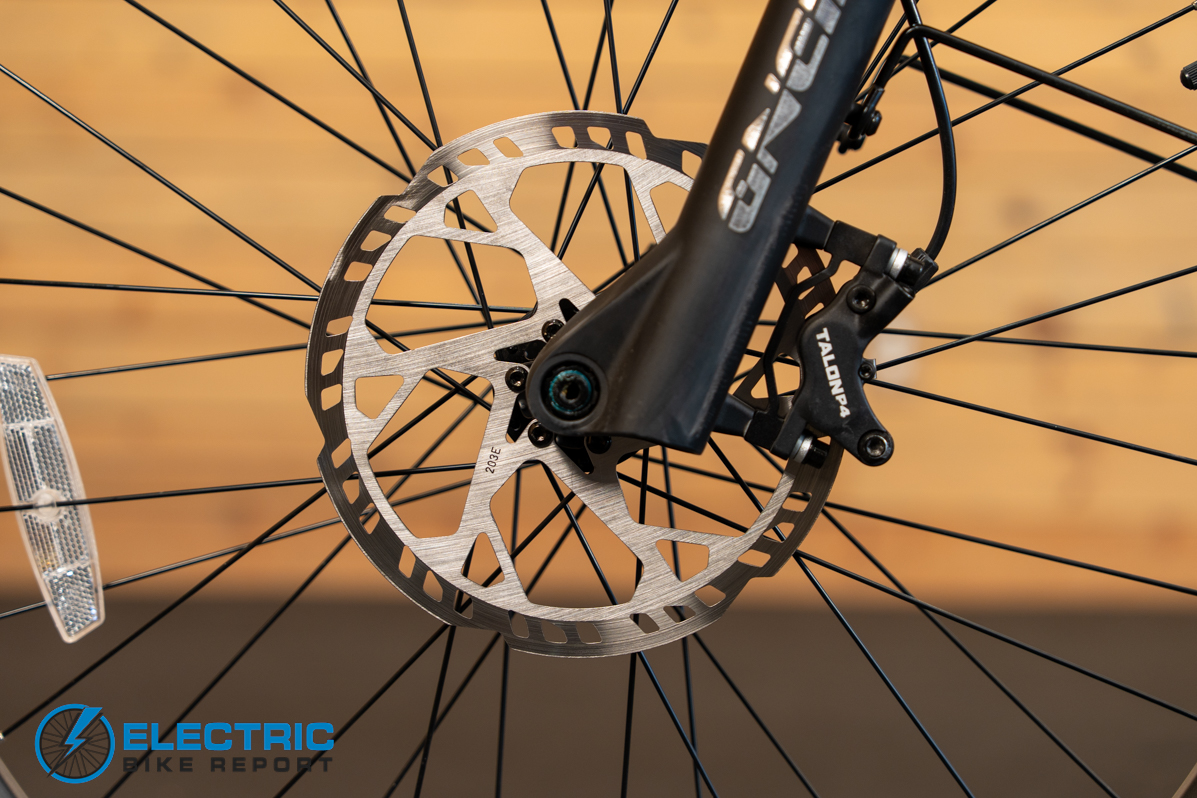
Monarc equipped the Tracer with powerful 4-piston hydraulic disc brakes.
Monarc Tracer Review: Brake Test
Stopping distance matters tremendously on a powerful, relatively heavy, and potentially speedy bike. At 75.5 lbs, the Tracer carries enough momentum at speed that brake performance is a genuine safety consideration, and we’re happy to report that it passed our brake test with flying colors.
We test braking by bringing the bike to 20 mph and applying the brakes in a controlled, consistent manner. We measure the distance from brake application to a full stop across multiple runs, then average the results for a final test score.
The Tracer averaged a stopping distance of 17 feet 9 inches, compared to a category average of 21 feet 11 inches — more than 4 feet shorter than average. We attribute this to its powerful hydraulic brake system, which is worth explaining in more detail.
The Tracer’s Talon P4 brake system, which was developed in conjunction with Star Union, uses four-piston hydraulic calipers rather than the two-piston units common at this price point. Most similar models use 1.8 x 180mm rotors on both wheels, while the Tracer is equipped with a 203mm front rotor and 180mm rear, both 2.2mm thick.
In comparison to its peers, the Tracer’s larger rotors dissipate heat more effectively and provide greater mechanical leverage. Its four-piston calipers also apply a larger brake pad surface area more evenly than two-piston system. Ultimately, this translates directly to shorter stopping distances and more consistent performance under repeated braking.
My experience showed that the brakes were immediately powerful with only a moderate squeeze of the levers. At full pressure, avoiding skidding and fishtailing required some attention, though this is not unusual. When riding downhill, the brakes did an excellent job of modulating speed smoothly and progressively.
Considering that the Tracer weighs a few pounds more than average for its style, Monarc’s decision to spec four-piston calipers and a larger-than-average front rotor was the right one. The braking system is appropriately matched to the bike’s weight and speed capability, and our test results accurately reflect the bike’s safe, capable feel.
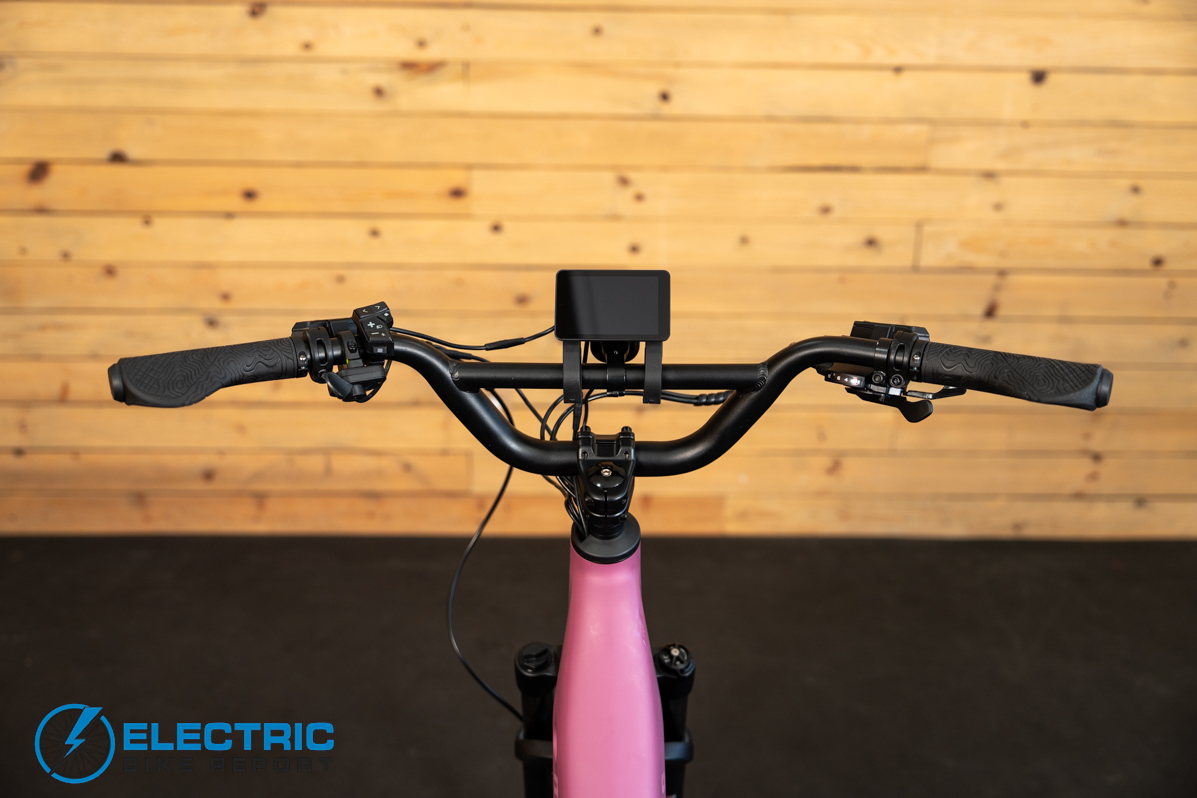
The ST model features more swept-back handlebars with a higher rise, while the step-over has flatter, lower handlebars.
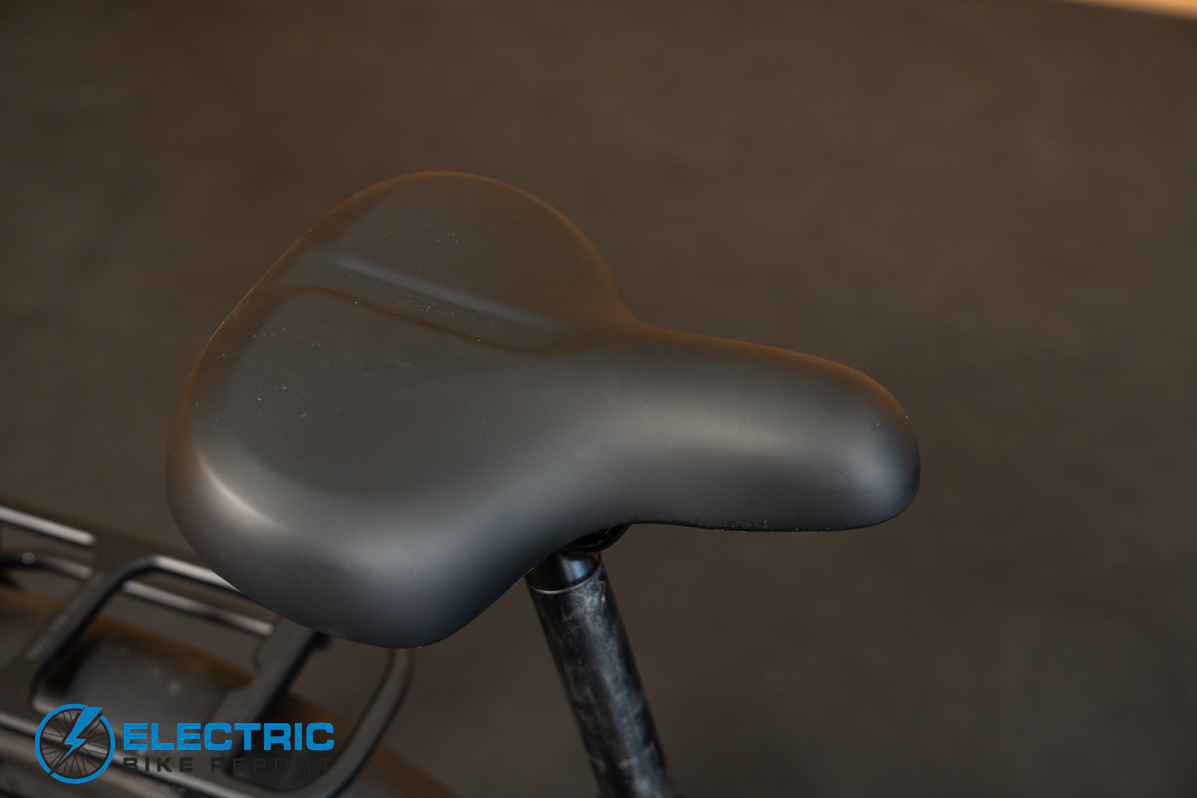
A custom saddle provides softness and support, effectively absorbing lots of the bumps you might encounter while riding.
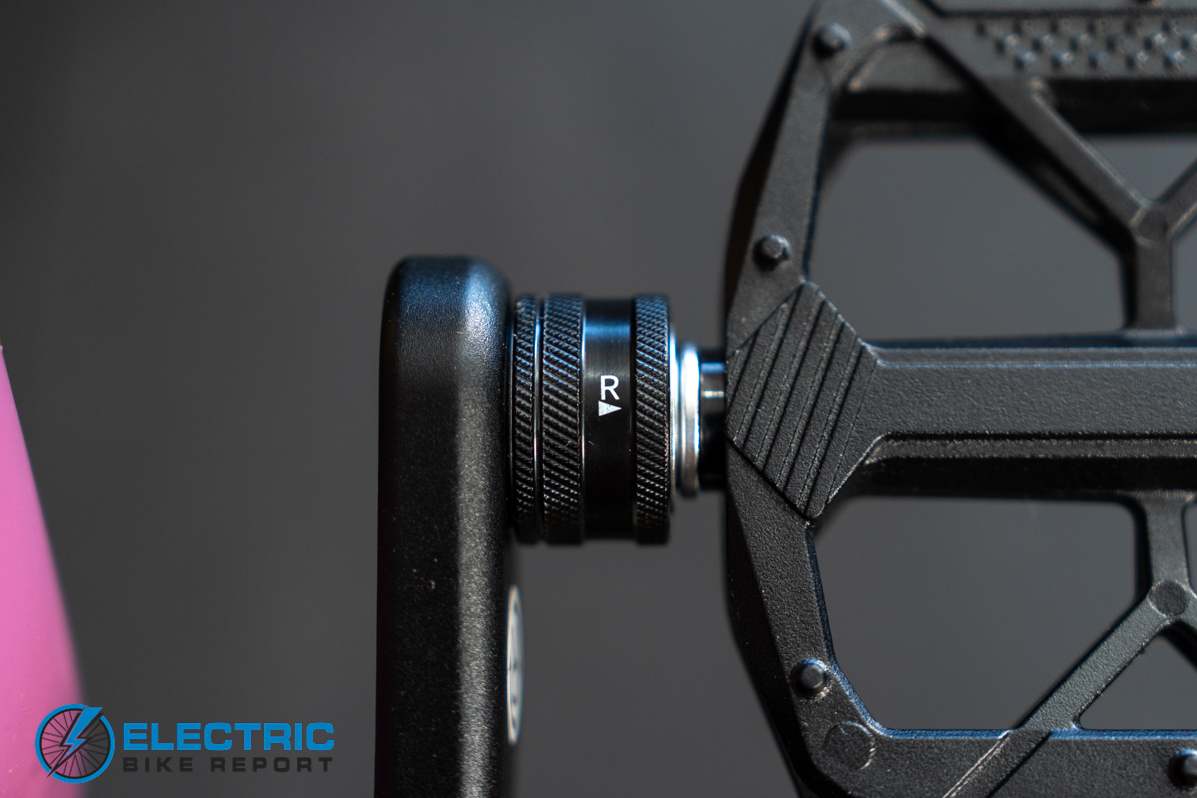
The bike features quick-release pedals for easy replacement.
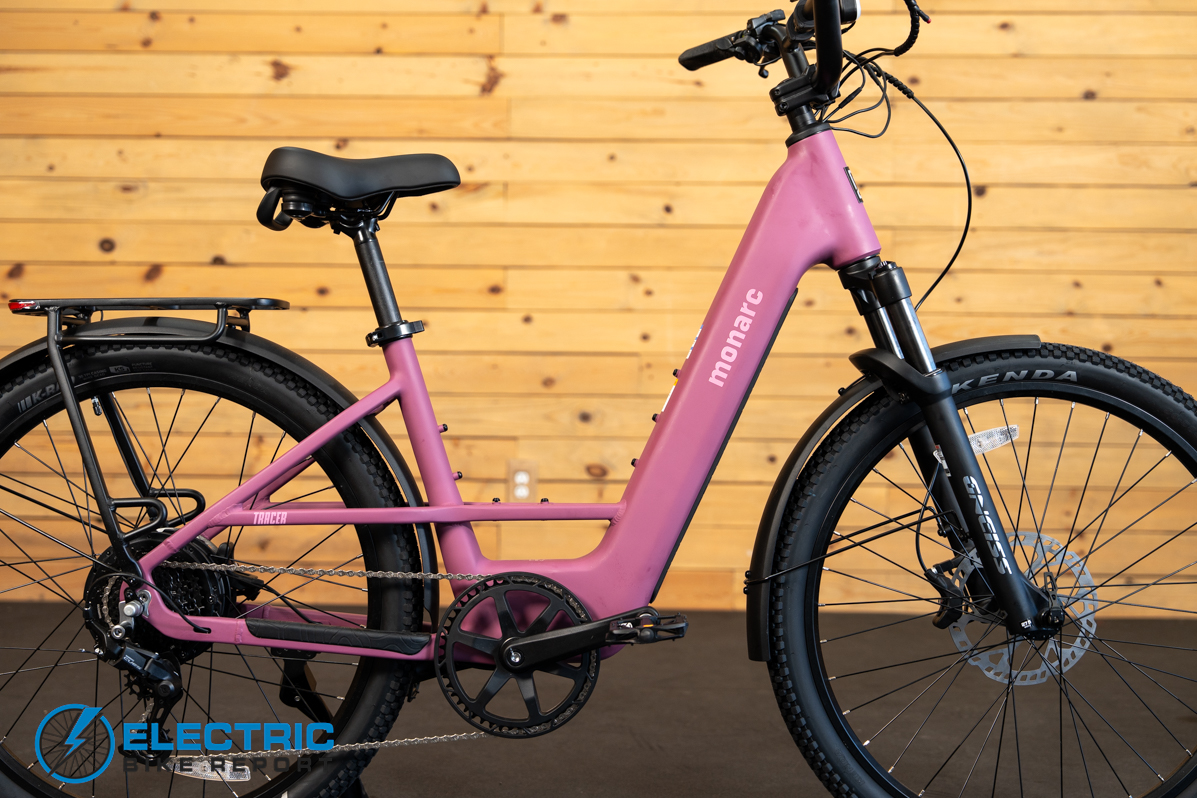
The ST model has a lower standover height for easier mounting.
Monarc Tracer Review: Ride Quality
The first thing I noticed on the Tracer is how planted it feels. There is a solidity to the ride that goes beyond simple weight; it corners without any detectable flex and rides with a strong, confident sturdiness. Steering is precise and predictable, and while the bike’s weight is noticeable, it’s also balanced with great overall maneuverability.
The riding position sits in comfortable, slightly sporty territory, with a modest forward lean that I didn’t find too aggressive. The 710mm handlebars are a bit wider than what we typically find on bikes in this category, which contributes to the confident steering feel and keeps the cockpit from feeling cramped.
At 5’11”, I found the fit comfortable with good leg extension and a comfortable reach. The seatpost offers roughly 10 inches of adjustment in saddle height—nice and accommodating for the full recommended height range of 5’2″ to 6’5″. The mid-rise handlebar angle is adjustable by rotating the bars, which allows for minor reach changes, though handlebar height is limited without swapping the threadless stem.
Still, it is worth noting that the Tracer has only a single frame size in both of its frame styles. Considering its price point and the fact that many of its competitors offer a wider variety of sizing options for a more dialed-in and personalized fit, we hope to see Monarc branch out with more sizing options in the future.
In my experience, the ride is smoothed effectively by the combination of front suspension and tires. The front fork is an 80mm Gneiss reverse crown coil unit with lockout and preload adjustment, designed to provide comfort and crisp handling. In combination with the ergonomic lock-on rubber grips, the setup absorbs enough chatter to keep the ride comfortable on pavement, hard-packed dirt, and light gravel alike.
The 27.5×2.1″ Kenda K-Rad inches wide strike a sensible middle ground between stability and maneuverability. The checkerboard tread pattern provides enough grip for light off-road use while keeping rolling resistance low enough for efficient pavement riding. The bike felt stable and planted both on and off-road, tracking well even over areas covered by loose gravel.
Like the Tracer’s sturdy feel, its motor’s presence in the ride quality equation is hard to ignore. I found Breeze, the second assist level, to be my sweet spot; the motor delivered enough power to make the bike’s weight disappear without overpowering my effort. I’m sure than many folks, however, will appreciate the higher assist levels, where pedaling becomes nearly effortless.
As covered in the intro, the Tracer comes well-equipped with many components that are a step above what we often find on similar models. It also includes useful accessories, including integrated lights with turn signals, fenders, and an MIK HD cargo rack. The optional, high-tech accessories (tire pressure monitors, radar system, smart helmet) also seem promising, and we look forward to testing them.
Finally, the bike’s touchscreen and display menu are worth mentioning. I liked the overall presentation of the display’s information, its settings menus provided loads of customization options, and when combined with the aforementioned optional accessories, we’re hopeful that it creates a comprehensive, user-friendly, and robust user experience.
Monarc Tracer HS vs ST Version
As I mentioned above, the HS and ST versions of the Tracer offer slightly different sizing, riding positions, and color options.
The step-over frame, with its diamond frame and a standover height of around 28″, is designed to accommodate riders from 5’4″ to 6’5″. Its flatter, low-rise handlebars promote a more forward-leaning riding position (still mostly upright) that gives the bike a slightly sportier feel.
The step-thru model, on the other hand, is intended for slightly shorter riders between 5’2″ and 6’3″. Its 20″ standover height is somewhat higher than many other step-thru models we’ve tested, but it trades some ease of mounting for a higher degree of frame stiffness; as mentioned above, the Tracer is remarkably stiff and stable when cornering.
I spent most of my testing time on the step-over model, but both have a lot to love!
Sponsor
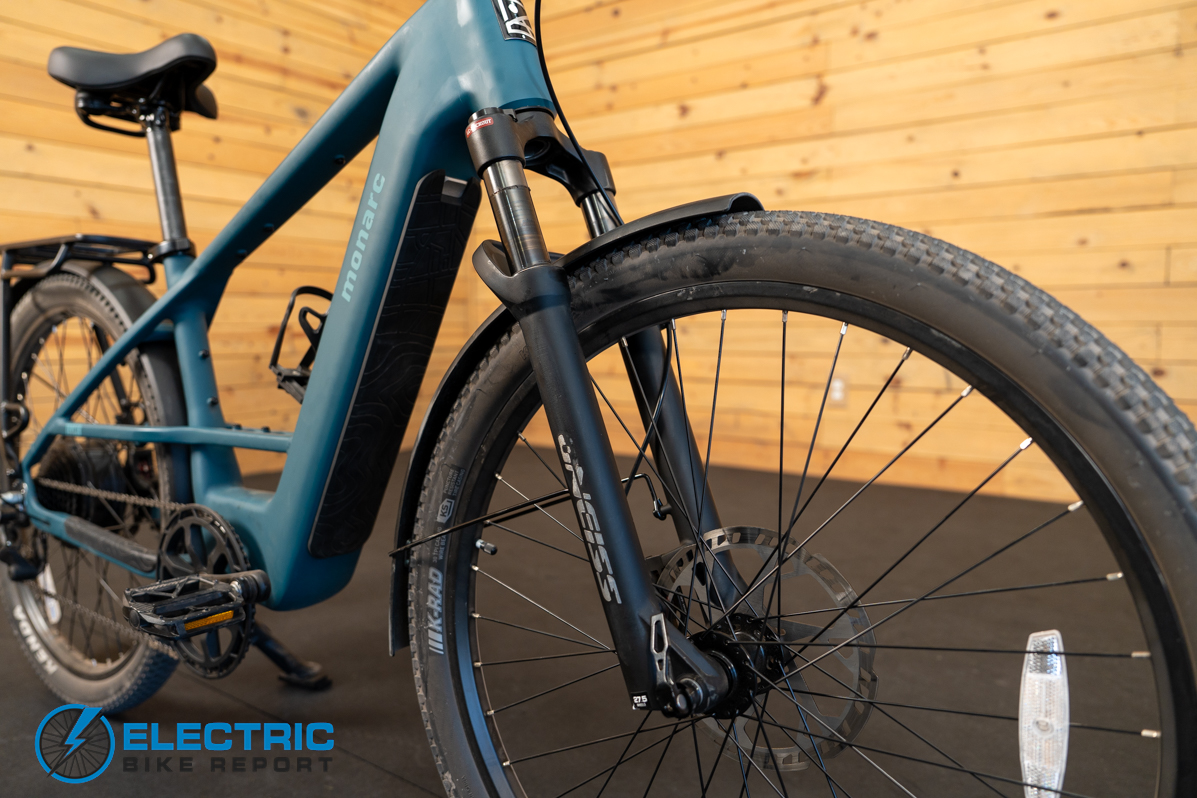
The Tracer’s coil suspension fork has 80mm of travel to smooth out the road or path.
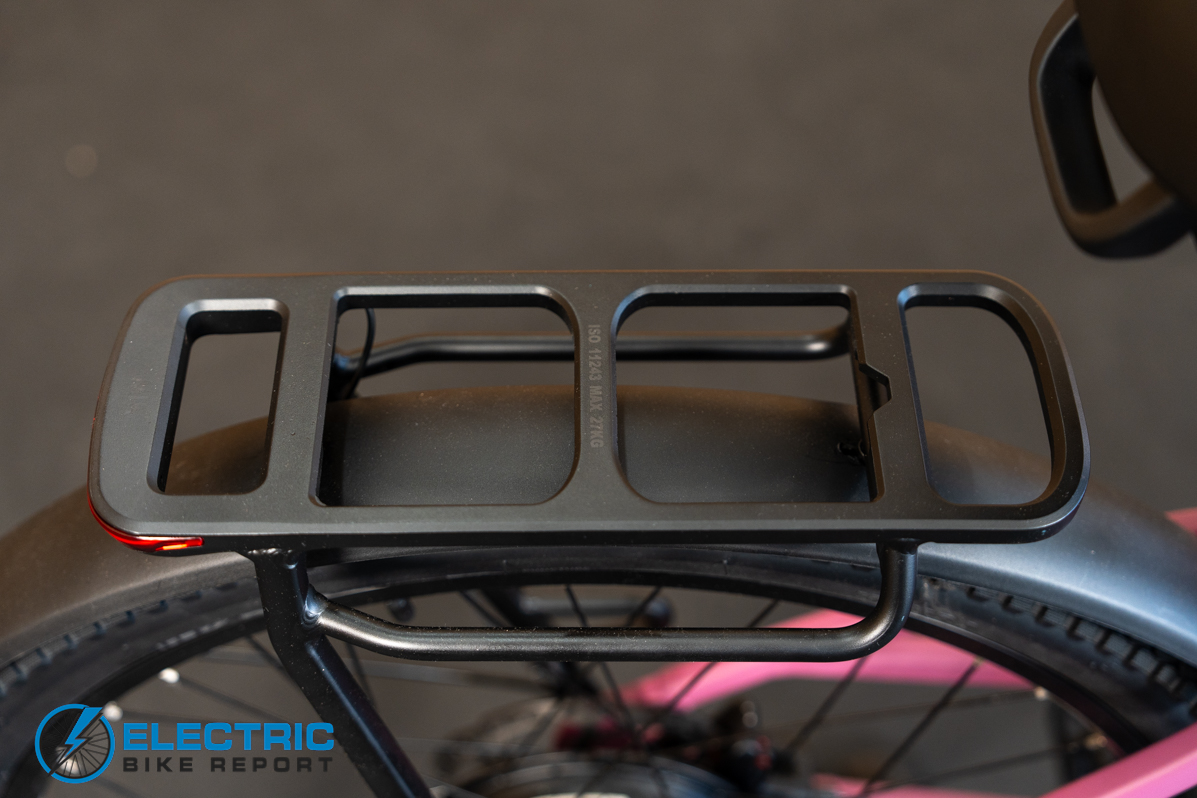
An MIK-compatible cargo rack features roughly 60 lbs of carrying capacity.
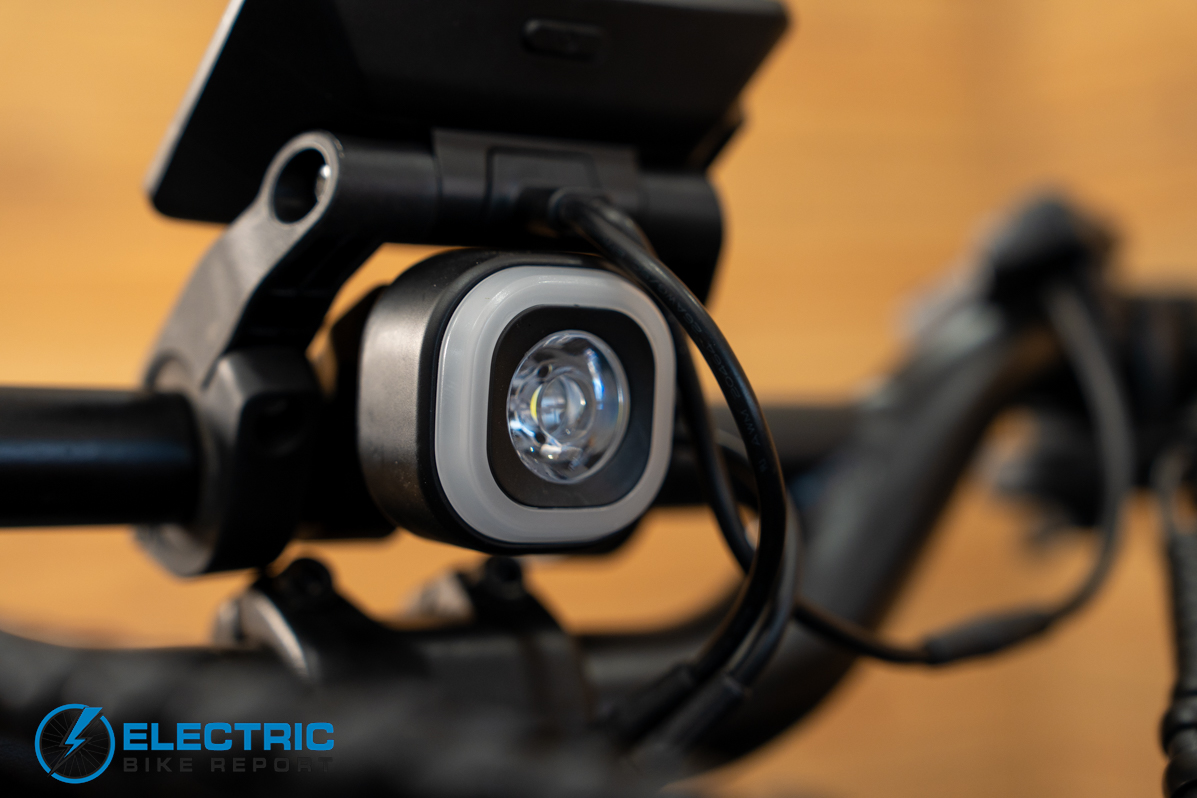
The Tracer’s headlight is small but totally functional. It also includes an auto mode.
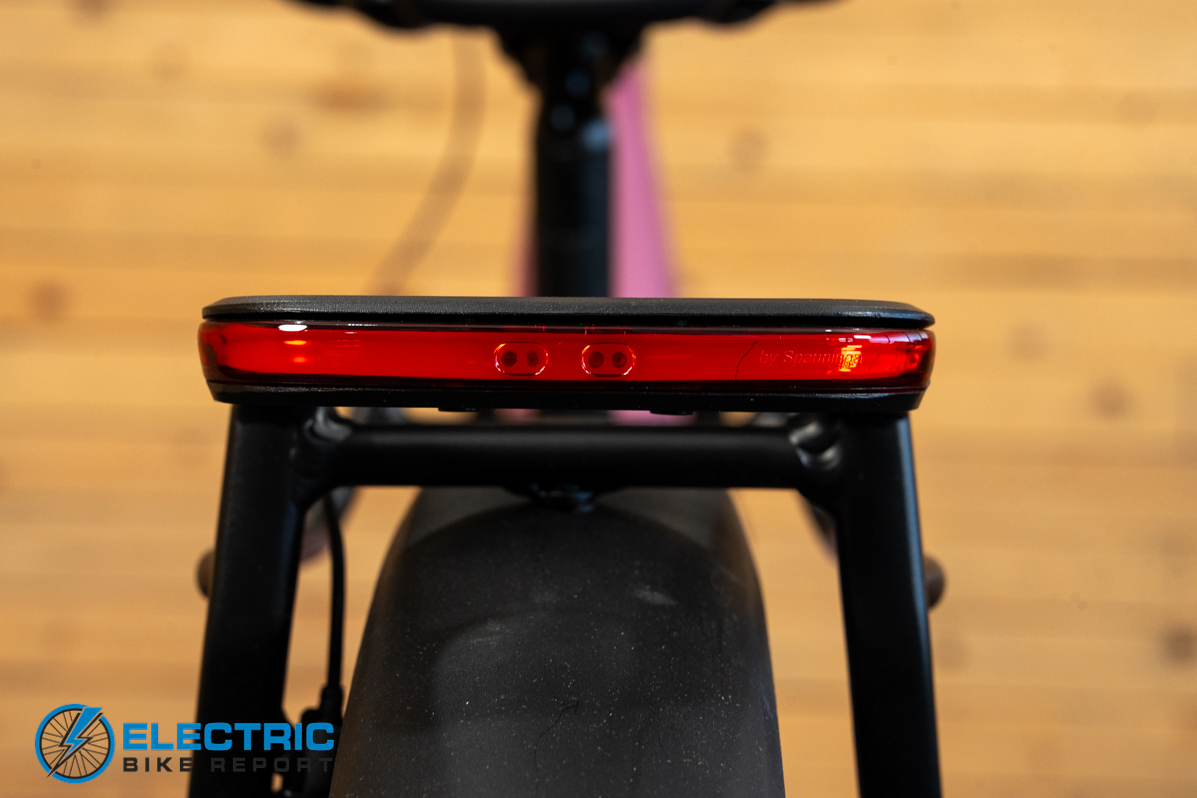
The rack-integrated tail light features brake light and turn signal functions.
Monarc Tracer Review: Summary / Where to Buy
At the end of the day, it’s difficult to argue with everything the Monarc Tracer brings to the table. It rides with a confidence and ease that is broadly appealing. It is lively off the line without feeling overpowered or off-putting.
It’s stable through corners, more maneuverable than its weight might suggest, and so well-equipped that most riders will never find themselves wanting for a feature the bike doesn’t have—or have an option for.
For someone who wants a single bike that handles a daily commute, weekend adventures, and the occasional heavily loaded errand run, the Tracer is primed for success. Its standard equipment, dual batteries, integrated technology, and overall performance are highly impressive considering the Tracer’s sub-$2k price point.
As far as critique goes, the bike’s weight and limited sizing options are some areas to be aware of. At 75.5 lbs, the Tracer will better suit riders who park their bike in a garage than who carry their bike up stairs or load it into a vehicle rack regularly.
Similarly, the Tracer’s single high-step and step-thru frame size will likely work for most folks, but riders on the shorter or heavier end of its size and payload range may find themselves bumping against the bike’s limits.
These aspects aside, the Tracer is genuinely easy to recommend for many riders for a variety of reasons. Its price point is extremely economical for its components, motor power, included dual batteries, and integrated tech. The bike’s connected accessory ecosystem and forthcoming app add further potential, though how that side of the experience develops remains to be seen.
Happy Riding! Make sure to let us know if you have any questions or if you think we left anything out in this review of the Monarc Tracer down in our comments section.
Sponsor
Sponsor
Reader Interactions
Comments
Leave a Reply




does the weight of 75.5 include 1 battery or both batteries and is there a method of securing the second battery if needed for longer ride? In terms of ride quality how does this bike compare to aima’s santa monica?