Ride1Up Vorsa Lite Review | No Fluff, Just the Good Stuff
Jun 01, 2026
 0 Comments
 Share
Share
This simple, straightforward commuter-style e-bike offers programmable pedal assist, a comfortable ride, impressive power, and off-road versatility.
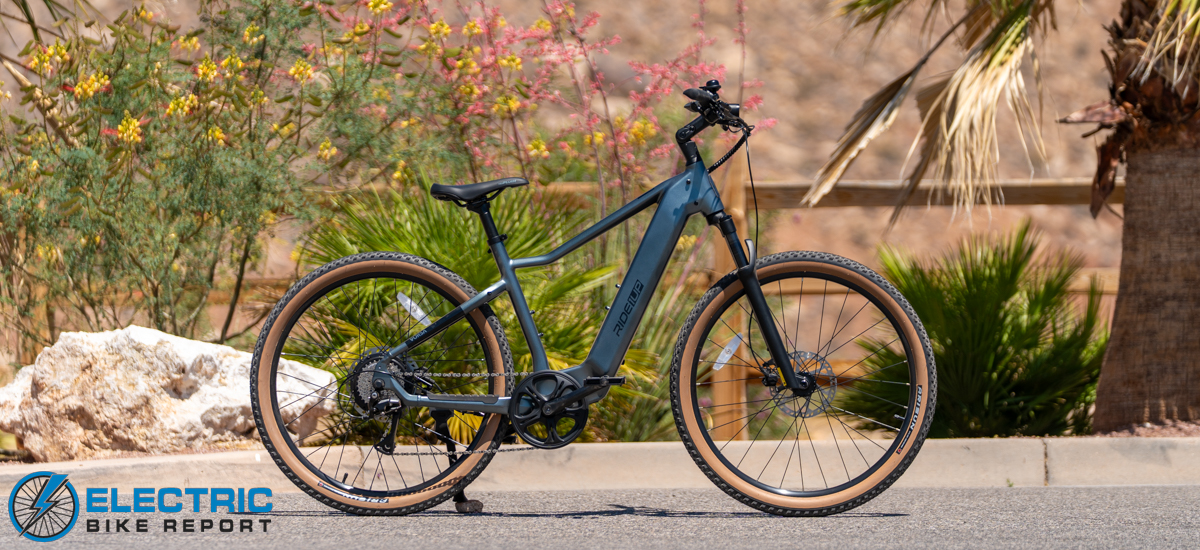
There was a distinct moment when I was cruising in Boost mode on the Ride1Up Vorsa Lite, my arms outstretched in a slightly forward-leaning position, when it hit me: the Vorsa Lite is just a really good bike.
For those familiar with Ride1Up’s older lineup, it quickly reminded me of the LMT’D V2 I tested a couple of years ago. The LMT’D was a bike riders loved for its simplicity; it stuck to the basics and did those things extremely well. The Vorsa Lite follows that same logic.
As the latest in the Vorsa family, the Lite is neither the do-it-all base model, nor the beefed-up fat tire version. It’s the Vorsa distilled: no cargo rack, narrower 27.5×2.2 tires, a lighter overall build, and a lower price point around $1,500.
Like its siblings, however, it keeps much of the Vorsa’s core platform: a powerful 750W AKM rear-hub motor with 95 Nm of torque, a 48V, 720Wh battery, a coil suspension fork with 100mm of travel, and a level of motor tuning and customization that genuinely separates this bike from many of its competitors.
The rider this bike is built for isn’t looking for an app, a host of control modules, or even a cargo rack for grocery runs. They want something nimble and capable that feels like a real bike, gets them where they’re going with meaningful pedal assist, and doesn’t weigh them down with features they’ll never use.
As with all e-bikes we review, we put the Vorsa Lite through a series of real-world performance tests. While it generally did well, its results in our range and hill tests were not what we expected for a bike at this price. They were better.
Keep reading below to learn more!

Sponsor
E-Bike Category:Commuter
E-Bike Class:Class 1 (pedal assist to 20 mph)
Class 2 (throttle to 20 mph)
Class 3 (pedal assist to 28 mph)
Class 2 (throttle to 20 mph)
Class 3 (pedal assist to 28 mph)
Sponsor
Ride1Up Vorsa Lite Video Review
 Pros
Pros- Riders can select between torque and cadence-sensing modes, either for a natural and rewarding active experience or a more relaxed, low-effort leisurely feel.
- As the lightest-weight Vorsa model to date, the Lite is highly nimble and lively-feeling. It’s also on the more portable side for a commuter.
- It’s a strong across-the-board performer, with standout results in our Range and Hill tests. It can go further and climb faster than many similar models we’ve tested.
- The bike is an affordable all-rounder, providing solid value for its $1,500 price point. It can serve as a commuter, exercise bike, light adventure bike, and more!
- Ride1Up designed the Vorsa Lite to accommodate riders from 5’1” to 6’4” with two frame sizes, step-thru and step-over styles, a long seatpost, and an adjustable stem.
- Users can customize the power and feel of each pedal assist level by tuning its torque output and and amperage through the display.
- This is an excellent bike for those who don’t need loads of features, apps, etc. It focuses on being a good, simple, approachable bike—and pulls that off well.
 Cons
Cons- While we appreciate the Lite’s stripped-down nature, we hoped it would still include an integrated tail light/brake light.
ELECTRICAL SPECS & FEATURES
- Battery: 48V, 720 Wh (15Ah) Reention Flamingo with Samsung 50GB cells, 21700 cell formation with Precise CanBus protocol SOC
- Charger:
- Display: Ride1Up ‘most customizable PAS’ color display with iOS FindMy tracking and USB-C accessory charging
- Motor: 750W AKM hub motor with 95nm of torque
- Headlight: 100 lux stem-integrated front light
- Taillights:Removable Seat Clamp Tail-Light, USB C- Rechargeable
- Pedal Assist: 5-level PAS, Intui-Drive torque sensor system or R1CBC cadence system
- Claimed Range: 30-60 miles
- Throttle: Left-side thumb throttle
- App:None
- UL Certification:UL 2849 & UL 2271 Certified
Weight & Dimensions
- Claimed weight: 61 lbs
- Tested Weight: 62.7 lbs
- Rider height range: 5’1″ – 5’11” (ST), 5’5″ – 6’4″ (XR)
- Total payload capacity: 440 lbs
Components & Accessories
- Brakes:Star Union hydraulic disc brakes with electric motor cutoff; 203mm R, 180mm F rotors
- Fenders:Optional
- Fork:100mm coil spring suspension thru-axle fork with hydraulic lockout
- Frame: Aluminum
- Drivetrain: 8-speed Shimano Acera, 48T Chainring, 11-32T Cassette
- Grips: VELO ergonomic silicone grips
- Saddle: VELO saddle
- Handlebar: Riser bars; 680mm width; 30mm rise; 31.8mm bar clamp; 10° sweep
- Kickstand: Included
- Pedals: Plastic Platform
- Tires: 27.5 x 2.2in Tires with Thorn Protection
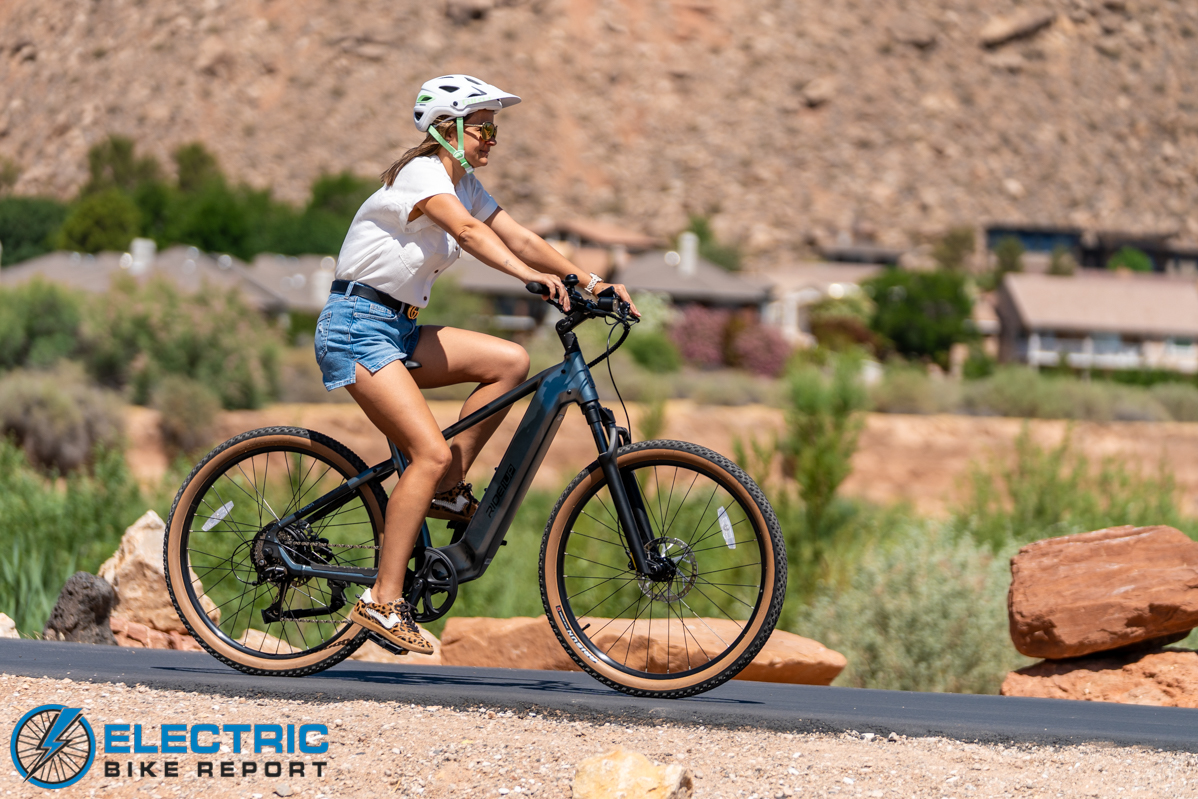
The Vorsa Lite is set to Class 2 mode by default, but can be unlocked to Class 3 or higher speeds via the display.
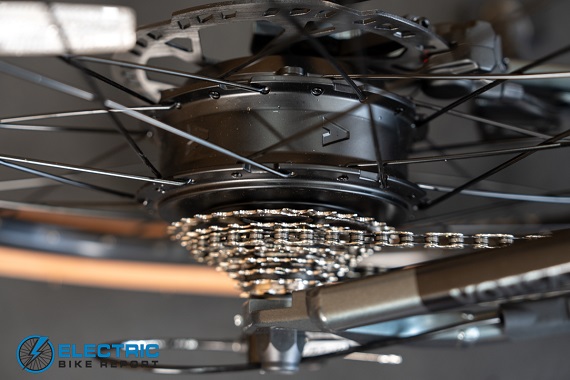
The bike’s 750W motor offers ample, responsive power via either torque or cadence sensors.
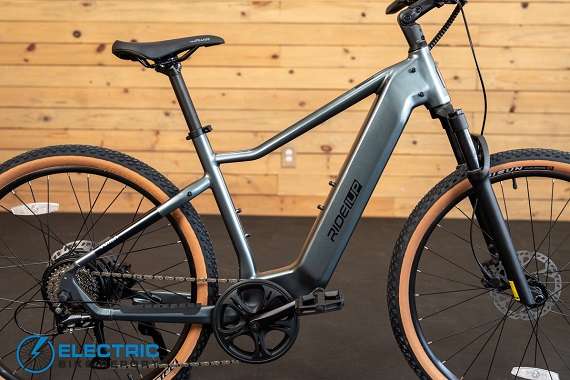
While we tested the XR model, Ride1Up also offers an ST model for shorter riders.
Ride1Up Vorsa Lite Review: Speed Test
Knowing that an e-bike can reach its advertised maximum speed is one thing, but digging into the details of how it gets there is another; this is why we perform a Speed Test with each bike we review.
We ran the Vorsa Lite through each of its pedal assist levels in both Class 2 and Class 3 modes, recording average speeds at each setting to map how the motor distributes its power across the range. We conducted this test on a flat section of the paved, shared-use trail system in our home base of St. George, Utah.
Out of the box, the Vorsa Lite ships as a Class 2 bike with torque-sensing pedal assist as its default mode, though riders can also switch to a cadence mode through the display. I tested it in both modes, starting without pedal assist to get a sense of the bike’s weight and gearing.
Without any assist, it rolled comfortably at around 10 mph—a reasonable baseline given its 63-lb weight. The bike pedals freely enough that most riders should be able to use it without pedal assist if the battery ran out of juice a couple of miles from home. .
In Class 2 torque mode, the lower assist levels felt genuinely natural. In Eco mode, the pedaling sensation was close enough to an analog bike that the assist almost blended into the background. Tour added a bit of speed without changing the feel much. Sport stepped up more noticeably, and both Turbo and Boost reached the Class 2 ceiling.
That ceiling effect was visible in the data: Turbo and Boost clustered tightly near 20 mph rather than spreading out, which is common on bikes that can switch between classes.
Class 3 mode gave the motor more room to stretch, allowing the bike’s speeds to be more evenly distributed across its assist levels. I reached 28 mph relatively quickly and easily, showing the bike’s overall power. It traded some of its natural feel to give me more reward for my effort in the higher levels, though it remained active and responsive.
Unfortunately, the bike’s cadence mode wasn’t functioning properly during our test, so we omitted those results here. Based on our experience with other Vorsa models, however, we would recommend this mode for riders who prefer a more relaxed, low-effort experience with steady power output when it functions correctly.
Finally, when testing the throttle, its acceleration was gradual off the line. The Vorsa Lite built speed steadily through the middle of the test run, then tapered approaching 20 mph. As a result, it felt safe and approachable—but still fun and effective.
Sponsor
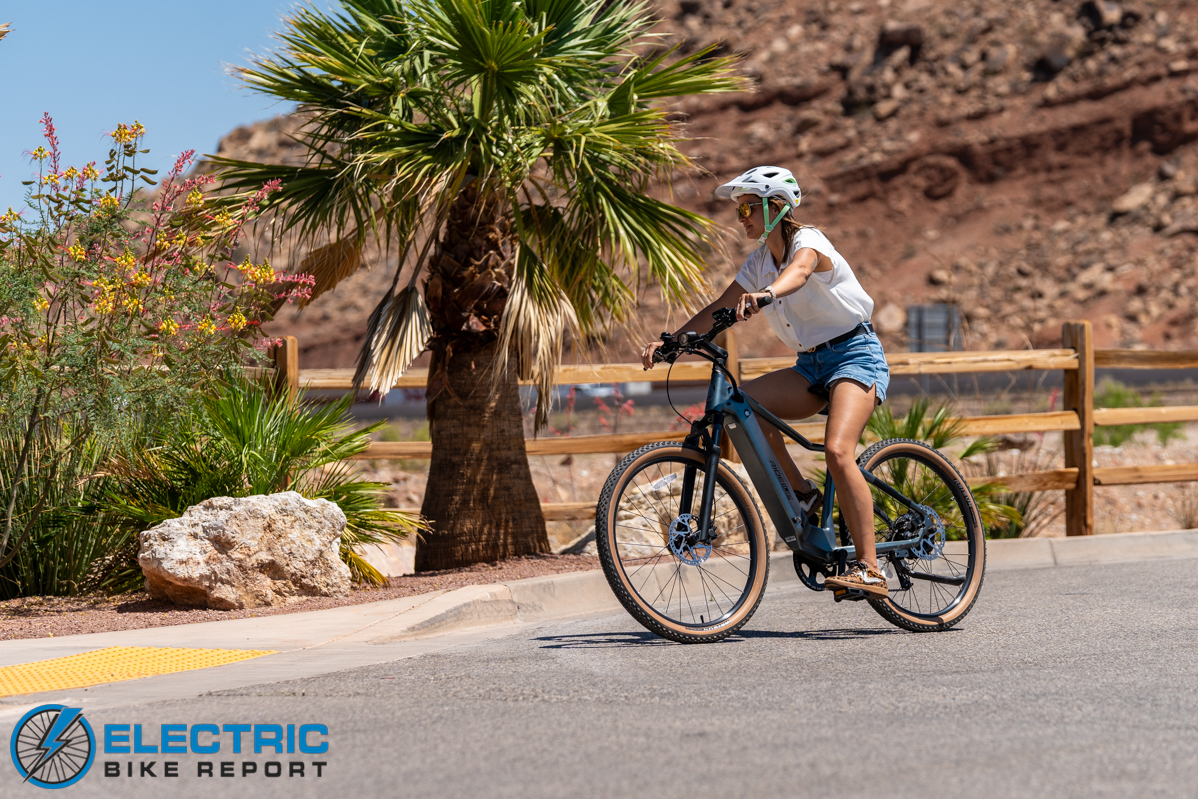
Weighing around 63 lbs, the Vorsa Lite is impressively nimble and maneuverable for its size.
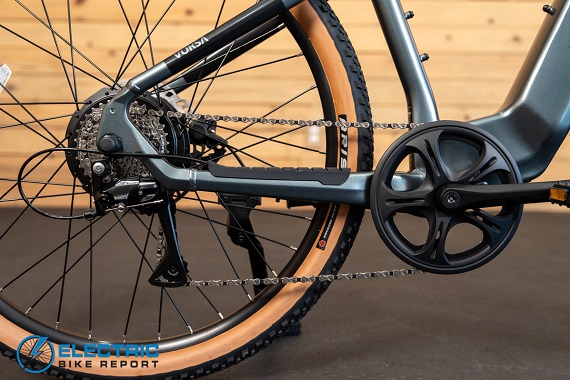
An 8-speed Shimano Acera drivetrain is a welcome step up from what we usually see at this price point.
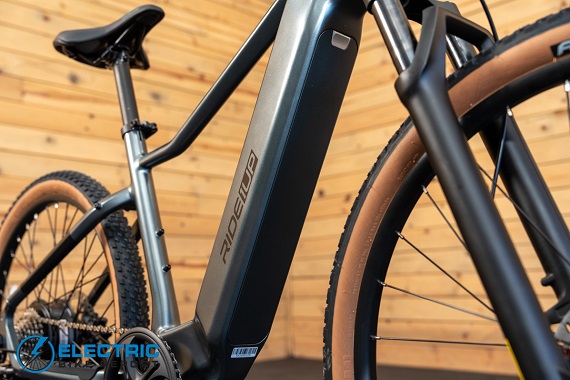
The bike’s removable 720 Wh battery is almost invisible when nested in the down tube.
Ride1Up Vorsa Lite Review: Range Test
Range is the spec that buyers fixate on and some manufacturers inflate, so we test it the same way every time: one run at the lowest practical assist setting, one at maximum power, both starting with a freshly-charged battery and riding until it’s drained. We expect most riders to fall between these minimum and maximum bookends.
The Vorsa Lite carries a 48V, 720 Wh battery pack, while similar commuters we’ve tested averaged 714 Wh of capacity. On paper, the small amount of extra power gives the bike a modest edge, but its real-world results showed potential that went far beyond our expectations!
In the low-assist test, the bike covered 105.2 miles. The category average for similar commuters is 72.6 miles. That impressive 35-mile gap points directly at energy efficiency rather than raw battery size.
Case in point: the Vorsa Lite used 6.9 watt-hours per mile (Wh/mi) in its low-assist test, while comparable bikes we’ve tested averaged 10.4 Wh per mile. At the high-power end, it covered 50.1 miles against a category average of 36.8 miles, using 14.4 Wh/mi versus the average of 20 Wh/mi.
By default, Ride1Up caps the motor’s peak output at 85% instead of its full 100% in Boost mode. That decision likely contributed to the greater difference in energy efficiency in the max-power test; riders who bump it up will likely reduce the bike’s effective range.
Based on our results, we can confidently say that most riders commuting in one of the bike’s lower settings should expect to cover a week’s worth of daily rides before needing to plug in. Even in the highest assist levels, many riders could get a couple of days of round-trip commuting from a single charge.
Ride1Up claims 30 to 60 miles. Both of our results cleared that range by a significant margin, making the advertised figures look conservative rather than optimistic. Ultimately, that can give you, the consumer, more confidence—the pleasant surprise of going further than expected is far better than running out of charge early!
Sponsor
Sponsor
Ride1Up Vorsa Lite Review: Hill Test
Climbing performance largely comes down to three variables: a bike’s weight, how much peak power its motor can produce, and how much torque it can put to the wheel. We measure a bike’s climbing ability by timing two runs up the Devil’s Backbone (see above) in both throttle-only and maximum pedal assist, then comparing against the category average for similar commuters.
On throttle power alone, our test rider, Justin, reached the top of the Devil’s Backbone in 1:50 at an average of 16.5 mph. In the highest level of pedal assist, his time dropped to 1:42 at a speedy 17.8 mph on average. Similar models, including some of the best commuter e-bikes, average 2:03 on throttle, while their average pedal result is 2:00. In both cases, these substantial margins demonstrate the bike’s above-average power.
The Vorsa Lite’s 750W motor has a peak of 1,380W and produces 95 Newton meters of torque. The category averages for comparable bikes are signficantly lower, at 1,036W peak and 75 Nm, putting the Vorsa’s faster times in context. The bike was also about five pounds lighter than average, which compounds its advantage to some degree.
Additionally, the Lite’s results match well with the standard Vorsa. Somewhat surprisingly, this model, which is heavier due to its included cargo rack and wider tires, completed the test one second faster on throttle, while its pedal test result was identical to that of the Vorsa Lite.
In my own time on the bike, I noticed that the motor asked for moderate effort rather than a soft spin when pedaling uphill using torque mode. I had to push some to keep speed up through steep sections, but most of the time, the experience was relatively low-effort.
In cadence mode, the bike nearly flew up steep hills, making climbs fast and easy. On throttle, the bike climbed steadily and confidently.
Clearly, the bike has plenty of muscle to handle climbs, giving riders three ways to approach hills: one active, one steady, and one relaxed but especially effective.
Sponsor
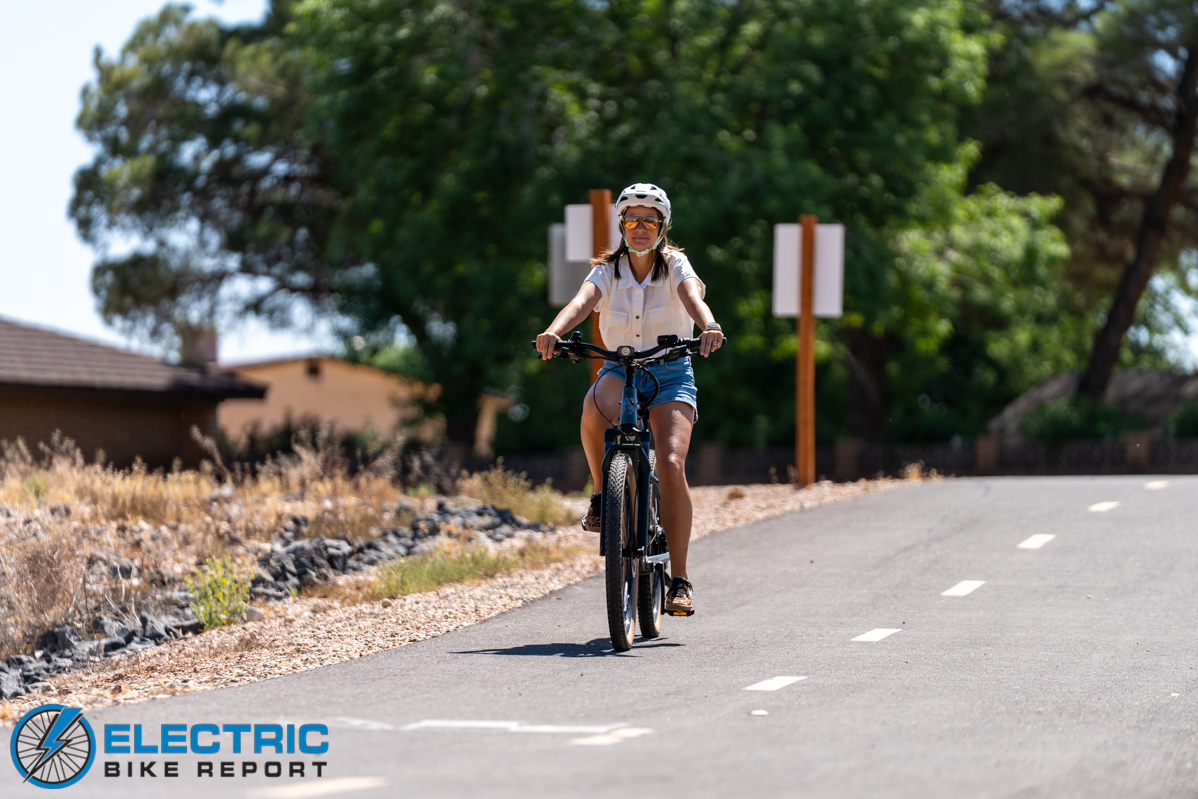
Whether you prefer a relatively upright riding position or a more aggressive forward lean, the Vorsa Lite can be tailored to your preferences.
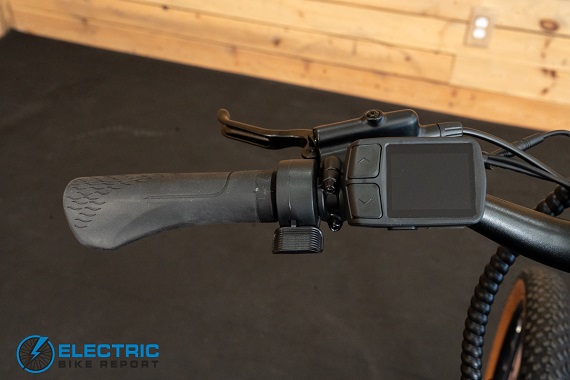
The Vorsa Lite’s throttle sits next to its display/control panel on the left handlebar.
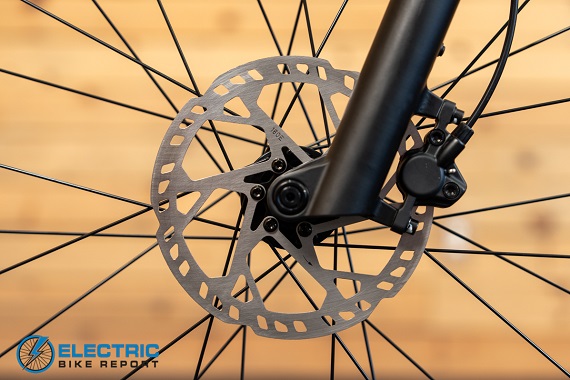
Ride1Up equipped the bike with capable hydraulic disc brakes.
Ride1Up Vorsa Lite Review: Brake Test
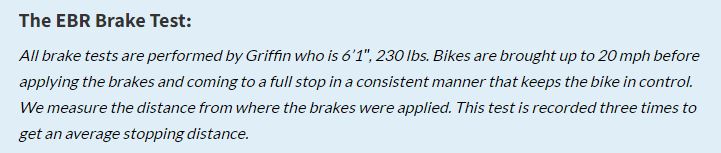
Stopping distance is an important measure (pun intended) of a bike’s braking power, and a way to judge how well its brakes are balanced with its speeds. For this test, We brought the Vorsa Lite to 20 mph, applied the brakes in a controlled, consistent manner, and recorded the distance from application to full stop.
The average stopping distance across our three test runs came to 22’2”. The category average is 21’5”, putting the Vorsa Lite about 9 inches longer than its peers. That’s not a dramatic gap, but it is worth digging into.
The Vorsa Lite uses two-piston Star Union hydraulic disc brakes with a 203mm rotor at the rear and 180mm up front. Hydraulic brakes at this price point are a reasonable expectation, and the hardware here is appropriate for a 63 lb commuter.
So what gives?
The feel at the lever told part of the story. The brakes felt safe and adequate, but they lacked some bite. Reaching a quick stop required relatively firm pressure rather than the confident, strong response you might expect with a light to moderate grip.
The bigger factor seemed to be the Vorsa Lite’s puncture-resistant tires. Under hard braking, the bike skidded noticeably, though not to a surprising degree. Tires made from a softer, grippier compound would likely reduce the bike’s average stopping distance, though we’d recommend some extra flat protection to those who make this change.
Based on our experience, we can say that the Vorsa Lite’s brakes are absolutely sufficient, though we might recommend getting a bit of practice to understand the bike’s feel and limitations.
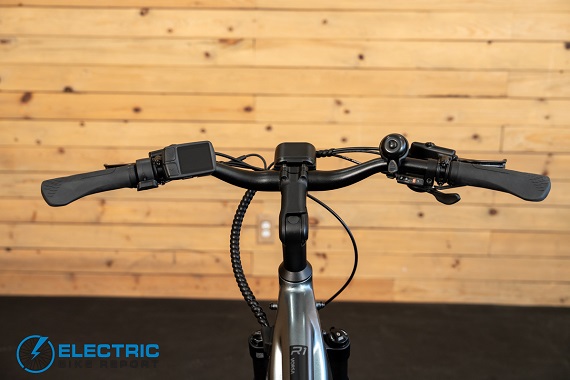
A set of ergonomically-angled handlebars and an adjustable stem ensures comfort and a personalized fit.
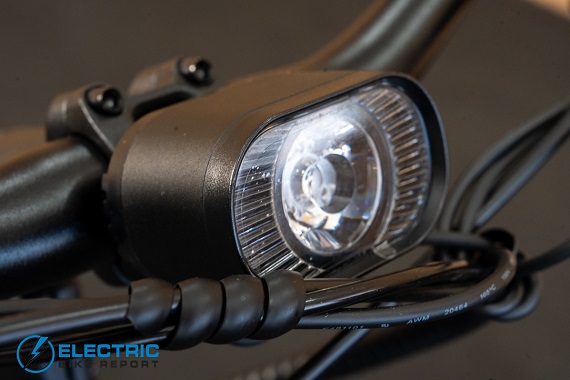
While no integrated taillight is offered on the Lite, it still includes a powered LED headlight.
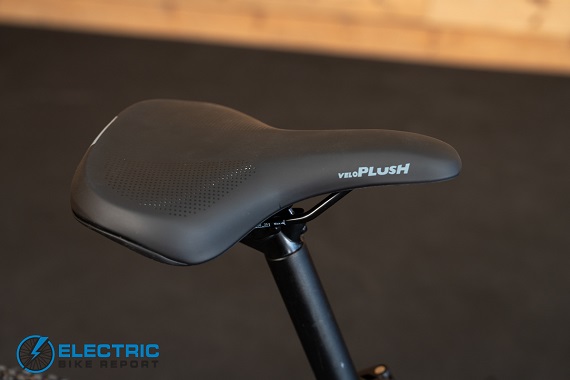
The Velo saddle is comfortable and shaped for both support and easy pedaling.
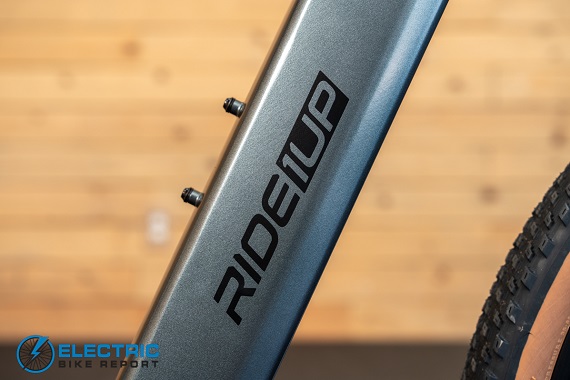
The down tube includes a bottle cage mount, so you can stay hydrated while riding.
Ride1Up Vorsa Lite Review: Ride Quality
With the Vorsa Lite, it really is all in the name. The bike doesn’t include a rack, it features narrower tires than both the standard Vorsa and the Vorsa FT, and it comes with a relatively basic but straightforward set of features. At the end of the day, it’s a simple, stripped-down e-bike for those who don’t want or need loads of bells or whistles.
In terms of sizing, Ride1Up offers the Vorsa in both step-over (XR) and step-thru (ST) frames, each with a single frame size. The recommended height range for the high-step runs from 5’5” to 6’4”, with the ST model intended for shorter riders from 5’1” to 5’11”.
The bike’s ergonomics are genuinely flexible. The seatpost offers around 11.5 inches of adjustment, which is quite a lot, and the adjustable stem lets riders dial in both height and reach distance independently. At 5’11”, with the stem at its lowest and most forward position, I found the riding posture comfortable and appropriately split between sporty and upright.
The coil suspension fork offers 100mm of travel, including both lockout and preload adjustment features. Whether riding on smooth or rough pavement, hard-packed dirt, or light gravel, it effectively absorbed bumps, dips, and chatter.
To be clear, the Vorsa Lite’s fork isn’t a trail fork and the bike itself isn’t a trail bike, but in my experience, the combination of the bike’s suspension travel and its 27.5×2.2 tires handles mixed-surface commuting without making you brace for every crack in the road.
The contact points felt well-matched to the bike’s commuter identity. The saddle was soft and supportive without interfering with my pedaling. The ergonomic rubber grips felt comfortable and effectively helped to absorb road vibrations in concert with the fork.
One of my first observations was that the Vorsa Lite’s handling felt more nimble than I expected based on its weight. At roughly 63 lbs, the bike is roughly mid-weight for a commuter, but its heft is well-distributed and balanced. The result is a pleasantly lively and responsive feel.
My only real point of critique is that, unlike its sibling models, the Vorsa Lite does not come with an integrated tail/brake light, which I consider somewhat of a miss on most e-bikes—especially those that are likely to share the streets with cars. Ride1Up did add a removable, battery-powered light, but I hope to see an integrated light in the future.
As I touched on in the Speed Test section above, the 750W rear hub motor is powerful enough in Boost mode that light pedaling produces a meaningful surge. The torque sensor reads input naturally, while the cadence mode feels steady and strong.
Users can switch between modes through the bike’s display menu, which also offers tuning for the five pedal assist settings. We found the default settings highly functional, but riders can adjust torque and amperage for each setting separately to dial in the bike’s feel and behavior.
Overall, I give the bike credit for offering a great blend of basic usability and customization. It’s entirely possible to hop on the bike and ride it effectively right out of the box—its default settings are thoughtfully chosen—though it also offers a lot of flexibility for riders who want to tweak and tune its personality.
Sponsor
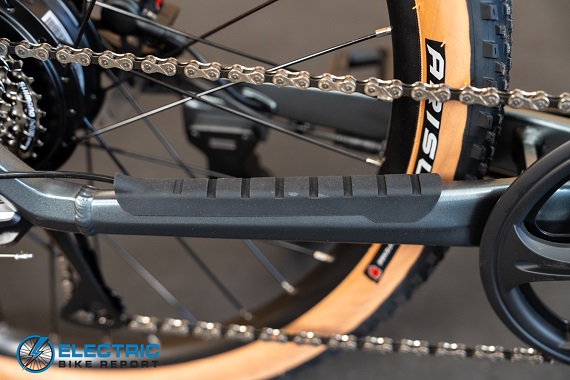
Ride1Up included a rubber chainstay protector to prevent damage to the paint.
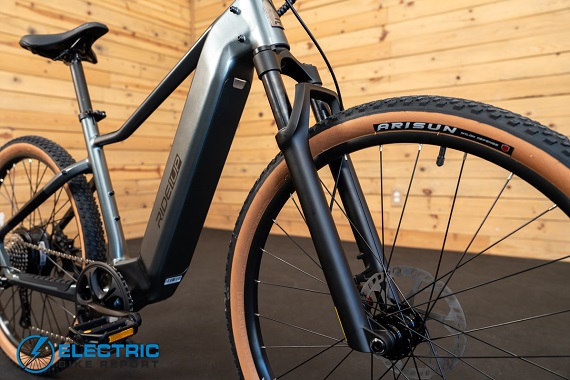
The coil suspension fork offers 100mm of travel—enough for dirt, gravel, or pavement.
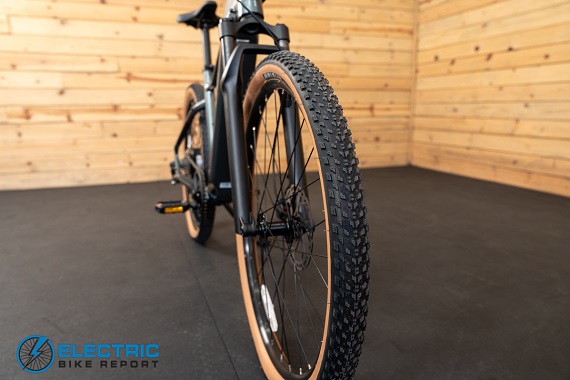
A set of 27.5×2.2” knobby tires give the bike limited off-road capability.
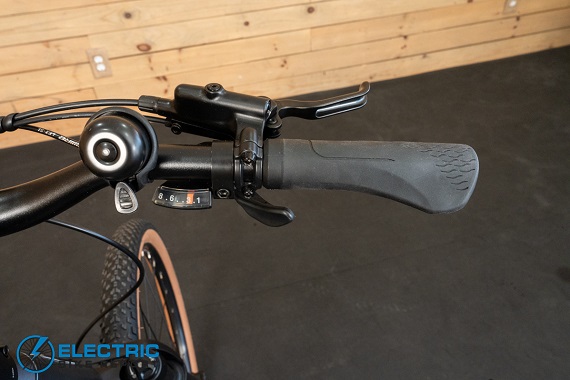
The Lite’s only real bell or whistle is, well, it’s handlebar-mounted bell.
Ride1Up Vorsa Lite Review: Summary / Where to Buy
The Vorsa Lite makes a case for itself the way good, simple things usually do: by doing its job better than expected. It sets out to be a capable, approachable commuter that feels responsive, adaptable, and fun to ride—and by that measure, it succeeds more convincingly than many similar e-bikes on the market.
While the bike proved competent in all areas of our testing, its range and hill results are the clearest expression of what Ride1Up got right here. A bike that can cover 105 miles on a charge in low assist and climb faster than the category average is not punching at its weight class quietly.
We recommend the Vorsa Lite for riders who want an uncomplicated, easy to use, relatively lightweight, and extremely versatile e-bike. Its cost-effective nature and suitability for daily commuting and light adventuring will likely attract attention. For those who get drawn in, the bike’s uncommon level of customization and climbing power might just seal the deal.
Those who need an integrated tail/brake light, a cargo rack, or tires that can handle looser terrain and all-weather conditions should look at the full Vorsa platform before settling here, especially as the Lite is deliberate about what it leaves out.
So whether you’re looking for a long-range commuter to get through the work week without needing a recharge, an exercise bike with an analog-like feel, a powerhouse that can help you climb steep hills, or a straightforward and affordable ride you can take just about anywhere, the Vorsa Lite may just fit the bill.
Happy Riding! Make sure to let us know if you have any questions or if you think we left anything out in this review of the Ride1Up Vorsa Lite down in our comments section.
Sponsor
Sponsor
Reader Interactions
Leave a Reply