

Magnum Bliss Review | Elegance and An Adventurous Spirit
May 21, 2026
 1 Comments
 Share
Share
This fat tire cruiser offers comfort, versatility, and fun with a cushy ride and responsive, approachable pedal assist.
When I first started reviewing e-bikes, I wrongly assumed that all models in a given category were more or less identical, perhaps with slightly different colors, components, and branding. Years later, I know there’s much more nuance to every bike, with manufacturers adding their own spin to a specific style in an effort to stand out from the crowd.
So how does Magnum’s fat tire e-bike, the Bliss, make a name for itself?
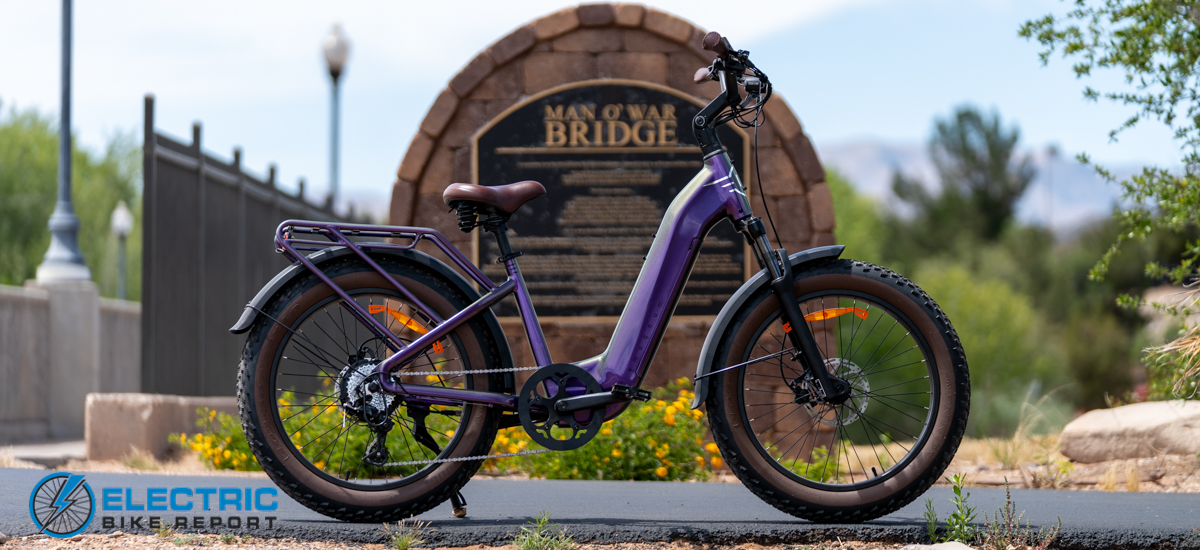
Most obviously, it follows the brand’s recently revamped and unified visual style, combining sleek step-thru frames, vivid and muted paint color options, classic-looking tan-wall tires, and brown saddles and grips. Looks are subjective, but from our point of view, the result is a bike that shows class and refinement.
With a clear focus on comfort, the Bliss’ cruiser influence is another of its most unique elements. Its adjustable stem and mid-rise handlebars promote a relaxed and upright riding position, while its cruiser-style spring saddle, suspension fork, and 4-inch-wide tires smooth and cushion the ride.
Motor response is a third area where the Bliss excels. By default, the bike is set to offer adaptive torque-based pedal assist up to 20 mph, responding quickly and intuitively to changes in pedal pressure. Riders can, relatively easily, switch to a cadence-based mode, however, which provides fast, easy power for cruising and climbing with minimal effort.
In short, the Magnum Bliss aims to offer an elegant, ergonomic, and engaging experience suitable for leisure, exercise, or daily travel. Whether or not it meets those goals, however, is something you’ll need to continue reading to discover. Below, you’ll find the bike’s results in our standardized, real-world performance tests and our thoughts on its ride quality.

Sponsor
E-Bike Category:Fat Tire
E-Bike Class:Class 1 (pedal assist to 20 mph)
Class 2 (throttle to 20 mph)
Class 3 (pedal assist to 28 mph)
Class 2 (throttle to 20 mph)
Class 3 (pedal assist to 28 mph)
Sponsor
Magnum Bliss Video Review
 Pros
Pros- The Bliss combines fat tire power with cruiser approachability. Its 750W motor is capable while feeling safe and controlled.
- Its comfort factor is extremely high, with an upright & adjustable fit, and a plush, cushy ride from its fat tires, spring saddle, and 100mm suspension.
- Swappable torque and cadence modes let you choose the feel you prefer. The former is responsive and natural, while the latter is easy and ultra-relaxed.
- The bike fits riders of all kinds, with a recommended height range from 4’10” to 6’3” and a standover height of just 16 inches.
- The Bliss has multiple throttle acceleration settings tied to its assist levels, making the bike flexible and control of its feel intuitive.
- Like other Magnum models, the Bliss has a handful of appreciated and uncommon extras, like a stem-integrated color display, MIK-HD cargo rack, AirTag-compatible bell, etc.
- It has an easy to grasp interface, making it user-friendly for new riders or those who prefer a straightforward experience.
- Everyone’s preferences are different, but we dig the Bliss’ blend of bold and classic styling, plus unique paint colors like Amethyst and Wildfire.
 Cons
Cons- It’s clear that the bike brings a lot to the table, but additions like an included AirTag, fast charger, turn signals, etc., would add value at its price point.
- We encountered a few minor motor inconsistencies after adjusting speeds. Fortunately, a pause in pedaling helped smooth things out.
ELECTRICAL SPECS & FEATURES
- Battery: 48V, 720 Wh (15 Ah), Samsung 21700, Li-NMC
- Charger: 54.6V 2A Charger
- Display: VeloFox Stem-Integrated Color Display
- Motor: Sutto Hub-Drive; brushless; planetary geared, 750 Watts (1,000 Watts Peak)
- Headlight: Integrated 80 lumen front light
- Taillights:multi-function rear light (flashes when brakes are pulled)
- Pedal Assist: Torque Sensor Pedal Assist
- Claimed Range: 50 Miles
- Throttle: Thumb Throttle
- App:N/A
- UL Certification:UL2271 & UL2849 Certified
Weight & Dimensions
- Claimed weight: 81 lbs
- Tested Weight: 81.6 lbs
- Rider height range: 4’10” – 6’2”
- Total payload capacity: 330 lbs
Components & Accessories
- Brakes:Tektro Hydraulic 180mm rotors
- Fenders:Front and rear full coverage fenders included
- Fork:FAT 24-inch wheel, thru-axle, 100mm travel, w/ lock out
- Frame: Aluminum Alloy
- Drivetrain: 8-Speed Microshift Acolyte, 52T Chainring, 11-32T Cassette
- Grips: Faux leather ergonomic
- Saddle: Selle Royal Cruiser w/ elastomer springs
- Handlebar: 710 mm
- Kickstand: Center-Mounted Single Side Adjustable Length
- Pedals: Wide alloy Platform with reflectors
- Tires: Innova 24 x 4.0 knobby
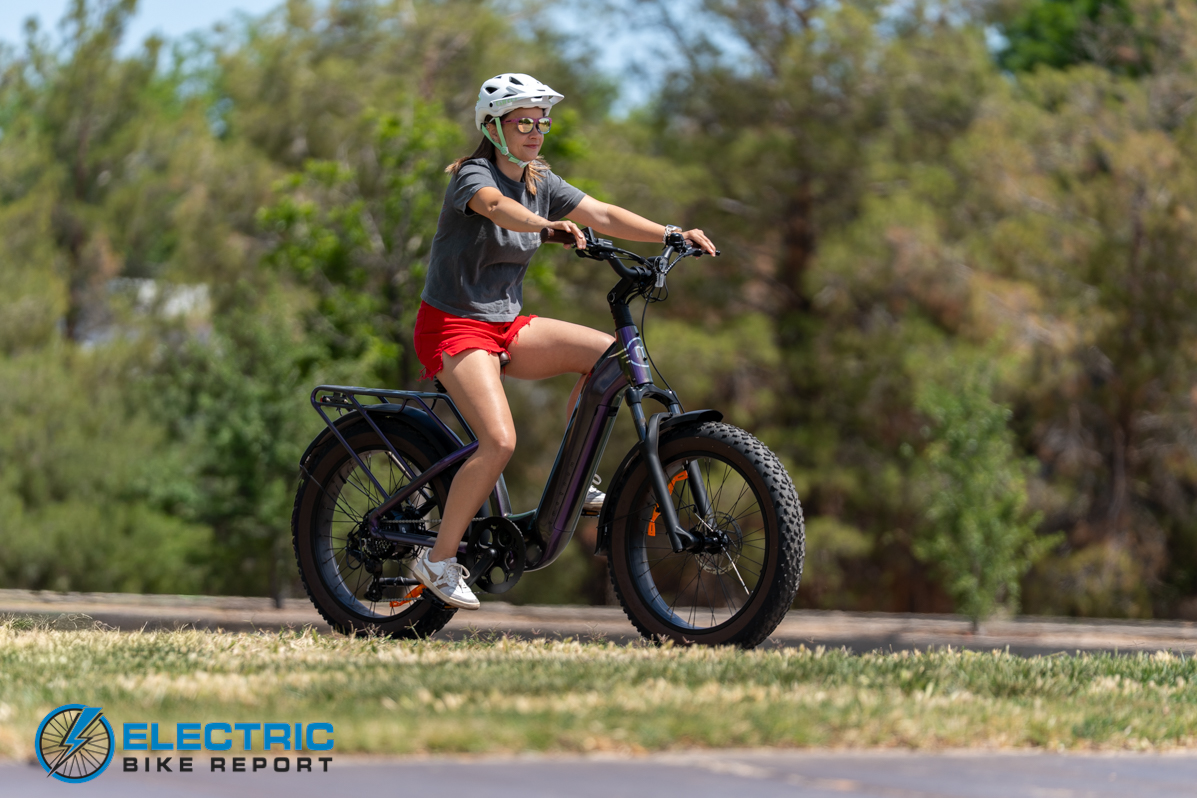
Riders can choose between active and low-effort riding experiences by switching between torque and cadence-sensing modes.
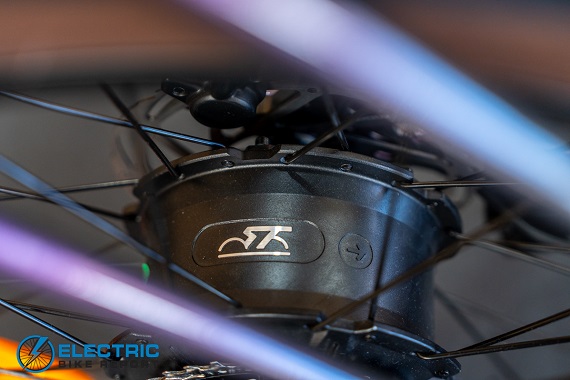
Magnum equipped the Bliss with a 750W rear hub motor from Sutto, producing 1000W of peak power and 85 Nm of torque.
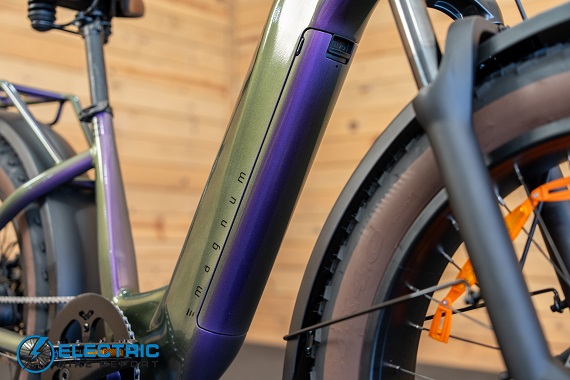
The bike’s 720 Wh battery is removable and fully concealed in the underside of the down tube.
Magnum Bliss Review: Speed Test
As always, I took the Magnum Bliss to a flat section of our local shared-use path system. While riding on this paved trail, I tested the Bliss in all combinations of its Class and sensor modes while stepping up through its pedal assist levels. The average speeds I achieved in each level are graphed above.
Like other Magnum e-bikes, the Bliss has a few interesting characteristics to explain up-front.
First, when set to Class 2 speeds (throttle and pedal assist limited to 20 mph), the bike has four power levels—Eco, Tour, Sport, and Turbo. When set to Class 3 mode (pedal assist to 28 mph and throttle to 20 mph), it adds two additional power levels—Boost and Hyper.
Second, when in the default torque-sensing mode, the bike’s speeds are not limited (except for the Class maximum). There, the pedal assist system felt smooth, responsive, and natural; its power fluctuated in response to my pedaling force, providing a feel similar to that of a non-electric bike.
In cadence mode, each of the four or six assist levels had preset speed limits. The motor engaged almost immediately after I started pedaling, and it delivered a steady flow of power output as long as the cranks were turning. That means that, even with light pedaling, the motor did most of the work of moving the bike; the ride was relaxed and low-effort.
The graphs of my results, which show a generally linear pattern in both torque- and cadence-sensing modes, reflect the bike’s well-distributed power and intuitive programming.
In torque mode, my pedaling combined with the motor’s output to put me near the bike’s maximum speed in Sport when riding with Class 2 settings. As such, my results tapered off with only a small jump to 20 mph in Turbo. Once opened up to Class 3 speeds, however, I was able to reach 28 mph with relatively consistent jumps in power. There were a few small spikes or dips in my average speed due to fluctuations in my pedaling and the surface of the path itself.
In cadence mode, however, my results are almost perfectly linear, showing the bike’s assist-level-specific speed limits. This was possible only because my relatively casual pedaling did not overpower the bike, and the motor stopped upon reaching these preset speeds.
Results such as these are what we generally consider ideal, as each step up to a higher assist level delivers a predictable and meaningful increase in speed and power. This translates to an intuitive user experience, which I can say that the Bliss lived up to in my hands-on testing.
In addition to a pedal test, I tried out the bike’s throttle to gauge its acceleration. I noticed that its force varied depending on the pedal assist level I selected. In Eco, the Bliss picked up speed gradually, while in Turbo, it felt much stronger—though it never launched off the line too forcefully or unexpectedly.
Overall, the Bliss performed well in this test, though I did notice some minor hiccups after switching speeds. Specifically, when moving from Class 2 to Class 3 mode, the motor still wanted to stop at 20 mph. Fortunately, it seemed to reset itself after I paused my pedaling.
We encourage Magnum to smooth out these small inconsistencies, but otherwise, we give the brand kudos for the Bliss’ responsive nature and intuitive programming.
Sponsor
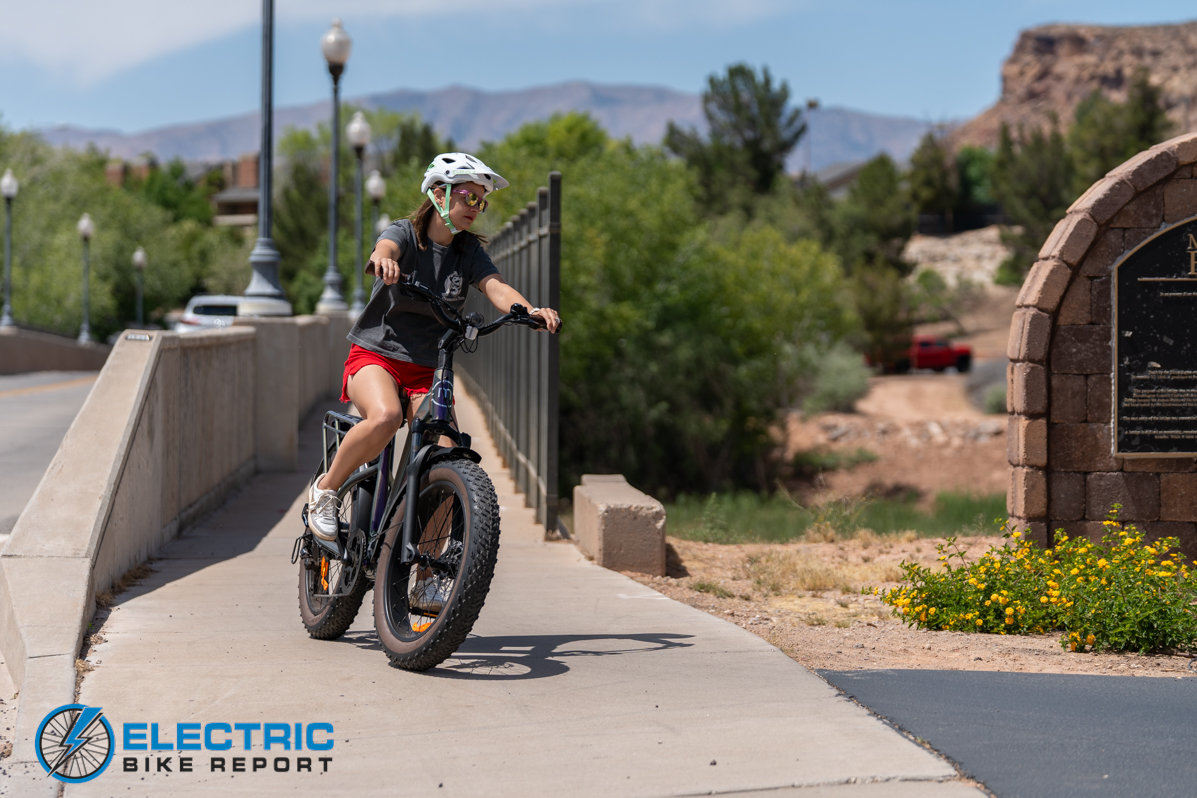
With 24×4” tires instead of the more common 26×4” tires, the Bliss maneuvers well and sits relatively low to the ground.
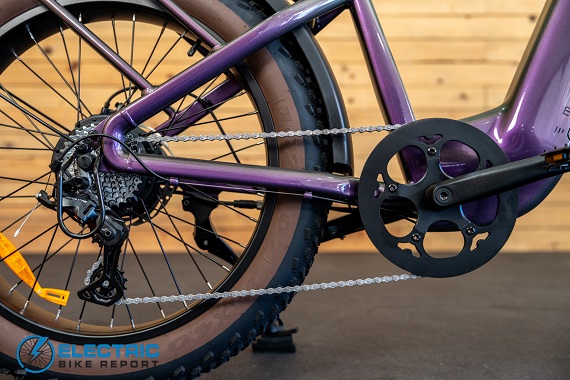
We liked the 8-speed Microshift Acolyte drivetrain, which shifts crisply and offers a useful gearing range.
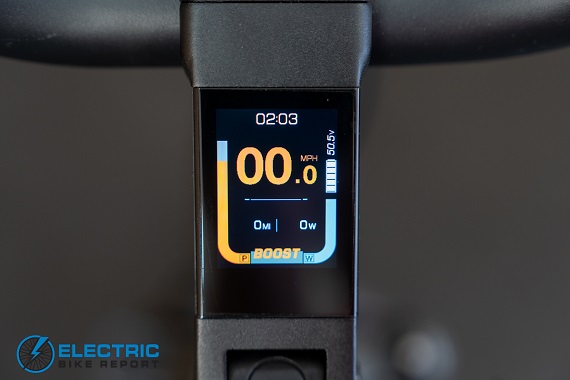
The bike has four assist levels in Class 2 mode and six when unlocked to Class 3 speeds.
Magnum Bliss Review: Range Test
Since range is often a deciding factor in consumers’ buying decisions, we perform a real-world range test with every e-bike we review. By using the method explained above, we can provide a bracket that most riders should fall between, depending on where and how they use their bike.
Our test riders traveled 34.3 miles on the Bliss when riding in Turbo. In Eco, they managed an impressive 64.7 miles.
A group of similar popular models we’ve reviewed, including many of the best fat tire e-bikes we’ve tested, averaged slightly higher results of 36 and 76.1 miles. These bikes, however, had the advantage of higher battery capacities; they averaged a substantially larger 851 watt-hours (Wh) in comparison to the Bliss’ 720 Wh.
In the grand scheme of things, the Bliss performed well—as evidenced by its relatively efficient energy consumption. When calculating the number of watt-hours used per mile (Wh/mi), the Bliss averaged 11.1 Wh/mi in Eco, while similar models were slightly higher at 11.4 Wh/mi in their lowest assist levels.
The difference between the Bliss and its competitors was much more noticeable in the bike’s high-power mode. Magnum’s fat tire e-bike used 21 Wh/mi, compared to the higher (and less efficient) 24.5 Wh/mi of its peers.
In essence, this shows that the Bliss made good use of its battery charge—and it likely would have traveled farther than its competitors if it had the same size battery.
Even with slightly less range potential than some other similar models on the market, the Bliss should be more than adequate for most riders. It’s rare that we interact with riders who travel more than 30 miles regularly—a distance the Bliss can easily cover in its highest power level with a single charge of the battery. When riding at slower speeds/lower power levels, it will likely hold enough charge for multiple rides.
As with all e-bikes that have adjustable sensor and Class modes, users should keep in mind that performance will vary depending on the bike’s settings. We tested the Bliss in its torque-sensing Class 2 mode, but riders using the cadence mode and/or cruising at Class 3 speeds should expect fewer miles.
Battery charge can be measured in both watt-hours and amp-hours (Ah); the Bliss’ 720 Wh battery equates to 15 Ah of capacity. With the included 2-amp charger, riders should expect a fully-depleted battery to be charged to full in about 7.5 hours.
Sponsor
Sponsor
Magnum Bliss Review: Hill Test
Like most e-bikes in the fat tire category, the Magnum Bliss cleared our Hill Test (see above) with flying colors. Our test rider, Justin, completed the throttle portion of our test in 1:50 while maintaining a 16.5 mph average speed. His pedal time was somewhat slower, at 1:55 and 15.8 mph on average.
The Bliss’s scores differed from the category averages by a maximum of 7 seconds. For context, a group of similar, popular models completed the throttle test in 1:57 and the max-assist pedal test in 1:52.
Such close results show that the Bliss is relatively average in its climbing performance—which is excellent, considering that fat tire e-bikes typically have some of the fastest results in this test. Many buyers gravitate toward this category for its ample power, which can effectively flatten hills and give inexperienced riders confidence to tackle just about anything in their path.
There are a few minor differences between the Bliss and our group of comparison models when it comes to specs. These similar models weighed an average of 81 lbs and produced up to 90 Newton meters (Nm) of torque and 1,148W of peak power.
Magnum’s fat tire e-bike weighed a slightly heavier 82 lbs and was slightly less powerful. Its motor produced an average of 85 Nm of torque and 1,000W of peak power.
With these minor differences in mind, it was no surprise that the Bliss came in a few seconds slower than average in its pedal test. Its faster-than-average throttle result, however, was somewhat unexpected—though it’s worth noting that the differences in time are within our margin of error for this test.
My personal experience in the saddle coincided with the bike’s motor specs; the Bliss felt slightly more restrained than the average fat tire e-bike. This complemented its cruiser influence well, giving it a somewhat more relaxed feel, while also showing that, in reality, it is no less capable than its peers.
Riders who want the fastest and easiest climbing will likely rely on the throttle, while those who want to pedal can enjoy a natural and responsive feel. With either approach, the Bliss is strong, capable, and helpful in conquering hilly terrain.
Sponsor
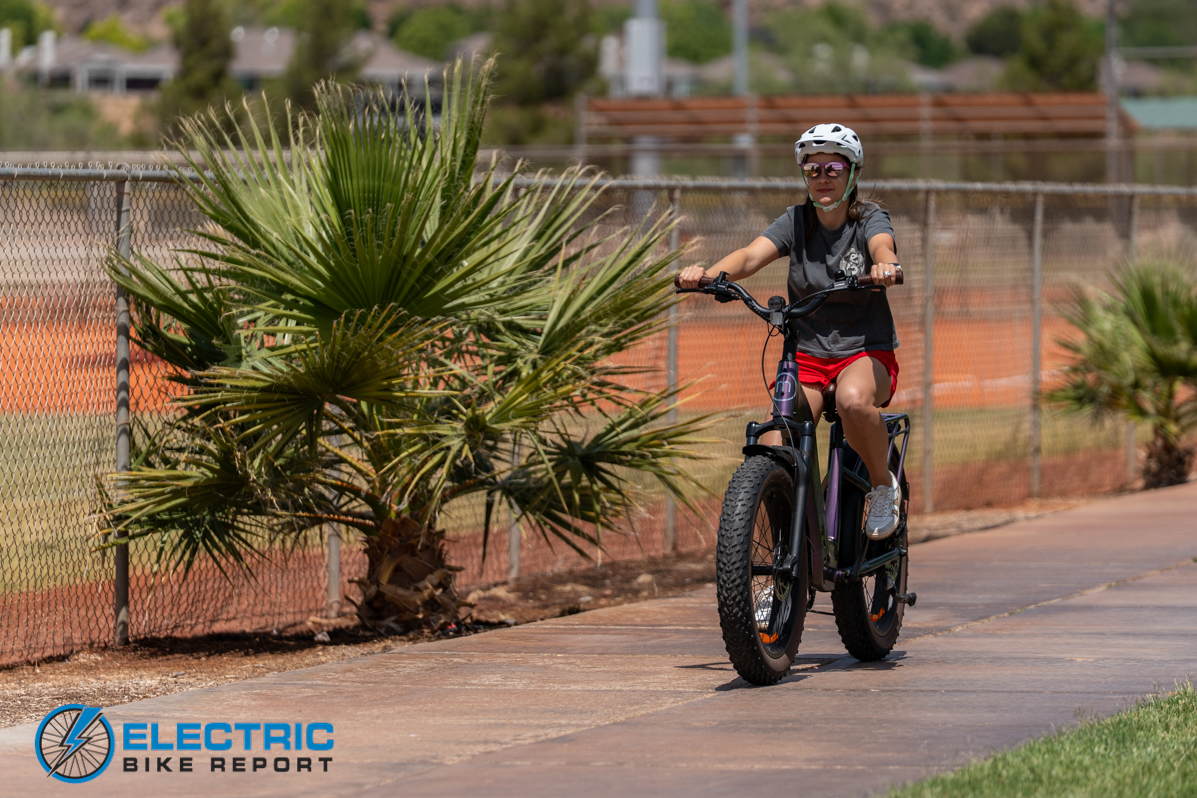
The Bliss is intended for riders between 4’10” and 6’2”, with plenty of adjustability to dial in its fit.
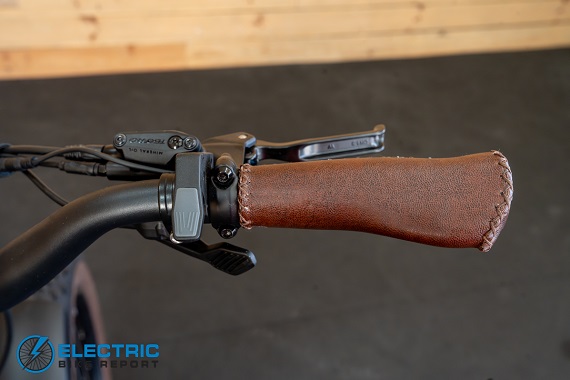
A thumb throttle allows riders to start up quickly or climb hills with no effort.
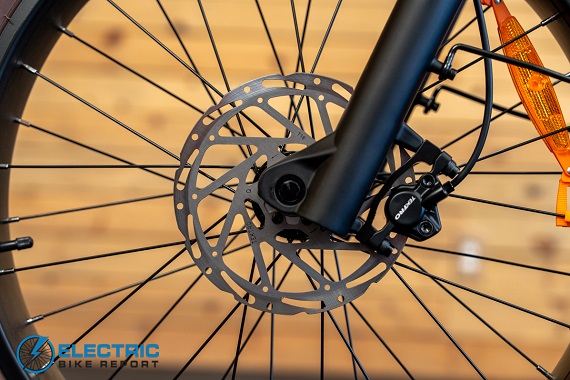
The Bliss’ Tektro hydraulic brake system uses 180mm rotors on both wheels.
Magnum Bliss Review: Brake Test
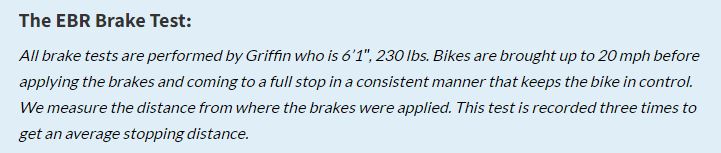
Continuing its trend of solid performance, we recorded an 18’7” average stopping distance when testing the Bliss using the method above. This is over three and a half feet shorter than our current average among similar fat tire e-bikes—comparable models averaged 22’2” in this test, which is still well within our expected range of results.
It’s not entirely clear why the Bliss performed so well, as its weight, brake system, and tires (all factors that affect results) are relatively average.
While the Bliss weighed around 82 lbs, similar models averaged 81 lbs, making the bike effectively no more or less difficult to bring to a stop.
Its brake system is Tektro’s HD-E3520 model: a two-piston hydraulic system with 180mm front and rear rotors. In our experience, this setup is common among similar e-bikes, typically performing very well.
The Bliss is equipped with knobby 24×4” Chaoyang tires, which are slightly smaller in diameter than the 26×4” tires that are common on fat tire e-bikes. While similar in weight and traction, their reduced size may have brought the bike’s center of gravity lower, which often translates to shorter stopping distances.
Regardless of the reason why its test score was so impressive, I noticed firsthand that the Bliss had excellent stopping power. Modulating speed when riding downhill was easy with light to moderate pressure, and the brakes could bring the bike to a halt somewhat aggressively if needed—while still maintaining control.
There’s no doubt that the Bliss is specced with safe, effective brakes, so it earns our stamp of approval in this test.
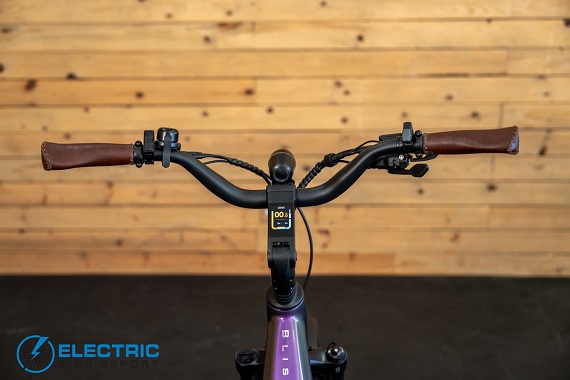
Mid-rise handlebars keep the ride feeling upright and comfortable.
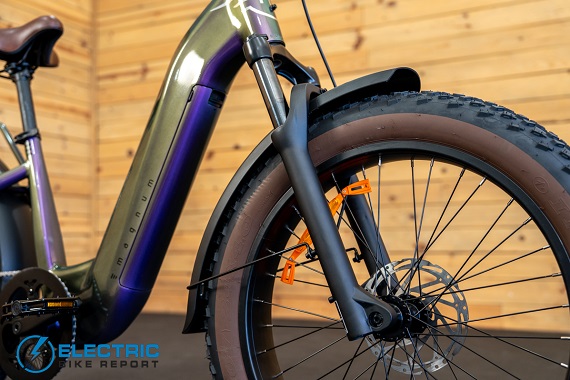
The 100mm coil suspension fork smooths bumps and softens impacts.
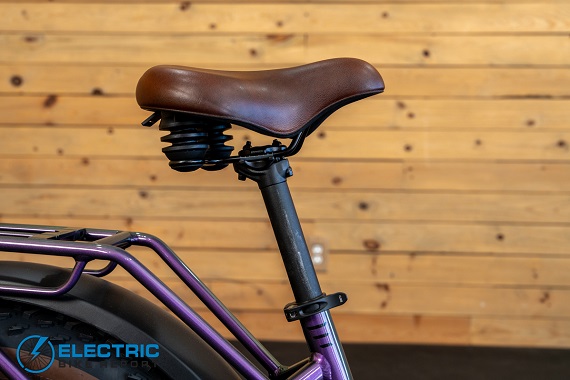
A cushy, cruiser-style spring saddle both looks and feels nice.
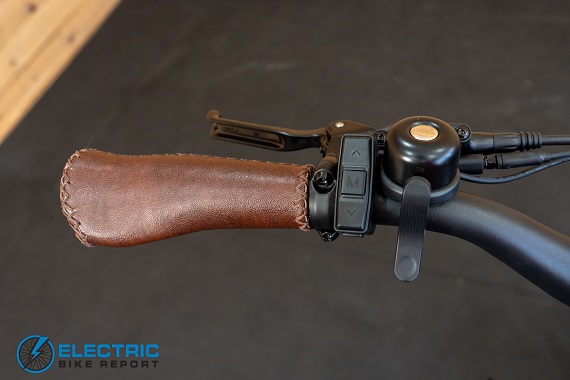
The included bell can hold an AirTag to help you track the bike’s location.
Magnum Bliss Review: Ride Quality
It’s easy to say that a bike rides extremely well or vice versa, but there are many factors that contribute to this overall sense. Here, we’ll discuss the Magnum Bliss’ sizing, handling, overall comfort, user interface, and more.
Magnum offers the Bliss in a single, accommodating frame size for riders between 4’10” and 6’2”. To achieve such a wide fit range, the bike offers multiple adjustment points. Its saddle height can be set within an 8.5” range, while its handlebar height/reach can be changed by altering the angle of the adjustable stem.
At 5’11”, I found a comfortable fit with the saddle near its highest position and the stem angled to roughly the middle of its range of rotation. The result was a relaxed, almost entirely upright seating position with good leg extension and a strain-free experience.
The Bliss has many features that contribute to its smooth and comfortable ride. In addition to the 100mm suspension fork and shock-absorbing 24×4” tires, the bike comes with ergonomic faux leather grips on slightly curved, mid-rise handlebar. The soft, supportive spring saddle rounds everything out. Put together, these elements make the bike completely easy and enjoyable to ride.
In terms of handling, the 70mm handlebars felt sturdy and offered great steering control. With slightly smaller than average diameter tires, the Bliss felt a bit more nimble than I’m used to for a fat tire e-bike, though it still felt appropriately planted and stable when cornering. The step-thru frame flexed somewhat, but overall, I was impressed with its feel.
Of course, it’s also worth noting that, like all fat tire e-bikes, the Bliss is suitable for riding beyond just paved roads and paths. The bike’s cruiser influence makes it more ideal for a cruise around town than a wilderness adventure, but light off-roading, such as exploring a gravel multi-use trail or riding on a dirt path through a park, is within its wheelhouse.
As with most of its models, Magnum equipped the bike effectively for daily use. The Bliss includes integrated LED lighting (headlights and a tail/brake light), a high-capacity MIK-HD cargo rack compatible with locking accessories, fenders, and an AirTag-compatible bell. It’s not overloaded with features, but the basics are present and well done.
Its user interface is similarly well-executed, with a color display and a small four-button remote/control panel. While there is an advanced settings menu that can be accessed by holding the M button on startup, it isn’t overwhelming or too complex. As such, the Bliss is easy to grasp and operate, making it well-suited for riders who want simplicity.
Overall, the Bliss offers a respectable package, but we acknowledge that it lacks some common features shared by many similarly-priced e-bikes. The addition of relatively small things, such as an included AirTag, a higher-amperage fast charger, integrated turn signals, etc., would boost the bike’s value and make its price more competitive.
As a whole, though, the bike’s ride quality is great. The bike is useful, functional, comfortable, and enjoyable to ride. We also appreciate that it looks great, too—the metallic purple Amethyst paint job of our test bike was a standout, and the orange Wildfire looks extremely eye-catching and full of personality, too.
Sponsor
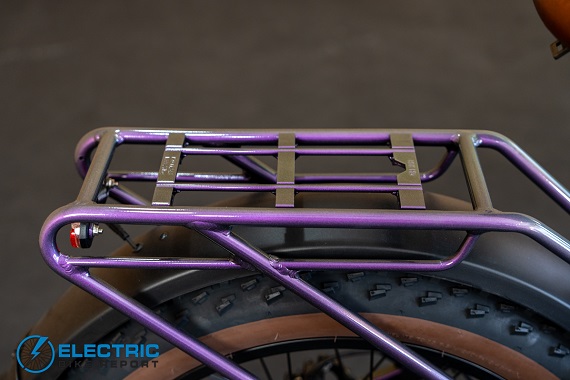
The bike’s welded MIK-HD cargo rack is compatible with locking accessories.
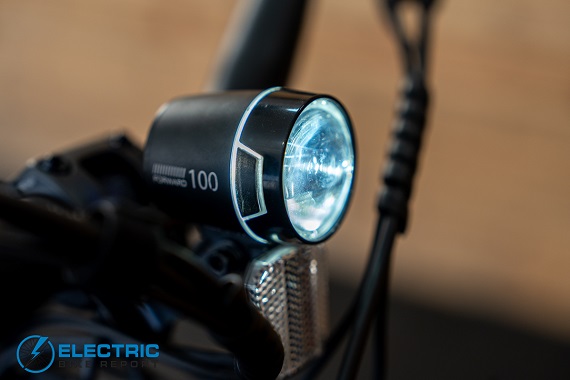
A 100 lux LED headlight shines ahead to aid low-light visibility.
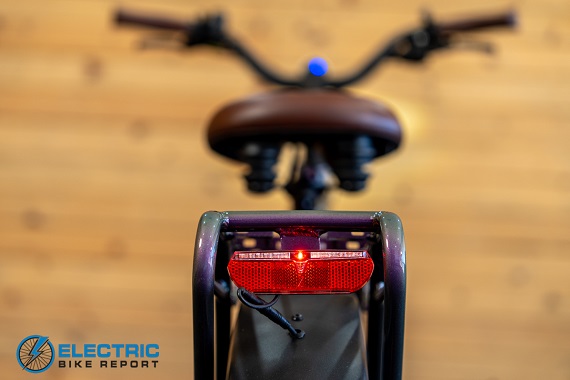
The bike’s tail light is mounted to the rear of its cargo rack, and it acts as a brake light when the levers are squeezed.
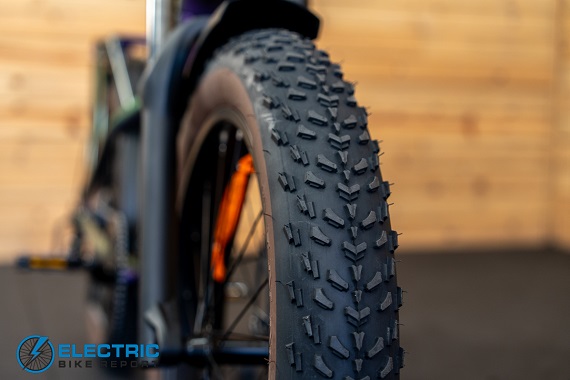
Knobby 24×4” tires offer comfort on pavement, but are capable of venturing off-road, too.
Magnum Bliss Review: Summary / Where to Buy
In our experience, the Bliss is a great example of how much Magnum has evolved since we first started reviewing its products. The brand’s e-bikes have always been well-crafted, but Magnum has clearly become even more adept at building bikes that focus on what its riders appreciate most—good looks, a comfortable ride, and reliable performance.
Our testing revealed that the Bliss is a solid fat-tire e-bike across the board, with a great balance and variety of power levels, strong range potential, confident climbing power, and safe braking.
What separates it the most from many of its peers, however, is its cruiser-influenced design. Its upright riding position is relaxed and comfortable, its step-thru frame is uncommonly low for its style, and its smaller-than-average tires make it impressively maneuverable. Additionally, while it comes standard with just a front suspension, the bike’s saddle and tires do a lot of heavy lifting when it comes to smoothing out the ride.
We identified two main areas with room for improvement. The addition of some extras present on some similar models (turn signals, an AirTag, a fast charger, etc.) would make the bike more enticing overall. And, while minor, there were a few inconsistencies in motor output that we expect could be corrected through a software update.
Otherwise, the Bliss brings a lot to the table—especially for riders who want a dependable, versatile, and easy to use e-bike. Whether you’re planning to take the bike for evening cruises, enjoy some light exercise, run some errands, or get from points A to B without relying on a car, the bright, comfortable, and customizable Bliss should be on your radar.
Happy Riding! Make sure to let us know if you have any questions or if you think we left anything out in this review of the Magnum Bliss down in our comments section.
Sponsor
Sponsor
Reader Interactions
Comments
Leave a Reply




Decent bike, good review. These companies need to know that some individuals want a 50 or less pound bike in order to transport on a bike rack.