

Juiced Scrambler Hardtail Review | Fresh-Squeezed Fun
May 05, 2026
 2 Comments
 Share
Share
A high-performance, yet budget-friendly, moto-inspired e-bike with street-legal speeds and enough punch to thrill any rider.
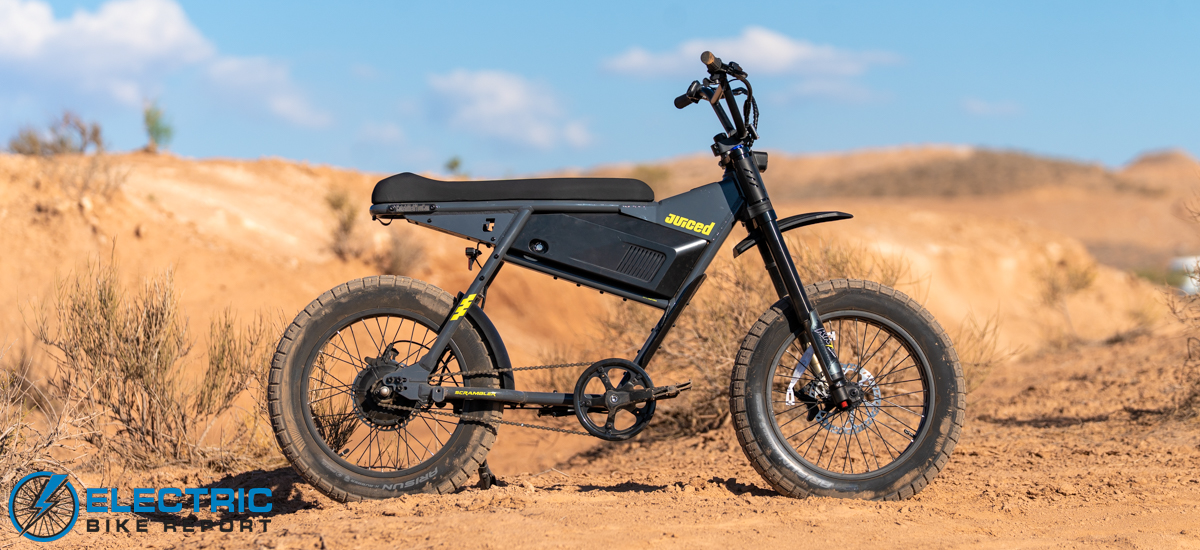
After many months of buildup and anticipation, Juiced Bikes is back! We were thrilled to be among the first to get our hands on the revived brand’s new lineup. Based on the success of Juiced’s original line of scramblers—including the HyperScrambler and CityScrambler—it was no surprise that Juiced’s newest model kept a similar style (with some big changes).
The Scrambler Hardtail (HT) is exactly what it sounds like: a moto-inspired e-bike designed for riding both on and off the pavement. As the base model, it features only a front suspension (we reviewed the higher-priced full-suspension flagship model separately), but otherwise, both versions of the bike are almost identical.
Following recent controversies surrounding high-powered e-motos (which the Scrambler is not), Juiced adheres strictly to industry standard Class 1, 2, and 3 speed limits. This clearly defines the Scrambler as an e-bike that can be legally used in most places—but that doesn’t mean it has to sacrifice fun to do so.
The bike features a component package that sets a high bar for both performance and value. It’s punchy and powerful, thanks to its combination of a 52V, 750W motor and a 30A controller; it packs an eyebrow-raising 1,764W of peak power and 90Nm of torque.
Additionally, the Scrambler HT sets itself apart from the competition with strong 4-piston brakes, a gigantic 998-Wh battery, a high-performance KKE suspension fork like those found on Sur-Rons and Talarias, and a jaw-droppingly low price of around $1,700.
In short, the Scrambler Hardtail promises speed, power, and style at a budget-friendly price. Crack open your juice box, drink up, and continue reading below to find out just how well it fared in our real-world performance tests!

Sponsor
E-Bike Category:Moped
E-Bike Class:Class 1 (pedal assist to 20 mph)
Class 2 (throttle to 20 mph)
Class 3 (pedal assist to 28 mph)
Class 2 (throttle to 20 mph)
Class 3 (pedal assist to 28 mph)
Sponsor
Juiced Scrambler Hardtail Video Review
 Pros
Pros- It’s street-legal while being seriously fun to ride! The Scrambler is limited to 20 mph out of the box, with a strong 750W motor for quick acceleration and climbing power.
- The bike offers excellent value, with performance-focused components, specs that rival or beat the competition, and an affordable price starting at around $1,700.
- Its range is tremendous! At the time of writing, the Scrambler gave us the longest throttle-only range test we’ve seen from an e-bike of its style.
- Unlike some similar models, the bike’s pedal-assisted speed can be increased to a 28 mph maximum. Users can quickly switch between Classes or set up a custom mode.
- Parents can lock the bike’s speed adjustment behind a security PIN to ensure that kids ride safely.
- Speaking of safety, the Scrambler features custom 4-piston hydraulic disc brakes with excellent stopping power.
- The Scrambler’s seat lifts up, providing quick access to the battery and the controller for service or removal.
- Juiced offers a three-year warranty, exceeding the standard 1-2 year warranties from many of its competitors.
- While it’s a small thing, the bike comes with Juiced-branded stickers and adhesive numbers, allowing and encouraging customization.
 Cons
Cons- While we liked the display’s appearance, it wasn’t as useful or easy to read as we hoped—see our Ride Quality section for more detail. We recommend a different, perhaps handlebar-mounted display.
- The battery is removable, but getting it back in place took some effort. Riders may want to charge the bike with the battery docked.
ELECTRICAL SPECS & FEATURES
- Battery: 52V, 998.4 Wh (19.2 Ah), LG cells
- Charger: 5A
- Display: Integrated TFT
- Motor: 750W Nominal | 1764W Peak | 90Nm of Torque
- Headlight: Front LED Headlight
- Taillights:Brake Light and Turn Signals
- Pedal Assist: 4 Levels
- Claimed Range:
- Throttle: Thumb throttle | 20mph top speed
- App:None
- UL Certification:Bike Certified to UL 2849 and Battery Certified to UL 2271 Standards
Weight & Dimensions
- Claimed weight: 83 lbs
- Tested Weight: 84.9 lbs
- Rider height range: 4’10”-6’3”
- Total payload capacity: 300 lbs
Components & Accessories
- Brakes:Talon P4 (4-Piston) Front and Rear Hydraulic Brakes
- Fenders:Plastic Front and Rear
- Fork:KKE Inverted Suspension Front Fork with 140mm of Travel
- Frame: 6061 aluminum
- Drivetrain: Single Speed, 46 x 16
- Grips: Lock-On Rubber
- Saddle: Moped-Style
- Handlebar: BMX Style
- Kickstand: Included
- Pedals: Platform
- Tires: 20 x 4.0 A-820 street
The Scrambler Hardtail is set to a street-legal speed of 20 mph, but parents can set a lower custom speed behind a PIN-protected adjustment feature.
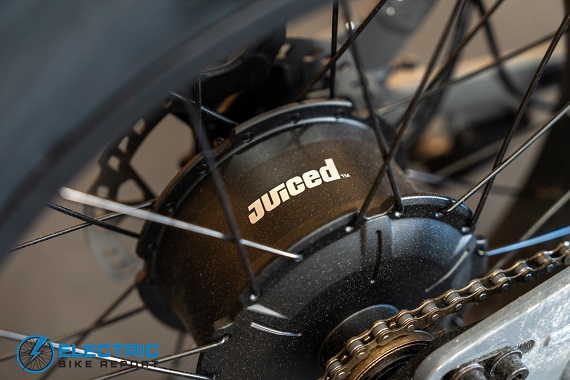
Juiced’s 750W motor is among the most powerful we’ve seen, with nearly an 1800W peak.
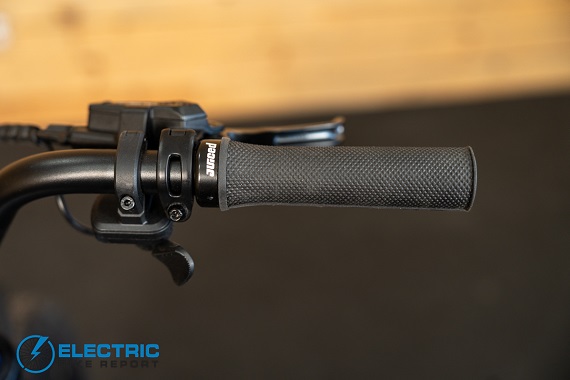
While some riders might pedal the Scrambler, most will likely rely on the thumb throttle.
Juiced Scrambler Hardtail Review: Speed Test
When it comes to moto-inspired e-bikes, speed is often the name of the game, so I was excited to take the bike for a spin on our local paths for this test.
My goals were simple: first, to find my average speed in each assist level; second, to test the throttle and get a sense of its acceleration force; and third, to ensure that the bike could reach its advertised speeds.
When starting my test without pedal assist, I noted that the Scrambler Hardtail was—as I’d expect for an e-bike of its style—relatively heavy and sluggish. Its single-speed drivetrain, combined with its weight and non-adjustable saddle, made pedaling relatively tough. Fortunately, this changed completely once the motor was engaged.
To clarify, the bike was difficult to pedal due to the amount of resistance I felt, not the bike’s geometry itself. I’ll discuss more about how the bike felt to ride later in this review, but its sizing and design were actually more conducive to pedaling than I’m used to with this style of e-bike.
As shown in the graph of my average speeds above, even the Scrambler’s lowest assist level delivered a speedy and enjoyable ride. With the Scrambler’s powerful 750W motor and a cadence sensor, a light, easy turning of the cranks is all that was required to keep pedal assist flowing and my speed rising.
The motor’s power output increases with each step up through its four assist levels, though the bike’s speed is not hard-capped (except as determined by its Class setting). As such, when riding on flat ground, the motor was able to propel me up to 20 mph in three of its four assist levels in Class 2 mode.
This trend was similar in Class 3 mode: I reached 28 mph in both PAS 3 and 4. In both cases, I would expect more of a difference in speed when riding uphill. As it stood, changing the bike’s assist level also changed its acceleration force; PAS 1 felt relatively gradual while PAS 4 felt more punchy.
By default, this same behavior extends to the throttle; it can reach 20 mph in all four assist levels, with four acceleration settings. The settings menu, accessed by holding the up and down arrows for a few short seconds, offers an option to provide the throttle’s full force in all assist levels.
In my experience, the system provided a great range of power levels. New riders might prefer PAS 1 or 2, while those with more experience—or those looking for more of a thrill—may prefer PAS 3 or 4.
Riders can also change Class settings through this menu, easily switching between Class 1, 2, and 3 modes. There’s also a California mode that disables the throttle when 28 mph pedal-assisted speeds are enabled, but riders can also set a custom maximum speed. This last feature is likely to be the most useful for parents, which can then set a 4-digit PIN requirement for the speed adjustment feature to prevent tampering.
Overall, the Scrambler HT performed as I expected in this test, with strong, thrill-inducing power and no difficulty matching its advertised speeds. In fact, I might appreciate a variety of speed limits in each assist level to allow riders more granular control over their speed, but as it is, I appreciate that the bike has a range of acceleration options that should work for both new and experienced riders.
Sponsor
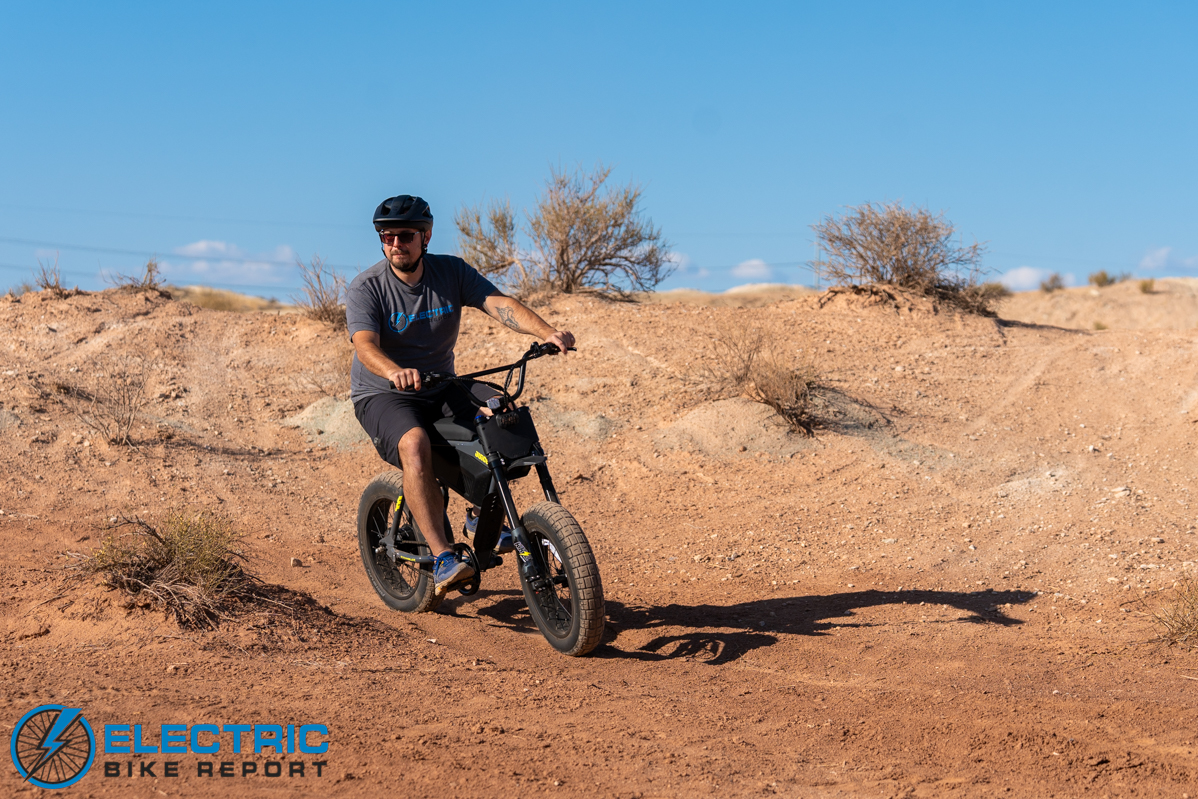
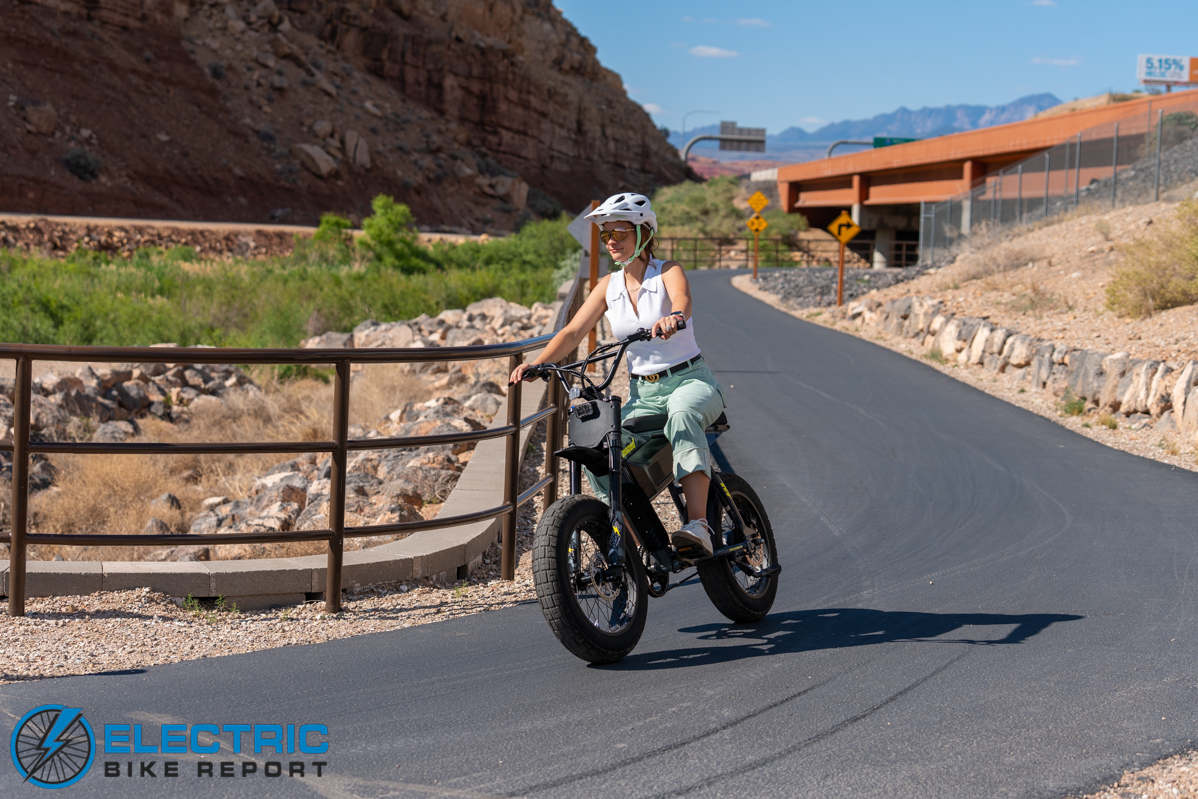
While it’s ideally suited for riding on paved surfaces, the Scrambler HT can also handle light off-roading on relatively smooth dirt or gravel.
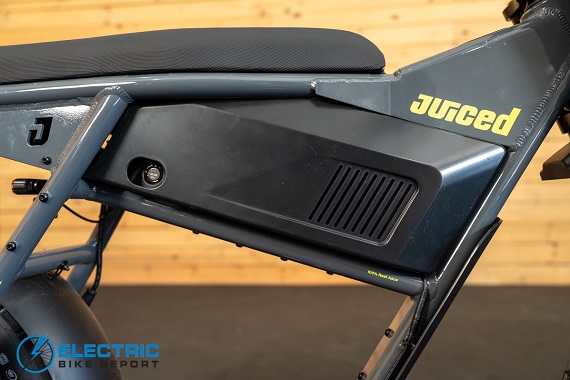
The bike’s 52V, 998 Wh battery is concealed behind plastic covers that add a cool look to the bike.
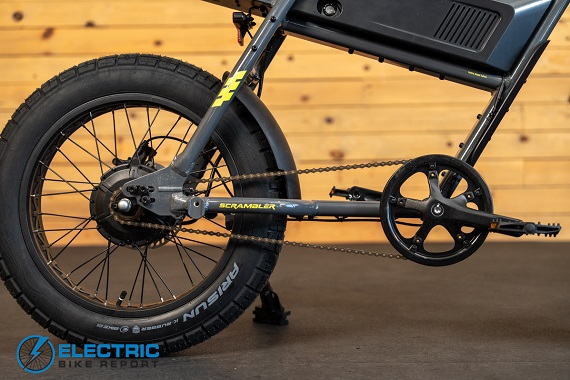
The Hardtail model features a direct single-speed drivetrain with a 46T chainring and 16T freewheel.
Juiced Scrambler Hardtail Review: Range Test
As explained in the graphic above, we break from our usual method of range testing when evaluating moped-style e-bikes like the Juiced Scrambler Hardtail. I personally performed our throttle-only range test, riding on our local network of shared-use paths until its fully-charged battery was fully depleted.
A caveat: due to extremely limited time constraints and a single battery to share between both the Hardtail and Full-Suspension Scramblers, we performed only one range test using the FS model. Both bikes have identical motors and batteries but slightly different weights and tires; it’s possible that the lighter HT model could squeeze out a few extra miles.
The Full-Suspension Scrambler’s range test result of 43.4 miles is spectacular! While we have only a relatively small pool of comparison models at this time, the bike exceeded the 24.8-mile average set by its peers by an impressive margin of nearly 20 miles.
One obvious reason for the Scrambler’s success is its massive 52V, 998 Wh battery. While the models in our comparison group were more limited in capacity, with batteries averaging 626 Wh, the Scrambler’s significantly larger power pack simply provided more energy to use, allowing it to stay on the path longer.
Size, as they say, isn’t everything. When calculating the bike’s energy efficiency by dividing its battery capacity by its mileage, the Scrambler also proved more efficient than average. While similar models used an average of 25 watt-hours per mile (Wh/mi), the Scrambler averaged 23 Wh/mi. While this difference is relatively small, it can add up to extend the bike’s range.
Considering that many similar e-bikes we’ve tested averaged 20-25 miles on throttle power, and that we deem these e-bikes practical for most riders, the Scrambler’s extended range gives it a leg up for range-anxious individuals. Whether dealing with long commutes, frequent errand runs, or the simple desire to have your bike spend less time on the charger, Juiced offers a great solution.
It’s worth noting that the bike’s battery charge readout decreases in increments of 10%. Toward the end of my range test, when the charge level was getting low—and, like many e-bikes, prone to dropping faster than when the battery was full—I found it somewhat difficult to estimate my remaining mileage. I’d recommend Juiced use a more precise, granular charge meter—but until then, I advise being close to home at around 10-20%.
When it is time to recharge, both versions of the Scrambler ship standard with a speedy 5-amp fast charger. Users can charge the battery either on or off the bike—the seat lifts up to allow access when removing it. I found it a bit tough to get the battery back in place, so I’d recommend leaving it in place as often as possible.
Regardless, with its battery capacity in amp-hours totalling 19.2 Ah, the included 5-amp charger should power up a fully-drained power pack in roughly 4 hours.
Sponsor
Sponsor
Juiced Scrambler Hardtail Review: Hill Test
The Scrambler HT conquered our Hill Test with ease! When testing it using the method explained above, the bike’s throttle result clocked in a 1:39 with an average speed of 18.3 mph. When pedaling in its highest assist level, our test rider, Justin, finished the test in 1:37 at 18.7 mph.
While we’re in the middle of a surge in popularity for moped-style e-bikes, this has not always been the case. As such, our comparison group is relatively small—but still useful. Similar bikes we’ve tested at the Devil’s Backbone averaged 1:53 on throttle and 1:50 when pedaling, placing Juiced’s bikes among the fastest we’ve seen at this location.
There are a couple of obvious factors for the Scrambler Hardtail’s success:
First, like previous models from Juiced’s past, it uses a 52-volt electrical system. If electrical current is thought of like water pressure, higher voltage equates to more/faster available power. This can translate to faster acceleration and easier climbing, which was apparent in the Scrambler’s feel and its average speed throughout our Hill test.
A second factor is raw power. While the Scrambler’s torque output of 90 Newton meters (Nm) is average—similar models averaged 91 Nm—its peak motor power vastly exceeds the norm. Our group of comparison bikes averaged 1,152W of peak power, but the Scrambler HT topped out at a whopping 1,764W, achieved with a 30A controller.
The result of this combination is tremendous climbing capability. In my personal experience, the Scrambler HT confidently powered up and over substantial hills, often continuing to pick up speed where other bikes commonly slowed down.
The bike’s abundant power should give confidence to consumers who live in hilly areas; most riders should be able to tackle most hills. Using pedal assist may be the fastest way to reach the top, but the throttle should be just as effective in most cases.
Sponsor
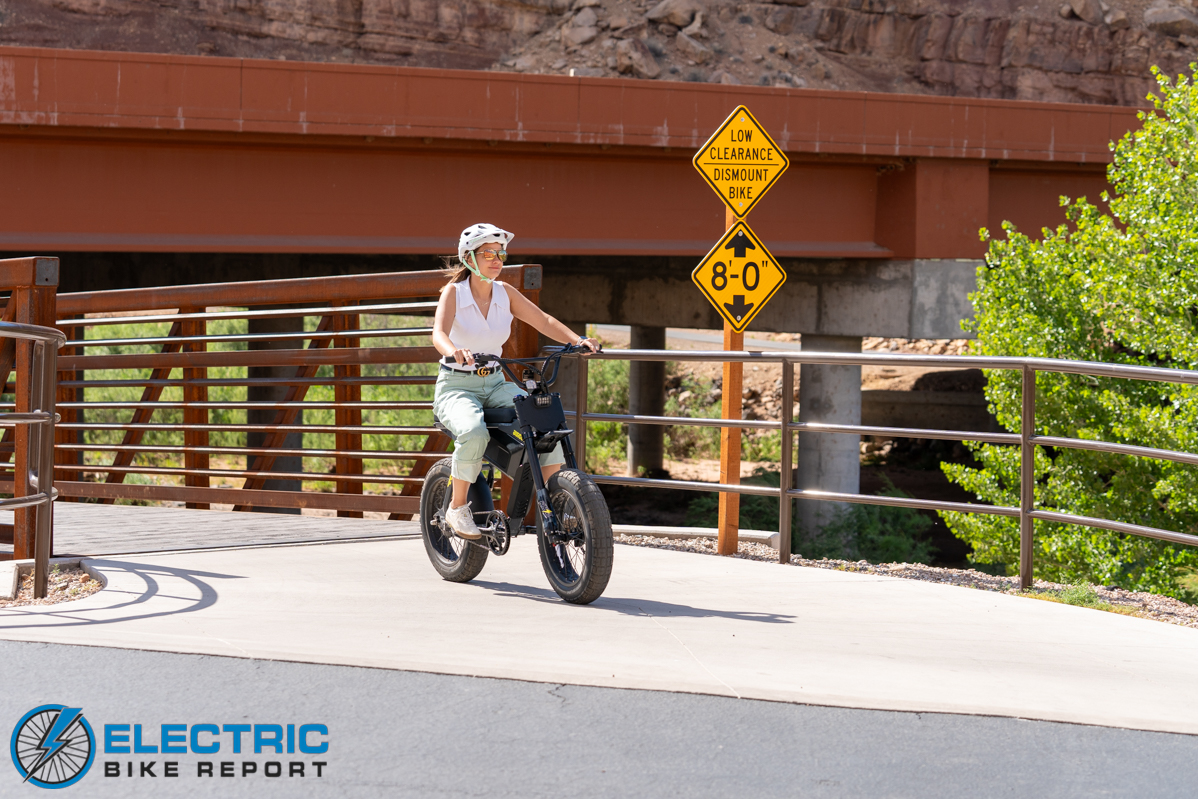
Whether riding to work or cruising around with friends, there’s no denying that the Scrambler is a blast to ride!
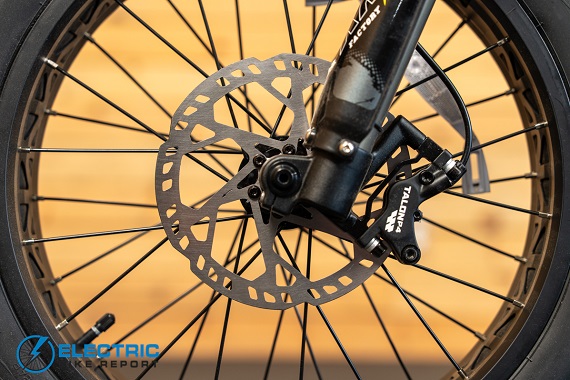
Custom Talon P4 brakes pair four-piston calipers and 180mm rotors.
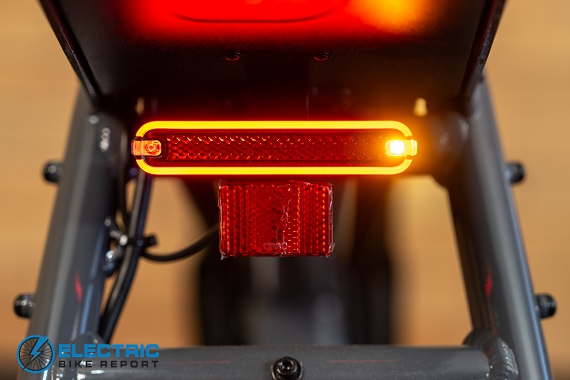
The Scrambler’s tail light includes brake light functionality and turn signals.
Juiced Scrambler Hardtail Review: Brake Test
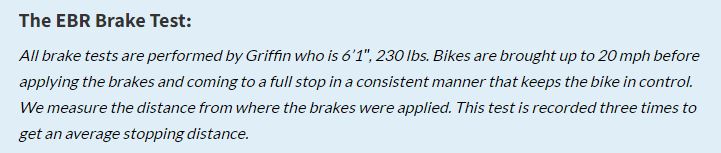
Continuing with our Brake Test, the Scrambler Hardtail once again demonstrated great performance. With its custom four-piston hydraulic brake system, the bike averaged an impressive stopping distance of 18’10”. For perspective, similar bikes in this category averaged a somewhat longer 19’5”.
This shorter-than-average result is likely due to the brake system itself, as many similar models come equipped with two-piston brakes. In comparison, four-piston brakes apply more even pressure to larger brake pads, which work to slow the bike faster.
Additionally, while many similar models use 180mm brake rotors that are 1.8mm thick, the Scrambler HT’s rotors are a thicker 180×2.3mm. This added thickness helps to dissipate heat, which reduces fade with repeated use.
This improved heat dissipation was noticeable in the bike’s three individual test results, which showed an uncommon consistency. While many e-bikes’ scores vary widely between tests (and often increase after repeated tests), the Scrambler HT’s braking distances varied by just an inch across three trials!
One minor thing to be aware of regarding the brakes; the front brake line on our test bike had enough slack to cause some rubbing on the wheel spokes. A piece of tape would likely solve this problem, which resulted in a bit of additional noise while braking.
Otherwise, the Scrambler HT’s braking felt strong, safe, and powerful. They had good bite and easy modulation over speed, proving to be a great match for the bike’s speed and power.
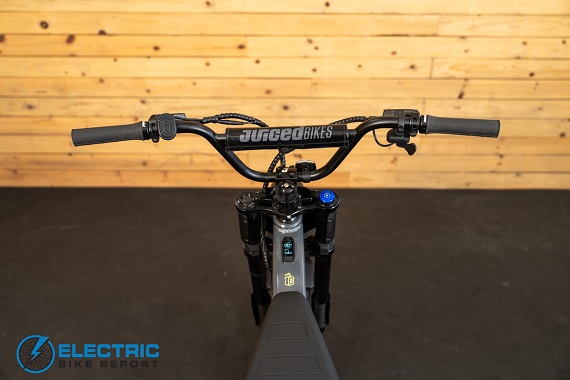
We liked the wide BMX-style handlebars, which make steering easy and controlled.
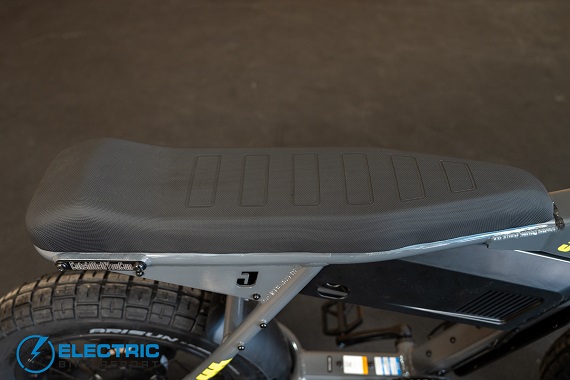
The long saddle helps absorb bumps, provide comfort, and can accommodate a passenger.
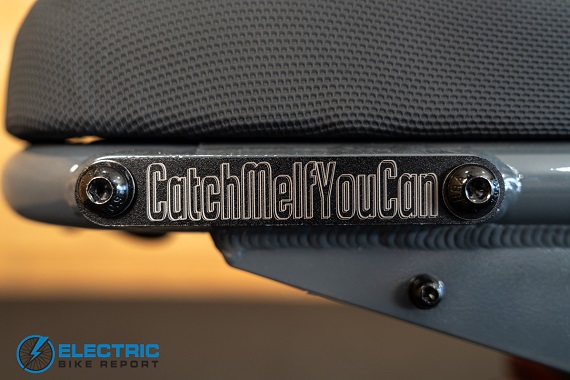
Preorders come with a custom nameplate upgrade. We thought this was fitting!
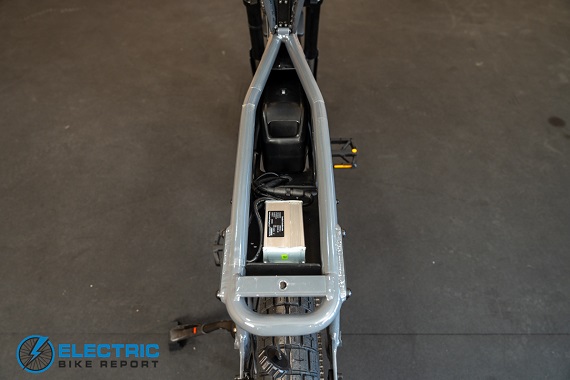
The battery can be removed by lifting up the seat, unlocking it, and sliding it out.
Juiced Scrambler Hardtail Review: Ride Quality
Ride quality is a measure of how a bike fits, how comfortable it feels to ride, how easy it is to operate, etc. All in all, the Juiced Scrambler stacked up well in these areas; we found much to enjoy and only a couple of minor points of critique.
The first, most important aspect of the bike for me was its fun factor: this thing rips! Its motor’s strong, confident acceleration and climbing power often gave me the illusion that I was cruising faster than 20 mph, making the experience thrilling and grin-inducing. The bike is powerful without being too punchy, which is a winning combination.
Like most similar e-bikes on the market, the Scrambler comes in a single frame size. Juiced advertises that it is suitable for riders between 4’10” and 6’3”, which I believe will at least partially depend on whether you plan to pedal the bike or use the throttle. Of those who do, shorter riders will likely sit closer to the cockpit, while taller riders may find it best to scoot back on the saddle for better leg extension.
At 5’11”, I was pleased to find the bike very comfortable and well-sized. In contrast with some similar models that were confining and cramped, the Scrambler felt roomy and relaxed. As with all moped-style e-bikes I’ve tested, I found it more comfortable to use the throttle instead of pedaling, but putting in some legwork was easier and more enjoyable than I expected.
The bike’s padded saddle, suspension fork, and tires all contributed to its comfort and smoothness. As a hardtail model without rear suspension, bumps were noticeable, but not egregious; a fair trade for those looking to save some cost. The saddle did a solid job of absorbing small rattles, the fork felt sturdy and robust, and the tires added an additional, appreciated layer of shock absorption.
In terms of handling, the bike felt relatively playful, yet predictable. As an e-bike with 4-inch-wide tires and one weighing over 80 lbs, the Scrambler Hardtail felt planted and stable, though it could maneuver quickly when needed.
Overall, it felt sturdy, though its relatively light tubing and plastic housing panels weren’t as solid-feeling as some other (significantly heavier) e-bikes.
The cockpit was simple, and the bike’s controls were familiar and easy to grasp. The operation of its lights and turn signals were likely the most complicated element (i.e. not difficult at all) and I appreciated its simple 4-stage pedal assist system. I’d prefer a half-twist throttle to the thumb lever, but that largely comes down to personal preference.
One area of critique that I wish to call some attention to is the Scrambler’s horizontal, frame-integrated display. I found the screen’s placement and the size of some of its text difficult to read at a glance, requiring a few seconds of time where my eyes weren’t on the road ahead. Additionally, with no indicator arrow for the turn signals, I had trouble knowing when the turn signals were on or off.
These factors, combined with the charge meter inaccuracy I mentioned in the Range Test section, leads me to recommend a different, handlebar-mounted display. This placement, along with indicators and a more precise charge meter, would be easier to read and more user-friendly.
To balance out this critique, I want to highlight a valuable and uncommon feature that can be enabled through the display: Parent Mode. When enabled, this mode requires a security PIN be entered to grant access to speed/Class adjustment. Parents looking to encourage safety by restricting their child’s speed can activate this feature for peace of mind.
In summary, the Scrambler Hardtail is fun, fast, comfortable, and easy to use, making it an appealing moto-inspired design.
Sponsor
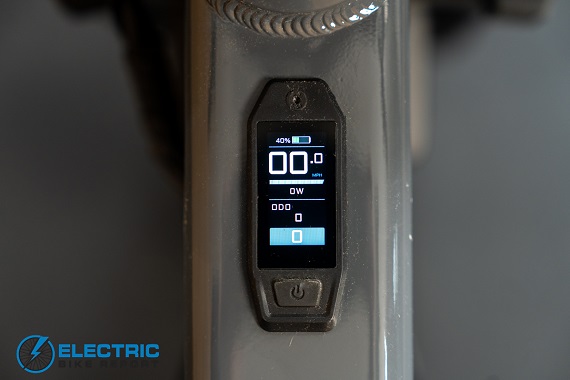
The color TFT display packs in lots of ride data, a charge meter, speedometer, and power meter.
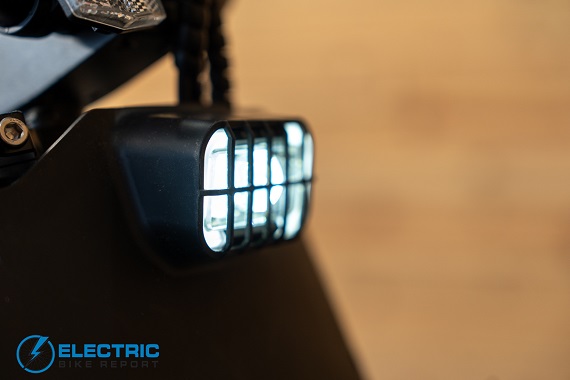
An LED headlight covered by a plastic faceplate keeps the road ahead illuminated.
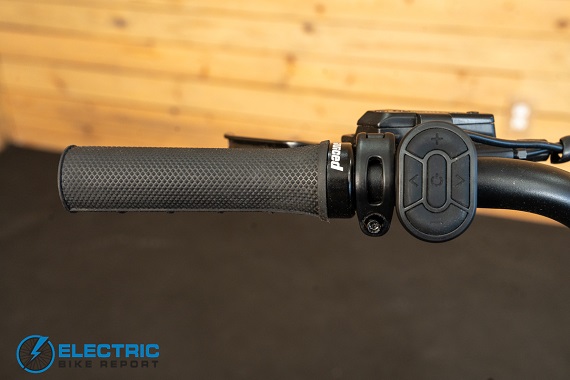
Riders can change pedal assist levels, activate the lights and turn signals, and enter the settings menu via the control pad.
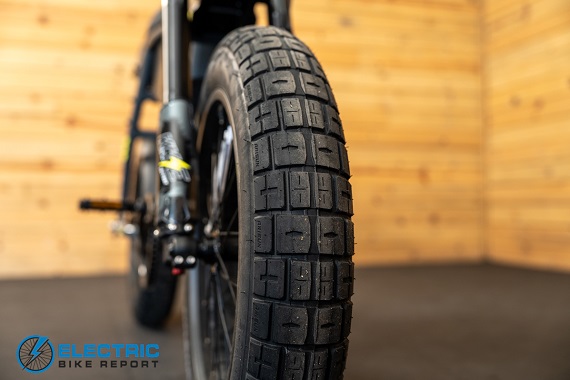
The Scrambler Hardtail rolls on 20×4” Arisun moped tires—perfect for riding on pavement and light off-roading.
Juiced Scrambler Hardtail Review: Summary / Where to Buy
I think it’s fair to say that a popular brand is likely to be judged with the most critical eye after a comeback. Based on our experience with the Scrambler Hardtail, Juiced came out of the gate swinging—which is not an easy thing to accomplish, given the ever-shifting landscape of consumer demand and e-bike legislation.
Based on the company’s early marketing materials, it was clear that Juiced aimed to set a new standard for moto-inspired e-bikes, with a focus on legality and fun. It’s also apparent that the brand wanted to make a statement through performance and price; the Scrambler proved remarkably impressive and surprisingly affordable for what it brings to the table.
It cleared each of our performance tests with flying colors, showing strong, quick acceleration, excellent range, safe braking, and mighty climbing power. In many areas, the bike set a new standard for e-bikes of its style—not unsurprising when considering that the brand is now owned by Lectric’s founders.
Our largest area of critique was the bike’s frame-integrated display, which looked great, but wasn’t always the most user-friendly.
Otherwise, we’re happy to welcome Juiced back to the market! The Scrambler Hardtail is an easy recommendation for those seeking solid quality, performance, and power at a price that’s tough to beat. Whether used for cruising, commuting, errand running, or off-road adventuring, this might be the smartest moped-style buy for the foreseeable future.
Happy Riding! Make sure to let us know if you have any questions or if you think we left anything out in this review of the Juiced Scrambler Hardtail down in our comments section.
Sponsor
Sponsor
Reader Interactions
Comments
Leave a Reply




I know it would be hard to test, but I’m curious how far the dual battery model can go on throttle alone.
We can get a pretty good estimate based on our testing of the single-battery version! That bike went a little over 43 miles on throttle power, so with a second battery, 80 miles seems like a relatively safe bet. Of course, the bike is a bit heavier with two batteries, but the extra weight shouldn’t massively reduce its range.