Murf Higgs Cargo Review | A Simple, Tried, and True Hauler
Apr 28, 2026
 0 Comments
 Share
Share
This beach-friendly passenger and/or cargo carrier is powerful, easy to ride, and comes with a remarkably low learning curve.
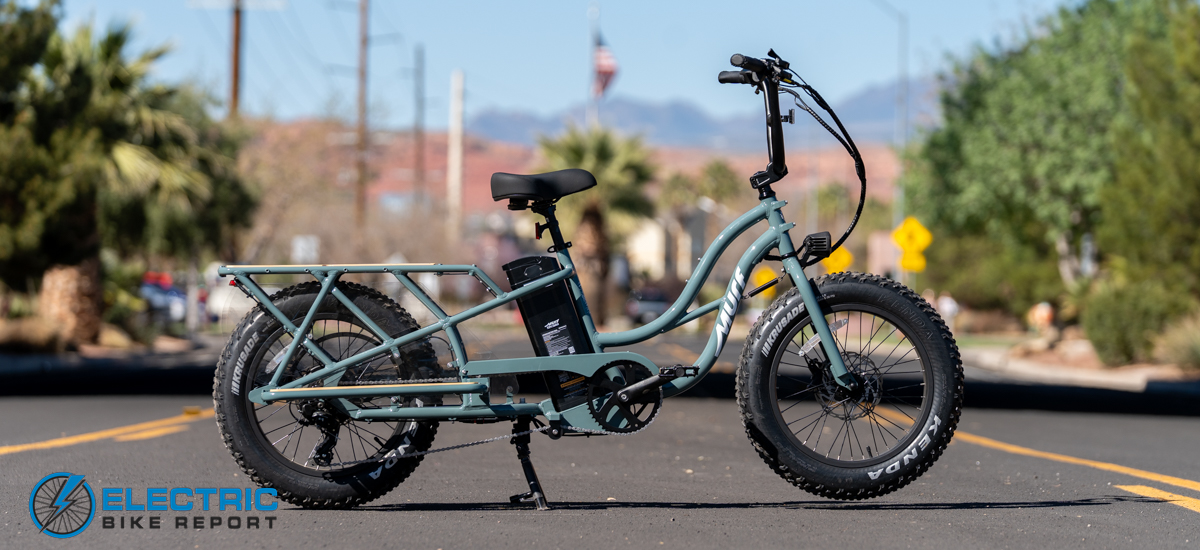
If you’ve ever found yourself catching reruns, listening to the oldies station, and otherwise missing the days when life was simpler, the Murf Higgs Cargo might be right up your alley. This longtail cargo e-bike is a reminder that things don’t have to be complex or overloaded with features to be fun, practical, and suitable for your needs.
Aside from the bike’s wavy and aesthetically pleasing design, a few things stood out to me about the Higgs Cargo right away.
First, its construction is tough and straightforward. The bike’s frame is built from sturdy tubing and is reinforced for rigidity and a high payload capacity—up to a whopping 440 lbs. Despite its step-thru style, its frame and handling felt crisp and solid from our first test ride.
Second, it’s not overloaded with features. This is a bike that sticks to the basics and covers those bases thoroughly while not venturing too far into the weeds. With a low learning curve, it’s easy to hop on and ride without needing to tweak settings or familiarize yourself with a myriad of buttons and knobs. It just works!
Third, in contrast with many folding e-bikes I’ve tested, the Higgs Cargo has knobby fat tires that make it feel stable while riding and cornering. They also help to soften the ride and give the bike limited off-road capability—perfect for the beach culture that the California-based Murf embraces.
On top of that, the bike’s powerful 750W motor and cadence-sensing pedal assist system (PAS) offer a relaxed, easy ride with no shortage of oomph for tackling hills or hauling heavy loads.
My first impression of the Higgs Cargo was one of enjoyment, simplicity, and practicality. But how does this family-friendly workhorse of an e-bike compare with similar models on the market? Continue reading below to see how its performance stacks up against comparable models we’ve tested!

Sponsor
E-Bike Category:Cargo
E-Bike Class:Class 1 (pedal assist to 20 mph)
Class 2 (throttle to 20 mph)
Class 2 (throttle to 20 mph)
Sponsor
Murf Higgs Cargo Video Review
 Pros
Pros- The Higgs Cargo offers easy pedaling and hauling. Its cadence-sensing 750W motor delivers lots of power with low effort.
- While many cargo e-bikes are limited to pavement, the Higgs Cargo is off-road capable with its knobby 20×4” fat tires.
- Riding and operating the bike is simple and straightforward. It requires no apps, has minimal settings menus, and comes with a super low learning curve.
- It has remarkable stopping power, with four-piston Tektro hydraulic disc brakes and one of the shortest stopping distances we’ve seen.
- The bike has crisp steering with a planted feel and responsive handling, thanks to its 85-lb weight, rigid fork, and 20” wheels.
- Its one size can fit nearly all riders, with multiple adjustment points for its saddle and handlebars. It’s recommended for those between 4’11” and 6’4”.
- Murf equipped the Higgs Cargo with sturdy bamboo footboards and a top board for the cargo rack.
- A massive wide-beam headlight keeps the rider and the road ahead visible in low-light conditions.
 Cons
Cons- While Murf equipped the bike with excellent brakes, the 7-speed Shimano Tourney drivetrain and press-fit ergonomic grips feel too entry-level at this price point.
- We’d like to see a more easily removable battery in the future that doesn’t require the saddle and seatpost to be pulled out.
ELECTRICAL SPECS & FEATURES
- Battery: 52-VOLT, 15 AMP-HOUR BATTERY, 780 WATT-HOUR, IPX6 WATER-RESISTANCE RATING
- Charger: 3A
- Display: DP C080 INTEGRATED KEYPAD DISPLAY
- Motor: 750 WATT MOTOR, 90 NM TORQUE
- Headlight: INTEGRATED OFF-ROAD HEADLIGHT
- Taillights:INTEGRATED BRAKE & TAIL LIGHT
- Pedal Assist: FIVE-LEVELS OF PEDAL ASSIST
- Claimed Range: 30-50 MILES
- Throttle: THUMB THROTTLE
- App:NONE
- UL Certification:UL 2849 & 2271 COMPLIANT
Weight & Dimensions
- Claimed weight: 80 LBS
- Tested Weight: 85.4 LBS (including battery)
- Rider height range: 4’11” to 6’4″
- Total payload capacity: 440 LBS
Components & Accessories
- Brakes:4-PISTON HYDRAULIC DISC BRAKES
- Fenders:NOT INCLUDED
- Fork:RIGID ALUMINUM
- Frame: ALUMINUM
- Drivetrain: 7 SPEED GEAR SYSTEM
- Grips: ERGONOMIC
- Saddle: CUSTOM SPRING SADDLE
- Handlebar: 680MM BMX-STYLE
- Kickstand: DUAL LEG CENTER STAND
- Pedals: ALLOY PLATFORM
- Tires: 20″ X 4″ FAT TIRE
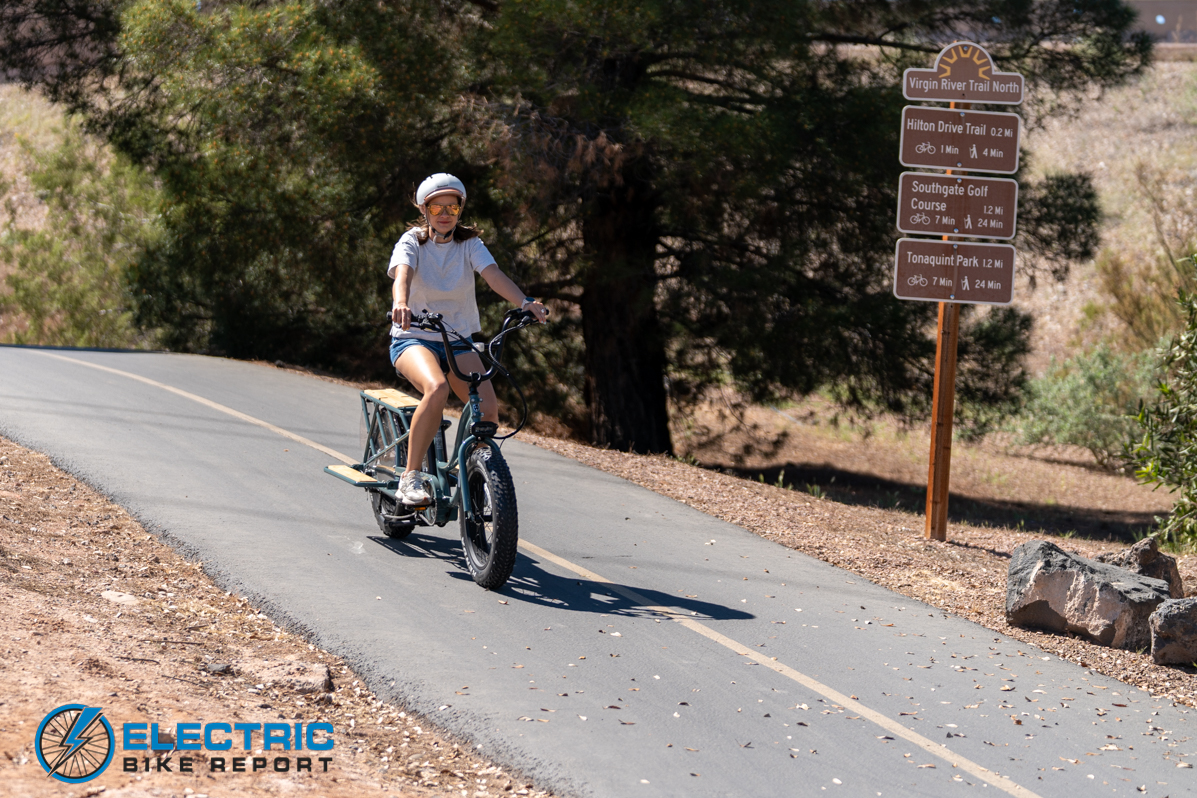
We liked the Higgs Cargo’s comfortable, upright riding position and sturdy, safe feel.
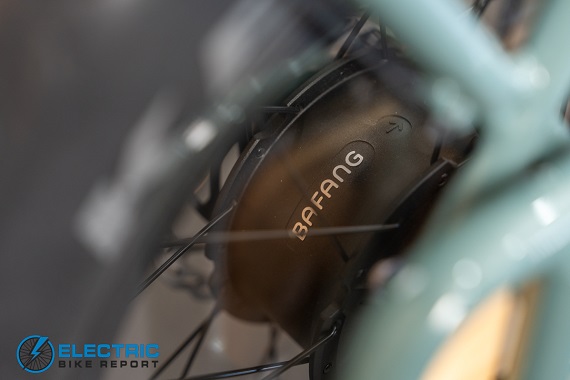
The 750W Bafang rear-hub motor provides strong power for moving heavy loads.
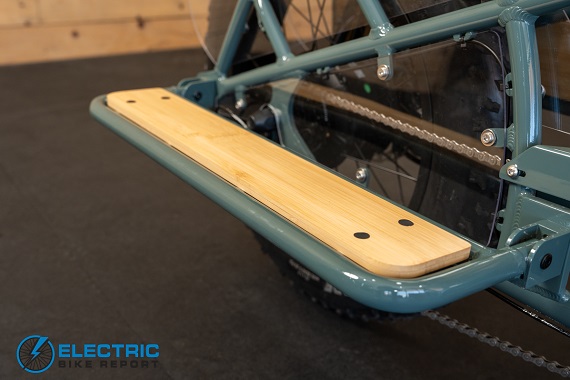
The bike comes with sturdy folding footboards that include bamboo panels.
Murf Higgs Cargo Review: Speed Test
The goals of our Speed Test were simple: to understand the Higgs Cargo’s programming, experience its feel while riding, and ensure that it could reach its maximum advertised speed. As a Class 1 and 2 e-bike, this means that its throttle and pedal assist system should be able to reach 20 mph.
To accomplish these goals, I rode the bike on a relatively flat, paved path in each of its five PAS levels while monitoring my average speed. As shown in the graph above, the Higgs Cargo’s power was very evenly distributed across its assist levels, with remarkably consistent incremental increases in speed throughout the test.
Without pedal assist, the weight of the bike was noticeable, so getting moving took some effort, but it pedaled decently once I built up some inertia. PAS 1 brought a gradual, subtle boost that maintained a controlled speed, while PAS 2 brought me steadily up to a faster cruising speed. PAS 3, 4, and 5 all had a strong and somewhat punchy feel with speeds that stepped up to (and slightly above) the 20 mph ceiling.
While many cargo e-bikes we’ve tested recently have largely shifted to torque-based pedal assist (or systems that switch between modes), the Higgs Cargo’s cadence-based system offers a few advantages.
First, and most importantly, it makes for easier, lower-effort starting up and cruising when carrying cargo or passengers. This is because it puts out continuous power that doesn’t require a specific level of rider input. Second, it provides easier uphill travel, for the same reason. Third, it offers more easily controlled speeds, due to the pre-programmed speed limits in each PAS level.
Based on my testing, I’d likely spend the majority of my riding in PAS 4 or 5 when riding without additional weight on the rear rack. When loaded, however, I’d likely reduce my speed to PAS 3 or 4 for better control, reserving the highest power level for climbing hills.
In addition to pedaling in each PAS level, I also tested the throttle to gauge its acceleration. The Higgs Cargo started gradually, then picked up speed swiftly and confidently before reaching 20 mph.
All in all, the bike performed extremely well in my tests. It is powerful, yet controlled, which helps it feel capable of moving a large payload—and more importantly, safe. Each of its pre-programmed speeds are intuitive, making it easy to select a preferred speed/feel and then relaxing to let the motor do most of the heavy lifting.
Sponsor
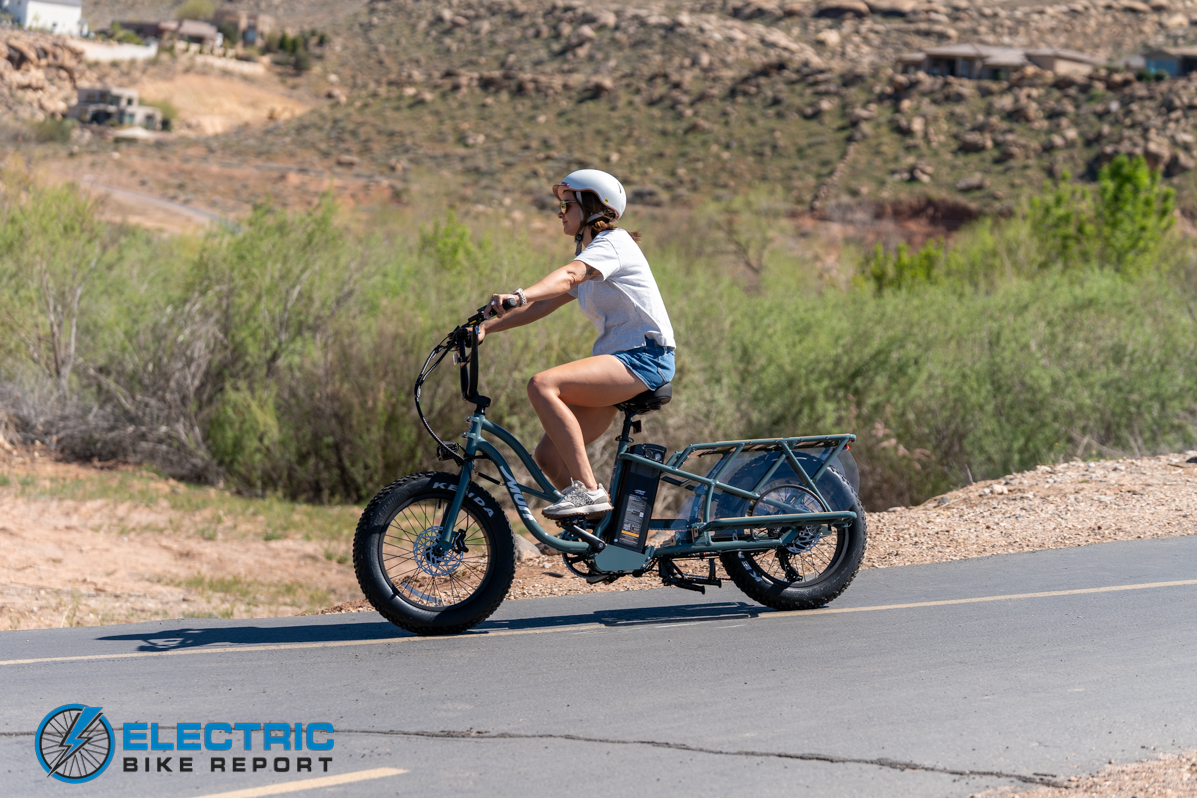
As a Class 2 e-bike, the Higgs Cargo has a top speed of 20 mph via throttle or pedal assist.
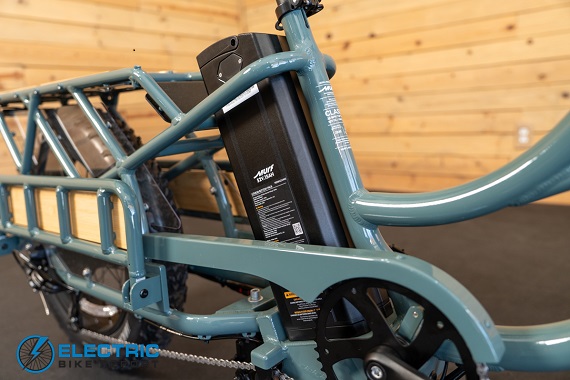
A huge 52V, 780 Wh battery docks behind the seat tube and is removable for charging.
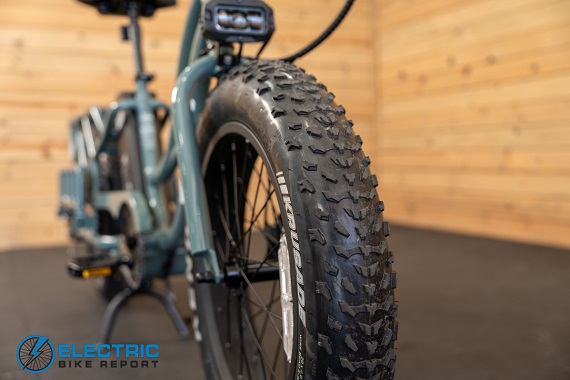
20×4” knobby Kenda Krusade tires give the bike stability, cushion, and off-road potential.
Murf Higgs Cargo Review: Range Test
One thing I didn’t mention in the introduction to this review is the Higgs Cargo’s obvious and relatively large battery, which is mounted directly behind its seat tube. This power pack—a 52V, 780 Wh battery—is advertised to give the bike 30-50 miles of range, on average. We tested both of these numbers using the method explained above.
Riding in PAS 5, our team of testers traveled 31.5 miles on a single charge. After refueling the battery and returning to the bike paths, we covered 61 miles using PAS 1.
In context, these figures are somewhat below average when compared to similar cargo e-bikes we’ve tested previously. A group of other popular models averaged 37.5 and 79.1 miles in their high- and low-powered range tests, respectively. There is one key difference that explains the Higgs Cargo’s lower score.
As I mentioned in the Speed Test section above, most similar models we’ve tested recently used torque-sensing motors, or offered the ability to switch between torque and cadence modes. In the latter case, we tested these e-bikes in their torque modes. This allowed their motor output to fluctuate in response to rider effort, allowing them to extend their battery charge—often less than the Higgs’ 780 watt-hours (Wh) of capacity—further for more mileage.
In contrast, the Higgs Cargo’s cadence-sensing motor produces a steady, non-fluctuating stream of power as long as its cranks are moving. While this means it uses energy faster than many of its peers, it also means that its ride is easier.
For evidence, we can look to the amount of energy used by each bike per mile, found by dividing its battery capacity by the mileage in each portion of the test. Our comparison group averaged 9.4 and 18.5 watt-hours per mile (Wh/mi), respectively, while the Murf Higgs Cargo expended a significantly higher 12.8 Wh/mi in PAS 1 and 24.7 Wh/mi in PAS 5.
All of our testing was conducted without additional weight on the rack, so prospective buyers should keep in mind that riding with cargo or passengers should expect fewer miles from a charge.
Regardless, the Higgs Cargo’s range is practical for neighborhood cruises, visits to the beach, stops at the farmer’s market, or other family outings that often don’t take riders far from home.
When the battery is fully drained, the included 3A charger should top it back up in roughly 5 hours. The power pack can be removed for charging after first pulling out the saddle and seatpost—we’d prefer if it were more easily removable via a different angle or with a forward-folding saddle. In its current state, however, we found it easiest to charge the battery while on the bike.
Sponsor
Sponsor
Murf Higgs Cargo Review: Hill Test
We took the Murf Higgs Cargo to our standard test hill, the Devil’s Backbone (explained above), to test its climbing power. Our test rider, Justin, completed the bike’s throttle test in 1:44 while maintaining an average speed of 17.4 mph. He shaved a few seconds off the test using the highest level of pedal assist, with a time of 1:41 and speed of 17.9 mph.
While our available pool of comparison models is still relatively small (we moved Hill Test locations about a year prior to the writing of this review), the Higgs Cargo performed well. The small group of other cargo e-bikes we’ve tested at this hill averaged 1:44 on throttle and 1:45 via pedal assist.
These results show that the Higgs is at least as capable as its peers, and potentially more so—which makes sense when considering its powerful motor. Like most similar models we’ve tested, the bike is equipped with a 750W rear-hub motor, though it has a couple of advantages that may have given it an edge in its pedal test.
First, in contrast with other cargo e-bikes with variable torque-based pedal-assist, its cadence-sensing motor put out a constant flow of power. This steady push likely increased its climbing speed to some degree.
Second, the Higgs Cargo’s motor produces up to 90 Nm of torque, while other bikes in our comparison pool averaged a slightly lower 83 Nm. This would have helped Justin conserve some energy while pedaling, making for a slightly easier overall experience.
Murf doesn’t share the bike’s peak power output, but our comparison group averaged a maximum of 1215W. Based on this average and the Higgs Cargo’s results, we’d expect its peak power to fall somewhere between 1200 and 1300W.
We performed this test without cargo or passengers, so its results would have been slower with additional weight on the cargo rack. Still, the motor has plenty of power to handle a heavier load, as evidenced by its climbing speed; while the Higgs Cargo exceeded 17 mph in both tests, many less powerful e-bikes (of other styles) complete their tests significantly slower.
The bottom line is that, as we expect from cargo e-bikes designed to move a high payload, the Higgs Cargo is more than powerful enough to summit steep hills. It’s also strong enough to do all the heavy lifting, but it might be slightly faster when riders add a bit of legwork to the mix.
Sponsor
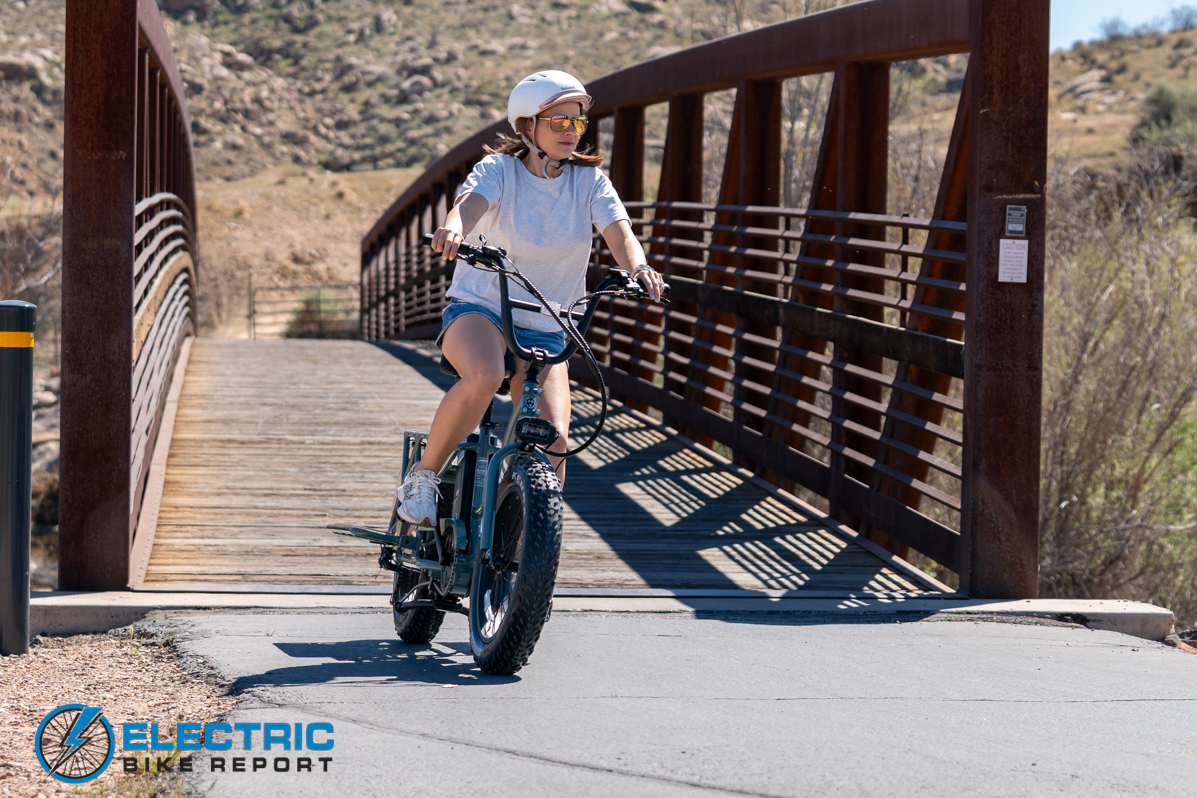
When riding, the Higgs Cargo feels stable and stuck to the ground—but also, pleasantly maneuverable at the same time.
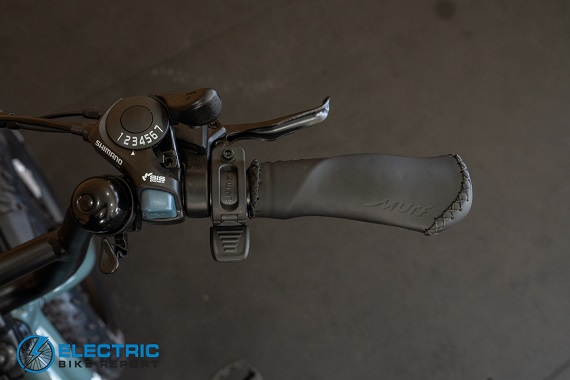
While the right handlebar is a bit busy, it offers a throttle lever to help out with starting up.
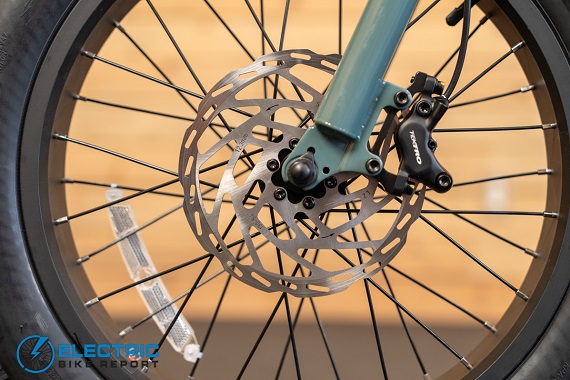
The four-piston Tektro hydraulic brake system offers remarkably strong, safe braking.
Murf Higgs Cargo Review: Brake Test
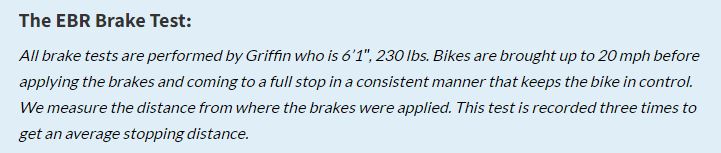
The Higgs Cargo scored well in our Brake Test. Its average stopping distance, gathered using the method explained above, was a remarkable 16’10”. This is over three feet shorter than the current average among similar cargo e-bikes, which is 20’1”.
There is one obvious reason why the Higgs Cargo performed so well: its brake system is more robust than most.
Murf smartly equipped the bike with Tektro’s HD-E3940 hydraulic disc brakes, which combine 4-piston calipers with 180mm rotors. At the time of writing, most similar models we’ve reviewed—even the best cargo e-bikes on the market—use two-piston brake systems.
In comparison, the Higgs Cargo’s calipers apply larger brake pads with more even pressure, which equates to more effective stopping power. Additionally, while most similar models employ 1.8mm-thick rotors, the E3940’s rotors are a sturdier 2.3mm thick, making them better at dissipating heat, which helps to reduce brake fade.
Case in point: the three stopping distances we gathered when testing the Higgs Cargo varied by only a total of five inches, while a foot or more of variation is common when examining other e-bikes we’ve tested previously.
The Higgs Cargo’s stopping power was noticeable by feel as well as by the numbers. During my time on the bike, I noted that it stopped quickly with excellent control and power. The brakes could be somewhat grabby, coming on strong when applied—without feeling too aggressive.
The result is a controlled, safe-feeling, and confidence-inspiring feel that is well-suited for a bike designed to carry heavy loads.
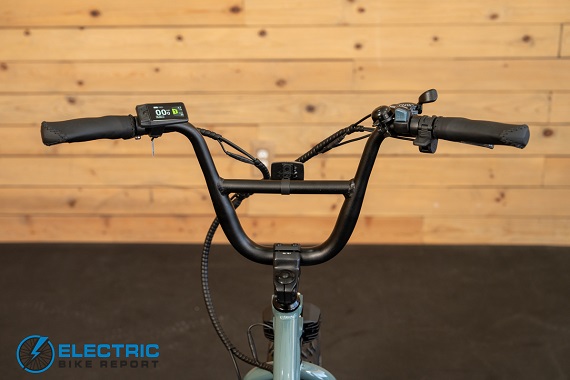
Wide BMX-style handlebars and a threadless stem combine well for precise steering and a sturdy feel.
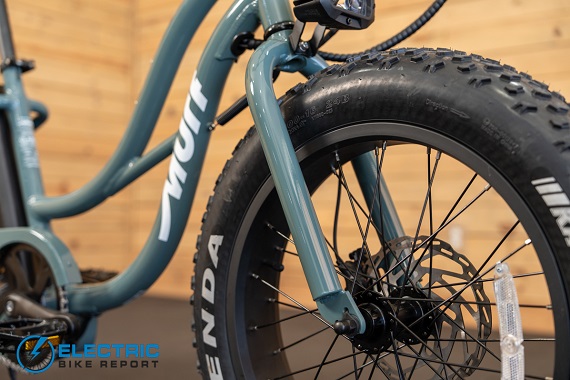
The rigid aluminum fork, reinforced frame, and fat tires make cornering feel stable and predictable.
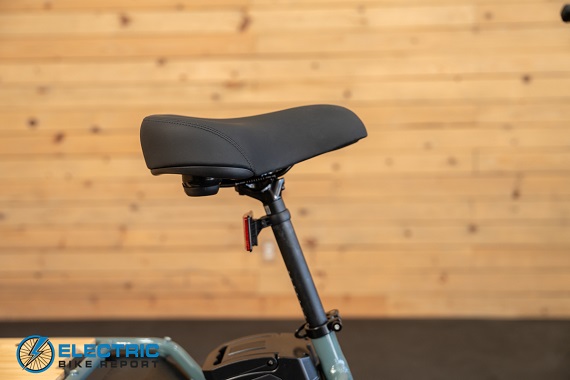
A wide cruiser-style spring saddle provides support and comfort for long rides.
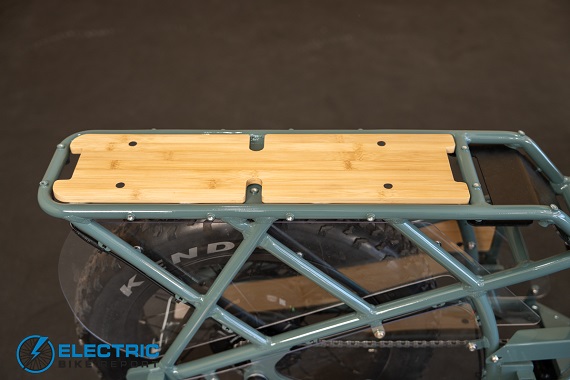
The bike includes a bamboo deck and plastic wheel guards right out of the box.
Murf Higgs Cargo Review: Ride Quality
A bike’s ride quality is every bit as important as its performance, and perhaps more so, depending on how much time you plan to spend on your e-bike. While complex, this subject can be broken down into many sub topics, including sizing/fit, comfort, motor engagement, the user interface, and others.
Beginning with sizing, Murf advertises that the Higgs Cargo is suitable for a massive range of riders between 4’11” and 6’4”. It offers multiple adjustment points, including 8” of saddle height adjustment and tiltable BMX-style handlebars on a threadless stem.
My height of 5’11” places me well within this recommended range. I found the bike’s upright riding position generally comfortable, though with no way to adjust its handlebar height, my hand position felt somewhat low for my preferences. When riding, I had a slight bend at the knee that was comfortable due to the low-effort pedal assist system.
Murf helpfully shows images of riders of various heights on the Higgs Cargo. Mirroring the body positioning of a rider close to your height can give you a sense of how the bike will feel for you. Going by these images, the handlebars may be on the taller side for shorter folks (they can always be swapped out if too tall) and low for tall people but they should work for the majority of riders.
In terms of handling, I found the Higgs Cargo to be well balanced between nimble and stuck to the ground. At 85 lbs, I could feel the bike’s weight mostly behind me, but its 20×4” tires, sturdy stem, and BMX-style handlebars helped it to feel maneuverable, predictable, and stable at the same time.
While the bike has no suspension, its cushy spring saddle and fat tires generally act as a good substitute when riding over bumps. Its tires, which provide more grip and cushion when their air pressure is reduced, also give the Higgs some off-road potential. If equipped with Murf’s optional surf rack, we expect the bike would serve well as a means of transport to and from the beach.
Right out of the box, the bike is set up well for carrying passengers, with an included bamboo deck and fold-out footboards. Murf sells three compatible passenger kits (we’d recommend adding at least the support bar and seat pads in the basic Passenger Bundle), but it is also compatible with a handful of cargo accessories like panniers, a plastic basket, and a rack bag.
The Higgs Cargo is also equipped with plastic wheel guards to prevent passengers from touching the wheel and other mechanical components. Depending on what you plan to carry and how you plan to load the bike, these panels may need to be removed, as I found that they could prevent bungee/strap hooks from finding purchase on the frame members.
In general, the bike is well-equipped for daily use. It comes with integrated lights—including an uncommonly-bright and wide triple-LED headlight and tail/brake light—along with a color display, a chain guard, a user-friendly center stand, and a spring to keep the front wheel aligned and balanced when loading. As covered previously, it’s also equipped with excellent brakes.
There were two apparent exceptions: the 7-speed Shimano Tourney and press-fit ergonomic grips. While both worked relatively well, they are components we’d expect to see on a more budget-friendly, entry-level machine. For added value, we hope to see an 8-speed drivetrain and lock-on rubber grips in the future.
Otherwise, as I touched on in the introduction to this review, I appreciated the Higgs Cargo’s simplicity. It seems to clearly prioritize function over fluff, giving it an approachable and uncomplicated feel that is welcoming to new and experienced riders alike.
This is perhaps the most defining element of the Higgs Cargo’s ride quality—its uncomplicated nature ensures that it works well without being intimidating.
Sponsor
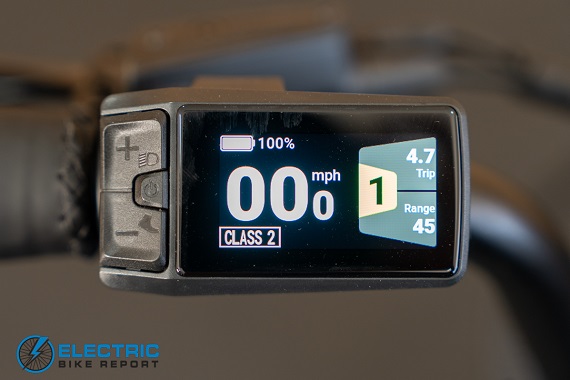
The Higgs Cargo’s display/control panel is mounted to the left handlebar, presenting essential ride data simply and clearly.
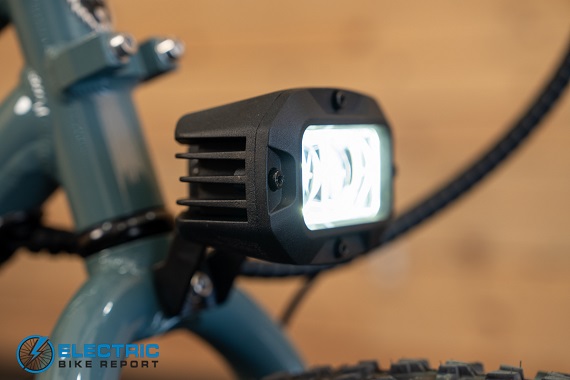
Murf equipped the bike with a wide, fork mounted triple-LED headlight that throws out bright illumination.
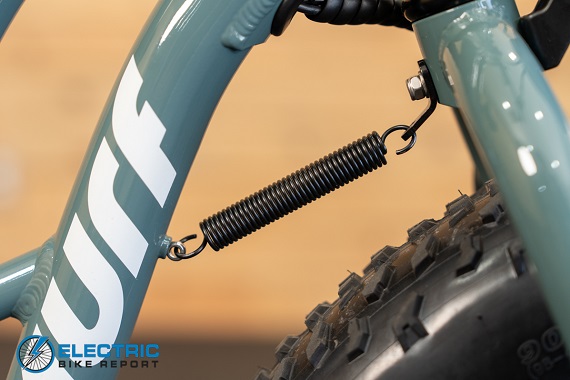
A spring connects the fork and down tube, keeping the front wheel aligned while loading up for the sake of balance and control.
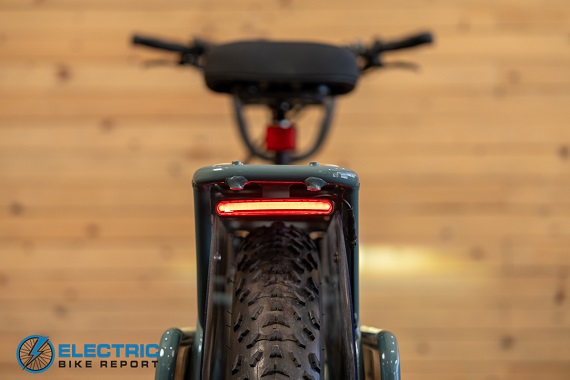
The Higgs Cargo’s tail light serves as a brake light, getting brighter when the brake levers are squeezed.
Murf Higgs Cargo Review: Summary / Where to Buy
As technology develops, it can be tempting to overload new products with features that tout convenience at the cost of complexity. We need only look to refrigerators with built-in screens that show us commercials while refilling our glasses or Bluetooth-equipped washing machines that require costly, frequent maintenance.
The Higgs Cargo takes a simple and straightforward approach to its role as a car alternative. Instead of offering a near-endless supply of settings, riding modes, levers, and buttons, it instead aims to give riders a relaxed, controlled, reliable and enjoyably simple experience.
With this in mind, the bike performed well in our testing. It offers ample power for moving weight effectively, with five intuitive and balanced power levels. The Higgs Cargo’s battery gives the bike enough range for practical, real-world use. Its motor is strong enough to tackle hills with relative ease. And finally, its powerful brakes ensure fast and safe stopping.
Like any e-bike, it has some room for improvement. Our main areas of focus were its handful of entry-level components, including its drivetrain and grips, as well as the difficulty of removing the battery for charging. These points are, however, relatively minor, as the bike functioned and performed to our expectations.
So who is the Higgs Cargo best for? Whether ridden by young or aging riders, the bike is best suited for anyone needing a simple, safe, low-effort, off-road-capable, and comfortable e-bike with a high payload capacity. We recommend the bike for those seeking a chill but capable kid carrier and grocery getter with a California vibe.
Happy Riding! Make sure to let us know if you have any questions or if you think we left anything out in this review of the Murf Higgs Cargo down in our comments section.
Sponsor
Sponsor
Reader Interactions
Leave a Reply