

Jasion Hunter Pro Review | Speed & Smoothness at a Steal
Apr 27, 2026
 2 Comments
 Share
Share
This folding, full-suspension, fat-tire e-bike offers power, comfort, and affordability—with a few caveats.
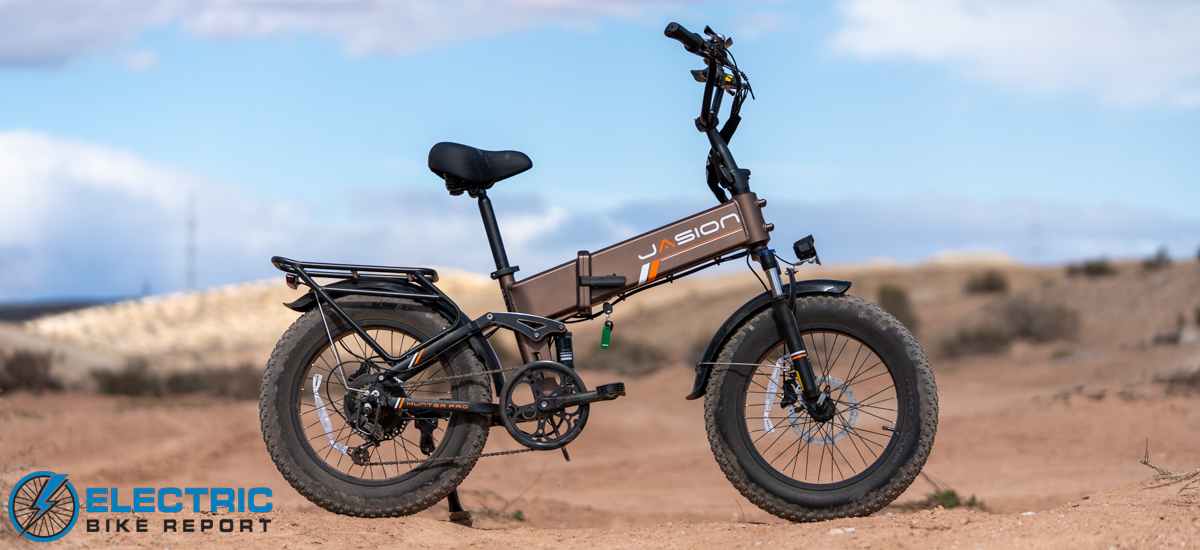
Some folding e-bikes prioritize low weight with the tradeoff of fewer features, less range, and a relatively small amount of power. Others focus more on ride quality and/or performance, with portability and size reduction as a secondary concern.
Then, there are e-bikes on the opposite end of the spectrum that do not seem to worry much at all about weight. These bikes, like the Jasion Hunter Pro, still fold down to take up a relatively small footprint, but they would rather shoot for the moon with their list of specs and features than make sacrifices to save a few ounces.
The Hunter Pro’s price of around $1,100 makes it one of the most affordable full-suspension models we’ve tested. It also claims to be one of the most value-packed, with a motor that peaks at 1800W, a range of up to 80 miles, and a top speed of over 30 mph.
From my first ride on the Hunter Pro, it was obvious that it had heaps of power, an ultra-comfortable ride, and plenty of bells and whistles to go along with them. Weighing in at around 72 lbs, it’s a lot of bike—and it’s clearly meant for those who unapologetically want exactly that.
With so much on the table, we were extremely curious to know how the Hunter Pro would perform when its real-world test results were side by side to those of similar e-bikes we’ve tested. Continue reading below to find out if it climbed above its competition or fell somewhat flat in comparison. The results might surprise you!

Sponsor
E-Bike Category:Folding
E-Bike Class:Unclassified (The tested bike exceeds stated class ratings)
Sponsor
Jasion Hunter Pro Video Review
 Pros
Pros- The Hunter Pro’s ride is easy, fast, and enjoyable, thanks to its powerful 1000W cadence-sensing rear-hub motor.
- Cruising feels smooth and comfortable, with a 60mm suspension fork, 25mm shock, and 20×4 fat tires to soften bumps.
- Its roughly $1,100 price makes it one of the most affordable full-suspension e-bikes we’ve tested.
- The Hunter Pro has excellent value, with features we don’t commonly see at this price. Its motor is uncommonly strong, it has integrated turn signals, and it pairs with the Jasion Ride app.
- It’s suitable for hilly terrain and heavier riders, with a 400lb total payload capacity and above-average results in our Hill Test.
- Steering feels stable and predictable, with the bike’s 710mm handlebars and 4-inch-wide tires.
- The bike is suitable for light off-roading, with wide, grippy knobby tires and its full suspension.
 Cons
Cons- The bike is extremely fun, but its 1000W motor and 30+ mph speeds mean that it’s not likely to be street-legal in many areas.
- While it was common on e-bikes in the past, we’d prefer the ability to remove the key while riding.
- We saw inaccuracies in speed, power delivery, and battery charge that we encourage Jasion to correct in the future. See the Speed and Range Test sections below for more details.
ELECTRICAL SPECS & FEATURES
- Battery: 48V 720 Wh (15Ah)
- Charger: 2A
- Display: Color LCD Display
- Motor: 1000W (1800W Peak) Brushless Hub Motor, 95 Nm
- Headlight: Integrated Quad-LED Light
- Taillights:Turning Lights & Brake Lights
- Pedal Assist: 0-5 Level
- Claimed Range: Up To 80 Miles
- Throttle: Twist Throttle
- App:Jasion Ride
- UL Certification:UL 2271 & UL 2849 Certified
Weight & Dimensions
- Claimed weight: 82 lbs
- Tested Weight: 72 lbs
- Rider height range: 5’1”-6’3”
- Total payload capacity: 400 lbs
Components & Accessories
- Brakes:Dual Hydraulic Brakes
- Fenders:Plastic Front and Rear
- Fork:Coil Suspension, 60mm Travel
- Frame: Aluminum
- Drivetrain: Shimano 7 Speed, 52T Chainring, 14-28T
- Grips: Ergonomic Rubber
- Saddle: K.San Spring Saddle
- Handlebar: 710mm BMX-Style
- Kickstand: Included
- Pedals: Plastic Folding
- Tires: 20×4”
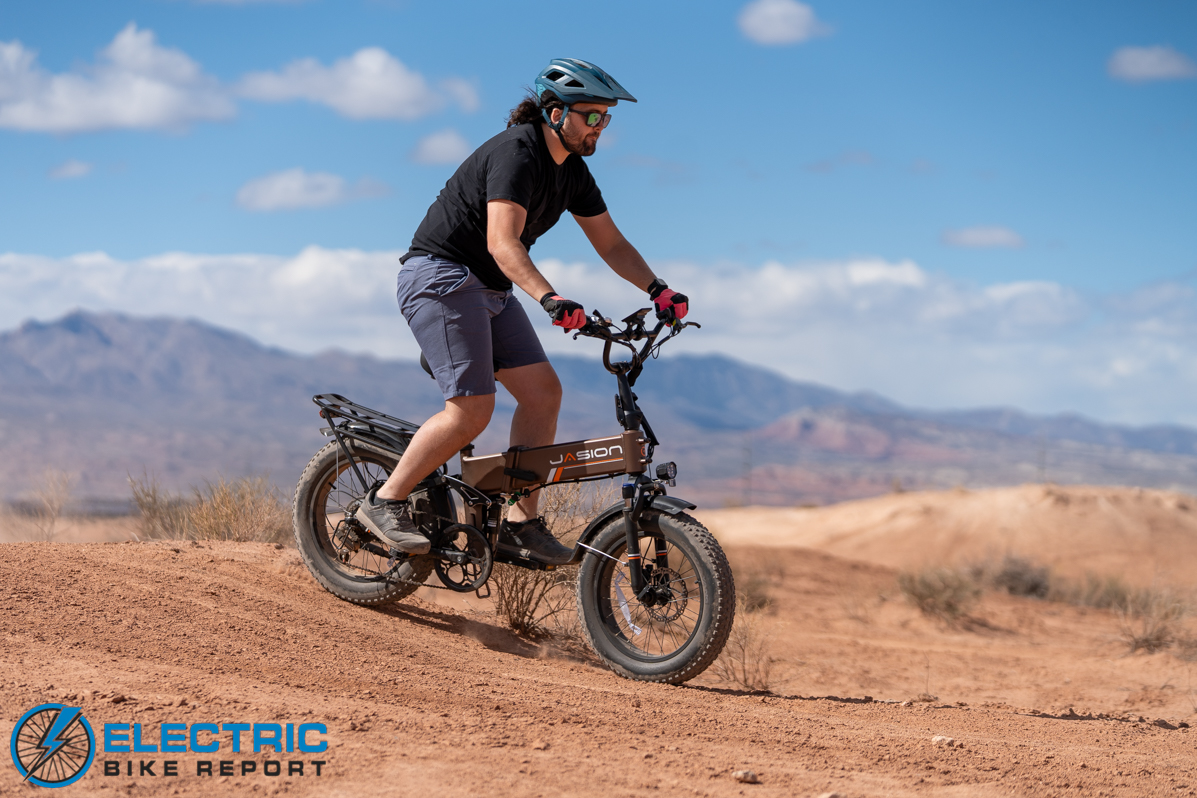
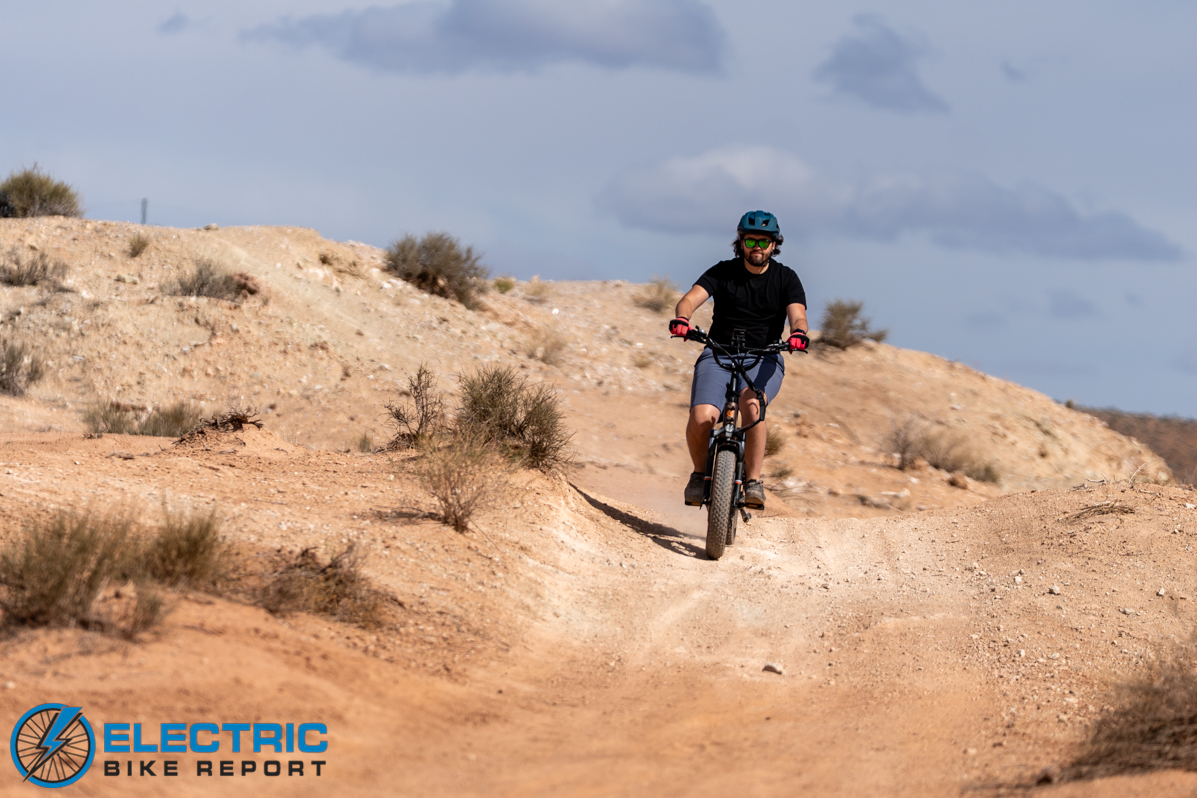
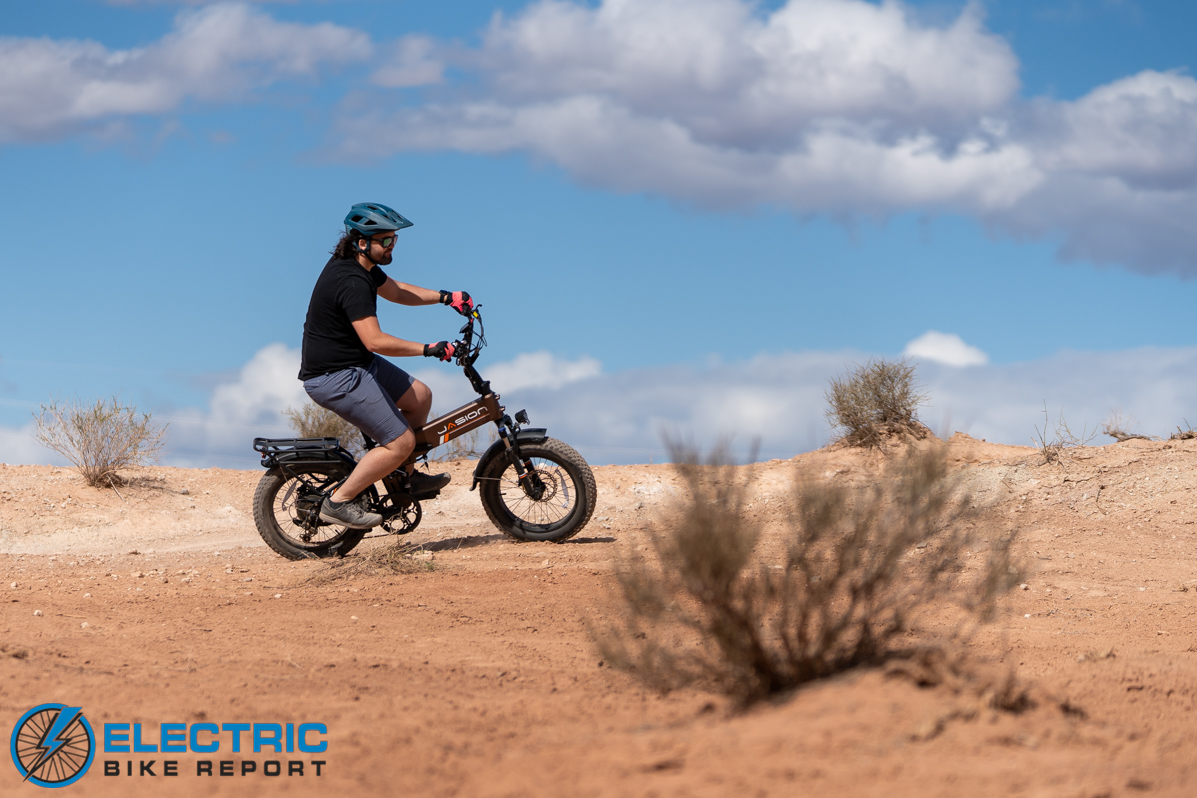
The Hunter Pro is uncommonly fast and powerful, which also makes it well-suited for off-roading.
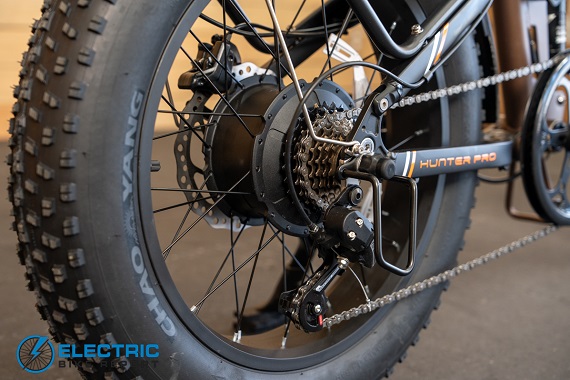
A cadence-sensing 1000W hub motor makes for fast acceleration and a low-effort ride.
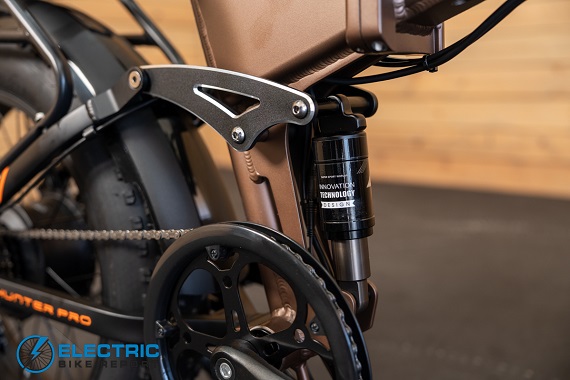
The bike’s rear shock, offering 25mm of stroke, helps ensure comfort.
Jasion Hunter Pro Review: Speed Test
I performed our Speed Test with the Hunter Pro by riding the bike in each PAS level on a relatively flat stretch of paved shared-use path. As I traveled, I monitored my average speed. The graph of my results (see above) reflects the bike’s programming.
While its maximum speed was set to exceed 30 mph right out of the box, I adjusted this to 20 mph and 28 mph during my two tests to meet Class 2 and Class 3 requirements, respectively. This default speed, coupled with the Hunter’s 1000W hub motor, mean that it is unlikely to be street-legal in most areas that have adopted the three-class system. We encourage Jasion to limit it to 20 mph by default to conform to common speed restrictions.
Even once its speeds were reduced, the Hunter Pro delivered a lively and energized feel even in its lowest assist level. As shown, PAS 1 averaged slightly above 15 mph—a comfortable cruising speed. PAS 2’s average speed jump was relatively small, but that was followed by two measured increases when moving up to PAS 3 and PAS 4.
In the Class 2 test, PAS 5 brought another small boost up to around 23 mph. In the Class 3 test, however, the bike’s highest assist level rocketed up to around 30 mph. In both cases, the Hunter Pro exceeded the maximum speed I set via the Jasion Ride app and the individual assist level speeds. I found that setting the top speed a few mph lower (17 and 24 mph, respectively) would result in Class-2- and Class-3-appropriate speed limits.
Additionally, while testing the Hunter Pro in Class 3 mode, there were a few times where the motor would put out a surge of power. These bursts of speed would carry me above the assist-level-specific speeds, though letting off the pedals momentarily seemed to reset these limitations.
Overall, these inconsistencies did not take away from my enjoyment. Pedaling was relaxed and low-effort due to the steady, non-adaptive power output from the Hunter Pro’s cadence-sensing motor. The bike’s speed and power made for a fast, fun, and easy ride, though its programming and power delivery do show some room for improvement.
In addition to my Class 2 and Class 3 pedal tests, I also tested the bike’s throttle acceleration. With its 1000W motor, the Hunter picked up speed swiftly once moving, though its initial start was relatively gradual, approachable, and safe.
Ultimately, the Hunter Pro proved to be powerful, speedy, and lots of fun, despite presenting some potential challenges for riders living in areas with tightening restrictions. We appreciate that the bike’s speed limits are adjustable through Jasion’s app for those who want more controlled power, but there’s plenty to enjoy for those who have the freedom to open it up fully.
Sponsor
Riders can adjust the Hunter Pro’s maximum speed and the limits of its individual assist levels via the Jasion Ride app.
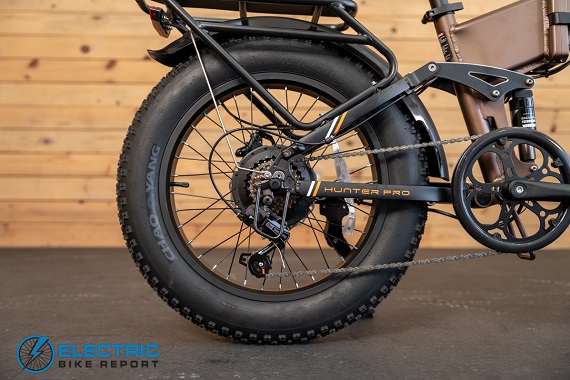
The 7-speed Shimano Tourney is a common entry-level drivetrain.
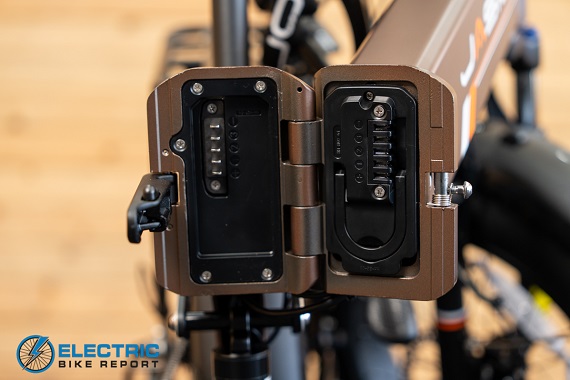
A 48V, 720 Wh battery docks in the bike’s down tube, but is removable.
Jasion Hunter Pro Review: Range Test
Range is often a major factor in consumers’ buying decisions, so we use the method explained above to get an idea of every e-bike’s real-world range capabilities. Similar folding e-bikes we’ve tested averaged roughly 30 and 63 miles in their max-PAS and low-assist tests, while our team covered 31.7 and 47.1 miles with the Hunter Pro.
In comparison to its peers, Jasion’s folding e-bike ranged from below-average in its low-power test to around average in its high-power test.
These results match up well when considering its energy efficiency; when dividing battery capacity by mileage, the Hunter Pro used 15.3 watt-hours per mile (Wh/mi) in PAS 1 and 22.7 Wh/mi in PAS 5. Similar e-bikes averaged 12 and 23.1 Wh/mi, respectively, showing that the Hunter used its charge faster than average in its low-assist test and slightly slower than average in its high-assist test.
Coupled with a larger-than-average battery—720 Wh, versus the category average of 671 Wh—the Hunter Pro exceeded our estimates for its PAS 5 range test. Based on its motor’s nominal power and its battery capacity, we estimated it would travel only around 13-14 miles in its highest assist level, but in reality, it more than doubled that figure.
Based on these results, the Hunter Pro seems well-suited for those who prefer to ride using high power settings—these riders will likely get around the same mileage from a single charge as they would with similar, less-powerful e-bikes.
Considering that Jasion advertises up to 80 miles of range in PAS 1, and that our test yielded nearly 35 miles less than this number, we encourage the brand to revise its advertised range estimate for better accuracy.
Speaking of accuracy, it’s also worth discussing the bike’s battery charge indicators— a bar-based readout on its display and a percentage-based readout via the Jasion Ride app. During my main test ride, which often depletes a battery by 20-40%, the Hunter Pro’s readouts never dropped below full/100%.
Considering that around half of my ride consisted of using high-powered assist levels and throttle, this seems unlikely, so I encourage Jasion to use a more reliable and accurate readout so that users can better estimate their remaining range.
Realistically, the Hunter Pro’s 32-47 miles of range makes it well-suited for most riders. Whether commuting (which, according to our interactions, is often less than 20 miles round-trip), adventuring, or simply cruising around, users should expect at least a couple of trips before needing to recharge.
There is one caveat to consider: we rode with the Hunter Pro’s maximum speed set to 20 mph during our testing. This is consistent with our Range Tests of other e-bikes, making comparisons fair, but riders using higher speeds should expect fewer miles per charge.
A final note: the Hunter Pro includes a 2A charger. When its battery is fully depleted, users should expect around 7.5 hours for it to return to full, making overnight charging practical.
Sponsor
Sponsor
Jasion Hunter Pro Review: Hill Test
The Hunter Pro did a great job in our Hill Test! Using the method explained above, our test rider, Justin, completed the test with above-average results. He throttled to the finish line in 1:48 at an average of 16.8 mph, but pedaled to the top of our test hill in just 1:38 at 18.5 mph.
For context, similar e-bikes we’ve tested at the Devil’s Backbone averaged 1:56 on throttle and 1:54 using their highest assist levels. This made the Hunter Pro noticeably faster in each portion of the test, which was not a surprise when considering its powerful 1000W rear-hub motor.
Our group of comparison models, most of which were equipped with 750W hub motors, averaged peak output of 1210W and 79 Newton meters (Nm) of torque. The Hunter Pro’s motor is more powerful through both metrics—it peaks at a robust 1800W and 95 Nm of torque.
This increased motor output translates to easy, fast climbing, which was apparent both in our test results and in my personal experience. I tested the Hunter Pro at Pilot Hill, our secondary test location, and found it to be strong, confident, and noticeably speedy when riding uphill.
As such, the Hunter Pro would serve riders who live and/or ride in hilly areas well. Its powerful motor makes it more than capable when throttling or pedaling, giving riders flexibility and freedom in how they approach the road’s ups and downs.
Sponsor
The throttle and pedal assist system share the same speed limit, so it’s possible to cruise at high speeds without pedaling.
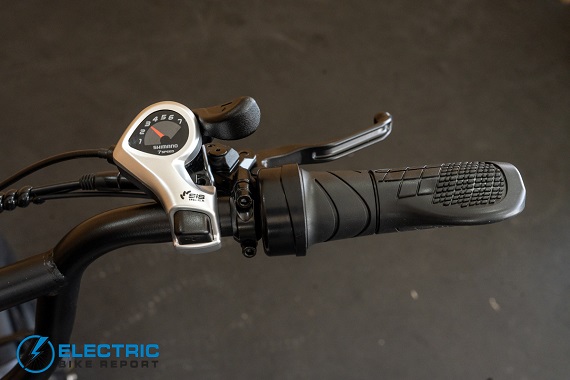
Everyone has different preferences, but the half-twist throttle felt appropriate for the Hunter Pro’s style.
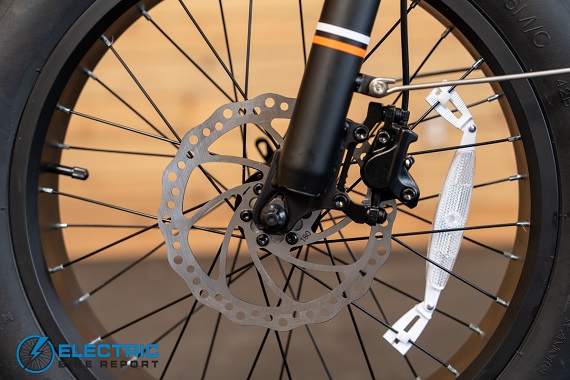
Two-piston hydraulic disc brakes paired with 180mm front and rear rotors provide safe, strong stopping power.
Jasion Hunter Pro Review: Brake Test
In our Brake Test, the Hunter Pro once again performed well. Using the testing method above, its final average braking distance was 20’5”, less than a foot beyond the current average among similar folding e-bikes we’ve tested. A group of comparable models, including some of the best folding e-bikes, stopped in 19’6”.
For context, the category average is particularly short when compared to other styles of e-bike, which often stop in 22-23 feet. By this metric, most folding e-bikes—including the Jasion Hunter Pro—are capable and, most importantly, safe.
There was no obvious reason for the difference, as the Hunter’s weight, tires, and brakes are all relatively standard for its style. Its 72-lb weight is identical to the category average, its 20×4” knobby tires are similar to those of many comparable models, and, like many folding e-bikes, it uses a two-piston hydraulic brake system with 180mm rotors.
While these brakes are unlabeled, their lever bodies are similar in shape to those made by Tektro—one of the most common and reliable brands we see on our test e-bikes. It is possible that Tektro makes these brakes, but either way, they performed well both by the numbers and by feel.
In my personal testing, I found them to be strong and somewhat aggressive. They quickly brought me to a stop when applying firm pressure and modulated my speed well when riding downhill. The Hunter Pro could skid relatively easily if I squeezed the levers too hard/fast, but I quickly got the hang of how to keep braking controlled.
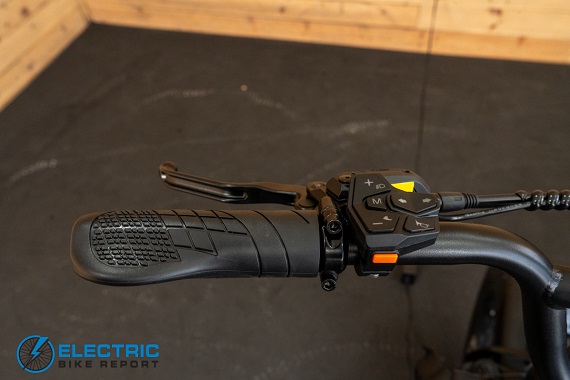
The main control panel is used to activate lights and turn signals, adjust pedal assist level, engage walk mode, and more.
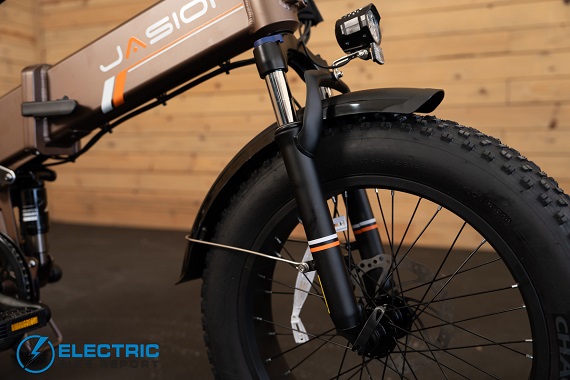
A 60mm suspension fork offers effective ride cushioning, but we wouldn’t mind a slightly sturdier fork.
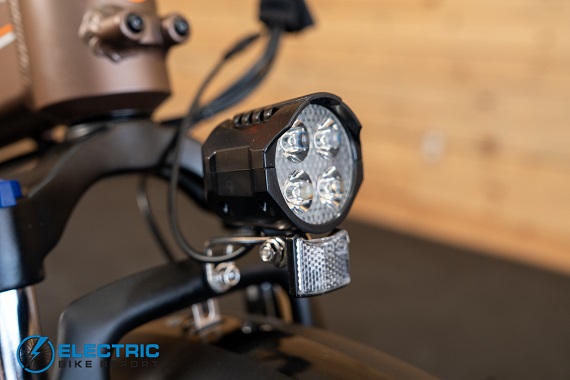
Jasion equipped the Hunter Pro with a quad-LED headlight that is relatively small but mighty.
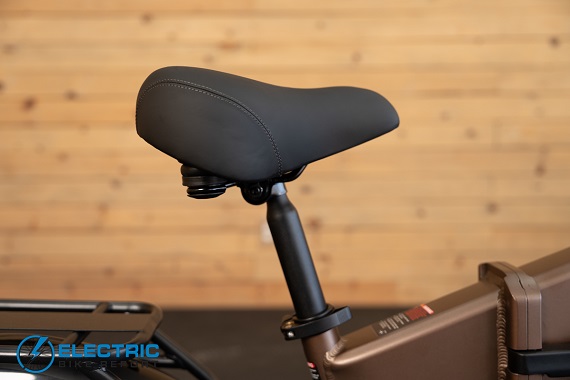
Thick padding and a built-in spring suspension make the Hunter Pro’s ride extra smooth.
Jasion Hunter Pro Review: Ride Quality
There’s no denying that the Jasion Hunter Pro offers a lot of bike for the buck—after all, it features a powerful motor, both front and rear suspension, and ride tuning through the Jasion app. In this section, we’ll dive deeper into its ride quality, discussing its overall comfort, handling, responsiveness, user interface, and more.
The bike comes in a single frame size, which Jasion advertises will fit riders from 5’1” to 6’3”. At 5’11”, I clearly fall on the taller end of this spectrum, and I was pleasantly surprised by how comfortable the bike felt—both in terms of ergonomics and ride smoothness.
I found the contact points easy to live with; the soft spring saddle was cushy without impeding pedaling, and the ergonomic rubber grips were supportive, if somewhat on the firm side. I raised the saddle to its maximum height, and while I still had a moderate bend at the knee when pedaling, the cadence-sensing motor ensured a strain-free experience.
I appreciated that, while the Hunter Pro’s stem collapsed to reduce its size for storage or transport, it did not telescope. The bike’s 710mm BMX-style handlebars allowed for reach and, to some degree, handlebar height adjustment—all while maintaining a sturdier feel than many folding e-bikes with telescoping stems offer.
Handling felt expectedly quick but stable. The Hunter’s 20×4” fat tires are relatively standard for the category, providing traction and riding/cornering stability while also making the bike fairly agile.
These tires, coupled with the 60mm suspension fork and 25mm shock, give the Hunter a smooth ride and some relatively light off-road potential. Considering the bike’s marketing materials (and similar capabilities of comparable e-bikes), we recommend that Jasion increase the fork’s stanchions from 28mm to at least 32mm. This change would inspire more off-road confidence by increasing rigidity and durability.
Another area with room for improvement is the Hunter Pro’s battery, which requires its key to be (and remain) inserted while riding. This somewhat dated design is something we have commonly critiqued; despite never having lost one while riding, the experience would be made more user-friendly and provide better peace of mind without the need for a key.
Otherwise, the bike is generally well-equipped, with integrated lights, fenders, turn signals (our brake light needed flipped for the turn signals to be properly oriented), and a cargo rack that can carry up to 55 lbs.
Additionally, the Jasion Ride companion app offers an uncommon amount of functionality and customization for a bike in the Hunter Pro’s price range. As I mentioned previously, it allows riders to adjust the bike’s maximum speed via a slider; it also has adjustable sliders for each PAS level’s speed limit.
Furthermore, the app offers a ride data tracking feature, gamified rewards based on your riding habits, and navigation via either Apple or Google Maps.
The only other thing to discuss is the Hunter Pro’s motor engagement. I mentioned in the Speed Test section above that the bike’s cadence-sensing 1000W motor gave it a relaxed, powerful, and speedy feel. I found that the motor required nearly a full turn of the cranks to engage, which felt somewhat sluggish, but riders can always use the throttle for easier starting up.
Ultimately, the bike’s strengths were in ride comfort, raw power, integrated tech, and customization. I rate its overall ride quality as good; it’s largely functional and enjoyable to ride, though it does have some areas with room for improvement.
Sponsor
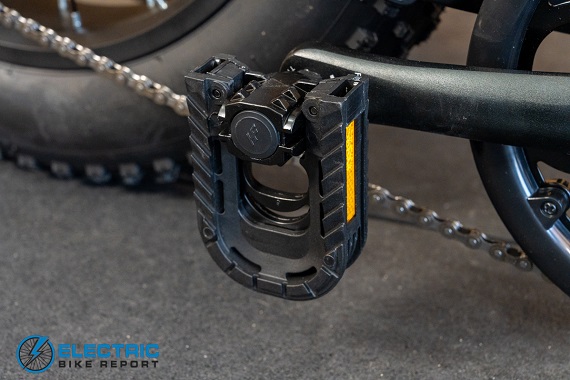
As with many similar e-bikes, the Hunter Pro has folding plastic pedals to reduce its width.
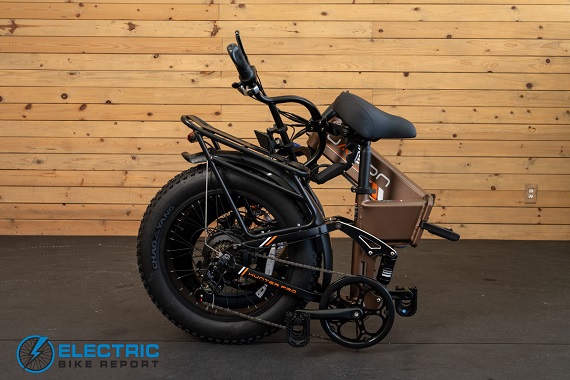
We measured the folded-up Hunter Pro at roughly 43” L x 23”W x 33” H.
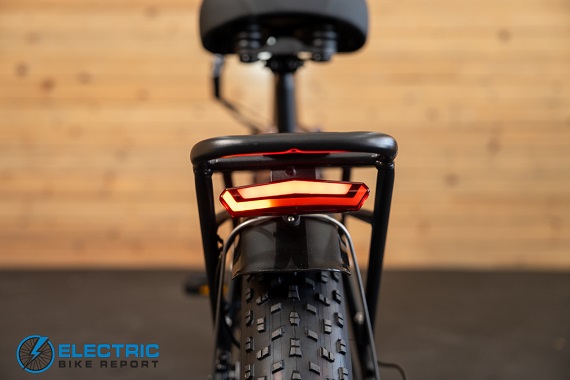
The LED tail light includes turn signals and brake light functionality.
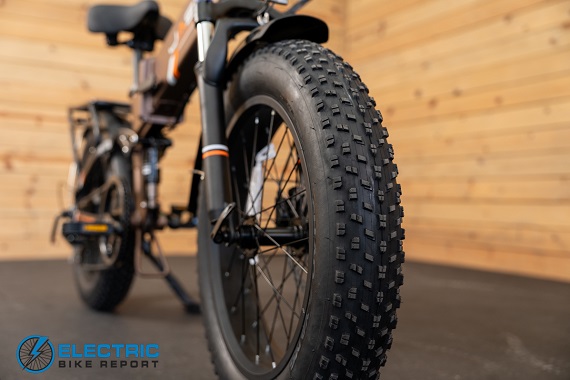
Knobby 4” fat tires provide traction for off-roading and excellent ride stability.
Jasion Hunter Pro Review: Summary / Where to Buy
Our audience often asks our team to review specific e-bikes; the Jasion Hunter Pro is one such model we’ve had many requests to cover. Being our first experience with the brand, we weren’t sure what to expect from the Hunter Pro. After testing it, however, we can say that the bike has a decent foundation that could be improved with some refinement.
Of course, price is a significant contributing factor to a bike’s value. As a full-suspension e-bike priced around $1,100, there is no doubt that the Hunter Pro aims to deliver a lot for its cost. From our point of view, it generally succeeds, though it makes a few tradeoffs to do so.
Broadly speaking, the Hunter Pro performed well. Its Range Test results showed that it can cover plenty of miles for practical commuting or leisure riding—especially for riders using high assist levels. Its Hill Test proved it more powerful than many similar models, while its Brake Test score reflected control and safety when slowing down. Additionally, its Speed Test showed it to be strong, speedy, and fun to ride.
There were, however, inconsistencies in programming, power delivery, and battery charge accuracy that we explained in greater detail above. Additionally, we hope to see a more contemporary battery setup in the future that does not require a key to ride.
Finally, prospective buyers should be aware that the bike’s 1000W motor and 30+ mph default speeds may limit its legality on roads or paths—though our contact at Jasion has shared that separate speed adjustments for the throttle and PAS will be available in the future to better enable riders to meet common speed restrictions.
Shoppers willing to accept these compromises will no doubt appreciate the bang earned for their buck. Whether cruising multi-use trails or dirt paths, riding to work or school, or stashing in the back of a pickup or RV for road trip adventures, there’s no denying that, even with some warts, the Jasion Hunter Pro is comfortable, speedy, smooth, and well-suited for hills.
With some further refinement, we’re hopeful that Jasion can build upon the Hunter Pro’s foundation, making it an even better budget-friendly folding option. We look forward to working with the brand to reach this goal.
Happy Riding! Make sure to let us know if you have any questions or if you think we left anything out in this review of the Jasion Hunter Pro down in our comments section.
Sponsor
Sponsor
Reader Interactions
Comments
Leave a Reply




Hey John, it’s been a minute however rest assured that I do continue to follow the channel although I sadden that Griff has taken a different path. The question I have is can you fit in a segment on the channel, how to properly store/charge/use batteries to get the most miles/usage during hot & cold weather riding. I find that it’s very difficult to judge how much power is still stored after riding and at what point it best to charge these very important and expensive main components to e-bike riding.
You guys know me by the handle
Papad9067
Your Jasion Hunter pro is not at ebike with peak power at 1800W and sustained at 1000W. By definition is an emoto.
Your calling it an ebike makes you part of the problem.
I was hit by one of these by a 14 year old yesterday on a Class1/2 trail this week.
Stop being part of the problem.
Your article vaguely mentions that it might have trouble with the new regulations.
Jasion is lying and you support it.