

Aventon Level 4 REC Review: 97 Mile Range?! This Changes Everything
Mar 30, 2026
 5 Comments
 Share
Share
This adaptable, responsive, and remarkably powerful commuter e-bike offers a sporty, speedy ride with more integrated tech and features than you can shake a stick at.
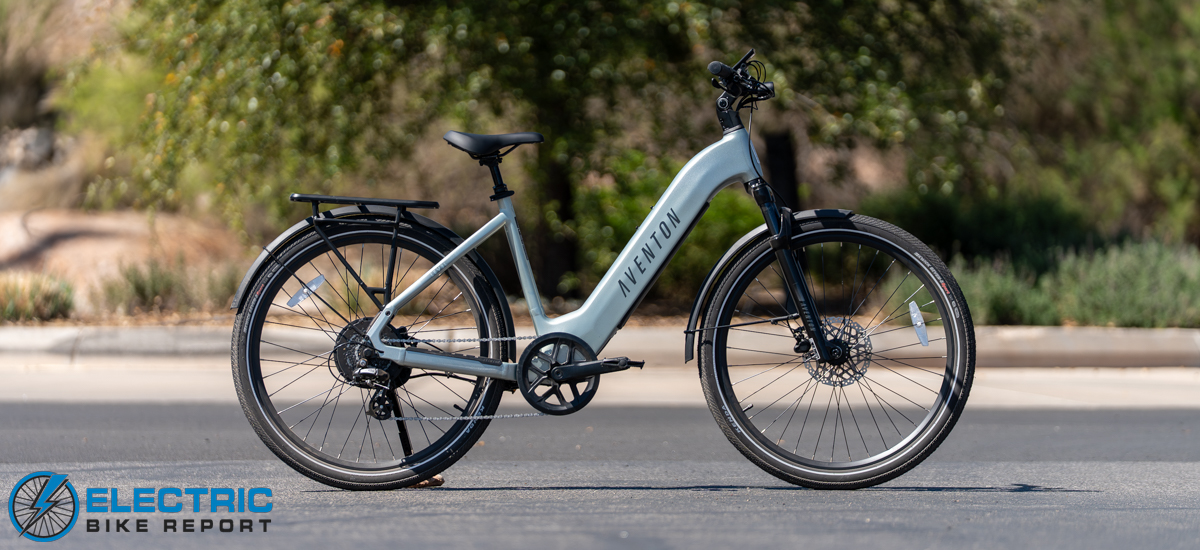
For e-bike brands, consumers, and reviewers like us, it’s essential that every e-bike has its own well-defined character. Models with clear and unique names, appearances, specs, and purposes are appealing for their simplicity; one can generally grasp the basics of these bikes with a single glance.
In some cases, such as when comparing Aventon’s Level 3 and Pace 4 models, the lines get a bit blurred. While the former was geared toward commuters with its stretched out frame and more aggressive posture, the latter positioned itself more as a leisure bike for cruising with more relaxed and upright geometry. Their specs, however, were nearly identical, making it potentially difficult for prospective riders to know which they might prefer.
The Level 4 REC aims to solve this dilemma. While the brand also released a mid-drive equipped ADV model we reviewed separately, this new rear-hub version of the Level 4 offers more power, new features, and an upgraded user interface—essentially tightening up and polishing the last-gen model’s great foundation.
On paper, this means that the Level 4 REC should define itself as a capable, user-friendly, and versatile e-bike that exists solidly between Aventon’s iconic fat-tire model, the Aventure, and its comfortable cruiser, the Pace.
We were excited to see how well this theory would hold up under real-world testing. Would the Level 4 REC stand out as a function-focused commuter with an extra dose of power? Would its performance meet the high bar set by the previous model? And what new additions are included?
See the full review below to find out.

Sponsor
E-Bike Category:Commuter
E-Bike Class:Class 1 (pedal assist to 20 mph)
Class 2 (throttle to 20 mph)
Class 3 (pedal assist to 28 mph)
Class 2 (throttle to 20 mph)
Class 3 (pedal assist to 28 mph)
Sponsor
Aventon Level 4 REC Video Review
 Pros
Pros- It’s remarkably peppy, responsive, and powerful, thanks to its 750W rear-hub motor. It can easily handle hills and reach its top speed of 28 mph.
- The Level 4 REC is loaded with customization and security features, including swappable torque and cadence modes, motor tuning, location tracking, wheel and battery locks, and so much more.
- The bike feels extremely sporty, thanks to its sharp handling, powerful motor, and adjustable but forward-leaning riding position.
- This is a huge win for value; we’re not aware of many other models priced around $2k that offer so much in terms of features and performance.
- It has tremendous range potential for a rear-hub e-bike, with an efficient motor, a torque sensor, and a new regenerative braking feature!
- The Level 4 fits a wide range of riders due to its impressive combination of frame sizes/styles. Four total options accommodate riders from 4’11” to 6’4”.
- It’s equipped for commuting right out of the box, with integrated lights (including brake lights and turn signals), fenders, a cargo rack, and a throttle.
- Aventon’s new display UI is a great upgrade! In addition to looking clean and contemporary, its pages of ride data are completely customizable through the Aventon app.
 Cons
Cons- At around 71 lbs, the Level 4 REC is relatively heavy. Its weight keeps it planted, and its motor is more than able to keep up, but lifting/moving it may require an extra set of hands.
ELECTRICAL SPECS & FEATURES
- Battery: Removable Lithium-Ion. 36V, 20Ah, 733Wh, LG 21700 Cells
- Charger: 42V/4A
- Display: Aventon A280 Customizable Center Display
- Motor: 36V, 750W Motor (1188W Peak / 80 NM Torque)
- Headlight: Integrated LED
- Taillights:Integrated LED
- Pedal Assist: 3 PAS Levels, Boost Mode (optional)
- Claimed Range: Up to 75 Miles
- Throttle:Included
- App:Aventon App
- UL Certification:UL 2849 & UL 2271
Weight & Dimensions
- Claimed weight: 68.5 lbs
- Tested Weight: 70.7 lbs
- Rider height range: 4’11” – 6’4”
- Total payload capacity: 300 lbs.
Components & Accessories
- Brakes:HD-E3120 w/ Cutoff 2-Piston Hydraulic Disc Brakes, 180mm 6 Bolt Rotors, Front and Rear
- Fenders: Plastic Full Coverage, Front and Rea
- Fork:80mm Travel, Coil Spring, with Lockout. 15x100mm thru axle, 43mm offset, Tapered Steerer Tube
- Frame: 6061 Aluminum, Gravity Cast Front Triangle
- Drivetrain: 8-Speed Shimano Altus, 48T Chainring, 12-32T Cassette
- Grips: Aventon Lock-On Grips
- Saddle: Aventon Saddle
- Handlebar: Aluminum 31.8, 680mm
- Kickstand: Included
- Pedals: 9/16” Composite Platform
- Tires: Kenda Kwick Seven-5 Sport 27.5”x2.2”
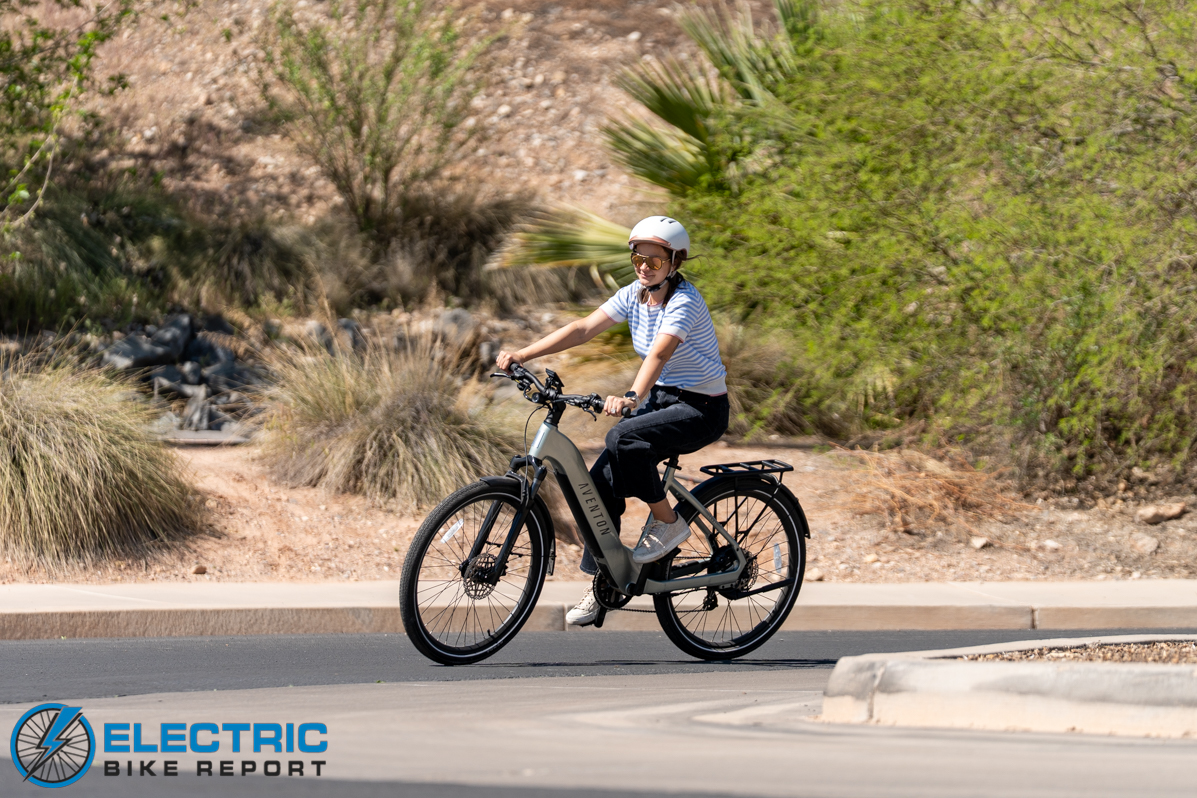
The Level 4 REC is an ideal commuter, with responsive pedal assist, fast acceleration, a comfortable ride, and loads of security features.
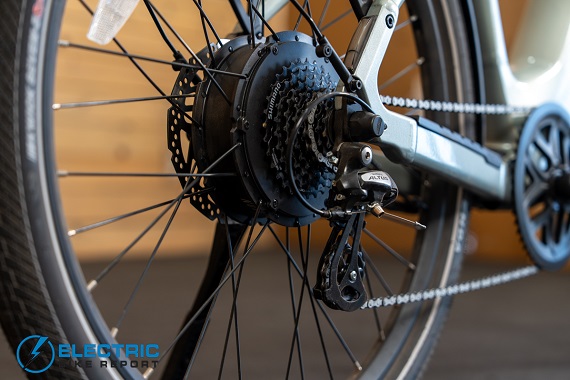
The REC’s 750W rear-hub motor is a big upgrade with measurable performance differences.
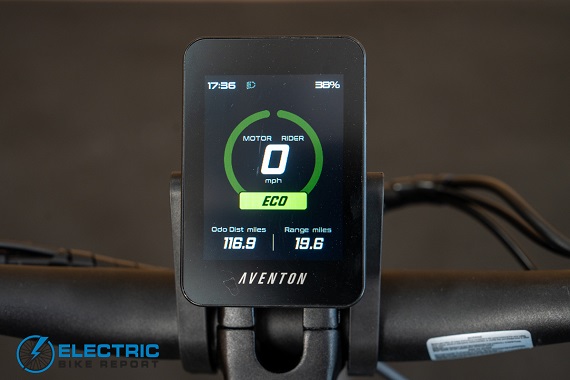
We liked the Level’s clean new display UI, featuring color coded assist levels, power meters, and customizable ride data screens.
Aventon Level 4 REC Review: Speed Test
I rode the Level 4 REC on a relatively flat section of paved shared-use path for our Speed Test, testing all combinations of its riding modes. I recorded my average speeds when using all three pedal assist settings in both both torque- and cadence-sensing modes with 20 mph (Class 2) and 28 mph (Class 3) maximum speeds—see a graph of my results above.
In the torque-sensing mode, the bike’s motor responded proportionally in response to my effort; when pushing harder into the pedals, the bike gave me more power, and vice versa. Pedal assist felt smooth, intuitive, and extremely responsive, with power levels that ranged from natural yet helpful in Eco to lively and strong in Turbo.
The incremental steps in power felt well-balanced and predictable when set to Class 2 mode. With a 28 mph speed limit, the lower two assist levels followed suit, while Turbo cranked things up to 11—accelerating to maximum speed was remarkably easy and quick!
Aventon’s cadence-sensing mode takes a slightly different approach than we’ve experienced when testing e-bikes from most other brands.
Instead of putting out a steady flow of power regardless of pedal pressure or rotations of the cranks per minute (RPMs), the motor’s output fluctuates in response to the rider’s cadence. If you move the cranks faster, the motor gives you more power, but if you slow your RPMs, the bike delivers less power. Additionally, there are no hard speed caps in each assist level, so the bike is free to continue gaining speed as it travels.
Riding with a relatively calm cadence on a nearly flat path, I felt a moderate boost from the motor in Eco, followed by a significant jump in speed in Sport. In the Class 2 test, Sport and Turbo were both able to reach the 20 mph maximum speed, while in the Class 3 test, Turbo gave me a small additional push up to the 28 mph top speed.
Based on this experience, I would likely spend most of my time in Eco, with the torque-sensing mode offering a more active feel and the cadence-sensing mode being easier and more relaxed. Sport and Turbo felt more appropriate for hills or traveling at high speeds (such as when commuting), with both torque and cadence modes offering a similarly low-effort experience in the highest assist level.
It’s worth noting that the Level 4 REC has an optional Boost mode that serves as a fourth, temporary assist level when additional power is required for climbing or getting up to speed. I tested this mode in all of my pedal tests, but measured no difference in speed, considering that I was already cruising at maximum velocity in Turbo.
In addition to my pedal tests, I also tried out the Level 4 REC’s throttle to gauge its acceleration force. The bike started off strong and steady—without feeling too punchy—then picked up speed quickly before reaching 20 mph.
Overall, I think the bike performed well in this test. Its cadence-sensing mode wasn’t quite as intuitive as I’d hoped (this may be simply because it takes a somewhat different and new approach), but the Level 4 REC’s adaptive, dialed-in torque-sensing mode more than made up for it. I also appreciated that the bike’s motor tuning can be customized via the Aventon app—more on that later.
My experience showed that the bike is programmed and equipped for both ease and speed, though its lowest power level can offer a natural feel for those who wish to pedal actively. I found it remarkably fun, capable, and adaptable—all traits that are welcome on a daily-use e-bike.
Sponsor
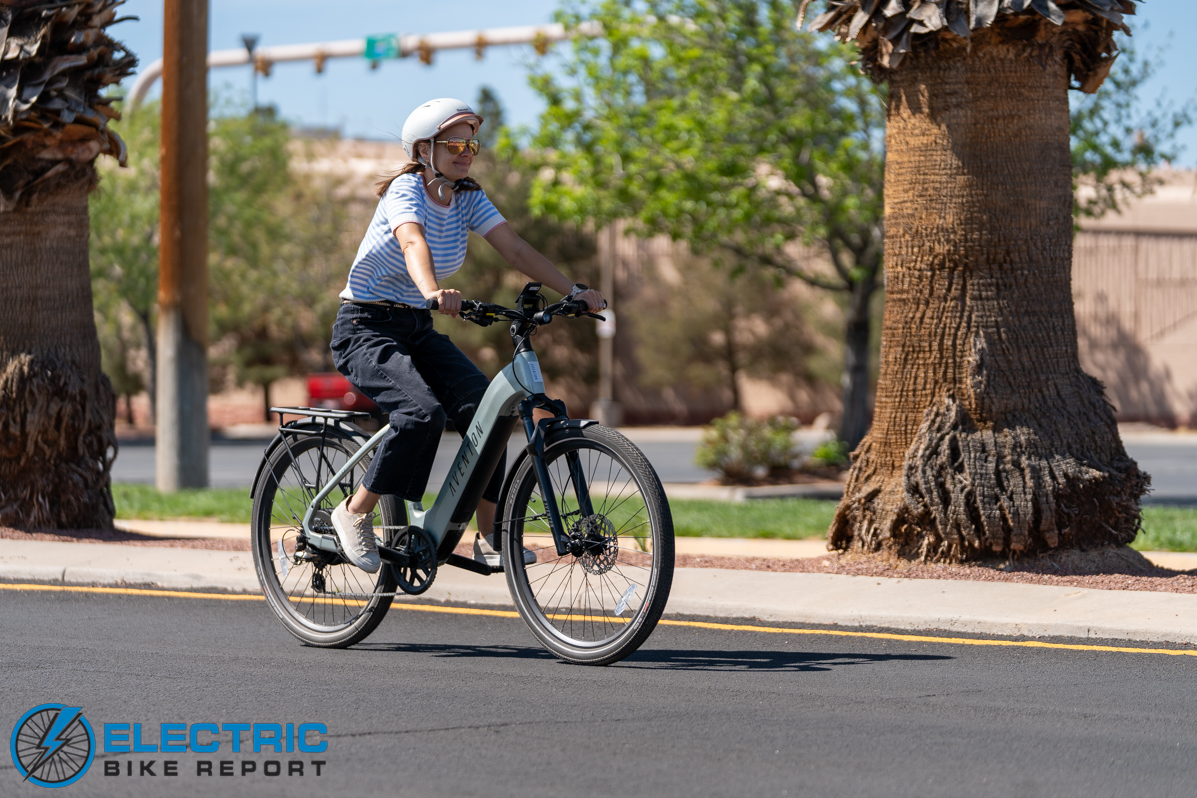
The Level 4 REC has an adjustable, forward-leaning, yet comfortable riding position.
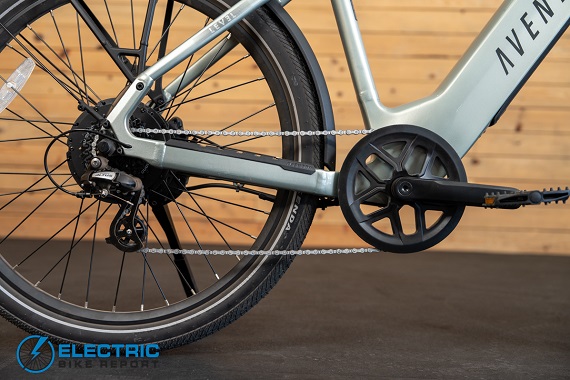
An 8-speed Shimano Altus drivetrain keeps things functional and simple, providing gearing for flats and hills.
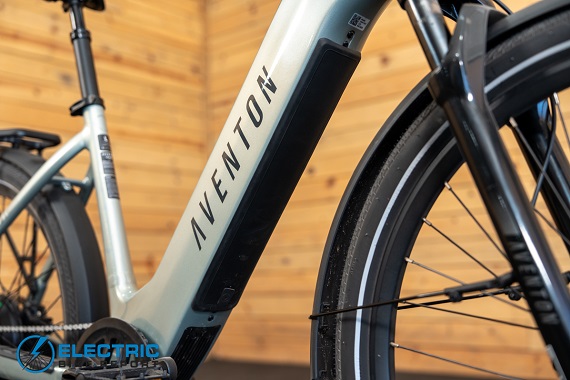
Aventon’s locking, nearly-universal 36V, 733 Wh battery rests in the underside of the down tube.
Aventon Level 4 REC Review: Range Test
The Level 4 REC was highly impressive in our Range Test, where we used the method explained in the graphic above to record its real-world minimum and maximum mileage. With a relatively tight timeline for our review, our team rotated almost nonstop through testing, traveling 43.8 miles in Turbo and a whopping 97.0 miles in Eco!
In comparison to our test results from similar commuter-style e-bikes, the REC’s Turbo results are moderately above average (roughly 9 miles). Its Eco mileage, however, exceeded the average by over 27 miles (the category averages 69.7 miles).
When looking at our data, there seems to be a handful of reasons for the bike’s success: battery capacity, overall energy efficiency, and, perhaps, its regenerative braking feature.
The Level 4 REC carries Aventon’s relatively universal 36V, 733 Wh power pack. This battery’s size exceeds the average capacity of bikes in our comparison group by a relatively small 36 Wh (these bikes average 697 Wh). The difference between their capacities is relatively minimal, but every bit of additional capacity is an advantage.
Additionally, when calculating the number of watt-hours used by each bike per mile (Wh/mi), the Level 4 REC proved itself significantly more energy efficient. Aventon’s commuter used 7.6 Wh/mi in Eco and 16.7 Wh/mi in Turbo, while bikes in our comparison group averaged 10.4 Wh/mi in their low-assist tests and 20 Wh/mi in their high power modes.
This increased efficiency could, at least partially, be a result of the Level 4 REC’s regenerative braking feature, which recovers small amounts of energy when the brake levers are squeezed. Again, the difference may be minimal, but combined marginal gains do add up over time—and our Eco mode Range Test lasted for nearly 8 hours.
It’s important to note that we performed our testing using the bike’s default programming, riding in its torque-sensing mode, and with a 20 mph maximum speed. As always, adjusting power levels, using cadence mode, or riding at faster speeds will likely use energy faster, resulting in fewer miles from a charge.
Regardless, we expect most riders will land somewhere between our results—providing more than enough mileage from a single charge for multiple commutes, leisure rides, errand trips, or other uses. Once the battery is drained, the included 4-amp charger takes around 5 hours to bring it back up to 100%.
Sponsor
Sponsor
Aventon Level 4 REC Review: Hill Test
Continuing its trend of great performance, the Level 4 REC completed our Hill Test (explained above) with well-above-average results.
Its throttle time and speed of 1:41 and 17.9 mph was 23 seconds faster than the commuter average of 2:04. The REC’s pedal time and speed of 1:37 at 18.7 mph echoed the same 23-second gap; similar bikes we’ve tested averaged 2:00 using their highest assist levels.
These results were particularly impressive because of the Level 4 REC’s weight; at 71 lbs, it is relatively heavy compared to many other e-bikes in its category. The group of models used for comparison averaged a somewhat lighter 67 lbs, making them easier to travel uphill on an incline.
Aventon’s advantage seemed to be the peak power output of its motor. The REC’s motor produces up to 1188W and 80 Newton meters (Nm) of torque in Turbo. Our group of comparison models averaged a slightly lower 1031W and an equal 80 Nm of torque. While this difference in peak watts is less than I’d expect based on the bike’s results, it still proved to make a significant difference.
My personal experience on the Level 4 REC lined up well with our test results. When riding the bike at Pilot Hill, our secondary Hill Test location, I was impressed by the throttle’s steady climbing speed. Pedaling in Turbo felt remarkably fast, and I remember thinking that the climb was one of the easiest I’ve made on that particular hill.
It’s worth noting that the bike offers an optional Boost mode, which is a fourth assist level that can temporarily provide even more power than the peak values stated above—up to 1425W and 96 Nm of torque. While we did not enable this mode for our Hill Test, it’s possible that our results would have been even better when using this mode.
Additionally, I tested the bike in both torque and cadence-sensing modes. While the more active torque mode gave me no trouble, I measured a slight increase in climbing speed when switching to the cadence mode.
All of this is to say that the Level 4 REC is an uncommonly capable and powerful commuter-style e-bike that is well-suited for climbing hills. Even steep, challenging hills should be relatively easy to conquer with the bike, and we expect most users will have the option to throttle or pedal uphill without worry.
Sponsor
The Level 4 REC includes two optional energy-recovering regenerative modes that can engage when braking and/or coasting.
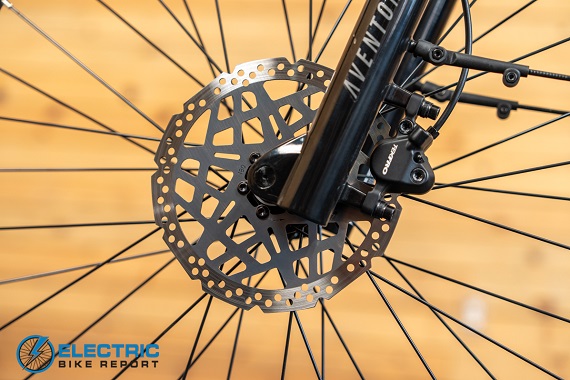
We measured impressive stopping performance from the REC’s Tektro brakes.
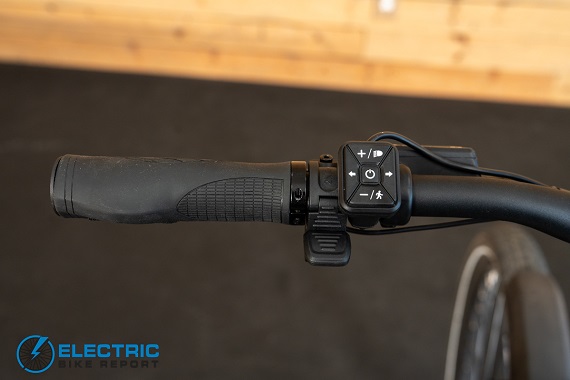
The strong but controlled throttle can be engaged via the thumb lever on the left bar.
Aventon Level 4 REC Review: Brake Test
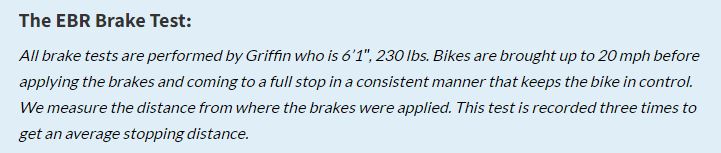
The Level 4 REC is equipped with hydraulic disc brakes made by Tektro: the HD-E3120 system, which pairs two-piston calipers and 180mm front and rear rotors. We tested these brakes using the method above, and calculated an average of 20’2” from our three individual test results.
This number compares extremely well to similar e-bikes we’ve tested, including many of the best commuters on the market. A group of popular models of this style averaged 22’0”, which is nearly two feet beyond the REC’s final score.
Considering that this e-bike is heavier than average by around 4 lbs (71 lbs vs 67 lbs) and that its tires are relatively standard, we attribute its strong performance to the aforementioned brake system. While we have less experience with the E3120 model than we do with some others, its performance has been consistently great.
Proof of this can be found in the Level 4 ADV’s test score. This sister model to the REC, which features a 3120 system that does not include a motor cutoff function, averaged a slightly shorter 20’0” due to its lower weight.
In real-world use outside of this test, I found the REC’s brakes to be effective and capable without feeling too harsh. Its tires could skid and produce some noise under hard braking, but this is not abnormal. As such, we consider the bike to have performed extremely well, and we deem its brake system to be safe and strong.
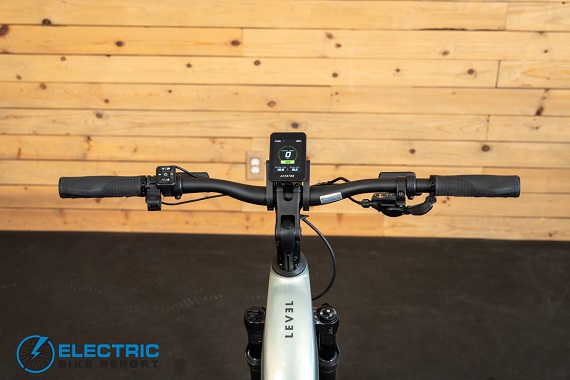
Low-rise 680mm handlebars sit on an adjustable stem.
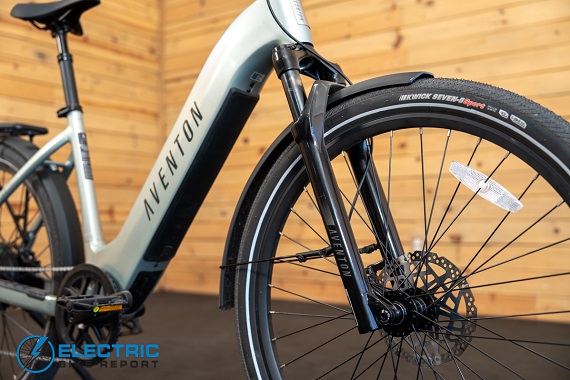
The Level 4 REC includes a suspension fork with 80mm of travel.
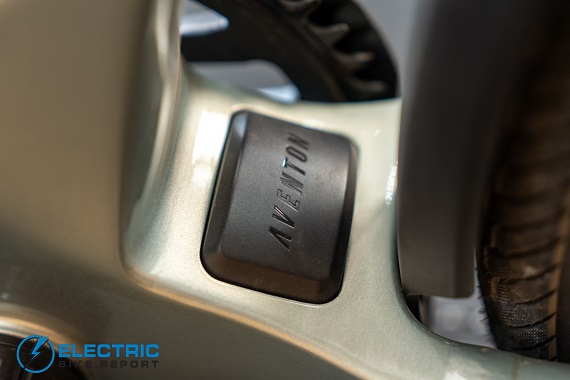
The small black box behind the seat tube is the bike’s 4G-enabled ACU smart module.
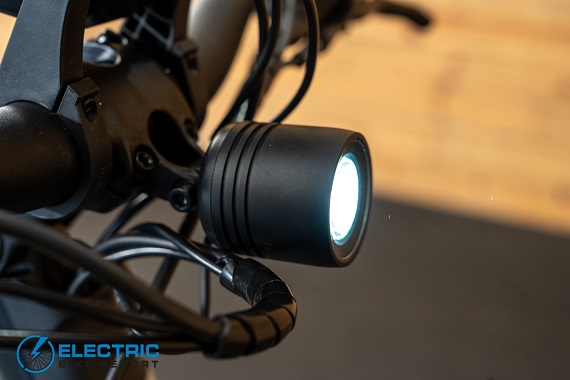
A small integrated LED headlight illuminates the path ahead.
Aventon Level 4 REC Review: Ride Quality
Depending on the e-bike and its features, the subject of ride quality can be relatively simple or decidedly complex. The Level 4 REC, with all of its customization options, security features, riding modes, and integrated technology, is firmly on the latter side. Regardless, it manages to excel in nearly all areas we will discuss.
Beginning with sizing, Aventon offers the Level 4 REC in two frame styles—high-step (HS) and step-thru (ST)—with two size options for each. The ST model, intended for shorter riders, has options for riders between 4’11” and 6’1”, while the HS frame has a recommended height range from 5’3” to 6’4”.
I tested the L/XL ST model, intended for those between 5’7” and 6’1”. At 5’11”, I am near the top end of its recommended range, and while I could tell this primarily by the frame’s reach distance, I found the bike comfortable and well-fitting. There was enough room in the seatpost to set proper saddle height for riders slightly taller than I, and I appreciated that the adjustable stem allowed me to find a comfortable and practical handlebar position.
Handling felt sharp and crisp; I could feel the bike’s weight keeping it planted while riding, but it was more nimble than I expected from its size. Its agility was well-balanced by the stability of its 2.2”-wide tires, and the Level’s overall feel matched its sporty looks and riding position.
Like the previous-gen model, the REC is equipped with both a suspension fork and seatpost. The fork’s 80mm of travel and the seatpost’s 50mm of cushion felt appropriate for its style, effectively smoothing cracks, small bumps, and rough pavement. I also liked the custom sport-style saddle and ergonomic rubber grips, which felt comfortable without being too large or chunky.
As mentioned previously, the bike’s motor felt strong, lively, and responsive. At minimum, it provided reserved yet impactful power, effectively making pedaling both active and enjoyable. At maximum, cruising could be fast, rewarding, and extremely low-effort. In all cases, it responded smoothly and quickly, making the ride intuitive and fun.
The Level 4 REC includes a color display with a clean new user interface. It pairs an easily readable display and a squared control panel with rubberized buttons. Riders can scroll through multiple pages of ride data, adjust pedal assist levels, activate lights and turn signals, or engage walk mode via these controls. There’s a fair amount of information to absorb, but it’s also relatively intuitive and easy to grasp.
Riders can also use the control panel to access the Level’s settings menu, where they can then pair with the Aventon app, release the battery lock for removal, engage and disengage the wheel lock, etc.
Once paired with the Aventon app, Level 4 REC users have access to the full scope of its features, including speed adjustment, motor tuning, location tracking, and beyond. I’ll give a brief description of some of the major elements below:
- RideTune: this feature allows users to tailor the power and responsiveness of each pedal assist level (Eco, Sport, and Turbo) using sliders for the Torque, Assistance (peak watts), and Pedal Response parameters.
- Regenerative Braking: there are two modes for this feature that can be enabled/disabled and adjusted separately. Braking Regen allows energy to be recovered when the brake levers are squeezed, while Coasting Regen automatically slows the bike when coasting to engage the recovery mode.
- Display Customization: riders can choose which ride data metrics are displayed on the screen’s scrollable pages. Up to three metrics can be displayed on a single page, and users can alter, reorder, or add/remove pages as desired.
- GO: this central button starts a ride tracking feature. Rides can be tracked in the Rides tab, synced with other apps (Strava and Apple Health) for fitness, or shared with a community of other Aventon riders via the Discover panel.
- Security & Anti-Theft: this menu offers options for the Level 4 REC’s security and 4G-enabled location tracking system. When enabled (free for the first year and then $20 annually), it allows users to see their bike’s location, remotely deactivate the bike, set the sensitivity and alarm function of its motion detection system, etc.
- Geofencing: users can set boundaries via GPS, either to contain the bike or discourage riders from entering certain areas. When inside a restricted area or outside of an allowed area, the bike’s pedal assist system does not function, and its alarm sounds when enabled.
All in all, the features listed above make owning the Level 4 REC one of the most secure and connected e-bikes in its price range. Considering that e-bikes are such a significant investment for many riders—especially those commuting by bike daily—we greatly value the inclusion of these features for both peace of mind and overall functionality.
My only real critique of the Level 4 REC is its weight of around 71 lbs. While I don’t feel that its performance is negatively affected by this aspect of the bike, it can be somewhat cumbersome to move around or lift onto a bike rack.
Otherwise, the bike offers an impressive selection of qualities and features that I believe most commuters will appreciate. The REC is speedy, sporty, comfortable, high-tech, nimble, responsive, and well-equipped for its purpose. Simply put, the bike’s overall ride quality is great.
Sponsor
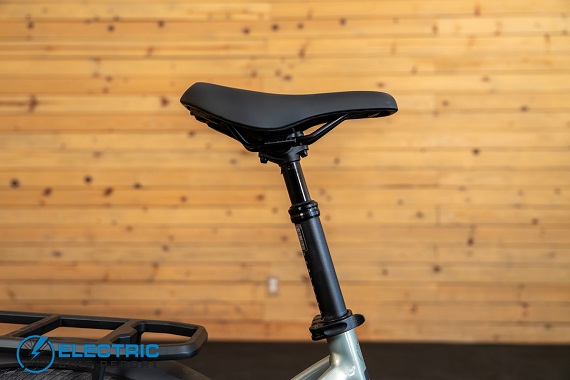
A custom sport saddle is mounted to the REC’s 50mm suspension seatpost.
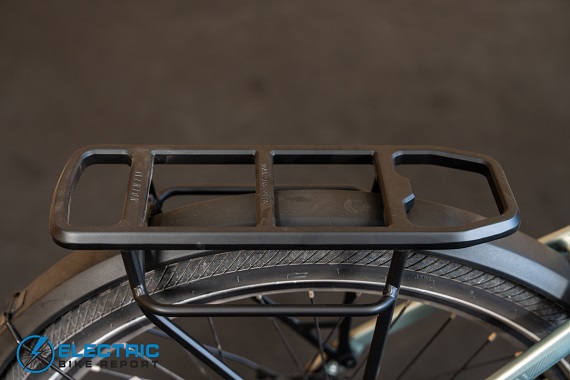
The integrated cargo rack can carry up to 59 lbs.
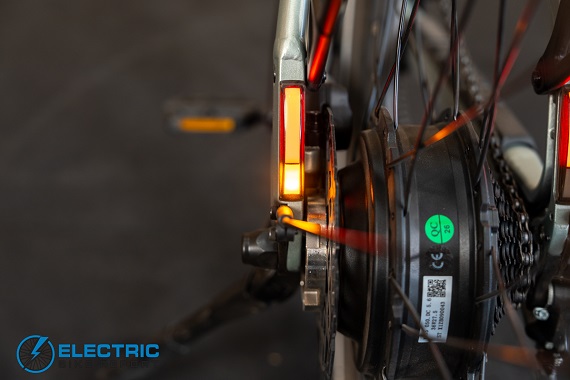
This version of the Level includes both integrated tail/brake lights and turn signals.
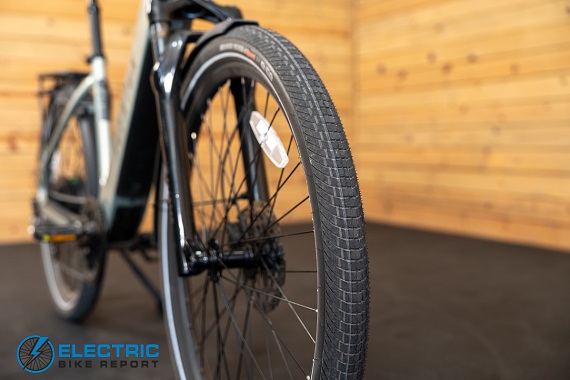
27.5×2.2” Kenda Kwick Seven-5 street tires match the bike’s purpose and urban feel.
Aventon Level 4 REC Review: Summary / Where to Buy
After only a year of selling the last-gen model, I admit that I was initially somewhat confused when I discovered that Aventon was releasing a brand-new rear-hub-equipped Level 4. After having tested the bike and experiencing everything it has to offer, I’m thrilled that the company made the decision to give it another refresh!
The Level 4 REC’s 750W motor, new user interface, and optional regenerative braking modes are game-changing to different degrees. The motor gives the sporty commuter better acceleration and climbing performance to match its appearance. The UI update gives it a more contemporary look. Finally, the regenerative braking system adds a much-asked-for feature with real-world practicality.
As we hoped, the Level 4 REC performed well in our testing, with scores that met or exceeded those of the last-gen Level 3. It offers a mostly intuitive selection of pedal assist levels and riding modes for a variety of users. It eats hills for breakfast. It delivers remarkable range for its specs. And its braking performance is exactly where it should be.
Our only real point of critique is the bike’s relatively hefty weight—but this is more something to be aware of ahead of time instead of something that holds it back.
Otherwise, the Level 4 REC is an impressive, high-tech, and value-forward commuter that is ready for the rigors of daily use.
As an e-bike that can give you a light workout or conquer hills with ease, we believe it would be a great fit for riders who want a lot of flexibility. Due to its speedy nature, it’s a solid choice for those who often find themselves running late on the way to work. It’s also great for those in areas where theft is a concern, since the included security features help you to keep tabs on your bike and give you an edge in getting it back if it goes missing.
Happy Riding! Make sure to let us know if you have any questions or if you think we left anything out in this review of the Aventon Level 4 REC down in our comments section.
Sponsor
Sponsor
Reader Interactions
Comments
Leave a Reply




How would you compare this bike with the Velotric Discover 3 and which would you prefer?
Hi Sandy, I recently did a comparison of both bikes in our podcast, the Weekly Recharge. Check out Episode 77 to see how the bikes break down and which might be best for you.
Is it worth the extra cost when compared to the level 3? I see $300-500 less for the level 3
The Level 3 is a fantastic bike, but the 4 REC offers noticeable upgrades that build on the 3’s foundation. Most importantly is the more powerful 750W motor. The Level 3 felt peppy with a 500W motor, but the REC’s extra dose of power makes for an easier and more fun experience. In addition to that, the bike has an updated display/UI and a regenerative braking feature that allows it to exceed the Level 3 in range.
I live in a hilly area, am 157cm tall, and am weighing up between the Aventon Level 4 Rec and the Aventon Pace 5 Rec. My only dilemma is do I go for the Level 4 because it has suspension forks, suspension post, fenders and rack but is heavier or the Pace 5 which is lighter but does not offer all the extras?
Hills is my number 1 concern, comfort and commuting.