Heybike Hybrid Review | Laid-Back & Long Range
Mar 27, 2026
 0 Comments
 Share
Share
The Hybrid lives up to its name as a balanced fusion between an energy-efficient commuter and a comfortable cruiser, with a few dashes of tech for good measure!
About a year before the writing of this review, Heybike released its mid-drive-equipped fat tire e-bike, the Alpha. It should not have been surprising, then, that the brand would follow the Alpha up with the Omega.
The Omega Series Hybrid, that is.
This e-bike is one of the latest models we’ve seen in the increasingly popular cruiser/commuter category. E-bikes of this style typically blend the comfort and softness of cruisers with the robust features and long-range capabilities of commuters. As such, they’re typically equally suited for the rigors of daily travel, regular leisure rides, or both.
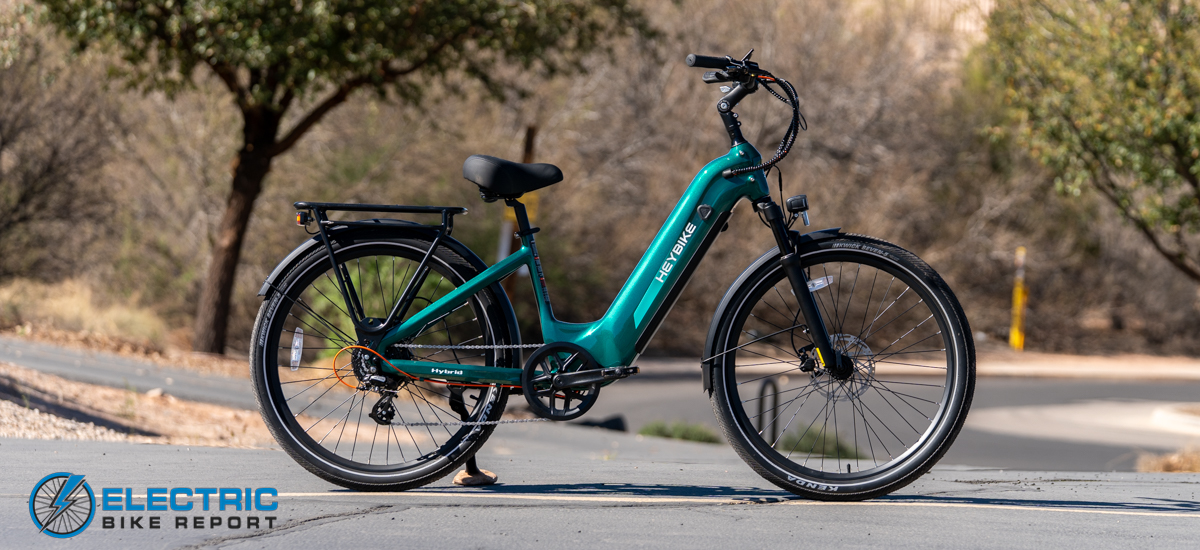
At face value, the Heybike Hybrid is just that—a fusion of e-bike styles meant for multipurpose use. Its curved handlebars, shock-absorbing suspension fork, and broad, squishy saddle check the boxes for comfort. The bike’s oversized battery, powerful motor, pragmatic component package, and functional accessories cover the commuting side.
One of the Hybrid’s largest draws is its massive, fully-integrated 48V, 864-Wh battery. It’s hard to miss, as the bike’s prominent down tube is scaled up to house this beefy, plus-sized power pack. Heybike advertises that this battery can fuel the Hybrid’s 750W motor for up to 100 miles of range—an impressive distance for any e-bike.
Another appealing feature is the Hybrid’s combination of torque and cadence sensors. Offering both the adaptive power of a torque-based system and the granular speed control of cadence-based pedal assist, the bike is easy to pedal and control. Users can also take advantage of the Heybike app to customize its speeds and other aspects of its ride feel.
So how did the Hybrid’s specs, components, and features combine in terms of real world performance? See below for details!

Sponsor
E-Bike Category:Commuter/Cruiser
E-Bike Class:Class 1 (pedal assist to 20 mph)
Class 2 (throttle to 20 mph)
Class 3 (pedal assist to 28 mph)
Class 2 (throttle to 20 mph)
Class 3 (pedal assist to 28 mph)
Sponsor
Heybike Omega Series Hybrid Video Review
 Pros
Pros- The Hybrid provides responsive power up to preset speed limits, with its 750W motor and swappable torque and cadence sensor modes.
- Heybike’s advertised 100-mile range proved possible in our testing due to the Hybrid’s huge 864 Wh battery.
- It’s impressively customizable via Heybike’s app; users can switch Classes, assist level speeds, throttle modes, and more.
- The Hybrid’s fit and riding position are adjustable, accommodating riders with either a sporty or relaxed feel.
- It keeps the ride smooth with a combination of a cruiser-style spring saddle and a 100mm suspension fork.
- While many similar models top out much lower, the Hybrid has an impressive 440-lb total payload to suit heavier riders and/or those carrying cargo or a child passenger.
- Heybike equipped the Hybrid well for daily use, including fenders, lights, turn signals, and a cargo rack.
- The bike’s above-average weight keeps it planted and stable.
 Cons
Cons- In our testing, the Hybrid’s battery readout proved somewhat inconsistent. We encourage Heybike to use a more reliable system in the future.
- With a single frame size, shorter riders may need to consider other models, like the Heybike Venus.
ELECTRICAL SPECS & FEATURES
- Battery: 864 Wh
- Charger: 54.6V Output, 3A
- Display: LCD Color Display
- Motor: 750W Hub Motor, 1200W Peak, 75 Nm Max Torque
- Headlight: Front Light w/Horn
- Taillights:Taillight with Brake & Turn Signals
- Pedal Assist: Dual Sensor (Torque + Cadence)
- Claimed Range: 100 Miles (Tested with a 155 lb rider using PAS 1)
- Throttle:Left Thumb Throttle
- App:Heybike Smart APP for iOS & Android
- UL Certification:UL 2271 & UL 2849 Certified
Weight & Dimensions
- Claimed weight: 69 lbs
- Tested Weight: 72.1 lbs
- Rider height range: 5’3” – 6’3”
- Total payload capacity: 440 lbs
Components & Accessories
- Brakes:Tektro Hydraulic, HD-E3520, 180×2.0mm rotor
- Fenders: Included
- Fork:Hydraulic Front Fork, T: 100mm, Suspension Seatpost (Optional)
- Frame: 6061 Aluminum Alloy
- Drivetrain: Shimano Altus 8SP, 12-32T, 48T Chainring
- Grips: Ergonomic Rubber
- Saddle: Extra Wide Cushioned Spring Sadddle
- Handlebar: Dutch-style Alloy
- Kickstand: Included
- Pedals: Plastic Platform
- Tires: 27.5”x2.4” Kenda
With both torque and cadence-sensing modes, switching the bike’s feel is as easy as holding a button.
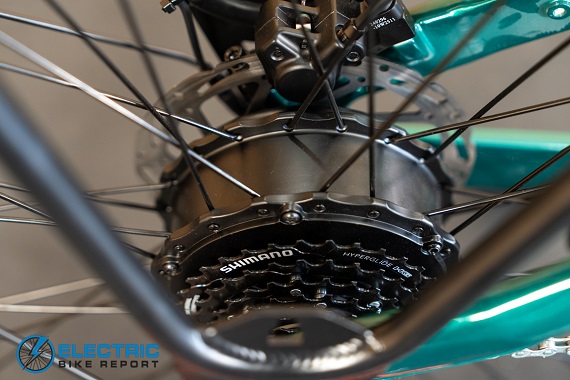
The 750W rear-hub motor provides controlled but capable power.
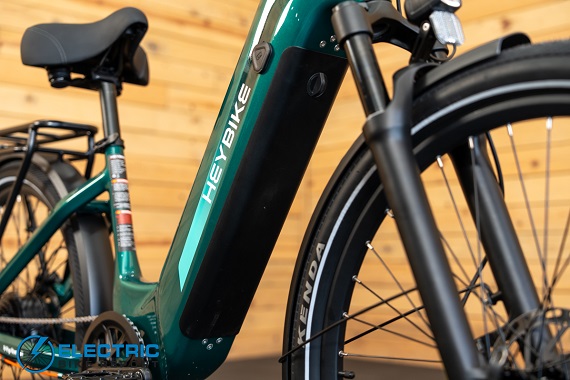
A gigantic 864 Wh battery keeps the bike rolling after most others run out of charge.
Heybike Omega Series Hybrid Review: Speed Test
As an e-bike that offers both torque- and cadence-sensing pedal assist, the Heybike Hybrid’s 750W rear-hub motor delivers power in two ways. In torque mode, its power output adjusts in response to its rider’s effort, while in cadence mode, it puts out steady power as long as the pedals are moving—even with light effort.
Regardless of the chosen mode, each assist level has a different limit where motor assist stops, allowing riders to easily control their speed. Additionally, the bike’s maximum speed can be quickly adjusted via the Heybike app by selecting between two standard riding modes.
I rode the Hybrid on a network of paved shared-use paths in both Eco (Class 2) and Sport (Class 3) riding modes, and in both cadence- and torque-sensing modes, for our Speed Test. After starting the test by pedaling without assistance, I stepped up through its five power levels while monitoring my average speed. My results are graphed above.
In the default torque-sensing mode, each assist setting delivered a measured and intuitive increase in power. The speed limits of PAS 1 were identical in both the Eco and Sport tests, with smaller jumps in velocity with the bike set to a maximum of 20 mph and wider gaps when set to 28 mph.
My actual average speed in each assist level differed from the app’s stated limit, being slower by around 1 mph. While I hoped to see better accuracy in the bike’s programming, the app does allow users to set a custom riding mode. When enabled, sliders can be used to adjust each assist level’s speed, allowing users to counteract the stated speed difference.
In the cadence-sensing mode, my speeds were nearly identical to the results of the torque-sensing tests throughout most of assist levels. There were two main differences between the modes. First, pedaling was even more relaxed, requiring only casual effort. Second, the bike seemed to struggle to reach the same maximum speeds, falling further below the programmed limits than in the other assist levels.
Overall, the bike’s speed limits felt well-balanced and intuitive. Each assist level feels meaningful, with lower power levels offering controlled and approachable speeds for new riders and higher assist settings delivering more speed for experienced riders. I found myself mostly riding in PAS 3 or 4 (in Sport Mode) to balance speed with energy efficiency.
In addition to testing its pedal-assisted speeds, I also tried out the Hybrid’s throttle. By default, the bike can reach 20 mph in all assist levels, though users can choose a more granular level of speed control via the app. If this feature is turned on, the individual PAS speed limits will also govern throttle speed.
Ultimately, the Hybrid met our expectations in this test, with generally intuitive programming and meaningful differences between all assist levels. There is some room for improvement in the accuracy of its speed limits, but as it is, riders of all ages and experience levels should find the bike easy and comfortable to use.
Sponsor

We found the Hybrid’s handling to be more nimble and responsive than its size and weight would suggest.
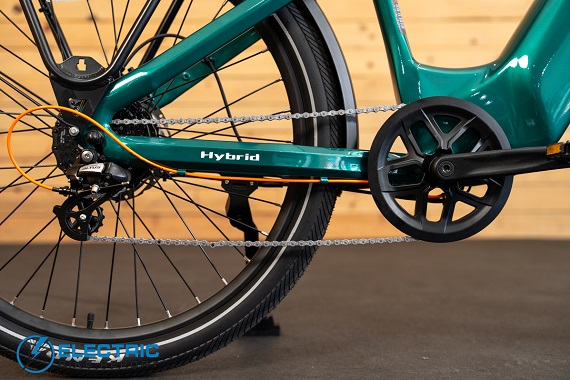
The 8-speed drivetrain is geared well for the Hybrid’s class settings.
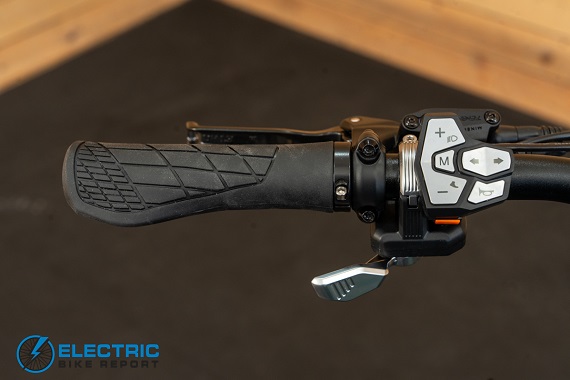
The bike’s controls sit within easy reach of its ergonomic rubber grips
Heybike Omega Series Hybrid Review: Range Test
As I mentioned previously, Heybike advertises an impressive 100-mile range for the Hybrid. We tested this claim by riding the bike until its fully-charged battery was depleted.
While Heybike based its advertised mileage on riders using PAS 1, we opted for PAS 2, as we found the higher speed limit of this assist level to be more practical for most riders. We also tested the bike’s minimum range using its highest assist level. Our testers covered 39.5 miles in PAS 5, while our PAS 2 distance totaled 104.7 miles!
Not only do these results show that the Hybrid is capable of reaching Heybike’s advertised range, they also prove that, on average, the bike has greater range potential than its peers. Case in point: a group of similar cruiser/commuter e-bikes we tested averaged 34.8 and 69 miles in their high-power and low-power range tests, respectively.
Battery capacity seems to be the greatest factor influencing the Hybrid’s results, though energy efficiency played a role, too. For reference, it carries a 48V, 864 Wh battery, while other models average just 661 Wh of capacity—a 203 Wh difference.
By dividing the bike’s battery capacity in watt hours (Wh) by its mileage in both tests, we can determine how much energy its motor used per mile (Wh/mi). Other cruiser/commuter hybrids used 9.8 Wh/mi in their low-assist tests and 19.3 Wh/mi in their high-power tests, while the Heybike Hybrid used 8.25 and 21.9 Wh/mi, respectively.
Using slightly more power than many other models in its PAS 5 test, the Hybrid burned through charge faster, so its result exceeded its peers by a relatively small margin. It used less energy than average in its PAS 2 test, however, which allowed it to stretch its substantial capacity even further.
Note that we performed our testing using the Eco riding mode, with a limit of 20 mph; riders using Sport or a custom mode with the bike’s maximum speed set higher than 20 mph should expect less range.
Our range testing brought up one point of critique that we’ve noticed with some of Heybike’s other models, as well as the Hybrid. Whether referencing the bar-based battery charge indicator on the display or the percentage-based readout in the app, the bike’s charge level fluctuated depending on the motor’s energy use at a given time.
For the sake of user friendliness, we encourage Heybike to switch to a more stable and reliable readout for more accurate range estimation in the future.
In general, however, users who ride the Hybrid to work expeditiously will likely use one of its higher-power PAS levels, but even these folks should expect a couple of round trips with the bike’s ample power supply.
Those who use the bike for slower and more casual trips, be they for commuting or leisure, should get many rides before needing to recharge. As such, we consider the Hybrid to have performed exceptionally well, and it is ideally suited for daily use and long rides.
Heybike included a 3A charger, which should power up the 18 amp-hour (Ah) battery in roughly 6 hours.
Sponsor
Sponsor
Heybike Omega Series Hybrid Review: Hill Test
The Heybike Hybrid performed well in our Hill Test, thanks to its powerful 750W rear hub motor. We tested it using the method explained above. The bike clocked a throttle time of 1:54 and an average speed of 15.9 mph. When our test rider, Justin, pedaled in PAS 5, his time and speed were 1:49 and 16.6 mph on average.
Similar cruiser/commuter hybrids, including many of the best cruisers we’ve tested, averaged 2:05 and 2:04 in their throttle and pedal tests, respectively. While the difference between the Hybrid’s throttle result and the category throttle average is within the margin of error for this test, its pedal test result proves that it is undoubtedly more capable than many of its competitors.
The proof, as they say, is in the pudding. The Heybike Hybrid is around 7 lbs heavier than the average among similar e-bikes (72 lbs versus our comparison group’s 65 lbs), and therefore more difficult to push uphill.
The bike’s faster than average climbing times, then, make more sense when looking at the peak power of its motor. While the motors carried by similar models produced an average of 974W and 70 Newton-meters (Nm) of torque, the Hybrid’s motor produces up to 1200W and 75 Nm of torque. This extra power allowed it to overcome its additional weight and reach the top of our test hill faster than many similar models we’ve tested.
From my hands-on experience, I can say that the bike felt steady and capable when traveling uphill. Pedaling felt noticeably more speedy than when relying solely on the throttle, though both modes worked well.
Riders wanting the fastest travel on slopes should expect to contribute a modest amount of legwork, but the bike proved able to do all of the work for those who want an extremely easy experience.
Sponsor
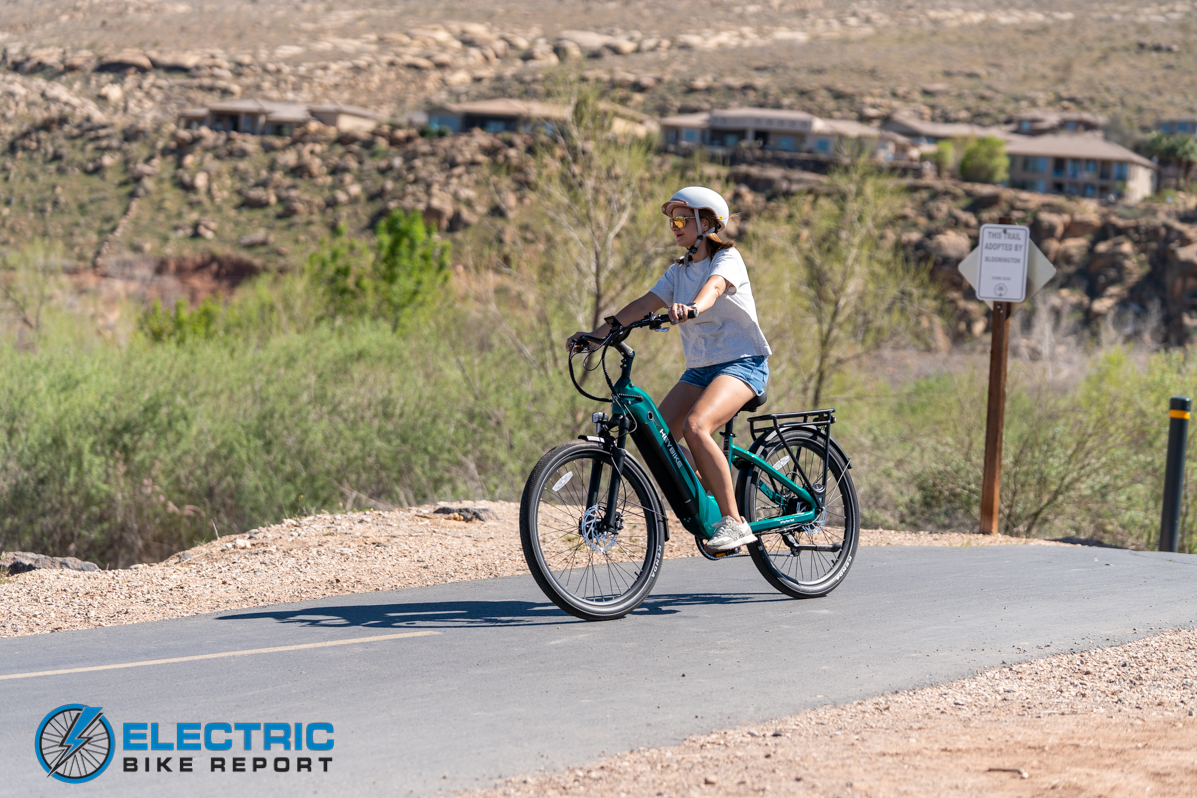
The Hybrid comes in three color options: Onyx Black, Ruby Red, and Emerald Green (pictured).
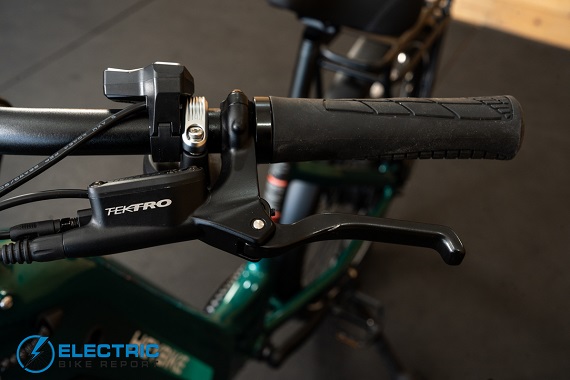
Sturdy Tektro brake levers provide great stopping power without requiring a ton of grip strength.
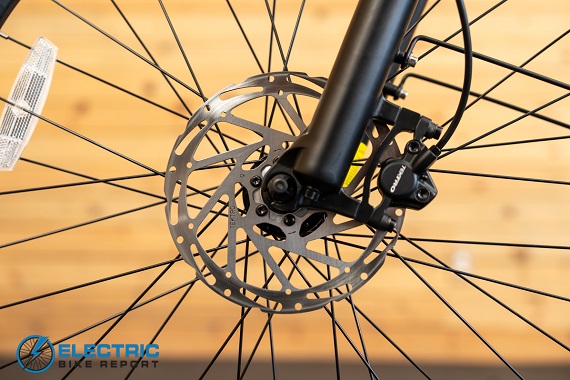
The Tektro hydraulic disc brakes use thicker than average rotors for great heat dissipation.
Heybike Omega Series Hybrid Review: Brake Test
The Heybike Hybrid’s average stopping distance in our Brake Test, as determined using the method above, was 19’ 9”. This result is over two feet shorter than average when compared to similar commuter and cruiser-style e-bikes we’ve tested, proving the Hybrid to be well-equipped for safe, confident braking.
An e-bike’s weight, tires, and brake system are three major factors that influence its result in this test. The Hybrid’s 27.5×2.4” tires and Tektro HD-E3520 hydraulic brake system are common for similar cruiser/commuter e-bikes.Considering that its weight of 72 lbs is heavier than average for its style, we expected the bike to have a longer average stopping distance.
The only obvious difference between the Hybrid and similar models that may have given it an edge is the thickness of its 180mm brake rotors. While many similar bikes we’ve tested used thinner 1.8mm rotors, the Hybrid’s 2.0mm-thick rotors take longer to heat up, which helps reduce fade and make braking more effective.
In fact, the effect of the bike’s thicker-than-average rotors was apparent in its test results. It’s not uncommon for us to observe many inches—sometimes feet—of difference between a bike’s three test results. The Hybrid’s stopping distances, on the other hand, differed by only 2 inches in total, making its performance both effective and consistent.
Based on my personal experience, I can say that these characteristics were noticeable by feel. In my testing, the Hybrid’s brakes felt strong, capable, and reliable without feeling too aggressive.
The bike scored remarkably well here, proving that small differences in specs can add up to major differences in performance.
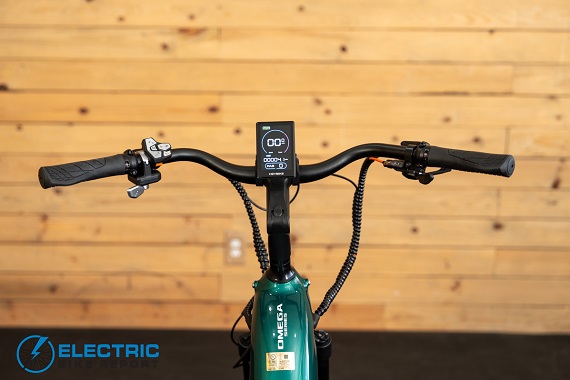
Curved, Dutch-style handlebars encourage an upright posture with a comfortable hand and wrist position.
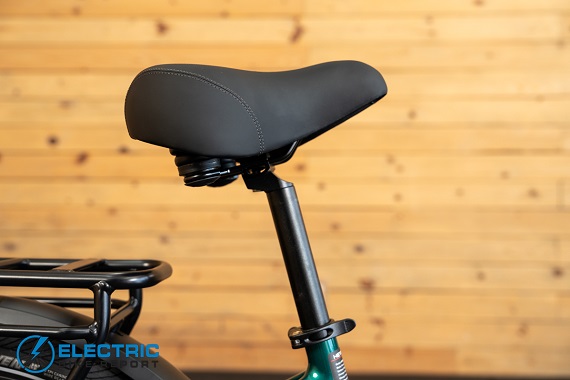
A cruiser-style spring saddle offers lots of cushion, but it might impede pedaling for some riders.
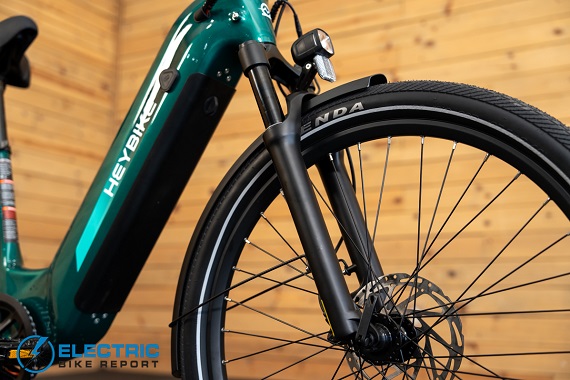
A 100mm-travel suspension fork helps to smooth bumps. A suspension seatpost is optional.
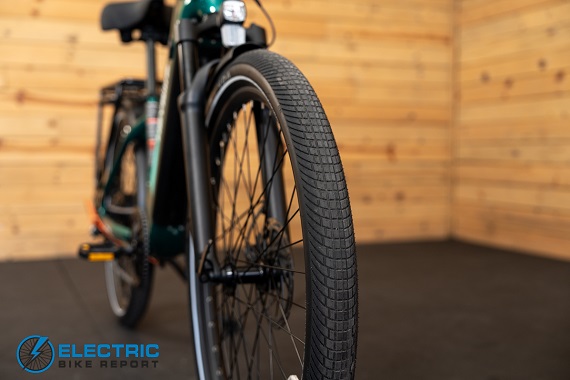
The 27.5×2.4” street tires provide comfort, traction, stability, and visibility.
Heybike Omega Series Hybrid Review: Ride Quality
The Hybrid felt solid in terms of its overall ride quality, with a clear focus on comfort, customization, and functionality. It does, however, have some room for improvement, with a few areas of critique that stood out.
First, in terms of sizing, the bike should be generally accommodating for most riders. Heybike offers the Hybrid in a single size advertised to fit those from 5’3” to 6’3”. As a 5’11” rider that is well within this recommended range, I found the bike comfortable, and I believe its pedal assist system is responsive enough that pedaling should still be comfortable for those above 6’3”.
Riders on the shorter end of the spectrum may be somewhat limited, however, since the bike’s saddle can only drop so far. An extra frame size would likely help to accommodate shorter riders, but in the meantime, those who are “vertically challenged” may need to consider the Heybike Venus as an alternative due to its lower recommended height range.
One feature that I greatly appreciated was the Hybrid’s adjustable stem, which allowed me to raise the handlebars and bring them a bit closer to me. This changed the riding position from a sporty, forward-leaning position to one that was more relaxed and upright—embracing the bike’s cruiser influence.
I found the Hybrid’s ride generally smooth and comfortable, thanks to the softness of its wide, cruiser-style spring saddle and 100mm suspension fork. Those who enjoy relaxed pedaling or who often rely on the throttle will likely enjoy the bike’s feel, but its saddle could impede more active pedaling to some degree. I’d personally be likely to swap to something narrower, but other riders may be fine with the stock saddle.
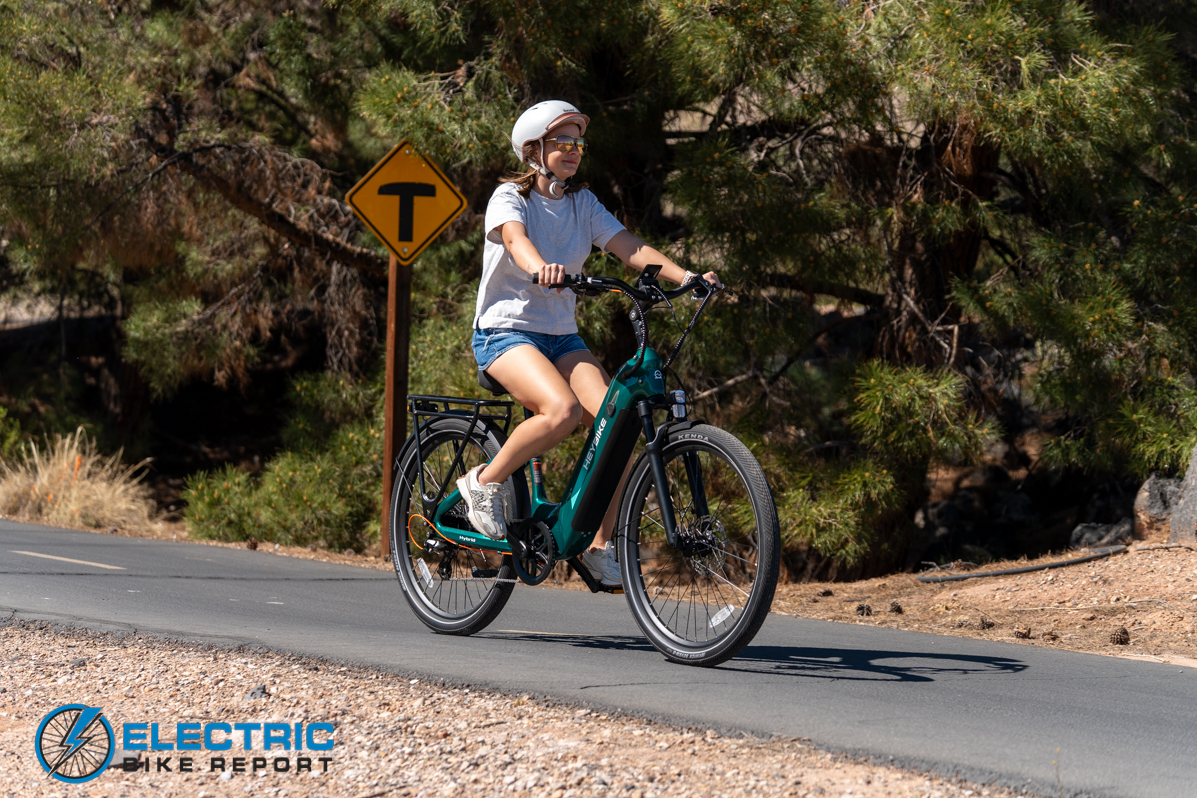
In terms of handling, the Hybrid felt planted and stable. It had a slightly more nimble feel than I expected for its weight, which I attribute to the bike’s curved Dutch-style handlebars. Steering felt predictable and crisp.
The Omega Series Hybrid is the first e-bike from Heybike that we’ve tested with the ability to switch between torque and cadence-sensing modes. The former offers an engaging feel with power that responds to the rider’s effort level. The latter mode’s steady power output makes it better for climbing hills or moving a heavy load of cargo. In both cases, I found the motor engagement to be quick and strong without feeling punchy or overpowered.
I felt the bike was well-equipped for daily use. It comes outfitted with commuter-friendly essentials, such as integrated lights (including brake lights and turn signals), fenders, a cargo rack with a 66lb capacity, an electronic horn, and a throttle. Riders can also choose to add an optional suspension seatpost for even more comfort.
I’d say that the Hybrid’s cockpit felt a bit busy with its relatively large control modules, but after some tweaking, I was able to get everything within easy reach of the supportive rubber grips. The user interface had a small learning curve, but overall, the bike’s operation was intuitive and relatively straightforward.
The Heybike app is worth diving into in more detail. In addition to changing Classes, riding modes, and the speeds of individual assist levels, the app also offers ride tracking features, access to a social-media-like platform shared with other Heybike riders, and navigation in concert with either Apple or Google maps. As e-bike apps go, it’s one of the more robust that we’ve tested, offering a range of useful customization options and ride tools.
Ultimately, the Hybrid checked the boxes we look for in ride quality. The bike felt comfortable, sturdy, and well-put together. It’s flexible and customizable for riders of different styles, it’s thoughtfully equipped with practical features, and it generally offers solid value for its price.
Sponsor
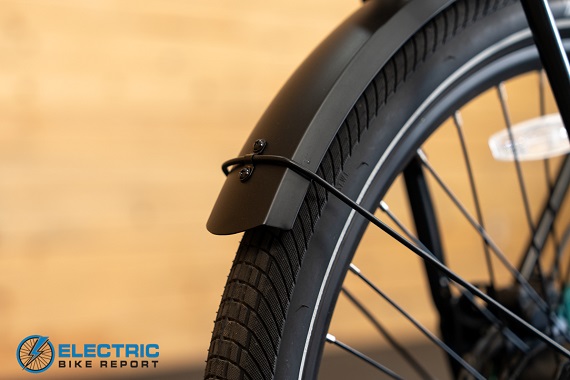
Both wheels are covered by plastic fenders to ward off water and mud when riding on wet streets.
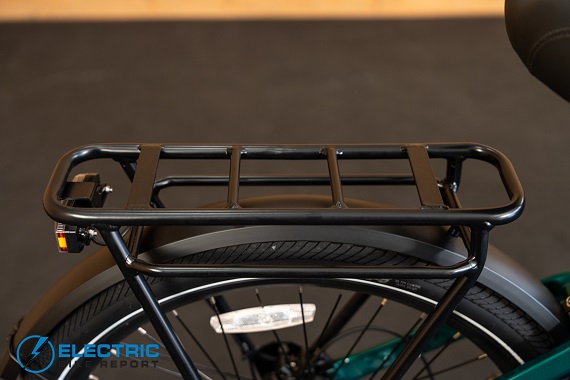
The bike’s cargo rack can carry an impressive 66 lbs, making it suitable for errands and beyond.
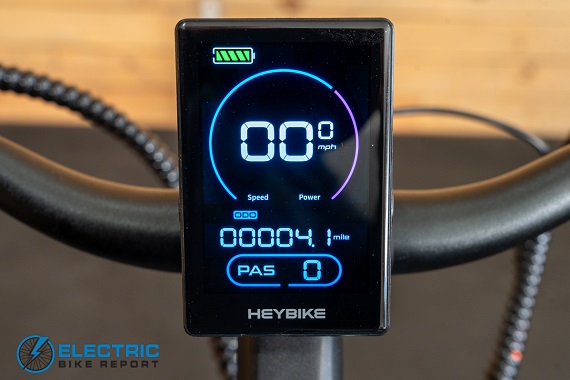
A color LCD display shows essential metrics like speed, charge level, PAS setting, motor power, mileage, and more.
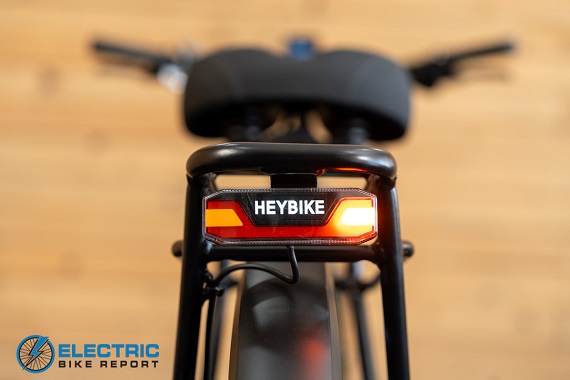
The Hybrid includes a tail light with brake lights and turn signals mounted to its cargo rack.
Heybike Omega Series Hybrid Review: Summary / Where to Buy
When asked what characteristics will define the Omega Series, our contact at Heybike shared that e-bikes in this line will “deliver long-range performance alongside a premium, comfort-focused riding experience.” Our testing showed that range and comfort were two of the bike’s biggest strengths, but they’re not the only areas where the Hybrid succeeds.
Based on the tests above, we can confidently say that the Hybrid has well-balanced default programming that provides meaningful differences between each of its assist levels. It also has ample power for climbing hills and brakes that stop it safely and effectively.
Additionally, the bike feels both capable and controlled, making it friendly for new riders. It’s highly customizable, allowing it to be tailored to a variety of riding styles and uses. It’s also well-equipped with a set of solidly-performing components, useful features, and beneficial accessories.
In terms of areas for improvement, we found only a handful of relatively minor points to address, with the bike’s fluctuating battery readout and single frame size at the forefront. See the range test and ride quality sections above for more details, but in general, we don’t consider either point to be a dealbreaker.
Overall, the Hybrid is a solid offering that blends the defining features of cruiser and commuter-style e-bikes effectively. It would likely make a value-forward choice for long-distance daily travel, a controlled and easy-pedaling leisure bike, or a capable, energy-efficient errand-runner.
Happy Riding! Make sure to let us know if you have any questions or if you think we left anything out in this review of the Heybike Omega Series Hybrid down in our comments section.
Sponsor
Sponsor
Reader Interactions
Leave a Reply