

Magnum Melody E-Bike Review | Classical Meets Contemporary
Mar 19, 2026
 1 Comments
 Share
Share
Like a catchy song, the Magnum Melody is fun, easily enjoyed by just about anyone, and quick to get stuck in your head.
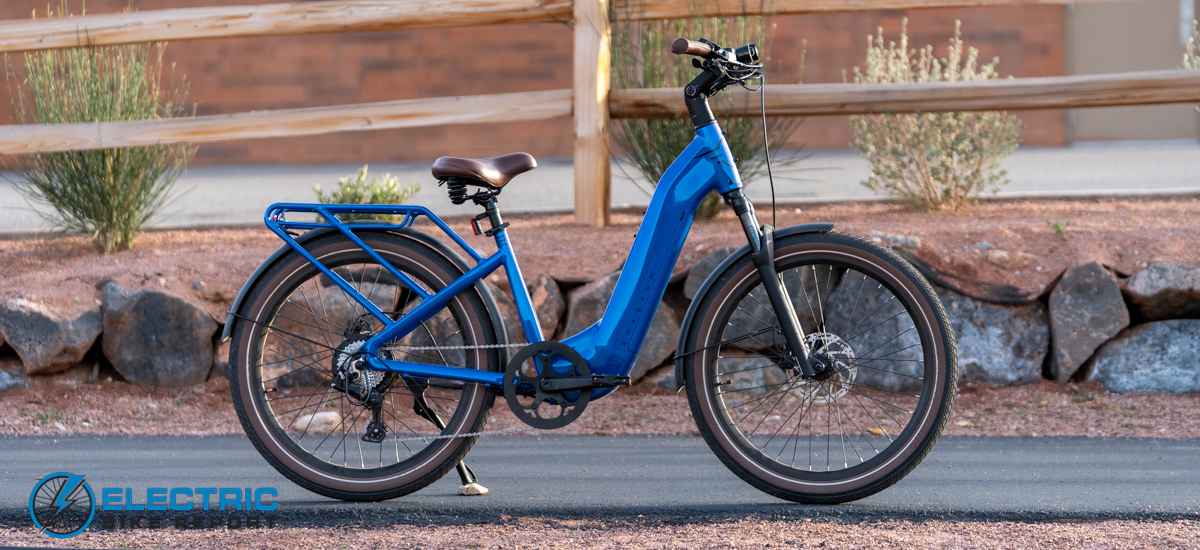
Cruiser / commuter hybrid e-bikes are nothing new, but in my experience, they exist on a spectrum. On one end are models that lean more into their cruiser aspects, perhaps offering a relaxed and casual vibe along with a large battery for extended range. On the other are sportier, speedier e-bikes, often with an extra dash of softness and support.
Each bike of this style strikes its own balance between the extremes, blending practically and comfort. Based on my first test ride, I can say that the Magnum Melody is one of the e-bikes most evenly split between the cruiser and commuter categories that I’ve reviewed.
Not only is it able to fit a wide range of riders, thanks to its 26-inch wheels, low standover height, and adjustable stem—the Melody is also remarkably comfortable. The stem, swept-back handlebars, and ergonomic grips promote an upright, strain-free posture. The suspension fork and wide, cruiser-style spring saddle keep the ride soft and smooth.
On top of that, the Melody is well-equipped for daily use without being overcomplicated. In contrast with many e-bikes I’ve tested that were overloaded with controls or needed to be paired with mobile apps, Magnum kept this one simple. It’s a bike with a helpful motor, a respectably-sized battery, and a display—and not much more beyond the essentials.
My first impressions were that the Melody was comfortable, easy to pedal, generally well put together—and, of course, impressively sharp-looking. Initial opinions don’t always pan out, however. So did my up-front takeaways hold up throughout our standardized testing and review process? See my full review below to find out!

Sponsor
E-Bike Category:Cruiser/Commuter
E-Bike Class:Class 1 (pedal assist to 20 mph)
Class 2 (throttle to 20 mph)
Class 3 (pedal assist to 28 mph)
Class 2 (throttle to 20 mph)
Class 3 (pedal assist to 28 mph)
Sponsor
Magnum Melody Video Review
 Pros
Pros- Pedal assist from the Melody’s 500W rear hub motor is smooth and plentiful, making for a responsive and easy ride.
- The bike is extremely comfortable, thanks to its combination of an adjustable, mostly-upright riding position, soft saddle, and ergonomic handlebars/grips.
- Its feel is largely customizable, allowing riders to switch between torque and cadence sensing modes and adjust speed limits for individual assist levels.
- Operating the Melody is easy, thanks to the bike’s simple control panel and cockpit layout.
- The accessible step-thru frame has a low standover height, accommodating riders as short as 4’11” up to 6’3”.
- Extras such as the stem-integrated display and MIK-HD cargo rack add refinement and versatility.
- Magnum offers four appealing color options, including the cool metallic Green, Ocean, and Blue.
 Cons
Cons- We liked the Melody’s simplicity, but we’d love to see extras such as integrated turn signals, onboard security, a fast charger, etc. for added value at its price point.
ELECTRICAL SPECS & FEATURES
- Battery: 48V 15Ah/720Wh Samsung Cells
- Charger: 2.5A, 6 Hours Charge Time
- Display: Velofox DM11 Stem Integrated, Full Color LCD
- Motor: Sutto 500W, 750W Max
- Headlight: Integrated 100 Lumen Front Light
- Taillights:Multi-function Rear Brake Light
- Pedal Assist: Torque sensor OR Cadence (swappable in display settings)
- Claimed Range: Up to 55 Miles
- Throttle:Thumb Throttle
- App:N/A
- UL Certification:UL2271 and UL2849 Certified by TUV
Weight & Dimensions
- Claimed weight: 71 lbs, Including 9 lb battery
- Tested Weight: 72.2 lbs
- Rider height range: 4’11” to 6’3″
- Total payload capacity: 330 lbs
Components & Accessories
- Brakes:Tektro HD-E3520 Hydraulic Disc Brakes, 180mm rotors F & R
- Fenders: Full Coverage Front & Rear Fenders
- Fork:Trama 100 MM Travel w/ Preload, compression, and lockout adjustments
- Frame: City Tuned, Low Step 6000 series alloy
- Drivetrain: 8 Speed Microshift Acolyte w/ Clutched Derailleur
- Grips: Ergonomic Faux Leather
- Saddle: Elastomer Spring Cruiser Saddle
- Handlebar: Backsweep handlebar
- Kickstand: Included
- Pedals: Aluminum platform
- Tires: 26″ X 2.4″

Comfortable and well-equipped, the Melody is suitable for relaxing cruises or dedicated daily commuting.
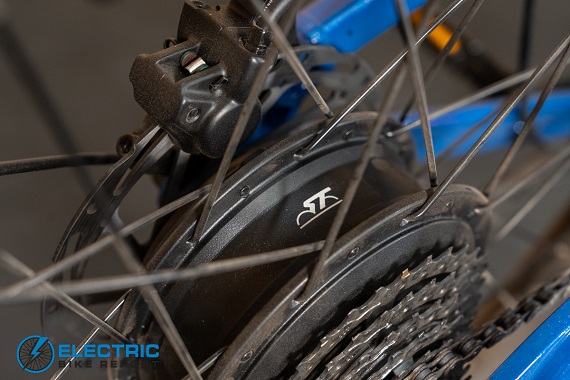
A 500W rear hub motor is equipped with both torque and cadence sensors.
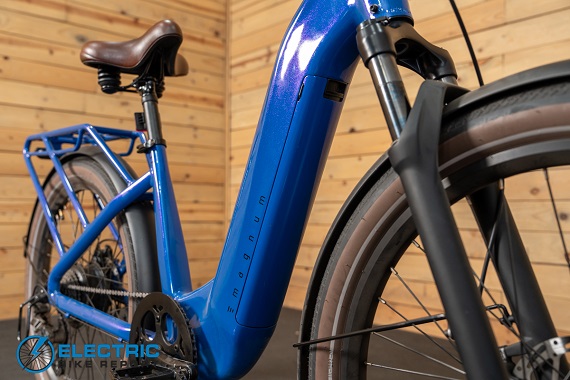
The Melody’s fully-integrated 720 Wh battery blends right into the down tube.
Magnum Melody Review: Speed Test
With the ability to switch between torque and cadence sensing modes—and between Class 2 and Class 3 functionality—I performed a total of four Speed Tests with the Melody while riding on paved shared-use paths. The average speeds I tracked in each pedal assist level throughout the tests are graphed above.
Riding without pedal assist, I reached a comfortable 9.3 miles per hour with relatively casual pedaling. I felt the bike’s weight to some degree, but its gearing made riding without power relatively easy and enjoyable.
I usually explain this test by beginning with a bike’s default settings—this would be Class 3 in the bike’s torque-sensing mode, going by our test bike—but in this instance, I will begin by analyzing its performance in its cadence-sensing mode. The bike showed ideal, intuitive, and well-balanced programming in this mode, which we can use as a baseline.
In both portions of this test, the motor carried me up to preset speed limits with only light pedaling—the motor cared only that I was moving the pedals, not how much pressure I used when doing so. In Class 2 mode, there were four power levels that increased my speed steadily to the 20 mph maximum, as shown by the linear graph of my results above.
In Class 3 mode, the pedal assist system (PAS) added two additional power levels with higher speeds. My results in the four overlapping assist settings were roughly identical to in the Class 2 test, with those in the added Boost and Hyper settings continuing the same trend of providing incremental, evenly-spaced jumps in speed.
While I found the speed limit of Eco in the cadence-sensing mode to be somewhat too low for my personal tastes, I appreciated the overall distribution of power levels, which gives options to riders of all styles and experience levels. We consider this type of programming ideal when testing cadence-sensing motors, as such even increases in speed and power make selecting a mode and controlling speed both intuitive and easy.
It’s worth noting that the individual speeds of each assist level can be customized with a double-press of the M (Mode) button on the bike’s control panel when in cadence mode. It would be great to be able to set exact speeds here instead of relatively vague and unlabeled sliders, but I’m happy to see that the Melody offers this level of personalization.
In the bike’s default torque-sensing mode, my results were somewhat less consistent than in the cadence tests. This is more likely a result of my effort than the bike’s programming, since the motor responds to variations in pedal pressure.
Again, Class 2 mode had four assist levels, while Class 3 mode offered a wider range of six settings to accommodate its higher speeds. Overall, both modes showed relatively evenly-distributed power levels, though my range of results was narrower when using the torque-sensing mode due to a significantly higher baseline of speed in Eco.
In my experience, Magnum is the only e-bike brand that offers this approach to Class 2 and Class 3 modes, with a simplified PAS in the slower mode and a greater number of settings in the faster mode. I give the company kudos for this intuitive approach; it largely avoids the pitfalls we’ve seen with other types of programming, which often lead to bikes set to Class 2 speeds reaching the 20 mph ceiling early.
When testing the Melody’s throttle, the bike accelerated gradually at first, then steadily picked up speed until it reached 20 mph.
With a variety of options to suit riders who prefer to pedal casually or actively, and the ability to reach both Class 2 and Class 3 speed limits confidently, we consider it to have performed well in this test.
Sponsor

Riders can easily switch between sensor and Class modes via the bike’s display menu.
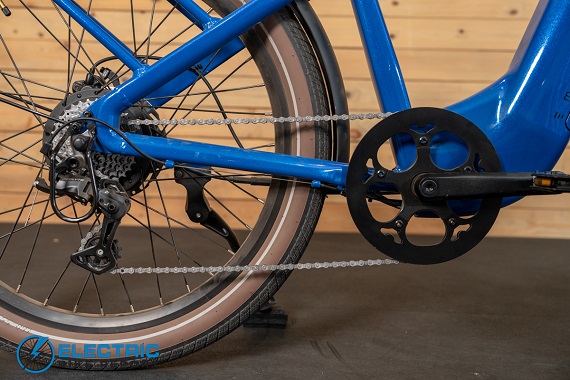
An 8-speed MicroShift drivetrain with a clutched derailleur makes shifting crisp and smooth.

The cruiser-style spring saddle is soft, squishy, and supportive.
Magnum Melody Review: Range Test
The Magnum Melody also performed well in our Range Test, where we measured its real-world minimum and maximum range using the method explained in the graphic above. As shown, our testers traveled 35.7 miles in the highest assist level and 76.5 mph in the lowest.
It’s worth noting that we adhered to the 20 mph limit on our local paths; riders traveling at 28 mph with the bike set to Class 3 mode should expect fewer miles. We also used the more energy efficient torque-sensing mode; those using cadence sensing should also expect to expend battery charge faster.
Similar cruisers and commuters, including some of the best commuter-style e-bikes we’ve tested, averaged 33.9 and 64.3 miles using the same restrictions and methodology. In comparison, the Melody is on par with its competition when riding at full power. Its score was notably above average in Eco.
The reason for the Melody’s success is likely its above-average battery capacity; Magnum equipped the bike with a 720 watt-hour (Wh) battery, while its competitors averaged 670 Wh. This difference of only 50 Wh is not enormous, but its effect can be seen when breaking down all bikes’ energy efficiency.
By dividing a bike’s battery capacity by the number of miles it traveled, we can find the amount of energy it used per mile. The Melody and its competitors averaged the same 20.2 watt-hours per mile (Wh/mi) in their max-assist tests. Magnum’s e-bike was somewhat more energy efficient in its low-assist test, using 9.4 Wh/mi compared to 10.7 Wh/mi.
With the same energy consumption in its high-power test, the Melody differed from its competitors by a small margin. The much greater gap in all bikes’ low-power test results was likely a combination of lower consumption and a larger “gas tank.”
A rough real-world range of 36 to 77 miles makes the Magnum Melody suitable for occasional leisure rides and daily commuting. Assuming that riders use the same settings and speed limitations, we expect most riders should have at least a single round trip covered by a full charge even at the highest assist level.
Those using a lower/slower power level should be able to extend their charge and cover more rides and/or miles before needing to recharge.
Considering that Magnum advertises a range of up to 55 miles, we’re thrilled to have met and exceeded that mark!
Sponsor
Sponsor
Magnum Melody Review: Hill Test
The Melody ultimately proved capable, but not exceptionally speedy, in our Hill Test. Using the method above, our test rider (who tests each bike for consistency) recorded successful completion of the test using both the bike’s throttle and PAS.
On throttle power alone, Justin climbed the hill in 2:27 at an average of 12.3 mph. When pedaling in Turbo (the highest assist level with the bike set to Class 2 mode), he pedaled up the Devil’s Backbone faster, reaching the finish line in 2:16 at 13.3 mph.
Other cruisers and commuters averaged 2:08 and 2:05 in their throttle and pedal tests, respectively, making the Melody slightly behind the average in Turbo and noticeably slower in Eco.
These results coincide with my personal testing at our secondary location, Pilot Hill. There, the bike seemed to struggle somewhat on throttle (at the time of writing, I’m heavier than Justin by around 20 lbs), but pedaling felt much steadier and more comfortable.
The difference between the Melody’s test results and those of its competitors is obvious: Magnum’s e-bike is heavier and less powerful than average. While the Melody weighed just over 72 lbs and its motor produced 750W of peak power and 65 Nm of torque, our group of comparison models averaged 66 lbs with 991W of peak power and 112 Nm of torque.
The Melody’s 500W nominal rear-hub motor gives it a safe and approachable feel that we believe will appeal to new and/or aging riders, but it trades some uphill muscle for this controlled nature. Our testing proved that it is still capable of helping riders pedal up and over large hills, though most may need to add some leg power for the fastest travel.
A few final thoughts to keep in mind:
First, we generally recommend e-bikes based on their ability to summit steep hills rather than their speed. With this in mind, the Melody proved successful, and therefore, plenty effective.
Second, we performed our testing using the bike’s default torque-sensing mode. Our testing suggested that, depending on the rider, this may be slightly faster than the bike’s cadence-sensing mode. Cadence mode will, however, require less effort overall.
Third, those living in exceptionally hilly areas who are concerned about the Melody’s suitability for such terrain may want to consider another of Magnum’s newest models, called the Bliss. This e-bike shares much in common with the Melody, but uses a more powerful 750W motor that we expect would make climbing faster and easier.
Sponsor

Magnum offers the Melody in four colors: Green, Ocean, Blue, and Pearl White.
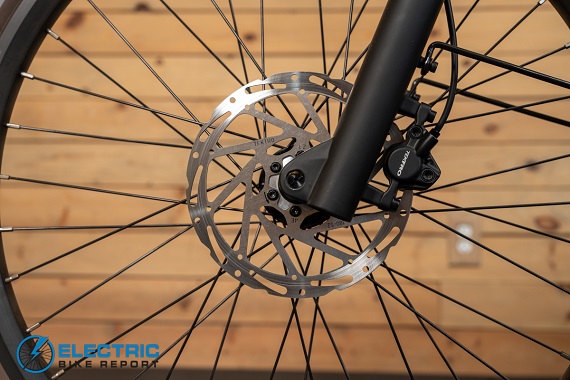
Tektro’s HD-E3520 brake system is both familiar and reliable.
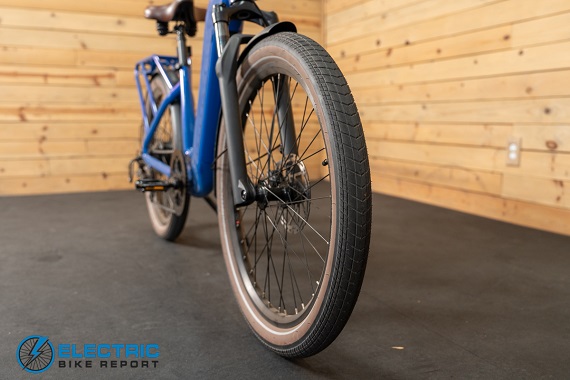
26×2.4” tan-wall street tires look great and keep the ride stable.
Magnum Melody Review: Brake Test
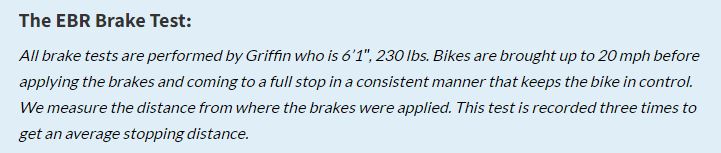
The Melody is equipped with a capable and familiar hydraulic brake system: the HD-E3520 model from Tektro. Using these brakes, we used the method above to measure an average stopping distance of 19’9”. This final score is roughly 2.5 feet shorter than the cruiser/commuter average (at the time of writing) of 22’2”.
With well above average performance, we’re extremely pleased with the Melody’s results, though the reason for its success is not immediately obvious. As covered in previous sections, the bike is a few pounds heavier than average when compared to many similar models, and it also shares its brake system with some of those other e-bikes.
It is possible that the bike’s relatively wide 26×2.4” tires were to thank, as they provide a stable, grippy contact patch that helps to stop the bike. Additionally, many similar models have started to adopt knobbier SUV-style tires, which often have slightly less traction than smoother street tires like those of the Melody.
Interestingly, the bike didn’t seem quite as effective when braking under my general testing as it was during Griffin’s formal Brake Tests. The brakes performed as expected, though under hard braking, I noticed that the tires could skid relatively easily and for a moderate distance.
Still, the Melody generally felt confident and controlled when coming to a stop. With such excellent test results, we give the bike a well-earned two thumbs up.
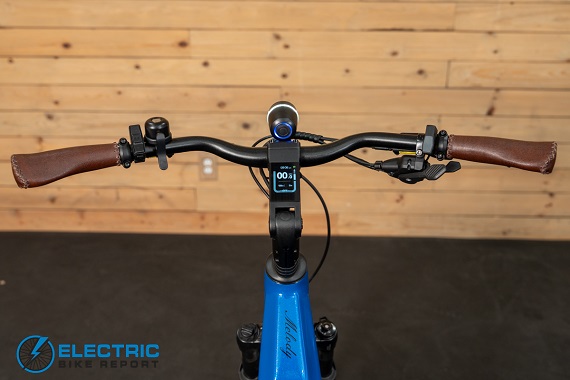
I liked the shape of the Melody’s ergonomically-swept handlebars.
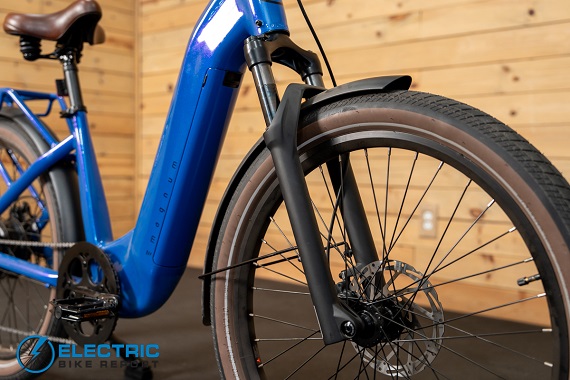
The Trama suspension fork offers 100mm of travel to keep the ride soft and smooth.
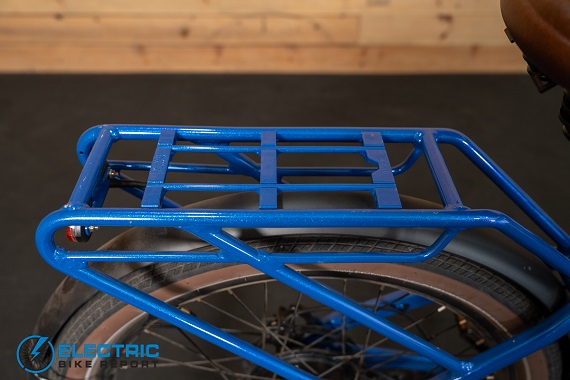
An MIK-HD cargo rack can be loaded with locking accessories, and has a 59.5 lb payload capacity.
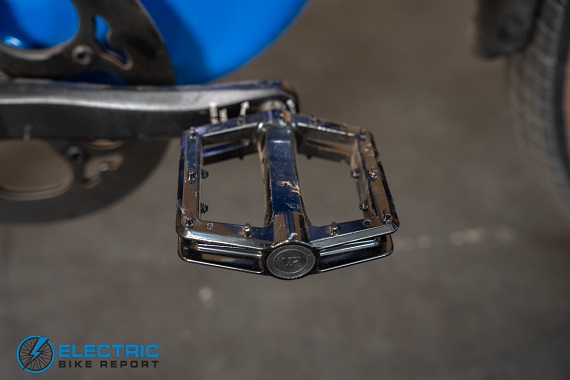
The Melody includes sturdy aluminum platform pedals.
Magnum Melody Review: Ride Quality
As we have seen throughout the main test sections above, the Melody’s performance is impressive. Ride quality is another area where the bike stands out; in this section, we’ll examine its fit, ride comfort, motor engagement, handling, and user interface.
Starting with sizing, Magnum offers the bike in a single frame size for riders between 4’11” and 6’3”, though this is somewhat dependent on inseam measurements. At 5’11”, and with a roughly 31” inseam, I found the bike extremely comfortable and well-sized.
These days, e-bikes commonly offer a relatively wide range of adjustability, but the Melody goes further than most to ensure a good fit. Its seatpost offers around 8 inches of saddle height adjustment, which was plenty for finding comfort and proper leg extension. The bike’s adjustable stem, which includes an integrated color display, offers a range of angles for handlebar height and reach.
I enjoyed the bike’s slightly sporty, yet mostly upright riding position. The soft, plush cruiser-style spring saddle and 100mm suspension fork largely eliminated bumps, making the ride feel silky smooth. While I don’t usually prefer faux leather grips, the Melody’s ergonomic handlebars and grips were both comfortable and easy to hold on to.
In terms of handling, the Melody steered predictably, and its 26” wheels made it more comfortable than many similar bikes with larger wheels and tires. As expected, the bike’s step-thru frame exhibited some flex, but I’d say it felt sturdier than most. Additionally, being slightly on the heavier side, the Melody felt solid and planted while riding.
The bike’s pedal assist system engaged quickly and responsively regardless of whether I used torque or cadence-sensing modes. In torque mode, the bike seemed to prioritize smoothness over a natural feel, so while it definitely felt like an e-bike instead of an analog bike, it expertly blended steady power with sensitive adjustments to my pedaling.
I was extremely pleased by the Melody’s level of customization. The ability to switch between sensor modes and Classes in addition to adjusting speeds is not an uncommon feature, but it is extremely useful. These options also allow e-bikes to be more versatile, adapting to their rider’s preferences as they might change over time.
As I touched on in the intro, the bike’s user interface is relatively simple and easy to grasp. The stem-mounted display looks clean and presents essential information legibly. Additionally, the cockpit isn’t overloaded with modules and controls, so with the exception of the small control panel and throttle lever, it functions just like a “regular” bike.
Magnum equipped the Melody with useful essentials, such as LED lighting (including a brake light), an MIK-HD cargo rack, fenders, and a color display. Considering its price point, however, we’d appreciate some additional value to better compare with similar models. Features such as turn signals, security measures, and/or a fast charger are just a few ideas.
To be clear, the Melody delivers a lot of e-bike for the buck. Its overall ride quality is great, with a comfortable and easy ride, a stable and sturdy feel, and a low learning curve.
Sponsor
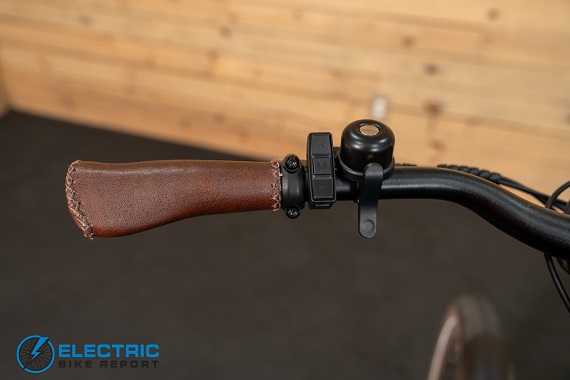
Ergonomic faux leather grips contribute to the Melody’s comfortable ride.
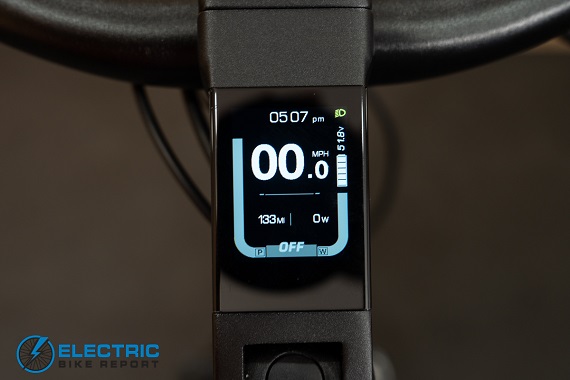
The stem-integrated color display is legible, clean-looking, and cool.
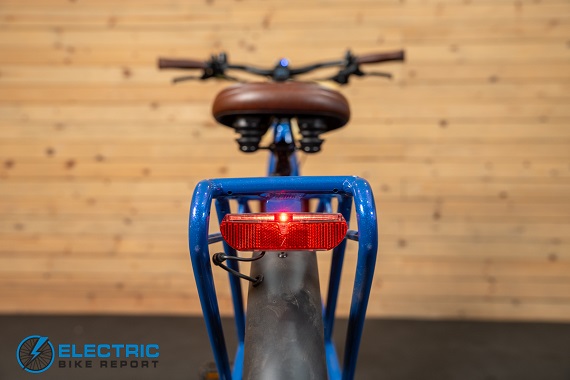
The rack-mounted LED taillight also functions as a brake light when the levers are squeezed.
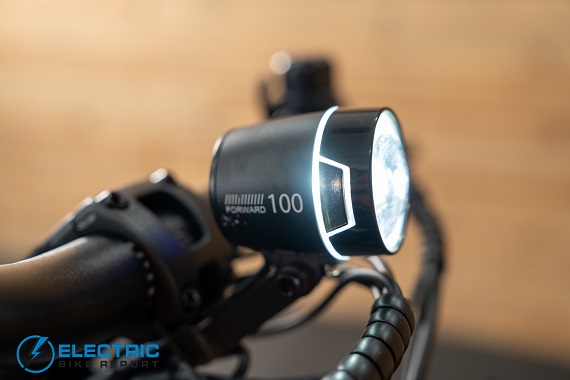
Integrated LED lighting helps keep the road ahead in view.
Magnum Melody Review: Summary / Where to Buy
Having previously tested a handful of e-bike models from Magnum, I can confidently say that the Melody is a noticeable step forward for the brand. In addition to simply being the comfortable and well-put-together ride we’ve come to expect, it also boasts more refined looks, a more contemporary user interface, and a more impressive array of customization options than we’ve seen before from Magnum.
The Melody performed well in our testing, with particularly impressive performance in a few key areas. It demonstrated well-balanced programming and the ability to confidently reach its advertised speeds in our Speed Test. It showed the potential to match, and potentially exceed, the performance of similar bikes in our Range Test.
Its slowing and stopping ability in our Brake Test was similarly impressive. And, while it may not have been the fastest e-bike we’ve ridden in our Hill Test, it proved able to complete the challenge—and successful at making the job both enjoyable and significantly easier than it would have been without a motor.
We appreciated the straightforward nature of its user interface and the simplicity of its features. With that in mind, our only real point of critique was that we hoped to see a few relatively common extras to increase the Melody’s overall value.
Otherwise, this relaxed and comfortable cruiser/commuter hybrid offers an adaptable, smooth, and responsive ride to those seeking a sturdy, controlled, and approachable e-bike. Whether used for evening leisure rides or the morning trip to the office, we recommend the Melody for new and experienced riders alike.
Happy Riding! Make sure to let us know if you have any questions or if you think we left anything out in this review of the Magnum Melody down in our comments section.
Sponsor
Sponsor
Reader Interactions
Comments
Leave a Reply




thanks for info.