

Mokwheel Flint Pro Review | Fitness Whole Bike Into My Life
Feb 27, 2026
 1 Comments
 Share
Share
This simple, lightweight city e-bike makes pedaling easier, gets you to work faster, and still allows you to get in a workout when you want it.
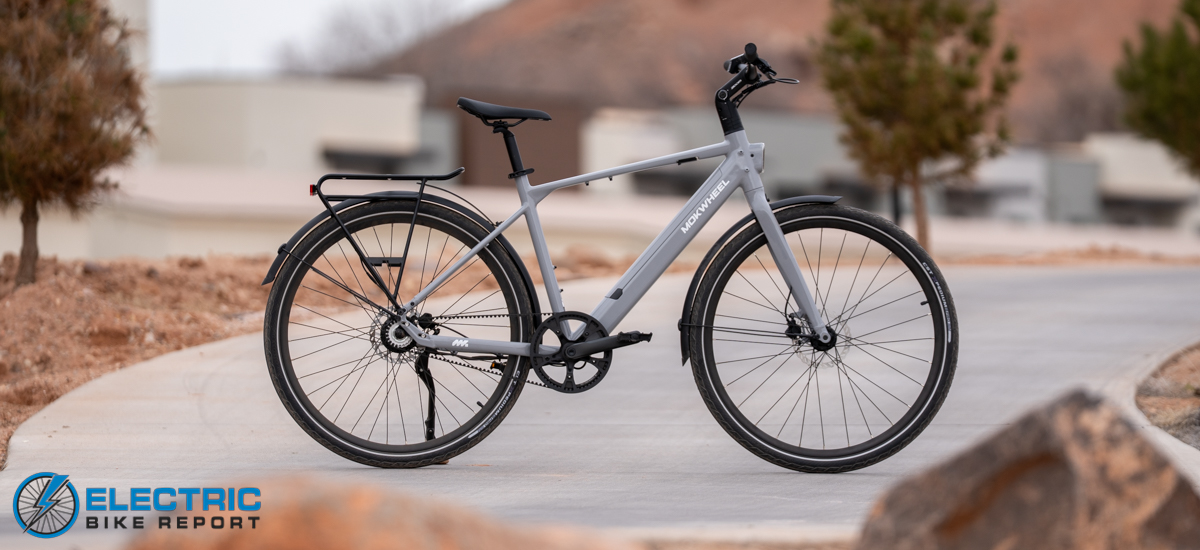
Some riders buy speedy throttle-equipped e-bikes to use as affordable, effort-free means of transportation. Others enjoy pedaling powerful e-bikes with the muscle to flatten hills and tear through loose dirt or sand. Still others prefer mid-power e-bikes for commuting or errand running, allowing for smooth, easy pedaling that doesn’t leave them sweaty.
Based on my experience, I’d say that the 40-lb Mokwheel Flint Pro is likely to appeal to the latter group, in addition to those seeking an active e-bike for fitness purposes. Its torque-sensing 250W hub motor provides responsive, supplemental power for easier pedaling and a boost of speed—all without taking away the natural feel of an analog bike.
Truly, I found it difficult to identify the Flint as an e-bike at first glance, as its tiny Mivice motor isn’t much larger than a standard wheel hub. Additionally, the unobtrusive, minimal display could easily be mistaken for a handlebar-mounted accessory. Only the Flint’s removable battery is an obvious tell, but even then, its slight down tube looks similar to that of a non-electric bike.
The bike’s minimalist design and simple interface also makes it approachable and easy to use. Its single-speed drivetrain requires no shifting, and its cockpit is generally clean and uncluttered, so it presents a small learning curve. Users can simply hop on the saddle, turn the bike on, choose a power level, and enjoy their ride.
But how does the Flint Pro’s performance compare to other lightweight urban e-bikes we’ve reviewed? We evaluated its speed, range, hill climbing power, and braking capabilities in our standardized testing. Continue reading below for all the details!

Sponsor
E-Bike Category:City/Urban
E-Bike Class:Class 1 (pedal assist to 20 mph)
Sponsor
Mokwheel Flint Pro Video Review
 Pros
Pros- The Flint Pro’s 250W motor provides responsive, modest pedal assist that’s ideal for active riders.
- It’s remarkably straightforward, simple, and easy to use, with a minimal display, no throttle, and no need to shift.
- A single-speed drivetrain makes for an easy, clean, low-maintenance experience, as the Gates Carbon belt lasts twice as long as a chain.
- At around 40 lbs, the Flint Pro is among the lightest, most nimble, and most portable e-bikes we’ve tested in the city category.
- The bike is firmly in the affordable tier, with a price point around $1,400 (at the time of writing).
- Mokwheel offers a variety of spec and comfort options, including a suspension-equipped ST model, a multi-speed chain drive option, etc.
- The Flint Pro feels sporty, yet comfortable, with an adjustable riding position and low-rise handlebars.
- The bike’s removable battery allows users to easily bring it inside for convenient charging—without the need to carry the whole bike in.
- There are a whopping total of 8 color options between the high-step and step-thru models.
 Cons
Cons- It’s great to have a comfort-focused ST option, but both frame styles are limited to a single size best suited for average to tall riders.
- As an urban e-bike, we hoped the Flint would include brake light functionality.
ELECTRICAL SPECS & FEATURES
- Battery: 36V 10Ah Complies with UL standards, IPX7 Waterproof
- Charger: 36V 3A
- Display: Intuitive Ride Data Display
- Motor: 250W Continuous Power, 500W Peak Power, 40 Nm Torque
- Headlight: Frame-integrated headlight
- Taillights:LED taillight mounted to cargo rack
- Pedal Assist: PAS 1-5
- Claimed Range: 50~70miles
- Throttle:N/A
- App:N/A
- UL Certification:Coming soon
Weight & Dimensions
- Claimed weight: 31 lbs
- Tested Weight: 40.4 lbs
- Rider height range: 5’5″ – 6’7″
- Total payload capacity: 350 lbs
Components & Accessories
- Brakes:TEKTRO HD-M275 Hydraulic Brakes, 160mm rotors
- Fenders: Plastic
- Fork:Aluminum front fork
- Frame: 6061 Aluminum Alloy
- Drivetrain: Single-Speed Belt Drive, 60T chainring, 22T freewheel, Gates Carbon belt
- Grips: Standard Rubber
- Saddle: High-resilience cushioning
- Handlebar: Aluminum Alloy, φ31.8mm, 700mm
- Kickstand: Sturdy Aluminum Alloy
- Pedals: Plastic Platform
- Tires: CST 700×45C
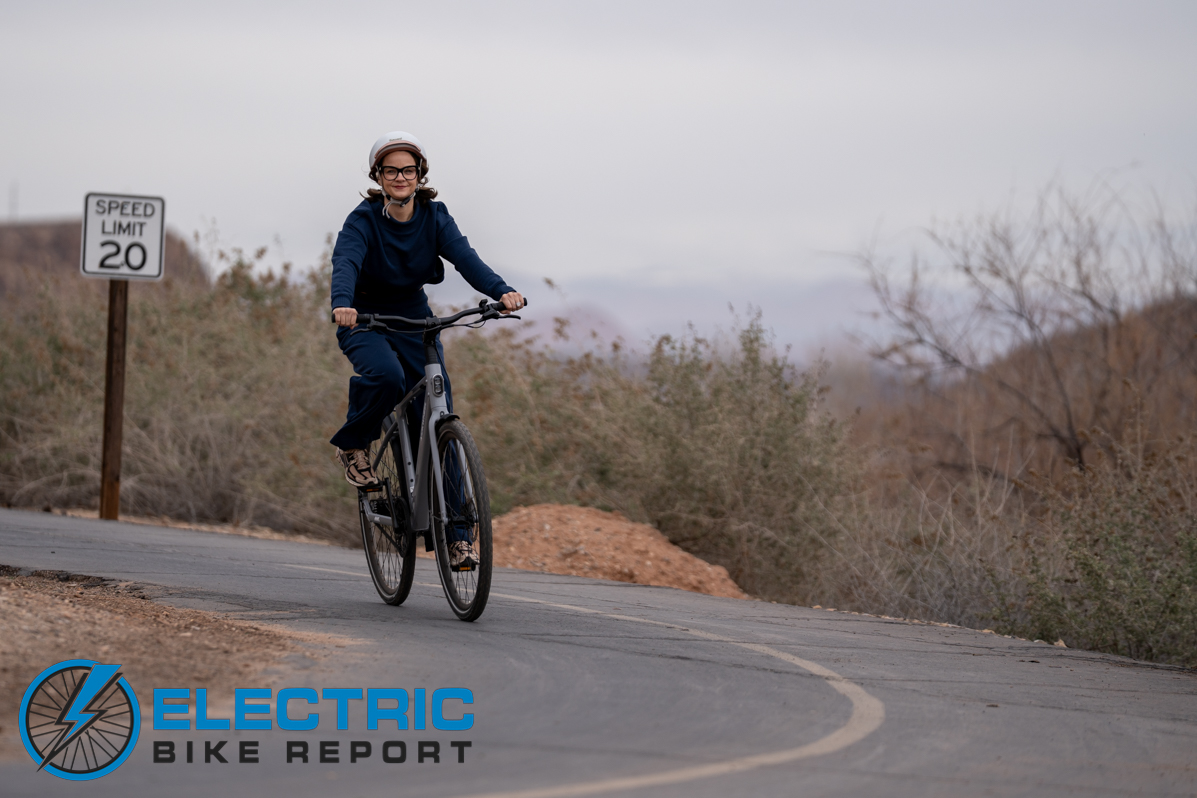
The Flint Pro is a Class 1 e-bike offering pedal assist to 20 mph and no throttle.
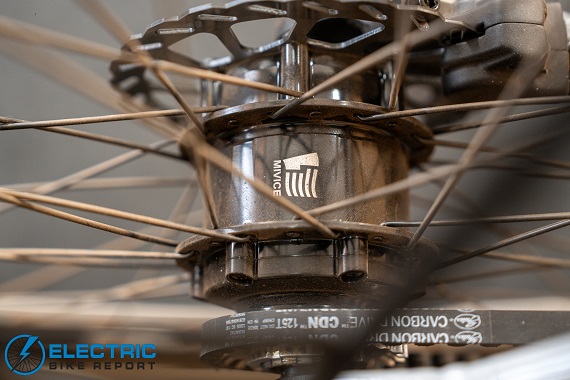
A 250W rear-hub motor provides a gentle boost that won’t overtake your effort.
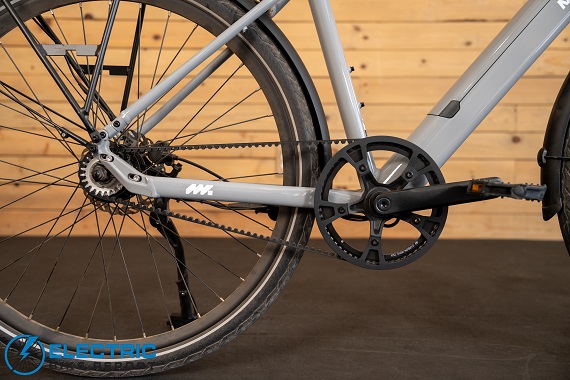
The Gates Carbon belt drive makes both pedaling and taking care of the bike easy.
Mokwheel Flint Pro Review: Speed Test
My Speed Test with the Mokwheel Flint Pro was simple: I pedaled the bike on a paved shared-use path in each of its five pedal assist levels while monitoring my average speed. With no throttle and no option to unlock the bike to speeds above 20 mph, the experience was short and sweet. See the graph above for my results.
As shown, I began pedaling with no assist at a relatively high speed with moderate effort. With a single-speed drivetrain that incorporates a large 60T chainring, starting from a complete stop required some effort, but maintaining speed once moving was an easy task.
Once I activated the pedal assist system (PAS), the bike’s 250W motor gave me a helpful boost, with incremental jumps in speed and power as I tested each power level. Going by my data, the largest and most meaningful leaps occurred when moving from PAS 1 to PAS 2 and PAS 2 to PAS 3.
This was potentially a result of changes in the path or my own pedal effort, as the Flint’s torque sensor allows its motor output to fluctuate. By feel, I noticed the most meaningful increase in assistance when moving up to PAS 4.
Regardless of which setting I used, the bike maintained an analog-like feel and response. Pedaling felt active and engaging at all times, giving me a light to moderate workout. Having put on a few pounds during the holidays, I rode mostly using PAS 4 and 5, which effectively lowered the effort needed to move the bike while still bringing my heart rate up.
All in all, the Flint Pro showed a well balanced PAS with meaningful differences in power output. While it required some effort to reach the maximum of 20 mph, the bike’s feel and performance matched our expectations for a modestly powered exercise-centric e-bike.
Sponsor
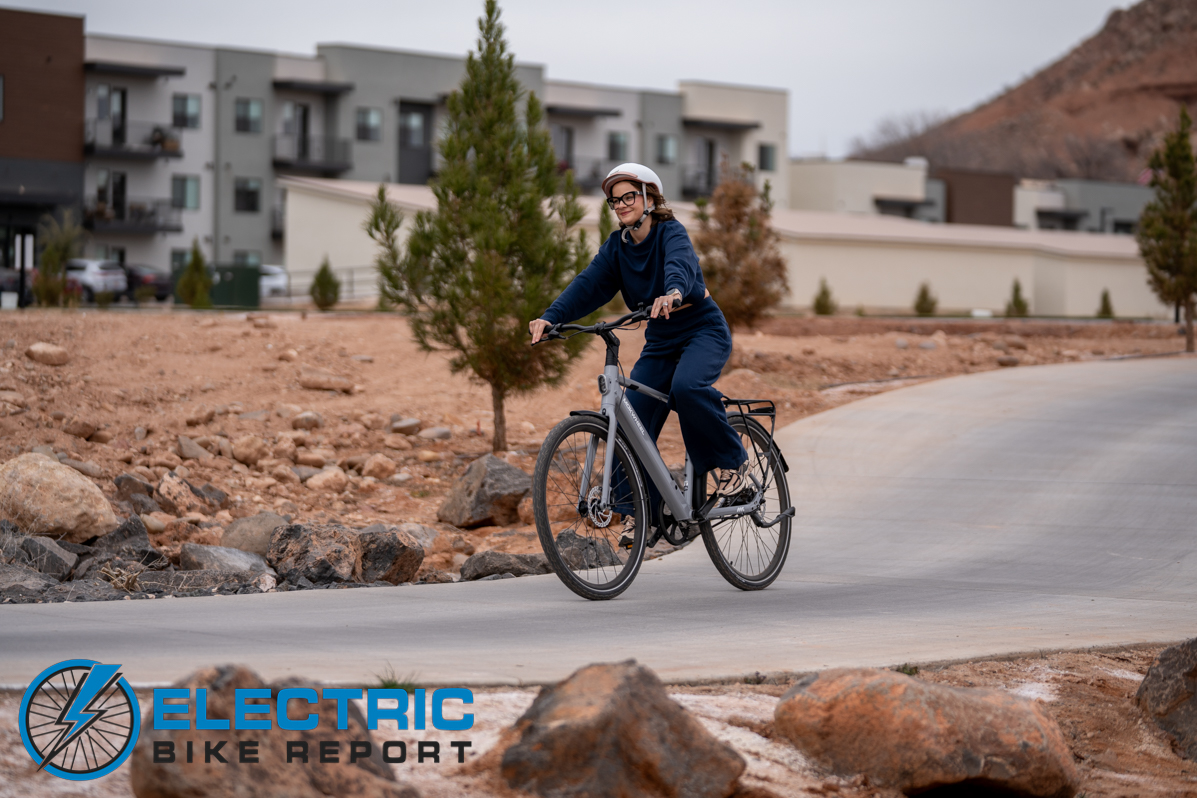
The simple interface and single-speed drivetrain make for a simple and easy to learn e-bike.
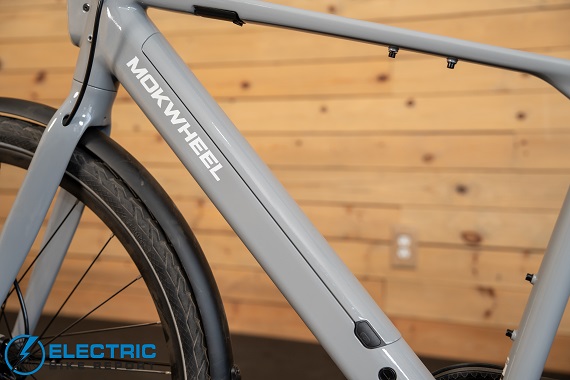
We liked that the Flint Pro’s battery was removable for easier charging.
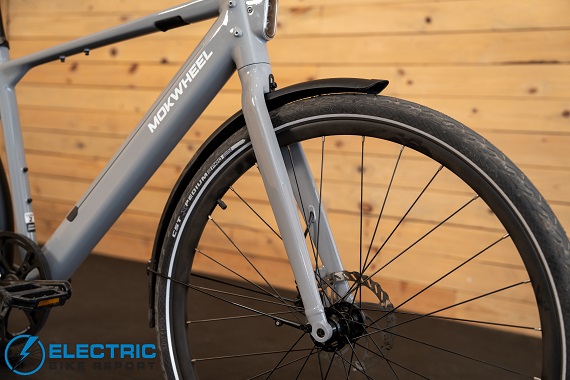
A rigid aluminum fork keeps the handling crisp and nimble.
Mokwheel Flint Pro Review: Range Test
As shown in the graph above, a team of four of our test riders (including myself) completed two tests designed to measure the Flint Pro’s minimum and maximum range. For our low-power range test, we opted to use PAS 2 instead of PAS 1, as we felt most riders would prefer the more meaningful level of assistance in the bike’s second riding mode.
The Flint Pro covered 41.3 miles in its PAS 5 test and 59.8 miles in PAS 2, both of which exceed the average minimum and maximum test results among similar e-bikes. These models, including many of the best city e-bikes we’ve tested, averaged 25.5 and 53.2 miles in their testing.
These bikes carried batteries averaging 359 Wh of capacity—nearly identical to the Flint Pro’s 360 Wh battery. With this in mind, the main reason for the Flint Pro’s greater range was its motor.
Our comparison group included e-bikes with 250W, 350W, and 500W motors, which averaged 361W, so the Flint’s less powerful than average 250W motor was more economical in using the same amount of charge.
Mokwheel advertises a range of 50-70 miles with a full battery. Our testing shows that the low end of this range may be hopeful, though it is possible that riders using a minimal amount of power in PAS 1 may be able to reach the 70-mile ceiling.
A realistic range of roughly 41-60 miles is not only impressive, it should give users many rides from a single charge regardless of whether it is used for commuting, leisure, or long exercise trips.
Mokwheel smartly equipped the bike with a removable battery, which can be separated from the bike for inside charging or to reduce weight during transport. The included 3 amp charger can refuel the Flint Pro’s 10 Ah battery in under 3.5 hours, requiring only a short break in riding before getting back out on the roads.
Sponsor
Sponsor
Mokwheel Flint Pro Review: Hill Test
The Flint Pro made another strong showing in our Hill Test, where we measured its climbing performance using the method explained in the graphic above. Our test rider, Justin, pedaled to the top of the Devil’s Backbone in 2:31 while maintaining an average speed of 12.0 mph.
This closely matches the average among similar models we’ve tested, which completed their own climbs in an average of 2:30. The ability to achieve average results typically means that a bike is specced appropriately and able to match its competition, so we consider the bike to have performed very well.
The Flint’s results are even more impressive when considering the main factors that influence this test: a bike’s weight, peak motor power, and torque. Its motor peaks at 500W and can produce 40 Nm of torque—both significantly less than the average of 613W and 49 Nm when compared to similar models—but it also weighed a few pounds less. Mokwheel’s city bike weighed 40.4 lbs, while the comparison models weighed 44 lbs on average.
Single-speed drivetrains are typically a limiting factor during this test, and the inability to adjust the Flint Pro’s gearing ratio did make it necessary for Justin to pedal harder to reach the top. This may have also had the unintended effect of increasing his cadence to maintain speed and continue traveling uphill, giving the bike an unexpected edge in its test results.
In my personal testing at our secondary location, Pilot Hill, I was grateful for the motor’s modest but helpful power. The single-speed drivetrain created resistance that left me breathing hard upon reaching the top. The motor successfully made the experience far less exhausting than it would have been on an analog bike, though still appropriate for an exercise-focused experience.
Additionally, while the Flint Pro’s test score proves that it can and does provide helpful power, it is optimized for riding on relatively flat ground. Riders in hilly areas may want to consider the standard version of the Flint, which includes an 8-speed chain drive for more efficient uphill pedaling and a slightly more powerful 350W motor, though this version of the bike is not as low-maintenance.
Sponsor
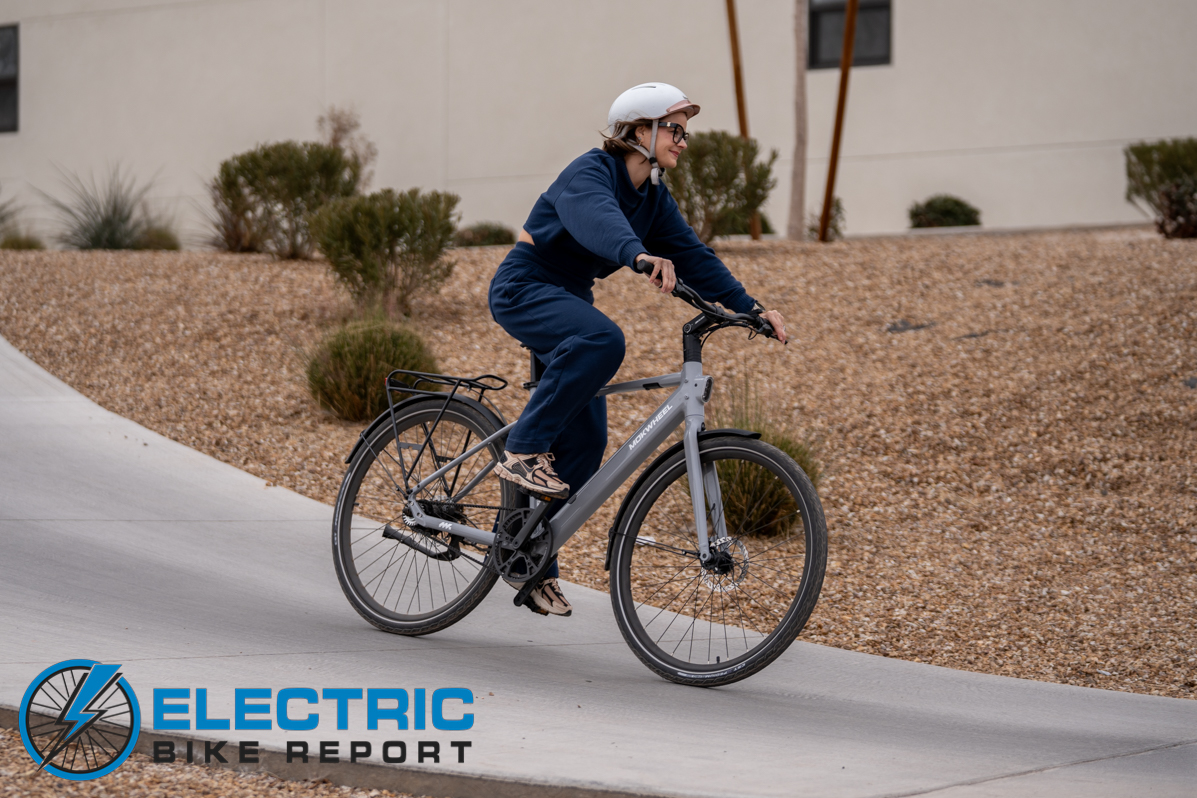
The Flint Pro has a sporty, forward-leaning rider position, but we never found it too aggressive.
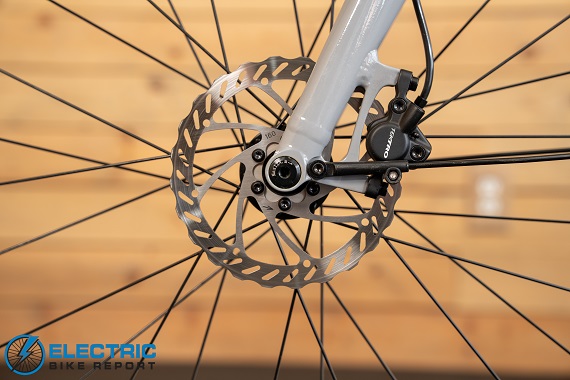
The brakes pair two-piston calipers with 180mm rotors.
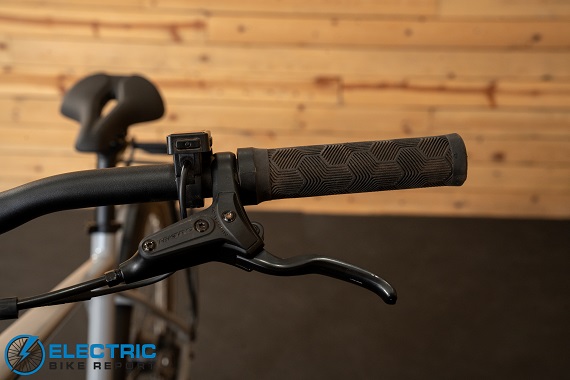
Mokwheel equipped the Flint Pro with Tektro’s HD-M275 hydraulic brake system.
Mokwheel Flint Pro Review: Brake Test
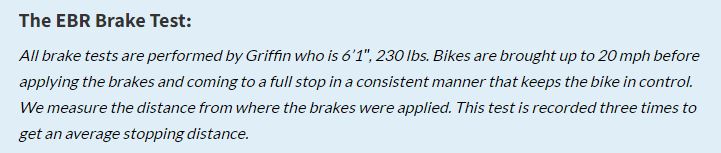
In our Brake Test, the Mokwheel Flint Pro once again proved competent. Using the method above, we determined its average stopping distance to be 23’2”. This score is just a few inches beyond the average of 22’11” when comparing it with similar models, meaning that the Flint is appropriately outfitted.
Like many similar bikes, the Flint Pro uses a two-piston hydraulic disc brake system with 160mm front and rear rotors. More specifically, it uses the Tektro HD-M275 brake system—a common model that should be easily serviced and has proven effective in our testing.
Considering that its brake system is familiar, its weight is just shy of the average, and its 700c x 45mm CST Xpedium tires are also appropriate for a lightweight urban e-bike, it was no surprise that the bike’s performance lined up so well with its competition.
In my own testing, I found the brakes strong and effective with good modulation. Under hard braking, I experienced some expected skidding and fishtailing due to the tires’ relatively smooth tread, but the bike felt safe and controlled.
My only point of critique is that the Flint Pro’s taillight does not function as a brake light when the brake levers are squeezed. Considering its onboard battery, I would like to see this feature in the future, as it increases rider safety on congested roads.
Otherwise, the Flint Pro performed well and proved safe, so it earns our approval.
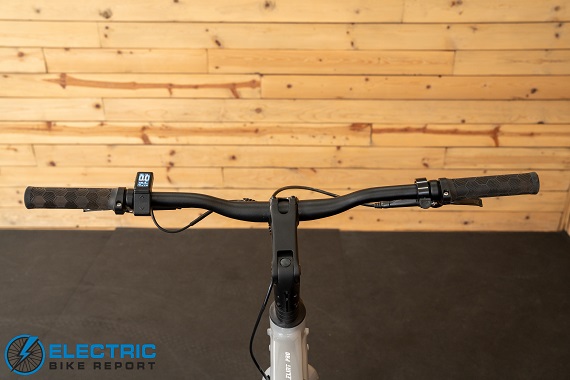
The low-rise handlebars provide great steering control and solid comfort, too.
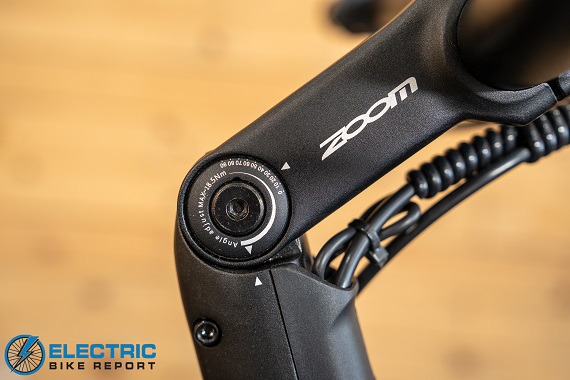
An adjustable stem allows riders to set the reach and handlebar height comfortably.
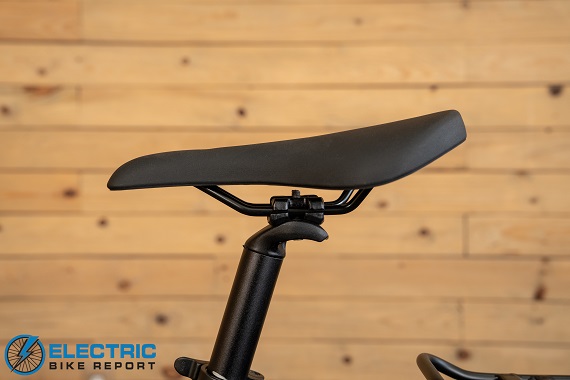
The slim, performance-style saddle was softer and more comfortable than I expected.
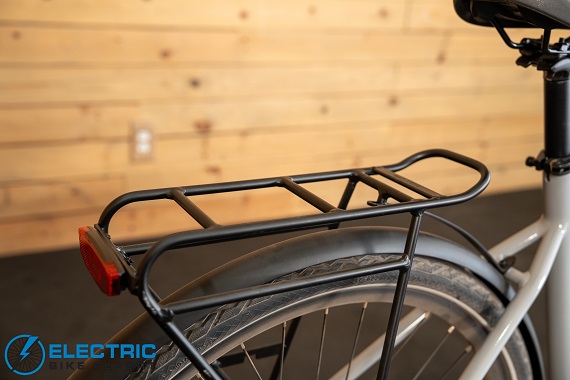
An included cargo rack makes the Flint Pro well suited for daily commuting.
Mokwheel Flint Pro Review: Ride Quality
As a lightweight city e-bike, I found the Flint Pro to be nimble, straightforward, and approachable.
Mokwheel offers just a single frame size intended for riders between 5’5” and 6’7”. As such, it’s best-suited for riders of average to tall height; those on the shorter end of the spectrum may need to consider other models in the company’s lineup, such as the Asphalt ST.
The Flint Pro is, however, available in two configurations. We tested the high-step model, which includes a traditional diamond frame, a rigid aluminum fork, and low-rise handlebars. A more comfort-oriented step-thru (ST) model is also available, which includes a 65mm suspension fork, swept-back cruiser-style handlebars, and a 17” standover height.
As a 5’11” rider, I found the HS model to be comfortable and sporty, with a somewhat stretched out, forward-leaning riding position. The seatpost gave me enough room for efficient pedaling and full leg extension, while the adjustable stem allowed me to set my preferred handlebar height. Soft rubber grips helped absorb vibrations and impacts.
The Flint Pro’s ride is agile and spirited, with quick handling and great maneuverability. Its 700c x 45mm tires provide good traction and stability; they can also serve to smooth bumps when their pressure is reduced. The bike’s 40-lb total weight makes it fun to ride and easy to carry up a flight of stairs, bring on public transit, or lift onto a vehicle rack.
I was impressed with how well-equipped the bike was for its sub-$1,500 price. The Gates CDN belt drive is long lasting, with an expected lifespan twice that of a chain. It also requires no lubrication and allows for smooth, quiet pedaling. Additionally, the Flint Pro includes fenders, lights, and a cargo rack rated for up to 33 lbs, and comes in four color options (technically 8 when considering the ST model).
As I touched on in the introduction to this review, the Flint Pro’s simplicity is one of its best features; it’s a great option for riders seeking a straightforward e-bike that is uncomplicated by too many buttons, settings, and features.
Its responsive motor output is also worth touching back on. Having tested many of Mokwheel’s e-bikes, I can attest that the Flint Pro is one of the most natural-feeling models from the brand. For those seeking a stripped-down, active, and comfortable city e-bike, it delivers great overall ride quality.
Sponsor
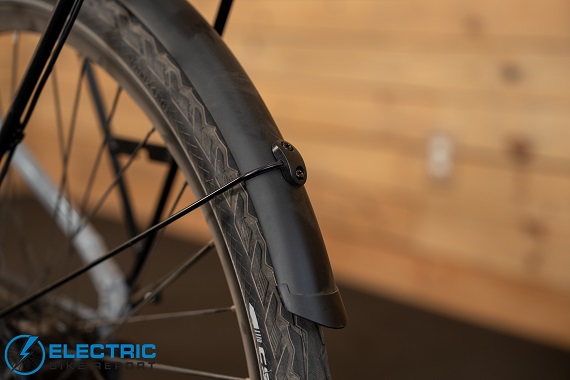
Both wheels have full coverage plastic fenders to keep you dry in the rain.
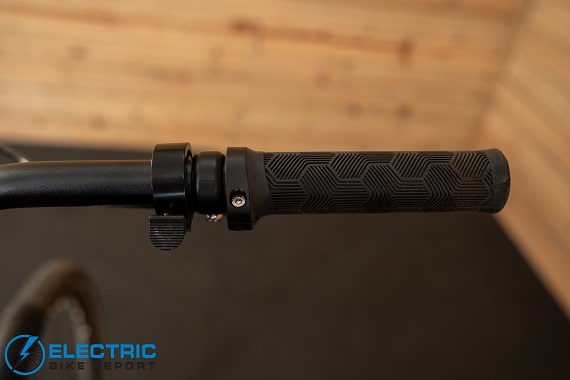
Textured rubber grips help absorb vibrations and soften the impact of bumps.
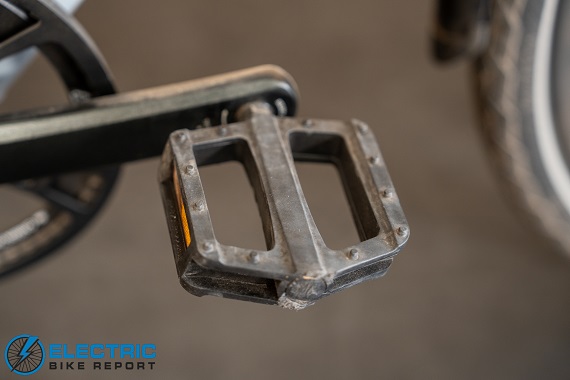
The plastic platform pedals are relatively standard for a city e-bike.
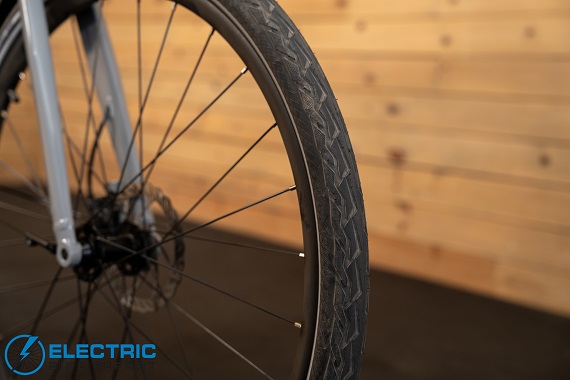
The Flint Pro’s street tires have a low-profile tread for smooth rolling.
Mokwheel Flint Pro Review: Summary / Where to Buy
Whether talking about fat tire e-bikes like the Basalt, the Obsidian, or the Onyx, Mokwheel’s e-bikes have a well-earned reputation for being speedy and powerful. With its lightweight frame, 250W motor, and modest, responsive pedal assist system, the Flint Pro is different from many of the brand’s other models, but every bit as well put together.
In spite of the natural limitations of a single-speed drivetrain, this version of the Flint demonstrated consistently good performance that met or exceeded that of its peers. In addition to intuitive programming and consistent climbing performance, the bike delivered solid braking and impressive range.
Of course, its setup makes it best suited for relatively flat areas and riders seeking a light to moderate workout while pedaling, but these aspects help to increase its energy efficiency and make it easy to operate. The Gates belt drive also makes for a low-stress and low-maintenance experience, along with clean and quiet operation.
Our main points of critique were relatively minor; additional frame sizes would make the bike more approachable for shorter riders, while the inclusion of brake lights would increase rider safety on crowded streets.
Even with these factors, however, the Flint Pro is easy to recommend for riders who enjoy pedaling and wish to retain the sensation of using a non-electric bike. It’s an affordable, active, lightweight, and approachable e-bike that would make a great short-range commuter, long-distance exercise bike, or just about anything in between.
Happy Riding! Make sure to let us know if you have any questions or if you think we left anything out in this review of the Mokwheel Flint Pro down in our comments section.
Sponsor
Sponsor
Reader Interactions
Comments
Leave a Reply




The lowest seat height requires someone at least 5’8″ and long legs. I’m 5’8″ and apparently short legs and it would be hazardous for me to ride and no way could my 5’7″ wife use it!