Heybike Venus Review | A Veritably Lovely City Cruiser
Mar 03, 2026
 0 Comments
 Share
Share
The Venus is sleek, comfortable, and approachable, offering excellent value for riders who want more than the basics without spending an arm and a leg.
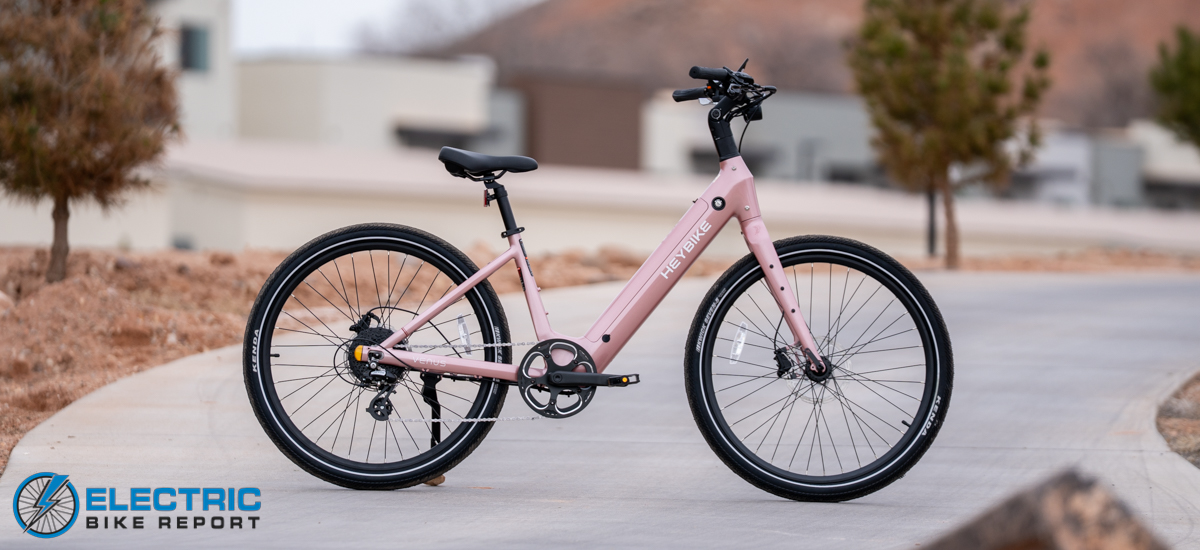
E-bikes in the city cruiser category are popular for a variety of reasons. First, their upright riding positions feel comfortable and relaxed, keeping your wrists, neck, and back free from strain. Second, their light-to-mid-weight frames allow for nimble handling and easy portability. Third, bikes of this style are often lively and fun without being overpowered.
In my experience, the complexity of a city cruiser can vary greatly. Some are extremely simple and feature-light, making for budget-friendly but sparsely-equipped e-bikes. Others on the opposite end of the spectrum can be costly, overloaded with features and functions, and relatively difficult to learn and operate.
Based on my first test ride, the Heybike Venus strikes a great balance between these extremes.
On one hand, the Venus includes coveted features such as Bluetooth connectivity and a useful mobile app, along with a peppy 750W motor, integrated turn signals, and hydraulic disc brakes. For its price of around $1,500, this means that it provides solid value while still sitting firmly on the affordable side.
On the other hand, it’s not overcomplicated with too many settings, buttons, or customization options. Its default programming is practical, its motor provides smooth and helpful power for easy pedaling, and its feature package doesn’t extend too far beyond the basics.
In short, my first thoughts about the Heybike Venus were that it was comfortable, approachable, and generally well-equipped, which is exactly what I’d hoped for. But did its performance in our standardized testing hold up to that initial impression? See our full review below for test scores, comparisons with similar models, and a final verdict!

Sponsor
E-Bike Category:Cruiser / Commuter
E-Bike Class:Class 1 (pedal assist to 20 mph)
Class 2 (throttle to 20 mph)
Class 3 (pedal assist to 28 mph)
Class 2 (throttle to 20 mph)
Class 3 (pedal assist to 28 mph)
Sponsor
Heybike Venus Video Review
 Pros
Pros- Pedaling the Venus is fun and easy, thanks to the bike’s peppy 750W motor and pre-programmed speed limits.
- Power feels smooth yet responsive thanks to the combination of torque and cadence sensors.
- Its $1,500 price is well balanced with its specs, feature package, and overall ease of use. Notable inclusions are its 750W motor, 680 Wh battery, turn signals, color display, and more!
- At 54 lbs, the Venus is nimble and manageable to lift while also feeling stable and solid.
- The Heybike app is robust and useful, offering speed and PAS level adjustments, navigation, ride tracking, and a social media platform.
- Our estimated low-power range of around 75 miles puts the Venus well above average when compared to similar bikes. See below for more details.
- The bike’s fit is comfortable and adjustable, with upright positioning, 90 degrees of stem adjustment, and an accessible step-thru frame.
- Heybike offers a handful of appealing color options for the sleek frame, including a bluish Titanium Grey, an elegant Rose Gold, and a traditional Pearl White.
 Cons
Cons- The bike’s fluctuating battery charge level made it difficult to estimate the bike’s remaining range. We encourage Heybike to use a more reliable readout.
- We hoped to see an integrated tail/brake light to go with the bike’s headlight and turn signals.
ELECTRICAL SPECS & FEATURES
- Battery: 680Wh (UL 2271 Certified)
- Charger: 54.6V/2A
- Display: LCD Color Display
- Motor: 750W (1100W Peak) Hub Motor (Galaxy eDrive System), 70 N.m
- Headlight: Front Light w/ Horn
- Taillights:Integrated Turn Signals & Red Reflector
- Pedal Assist: Dual Sensor (Torque + Cadence)
- Claimed Range: 85 Miles (Tested with a 155 lb rider using PAS 1)
- Throttle:Thumb Throttle
- App:Heybike Smart APP for iOS & Android
- UL Certification:UL 2271 & UL 2849 Certified
Weight & Dimensions
- Claimed weight: 50 lb w/ Battery
- Tested Weight: 54.1 lbs w/ Battery
- Rider height range: 4’11” – 6’2″
- Total payload capacity: 350 lb
Components & Accessories
- Brakes:Hydraulic Disc Brakes, 180×1.9mm Rotor
- Fenders: Not Included
- Fork:Aluminum Rigid Fork
- Frame: 6061 Aluminum Alloy Frame
- Drivetrain: Shimano Altus 8SP , 11-32T Cassette, 48T Chainring
- Grips: Ergonomic Rubber
- Saddle: Sport Saddle
- Handlebar: Dutch style
- Kickstand: Included
- Pedals: Plastic Platform
- Tires: 27.5″x2.2″ Kenda
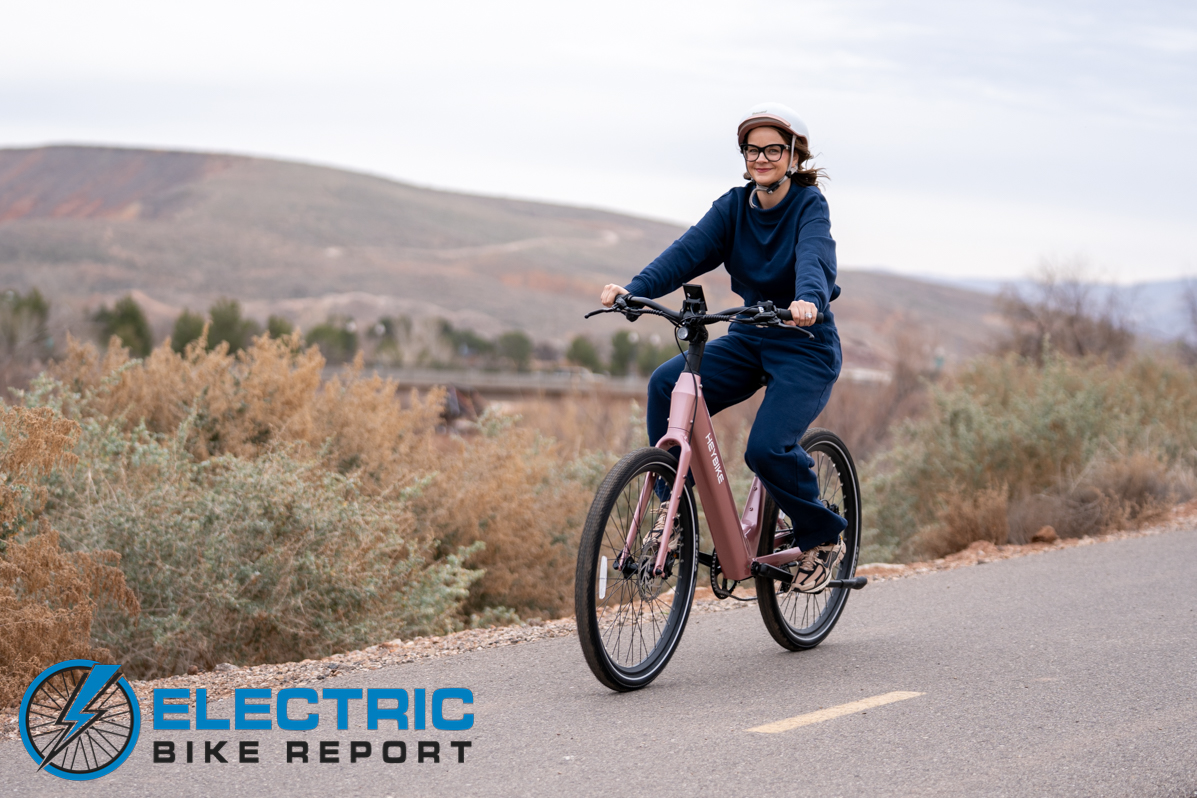
Riders can switch between Eco (20 mph max.) and Sport (28 mph max.) modes through the Heybike app.
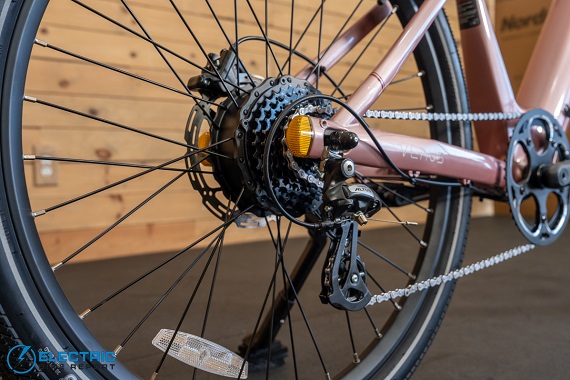
A 750W hub motor delivers helpful power quickly without feeling scary or punchy.
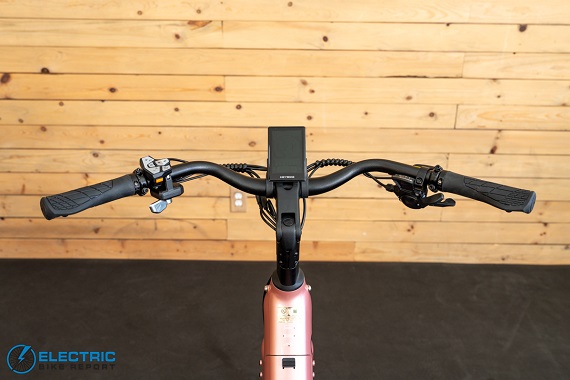
The bike’s curved, cruiser-style handlebars promote comfort and a relaxed riding position.
Heybike Venus Review: Speed Test
Out of the box, the Venus is a Class 2 and 3 e-bike, offering pedal assist up to 28 mph and throttle up to 20 mph. Once paired with the Heybike app, users can adjust the bike’s maximum speed and the individual limits of its five pedal assist system (PAS) settings—or quickly switch between Eco and Sport riding modes to change Classes and speeds.
I tested the bike in both modes to determine its preset speeds; see the graph of my results above.
When riding without power from the motor, the Venus felt somewhat weighty (it is an e-bike, after all), but its gearing range made it generally comfortable and easy to pedal. The lowest assist level delivered minimal power, with each subsequent PAS setting kicking out more power and creating an easy, low-effort experience.
While the bike’s programming in Sport resulted in more smoothly balanced, incremental jumps in speed when moving between assist levels than in Eco, both riding modes generally felt intuitive. In most cases, the bike’s actual velocity differed slightly from its listed speeds within the app, though it still felt capable, powerful, and quick to deliver power at all times.
In addition to Eco and Sport modes, the app offers a custom setting where riders can select between three and five assist levels, fine-tune the speeds of each PAS setting, and determine whether the throttle is limited to 20 mph in all settings or set to match the PAS limits.
When testing the default throttle settings, the bike accelerated gradually at first, then picked up speed steadily as it cruised to the Class 2 limit. Interestingly, it was able to firmly reach 20 mph via throttle despite not quite landing at that limit when pedaling in Eco.
Overall, the Venus performed well here, though the accuracy of its default programming has some slight room for improvement. I liked that the bike felt safe and approachable with intuitive speed distribution, and the fact that each programmed speed limitation can be adjusted to suit the rider’s preferences largely negates any critique.
Sponsor

Whether cruising the neighborhood, riding to work or school, or tagging along on family bike adventures, the Venus is well-suited for relaxed and easy riding.
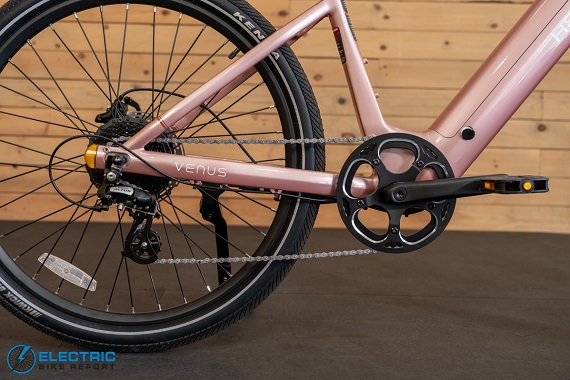
An 8-speed Shimano Altus drivetrain offers gearing for comfortable pedaling and quick speeds.
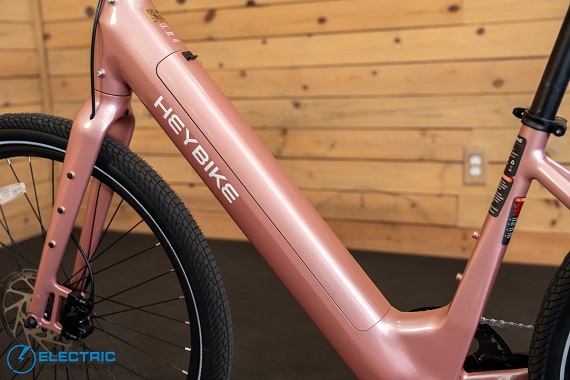
The bike’s fully integrated 680 Wh battery can be accessed by removing the cover in the down tube.
Heybike Venus Review: Range Test
Those shopping for the Heybike Venus may notice the bike’s advertised 85 mile range, which is based on the bike’s 750W motor, 680 watt-hour (Wh) battery, and the bike’s lowest pedal assist level. We tested the bike’s real-world minimum and maximum range using the method explained above, though we encountered a technical issue along the way.
We rely heavily on Strava to track mileage while conducting our range tests, often sharing long rides between our team of test riders. During our maximum range test with the Venus, where our testers used the bike’s lowest assist level, we lost the data from the final segment of the test.
Our PAS 5 test was completed successfully, showing that riders should expect a minimum of 31.6 miles from a single charge. We calculated a total estimated distance of roughly 75 miles for the bike’s PAS 1 test based on the portions of data that were collected and saved.
How do these results compare to similar e-bikes we’ve tested?
Quite well, as it turns out; a group of popular, extremely similar city cruisers averaged 31.2 miles in their max-assist tests. This shows that the Venus is generally well-equipped and programmed, and able to keep pace with its competitors. The same group averaged 61.3 miles in their low-power tests, so the Venus has clear potential to exceed this benchmark.
The group of models used for comparison had less powerful motors and smaller batteries—on average, 560W and 574 Wh, respectively—so these results are not surprising. Heybike equipped the Venus with a powerful (yet controlled) motor and a larger battery to keep it running at least as long as its competition.
It’s worth noting that we adjusted the bike’s speeds to match the 20 mph speed limit on our local shared-used paths for this test; riders traveling at higher speeds or relying on the throttle for propulsion should expect fewer miles.
A realistic range of roughly 32-75 miles, however, should provide enough mileage for those with long commutes who use relatively high power levels to get to their destination without range anxiety. Those using the bike for shorter trips or who are comfortable traveling at slower speeds should anticipate multiple rides from a single charge.
There was one area with some room for improvement that became apparent during our test—the bike’s charge indicator. Whether using the bar-based readout on the display or the percentage-based readout in the Heybike app, the charge level fluctuated widely depending on the motor’s energy requirements in a given moment. We challenge Heybike to include a more steady and reliable readout in the future for more predictable range estimation.
Regardless, the Venus includes a standard 2A charger that can refuel the battery in roughly 7 hours. As such, riders with extended commutes will be able to top up their battery during their shift, while those recharging at home can plug the bike in overnight.
Sponsor
Sponsor
Heybike Venus Review: Hill Test
The Heybike Venus proved impressively capable in our Hill Test. Using the process above, we tested its motor power in two trials. Using its throttle, the Venus completed the test in 1:59 at 15.2 mph on average. When our test rider, Justin, pedaled using PAS 5, he shaved the bike’s time down to 1:55 at 15.8 mph.
Similar city cruisers completed their throttle tests in an average of 2:06 and their max-assist tests in 2:08. So while the Venus didn’t outperform its competitors by a huge margin, it still proved consistently faster in both portions of the test.
The bike’s main advantage seemed to be in peak power output, though it was also a few pounds lighter than average. While our group of comparison models weighed 57 lbs and were driven by motors with 944W of peak power and 64 Nm of torque, the Venus tipped the scales at 54 lbs, and its 750W motor produced 1100W of peak power and 70 Nm of torque.
In practice, this means that Heybike’s city cruiser is well-equipped for hilly areas. It is powerful enough to give riders the option of throttling or pedaling over hills, though as is typically the case, the fastest results are possible when the rider contributes some pedal effort. As touched on elsewhere, however, pedaling is easy and relaxed at all times.
Sponsor

Five pedal assist levels with pre-programmed speeds allow riders to choose their pace and stick to it with strain-free pedaling.
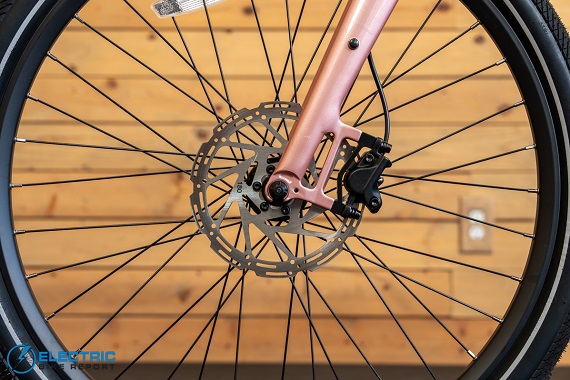
The brake-system’s two-piston calipers are paired with 180mm rotors.
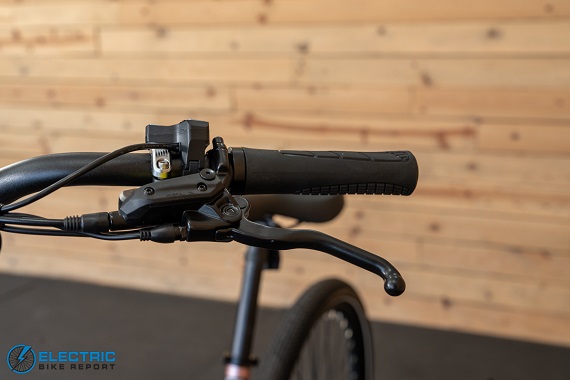
Brakes are activated by squeezing the sturdy-feeling brake levers.
Heybike Venus Review: Brake Test
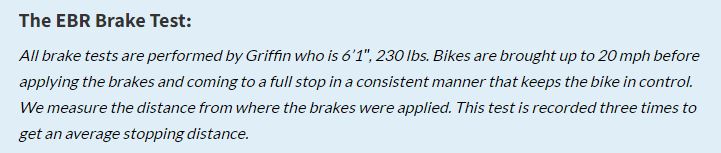
After conducting our Brake Test using the method explained above, we calculated the Heybike Venus’s average stopping distance to be 24’5”. This result is decidedly on the longer side when compared to similar models, though it is still within the range we consider safe.
A group of similar e-bikes, including many of the best electric cruiser bikes we’ve reviewed, averaged 22’2” in their tests, placing the Venus over two feet beyond this distance. To determine why its braking distance was extended, let’s examine some of the main factors influencing the results of this test, including the bike’s weight, brake specs, and tires.
We weighed the Heybike Venus at just over 54 lbs, including its 7-lb battery, while similar models averaged around 57 lbs. With this in mind, the Venus should be no more difficult to slow down than its competitors.
Heybike equipped its city cruiser with two-piston hydraulic disk brakes and 180mm rotors on both wheels. While its brake levers and calipers are unbranded, its base-level specs are comparable to our group of comparison models. By feel, they also provided good control and modulation of speed, so nothing seemed off in this area.
Finally, the Venus uses Kenda’s 27.5×2.2” Kwick Seven.5 street tires, which are relatively common and appropriate for this style of bike, though they are made with a relatively firm compound.
We’ve noticed some other models with this tire exhibiting somewhat longer than average stopping distances, and in my personal testing, the bike could skid for an extended time under hard braking. This required me to make a controlled ramping up in grip pressure when applying the brakes to avoid losing traction.
One of my few points of critique centers around the bike’s integrated lighting system. As I would expect, the Venus includes a functional LED headlight. I was pleased to see that it also had frame-integrated rear turn signals, but I would personally rather see an integrated tail light/brake light for safety instead of the indicator lights and the included red reflector.
Overall, the Venus performed well in real-world conditions and its braking distance landed within the range of our expectations, though I recommend some practice with the bike to understand its nuances.
As such, we don’t recommend that Heybike implement any changes. Those who wish to shorten its braking distance, however, may want to consider swapping to a tire with a softer, grippier compound.
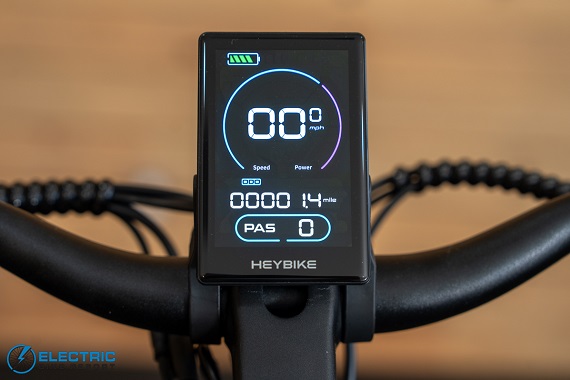
A color LCD display presents ride data, assist level, motor power, charge level, etc., in an appealing and well-organized manner.
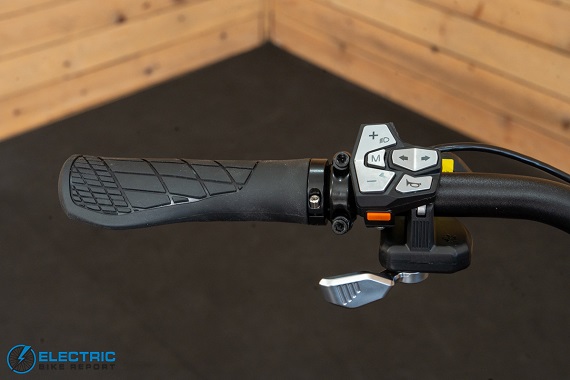
All of the bike’s main functions, including the throttle, PAS adjustment, and turn signals, can be accessed comfortably from the grips.
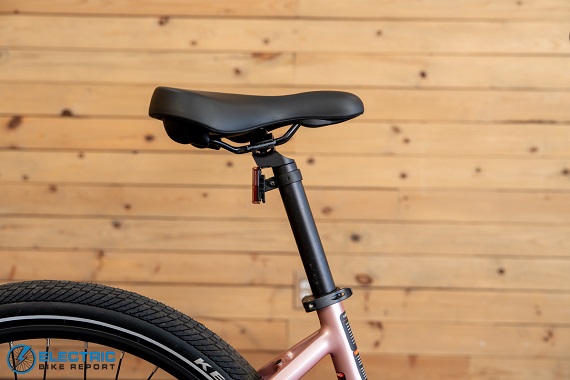
The Venus’s sport-style saddle is soft, comfortable, and supportive.
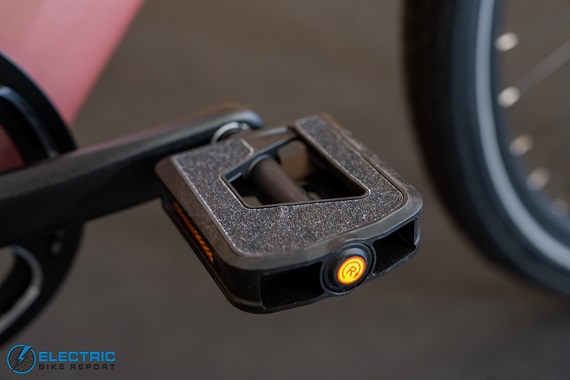
The standard pedals with grip tape worked fine, but aren’t as grippy as studded pedals.
Heybike Venus Review: Ride Quality
Each e-bike is unique, exhibiting different levels of comfort, motor responsiveness, user-friendliness, and functionality. In this section, we’ll examine the bike’s sizing and fit, ride feel, user interface, and more to explain what riding and using the Venus is like.
Beginning with sizing, Heybike makes a single frame size advertised to fit those between 4’11” and 6’2”. The bike offers a respectable 7” of saddle height adjustment and an adjustable stem with 90 degrees of rotation, allowing riders to tweak its fit and riding position to their preferences.
At 5’11”, I felt generally comfortable, though I’d have personally preferred more leg extension when pedaling. With the stem set to a relatively vertical angle, its reach felt average to somewhat long. While I had a bend at the knee when pedaling, the motor and PAS were well-tuned to provide an easy, strain-free experience.
As we’ve come to expect from e-bikes of this style, the Venus felt nimble and quick to accelerate. Its 27.5×2.2” tires offered a stable ride with a good balance of comfort and rolling efficiency, effectively softening bumps and steering responsively. Like many city cruisers, the Venus has a rigid fork that provides crisp handling, and its tires and saddle absorb most impacts and vibrations.
Riding is relaxed and upright, with comfortable positioning and ergonomic hand placement from the swept-back handlebars. I’d likely swap the basic grip-tape-covered pedals for grippier studded pedals, but otherwise, I liked the rubber grips and sport-style saddle.
The motor felt capable and quick to respond. As I touched on previously, the customizable and programmable nature of the pedal assist system made it possible to adjust speeds to my preferences, though some unusual combinations, such as increasing the PAS limits as high as possible with a 28 mph maximum, did not always translate as well as I’d hoped.
In general, the bike’s user interface was straightforward and easy to grasp. New riders may find the multi-button control panel somewhat complex initially, but its functions are intuitive and work well with the color LCD display. I tested the bike during winter, and found the turn signals somewhat tough to activate while wearing gloves, but otherwise the interface met my expectations for an affordable, entry-level cruiser.
I mentioned the Heybike app in previous sections, but it’s worth discussing in more detail. In addition to changing the Venus’s riding mode and customizing its speed limits, the app offers navigation (via either Google or Apple maps), a gamified ride tracking system, visual customization options, and access to a social media platform shared with other Heybike owners.
The complete package is robust without being overcomplicated, offering comfort, great handling, responsive power, and a suite of useful features to the rider—all without breaking the bank. As cost-friendly e-bikes go, the Heybike Venus’s ride quality met and exceeded my expectations.
Sponsor
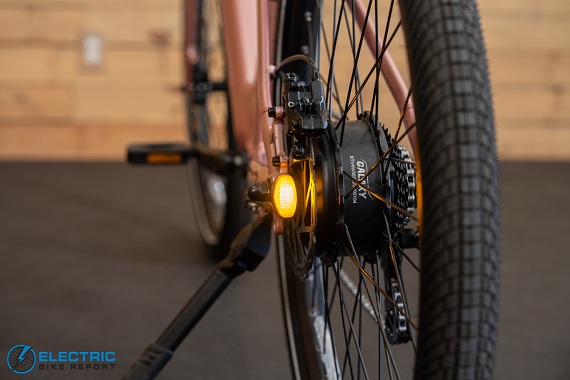
Turn signals are mounted to the frame at the rear axle where the seat and chain stays meet.
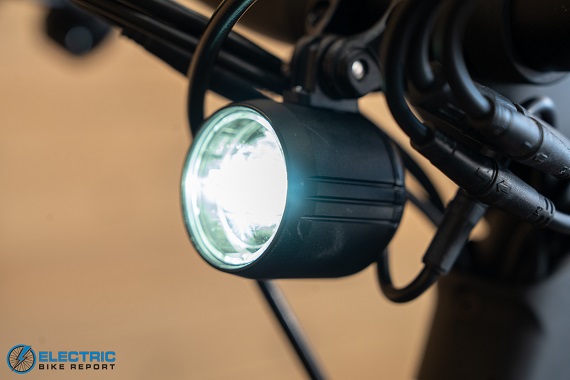
The integrated headlight can be activated through the control pad or the Heybike app.
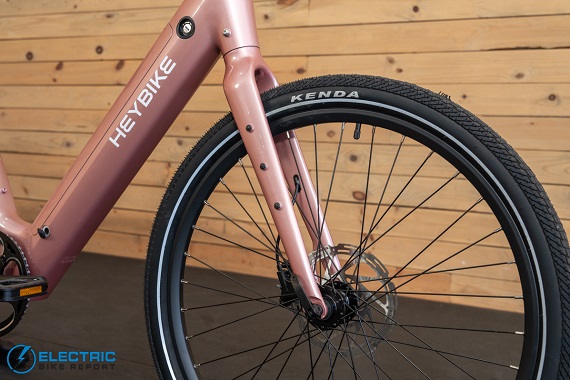
A rigid fork keeps steering stable and predictable.
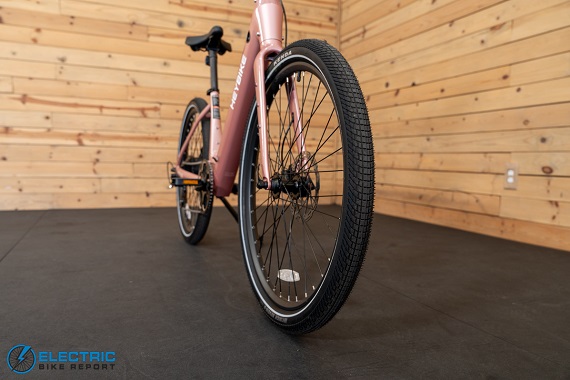
The Venus rolls on 27.5×2.2” Kenda Kwick Seven.5 street tires.
Heybike Venus Review: Summary / Where to Buy
Riders of city cruiser e-bikes like the Heybike Venus often prioritize accessibility, comfort, safety, and ease of use. Heybike scored a win in each of these areas, as the Venus is simple and enjoyable to ride. It also generally performs well and comes with a small learning curve, making it ideal for new riders seeking a bike that does what it needs to do.
E-bikes of this style are popular, with a range of options occupying different levels of cost and complexity. In our testing, the Heybike Venus established itself as an affordable option that covers the basics well while still providing some extra features that many riders will find appealing—namely, pairing with the Heybike app and its customization and navigation features.
In terms of real-world performance, the Venus demonstrated generally intuitive programming, controlled speeds, and great handling. It matched its peers in range—with the potential to outpace them. The bike also proved capable of strong, quick climbing and safe braking.
Our largest points of critique revolve around user-friendliness. A more reliable battery readout would make estimating range easier and reduce range anxiety, while the addition of brake lights would improve safety and communication when sharing the road with vehicular traffic.
Those points aside, the Venus offers affordability, easy pedaling, and a comfortable, ergonomic feel. Whether used for daily commuting or leisure rides, it’s an approachable, functional, and easy to use e-bike well-suited for new and experienced riders alike.
Happy Riding! Make sure to let us know if you have any questions or if you think we left anything out in this review of the Heybike Venus down in our comments section.
Sponsor
Sponsor
Reader Interactions
Leave a Reply