Aventon Soltera 3 ADV Review | A Cyclist’s Dream Come True?
Jan 23, 2026
 0 Comments
 Share
Share
This sub 40-lb city e-bike keeps a focus on simplicity and responsiveness, with a single-speed drivetrain, a clean cockpit, and a sporty yet comfortable ride.
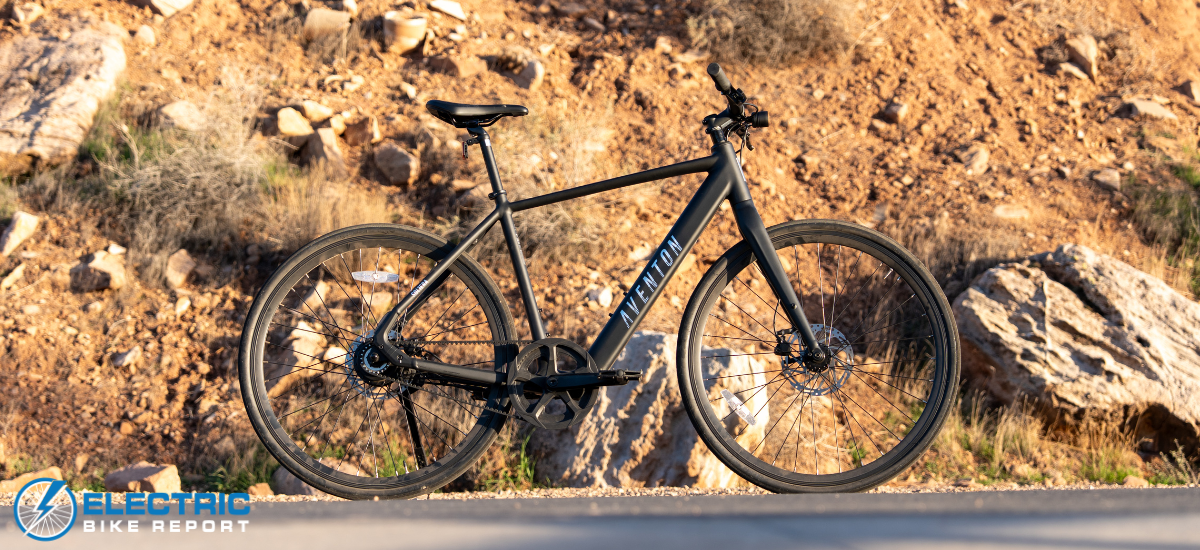
Simplicity can be a beautiful thing, especially in a lightweight city/urban e-bike.
As a burgeoning e-bike reviewer, one of my first experiences with Aventon was the brand’s original Soltera model. In contrast with many of the heavy, and powerful fat tire e-bikes that dominated the market—and which felt more like motorcycles than bicycles—the Soltera presented a stripped-down, simplified, and much more analog-like experience.
More recently, the Soltera 2 upped the ante with a much more natural-feeling and responsive ride, all thanks to its torque sensor. This version of the bike also added a more robust package of features, including integrated turn signals, a thumb throttle, and app connectivity, without departing from the soul of Aventon’s first Soltera model.
Now, the Soltera 3 ADV feels like a merging of the bike’s previous iterations. It features the torque-sensing pedal assist, Bluetooth connectivity, and integrated lights and turn signals of the Soltera.2. It borrows the spartan cockpit layout and single-speed drivetrain of the original Soltera. Additionally, it offers a longer wheelbase and a low weight of just 39 lbs.
While most other recent releases in Aventon’s lineup have been equipped with a 4G-enabled smart module and a full security suite, the Soltera eschews these features to prioritize low weight, affordability, and easy operation. With a 250W rear-hub motor, it provides helpful power while encouraging an active cycling experience similar to riding a non-electric bike.
In our experience, city e-bikes have diversified in recent years, with some skewing toward the light and natural side while others lean toward more power for easier pedaling and hill climbing. We tested the Soltera 3 ADV to learn where it falls on this spectrum; continue reading below to see how its performance compares to other e-bikes in this category!

Sponsor
E-Bike Category:City/Urban
E-Bike Class:Class 1 (pedal assist to 20 mph)
Sponsor
Aventon Soltera 3 ADV Video Review
 Pros
Pros- The Soltera 3 ADV provides an active and engaging ride, due to its torque-sensing 250W rear hub motor.
- It is simple and easy to use, with only three assist levels, a single-speed drivetrain, and a simple user interface.
- With a total weight of 39 lbs, the bike is agile, highly portable, and suitable for carrying up flights of stairs.
- The Soltera 3 ADV is seriously low-maintenance, with its clean and long-lasting Gates Carbon belt drive.
- Aventon offers an impressive four frame sizes to accommodate riders between 5’1” and 6’4”.
- As city e-bikes go, the Soltera’s riding position is relatively relaxed and upright, making it both sporty and comfortable.
- As is common with bikes of this style, the Soltera is nimble, with crisp steering resulting from its rigid aluminum fork.
- The Aventon app allows riders to tune motor output and responsiveness, making it easy to personalize how the bike feels.
 Cons
Cons- We liked the bike’s overall braking performance, but we hoped to see a system with motor cutoff to enable brake light functionality.
- While not an outright downside, potential buyers should know that the bike’s battery is not removable for charging (though it can be accessed for service).
ELECTRICAL SPECS & FEATURES
- Battery: Integrated Lithium-ion 36.9V, 9.94Ah, 366.8Wh
- Charger: 36V Output: 42V/ 4A
- Display: Aventon BC147
- Motor: 36V, 250W, 40 Nm Torque
- Headlight: Integrated LED
- Taillights:Integrated LED, with Turn Signals
- Pedal Assist: Eco, Sport, Turbo
- Claimed Range: Up to 70 Miles
- Throttle:None
- App:Aventon
- UL Certification:UL 2271, UL 2849, and TUV Certified
Weight & Dimensions
- Claimed weight: 37 lbs
- Tested Weight: 39 lbs
- Rider height range: S – 5’1″-5’5″, M – 5’5″-5’9″, L – 5’9″-6’1″, XL – 6’1″-6’4″
- Total payload capacity: 300 lbs
Components & Accessories
- Brakes:Tektro HD-T3020 Hydraulic Disc Brake (w/o e-cutoff), 180mm Front & Rear Rotors
- Fenders: None
- Fork:Rigid Aluminum Fork
- Frame: 6061 Double-Butted Aluminum Alloy with Internal Battery
- Drivetrain: Single Speed, Gates Carbon Belt Drive, 60T chainring, 22T Hub Flywheel
- Grips: Aventon Lock on grips
- Saddle: Aventon Saddle
- Handlebar: Aluminum 31.8mm, 680mm
- Kickstand: Included in accessory box
- Pedals: 9/16″ Composite Platform
- Tires: Kenda K1085 700x38C
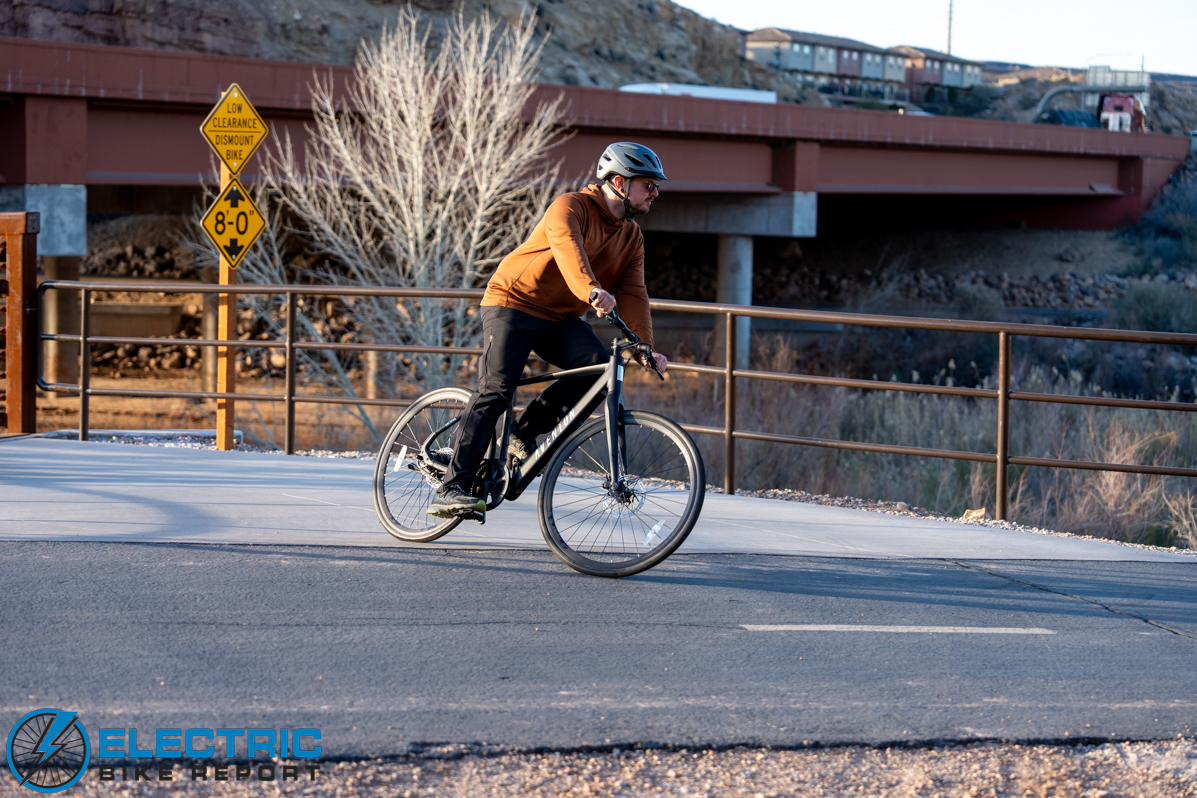
As we hoped for a lightweight city e-bike, the Soltera 3 ADV feels nimble, quick, and responsive.
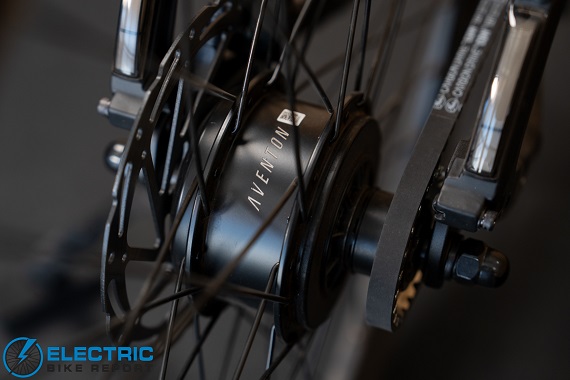
A 250W rear hub motor provides a pleasant boost that’s right in line with the Soltera’s weight and style.
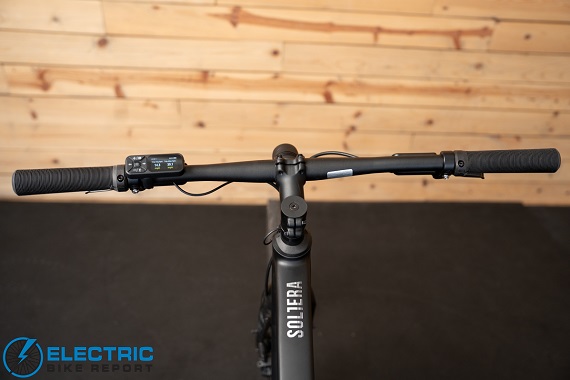
The bike’s cockpit layout is simple, clean, and uncluttered, making it easy to learn and use.
Aventon Soltera 3 ADV Review: Speed Test
To test the Soltera 3 ADV’s speed, I rode the bike on a flat, paved shared-use trail and recorded my average speed while pedaling. As a Class 1 e-bike, the bike offers pedal-assist up to 20 mph and does not include a throttle. My speed test results are graphed above, but I will also list them below:
- No Assist – 12.9 mph
- Eco – 17.1 mph
- Sport – 18.8 mph
- Boost – 19.9 mph
When starting the test without pedal assist, I found the bike relatively easy to pedal. Its low weight and nearly smooth road tires made accelerating fast, though there was some expected resistance from the large 60T chainring; this is a natural side effect of a single-speed drivetrain.
As the graph above shows, even the lowest of the bike’s three assist levels, Eco, made a significant difference in speed, though its power output was relatively minimal in comparison to Sport and Turbo.
The motor was remarkably quiet, delivering power smoothly and responsively. Overall, the experience felt extremely natural, as though I was pedaling an analog bike—except, of course, that I was moving much faster and easier than if that were the case.
Each of the three assist levels stepped up power and speed incrementally. I appreciated the bike’s programming, which subtly tapered off power as I approached its top speed and ramped up again when I fell below roughly 19 mph. The result was a remarkably smooth pedal experience without any jarring changes in speed or power.
It’s worth noting that I tested the bike with its default settings, but riders can customize the feel of the pedal assist system via the Ride Tune feature in the Aventon App (more on this later).
If I were riding the Soltera daily, I’d likely give Eco a bit of a boost to make it more appealing to my riding style, while saving the higher assist levels for hills. Your preferences may be different, however, which is the beauty of the bike’s fully customizable system!
The Soltera 3 ADV performed excellently in this test, with well balanced default programming, smooth and responsive power delivery, and no problems reaching its advertised top speed. It’s relatively simple and straightforward, which is an advantage for riders who need a bike that simply works without an overcomplicated interface or an overabundance of features.
Sponsor
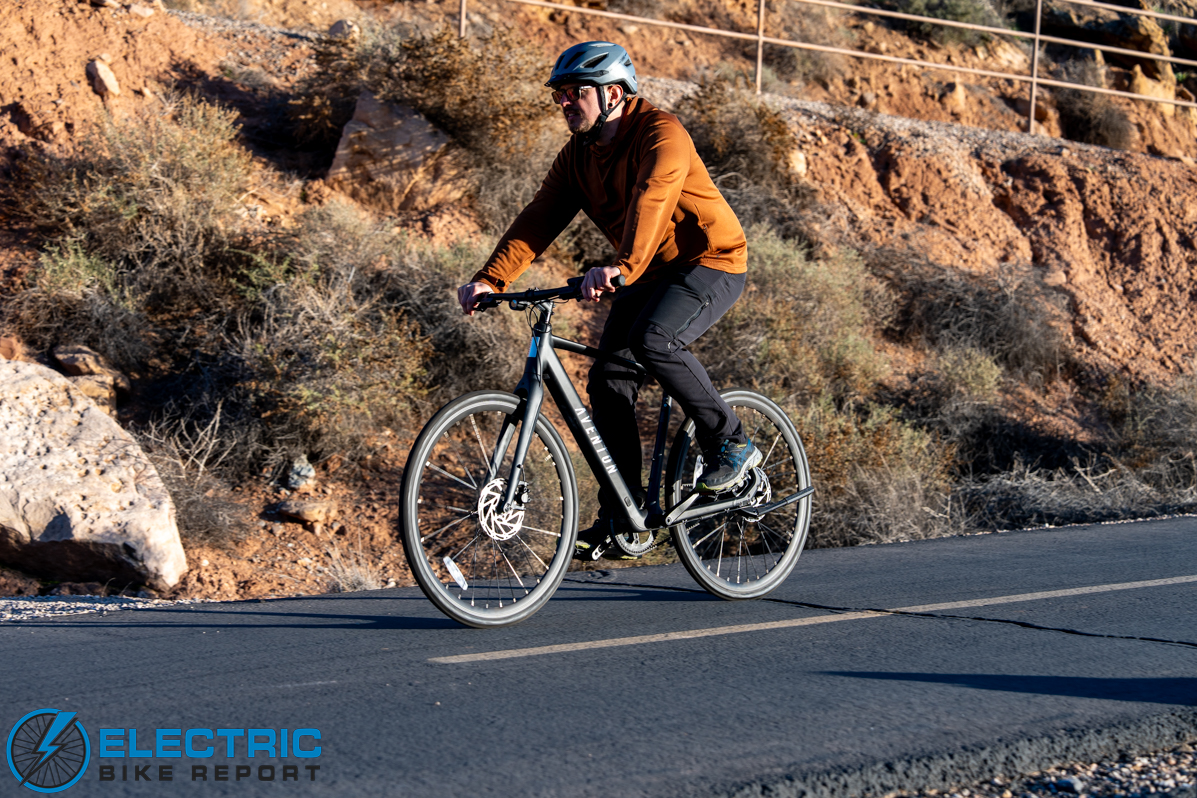
The Soltera 3 ADV is sportier than its most recent predecessor, while still offering a comfortable ride.
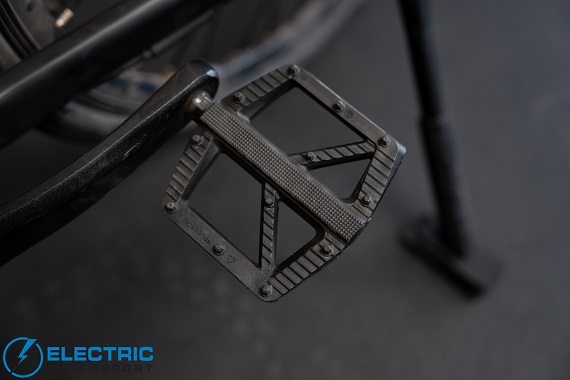
The Soltera 3 ADV includes basic plastic platform pedals.
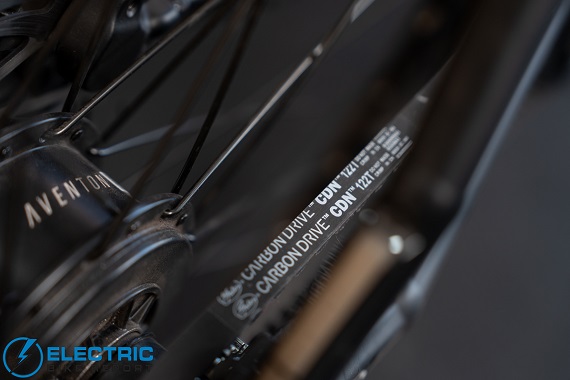
With a Gates Carbon belt, riders have a clean, quiet drivetrain that should last twice as long as a chain.
Aventon Soltera 3 ADV Review: Range Test
Aventon advertises a range of up to 70 miles with the Soltera 3 ADV’s torque-sensing 250W motor and fully internal 367 watt-hour (Wh) battery. We tested this claim using the method explained above, with the bike’s charge lasting 23.7 miles in its highest assist level and 55.1 miles in its lowest.
Similar lightweight city and urban e-bikes with 250W and 350W rear-hub motors averaged 25.7 and 53 miles in their testing. These bikes carried batteries with an average of 358 Wh. With such close results, the Soltera performed extremely well, showing that it can keep pace with its peers.
These results are reinforced when calculating the average energy used by the motor per mile. The group of comparison models averaged 6.8 watt-hours per mile (Wh/mi) in their low power tests and 14.5 Wh/mi in their max assist tests; the Soltera 3 ADV averaged similar results of 6.7 and 15.5 Wh/mi, respectively.
While our testing shows that Aventon’s advertised maximum range may be hopeful, we’re satisfied with the bike’s performance. With roughly 24 to 55 miles of real-world range from a single charge, the Soltera 3 ADV should be suitable for commuting, exercise, or leisure riding.
It’s worth noting that we tested the bike with its standard settings; increasing motor output via the Aventon app will likely reduce range, while lowering it could improve results, assuming that all other factors (rider weight, speed, terrain, etc.) stay the same.
Those using minimal pedal assist and/or taking short rides should expect multiple trips from a single charge, while those using higher power levels or traveling longer distances may need to recharge more often.
With a fully internal battery, prospective buyers should note that the entire bike must be brought inside and plugged in when charging. We were thrilled to note, however, that the Soltera 3 ADV ships with a 4A fast charger, which should fully recharge a depleted battery in just 2.5 hours!
Sponsor
Sponsor
Aventon Soltera 3 ADV Review: Hill Test
With the Soltera 3 ADV being a Class 1 e-bike with no throttle, we performed a single Hill Test using its highest pedal assist level at the Devil’s Backbone (see the graphic above for more info). The bike’s result was a time of 2:21, with our test rider, Justin, pedaling at an average of 12.9 mph.
Similar city and urban e-bikes our team has tested, with motors ranging from 250W to 500W, averaged a pedal time of 2:39, making the Soltera 3’s result particularly impressive. To be clear, we did adjust its motor output via the Aventon app, increasing the Assistance and Pedal Response sliders to 100%, instead of their default 90% / 80%, respectively.
On paper, the Soltera 3 ADV’s motor is below average in terms of peak power and torque output. Its 250W motor peaks at 500W with 40 Nm of torque, while the category averages 612W and 47 Nm. In reality, however, the bike felt unexpectedly powerful and capable—especially considering the limitations of its single-speed drivetrain.
Don’t misunderstand: pedaling the Soltera 3 ADV uphill is an active experience that requires a moderate amount of effort from the rider, but this is expected for an e-bike with a 250W motor and only one gear ratio. The point of the motor is to make the job significantly easier, reducing strain and exhaustion, and in this regard, the bike succeeds.
A few months ago, we reviewed Aventon’s Soltera 2.5, which was the brand’s latest iteration of its city e-bike at the time. I compared the Soltera 3 ADV’s feel and climbing performance against that of the Soltera 2.5 at our nearby secondary test location, called Pilot Hill.
Despite the 2.5 featuring a 7-speed drivetrain and a more powerful 350W rear-hub motor, I finished the climb three seconds and 0.4 mph faster when pedaling the Soltera 3 ADV. This proves that Aventon’s latest model is effective and that its weight, power, and gear ratio are well balanced.
This last point is perhaps the most important—and also one of the most difficult things to manage on a single-speed e-bike. I’ve tested many similar single-speed models during my time at Electric Bike Report, and while some of their drivetrains have been as well-balanced as the Soltera 3 ADV’s, many others have not.
In some cases, these bikes were geared more for speed on flat ground, making them much more difficult to pedal uphill. In other cases, their gearing made hills manageable while resulting in ghost pedaling and low speeds on flats. In contrast, the Soltera 3 was effective and relatively easy to pedal in both environments, with its gearing and 20 mph speed limit feeling like an appropriate mix.
Ultimately, the Soltera 3 ADV’s climbing performance was better than expected, making hills that would normally be exhausting much easier and more enjoyable. It’s not the sort of bike that is made to do the work for you, but instead will give you a light to moderate workout while ensuring that you have the energy to keep pedaling after you reach the top.
Sponsor
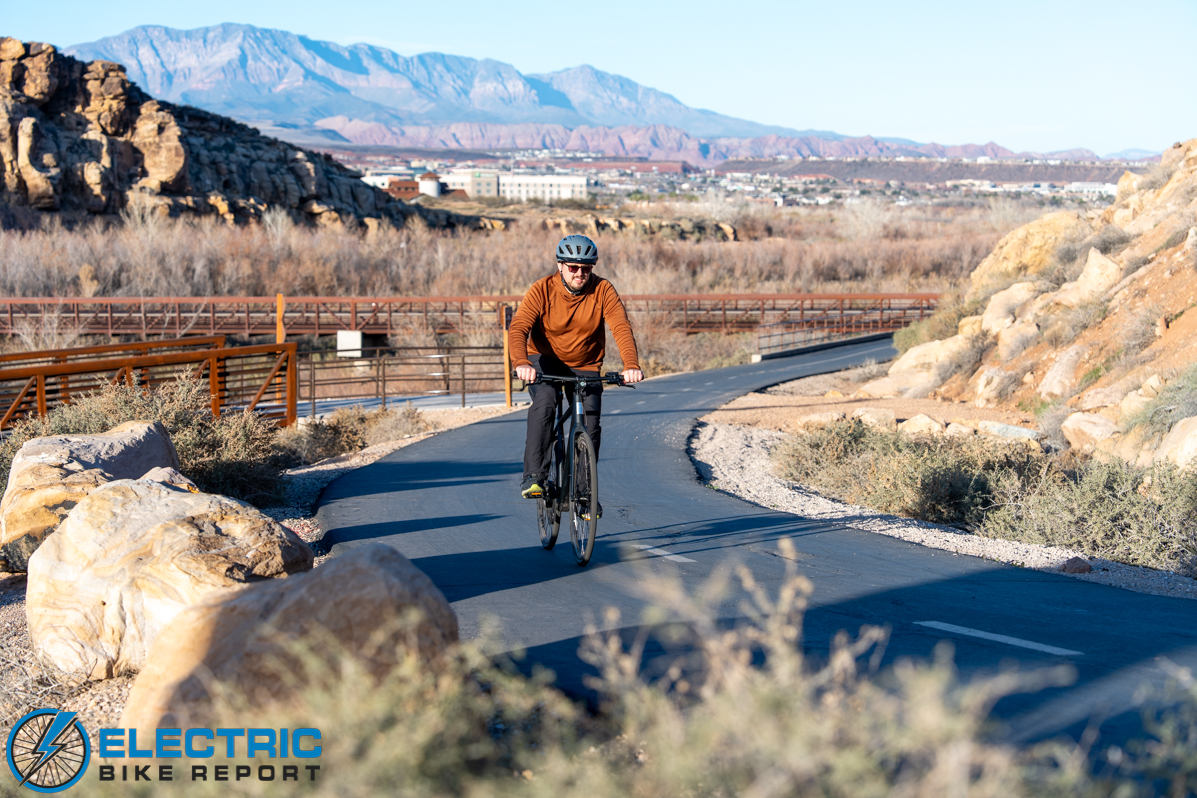
While riders can tune the motor via the Ride Tune feature Aventon app, the bike is limited to a strict 20 mph speed limit.
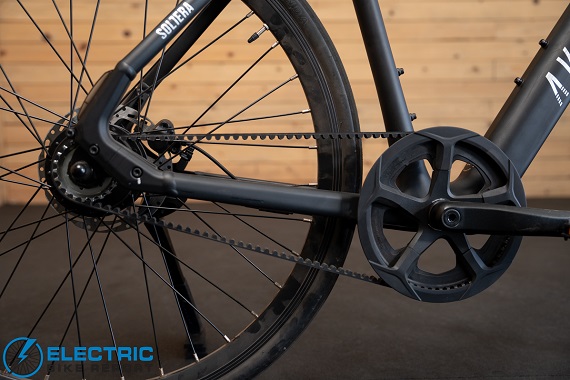
While the single-speed drivetrain has its limitations, the bike felt great to pedal on flats and uphill.
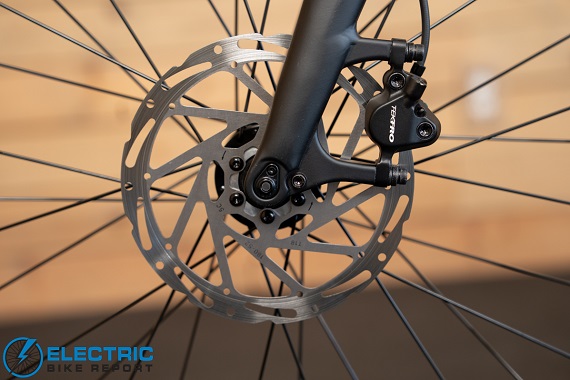
Aventon equipped the Soltera 3 ADV with Tektro hydraulic disc brakes and 180mm rotors.
Aventon Soltera 3 ADV Review: Brake Test
The Soltera 3 ADV’s final brake test score, after we performed three tests using the method explained above, was 21’ 7”. This is over a foot shorter than the current category average (at the time of writing), which is 22’8”.
As mentioned above, the Soltera 3 is a few pounds lighter than average (39 vs 42.5, respectively), making it easier to slow down. The bike also uses an effective hydraulic brake system from Tektro, the two-piston HD-T3020 with 180mm rotors, which clearly performed well in combination with the bike’s grippy 700c x 38mm Kenda road tires.
These tires may have been another factor in the bike’s performance, as most similar models we’ve tested had more heavily textured tread made of a harder rubber compound.
We noticed that hard braking could burn through the Soltera 3 ADV’s minimal tread quickly, but the bike’s above average braking performance was noticeable both during and outside of our formal testing. When I came to a stop during my time on the bike, I noted the bike’s fast and aggressive (but not too abrupt or scary) braking.
The brakes felt responsive and modulated speed well when riding downhill, though it is worth noting that they do not have a motor cutoff function. This means that they do not allow the tail lights to function as brake lights, but they do provide seamless and instantaneous control over speed, as the motor will deliver power immediately during or after braking.
All in all, the Soltera 3 performed very well in this test, showing that it is well-specced and safe.
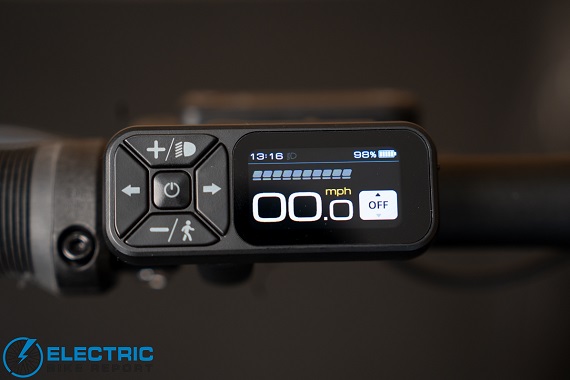
The handlebar-mounted control panel offers color coded assist levels, a power meter, and more.
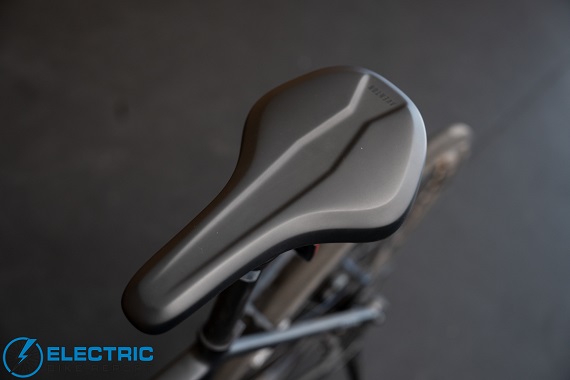
The Soltera has a performance-style saddle that is slim but well-padded.
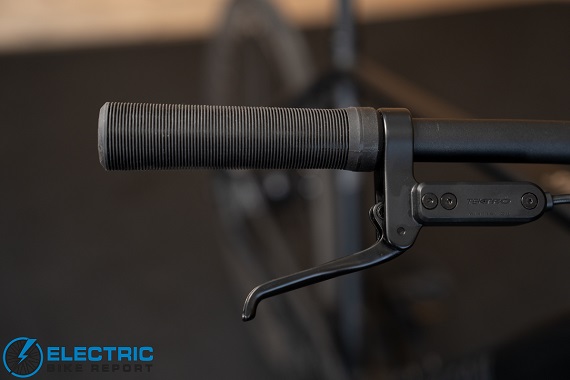
Ribbed lock-on rubber grips offer comfort and simplicity without adding much weight.
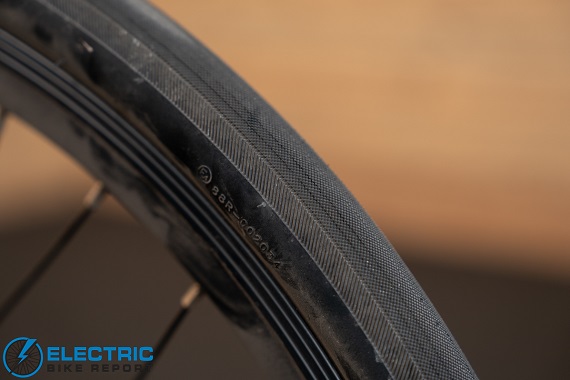
With minimal tread, the 700x38c Kenda road tires provide quick acceleration and low rolling resistance.
Aventon Soltera 3 ADV Review: Ride Quality
While a bike’s overall feel and comfort level are highly subjective, we can use our experience testing hundreds of e-bikes of various styles to evaluate the Soltera 3 ADV’s ride quality in comparison to its peers. Overall, the bike felt solid, sporty, and responsive, with only a couple of downsides that are more points to be aware of instead of problem areas.
In our experience, it is relatively uncommon for brands to offer a wide range of frame sizes, but Aventon sells four Soltera 3 options for riders between 5’1” and 6’4”. We tested the Large frame size, which is advertised to fit folks between 5’9” and 6’1”, so our team of roughly 6’-tall riders was well accommodated.
With roughly 6.5” of adjustable seatpost length, I was able to set the saddle height for both comfort and proper pedal efficiency. I found the bike’s sport-style saddle to be slim but well-padded and generally comfortable. The reach was relatively short, resulting in an uncommonly upright riding position, so the Soltera felt more relaxed than many similar models I’ve tested.
As expected for a city e-bike, its handling felt crisp and agile; the combination of a lightweight frame and rigid fork gave the Soltera 3 precise steering, quick cornering, and a high degree of maneuverability. With relatively narrow 700c x 38mm road tires and no suspension, bumps were noticeable, but acceleration was fast and smooth.
I touched on the feel of the Soltera’s pedal assist system previously, but I feel it important to reiterate that its active, natural feel pairs perfectly with its style. For exercise enthusiasts or traditional cyclists wanting a boost to reduce strain or increase speed, the Soltera 3 ADV is likely to provide an ideal feel and just the right amount of power.
With a Gates Carbon belt at the heart of its single-speed drivetrain, the Soltera 3 is remarkably low-maintenance. Gates rates its belts to hold up for least twice the lifespan of a traditional chain, and with no need for lubrication, the long-lasting system is also incredibly clean.
Another of the bike’s greatest highlights is its simplicity and ease of use. The single-speed drivetrain requires no shifting, while most riders should find it easy to find the right amount of power with the bike’s three assist levels. The bike’s control panel is intuitive, with only the turn signal buttons being the most likely to be operated regularly while moving.
Considering that the Soltera 3 has integrated lights and turn signals—which we’re always pleased to encounter on urban e-bikes—we’d have liked to see functioning brake lights. Recent Aventon models have initially omitted this feature but added it later, so there is a chance that potential buyers will get it down the road. Fingers crossed!
Another unexpected omission was the Aventon Control Unit (ACU) present on all of the brand’s other models (at least at the time of writing). This smart module enables location tracking, battery and wheel/kickstand locks, an alarm system, etc.
Without this element, the Soltera 3 ADV is notably simpler and likely lighter, showing that Aventon prioritized maneuverability, portability, and an easy user experience. An ACU-equipped Soltera would be exciting, but buyers seeking more robust security features should consider the Aventon Level 3 commuter e-bike.
When paired with the Aventon app, the Soltera 3 ADV does not have as many customization options and features as other Aventon models, but it can still receive over-the-air (OTA) updates and allows riders to customize motor output.
Additionally, the app can manually and automatically track ride data, it provides access to a private social media platform with Aventon e-bike owners, it can set up maintenance reminders, and it can sync with Apple Health and Strava.
While the Soltera 3 ADV’s ride experience is approachable for both new and experienced cyclists, the bike’s integrated light system and Bluetooth connectivity combine to create an uncommonly robust yet simple city e-bike.
Sponsor
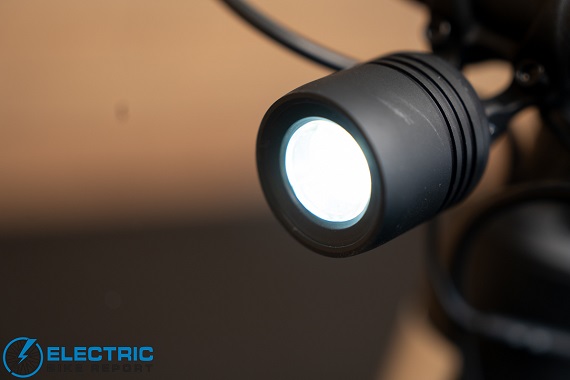
A small but bright LED headlight is mounted to the front of the stem.
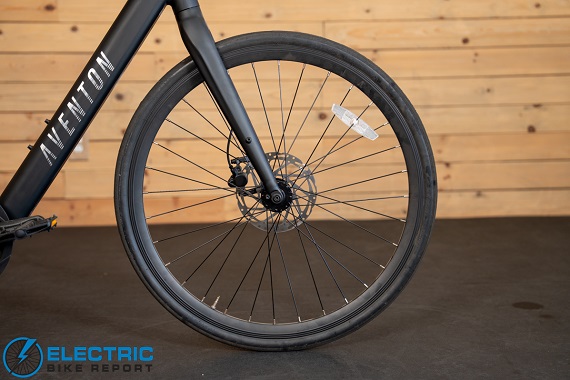
A rigid fork keeps the bike’s weight down and its agility front-and-center.
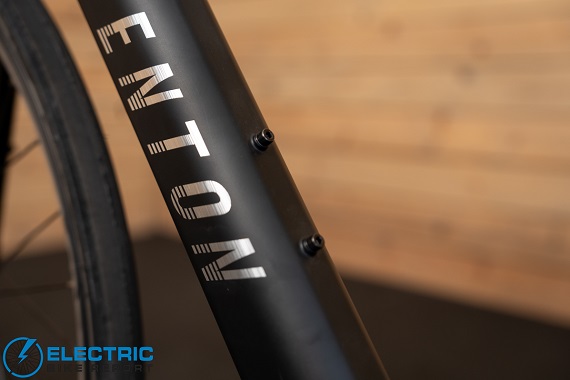
In addition to housing the Soltera’s 367-Wh battery, the bike’s down tube also features a bottle cage mount.
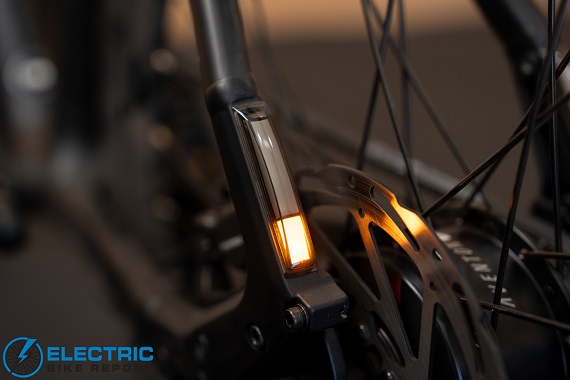
The seat-stay integrated taillights include turn signals operated by the handlebar-mounted button pad.
Aventon Soltera 3 ADV Review: Summary / Where to Buy
The original Aventon Soltera served as my introduction to lightweight city e-bikes. It taught me to appreciate the style’s characteristic simplicity, agility, and the analog-like feel that comes as a result of relatively modest pedal assist.
Having ridden and/or reviewed each of Aventon’s subsequent Soltera models, I’ve seen the course of the bike’s evolution. While its geometry, features, and specs have changed over time, it hasn’t strayed far from its roots as a value-forward cyclist’s e-bike. With its streamlined look and stripped-down nature, the Soltera 3 ADV continues this trend.
Our testing showed that the bike’s performance was average to above average in all areas, making this objectively one of the best Soltera models we’ve seen to date. It delivers natural and responsive power through three balanced and customizable assist levels. Additionally, it climbs hills better than its specs suggest, its braking performance is great, and its range holds up well when compared to its peers.
There are a few things prospective buyers should be aware of: the bike lacks brake lights, a removable battery, and the high-tech security features of other Aventon models.. We look forward to seeing whether Aventon adds brake light functionality in the future, though this would require the bike to come with different brakes, and while the bike must be brought inside for charging, this is likely the approach most urban riders will take anyway.
Priced solidly between $1,000 and $2,000, the Soltera 3 ADV is uncomplicated, approachable, active, and value packed. We would highly recommend it to new riders seeking an e-bike with a low learning curve, experienced cyclists looking for an easy and familiar transition to e-biking, commuters living in urban environments, and buyers who want an electric bike that doesn’t overpower their own effort.
In our opinion, this is the best-looking, sportiest, and most natural-feeling Soltera model yet, offering smooth pedaling, low maintenance requirements, and the ability to hop on and ride without much additional thought or worry.
Happy Riding! Make sure to let us know if you have any questions or if you think we left anything out in this review of the Aventon Soltera 3 ADV down in our comments section.
Sponsor
Sponsor
Reader Interactions
Leave a Reply