Trek Rail+ 8 Review | Something For Everybody
Jan 15, 2026
 0 Comments
 Share
Share
Power, adaptability, and comfort come together in the newly reworked Rail+. The latest Bosch motor pushes performance to new heights, while Trek’s frame design and components make sure this eMTB feels right at home on any stretch of singletrack.
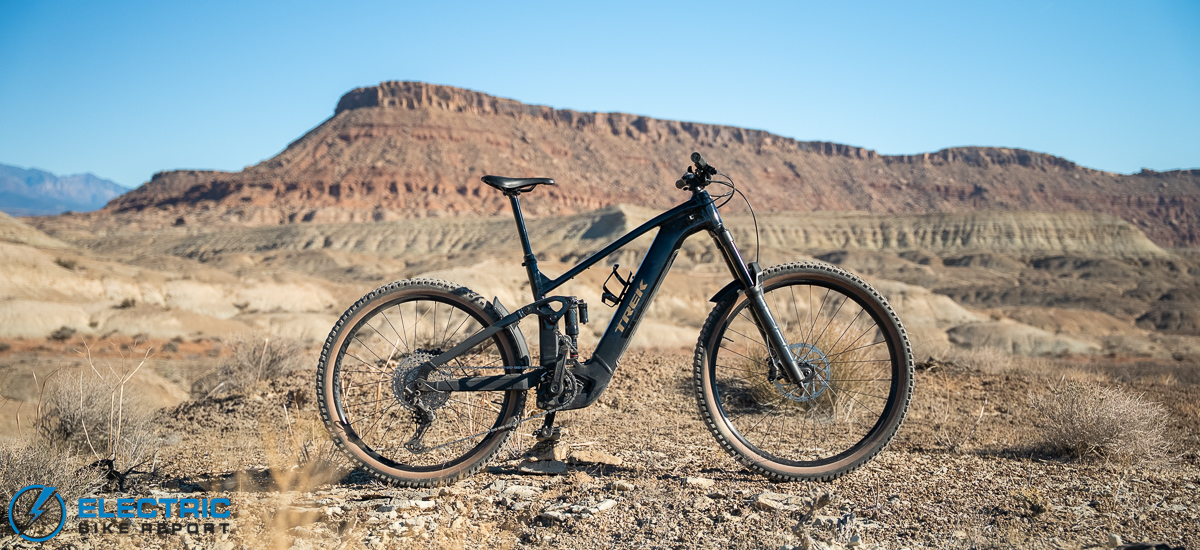
Trek’s Rail has seen major updates this generation. It feels fresh, yet still true to its “Enduro-does-everything” roots. The redesigned frame now includes Mino Link adjustable geometry, a mullet wheel setup, and Bosch’s latest drive system that joins the 100Nm torque club and delivers punchy peaks up to 750W (as if the Bosch CX wasn’t punchy enough already).
The Rail feels confident in a wide range of environments. Its 160mm Rockshox front and rear suspension is plush yet supportive, keeping you composed through chunky, technical descents while remaining eager to climb steep obstacles. With Bosch’s new power levels, you might want to fine-tune things for more technical terrain, but the Flow app makes dialing in assist behavior easy, and the suspension’s progression adjustment ensures the setup can adapt to whatever style of trail you prefer.
The electronics package shines, too. The new 800Wh battery provides more range than previous generations, yet the updated cell tech keeps the system lighter and still fully removable for easy transport or charging. The Bosch Kiox 400 display sits cleanly recessed into the top tube, offering detailed ride metrics and navigation support, and we love the added peace of mind from its motor lock feature that requires your phone to activate.
Componentry on the Rail+ 8 is solid across the board. The shifting is crisp, the brakes inspire confidence, and the overall weight gives the bike a planted, controlled feel. It’s not the most playful setup, but that’s part of its universal appeal—this is a jack-of-all-trades eMTB that feels equally at home across desert hardpack or carving through loamy forest singletrack. The middle-of-the-road geometry makes it approachable for most riders, and the adjustable frame angles help you tailor it for flow trails or steep, techy descents.
Aside from a few sizing quirks, Trek has built a powerhouse for the masses; this is a capable, comfortable, and highly refined eMTB that’s ready to slot into singletrack anywhere.

Sponsor
E-Bike Category:eMTB (Enduro)
E-Bike Class:Class 1
Sponsor
Trek Rail+ 8 Video Review
 Pros
Pros- Powerful motor performance: Bosch’s new “Gen 5” motor is lighter, quieter, and stronger than ever, delivering terrific climbing power and an impressively natural feel.
- Versatile geometry: The frame balances comfort for both climbs and descents, with the updated Mino Link allowing you to fine-tune your setup for a steeper or slacker feel—or raise the bottom bracket for chunkier terrain.
- Supple suspension: The 160mm RockShox setup front and rear smooths out rough trails and offers enough adjustability for a wide range of rider weights and preferences.
- Large, removable battery: The 800Wh battery offers generous range for all-day rides and can be easily removed for convenient charging or transport.
- Trek quality and dealer support: The Rail+ frame is confidence-inspiring and built to last, backed by one of the largest and most established dealer networks around.
- Mullet setup: The new 29” front / 27.5” rear wheel combo adds agility and playfulness, giving the bike a snappier, more responsive ride.
- Customizable power settings: With Bosch’s Flow app, you can tailor power delivery, assist levels, and responsiveness to match your personal riding style.
 Cons
Cons- Frame sizing gap: The reach jump from medium to large is considerable, making it trickier for riders on the fence to find an ideal fit.
ELECTRICAL SPECS & FEATURES(As tested, Size L)
- Battery: Bosch PowerTube 800Wh, smart system
- Charger: Bosch standard 4A, 110V, smart system
- Display: Bosch Kiox 400C, mini remote
- Motor: Bosch Performance Line CX, 20 mph / 32 km/h max assist (25 km/h max assist in EU and APAC), 750W max, 100Nm max torque
- App:Bosch Flow
- UL Certification:2849
Weight & Dimensions
- Claimed weight: M – 25.08 kg / 55.3 lbs (with TLR sealant, no tubes)
- Tested Weight: L – 55.8 lbs (with sealant and pedals)
- Rider height range: 5’1” – 6’5” (across 4 available frames)
- Total payload capacity: 300 lbs (bike + rider)
Components & Accessories
- Brakes:SRAM DB 8 4-piston hydraulic disc, 220mm f, 200mm r
- Fork:RockShox ZEB Select, DebonAir spring, Charger RC damper, tapered steerer, 44mm offset, Boost110, Maxle Stealth, 160mm travel
- Shock: RockShox Super Deluxe Select RT, 205mm x 65mm, 160mm travel
- Linkage:
- Frame: Alpha Platinum Aluminum, Removable Integrated Battery (RIB 2.0), tapered head tube, guided internal routing, Motor Armor, angle-adjust headset, Mino Link adjustable geometry, adjustable leverage rate, 34.9mm seat tube, ABP, UDH, Boost148, 12 mm thru axle, 160 mm travel
- Drivetrain: Shimano XT M8100, long cage, 12-speed, 36t chainring, 10-51 cassette
- Grips: Bontrager XR Trail Comp, nylon lock-on
- Saddle: Bontrager Verse P3, steel rails
- Seatpost: Bontrager Line Dropper, 150-200mm travel, MaxFlow, internal routing, 34.9mm, 450mm length
- Handlebar: Bontrager Line, alloy, 35mm, 27.5mm rise, 780mm width
- Cranks: E*thirteen E*spec Plus, 160mm length
- Pedals: VP-536 Nylon platform
- Wheels: Front: Bontrager Line Comp 30, Tubeless Ready, 6-bolt, Boost110, 15mm thru axle 29” Rear: Bontrager Line Comp 30, Tubeless Ready, 6-bolt, Shimano Micro Spline frerehub, Boost148, 12mm thru axle, 27.5”
- Tires: Bontrager Brevard Pro XR, Tubeless Ready, dual compound, aramid bead, 60 tpi, 29×2.5” front, 27.5×2.50 rear”
- Hubs: Boost110, 15mm thru axle F, Shimano Micro Spline freehub, Boost148, 12mm thru axle, 27.5” R
- Spokes: 14G spokes with brass locking nipples
| *Listed in “low” setting of the flip chip. Some measurements can be altered when adjusting to a high setting. | S | M | L | XL |
| Head Tube Length | 100mm | 100mm | 120mm | 145mm |
| Head Tube Angle | 64.5° | 64.5° | 64.5° | 64.5° |
| Effective Top Tube Length | 563mm | 592mm | 639mm | 670mm |
| Seat Tube Length | 380mm | 410mm | 435mm | 470mm |
| Seat Tube Angle | 74.8° | 74.8° | 74.8° | 74.8° |
| Stack Height | 594mm | 627mm | 649mm | 667mm |
| Reach | 430mm | 450mm | 490mm | 515mm |
| Chainstay Length | 448mm | 448mm | 448mm | 448mm |
| Wheelbase | 1278mm | 1230mm | 1278mm | 1314mm |
| Standover Height | 762mm | 778mm | 779mm | 798mm |
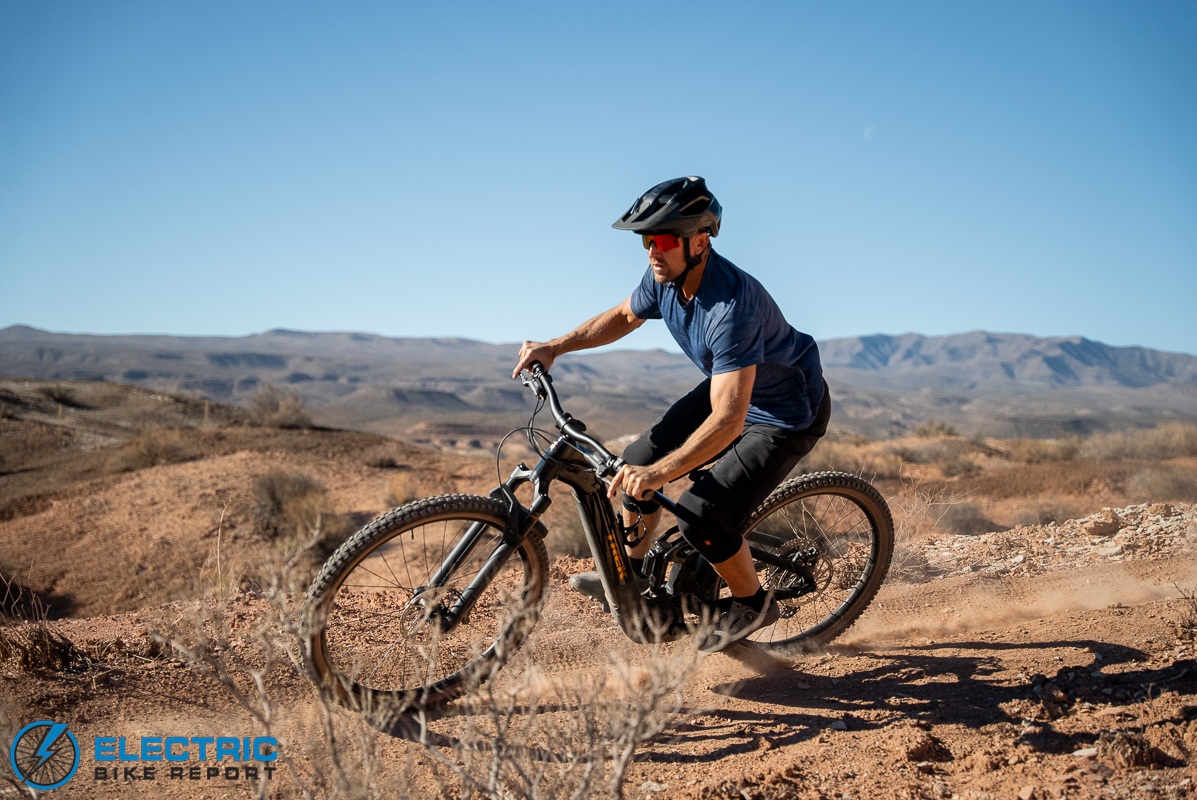
The Trek Rail+ 8 feels confident and composed on loose, rocky terrain, delivering a planted ride that encourages speed and control on technical trails.
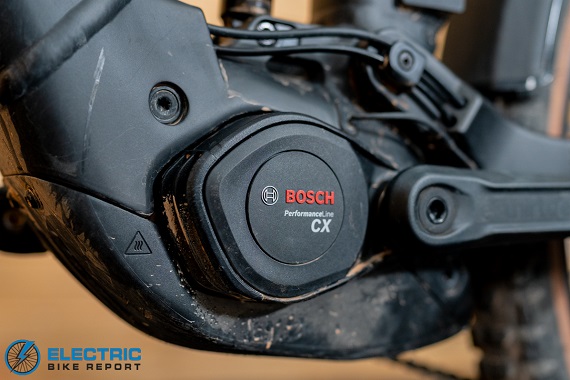
Bosch’s Gen 5 Performance Line CX motor is lighter, quieter, and more powerful than previous generations, delivering up to 750W and 100Nm of torque.
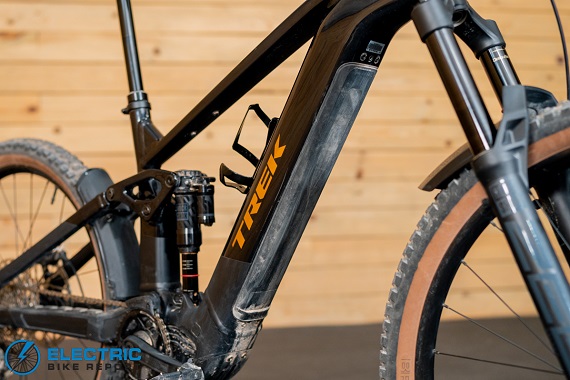
The 800Wh Bosch PowerTube battery is cleanly integrated into the downtube and remains fully removable for easy charging or transport (now with a hex tool, no key required).
Trek Rail+ 8 Review: Motor & Battery
Over the last couple of years, all the major eMTB motor makers have been answering the call for more power and Bosch is no exception. Its latest “Gen 5” drive unit trims weight from the previous generation while allowing for higher torque and wattage ceilings, giving the Rail+ both a lighter and quieter system than before.
Out of the box, the motor peaks at 600W and delivers 85Nm of torque which matches the previous generation’s top-end numbers but with a more refined feel and none of the old rattle that was occasionally heard in the Gen 4. However, a quick firmware update and a trip into the Flow app’s power settings let you bump those figures up to 750W and 100Nm, respectively. Naturally, that unlocks faster acceleration and easier climbing, though you’ll trade a bit of range in the process. Bosch even includes a friendly word of caution that higher output settings can accelerate drivetrain wear.
There are four main assist modes: Eco, Tour+, Turbo, and eMTB (the adaptive automatic mode). The stock tuning feels well balanced, but it’s worth experimenting to see how the higher power profile suits your riding. The eMTB mode is one of the better adaptive settings I’ve tested. It handles about 80–90% of riding situations perfectly, though there are times you’ll still want to switch manually. For example, you might kick it into Turbo when you see a long climb coming up, or tone things down for a more technical stretch ahead.
Bosch motors have always delivered smooth yet punchy performance, and that reputation continues here. They tend to feel slightly more aggressive, especially at high or low cadences, which makes for a lively and responsive ride. Bosch also includes a touch of overrun—a brief continuation of power after you stop pedaling—to help you crest obstacles cleanly. Riders who spend a lot of time on slow, technical climbs or in rock gardens may need a short adjustment period, but using the lower assist modes can help smooth out that learning curve.
In my own testing, I found the default tuning to be excellent. The increased power settings were most useful for blasting up access or fire roads, while I preferred sticking to the middle modes—especially Trail—for more precise control on technical climbs.
The battery is equally impressive. The 800Wh pack marks a healthy upgrade; the new battery is 50Wh more than before (or up to 175Wh more for smaller frame sizes that previously used reduced-capacity units). Despite the added capacity, the latest cell tech gives it a higher energy density, allowing Bosch to keep the unit compact and manageable.
I always appreciate removable systems, and I’m glad Trek stuck with that design. A simple key release lets the battery drop out from the bottom of the downtube for quick swaps or charging. It’s convenient, travel-friendly, and easy to replace down the line without dealer involvement. Having the option to carry a spare battery for double the range is the kind of real-world practicality that makes this setup shine.
Sponsor
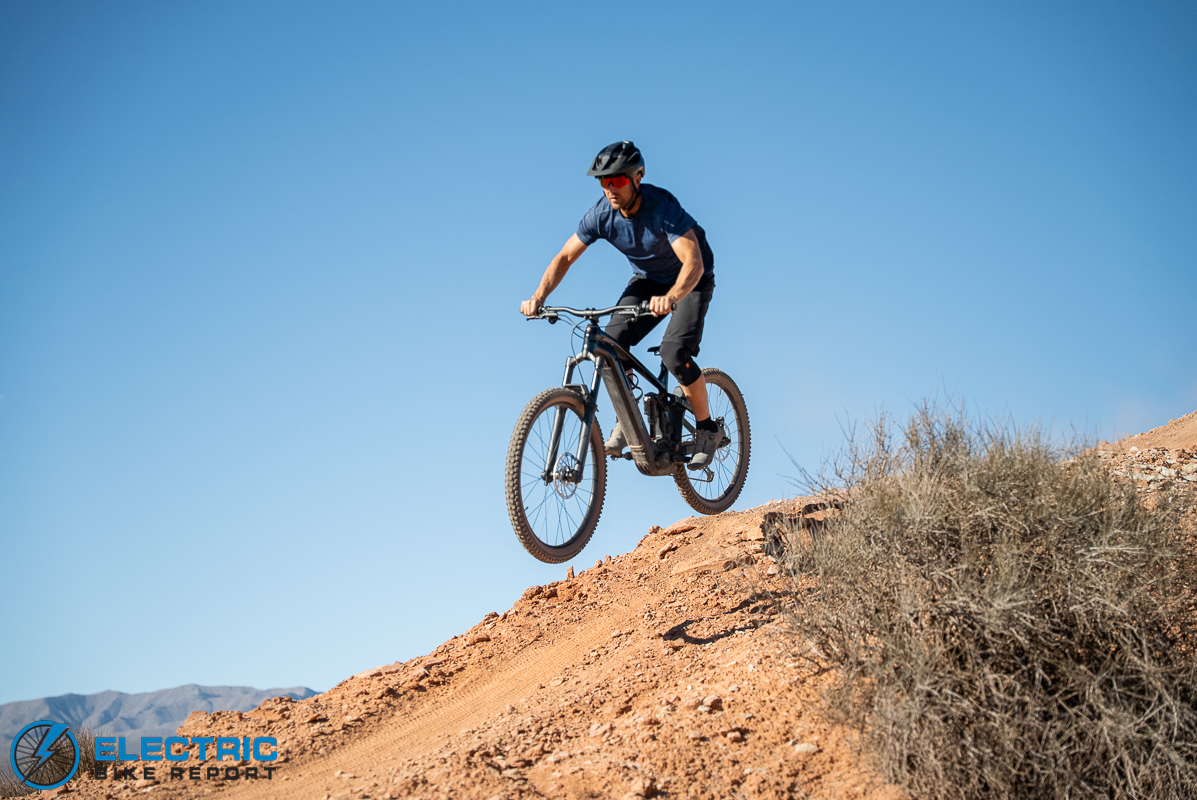
It’s not the lightest bike, but you can still catch air if you want!
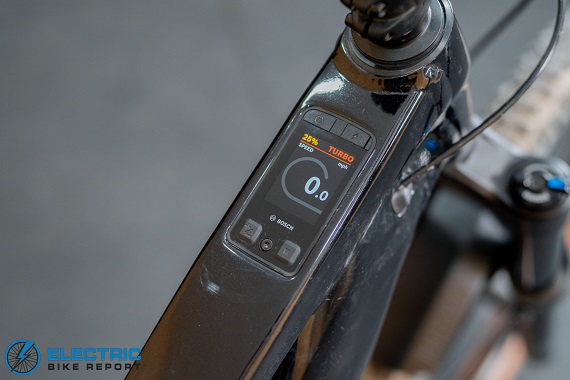
The Bosch Kiox 400 display offers a bright, premium interface with detailed ride data, navigation support, and intuitive controls.
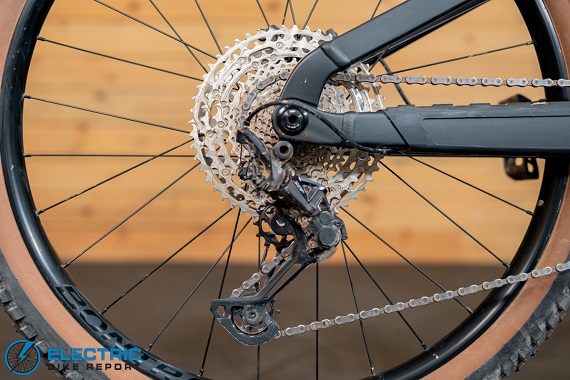
The Shimano XT drivetrain delivers crisp, reliable shifting no matter your style, from hard climbing to aggressive trail riding.
Trek Rail+ 8 Review: Display & App
Bosch’s ecosystem feels like a win to me. The Kiox 400 display looks fantastic—it gives the bike a more premium feel—and it’s packed with useful ride data. At the same time, it’s minimal enough that you can completely ignore it and just focus on the trail if you want. A compact remote on the left side of the handlebar lets you toggle screens and adjust assist levels on the fly. You also get redundant buttons directly on the display itself for power, navigation, and mode switching. Bosch even adds a small USB-C port in the top corner for charging your phone or action camera mid-ride, which is a thoughtful touch.
The Flow app expands on what you see in the display. You can view detailed ride statistics, automatically sync your data to Strava, or plan routes with turn-by-turn navigation that pushes directly to the Kiox screen. Riders who prefer a bigger view can mount their phone and use it as a full display—complete with 3D maps, cadence, power output, and other advanced ride metrics.
Where the app really shines is in power customization. You can fine-tune the assist response, torque delivery, and maximum speed (up to 20 mph in the U.S.) to better match your riding style. Whether you want a quick, snappy feel or smoother, more gradual engagement, it’s easy to make the bike behave exactly how you like.
Trek’s Rail+ 8 is a serious investment, so I also appreciate Bosch adding some peace-of-mind features. Within the Flow app, you can enable motor lock, which keeps the drive system disabled until it detects your phone nearby. It’s not a substitute for a proper lock, but it’s a clever deterrent that adds an extra layer of reassurance when you step away from the bike.
Sponsor
Sponsor
Trek Rail+ 8 Review: Range Test
Big motors need big tanks, so to speak, and Trek delivers with Bosch’s 800Wh battery. To put its endurance to the test, we ran it on our local singletrack loop with a mix of green, blue, and black sections, keeping the assist cranked to full power nearly the entire time (dropping to Trail mode only on the more technical bits). And because “more power” seems to be the theme with this bike, we tested it with the full 750W / 100Nm performance profile enabled.
The results were nothing short of impressive. The Rail+ 8 covered 32.5 miles and climbed 3,312 feet of elevation before tapping out; it’s one of the strongest results we’ve seen from any eMTB in our testing. Even more surprising was its efficiency: at 24.7 watt-hours per mile, it outperformed our current eMTB average of 25.4 Wh/mi on this course. I expected the higher power ceiling to eat into range, but Bosch’s tuning and Trek’s setup kept things remarkably efficient.
Sure, big batteries add weight—and some mountain bikers avoid that like cats avoid water—but if you’re willing to trade a few extra pounds for noticeably more ride time, this setup makes a compelling case. And keep in mind, that 32.5-mile result is the floor, achieved under full-send conditions. Mix in the adaptive eMTB mode or moderate your assist levels, and you can stretch that number considerably further.
Another way to extend the range is to increase the battery capacity. The Rail+ is compatible with the PowerMore range extender. It’ll take the place of your bottle cage, but it adds an additional 250Wh of capacity. Based on our data, that’s another 10.2 miles or so.
Sponsor
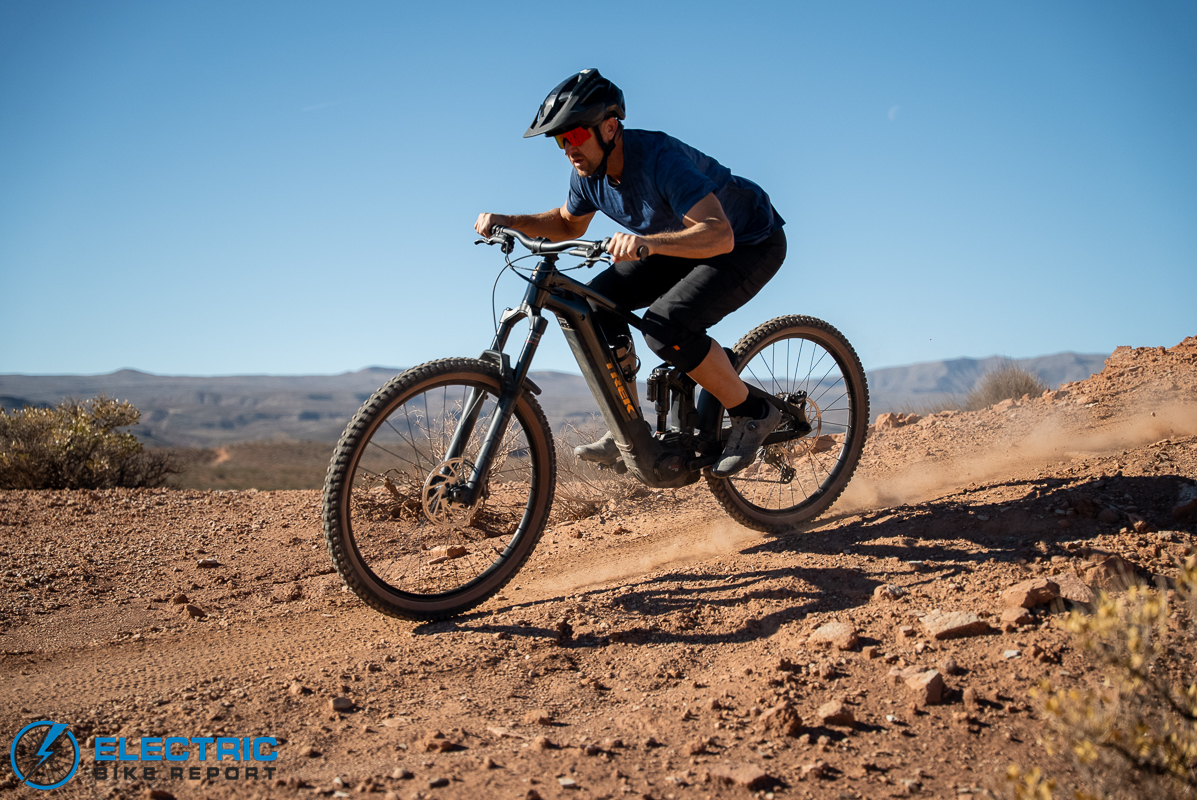
Trek’s Alpha Platinum Aluminum frame feels robust and well-engineered, offering confidence-inspiring stiffness without excessive weight.
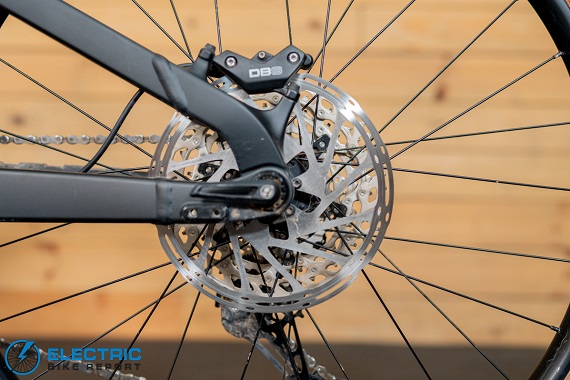
SRAM DB8 four-piston brakes with oversized rotors provide confident, consistent stopping power on long descents.
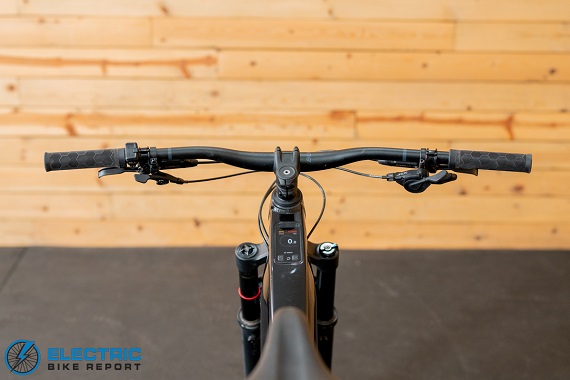
The cockpit layout is clean and functional, with a wide handlebar and intuitive control placement that feels natural on the trail.
Trek Rail+ 8 Review: Hill Test
The Rail+ 8 has the raw muscle to summit just about anything you can reasonably point a bike toward. From our smooth, paved climb on Devil’s Backbone to the bumpier, looser dirt of our Water Tower hill, the Rail consistently beat our category averages.
DBB:
Time: 1:59
Pace: 15.2 mph
eMTB Average: 2:12
Water Tower:
Time: 3:25
Pace: 15.2 mph
eMTB Average: 3:45
Those are standout numbers. The new Bosch Gen 5 motor puts the Rail in elite company. It’s about on par with Specialized’s Turbo Levo AL when it comes to climbing efficiency, with both sitting just behind the blistering pace of the Amflow PL Carbon Pro. Still, the Bosch setup holds its own as one of the strongest and most controllable systems on the market.
Bosch motors have long been praised for their natural yet powerful feel, and this latest generation continues that tradition. Compared to the previous model, the improvements are immediately noticeable. As a Trek Rail+ Gen 4 owner myself, I can say firsthand that the earlier motor’s faint rattle and mid-level whir are now completely gone. The Gen 5 is quieter across the board—no rattle, less noise, and somehow even more power.
I rode the new Rail for quite a while using the familiar power profiles from my own bike, and it already felt strong and smooth climbing up steep grades. But once I switched to the higher-output settings enabled through the Flow app, it was a different animal altogether—faster, easier, and incredibly responsive.
That said, a word of caution: in the highest power modes, the motor’s overrun (that brief push of power after you stop pedaling) can make technical climbing a bit tricky until you get used to it. Once you learn its behavior, though, that same feature becomes a real advantage—it’ll help you clear obstacles you might’ve thought were 50/50 at best.
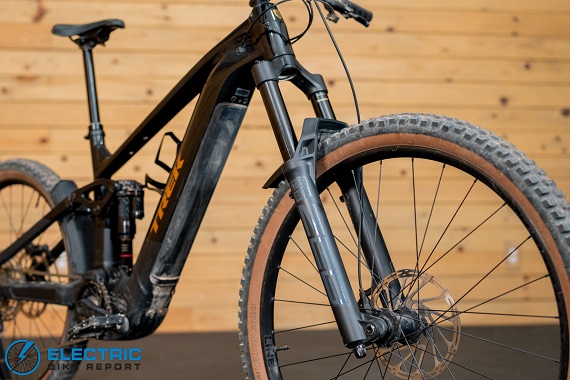
The Rail+ 8’s balanced geometry and 160mm RockShox suspension keep it composed and predictable when charging through rough terrain.
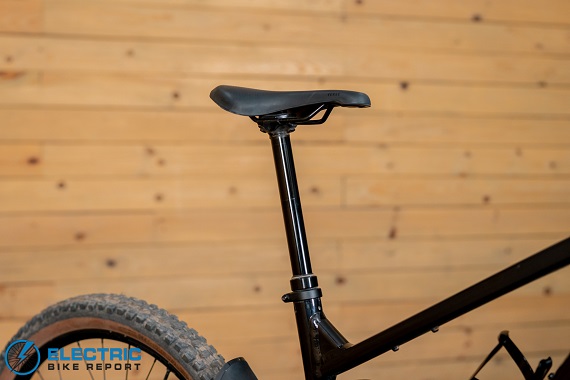
Smooth action from the Bontrager dropper with 150-200mm of travel available depending on your frame size.
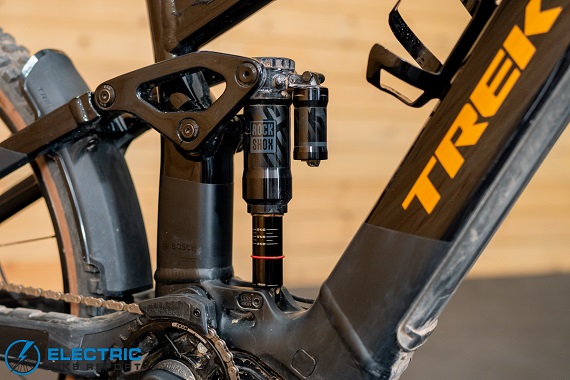
The RockShox Super Deluxe rear shock and adjustable linkage allow riders to fine-tune suspension progression for their terrain and style.
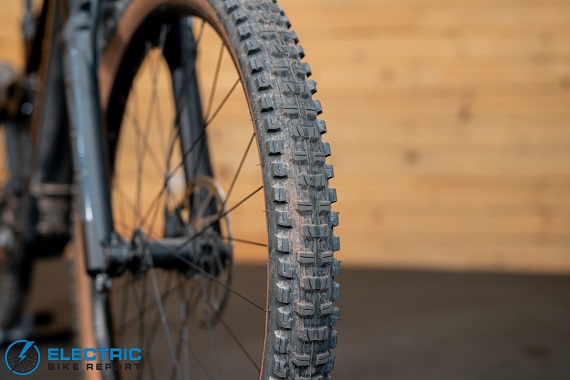
They’re not the fastest tires but they’re a happy blend of speed, grip, and float.
Trek Rail+ 8 Review: Ride Quality
As I mentioned earlier, I own a Trek Rail+ myself, so when I saw how much had changed with this new version, I expected it to feel like a completely different bike. To my surprise, the Trek DNA still shines through. Yes, it’s evolved, but it remains unmistakably a Rail—built to be as approachable and capable for as many riders and trail types as possible, now with more adjustability and refinement to fine-tune your experience.
Our test bike was the Rail+ 8, built from Trek’s Alpha Platinum Aluminum (ethically sourced and made in part from recycled materials). It feels solid and well-engineered. The geometry isn’t ultra-slack, but it strikes a sweet spot that’s stable and confident without sacrificing responsiveness. Paired with Rockshox 160mm front and rear travel, it’s ready to dive into rougher terrain while maintaining a comfortable, composed demeanor. If downhill is more your flavor, you can even bump the fork travel up to 170mm to make it a more dedicated descender. There’s also space for a coil shock too if you want to go that route.
The new Mino Link adds a welcome layer of versatility. You get about half a degree of adjustability in both the head tube (64.5°–65°) and seat tube, allowing you to tailor the handling for your terrain or style. We rode primarily in the lower setting for a slacker, more stable feel on descents, but flipping it to the high setting sharpens handling for flatter, flowier trails. If you want more adjustment than that, there are optional headset cups you can look into for another degree to play with for even slacker or steeper rides.
There are four frame sizes and two color options available. My one gripe: the jump from medium to large is significant, with a 45mm difference in reach which is a noticeable gap that could make sizing tricky for riders in between. And while there’s room for a bottle cage, it only accommodates a single 500ml bottle, which feels a bit limiting for longer rides. Still, small details aside, Trek nails most of the fit and finish elsewhere.
Our test bike came spec’d with a 780mm handlebar, 170mm dropper post, and 160mm crank arms. The dimensions felt dialed for an all-around trail bike. I especially like seeing shorter crank arms becoming the norm on eMTBs; with the motor’s torque doing the heavy lifting, it makes perfect sense and adds ground clearance.
This new Rail+ moves to a mullet setup (29” front / 27.5” rear), which gives it a snappier, more maneuverable rear end. The short chainstays help it feel impressively agile for a heavier aluminum build, and that benefit will only increase with the lighter carbon models higher up the lineup. As someone used to full 29ers, I didn’t mind the change, but I do wish Trek still offered the option for matching wheel sizes. For now, it’s a members-only club: mullets only.
The component package fits well within the Rail+ 8’s tier. The SRAM DB8 brakes delivered consistent, confident stopping power without the bite of the more aggressive Maven line, and the Shimano Deore 12-speed drivetrain shifted smoothly throughout testing.
In today’s eMTB market, the value feels fair—not a screaming deal, but certainly not overpriced given the performance, construction, and Bosch system you’re getting. And of course, Trek’s lifetime frame warranty and expansive dealer network add a level of long-term security that few brands can match. Wherever your trails take you, support won’t be far away.
Sponsor
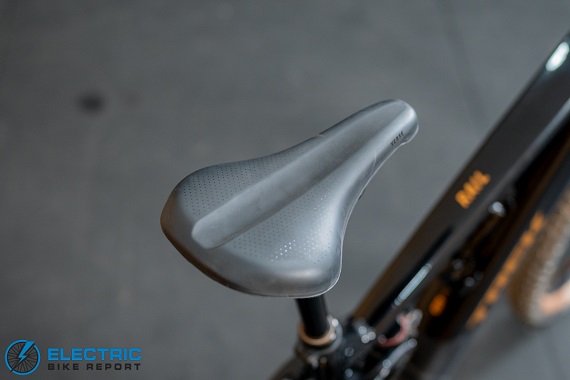
The saddle is supportive enough for longer sessions.
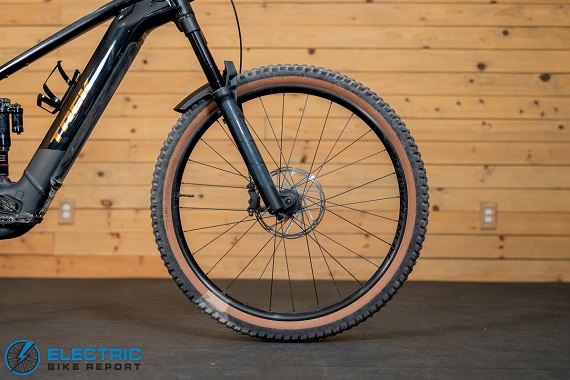
29” up front with 27.5” in back. Mullets are here to stay (Billy Ray Cyrus, rejoice).
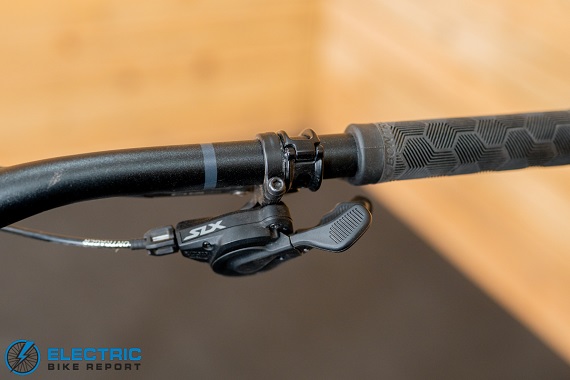
Nothing fancy, but reliable and easy shifting from the SLX shifter.
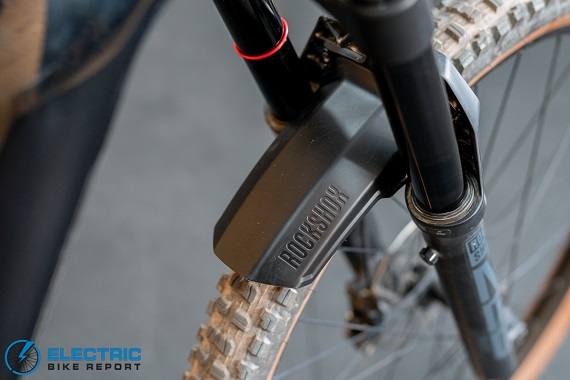
Many bikes omit the short fender, but I’m glad to see the Rail isn’t guilty of the nice inclusion.
Trek Rail+ 8 Review: Summary / Where to Buy
The latest generation of the Rail+ brings some big changes, and the result is an exceptionally well-balanced eMTB that delivers on nearly every front. It’s powerful, planted, and adaptable, with a suspension setup that feels at home on everything from flow trails to chunky rock gardens. Add in the new Mino Link for geometry tuning and the mullet wheel setup for added agility, and you’ve got a bike that’s noticeably more customizable and maneuverable than before.
Bosch’s motor has always been known for its punch, but bumping it up to 750W and 100Nm of torque gives the Rail+ a whole new gear—literally and figuratively. It rockets up climbs, builds speed effortlessly, and still offers the control you need to handle tighter, more technical sections when you dial the settings in through the Flow app.
Across all our rides, the Rail+ 8 never felt out of place. It handled smooth singletrack, loose climbs, and steep descents with equal confidence. Trek has managed to evolve the Rail’s capability without compromising its all-rounder identity. It remains one of the most versatile full-suspension eMTBs out there—powerful enough for thrill-seekers, but balanced and approachable enough for everyday trail riders.
Happy Riding! Make sure to let us know if you have any questions or if you think we left anything out in this review of the Trek Rail+ 8 down in our comments section.
Sponsor
Sponsor
Reader Interactions
Leave a Reply