

Dahon K-Feather Review | Lightweight Urban Practicality
Jan 30, 2026
 6 Comments
 Share
Share
This simple, spartan, and superlight folding e-bike is ideally suited for city dwellers seeking an affordable, highly portable ride.
If you live in a cramped, expensive apartment in a dense city, regularly taking public transit as part of your daily commute, a folding e-bike might be a great supplement to your lifestyle. There’s just one problem: the average 70-lb folding e-bike might be more of a hindrance than a help.
Folding e-bikes in the US market have been trending toward the heavier, more feature-rich, and more powerful side in recent years. This approach can improve their range and ride quality, but it also makes them more difficult to fold, lift, store, and transport. A city bus driver likely won’t be thrilled if folding and hoisting your bike on board holds up their route.
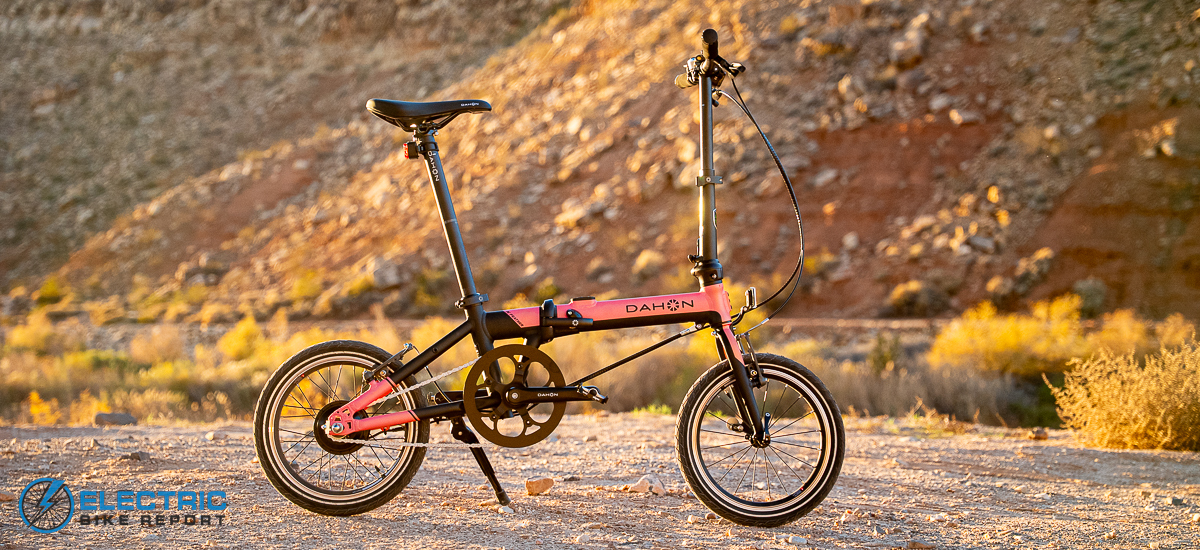
If you’re in need of a more convenient, quick-folding, and compact e-bike for urban riding, an ultra-lightweight model like the Dahon K-Feather might be right up your alley. Weighing in at an incredible 28.3 lbs, this featherweight folder is light enough to lift with one hand, and it collapses down to one of the smallest packages we’ve seen in a bike of its style.
The K-Feather’s low weight is a result of a minimalist approach to its design; the bike features a small but helpful 250W motor, a similarly tiny 120 Wh battery, a utilitarian single-speed drivetrain, a single on/off button, and one assist level. There are no gears to shift, screens to read, or options to select—just turn it on, hop on the saddle, and pedal!
Based on the K-Feather’s specs and feature-light approach, we expected the bike to function well without blowing away its more robustly-equipped competition. Continue reading our full review below to find out how it performed in our series of standardized performance tests and how it felt to ride!

Sponsor
E-Bike Category:Folding
E-Bike Class:Class 1 (pedal assist to 16 mph)
Sponsor
Dahon K-Feather Video Review
 Pros
Pros- It’s incredibly lightweight and portable! At just over 28 lbs, the K-Feather is one of the lightest and most practical folding e-bikes we’ve tested.
- Dahon prioritized easy operation, with just a single assist level, one button, and a single-speed drivetrain. Just turn it on and go!
- The bike is incredibly nimble and maneuverable, thanks to its lightweight frame and 16” wheels.
- Its pedal assist system is highly responsive and natural feeling, with a torque sensor that responds to your level of effort.
- It folds quickly and stores small! The bike includes helpful guides for the seatpost and stem heights, along with a magnet/metal plate to keep the frame folded for transport.
- With a price point between $1,000 and $1,500, the K-Feather is affordable for the masses.
- The bike’s fit is adjustable for a wide range of riders between 4’7” and 6’0”, with an extended seatpost and telescoping stem.
 Cons
Cons- We found the bike’s speed and power levels to be appropriate for dense urban environments, but the average American rider may prefer more oomph.
- The bike’s feature-light nature helps conserve weight, but integrated lights would be a nice upgrade from the current battery operated units.
ELECTRICAL SPECS & FEATURES
- Battery: Built-in 24V 120WH (5AH) battery Samsung Cell
- Charger: 2A
- Display: None
- Motor: Dahon 24V/250W (max 16 mph), 32 Nm torque
- Headlight: Battery Operated
- Taillights:Battery Operated
- Pedal Assist: One assist level
- Claimed Range: Up to 25 miles
- Throttle:None
- App:None
- UL Certification:None (EN15194 certified)
Weight & Dimensions
- Claimed weight: 26.4 lbs
- Tested Weight: 28.3 lbs
- Rider height range: 4’7″ – 6’0″
- Total payload capacity: 231 lbs
Components & Accessories
- Brakes:DAHON Custom V-brake, WB-985DK F+R L:110mm aluminum
- Fenders: Optional
- Fork:Rigid Aluminum
- Frame: 16″ Aluminum
- Drivetrain: Single-speed, 53T chainring, 13T cog
- Grips: DAHON Ergo Comfort
- Saddle: DAHON Ergo Comfort
- Handlebar: 6061 Aluminum Flat Bar, 560 mm Wide
- Kickstand: Included
- Pedals: Wellgo R200DU
- Tires: DAHON 16″*1.5″
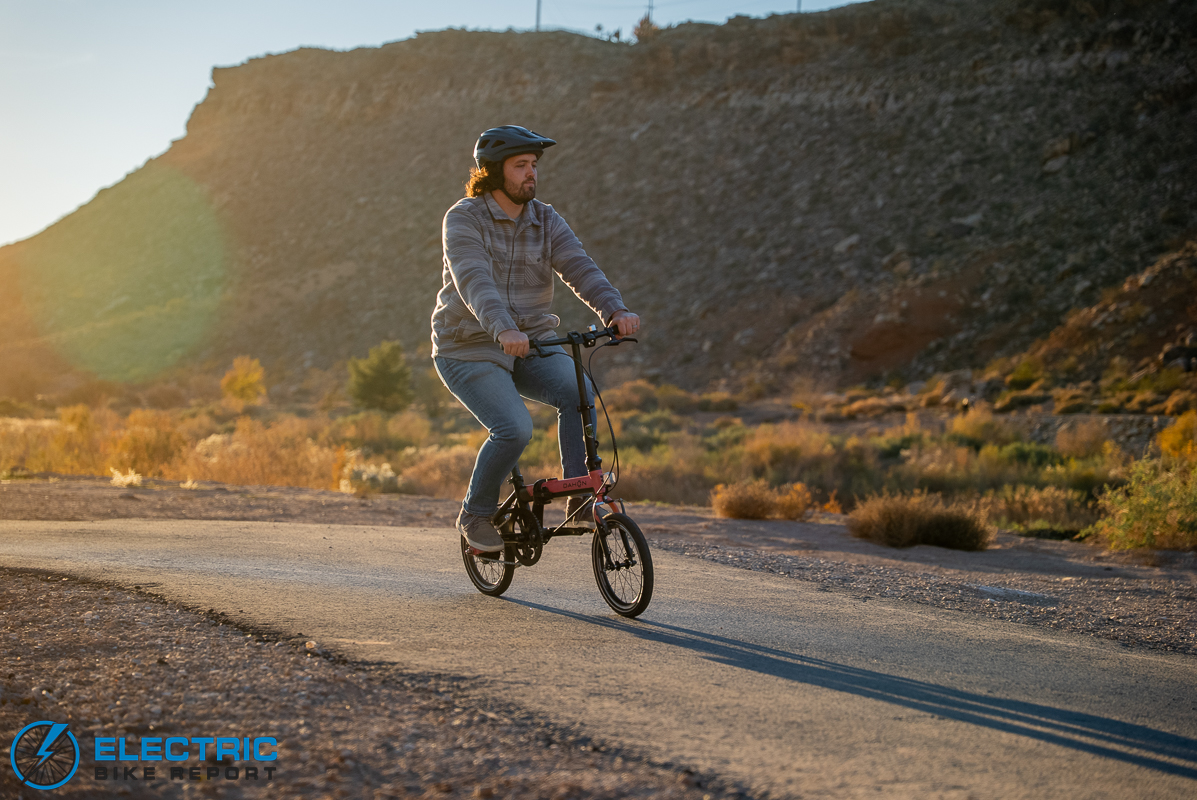
Dahon advertises a maximum speed of 16 mph for the K-Feather.
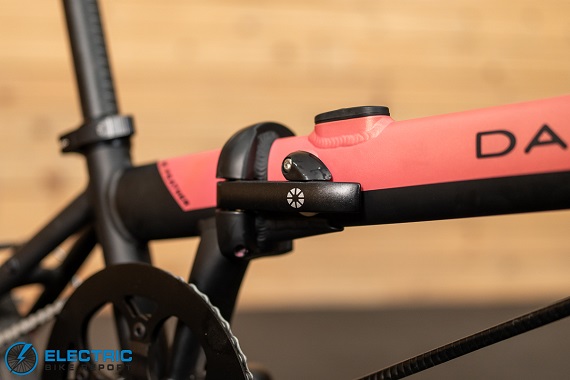
A hinged frame allows the lightweight bike to fold down to a small, portable package.
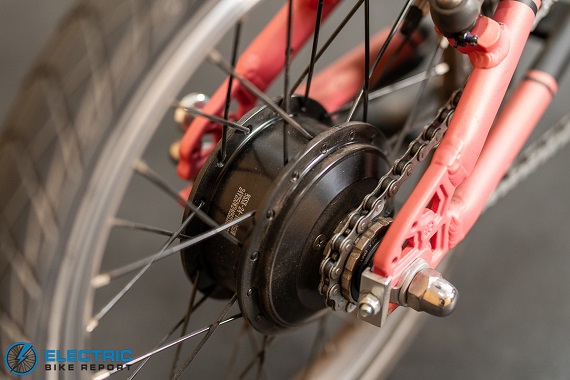
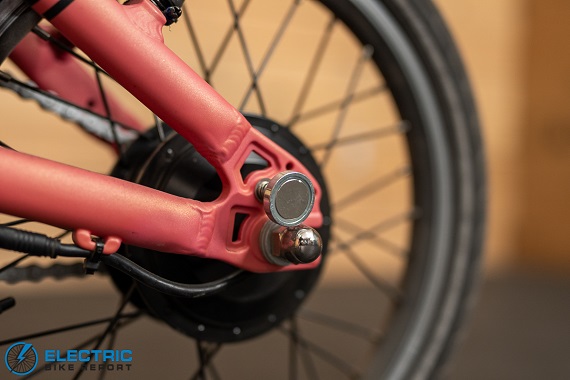
The bike’s 250W rear-hub delivers helpful power in response to your pedaling.
Dahon K-Feather Review: Speed Test
As a Class 1 e-bike manufactured outside the US, the Dahon K-Feather has an advertised 16 mph maximum speed with just one pedal assist level. I tested its ability to reach this speed by riding on a flat section of our local paved shared-use path.
When riding, the K-Feather’s 250W rear-hub motor responded to my effort thanks to its torque sensor. With harder pedaling, it brought me up to speed faster, while if I applied lighter pressure, the pedal assist felt more subtle. In all cases, the single-speed drivetrain added some resistance to the pedals, but the overall power delivery felt smooth and natural.
Despite the bike’s advertised maximum speed, I found that my average speed was roughly 13.3 mph; the motor seemed to switch off upon reaching this threshold. I could pedal faster under my own power by pushing beyond this point, but the motor did not seem to contribute any more assistance.
In the US market, we expect most riders would prefer higher speeds, with the ability to reach 20 mph at a minimum. Still, for certain types of cyclists, the K-Feather could be a practical method of shortening a commute, getting some exercise, or simply offering a functional mode of transportation that fits in a small personal space.
While I didn’t reach the 16 mph maximum, pedaling the bike between 13-14 mph was comfortable and enjoyable. Considering that the motor did provide useful power, the K-Feather proved practical for use in dense urban environments, whether that be getting between an apartment and the subway station or completing a ten-block commute.
Sponsor
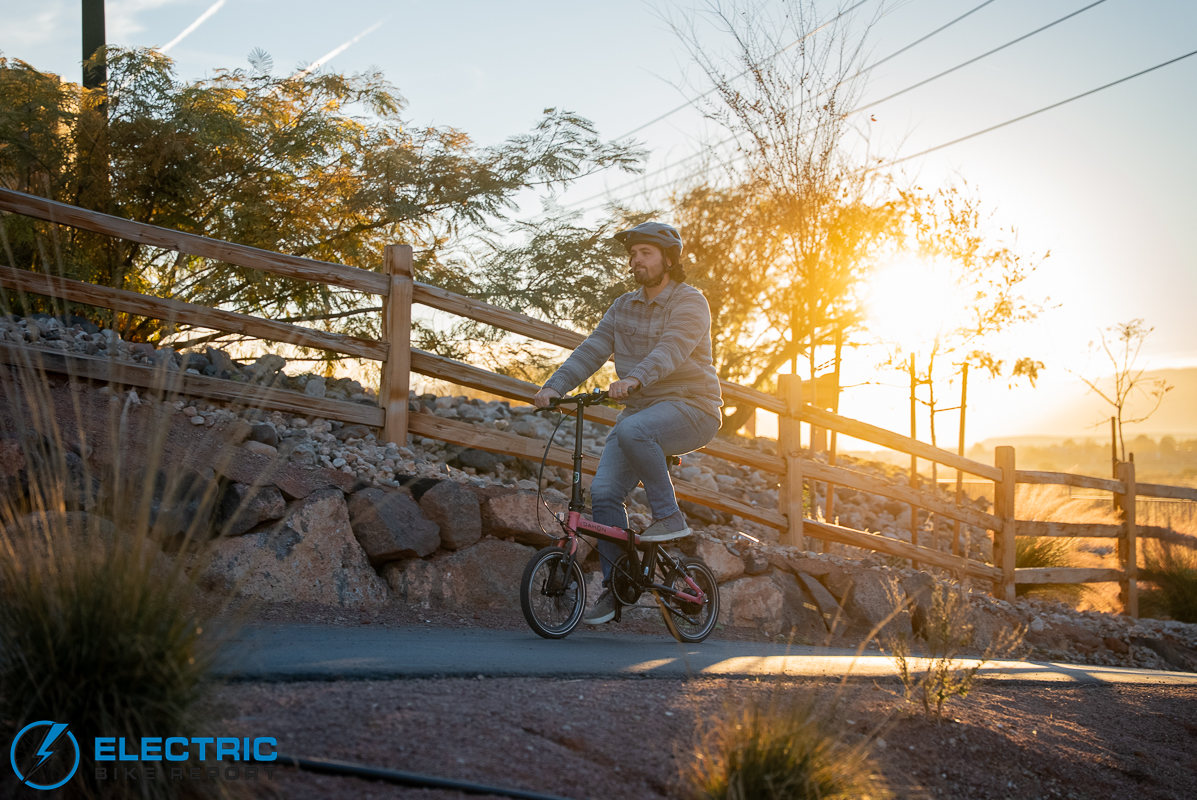
Whether used for quick jaunts between the apartment and subway or longer exercise rides, the K-Feather prioritizes function.
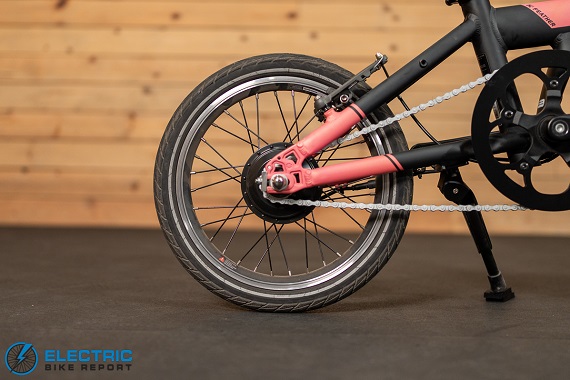
A single-speed drivetrain makes the K-Feather easy to hop on and pedal.
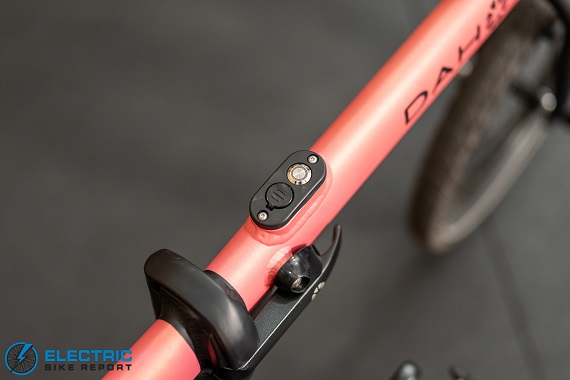
TThe bike has just a single button, making its operation nearly effortless.
Dahon K-Feather Review: Range Test
As a folding e-bike that prioritizes low weight and portability, the Dahon K-Feather features a fully internal 24V, 120 Wh battery rated for up to 25 miles of range. We tested its range in the real world by pedaling it on a network of shared use trails until its battery was fully depleted; our testers traveled 21.2 miles on a charge.
While we have tested a wide variety of folding e-bikes, the pool of lightweight, relatively low-power models similar to the K-Feather is relatively small. These bikes, which typically had at least three assist levels, averaged roughly 23.3 miles in their highest power setting.
The K-Feather’s result is therefore slightly below average when compared to similar e-bikes, but it’s important to note that its competitors also had significantly larger batteries averaging 318 watt-hours (Wh). With this in mind, the K-Feather’s results are truly admirable given its petite 120 Wh power pack!
There are likely two reasons for the K-Feather’s relative success in this test. First, with a torque sensor that fluctuates power output based on rider effort, the motor can conserve more energy when compared with e-bikes using cadence sensors that act more like on/off switches.
Second, while we didn’t notice it much due to the speed we picked up, Dahon advertises a “Smart Power Adjustment” feature that turns off the motor automatically when going downhill. This may have also contributed to the bike’s energy efficiency and its ability to stretch its charge for an impressive number of miles.
Based on our testing, we feel confident that riders using the K-Feather for short commutes (or parts of a commute) should expect many rides from a single charge. Most commuters we interact with have one-way trips up to 10 miles, so the Dahon’s range should cover lengthier travel for those who need it—with more frequent recharging, of course.
When the bike’s 5 Ah battery does need to be plugged in, the included 2A charger should have it recharged in roughly 2.5 hours.
Sponsor
Sponsor
Dahon K-Feather Review: Hill Test
Testing the hill climbing performance of an e-bike is an essential part of its overall evaluation. We used the process described in the graphic above to test the Dahon K-Feather, and recorded a pedal time of 3:21 from the bottom of the hill to the finish line at the top.
Once again, comparison is relatively difficult; while we have reviewed a handful of similar e-bikes in our history, most of those were tested at our previous Hill Test location, Hell Hole Trail. With a completely different length and slope at the Devil’s Backbone, it is not possible to compare results from one location to another.
We have tested one single similar model at our new location. That bike, which weighed 9 lbs more than the K-Feather and was also equipped with a 250W rear-hub motor, completed the test 41 seconds faster. In fact, the K-Feather’s result is one of the slowest we have recorded at our new location, but let’s consider the reasons why.
The difference in results was likely due to differences in motor output. According to our contact at Dahon, the K-Feather’s 250W motor peaks at around 318W and it produces a maximum of only 32 Newton meters (Nm) of torque. The competing e-bike’s motor peaked higher via both metrics, at an impactful 500W and 42 Nm of torque.
After testing hundreds of e-bikes in total, we knew to expect that the K-Feather would likely not break any records in this test. Still, it is more than capable of providing useful power when climbing, as evidenced by my personal experience.
I tested the bike at our secondary location, Pilot Hill, which is near to our office and typically a part of our individual testing. In all honesty, I wasn’t looking forward to the experience, as I anticipated a difficult climb, but I found myself pleasantly surprised. My trip to the top was active, but not exhausting, which is exactly the result and benefit an e-bike should provide.
Ultimately, it’s fair to say that the K-Feather is best suited for mostly flat areas and relatively small hills, but it’s still powerful enough to make a difference when pedaling up more intense slopes. Those looking for an e-bike capable of doing all the heavy lifting may find it somewhat lacking, but cyclists who enjoy an active workout will likely appreciate its light but helpful power.
Sponsor
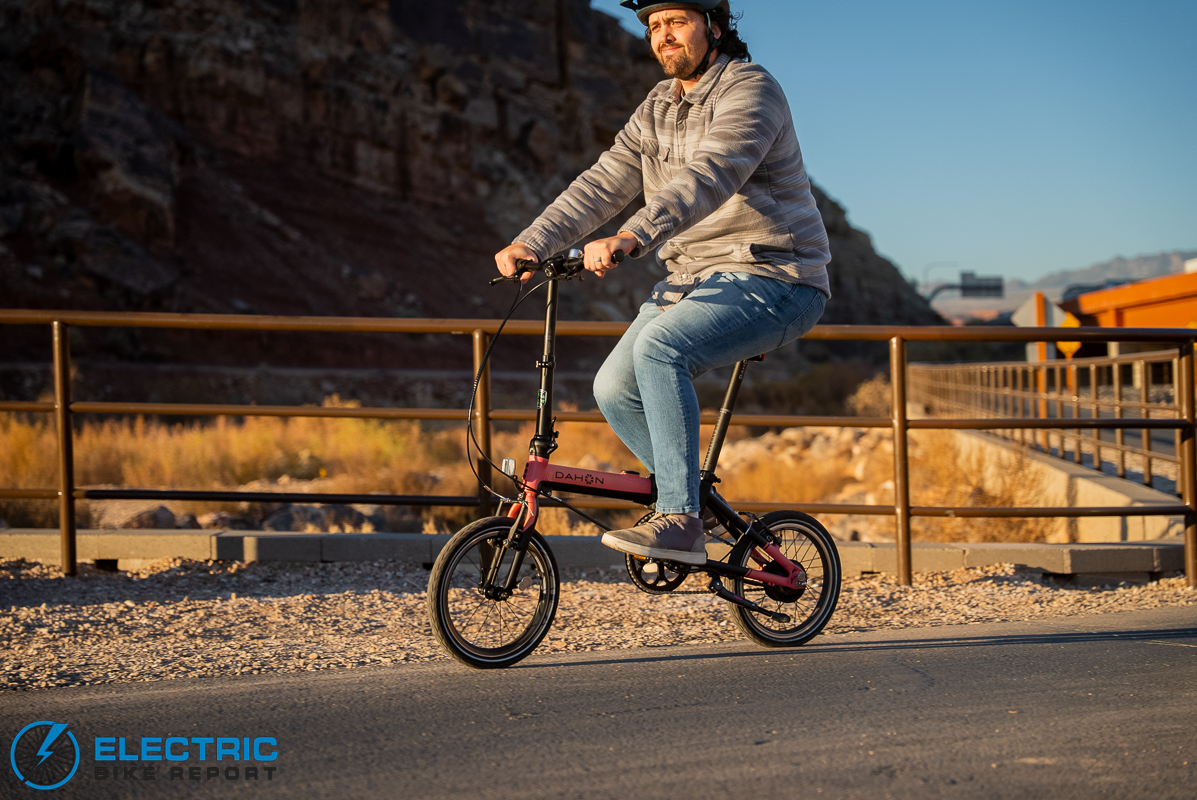
While the K-Feather’s small size might look a bit funny, the bike is surprisingly comfortable and accommodating.
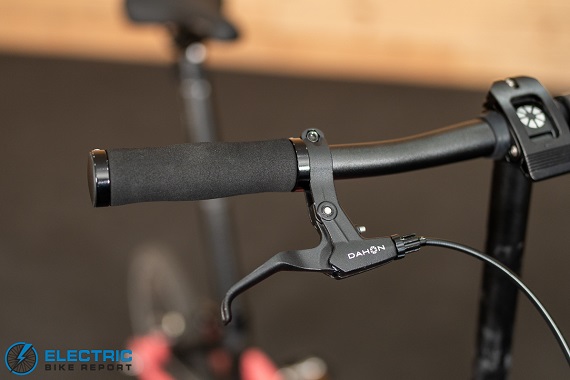
The bike’s brake levers are custom-branded.
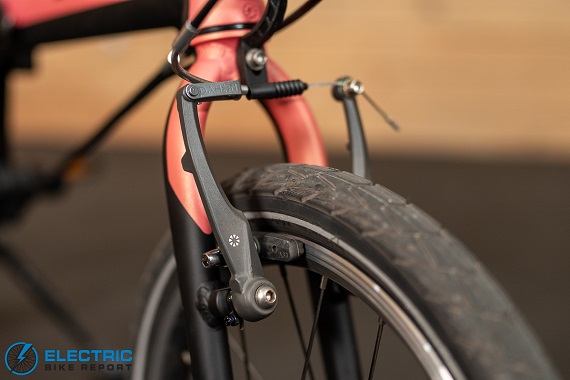
Our testing proved the bike’s rim brakes capable and effective.
Dahon K-Feather Review: Brake Test
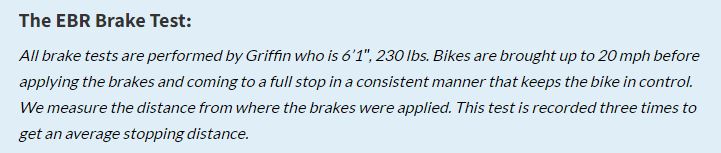
Our final formal performance test is our Brake Test, described above. The Dahon K-Feather scored an excellent average result of 16’ 3”, which is one of the shortest distances we have recorded from any of the hundreds of e-bikes we’ve tested.
Once again, comparison is relatively difficult, as the K-Feather differs from most folding e-bikes we’ve tested in both its brake type and its maximum speed. While most similar models were equipped with hydraulic or mechanical disc brakes and could reach at least 20 mph, Dahon outfitted the K-Feather with rim brakes. Our tester, Griffin, was able to pedal it to around 15 mph for this test.
At the time of writing, we’ve reviewed one similar lightweight folding e-bike with a 16 mph top speed and rim brakes. It was roughly 10 lbs heavier (and therefore, more difficult to stop) than the K-Feather, but scored 19′ 9″ in its Brake Test. We considered that bike and its brakes extremely effective, so it would follow that we would rate the Dahon similarly.
It’s worth noting that rim brakes typically require more grip strength than hydraulic disc brakes, but they do provide good modulation over speed—and clearly, in the right place, solid stopping power.
Additionally, under extremely firm braking, the K-Feather was so light that its rear wheel lifted while braking. We performed this test relatively early in our testing and had to make a few practice runs to adapt to this tendency. Overall, we felt safe when braking, but we might advise some similar testing of the brakes to ensure you get the feel for using them.
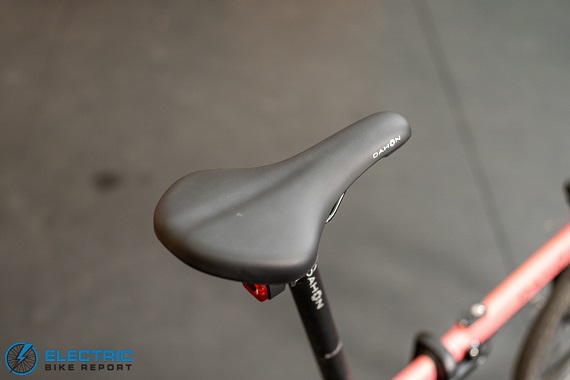
The bike’s slim saddle is supportive and surprisingly comfortable.
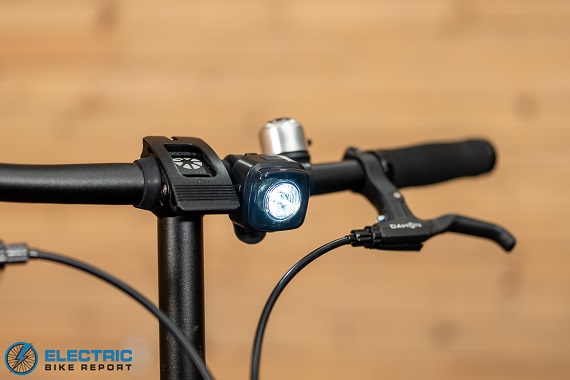
A set of battery operated lights add low-light visibility.
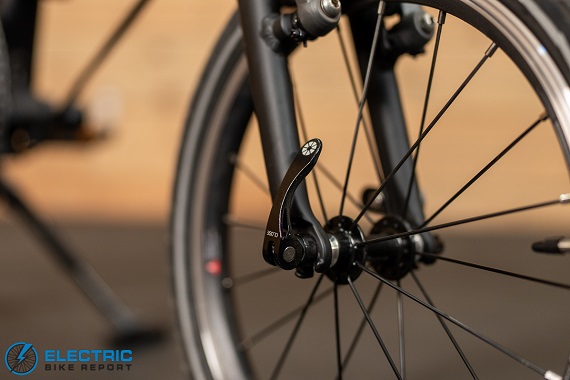
The K-Feather’s front wheel has a quick release skewer for even more portability.
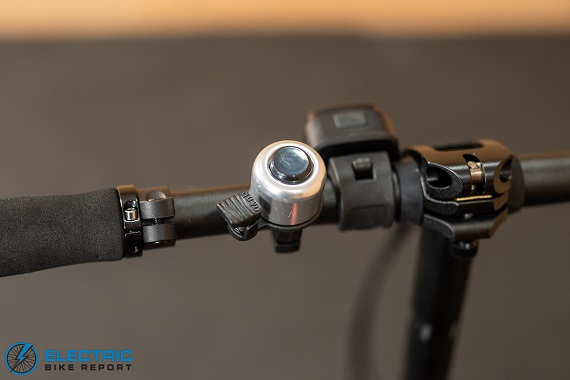
The handlebar-mounted bell encourages signaling to other riders and pedestrians.
Dahon K-Feather Review: Ride Quality
Ride quality is an overall measure of how a bike feels to ride. It encompasses sizing, suspension, stability, motor engagement, the bike’s user interface, etc. With such a minimalist approach, the K-Feather was easier to evaluate than many more complicated e-bikes; we found its ride quality to be right in line with its design and purpose.
Dahon makes the K-Feather in a single frame size (with four color options) suitable for riders between 4’ 7” and 6’ 0”. I am just below the ceiling of that recommended range at 5’ 11”, and I found it comfortable, though I could tell its range of adjustability was near its limits.
With the telescoping stem at its highest position and the extended seatpost near its apex, I had a comfortable, if moderately aggressive, forward-leaning riding position. I opted for a slightly lower-than-usual saddle position to balance comfort and pedal efficiency, and overall, the ride felt sporty and enjoyable.
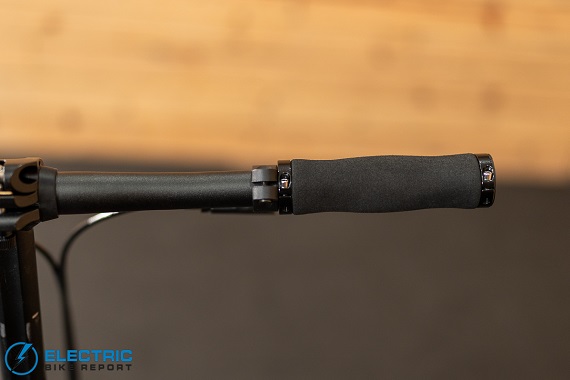
Handling was a highlight; the K-Feather’s light frame and 16” wheels make it feel airy and agile. Steering was quick and responsive (some might say relatively twitchy) due to its narrow 560 mm handlebars, but the light foam grips were soft and comfortable.
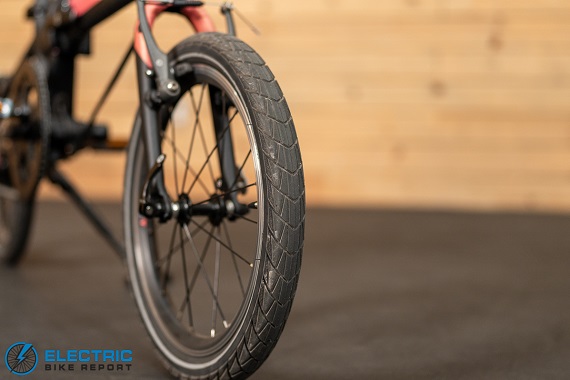
Interestingly, while the bike does not have any form of suspension, the ride felt surprisingly smooth and softer than I expected.
It’s possible that the 1.5”-wide tires absorbed some bumps and roughness, but I believe the frame—and possibly the Deltech support cable between the bottom bracket and junction of the top tube and head tube—helped to reduce jarring vibrations. This feature is exclusive to Dahon e-bikes, and advertised to increase frame rigidity and pedal efficiency.
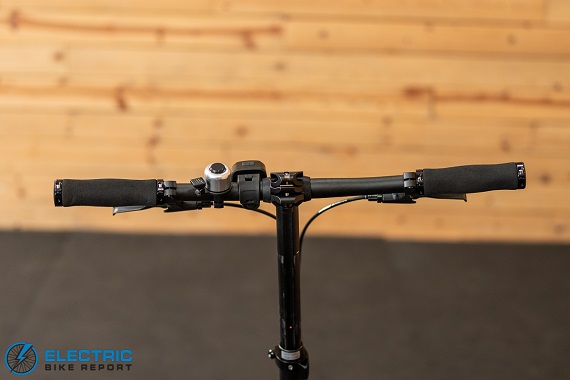
In terms of overall operation, it really doesn’t get simpler! Instead of a display and control panel, the bike has a single on/off button with a colored light ring to indicate battery charge. The single-speed drivetrain requires no shifting, so the only handlebar-mounted controls are the brake levers and a small bell.
As I touched on in the Speed Test section above, motor engagement is smooth and natural. Pedaling requires light to moderate effort due to the motor’s relatively low power output and the single-speed drivetrain, but the experience feels intuitive and responsive. The pedal assist provides a helpful boost without overpowering the rider’s effort, so pedaling the K-Feather still feels very much like riding an analog bike.
The bike is extremely feature-light, with no fenders, cargo rack, or other accessories; only a kickstand and two battery-operated lights come along with the bike. I appreciate Dahon’s minimalistic approach, but integrated lighting would make the K-Feather feel more complete as an e-bike.
In terms of its folding feature, the K-Feather breaks down quickly, though there is a slight learning curve to the handlebars. The bike’s telescoping stem is marked with a recommended height for folding. When collapsed, its stem and handlebars are sandwiched by the frame halves, which are held together by a magnet and metal plate. We measured the folded bike at roughly 29”L x 18.5”W x 24”H.
All in all, the K-Feather takes a relatively utilitarian approach to its function and folding. It’s a straightforward product that’s comfortable and extremely easy to learn and use, making it great for new riders and those seeking an uncomplicated mobility tool.
Sponsor
Dual-beam LED headlight helps with visibility when dusk sets in.
There are mounts if you want to add a front rack, just mind the cables as spacing will be tight.
The saddle is on the plush side.
The brakes were safe in testing, but we wouldn’t say no to larger rotors given the weight of the bike.
Dahon K-Feather Review: Summary / Where to Buy
Some folding e-bikes aim to provide a plush, extremely versatile, and robust experience akin to that of a full-size commuter, SUV-style or fat tire bike. Others focus more on portability, simplicity, and solid execution. The Dahon K-Feather is more the latter than the former, with a stripped-down, spartan design—but it’s also completely suited for its role.
It takes a more traditional approach to being a folding e-bike, prioritizing a compact and quick-folding design, an agile and engaging ride feel, and a simple, easy-to-use interface. Its low weight and small size make it ideal for city dwellers in small living spaces, enabling cross-town travel with or without the supplemental use of public transportation.
Due to its unique nature, including a 16 mph maximum speed, a 250W rear-hub motor, rim brakes, and an incredibly low weight of 28 lbs, it’s difficult to judge the Dahon K-Feather’s performance against most other folding e-bikes we’ve tested. With that in mind, we found its braking excellent, its range impressive for its specs, and its climbing power appreciable and appropriate for its style.
We consider the bike successful as a lightweight urban mobility device, a relatively short-range commuter, and an exercise bike, but it showed some room for improvement in two main areas. The ability to reach 20 mph would likely make it more appealing to US consumers, and integrated lighting would add both real and perceived value (though we appreciate its affordability and simplistic design).
Whether you’re a college student looking for a fun and functional way to get across campus, an apartment dweller seeking a way to shorten the morning commute, or a downtown resident wanting a bike to carry on the city bus or subway, the Dahon K-Feather is a lightweight, budget-friendly, smartly designed folding e-bike that might be right for you!
Happy Riding! Make sure to let us know if you have any questions or if you think we left anything out in this review of the Dahon K-Feather down in our comments section.
Sponsor
Sponsor
Reader Interactions
Comments
Leave a Reply




Looks lie another really fast 17+ mph bike.
How about a picture of it folded?
Opps, sorry about the last comment. I had no watched to video!
I don’t think this was covered in the video or written review, but if I’m not mistaken, if you run out of battery you are stuck in a 53-13 gear, is that correct?! That would be a tough gear for a lot of people to push unassisted, especially from a stand still and even more so on an incline.
That is true, though the low weight of the bike helps to offset pedaling difficulty to some degree. As with any e-bike, we’d recommend sticking close to home if your battery charge is getting low.
I have not been able to get mine above 12mph how on earth did you get it to 16? Even at 12 I was peddling like a maniac.