

Priority Skyline Smart.Shift E-Bike Review | Smart & Savvy
Dec 19, 2025
 1 Comments
 Share
Share
A sporty, responsive, and well-equipped commuter with a semi-automatic, low-maintenance drivetrain and an approachable price.
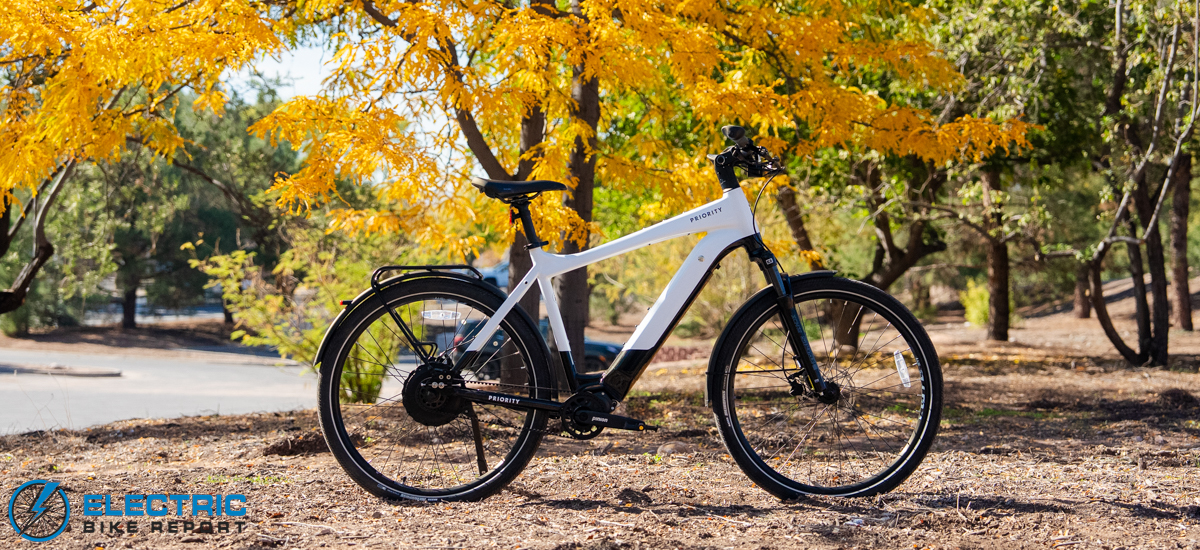
Lifestyle e-bikes can generally be lumped into three categories by their specs and components: entry-level, mid-tier, and premium. Bikes in each category typically have a significant amount of overlap, and it’s relatively uncommon for them to offer features found in higher spec tiers.
The Priority Skyline Smart.Shift E-Bike, then, is somewhat of an unusual case. This mid-tier commuter offers comparable specs and a similar, sporty feel to many of its peers—with one notable exception.
This bike features a12-speed C1.12i Pinion gearbox at the bottom bracket, paired with a Gates Carbon belt drive and a powerful, torque-sensing 750W rear-hub motor. This combination places the Skyline a step or two above many similar models due to its noticeably high-tech, extremely low-maintenance, and seriously user-friendly nature.
To put it simply, the Pinion makes the Skyline a dream machine. In addition to snappy electronic shifting that happens at the push of a button (technically two), users can select between two semi-automatic shifting modes. One downshifts to a preselected gear upon stopping, while the other adds downshifting while coasting to match a preset cadence.
Additionally, the transmission system is sealed and protected from damage and wear. Owners need only to change the internal oil bath semi-regularly, and the paired Gates belt is rated to last at least twice as long as a chain.
The Skyline is also one of the lowest-priced e-bikes equipped with this drivetrain we’ve seen! Aside from its cool tech and approachable price, we liked the bike’s responsive, capable, and energy efficient motor.
Our first ride left us eager to know how its performance would compare to that of its peers. See our full review below to see the results of our Speed, Range, Brake, and Hill Tests!

Sponsor
E-Bike Category:Commuter
E-Bike Class:Class 1 (pedal assist to 20 mph)
Class 2 (throttle to 20 mph)
Class 3 (pedal assist to 28 mph)
Class 2 (throttle to 20 mph)
Class 3 (pedal assist to 28 mph)
Sponsor
Priority Skyline Smart.Shift E-Bike Video Review
 Pros
Pros- Its premium features come at an approachable price! The Skyline’s MSRP of $4k makes it one of the lowest-priced e-bikes on the market with its high-end transmission.
- The 12-speed Pinion gearbox offers electronic and semi-automatic shifting. It’s also incredibly convenient and low-maintenance.
- We thoroughly enjoyed the bike’s handling. Its wide 740mm handlebars and 27.5×2” tires provide precision and agility.
- It performed well across the board in our testing, with scores that matched or exceeded the average for similar commuters.
- Its fit is both precise and customizable, with three frame sizes and an adjustable stem for riders between 5’4” and 6’3”.
- The Skyline’s sporty riding position matches its speedy and responsive nature. Think of it like the e-bike equivalent of an executive sedan.
- It’s decked out with reliable, name-brand parts from front to back. This means solid performance and easy parts replacement when needed.
 Cons
Cons- There is a short delay when engaging the throttle while stopped; faster power delivery would be more user friendly.
- When in Class 3 mode, PAS 1-4 are capped at 23 mph. We’d prefer a 28 mph limit in all assist levels.
ELECTRICAL SPECS & FEATURES
- Battery: Removable 720Wh integrated downtube battery with charging port accessible on and off bike
- Charger:
- Display: Backlit display with 5 assist modes, speedometer, trip distance, and odometer
- Motor: Priority 750w torque-sensing hub motor, 1056W peak, 90 Nm torque
- Headlight: Ultra-bright 500lm front light
- Taillights:integrated to the fender rear light
- Pedal Assist: 5 assist modes
- Claimed Range: Between 20 and 60 miles per charge, depending on your assist level, throttle use, terrain, elevation, rider weight, temperature, and riding speed.
- Throttle:Left Thumb Throttle
- App:Pinion Smart.Shift
- UL Certification:UL 2271 & UL 2849 Certified
Weight & Dimensions
- Claimed weight: 68 lbs
- Tested Weight: 68.4 lbs
- Rider height range: 5’4 – 5’7 (S), 5’7 – 5’10 (M), 5’10 – 6’3 (L)
- Total payload capacity: 300 lbs max combined weight (rider, bicycle, and cargo)
Components & Accessories
- Brakes:Tektro HD-E350 Hydraulic disc brakes, 180mm rotor front, 180mm rotor rear, cut-off sensors
- Fenders: Alloy full fenders with integrated rear rack and routing for rear light
- Fork:SR Suntour XCM 32, 80mm travel
- Frame: 6061 aluminum
- Drivetrain: Pinion C1.12i Smart.Shift – 600% gear range, fully sealed, Gates CDX Black 39T Chainring, 28T Cog, Gates 115t CDX belt
- Grips: Priority ergonomic grips
- Saddle: Selle Royal Comfort Saddle
- Handlebar: 740mm width, 17-degree backsweep
- Kickstand: Frame-mounted rear kickstand
- Pedals: Composite body, chromoly spindle
- Tires: Maxxis Metropass 27.5 x 2.0″, reflective sidewalls
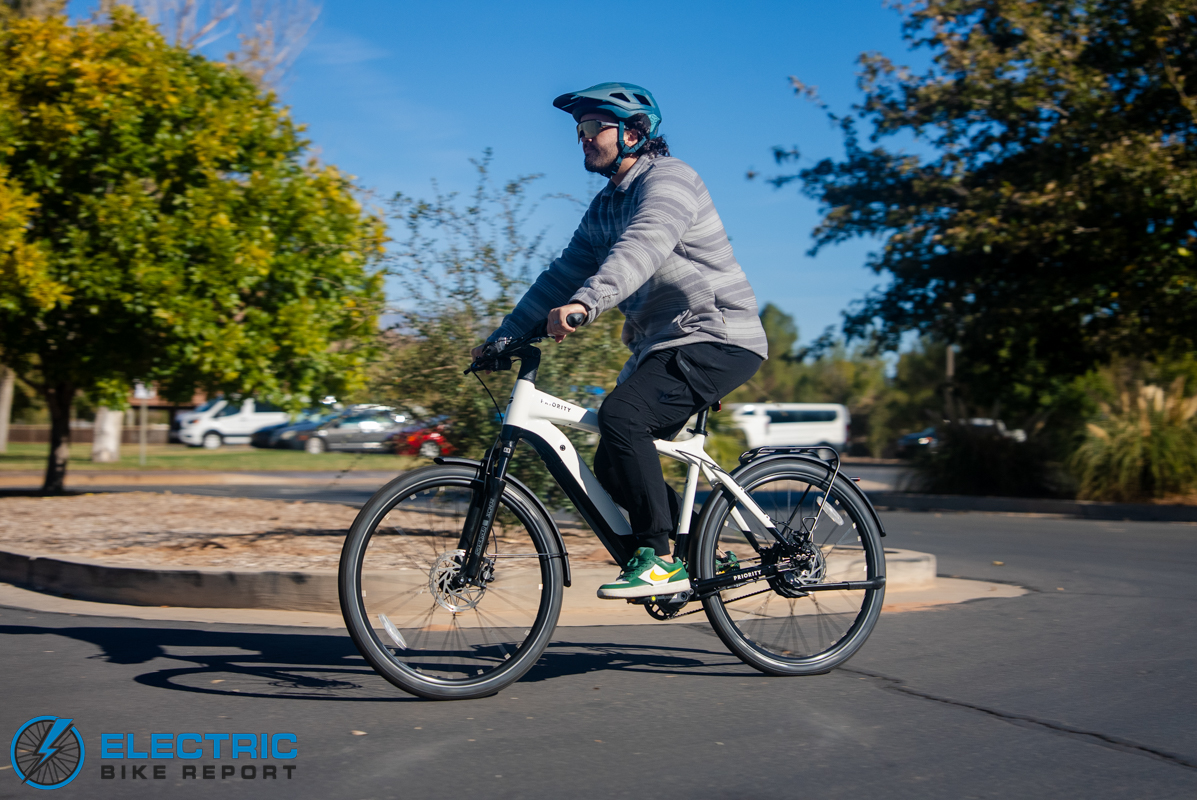
Riding the Skyline seems like pedaling a non-electric bike—until you glance down at the speedometer!
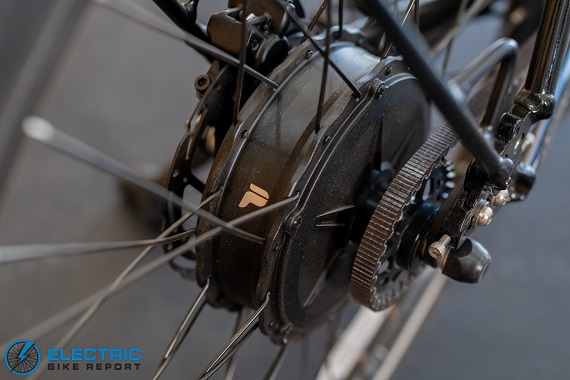
A robust 750W motor powers the bike over hills and up to 28 mph via torque-sensing pedal assist.
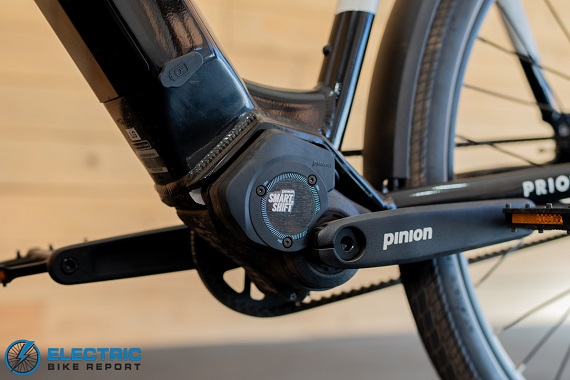
The 12-speed Pinion gearbox provides crisp manual and semi-automatic shifting along with a high-tech feel.
Priority Skyline Smart.Shift E-Bike Review: Speed Test
Like many similar e-bikes, the Priority Skyline ships as a Class 1 and 2 e-bike with its throttle and pedal assist system (PAS) limited to 20 mph. Users who live in areas where higher speeds are allowed can unlock the PAS to a maximum of 28 mph.
I tested the bike’s ability to reach these speeds by riding in each of its five PAS levels along a predetermined section of our local shared-use trail system. As I pedaled the Skyline, I maintained a relatively consistent level of effort to learn how much of an impact each power level had on my average speed.
My results are graphed above, but I will provide the breakdown below, as well.
In the bike’s Class 2 settings, my speeds were as follows:
- No PAS – 11.4 mph
- PAS 1 – 15.3 mph
- PAS 2 – 17.3 mph
- PAS 3 – 19.1 mph
- PAS 4 – 19.8 mph
- PAS 5 – 19.8 mph
In the bike’s Class 3 settings, my speeds were:
- No PAS – 11.4 mph
- PAS 1 – 15.8 mph
- PAS 2 – 17.2 mph
- PAS 3 – 19.3 mph
- PAS 4 – 21.8 mph
- PAS 5 – 28.1 mph
The bike felt similar in its first three assist levels, regardless of whether I rode in Class 2 or Class 3 mode. Its lowest PAS setting delivered a helpful, yet not overwhelming dose of power, while the next two levels provided measured increases in speed and ease of pedaling.
In the Class 2 test, I experienced a small step up in PAS 4 before reaching the 20 mph ceiling, which stayed consistent in the highest assist level.
In the Class 3 test, the motor gave me another incremental jump in speed, while PAS 5 delivered a noticeably higher burst that enabled me to reach 28 mph.
I noted that the bike felt remarkably natural throughout all but its highest PAS level; I knew consciously that the motor was pushing me to higher speeds, but I felt as though I was doing most of the work. As such, the Skyline felt much like an analog bike despite moving much faster than I’d be able to reach under my own power alone.
After the pedal test, I tried the bike’s throttle from a standstill to experience its acceleration force and speed. I noticed a brief but relatively unusual delay after pressing the thumb lever before the motor kicked on. Once it engaged, it delivered gradual acceleration that ramped up to faster but steady force, carrying me swiftly up to 20 mph.
Upon further testing, I observed that the motor delay was not present if the bike was already moving when I engaged the throttle. This leads me to believe that the delay is a safety feature, but I believe faster engagement when at a standstill would be more user friendly, as it would enable riders to keep up with traffic and get through intersections faster.
Otherwise, I found the Skyline incredibly enjoyable to ride; I spend most of my time riding in its lowest power level to experience the blend of helpful pedal assist and an active, natural feel. Its programming and power delivery were intuitive, making the bike fun, engaging, and smooth.
Sponsor
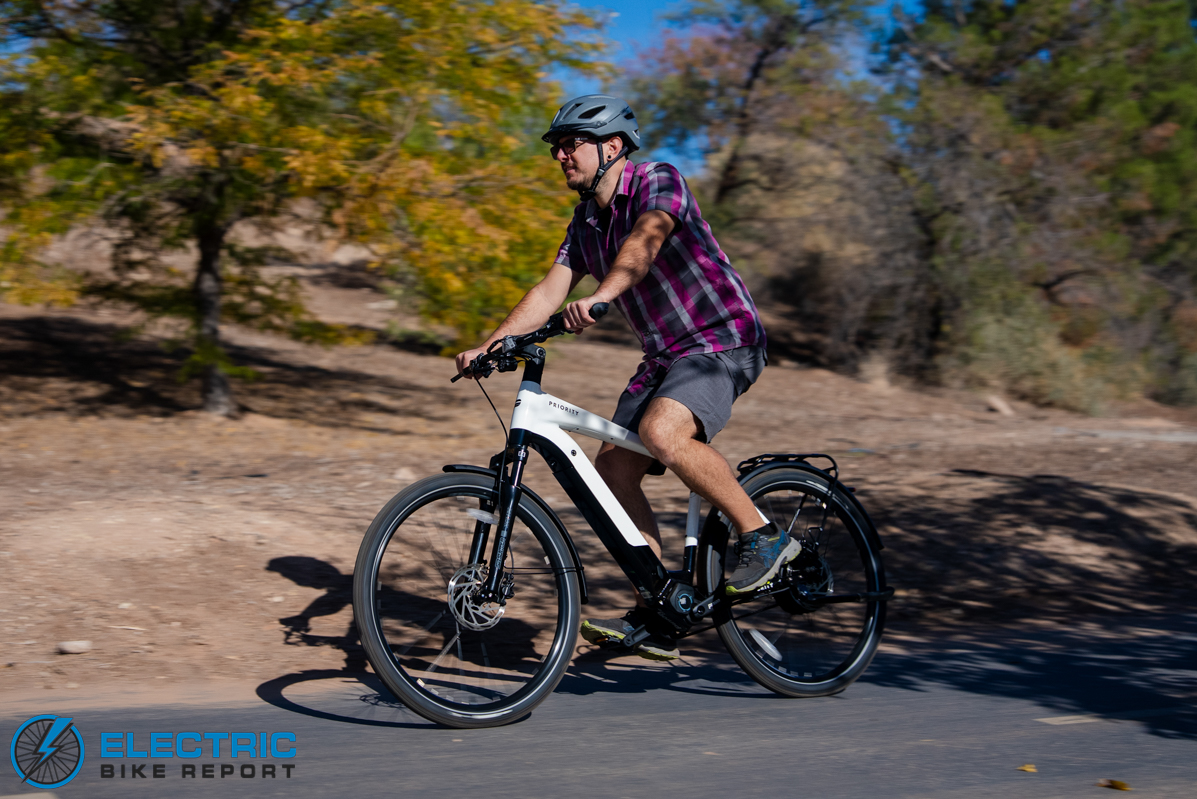
The bike is quick, natural-feeling, and agile: all excellent characteristics for a commuter.
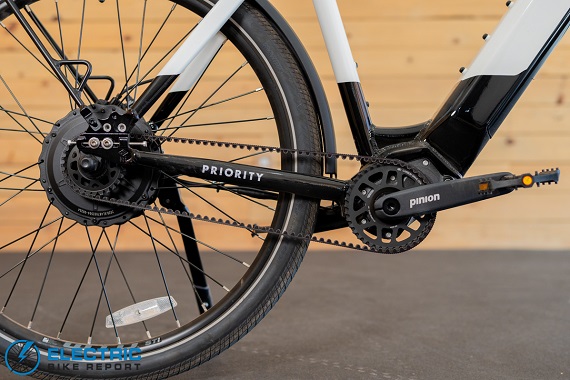
A Gates Carbon belt connects the drivetrain’s 39T chainring and 28T rear cog.
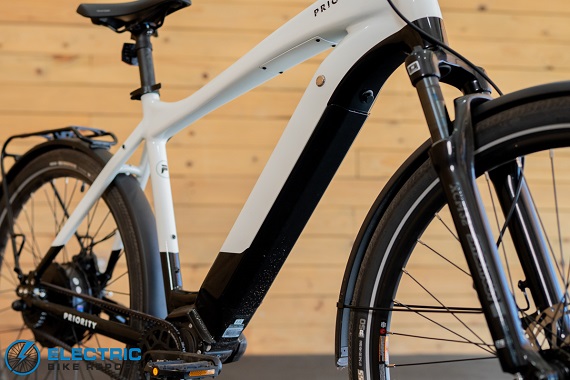
The Skyline’s 48V, 720 Wh battery blends nicely into its down tube while being removable for storage.
Priority Skyline Smart.Shift E-Bike Review: Range Test
The goal of our range test was to determine how far the Priority Skyline could travel on a single charge. We powered up the bike’s 720 watt-hour (Wh) battery and rode on paved paths until its charge was depleted; we performed one test in PAS 5 to find its minimum range and another in PAS 1 to determine its maximum.
Priority advertises 20 to 60 miles on the bike, while our testers covered 40.4 and 63.1 miles. As such, the brand’s top end estimate seems reasonable, but our results show that some riders could exceed the low end figure under the right conditions.
Similar commuter e-bikes we’ve tested averaged 35.1 and 65 miles from batteries averaging 662 Wh. This places the Skyline in line with (potentially slightly ahead) of its peers with its relatively large battery.
While it’s reasonable to expect higher results with a larger-than-average battery, our speed test showed that its lowest assist level delivered a relatively high amount of output. Additionally, the Range Test results of e-bikes with Pinion systems have suggested that the transmission may draw some extra power that reduces the bike’s range.
Still, our results show that the Skyline is well-specced, capable of long-rides, and suitable for its role as a daily commuter. Most riders we interact with who use their e-bikes for commuting have round trips between 10 and 20 miles, so our results show that the Skyline should be capable of multiple round trips from a single charge.
We appreciate that Priority ships the bike with a relatively fast 2.8-amp charger; Skyline owners can expect it to charge a fully depleted battery in around 5.5 hours.
Sponsor
Sponsor
Priority Skyline Smart.Shift E-Bike Review: Hill Test
When testing the Priority Skyline’s hill-climbing potential at the Devil’s Backbone (see the graphic above), the bike performed well when compared to its peers. When using only the bike’s throttle, our test rider reached the top of the hill in 2:06 at 14.4 mph. When pedaling, he completed our test slightly faster, with a time of 1:58 and an average speed of 15.4 mph.
Similar models we’ve tested, including the best commuter e-bikes, averaged 2:00 on throttle and 2:06 when pedaling. In comparison with this group, which includes e-bikes with both 500W and 750W hub motors, the Skyline’s results were roughly average, while its motor output was slightly above average.
Other bikes in our comparison group averaged 983W of peak motor output and 74 Nm of torque. The Skyline’s rear-hub motor produces 1056W and 90 Nm of torque, which is well in line with similar 750W nominal motors.
Outside of our formal test, the bike’s results lined up well with my personal experience at our secondary test location, Pilot Hill. There, I conducted a similar test using the Skyline’s throttle and highest level of pedal assist. On throttle power, the bike climbed confidently and steadily, but not remarkably speedily. When pedaling, it felt much more spirited.
All in all, our formal and informal testing shows that the Skyline is effective at conquering even challenging hills. Once again, the bike is well-specced in comparison to its peers, and its overall performance matched our expectations for its category and specs.
Sponsor
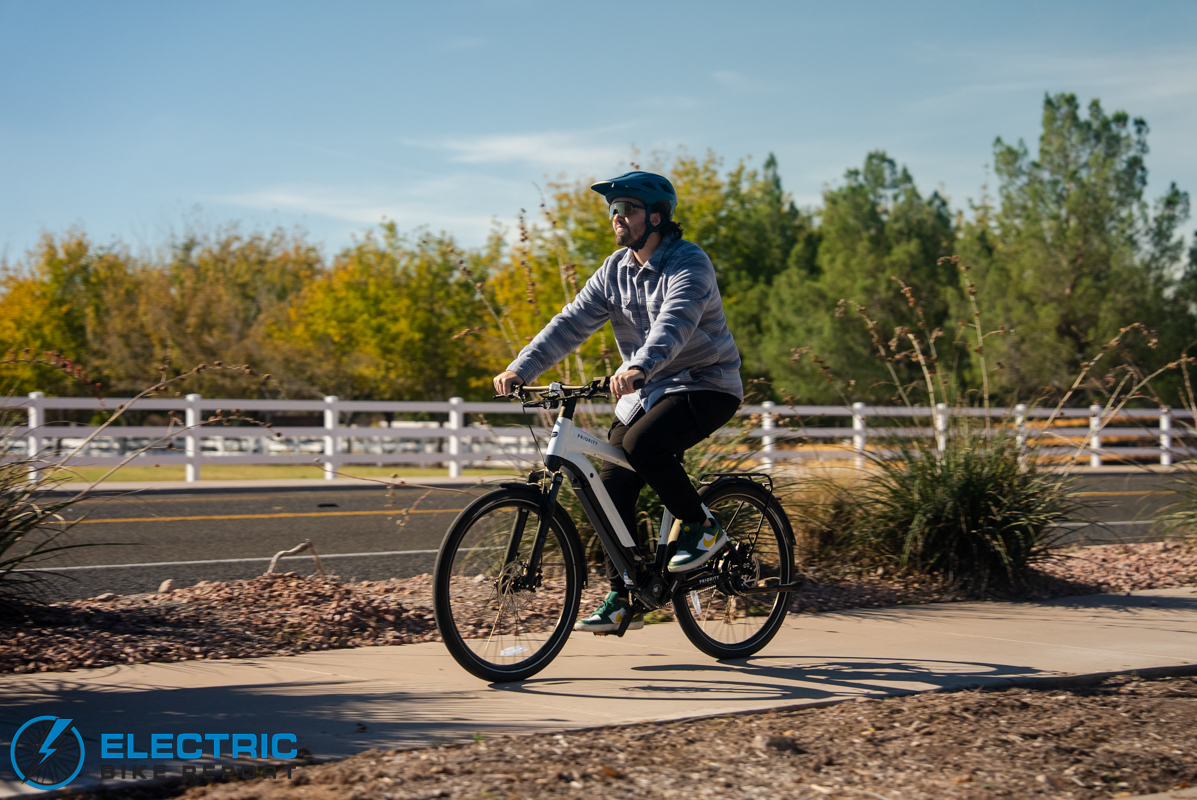
We liked the bike’s sharp black and white paint job, but a few additional color options would add an extra measure of fun and personality.
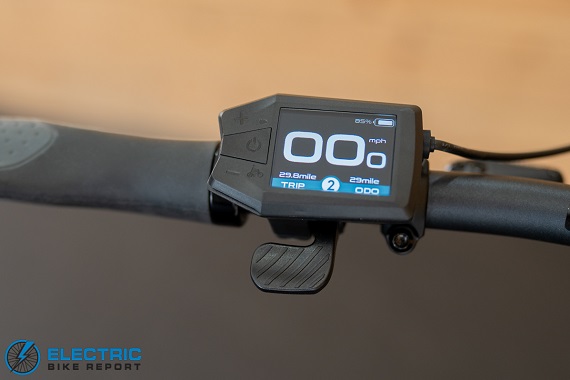
Riders can operate the throttle via the thumb lever beneath the bike’s small color display.
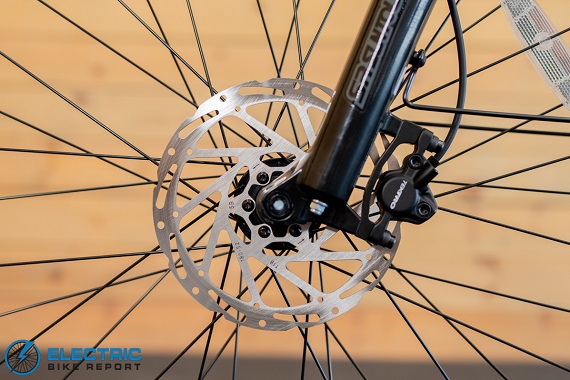
The Tektro E3520 brake system pairs two-piston calipers and 180 mm rotors.
Priority Skyline Smart.Shift E-Bike Review: Brake Test
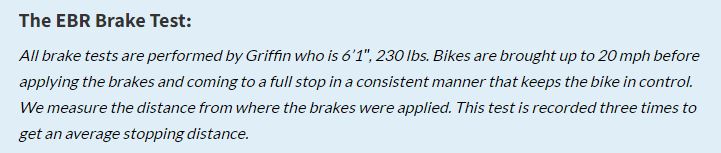
The Skyline is equipped with a familiar, e-bike specific hydraulic brake system from Tektro. We tested its performance using the above process; the bike’s average stopping distance was 21’ 6”.
Compared to similar e-bikes, this result places the Skyline above average for the commuter category. For context, other models in our comparison group averaged 22’ 2”.
These results are not unexpected; Tektro’s HD-E3520 brake system has proved reliable and effective in our testing. It combines two-piston calipers with 180mm front and rear rotors, which provide consistent, strong stopping power that is well-matched for the Skyline’s size and weight of around 68 lbs.
In my time on the bike, I noted that its brakes provided excellent modulation over my speed, as well as quick, controlled stopping power. When applying the brakes, the bike remained true to its line of travel and did not skid or fishtail.
With these details in mind, the Skyline gets an enthusiastic two thumbs up!
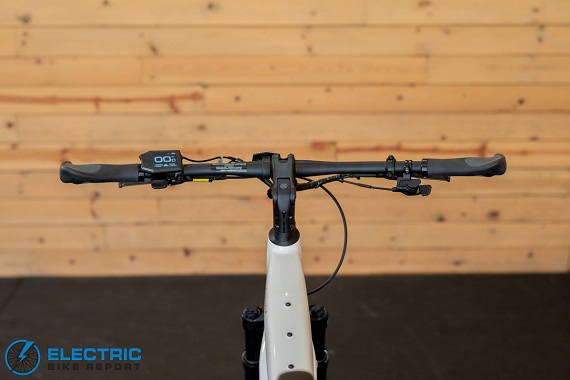
We found that the 740mm handlebars provided excellent steering control.
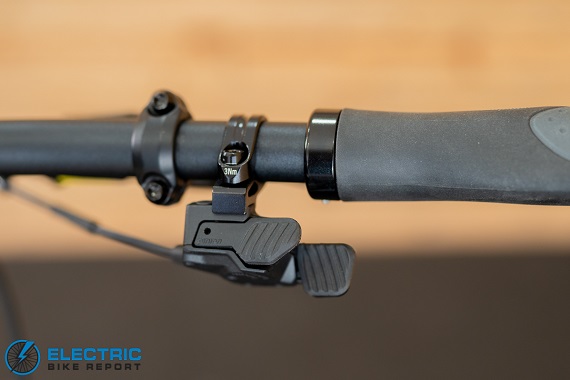
The Pinion gearbox is operated via two shift levers/buttons on the right handlebar.
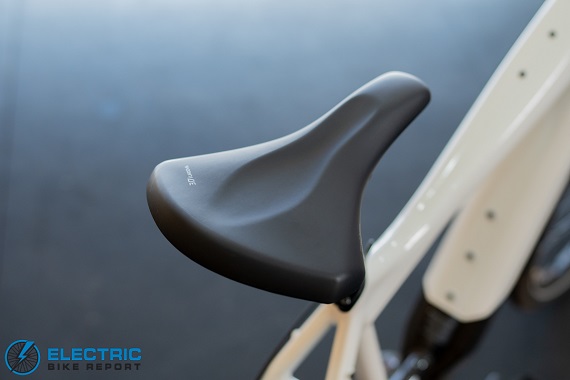
A sport-style saddle nicely balances comfort and performance.
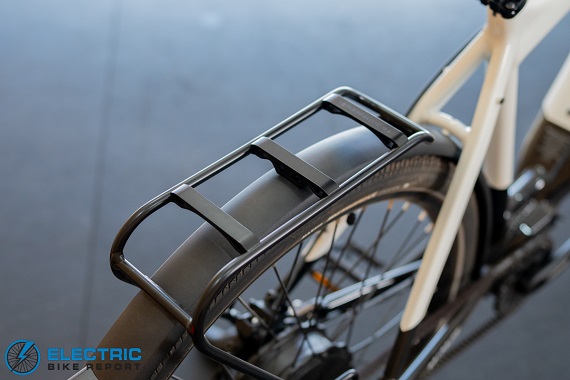
The rear cargo rack can carry up to 48.5 lbs.
Priority Skyline Smart.Shift E-Bike Review: Ride Quality
Ride quality, an overall measure of how a bike feels to ride, involves many aspects of its design, construction, and user interface. In a word, the Priority Skyline’s ride quality was great, though like any e-bike, it is not without areas that could be improved.
Priority makes three frame sizes for the bike, with the Small intended for riders between 5’4” and 5’7”, the Medium accommodating those from 5’7” to 5’10”, and a Large with a height range of 5’10” to 6’3”. More specifically, Priority recommends that buyers focus on the three inseam ranges of 28”-31”, 30”-33”, and 32”-35”, respectively.
At 5’11”, I found the Large frame well suited for a rider of my height and proportions. The bike’s 8” of saddle height adjustment granted me full leg extension with room for both taller and shorter riders. The standard forward-leaning riding position felt sporty and moderately aggressive without feeling too stretched out or uncomfortable.
I found the bike’s geometry and contact points extremely comfortable, which is a testament to Priority’s ergonomic design. When testing most e-bikes with an adjustable stem, I tend to prefer a more upright riding position, but I enjoyed the Skyline’s feel with its wide handlebars set further down and forward.
The saddle felt supportive and accommodating without being too firm or restrictive. The wide ergonomic rubber grips provided a comfortable, wide platform for steering, and the 80mm travel Suntour suspension fork effectively smoothed bumps and absorbed vibrations before they could make it to my wrists and arms.
The Skyline handled extremely well, too; its 740mm handlebars and 27.5×2” Maxxis tires offered fantastic steering control and maneuverability. The bike felt more nimble than its size and weight would suggest, which is ideal for commuting on crowded streets or paths.
I’ve mentioned the pedal assist system’s responsive, natural feel, but this is worth reiterating. In my experience, many of the best electric bikes with torque sensors deliver power subtly and smoothly. This allows the rider to feel as though they are stronger than their muscles alone could possibly be; the Skyline gave me this sense.
In terms of operation, the bike’s user interface is relatively simple and straightforward. In contrast with many similar e-bikes on the market that require connections with mobile apps to access their full range of features and customization options, the Skyline is more streamlined.
Users can pair the bike’s Pinion gearbox with the Pinion Smart.Shift app to switch between its two semi-automatic shifting modes, but otherwise, what you see is generally what you get. The bike’s small and appealing color display offers a handful of customization options—mainly over its maximum speed—but once the bike is set up, changes should be infrequent for most riders.
As I touched on in the introduction, however, the Pinion gearbox is a standout feature. Not only does the system’s electronic shifting feel cool and high-tech, but it is also fast and crisp. The gearbox also allows riders to shift while stopped or when pedaling uphill, removing many of the restrictions of traditional chain-and-cassette drivetrains.
The Pinion’s two automatic shifting modes are titled Start.Select and Pre.Select. The former downshifts automatically upon coming to a stop to allow for easy starting up, while the latter also downshifts while coasting to match the rider’s preferred cadence. I preferred the Pre.Select mode, which worked extremely well after I found my ideal settings (a process that only took a few minutes on my first test ride).
Coupled with a Gates Carbon belt, the Pinion system is clean and extremely low maintenance. Owners should change the gearbox’s internal oil bath annually or after every 6,200 miles. The belt, which requires no lubrication, can last for thousands of miles before needing to be replaced—we’ve read reports of some lasting over 20k miles!
In my testing, I only had one hiccup with the Pinion system, where the gearbox seemed stuck between gears. Running through the calibration feature in the Pinion app solved the problem, allowing me to get back on the move in a short amount of time.
One minor area with room for improvement is the Skyline’s programming when unlocked to Class 3 speeds. I noticed that the motor’s output in PAS 1-4 was limited to 23 mph; only PAS 5 allowed me to reach the 28 mph maximum. To conserve power, I’d prefer this lower cap to be removed so that riders pedaling in lower assist levels could reach top speed.
Aside from this, the Skyline is sporty, comfortable, nimble, and well-equipped for its role as a commuter. The bike features integrated lights (including a brake light function), fenders, and a cargo rack able to carry around 49 lbs. Priority also sells a handful of compatible accessories, including a suspension seatpost, electronic horn, etc.
Sponsor
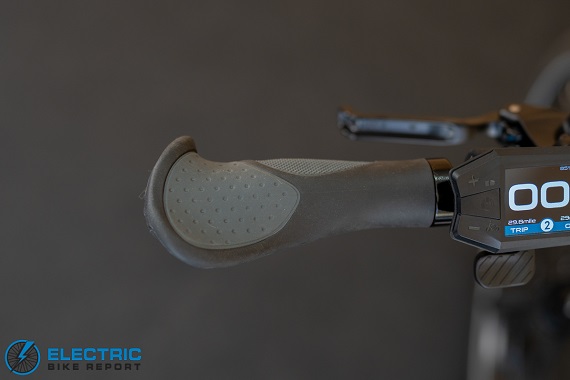
Wide, supportive ergonomic rubber grips complemented the bike’s sporty feel.
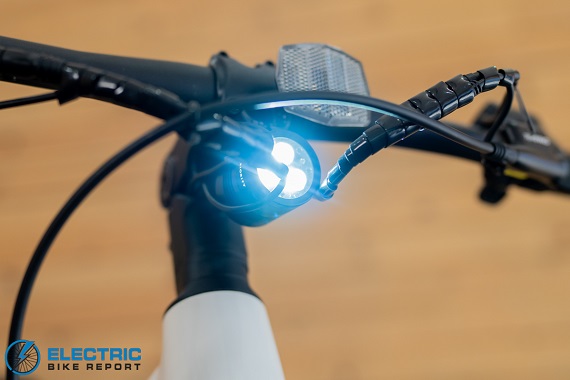
The Skyline includes a bright LED headlight for visibility.
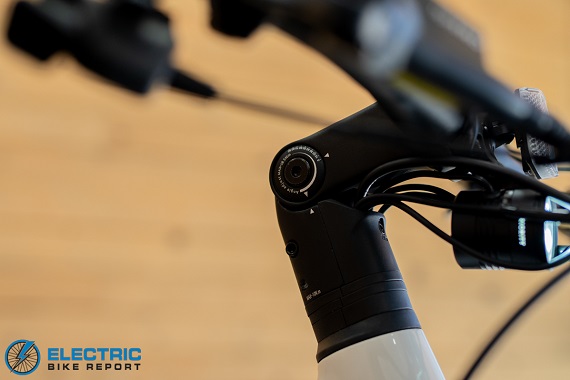
With 90 degrees of rotation, riders can adjust their handlebar height and positioning via the adjustable stem.
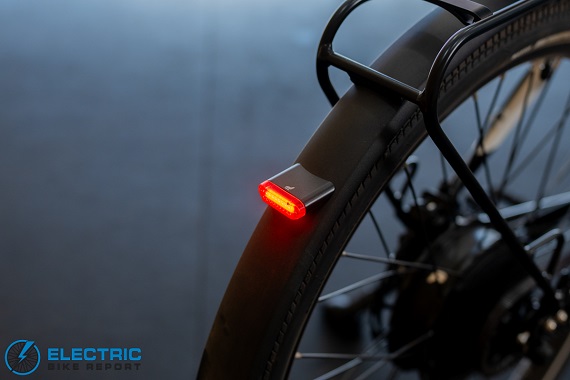
When the brakes are applied, the Skyline’s tail light flashes to attract attention.
Priority Skyline Smart.Shift E-Bike Review: Summary / Where to Buy
Commuter e-bikes are intended to be practical, reliable methods of daily transport. When done right, they can be much more than utilitarian machines. Those that are as well put together as the Priority Skyline are comfortable to ride, easy to enjoy on long trips, and ideally, something that you don’t want to put down.
We were highly impressed with the Skyline’s ride feel and performance. It scored well in all areas of our testing, proving itself able to keep pace with its peers, and in some cases, outshine them. It delivered intuitive programming with a fun and engaging ride, along with great range, plentiful power for tackling hills, and excellent braking performance.
The bike’s long-lasting, low-maintenance, and convenience-enhancing drivetrain adds an extra dimension to the Skyline’s user experience. With its semi-automatic modes and ability to shift under load, the Pinion gearbox elevates the bike’s operation and ease to a premium level. Its price point of around $4,000 makes this technology more accessible than most similarly-equipped bikes.
Our testing identified only a couple of relatively minor areas of critique. Faster throttle engagement from a standstill and the ability to reach 28 mph in all assist levels when in Class 3 mode would make the Skyline even more functional and commuter-friendly.
Otherwise, we happily recommend this e-bike to riders seeking a cool, high-tech daily-use e-bike with low maintenance requirements and an active, natural ride. Whether used for long-distance leisure rides, daily travel to work or school, an enjoyable means of exercise, or something else, we can confidently say that this commuter can deliver.
In short, with the Priority Skyline, the sky is the limit.
Happy Riding! Make sure to let us know if you have any questions or if you think we left anything out in this review of the Priority Skyline Smart.Shift E-Bike down in our comments section.
Sponsor
Sponsor
Reader Interactions
Comments
Leave a Reply




Great review!!
My ride is a 2018 RadRover and I am shopping for a new ride.
I live in a Pacific Northwest coast city, and it seems every direction is UP! So a good hill climb is necessary. My majority of riding is grocery getting and 10 to 15 mile recreation around town streets and packed gravel Rail to Trail, with a very occasional 30 mile paved/packed gravel trip.
I see you rode the Also TM-B at Sea Otter, can you compare that bike and the Priority Skyline?